MOTOSHARE 🚗🏍️
Rent Bikes & Cars Directly from Owners
Motoshare connects vehicle owners with people who need bikes and cars on rent. Owners earn from idle vehicles, and renters get flexible ride options.
Visit Motoshare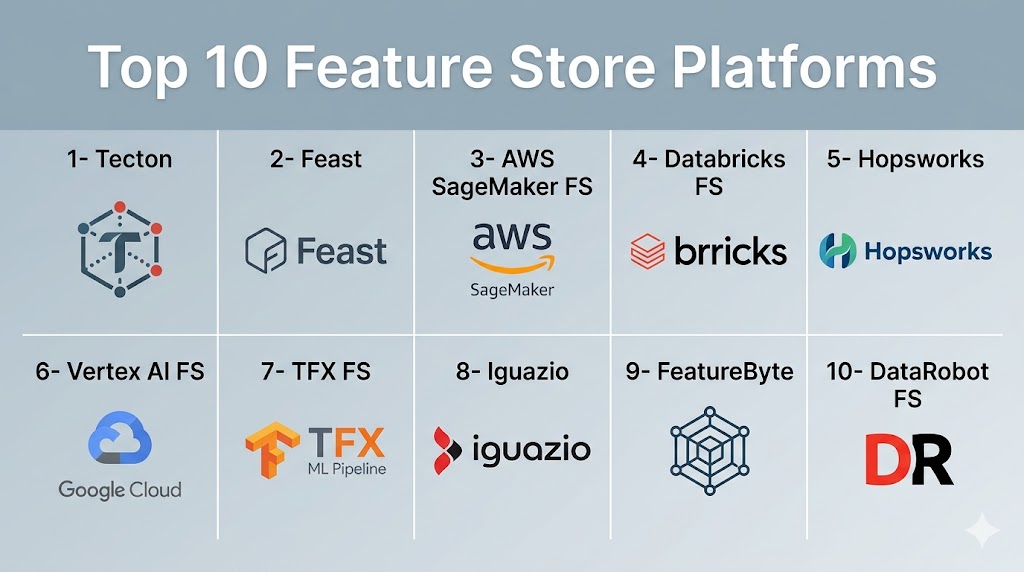
Introduction
Feature Store Platforms centralize, manage, and serve machine learning features for training and inference across teams. They streamline the process of feature engineering, versioning, and sharing, ensuring consistency between training and production environments. In 2026, with AI adoption expanding rapidly, having a reliable feature store is critical for scaling ML initiatives, reducing redundant engineering work, and improving model performance.
Real-world applications include maintaining feature consistency in e-commerce recommendation engines, enabling fraud detection models in financial services, managing sensor data for industrial predictive maintenance, powering personalized experiences in healthcare AI systems, and supporting real-time ad targeting models in marketing platforms.
When evaluating feature store platforms, buyers should consider:
- Centralized storage and feature versioning
- Real-time and batch feature serving
- Integration with popular ML frameworks and pipelines
- Data governance, security, and audit capabilities
- Support for large-scale data and multi-model workflows
- Automation for feature transformations and pipelines
- Observability and monitoring for feature drift
- Pricing models and total cost of ownership
- Extensibility through APIs and SDKs
- Vendor support and community strength
Best for: ML engineering teams, data scientists, and MLOps teams at SMBs, mid-market, and enterprise organizations across finance, healthcare, retail, and industrial sectors.
Not ideal for: Teams with minimal ML deployment, one-off experiments, or lightweight pipelines; simpler solutions may suffice without the complexity of a full-feature store.
Key Trends in Feature Store Platforms
- Real-time feature serving for low-latency inference across cloud and edge environments.
- Native integration with MLOps pipelines and CI/CD workflows.
- Unified platforms supporting feature engineering, monitoring, and drift detection.
- AI-assisted feature transformation and automated metadata tagging.
- Multi-cloud and hybrid deployment support for enterprise flexibility.
- Open-source adoption alongside commercial enterprise solutions.
- Feature lineage tracking for observability, reproducibility, and compliance.
- Pay-as-you-go and consumption-based pricing models for SMB accessibility.
- Emphasis on governance and secure access controls for regulated industries.
- Cross-team collaboration tools to reduce redundant feature engineering.
How We Selected These Tools (Methodology)
- Assessed market adoption and enterprise mindshare.
- Evaluated completeness of features, including serving, versioning, and transformations.
- Examined reliability, scalability, and performance in production environments.
- Verified security posture, compliance standards, and audit capabilities.
- Considered integrations with ML frameworks, cloud platforms, and data warehouses.
- Analyzed customer fit across SMBs, mid-market, and enterprise organizations.
- Reviewed developer experience, SDKs, and API capabilities.
- Considered multi-team collaboration and governance features.
- Factored in pricing models and total cost of ownership.
- Prioritized flexibility, extensibility, and roadmap alignment with ML trends.
Top 10 Feature Store Platforms
#1 — Tecton
Short description : Tecton provides an enterprise-grade feature store enabling ML teams to manage, serve, and reuse features at scale. Ideal for teams needing real-time and batch feature pipelines across multiple models.
Key Features
- Real-time feature serving
- Batch and streaming feature pipelines
- Feature versioning and lineage
- Integration with Spark, Python, and SQL workflows
- Feature transformation automation
- Observability and drift detection
Pros
- Enterprise-grade scalability and reliability
- Strong real-time support and monitoring
Cons
- Can be expensive for smaller teams
- Setup may require engineering effort
Platforms / Deployment
- Web, Cloud, Hybrid
Security & Compliance
- SOC 2, ISO 27001, SSO/SAML, MFA
Integrations & Ecosystem
Tecton integrates with major ML frameworks, cloud data warehouses, and MLOps pipelines.
- Python SDK
- Spark and SQL pipelines
- CI/CD integration
- REST API access
- Notification and alerting systems
Support & Community
Comprehensive onboarding, enterprise-grade support, active user community.
#2 — Feast
Short description : Feast is an open-source feature store designed for data scientists and ML engineers. It emphasizes flexible feature pipelines and multi-environment deployment.
Key Features
- Open-source and developer-friendly
- Batch and streaming feature support
- Multi-cloud and hybrid support
- Feature versioning and registry
- SDKs for Python and Go
Pros
- Open-source and highly extensible
- Integrates well with Kubernetes and cloud-native pipelines
Cons
- Enterprise-grade features require additional setup
- Smaller support ecosystem compared to commercial options
Platforms / Deployment
- Web, Self-hosted, Cloud
Security & Compliance
- Not publicly stated
Integrations & Ecosystem
- Python/Go SDKs
- Cloud connectors for AWS, GCP, Azure
- REST API for custom integrations
- CI/CD pipelines
Support & Community
Active open-source community, GitHub resources, community forums.
#3 — AWS SageMaker Feature Store
Short description : AWS SageMaker Feature Store centralizes ML features for Amazon SageMaker workflows, providing real-time and batch feature management for enterprise teams.
Key Features
- Integrated with SageMaker ecosystem
- Real-time and batch feature serving
- Automated feature versioning and lineage
- Security and compliance built-in
- Scalable cloud-native deployment
Pros
- Seamless integration with AWS ML services
- Strong scalability and security compliance
Cons
- Best for AWS users, limited multi-cloud flexibility
- Pricing may be high for small workloads
Platforms / Deployment
- Web, Cloud
Security & Compliance
- SOC 2, ISO 27001, HIPAA, SSO/SAML
Integrations & Ecosystem
- SageMaker pipelines
- AWS Lambda and Glue
- CloudWatch metrics and alerts
- REST APIs for custom access
Support & Community
Enterprise-level AWS support and detailed documentation, large user base.
#4 — Databricks Feature Store
Short description : Databricks Feature Store unifies feature management with the Databricks Lakehouse Platform, allowing teams to share features between training and inference seamlessly.
Key Features
- Centralized feature repository
- Integration with Delta Lake and Spark
- Real-time and batch feature pipelines
- Automated feature lineage tracking
- Governance and access controls
Pros
- Tight integration with Databricks platform
- Enterprise-grade collaboration and security
Cons
- Requires Databricks environment
- May not be cost-effective for small teams
Platforms / Deployment
- Web, Cloud
Security & Compliance
- SOC 2, ISO 27001, MFA, RBAC
Integrations & Ecosystem
- Spark and Delta Lake pipelines
- Python and SQL SDKs
- REST APIs
- MLOps pipeline integration
Support & Community
Databricks enterprise support, documentation, active user community.
#5 — Hopsworks Feature Store
Short description : Hopsworks is an open-source feature store focused on reproducible ML pipelines, providing strong data governance and real-time feature serving.
Key Features
- Open-source platform
- Batch and streaming features
- Feature versioning and lineage
- Governance and access control
- Python and Java SDKs
Pros
- Enterprise-ready open-source
- Supports multi-cloud and hybrid environments
Cons
- Requires engineering for production deployments
- Smaller community than commercial competitors
Platforms / Deployment
- Web, Self-hosted, Cloud
Security & Compliance
- Not publicly stated
Integrations & Ecosystem
- Python/Java SDKs
- Kafka and Spark integration
- REST APIs
- Cloud connectors
Support & Community
Open-source community support, enterprise subscription available.
#6 — Google Vertex AI Feature Store
Short description : Google Vertex AI Feature Store centralizes ML features within Google Cloud, supporting real-time and batch serving for large-scale models.
Key Features
- Integration with Vertex AI pipelines
- Real-time feature serving
- Feature versioning and lineage
- Cloud-native scalability
- SDK and API access
Pros
- Strong cloud-native support
- Scales for large enterprise deployments
Cons
- Best for Google Cloud users
- Limited outside Google ecosystem
Platforms / Deployment
- Web, Cloud
Security & Compliance
- SOC 2, ISO 27001, SSO/SAML, GDPR
Integrations & Ecosystem
- Vertex AI SDK
- BigQuery, Dataflow
- REST APIs and event-driven triggers
- CI/CD pipeline integration
Support & Community
Google enterprise support, extensive documentation, active forums.
#7 — TFX Feature Store
Short description : TensorFlow Extended (TFX) Feature Store integrates with TFX pipelines for end-to-end ML lifecycle management, optimized for TensorFlow users.
Key Features
- End-to-end ML pipeline integration
- Feature versioning and lineage
- Batch and streaming feature support
- Metadata tracking and observability
- Python SDK and MLflow support
Pros
- Tight integration with TensorFlow
- Open-source and flexible
Cons
- Best for TensorFlow workflows
- Requires engineering setup for production
Platforms / Deployment
- Web, Self-hosted, Cloud
Security & Compliance
- Not publicly stated
Integrations & Ecosystem
- TensorFlow, MLflow, Apache Beam
- REST API for custom pipelines
- CI/CD integration
Support & Community
Active TensorFlow community, documentation, GitHub support.
#8 — Iguazio Feature Store
Short description : Iguazio offers a real-time feature store with multi-cloud support and strong integration for streaming ML models in enterprise applications.
Key Features
- Real-time and batch feature serving
- Multi-cloud deployment
- Feature lineage and governance
- Automated feature pipelines
- SDK and API integration
Pros
- Supports low-latency, high-throughput workloads
- Enterprise-grade security and governance
Cons
- Higher cost for small deployments
- Steeper learning curve
Platforms / Deployment
- Web, Cloud, Hybrid
Security & Compliance
- SOC 2, ISO 27001, MFA, RBAC
Integrations & Ecosystem
- Python SDK, REST APIs
- Cloud storage connectors
- Kafka integration
- CI/CD pipelines
Support & Community
Enterprise support and onboarding, technical guides available.
#9 — FeatureByte
Short description : FeatureByte provides an end-to-end ML feature management platform with automated transformations and monitoring for production-scale ML.
Key Features
- Automated feature transformations
- Versioning and lineage tracking
- Real-time and batch serving
- Integration with Python and SQL pipelines
- Drift monitoring
Pros
- Automated feature engineering reduces engineering effort
- Scales for multiple models and teams
Cons
- Smaller ecosystem than older platforms
- Advanced analytics require configuration
Platforms / Deployment
- Web, Cloud
Security & Compliance
- Not publicly stated
Integrations & Ecosystem
- Python and SQL SDKs
- Cloud connectors
- REST API access
- Notification systems
Support & Community
Professional support and onboarding available, documentation provided.
#10 — DataRobot Feature Store
Short description : DataRobot Feature Store centralizes features for AI/ML pipelines within the DataRobot platform, providing governance, monitoring, and multi-model support.
Key Features
- Centralized feature repository
- Real-time and batch pipelines
- Feature versioning and drift alerts
- Governance and access controls
- API and SDK integration
Pros
- Tight integration with DataRobot ML platform
- Enterprise-grade monitoring and governance
Cons
- Limited flexibility outside DataRobot ecosystem
- Pricing may be high for small teams
Platforms / Deployment
- Web, Cloud
Security & Compliance
- SOC 2, ISO 27001, SSO/SAML, MFA
Integrations & Ecosystem
- Python SDK, REST APIs
- Cloud data connectors
- MLOps pipelines
Support & Community
Enterprise onboarding and support, extensive documentation.
Comparison Table (Top 10)
| Tool Name | Best For | Platform(s) Supported | Deployment | Standout Feature | Public Rating |
|---|---|---|---|---|---|
| Tecton | Enterprise, real-time | Web | Cloud/Hybrid | Real-time feature serving | N/A |
| Feast | Developer-friendly | Web | Cloud/Self-hosted | Open-source flexibility | N/A |
| AWS SageMaker FS | AWS ecosystem | Web | Cloud | SageMaker integration | N/A |
| Databricks FS | Enterprise ML ops | Web | Cloud | Delta Lake integration | N/A |
| Hopsworks | Open-source multi-cloud | Web | Self-hosted/Cloud | Governance & reproducibility | N/A |
| Vertex AI FS | Google Cloud users | Web | Cloud | Cloud-native scalability | N/A |
| TFX FS | TensorFlow-centric | Web | Self-hosted/Cloud | TFX pipeline integration | N/A |
| Iguazio | Streaming ML | Web | Cloud/Hybrid | Low-latency real-time serving | N/A |
| FeatureByte | Automated features | Web | Cloud | Auto transformations | N/A |
| DataRobot FS | DataRobot users | Web | Cloud | Governance & monitoring | N/A |
Evaluation & Scoring of Feature Store Platforms
| Tool Name | Core (25%) | Ease (15%) | Integrations (15%) | Security (10%) | Performance (10%) | Support (10%) | Value (15%) | Weighted Total (0–10) |
|---|---|---|---|---|---|---|---|---|
| Tecton | 9 | 8 | 8 | 9 | 9 | 8 | 7 | 8.5 |
| Feast | 7 | 9 | 7 | 7 | 8 | 7 | 9 | 7.7 |
| AWS SageMaker FS | 8 | 8 | 8 | 9 | 9 | 8 | 7 | 8.2 |
| Databricks FS | 9 | 8 | 8 | 8 | 9 | 8 | 7 | 8.3 |
| Hopsworks | 8 | 7 | 8 | 7 | 8 | 7 | 7 | 7.5 |
| Vertex AI FS | 8 | 8 | 8 | 9 | 9 | 8 | 7 | 8.1 |
| TFX FS | 7 | 7 | 7 | 7 | 8 | 7 | 7 | 7.2 |
| Iguazio | 8 | 7 | 8 | 8 | 9 | 7 | 7 | 7.9 |
| FeatureByte | 8 | 8 | 7 | 7 | 8 | 7 | 7 | 7.7 |
| DataRobot FS | 8 | 8 | 8 | 8 | 9 | 8 | 7 | 8.0 |
Interpretation: Higher weighted scores indicate stronger overall performance and suitability for enterprise and mid-market ML teams. Scores are comparative across features, integrations, usability, and security.
Which Feature Store Platform Is Right for You?
Solo / Freelancer
Open-source solutions like Feast or TFX FS offer flexibility and low cost for individual developers.
SMB
FeatureByte or Hopsworks provide automation, governance, and batch/real-time support at moderate cost.
Mid-Market
Databricks FS, Tecton, or Iguazio provide enterprise-grade dashboards, monitoring, and multi-model support.
Enterprise
Tecton, Vertex AI FS, AWS SageMaker FS, and DataRobot FS excel in multi-team observability, governance, and compliance readiness.
Budget vs Premium
Open-source tools reduce upfront costs but require engineering effort. Premium platforms offer full enterprise capabilities and support.
Feature Depth vs Ease of Use
Developer-centric tools emphasize extensibility and APIs, while enterprise solutions provide dashboards, alerts, and governance for broader stakeholders.
Integrations & Scalability
Select platforms that integrate with your cloud providers, data warehouses, MLOps pipelines, and alerting systems. Enterprise deployments require multi-model and multi-team support.
Security & Compliance Needs
High-risk sectors should prioritize SOC 2, ISO 27001, SSO/SAML, MFA, and audit logging. Open-source tools may need additional configuration for compliance.
Frequently Asked Questions (FAQs)
1. What is a feature store, and why is it important?
A feature store centralizes ML features to ensure consistent, reusable, and production-ready inputs. It reduces redundant engineering and improves model accuracy.
2. Can open-source feature stores meet enterprise requirements?
Yes, but additional engineering is required for scaling, security, and governance compared to commercial platforms.
3. How do feature stores handle real-time serving?
Modern platforms provide low-latency APIs to serve features in real-time for live predictions and low-latency applications.
4. Are these tools cloud-only or hybrid-friendly?
Most commercial solutions support cloud or hybrid deployments; open-source options can be deployed on-premises as needed.
5. Do feature stores support multi-framework ML pipelines?
Yes, top platforms integrate with TensorFlow, PyTorch, Scikit-learn, XGBoost, and other frameworks.
6. How is feature versioning handled?
Feature stores track versions and lineage, enabling reproducibility between training and inference.
7. Can they monitor feature drift?
Yes, drift detection is often built-in to alert teams of changing data distributions affecting model performance.
8. How do I integrate a feature store into MLOps pipelines?
Platforms provide Python SDKs, APIs, and CI/CD integration points to automate feature pipelines.
9. Are these platforms secure for sensitive data?
Commercial platforms include SOC 2, ISO 27001, SSO/SAML, and encryption. Open-source tools may require extra security setup.
10. Do feature stores improve collaboration across teams?
Yes, centralized repositories and governance features reduce redundant feature engineering and encourage cross-team collaboration.
Conclusion
Feature Store Platforms are foundational for modern ML operations, enabling consistency, governance, and efficiency in ML workflows. Selection depends on team size, deployment complexity, cloud preference, and compliance requirements. Open-source platforms like Feast and TFX FS are excellent for developers and SMBs seeking flexibility, while enterprise solutions such as Tecton, Vertex AI FS, and Databricks FS provide advanced monitoring, real-time serving, and compliance support. Critical considerations include real-time vs batch serving, versioning, observability, integrations, and cost. Organizations should shortlist suitable platforms, pilot integrations with their ML workflows, and validate compliance and security before scaling across teams.

Very engaging and informative read, thank you for sharing.