MOTOSHARE 🚗🏍️
Rent Bikes & Cars Directly from Owners
Motoshare connects vehicle owners with people who need bikes and cars on rent. Owners earn from idle vehicles, and renters get flexible ride options.
Visit Motoshare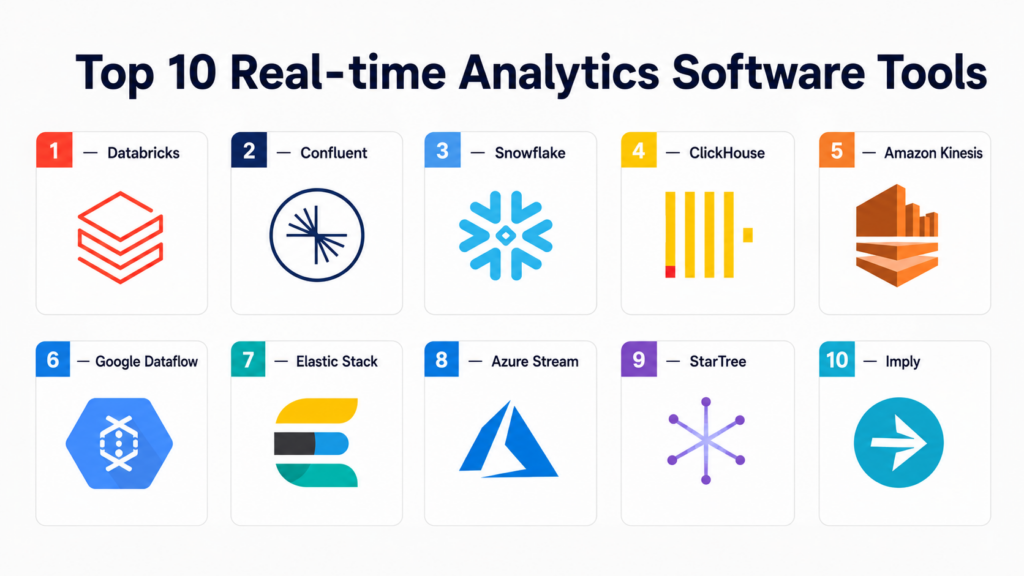
Introduction
Real-time analytics platforms are specialized data processing systems designed to ingest, analyze, and visualize data the moment it is generated. Unlike traditional batch processing systems that collect data over hours or days before executing a job, these platforms operate with sub-second latency. They allow organizations to shift from reactive decision-making to proactive, instantaneous action by converting high-velocity data streams into actionable intelligence. By processing data “in-motion,” these platforms ensure that insights are delivered while the data is still relevant and valuable.
In the modern digital economy, the speed of data processing is a fundamental competitive advantage. Whether it is a financial institution blocking a fraudulent transaction or an e-commerce site adjusting prices based on live demand, the ability to act in the “now” is critical. These platforms act as the central nervous system for data-driven enterprises, providing the infrastructure necessary to handle massive throughput while maintaining the integrity and accuracy of the analytical output.
Real-world use cases:
- Fraud Detection: Identifying and blocking unauthorized financial transactions within milliseconds of the attempt.
- Predictive Maintenance: Analyzing sensor data from industrial equipment to predict failures before they occur.
- Dynamic Pricing: Adjusting travel or retail prices in real-time based on current supply and demand metrics.
- Personalized Marketing: Delivering tailored advertisements to users based on their immediate browsing behavior and location.
- Network Security: Monitoring live traffic logs to identify and neutralize cybersecurity threats as they emerge.
Evaluation criteria for buyers:
- Ingestion Latency: The speed at which data is moved from the source to the analytical engine.
- Processing Scalability: The ability to handle massive spikes in data volume without performance loss.
- Query Performance: The time taken to return complex analytical results from live data streams.
- Integration Flexibility: Compatibility with existing message brokers, data lakes, and visualization tools.
- State Management: The sophistication with which the platform handles complex calculations across time windows.
- Security and Governance: Robustness of access controls, encryption, and data lineage tracking.
- Developer Experience: The quality of the APIs, SDKs, and support for familiar query languages like SQL.
- Operational Overhead: The complexity and cost associated with maintaining and scaling the platform.
- Fault Tolerance: The reliability of the system in recovering from node failures without data loss.
- Machine Learning Support: The ability to run AI models directly against incoming data streams.
Best for: Data-intensive organizations, fintech companies, e-commerce giants, and SRE teams requiring immediate visibility into high-volume event streams.
Not ideal for: Small businesses with static data needs, organizations that only require daily summary reports, or teams without the technical resources to manage distributed data systems.
Key Trends in Real-time Analytics Platforms
- Convergence of Streaming and Batch: Modern platforms are moving toward a unified architecture where the same engine handles both live events and historical data mining.
- Serverless Data Processing: A shift toward serverless models that automatically scale compute resources based on data throughput, reducing manual cluster management.
- Generative AI for Analytics: Integration of natural language processing that allows users to query live data streams using plain English instructions.
- Zero-ETL Architectures: Direct connections between data sources and analytical engines that eliminate the need for time-consuming data transformation steps.
- Edge-Native Analysis: Moving processing power to the edge of the network to analyze data closer to the source, further reducing latency.
- Predictive Anomaly Detection: Using integrated machine learning to automatically flag unusual patterns in live data before they become critical issues.
- Vector Search Integration: The blending of real-time stream processing with vector databases to power sophisticated AI recommendation engines.
- Real-time Data Sharing: Technologies that allow secure, instant sharing of live data streams between different organizations without data movement.
How We Selected These Tools (Methodology)
To determine the top platforms in the real-time analytics space, we employed a systematic evaluation process focused on technical capability and market maturity. The selection was based on the following logic:
- Throughput Reliability: We prioritized platforms that have a proven track record of handling millions of events per second in production.
- Architectural Resilience: Focus was placed on systems that offer high availability and robust fault-tolerance mechanisms.
- Ease of Adoption: We evaluated the platforms based on how quickly a team can move from setup to generating valuable insights.
- Feature Breadth: The selected tools cover the entire lifecycle of real-time data, including ingestion, transformation, storage, and visualization.
- Ecosystem Vitality: We looked for platforms with strong community backing and a wide array of third-party integrations.
- Security Posture: Preference was given to tools that offer enterprise-grade identity management and data protection protocols.
Top 10 Real-time Analytics Software Tools
#1 — Databricks
Databricks is a unified data and AI platform built on top of the Lakehouse architecture. It provides a collaborative environment for data engineers, scientists, and analysts to process massive datasets using Spark Structured Streaming. By combining the performance of a data warehouse with the flexibility of a data lake, it enables high-performance real-time processing and machine learning in a single governed workspace.
Key Features
- Photon Engine: A vectorized query engine designed to provide maximum performance for SQL and streaming workloads.
- Delta Live Tables: Simplifies the development of reliable and maintainable data pipelines with automated testing.
- Unity Catalog: A unified governance layer for all data and AI assets across the entire organization.
- Spark Structured Streaming: Built-in support for fault-tolerant and scalable stream processing.
- Serverless SQL: Provides instant compute power for querying live data without managing underlying infrastructure.
- MLflow Integration: Allows for the seamless deployment and tracking of AI models on live data streams.
Pros
- Exceptional performance for both massive-scale batch and low-latency streaming jobs.
- Unified governance model makes it easier to comply with data privacy regulations.
Cons
- The pricing structure can be complex and may lead to high costs for unoptimized workloads.
- Requires a technical team with deep knowledge of the Spark ecosystem.
Platforms / Deployment
- AWS / Azure / Google Cloud
- Cloud
Security & Compliance
- SSO/SAML, MFA, RBAC, and encryption for data at rest and in transit.
- SOC 2, ISO 27001, HIPAA, and GDPR compliant.
Integrations & Ecosystem
Databricks is deeply integrated into the modern data stack and cloud ecosystems.
- Apache Kafka and Confluent
- Amazon S3 and Azure Data Lake Storage
- dbt (data build tool)
- Tableau and Power BI
Support & Community
Offers tiered professional support and maintains a massive global community. Users have access to extensive documentation, certifications, and high-touch enterprise success programs.
#2 — Confluent
Confluent is a cloud-native platform built by the original creators of Apache Kafka. It is designed to act as the central nervous system for data-in-motion, allowing organizations to connect and process all of their data streams in real-time. By providing a fully managed version of Kafka with additional enterprise features, it removes the operational complexity of managing large-scale messaging clusters.
Key Features
- ksqlDB: A streaming SQL engine that allows developers to build real-time applications using familiar SQL syntax.
- Fully Managed Connectors: A library of over 120 pre-built connectors to link Kafka to any data source or sink.
- Stream Governance: The industry’s first governance suite for streaming data, ensuring data quality and compliance.
- Cluster Linking: Enables seamless data mirroring across different cloud regions and providers.
- Infinite Storage: Decouples storage from compute, allowing for the retention of data in Kafka indefinitely.
- Stream Designer: A visual interface for building and deploying complex streaming data pipelines.
Pros
- The most robust and reliable platform for high-throughput event streaming in the market.
- Removes the significant “hidden costs” of self-managing Apache Kafka clusters.
Cons
- Can become very expensive as the volume of streamed data increases.
- The platform is specialized for streaming, which may require pairing with other tools for long-term storage.
Platforms / Deployment
- AWS / Azure / Google Cloud / On-premises
- Cloud / Hybrid
Security & Compliance
- Role-based access controls, encryption, and comprehensive audit logs.
- SOC 2 Type II, ISO 27001, and PCI DSS compliant.
Integrations & Ecosystem
Confluent serves as the hub for real-time data, integrating with virtually every modern data tool.
- Snowflake and Databricks
- MongoDB and Elasticsearch
- Salesforce and ServiceNow
- Google BigQuery and Amazon Redshift
Support & Community
Provides industry-leading technical support for Kafka and a vibrant ecosystem of developers. They offer extensive training through Confluent Developer and have a global presence.
#3 — Snowflake
While traditionally known as a cloud data warehouse, Snowflake has expanded into the real-time space through its Snowpipe and Dynamic Tables features. It allows organizations to ingest data continuously and perform complex transformations in real-time within a single, fully managed environment. Its architecture separates compute from storage, enabling near-infinite scalability for analytical workloads.
Key Features
- Snowpipe Streaming: Provides low-latency, row-level ingestion directly into Snowflake tables.
- Dynamic Tables: Automatically refreshes the results of complex queries as new data arrives in the stream.
- Snowpark: Enables developers to write code in Python, Java, or Scala for real-time data processing.
- Unistore: A single platform that supports both transactional and analytical data workloads.
- Data Sharing: Securely share live data with partners and customers without moving files.
- Cortex: Integrated AI services for analyzing and summarizing live data using large language models.
Pros
- Zero-management architecture that allows teams to focus on insights rather than infrastructure.
- Unified platform for all data types, reducing the complexity of the data stack.
Cons
- The credit-based pricing model requires careful monitoring to prevent unexpected costs.
- Latency may be slightly higher compared to “pure-play” stream processors for individual events.
Platforms / Deployment
- AWS / Azure / Google Cloud
- Cloud
Security & Compliance
- End-to-end encryption, multi-factor authentication, and private network support.
- SOC 2, ISO 27001, FedRAMP, and HIPAA compliant.
Integrations & Ecosystem
Snowflake has one of the largest partner marketplaces in the data industry.
- Fivetran and Airbyte
- Informatica and Matillion
- Looker and Sigma Computing
- Datadog and Splunk
Support & Community
Offers 24/7 technical support and a dedicated customer success organization. The Snowflake Community provides access to a large network of “Data Heroes” and extensive peer resources.
#4 — ClickHouse
ClickHouse is an open-source, column-oriented database management system that allows for generating analytical reports in real-time. It is renowned for its incredible query speed and efficient data compression. Designed specifically for Online Analytical Processing (OLAP), it can process billions of rows and petabytes of data with sub-second response times, making it a favorite for telemetry and logging.
Key Features
- Columnar Storage: Highly optimized for analytical queries that only require a subset of table columns.
- Vectorized Execution: Uses modern CPU instructions to process data in large blocks for maximum speed.
- Materialized Views: Automatically calculates and stores query results in real-time as data is ingested.
- High-Speed Ingestion: Capable of ingesting millions of records per second from sources like Kafka.
- Efficient Compression: Advanced algorithms reduce the storage footprint and disk I/O significantly.
- Distributed Architecture: Scales horizontally across clusters to handle growing data volumes.
Pros
- Unrivaled query performance for large-scale analytical tasks on raw data.
- Open-source core provides high flexibility and cost-effectiveness for self-managed deployments.
Cons
- Limited support for traditional transactional updates and deletes compared to relational databases.
- Steeper learning curve for optimizing table schemas and engine configurations.
Platforms / Deployment
- Windows / macOS / Linux / Cloud
- Cloud / Self-hosted / Hybrid
Security & Compliance
- Role-based access control, SSL support, and encryption at rest.
- SOC 2 compliant in its managed cloud version.
Integrations & Ecosystem
Widely supported by modern open-source and commercial visualization tools.
- Apache Kafka and Redpanda
- Grafana and Superset
- Metabase and Tableau
- Vector and Logstash
Support & Community
ClickHouse has a very active open-source community and professional support available through ClickHouse Inc. They provide extensive documentation and regular community meetups.
#5 — Amazon Kinesis
Amazon Kinesis is a fully managed service on AWS that makes it easy to collect, process, and analyze real-time, streaming data. It is designed to handle any scale of data from millions of sources, allowing developers to build custom applications that react to data in real-time. It is a core component for AWS users building event-driven architectures and real-time dashboards.
Key Features
- Kinesis Data Streams: Ingest and store high-volume data streams for custom processing.
- Kinesis Data Firehose: Automatically loads streaming data into AWS data stores like S3 and Redshift.
- Kinesis Data Analytics: Analyze streaming data using SQL or Apache Flink without managing servers.
- Video Streams: Securely stream and store video for analytics and machine learning tasks.
- On-demand Mode: Automatically scales capacity in response to traffic fluctuations without manual tuning.
- AWS Lambda Integration: Trigger serverless functions instantly based on incoming data events.
Pros
- Deeply integrated with the AWS ecosystem, simplifying data flow between services.
- Highly cost-effective for organizations already operating primarily on AWS infrastructure.
Cons
- Proprietary to AWS, which can lead to vendor lock-in and complicate multi-cloud strategies.
- Requires manual management of shards and partitions in the standard provisioning mode.
Platforms / Deployment
- AWS
- Cloud
Security & Compliance
- Integration with AWS IAM, KMS encryption, and VPC endpoints.
- SOC 1/2/3, ISO 27001, and HIPAA compliant.
Integrations & Ecosystem
Seamlessly connects with virtually every service within the AWS catalog.
- Amazon S3 and Redshift
- Amazon DynamoDB and OpenSearch
- AWS Glue
- Splunk
Support & Community
Provided through standard AWS support plans. The community is massive, with endless documentation, tutorials, and third-party tools built specifically for Kinesis.
#6 — Google Cloud Dataflow
Google Cloud Dataflow is a serverless, fully managed service for unified stream and batch data processing. Based on the Apache Beam model, it allows developers to write code once and execute it in both streaming and batch modes. It is optimized for processing high-velocity data with advanced features for handling out-of-order events and complex windowing.
Key Features
- Unified Programming Model: Use the Apache Beam SDK to process both batch and streaming data.
- Autoscaling: Dynamically adds or removes worker resources based on the incoming data load.
- Flex Templates: Allows for the creation of reusable data processing templates across different teams.
- Dataflow Prime: A next-generation engine that optimizes resource utilization and reduces latency.
- Streaming Engine: Decouples compute from storage to improve performance and scaling responsiveness.
- Vertex AI Integration: Directly apply Google’s machine learning models to live data streams.
Pros
- True serverless experience that removes almost all operational management tasks.
- Superior handling of late-arriving data and complex time-based aggregations.
Cons
- Heavily reliant on the Google Cloud Platform, which may not fit multi-cloud environments.
- Apache Beam can have a challenging learning curve for developers used to simpler SQL engines.
Platforms / Deployment
- Google Cloud
- Cloud
Security & Compliance
- VPC Service Controls, encryption at rest/transit, and IAM integration.
- SOC 2, ISO 27001, and HIPAA compliant.
Integrations & Ecosystem
Optimized for the Google Cloud data and AI ecosystem.
- Google BigQuery and Bigtable
- Google Pub/Sub
- Looker
- Apache Beam
Support & Community
Available through Google Cloud support tiers. The platform benefits from the strong open-source community surrounding the Apache Beam project.
#7 — Elastic Stack
The Elastic Stack (Elasticsearch, Logstash, and Kibana) is a powerful set of tools for searching, analyzing, and visualizing data in real-time. While widely known for log analytics and observability, it is a versatile platform for any real-time data that requires fast search and complex aggregation. Its distributed nature allows it to scale to petabytes while maintaining sub-second query performance.
Key Features
- Elasticsearch: A distributed, RESTful search and analytics engine built for speed and scale.
- Kibana: A flexible visualization and management interface for navigating live data.
- Beats: Lightweight data shippers that send data from the edge to the analytical engine.
- Logstash: A server-side data processing pipeline that ingests data from multiple sources simultaneously.
- Search AI: Specialized features for semantic search and vector-based analytics on live data.
- Machine Learning: Built-in anomaly detection that automatically flags unusual patterns in live streams.
Pros
- The industry standard for log management, search, and real-time observability.
- Extremely flexible and capable of handling unstructured data with ease.
Cons
- Can be resource-intensive and expensive to scale for very large datasets.
- Managing self-hosted clusters requires a high degree of technical expertise.
Platforms / Deployment
- Windows / macOS / Linux / AWS / Azure / Google Cloud
- Cloud / Self-hosted / Hybrid
Security & Compliance
- Role-based access control, encryption, and comprehensive audit logs.
- SOC 2, ISO 27001, and PCI DSS compliant (Elastic Cloud).
Integrations & Ecosystem
Has one of the largest integration libraries for DevOps and security tools.
- Apache Kafka
- Docker and Kubernetes
- PagerDuty and Slack
- Terraform
Support & Community
Offers robust enterprise support and a massive open-source community. They provide extensive training, certifications, and a global network of user groups.
#8 — Azure Stream Analytics
Azure Stream Analytics is a fully managed real-time analytical engine from Microsoft designed for high-velocity data from devices, sensors, and applications. It allows users to define complex analytical logic using a familiar SQL-based syntax, making it accessible to a wide range of developers and analysts. It is optimized for low-latency processing and seamless integration with the Azure ecosystem.
Key Features
- SQL-based Syntax: Simplifies the development of streaming logic using familiar SQL queries.
- Edge Processing: Capability to run analytical logic directly on IoT devices using Azure IoT Edge.
- Reference Data Joining: Effortlessly join live data streams with historical datasets for richer context.
- Machine Learning Integration: Call Azure machine learning functions directly from within the query.
- Visual Studio Integration: Deep integration with familiar development tools for debugging and deployment.
- Built-in Connectors: Direct integration with Azure’s event hubs and diverse data stores.
Pros
- Minimal learning curve for teams already proficient in SQL and the Microsoft ecosystem.
- High reliability with built-in fault tolerance and guaranteed exactly-once processing.
Cons
- Tightly locked into the Azure platform, which may not be ideal for hybrid or multi-cloud strategies.
- Less flexible for highly complex, non-SQL-based data transformations.
Platforms / Deployment
- Azure
- Cloud / Edge
Security & Compliance
- Azure Active Directory integration, MFA, and VNET support.
- SOC 1/2/3, ISO 27001, FedRAMP, and HIPAA compliant.
Integrations & Ecosystem
Optimized for the Microsoft Cloud and enterprise software stack.
- Azure Event Hubs and IoT Hub
- Power BI
- Azure Synapse and Cosmos DB
- Azure Functions
Support & Community
Provided through standard Microsoft Azure support channels. The community is large, with extensive documentation and professional service partners available globally.
#9 — StarTree
StarTree is a managed real-time analytics platform built around Apache Pinot. It is designed to provide low-latency, user-facing analytics at an extreme scale. It allows organizations to serve millions of analytical queries per second to their end-users, powering features like real-time dashboards, usage tracking, and personalized recommendation engines.
Key Features
- Apache Pinot Core: A high-performance, distributed OLAP datastore designed for sub-second latency.
- Star-tree Indexing: A specialized indexing technique that significantly accelerates complex aggregations.
- Real-time Upserts: The ability to update existing records in real-time, which is rare in OLAP systems.
- Tiered Storage: Automatically manages data placement across hot and cold storage to optimize costs.
- Smart Multi-tenancy: Allows multiple teams to share a single cluster while ensuring resource isolation.
- Deep Kafka Integration: Native support for high-throughput ingestion from streaming brokers.
Pros
- Exceptional performance for “user-facing” analytics where thousands of people query the same data simultaneously.
- Highly efficient storage and indexing that reduces the overall infrastructure footprint.
Cons
- The architecture is more complex to understand and manage than traditional databases.
- Being a relatively newer platform, the third-party ecosystem is still maturing.
Platforms / Deployment
- AWS / Azure / Google Cloud
- Cloud / Hybrid
Security & Compliance
- SSO, role-based access controls, and data encryption at rest/transit.
- SOC 2 Type II compliant.
Integrations & Ecosystem
Focused on the modern data-in-motion and streaming ecosystems.
- Confluent and Redpanda
- Presto and Trino
- Tableau and Superset
- Apache Flink
Support & Community
StarTree provides enterprise-grade support for Apache Pinot. The community is growing rapidly, with a focus on high-scale engineering and real-time application development.
#10 — Imply
Imply is a real-time analytics platform built around Apache Druid. It is designed for building modern analytics applications that require sub-second response times and high concurrency. Imply provides additional management, visualization, and security tools on top of Druid, making it easier for enterprises to deploy and scale real-time dashboards and monitoring systems.
Key Features
- Apache Druid Engine: A distributed, real-time analytics database optimized for high-speed aggregations.
- Imply Pivot: A specialized visualization tool built specifically for exploring and interacting with live data.
- Continuous Ingestion: Ingests data from Kafka, Kinesis, and other brokers with zero downtime.
- Automatic Data Compaction: Keeps the data storage layer optimized without manual administrative effort.
- Intelligent Query Routing: Optimizes query execution across the cluster to maintain sub-second performance.
- Multi-stage Query Engine: Enables complex joins and aggregations across massive distributed datasets.
Pros
- Excellent for building external-facing analytics portals and internal operational dashboards.
- Proven performance in massive production environments like Netflix and Salesforce.
Cons
- Requires significant memory resources, which can lead to higher infrastructure costs.
- Self-hosting the open-source version can be operationally intensive for smaller teams.
Platforms / Deployment
- AWS / Azure / Google Cloud / Linux
- Cloud / Hybrid / Self-hosted
Security & Compliance
- LDAP/AD integration, encryption, and role-based access control.
- SOC 2 Type II compliant (Imply Cloud).
Integrations & Ecosystem
Deeply embedded in the big data and streaming technology stacks.
- Apache Kafka and Confluent
- Amazon Kinesis
- Superset and Tableau
- Prometheus and Grafana
Support & Community
Imply provides professional services and 24/7 technical support. They are major contributors to the Apache Druid project and maintain a strong presence in the analytical engineering community.
Comparison Table (Top 10)
| Tool Name | Best For | Platform Supported | Deployment | Standout Feature | Public Rating |
| #1 Databricks | Data Science & ML | AWS, Azure, GCP | Cloud | Photon Engine | 4.7/5 |
| #2 Confluent | Event-driven Apps | AWS, Azure, GCP | Hybrid | ksqlDB Engine | 4.8/5 |
| #3 Snowflake | Cloud Warehousing | AWS, Azure, GCP | Cloud | Dynamic Tables | 4.6/5 |
| #4 ClickHouse | High-speed OLAP | Multi-platform | Hybrid | Vectorized Execution | 4.8/5 |
| #5 Amazon Kinesis | AWS Ecosystem | AWS | Cloud | Lambda Integration | 4.5/5 |
| #6 Google Dataflow | Serverless Pipeline | Google Cloud | Cloud | Unified Batch/Stream | 4.5/5 |
| #7 Elastic Stack | Log & Search Analytics | Multi-platform | Hybrid | Real-time Search AI | 4.7/5 |
| #8 Azure Stream | Microsoft Ecosystem | Azure | Cloud | SQL-based Stream | 4.3/5 |
| #9 StarTree | User-facing Analytics | AWS, Azure, GCP | Cloud | Real-time Upserts | 4.6/5 |
| #10 Imply | High-concurrency Dash | AWS, Azure, GCP | Hybrid | Imply Pivot | 4.4/5 |
Evaluation & Scoring of Real-time Analytics Platforms
The following scoring model evaluates each platform based on the weights established in our methodology.
| Tool Name | Core (25%) | Ease (15%) | Integrations (15%) | Security (10%) | Performance (10%) | Support (10%) | Value (15%) | Weighted Total |
| Databricks | 10 | 6 | 9 | 9 | 10 | 9 | 7 | 8.45 |
| Confluent | 10 | 5 | 10 | 9 | 10 | 9 | 8 | 8.45 |
| Snowflake | 8 | 10 | 10 | 10 | 8 | 9 | 7 | 8.55 |
| ClickHouse | 10 | 4 | 7 | 7 | 10 | 7 | 9 | 7.70 |
| Amazon Kinesis | 7 | 8 | 9 | 9 | 8 | 9 | 8 | 7.95 |
| Google Dataflow | 8 | 8 | 8 | 9 | 9 | 8 | 8 | 8.15 |
| Elastic Stack | 9 | 6 | 9 | 9 | 8 | 9 | 7 | 8.15 |
| Azure Stream | 7 | 9 | 8 | 9 | 7 | 9 | 8 | 7.85 |
| StarTree | 9 | 5 | 8 | 8 | 10 | 8 | 7 | 7.85 |
| Imply | 9 | 5 | 9 | 8 | 9 | 8 | 7 | 7.75 |
How to interpret these scores:
- Weighted Total: A score of 8.0 or higher indicates a top-tier platform capable of handling the most demanding enterprise workloads.
- Ease of Use: Reflects how quickly a non-specialist team can deploy the platform. Snowflake leads here.
- Core Feature Score: Represents the technical depth of the streaming and processing engine.
Which Real-time Analytics Platform Tool Is Right for You?
Solo / Freelancer
For an individual developer or freelancer, Snowflake or Databricks are the most accessible options due to their managed serverless models. They allow you to build sophisticated analytics without the need for a dedicated infrastructure team.
SMB
Small and medium businesses should prioritize Confluent Cloud or Elastic Cloud. These platforms provide high-end enterprise power with a “pay-as-you-go” consumption model that aligns with smaller budgets and scales as the business grows.
Mid-Market
Organizations with established data teams should look toward Google Cloud Dataflow or Amazon Kinesis. These platforms offer deep integration with their respective cloud ecosystems, providing a balanced mix of performance and cost efficiency.
Enterprise
For large organizations with massive concurrency needs and complex multi-cloud strategies, StarTree (Apache Pinot) or Imply (Apache Druid) are the best fit. They are designed specifically for the extreme scale and high-user concurrency required by the world’s largest digital platforms.
Budget vs Premium
- Budget: ClickHouse (Open-source) and AWS WAF (Basic Rules) offer the lowest initial entry costs.
- Premium: Databricks, Confluent, and Snowflake provide the highest level of managed service and feature depth.
Feature Depth vs Ease of Use
- Feature Depth: Databricks and Confluent offer the most technical control over the streaming pipeline.
- Ease of Use: Snowflake and Azure Stream Analytics are designed for rapid deployment by SQL analysts.
Integrations & Scalability
- Top Integrations: Snowflake and Confluent have the largest partner ecosystems.
- Top Scalability: ClickHouse and Databricks are proven to handle the largest data volumes in the industry.
Security & Compliance Needs
Organizations in highly regulated sectors should prioritize Snowflake or Databricks, as they maintain the most comprehensive list of global security certifications and governance tools.
Frequently Asked Questions (FAQs)
1. What is the difference between real-time analytics and batch analytics?
Batch analytics processes data in large chunks at specific intervals, whereas real-time analytics processes data instantly as it is generated, resulting in sub-second latency.
2. Can real-time analytics platforms handle historical data?
Yes, platforms like Snowflake and Databricks are designed as unified architectures that can run queries against both live data streams and petabytes of historical data.
3. How do I measure the performance of a real-time analytics platform?
Performance is typically measured by ingestion latency (time from source to engine) and query response time (time to return results for an analytical query).
4. Do I need to be an expert in SQL to use these tools?
Most of these platforms (Snowflake, Confluent, Azure Stream) allow you to use familiar SQL-based syntax, while others like Databricks and Dataflow support Python and Java.
5. What are the common security risks with real-time data?
The primary risks include unauthorized data access during transit and the exposure of sensitive information in live dashboards, requiring robust encryption and RBAC.
6. Can real-time analytics help with cybersecurity?
Absolutely, these platforms are used to monitor network logs in real-time to identify patterns indicative of a DDoS attack or an unauthorized intrusion attempt.
7. What is “Exactly-once” processing?
This is a guarantee provided by platforms like Azure Stream and Flink that each data event will be processed exactly one time, ensuring data accuracy and no duplicates.
8. How does pricing typically work for these platforms?
Pricing is usually consumption-based, where you pay for the volume of data ingested, the amount of data stored, and the compute resources used for queries.
9. Can I use real-time analytics for IoT data?
Yes, platforms like Amazon Kinesis and Azure Stream Analytics are specifically designed to ingest and process high-frequency telemetry data from millions of IoT sensors.
10. Do these platforms support machine learning?
Most modern platforms allow you to call machine learning models directly from within your analytical queries, enabling real-time predictions and anomaly detection.
Conclusion
Selecting the right real-time analytics platform is a strategic decision that depends on your organization’s existing cloud environment, technical expertise, and specific performance requirements. While Databricks and Confluent offer the highest level of technical flexibility, Snowflake remains the most accessible option for teams looking to minimize operational overhead.
The ability to process data at the speed of business is no longer a luxury but a requirement for modern success. We recommend starting with a pilot project focused on a single high-impact use case to validate the performance and cost-effectiveness of your chosen platform before a full-scale deployment.

Nice breakdown of the subject, very useful.