MOTOSHARE 🚗🏍️
Rent Bikes & Cars Directly from Owners
Motoshare connects vehicle owners with people who need bikes and cars on rent. Owners earn from idle vehicles, and renters get flexible ride options.
Visit Motoshare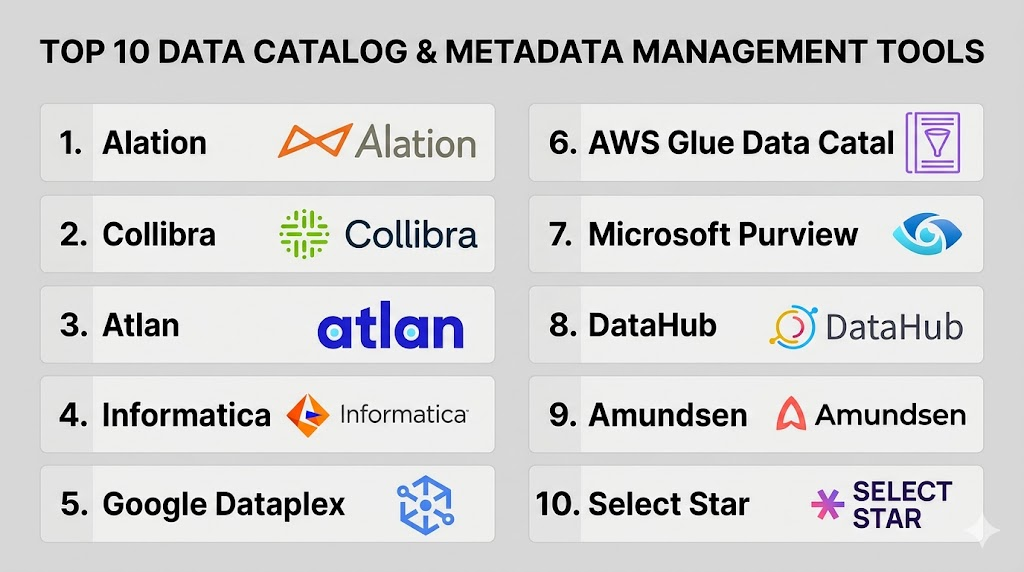
Introduction
A Data Catalog is a centralized inventory of an organization’s data assets, designed to help data citizens—ranging from analysts and data scientists to business stakeholders—discover, understand, and trust their data. It functions like a sophisticated library system, where data is the collection, and metadata (data about data) serves as the index. Metadata Management is the underlying discipline of managing this index, including technical metadata (schemas, tables), business metadata (glossaries, definitions), and operational metadata (lineage, usage statistics). Together, these tools bridge the gap between complex raw data and meaningful business insights.
In the modern landscape, the volume and variety of data have exploded. Organizations no longer store data in a single warehouse; they operate across multi-cloud environments, data lakes, and on-premises silos. Without a robust catalog, data becomes “dark data”—valuable but inaccessible. Effective metadata management ensures that data is not just found but is also compliant with global privacy regulations and understood within the correct business context. It acts as the foundation for data governance, enabling users to verify the lineage of a report or the sensitivity of a specific column before it is used in production.
Real-world Use Cases:
- Data Discovery: Allowing a new data analyst to search for “customer churn” and find all relevant, verified tables across the enterprise.
- Regulatory Compliance: Automatically identifying and tagging Personal Identifiable Information (PII) to comply with privacy laws.
- Impact Analysis: Visualizing data lineage to understand which downstream reports will break if a source table schema is modified.
- Data Trust and Quality: Providing “social proof” via ratings and certifications so users know which datasets are the “gold standard.”
- Cloud Migration: Mapping out legacy metadata to prioritize which assets should be moved to a modern cloud data platform.
Evaluation Criteria for Buyers:
- Automation Capabilities: The ability to automatically ingest metadata and apply AI-driven tags and classifications.
- Search and Discovery: A powerful, natural-language search interface that understands business context.
- Data Lineage: The depth and visual clarity of end-to-end lineage, from source system to BI dashboard.
- Collaboration Features: Support for wikis, chat, ratings, and crowdsourced documentation.
- Connectivity: The number of out-of-the-box connectors for databases, BI tools, and ETL pipelines.
- Governance & Privacy: Integration with access control and the ability to manage business glossaries.
- Ease of Use: A low technical barrier to entry for non-technical business users.
- Scalability: Performance levels when managing millions of metadata objects.
- Deployment Options: Availability of SaaS, on-premises, or multi-cloud hosting.
- Active Metadata: The ability to push metadata insights back into the source systems to trigger automated actions.
Mandatory Paragraph
- Best for: Large-scale enterprises, data-heavy startups, and regulated industries (FinTech, Healthcare) that need to democratize data access while maintaining strict governance and compliance.
- Not ideal for: Very small teams with a single, static database, or organizations that do not yet have a centralized data strategy or a need for data discovery among multiple users.
Key Trends in Data Catalog & Metadata Management
- Active Metadata Orchestration: Moving away from “passive” catalogs to active systems that use metadata to automate data quality checks and access control in real-time.
- AI-Augmented Discovery: Leveraging Large Language Models (LLMs) to allow users to “chat” with their data catalog and automatically generate business descriptions.
- Data Mesh and Data Fabric Support: Decentralizing metadata management to allow individual business domains to own their data while maintaining a global search layer.
- Observability Integration: Blending metadata management with data observability to show users the health and freshness of a dataset directly within the catalog.
- Automated PII Discovery: Using machine learning to scan data values (not just column names) to identify sensitive information with high precision.
- Column-Level Lineage: Providing microscopic visibility into how individual data points transform across the entire pipeline.
- Social Data Governance: Incorporating “social signals” such as popularity scores and top-user badges to help users identify the most reliable assets.
- Cloud-Native Interoperability: Deep, native integrations with cloud data warehouses like Snowflake, BigQuery, and Databricks as the primary metadata sources.
How We Selected These Tools (Methodology)
To determine the top tools for this guide, we evaluated the current market landscape based on functional maturity and professional adoption. The selection methodology followed these logic points:
- Market Mindshare: We prioritized tools that are consistently recognized by industry analysts and have a large, active user base.
- Feature Completeness: The tools must offer more than just a search bar; they must include lineage, governance, and automated ingestion.
- Connectivity Breadth: We evaluated the diversity of the connector ecosystem, ensuring support for both legacy and modern data stacks.
- User Persona Balance: We selected a mix of “business-first” catalogs and “technical-first” metadata management systems.
- Innovation Velocity: We favored platforms that have recently introduced advanced AI features and support for active metadata.
- Security Posture: Preference was given to tools with documented enterprise security features and compliance certifications.
Top 10 Data Catalog & Metadata Management Tools
#1 — Alation
Short description: A pioneer in the modern data catalog space, Alation focuses on combining machine learning with human collaboration to build a data-driven culture.
Key Features
- Behavioral Engine: Automatically ranks data assets based on how they are actually used within the organization.
- Intelligent SQL Editor: Provides real-time suggestions and warnings to analysts while they are writing queries.
- TrustCheck: Visual indicators (flags and endorsements) that tell users if a dataset is verified or deprecated.
- Automated Stewardship: Uses AI to suggest potential data stewards based on who uses the data most frequently.
- Open Connector Framework: Allows for the ingestion of metadata from a vast array of niche and standard sources.
- Business Glossary: A centralized hub for defining business terms and linking them to technical assets.
Pros
- Exceptional user adoption rates due to its intuitive, “Amazon-like” search experience.
- Strong focus on building a community of data users rather than just a technical index.
Cons
- Implementation can be resource-intensive, requiring dedicated stewards to maintain the glossary.
- Premium pricing that may be out of reach for smaller organizations.
Platforms / Deployment
- Web / Windows / macOS
- Cloud / Self-hosted / Hybrid
Security & Compliance
- SSO/SAML, MFA, RBAC, Data Masking.
- SOC 2 Type II, ISO 27001, GDPR.
Integrations & Ecosystem
Alation is designed to be the “central hub” for the entire data stack.
- Snowflake, Databricks, BigQuery.
- Tableau, Power BI, Looker.
- dbt, Informatica, Fivetran.
Support & Community
Offers Alation University for structured learning, a dedicated customer success model, and a vibrant user community “Alationers” with frequent regional meetups.
#2 — Collibra
Short description: A heavyweight in the enterprise data intelligence space, Collibra provides a robust platform for governance, quality, and cataloging.
Key Features
- Data Intelligence Cloud: A unified platform for cataloging, governance, and automated data quality.
- Policy Manager: Allows teams to define and enforce data policies across the entire organization.
- Edge Architecture: Processes data where it resides, ensuring sensitive metadata never leaves the protected environment.
- Automated Lineage: High-fidelity lineage that traces data from source to consumption with deep technical detail.
- Workflow Engine: Customizable workflows for data requests, access approvals, and stewardship tasks.
- Marketplace Experience: Allows users to “shop” for verified data sets through a familiar interface.
Pros
- The most comprehensive governance capabilities for highly regulated industries.
- Strong support for complex organizational hierarchies and decentralized ownership.
Cons
- Often criticized for having a steep learning curve and a complex user interface.
- Initial setup and configuration can take several months for large enterprises.
Platforms / Deployment
- Web
- Cloud / Hybrid
Security & Compliance
- SSO, SAML 2.0, RBAC, Encryption at rest and in transit.
- SOC 2, ISO 27001, HIPAA, FedRAMP.
Integrations & Ecosystem
Broad connectivity across legacy on-premises systems and modern cloud platforms.
- SAP, Oracle, Teradata.
- AWS, Azure, Google Cloud.
- Manta (for lineage), Tableau.
Support & Community
Extensive professional services, “Collibra University,” and a formal certification program for data governance professionals.
#3 — Atlan
Short description: A modern, “third-generation” data catalog built for the modern data stack, emphasizing collaboration and developer-first workflows.
Key Features
- Active Metadata: Syncs metadata back into tools like Slack or BI platforms to provide context where users work.
- Automated Lineage: Seamlessly extracts lineage from SQL logs, ETL tools, and BI dashboards.
- Google-like Search: Fast, intuitive search with advanced filters for tags, owners, and freshness.
- Playbooks: Automated rules to bulk-tag data assets or assign owners based on naming conventions.
- Embedded Collaboration: Allows users to chat about data assets and share context without leaving the catalog.
- Open API: Built as a “headless” catalog that can be controlled and queried via API.
Pros
- Very fast time-to-value; can be set up and populated in days rather than months.
- Deep integrations with modern tools like dbt and Snowflake that feel native.
Cons
- Might lack some of the “deep” legacy connectors found in older platforms like Informatica.
- Focuses primarily on cloud-native stacks, which may not suit “on-prem only” enterprises.
Platforms / Deployment
- Web
- Cloud (SaaS)
Security & Compliance
- SSO, MFA, Granular RBAC, PII Obfuscation.
- SOC 2 Type II, HIPAA, GDPR.
Integrations & Ecosystem
Tightly coupled with the “Modern Data Stack” ecosystem.
- dbt, Snowflake, Databricks.
- Fivetran, Airbyte.
- Sigma, Looker, Tableau.
Support & Community
Excellent documentation, a dedicated Slack community for users, and a proactive customer success team.
#4 — Informatica Enterprise Data Catalog (EDC)
Short description: An AI-powered data catalog that excels in massive, heterogeneous environments with complex technical metadata requirements.
Key Features
- Claire AI: An AI engine that automatically scans and classifies data assets across the enterprise.
- End-to-End Lineage: Deep technical lineage that covers mainframes, databases, and modern cloud stores.
- Discovery at Scale: Capable of scanning millions of objects across multi-cloud and on-prem silos.
- Relationship Discovery: Identifies hidden relationships between datasets using machine learning.
- Data Similarity: Suggests alternative datasets when a user is looking at a specific table.
- Privacy Dashboard: Provides a heat map of sensitive data across the entire organization.
Pros
- Unmatched depth in technical metadata extraction for legacy systems.
- Part of a larger Informatica ecosystem (ETL, Quality, MDM) for unified management.
Cons
- The interface can feel “technical” and less inviting for business stakeholders.
- Requires significant infrastructure and expertise to manage if deployed on-premises.
Platforms / Deployment
- Web / Linux
- Cloud / On-premises / Hybrid
Security & Compliance
- SSO, SAML, Kerberos, RBAC.
- SOC 2, HIPAA, ISO 27001.
Integrations & Ecosystem
Connects to almost any data source created in the last few decades.
- Oracle, DB2, SAP.
- AWS, Azure, GCP.
- PowerCenter, IICS.
Support & Community
Comprehensive global support, a large partner network, and the Informatica Network community portal.
#5 — Google Cloud Dataplex (Data Catalog)
Short description: A fully managed and scalable metadata management service within the Google Cloud ecosystem that helps organizations quickly discover and manage assets.
Key Features
- Serverless Architecture: No infrastructure to manage; scales automatically with metadata volume.
- Global Search: A unified search interface for BigQuery, Pub/Sub, and Cloud Storage.
- Tag Templates: Standardized templates to ensure metadata is consistent across the organization.
- Automated Discovery: Automatically syncs metadata from GCP resources as they are created.
- Integration with IAM: Uses standard Google Cloud permissions for catalog access.
- Technical & Business Metadata: Supports both automated technical tags and manual business descriptions.
Pros
- Seamless, one-click integration for organizations already operating on Google Cloud.
- Extremely cost-effective due to its serverless, pay-as-you-go model.
Cons
- Limited functionality for data residing outside of the Google Cloud environment.
- Lineage capabilities are less mature compared to standalone leaders like Collibra.
Platforms / Deployment
- Web
- Cloud (GCP)
Security & Compliance
- VPC Service Controls, Cloud IAM, Encryption.
- SOC 2, ISO 27001, HIPAA, FedRAMP.
Integrations & Ecosystem
Tightly integrated with the Google Data Cloud.
- BigQuery, Dataflow, Dataproc.
- Looker.
- Vertex AI.
Support & Community
Supported via Google Cloud support plans and extensive documentation on the Google Cloud portal.
#6 — AWS Glue Data Catalog
Short description: A persistent metadata store that acts as a central repository where you can store structural and operational metadata for all your data assets on AWS.
Key Features
- Glue Crawlers: Automatically scan data in S3 and other stores to infer schemas and populate the catalog.
- Hive Metastore Compatibility: Acts as a drop-in replacement for Apache Hive Metastore.
- Partition Management: Efficiently manages data partitions for high-performance querying in Athena and Redshift.
- Schema Registry: Manages and enforces schemas for streaming data (MSK and Kinesis).
- Integration with Lake Formation: Centralized access control and security for data lake assets.
- Version Control: Keeps track of schema changes over time for historical auditing.
Pros
- Foundational component for any data lake built on Amazon Web Services.
- High performance for analytical querying at a very low price point.
Cons
- Not a “user-friendly” catalog for business users; primarily a technical metadata store.
- Lack of collaborative features like ratings or social documentation.
Platforms / Deployment
- Web / API
- Cloud (AWS)
Security & Compliance
- AWS IAM, KMS Encryption, Resource-level policies.
- SOC, ISO, HIPAA, FedRAMP.
Integrations & Ecosystem
The heart of the AWS data ecosystem.
- Amazon Athena, Redshift, EMR.
- AWS Lake Formation.
- S3, RDS, Aurora.
Support & Community
Full AWS support ecosystem and a massive amount of community content on AWS forums.
#7 — Microsoft Purview (Data Map & Catalog)
Short description: A unified data governance solution that helps manage and govern your on-premises, multi-cloud, and SaaS data.
Key Features
- Automated Data Discovery: Scans data across Azure, Power BI, and SQL Server automatically.
- Classification Engine: Over 200 built-in classifiers for sensitive data (PII, Financial, etc.).
- End-to-End Lineage: Visualizes how data flows from Azure Data Factory into Power BI reports.
- Business Glossary: Centralizes business terminology and maps it to technical metadata.
- Insights Reports: Provides a high-level view of the data estate, including distribution and sensitivity.
- Integration with Microsoft 365: Leverages sensitivity labels used in Office 365 for data in the cloud.
Pros
- Native integration for organizations with a heavy Microsoft and Azure footprint.
- Strong focus on compliance and automated data labeling.
Cons
- Scanning non-Microsoft sources can sometimes be more complex to configure.
- The user interface can feel disjointed as it bridges multiple Azure services.
Platforms / Deployment
- Web
- Cloud (Azure)
Security & Compliance
- Azure AD (Entra ID), RBAC, Managed Identities.
- SOC 1/2/3, ISO 27001, HIPAA, FedRAMP.
Integrations & Ecosystem
Optimized for the Microsoft intelligent data platform.
- Power BI, Azure Synapse, Azure Data Factory.
- SQL Server, Microsoft 365.
- Multi-cloud support (AWS S3).
Support & Community
Standard Azure support tiers and the Microsoft Tech Community forums.
#8 — DataHub
Short description: An open-source, metadata-first platform originally developed at LinkedIn, designed to handle the complexity of the modern data ecosystem.
Key Features
- Push-based Ingestion: Allows systems to “push” metadata changes in real-time rather than waiting for a scan.
- Stream-based Architecture: Built on top of Kafka for high-scale, real-time metadata updates.
- GraphQL API: A modern API that makes it easy to query and integrate metadata into other apps.
- Data Observability Integration: Shows data health and test results directly on the asset page.
- Lineage Visualization: Automatically assembles lineage from a variety of sources.
- Impact Analysis: Allows users to see exactly what will be affected by a schema change.
Pros
- Extremely flexible and extensible for engineering-heavy organizations.
- Active open-source community with rapid innovation.
Cons
- Requires significant DevOps expertise to deploy and maintain at scale.
- Lacks some of the polished “business-user” features of paid SaaS platforms.
Platforms / Deployment
- Linux / Docker / Kubernetes
- Self-hosted / Managed SaaS (via Acryl Data)
Security & Compliance
- OIDC, RBAC, Metadata-level access control.
- SOC 2 (via Acryl Data).
Integrations & Ecosystem
Deeply connected to the open-source and modern cloud stack.
- Kafka, Airflow, dbt.
- Snowflake, BigQuery, Redshift.
- Looker, Tableau.
Support & Community
Very active Slack community (thousands of members) and enterprise support available through Acryl Data.
#9 — Amundsen
Short description: An open-source data discovery and metadata platform (originally from Lyft) that uses a search-first approach to improve data analyst productivity.
Key Features
- Page-Rank Style Search: Ranks search results based on table popularity and usage.
- Neo4j Graph Backend: Uses a graph database to store relationships between data, users, and queries.
- Preview Samples: Shows a small sample of the data (where allowed) to help users verify it’s what they need.
- Programmatic Descriptions: Allows for documentation to be treated as code.
- User Profiles: Shows which users are experts on a particular dataset.
- Issue Tracking Integration: Links data assets to Jira tickets for bug reporting.
Pros
- High focus on “Discovery” and “Search,” making analysts immediately more productive.
- Lightweight and easy to get started with for a technical team.
Cons
- Lacks deep governance and automated policy enforcement features.
- Lineage visualization is less advanced compared to Atlan or Alation.
Platforms / Deployment
- Linux / Docker / Kubernetes
- Self-hosted / Managed (via Stemma/Teradata)
Security & Compliance
- Basic Auth, OIDC, Integration with underlying DB security.
- Varies / N/A.
Integrations & Ecosystem
Built for the technical data ecosystem.
- Hive, Presto, Spark.
- Airflow, dbt.
- Snowflake, Redshift.
Support & Community
Community-driven via a dedicated Slack channel and GitHub; enterprise support via Stemma.
#10 — Select Star
Short description: An automated data discovery platform that focuses on providing an easy-to-use catalog by automatically mapping data lineage and usage.
Key Features
- Automated Mapping: Automatically generates a map of how data moves from DB to BI without manual effort.
- Popularity Scores: Ranks tables and columns by how often they are used in queries and dashboards.
- Column-Level Lineage: One of the strongest tools for tracing data at the granular column level.
- PII Tagging: Automatically identifies sensitive data across the warehouse.
- Query Analysis: Analyzes SQL logs to determine the “top users” of any given asset.
- Integrated Documentation: Allows for documentation to be synced from dbt directly into the catalog.
Pros
- Extremely low maintenance; the tool “auto-documents” much of the catalog.
- Clean, modern interface that business users find approachable.
Cons
- Smaller company with a more focused set of connectors compared to Informatica.
- Not intended for deep, legacy on-premises metadata management.
Platforms / Deployment
- Web
- Cloud (SaaS)
Security & Compliance
- SSO, MFA, RBAC.
- SOC 2 Type II.
Integrations & Ecosystem
Focused on the modern cloud data stack.
- Snowflake, BigQuery, Databricks.
- dbt, Fivetran.
- Tableau, Looker, Mode.
Support & Community
High-touch customer support and a growing user base in the startup and mid-market sectors.
Comparison Table (Top 10)
| Tool Name | Best For | Platform(s) Supported | Deployment | Standout Feature | Public Rating |
| Alation | Collaborative Culture | Web, Win, Mac | Hybrid | Behavioral Search Engine | 4.6/5 |
| Collibra | Enterprise Governance | Web | Hybrid | Data Intelligence Cloud | 4.3/5 |
| Atlan | Modern Data Stack | Web | SaaS | Active Metadata | 4.7/5 |
| Informatica EDC | Legacy/Technical Scale | Web, Linux | Hybrid | Claire AI Engine | 4.2/5 |
| Google Dataplex | GCP Ecosystem | Web | Cloud | Serverless Discovery | 4.1/5 |
| AWS Glue Catalog | AWS Infrastructure | Web, API | Cloud | Hive-Metastore Comp. | 4.0/5 |
| Microsoft Purview | Azure/Microsoft Shop | Web | Cloud | Automated Classification | 4.1/5 |
| DataHub | Engineering-First | Linux, Docker | Self-hosted | Push-based Ingestion | 4.5/5 |
| Amundsen | Analyst Productivity | Linux, Docker | Self-hosted | Popularity Ranking | 4.2/5 |
| Select Star | Column-Level Lineage | Web | SaaS | Automated Usage Mapping | 4.6/5 |
Evaluation & Scoring of Data Catalog & Metadata Management Tools
The scoring below evaluates each platform based on technical robustness and business adaptability.
| Tool Name | Core (25%) | Ease (15%) | Integrations (15%) | Security (10%) | Performance (10%) | Support (10%) | Value (15%) | Weighted Total |
| Alation | 9 | 9 | 10 | 9 | 9 | 9 | 7 | 8.85 |
| Collibra | 10 | 6 | 9 | 10 | 10 | 9 | 6 | 8.40 |
| Atlan | 9 | 10 | 9 | 9 | 9 | 9 | 8 | 8.95 |
| Informatica EDC | 10 | 5 | 10 | 9 | 10 | 8 | 6 | 8.15 |
| Google Dataplex | 7 | 9 | 8 | 9 | 9 | 8 | 9 | 8.05 |
| AWS Glue Catalog | 7 | 8 | 9 | 10 | 10 | 8 | 9 | 8.35 |
| Microsoft Purview | 8 | 8 | 9 | 10 | 9 | 9 | 8 | 8.45 |
| DataHub | 9 | 6 | 9 | 8 | 10 | 8 | 9 | 8.30 |
| Amundsen | 8 | 7 | 8 | 7 | 9 | 7 | 9 | 7.75 |
| Select Star | 8 | 10 | 8 | 9 | 9 | 9 | 8 | 8.55 |
Scoring Interpretation:
- Core Feature Score: Reflects the depth of lineage, metadata extraction, and search capabilities.
- Ease of Use: High scores indicate platforms that business users can adopt without extensive training.
- Weighted Total: A comparative indicator where $Total = \sum (Criterion \times Weight)$.
Which Data Catalog & Metadata Management Tool Is Right for You?
Solo / Freelancer
For a single consultant or freelancer, a full enterprise catalog is likely overkill. However, if you are managing a client’s data, the open-source Amundsen or a free-tier of a SaaS tool like Atlan can help you keep track of schemas. Often, simple documentation in a tool like Notion is sufficient until a team grows.
SMB
Small and medium businesses with a modern cloud warehouse (Snowflake, BigQuery) should look toward Select Star or Atlan. These tools prioritize “auto-discovery” and have lower management overhead, allowing a small data team to provide a high-quality catalog to the rest of the company.
Mid-Market
For companies with 50-200 data users, Alation or Atlan are the primary choices. Alation is ideal if the goal is “data culture” and collaboration. Atlan is better if the team wants a developer-first, automated approach that integrates tightly with modern orchestration tools.
Enterprise
Global enterprises with massive legacy debt and complex regulatory needs (GDPR, HIPAA) should prioritize Collibra or Informatica EDC. These platforms provide the rigorous governance and technical lineage required to pass audits and manage millions of assets across diverse environments.
Budget vs Premium
- Budget: AWS Glue (Technical), DataHub (Open Source), Amundsen (Open Source).
- Premium: Collibra, Alation, Informatica EDC.
Feature Depth vs Ease of Use
- High Depth: Collibra, Informatica EDC.
- High Ease: Select Star, Atlan.
Integrations & Scalability
- Top Integrations: Informatica, Alation.
- Top Scalability: Collibra, DataHub.
Security & Compliance Needs
Organizations with strict Microsoft or Google ecosystems should lean toward Microsoft Purview or Google Dataplex respectively, as these provide the most native security and automated classification within their specific clouds.
Frequently Asked Questions (FAQs)
1. What is the main difference between a data catalog and a data dictionary?
A data dictionary is a technical document primarily for developers that describes the schema and types of a single database. A data catalog is a broader business-facing platform that indexes multiple databases, provides search, social collaboration, and visual lineage.
2. Can a data catalog automatically document my data?
While AI can suggest descriptions and identify PII, true “automatic documentation” is still a hybrid process. Tools like Select Star and Atlan use query logs to auto-generate lineage and usage scores, but business context usually requires human input.
3. How do these tools handle data privacy?
Modern catalogs use machine learning to identify sensitive data like emails and credit card numbers. They can then automatically apply tags that trigger access control policies in the underlying database, ensuring only authorized users can see the data.
4. Do I need to move my data into the catalog?
No. Data catalogs only store “metadata” (schema names, table names, descriptions). The actual data remains in your warehouse or data lake. This makes them a very secure way to provide discovery without duplicating data.
5. What is data lineage and why is it in the catalog?
Data lineage is a visual map showing where data came from, how it was transformed, and where it ends up (like a BI report). It is essential for troubleshooting broken reports and understanding the impact of changing a table.
6. Is an open-source catalog like DataHub better than a paid one?
Open source offers more flexibility and is free of licensing costs, but it has much higher “human costs” for deployment and maintenance. Paid SaaS tools are typically better for organizations that want to start using the catalog immediately without managing infrastructure.
7. How does a data catalog support “Data Governance”?
The catalog serves as the “enforcement engine” for governance. It allows stewards to define terms in a glossary, certify “official” datasets, and monitor who is using sensitive data, ensuring policies are followed across the enterprise.
8. What is “Active Metadata”?
Active metadata refers to a catalog’s ability to not just read metadata but to use it to drive actions. For example, if a catalog identifies a dataset as “low quality,” it can automatically alert the data engineer or block the report from refreshing.
9. Can I integrate the catalog with my BI tools like Tableau?
Yes. Most top-tier catalogs have bidirectional integrations with Tableau, Power BI, and Looker. They can show the lineage of a dashboard and even display catalog metadata (like table descriptions) directly within the BI tool’s interface.
10. How long does it take to implement a data catalog?
A modern SaaS catalog (Atlan, Select Star) can be connected to your cloud warehouse in minutes and show results in days. However, a full enterprise rollout with a complete business glossary and stewardship usually takes three to nine months.
Conclusion
Metadata management is the secret ingredient that transforms a “data swamp” into a “data lake.” Without a central catalog, data teams waste up to 30% of their time just searching for assets. Whether you choose the collaborative depth of Alation, the governance rigor of Collibra, or the modern automation of Atlan, the goal is to create a single source of truth for your data estate.As organizations move toward “AI-ready” data architectures, the quality of your metadata will define the success of your automated systems. For your next step, we recommend running a pilot with one cloud-native tool and one open-source alternative to determine if your team values technical flexibility or automated ease-of-use.

This is exactly what I was looking for.