MOTOSHARE 🚗🏍️
Rent Bikes & Cars Directly from Owners
Motoshare connects vehicle owners with people who need bikes and cars on rent. Owners earn from idle vehicles, and renters get flexible ride options.
Visit Motoshare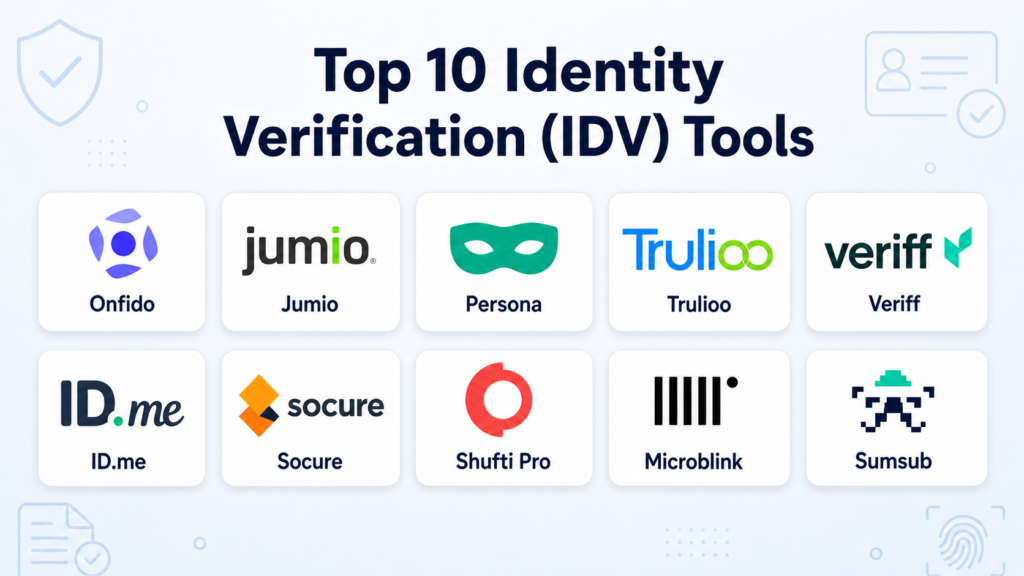
Introduction
Identity Verification (IDV) tools are specialized digital solutions designed to confirm that a person is who they claim to be. In an era where digital interactions have largely replaced face-to-face meetings, these tools serve as the primary gatekeeper for security and trust. They function by cross-referencing user-provided data—such as government-issued IDs, facial biometrics, and social security numbers—against authoritative databases or through advanced algorithmic analysis. By ensuring the “person on the other side of the screen” is authentic, IDV platforms protect businesses from fraud while enabling seamless onboarding.
The importance of robust identity verification has transcended traditional banking. Today, it is a fundamental requirement for the gig economy, digital healthcare, and age-restricted e-commerce. As sophisticated threats like synthetic identity fraud and AI-generated deepfakes become more common, IDV tools have evolved to include “liveness detection” and behavioral analysis. These platforms not only ensure regulatory compliance with Know Your Customer (KYC) and Anti-Money Laundering (AML) laws but also provide a frictionless experience that prevents user abandonment during the registration process.
Real-world use cases:
- Financial Services: Onboarding new customers for digital banking while adhering to strict global AML regulations.
- The Gig Economy: Verifying the identities of drivers or freelance workers to ensure safety and accountability within a marketplace.
- Healthcare: Authenticating patients for telehealth appointments to protect sensitive medical records and prevent insurance fraud.
- Real Estate: Facilitating secure, remote digital signatures for high-value property transactions and rental agreements.
- Travel and Hospitality: Enabling “touchless” check-ins at hotels or airports by verifying identity documents via mobile devices.
Evaluation criteria for buyers:
- Verification Accuracy: The ability to correctly identify legitimate users while flagging fraudulent attempts.
- Global Coverage: Support for a wide range of government documents across various countries and languages.
- User Experience (UX): How quickly and easily a user can complete the verification process without frustration.
- Liveness Detection: Sophistication in detecting deepfakes, masks, or photos used to spoof biometric checks.
- Integration Flexibility: The ease of deploying the tool via SDKs, APIs, or low-code web forms.
- Automation Rate: The percentage of verifications that can be completed by AI without human intervention.
- Data Privacy: Adherence to global standards like GDPR and CCPA to protect user information.
- Orchestration Capabilities: The ability to create dynamic workflows based on the user’s risk profile.
- Reporting and Analytics: The depth of the dashboard for monitoring fraud trends and conversion rates.
- Scalability: The platform’s ability to handle high volumes of verification requests during peak periods.
Mandatory paragraph
- Best for: Highly regulated industries, online marketplaces, and enterprise businesses that require high-assurance security and automated user onboarding at scale.
- Not ideal for: Small personal blogs with no sensitive data, internal corporate tools that rely solely on SSO, or businesses that do not handle financial transactions or age-restricted content.
Key Trends in Identity Verification (IDV) Tools
- AI-Powered Liveness Detection: Modern platforms are moving beyond static photos to “active” and “passive” liveness checks that ensure the user is physically present and not an AI-generated deepfake.
- NFC Chip Scanning: With the rise of e-passports, tools are increasingly using Near Field Communication (NFC) to read data directly from the ID’s embedded chip, providing a 100% accurate data extraction method.
- Decentralized Identity (DID): A shift toward “portable” identities where users control their own data and share verified “claims” rather than the raw documents themselves.
- Deepfake Prevention: Specialized algorithms designed specifically to detect the subtle artifacts left by generative AI in video streams.
- Reusable Identity: Allowing users to verify their identity once and then use that “verified status” across multiple different platforms without repeating the process.
- Behavioral Identity Signals: Analyzing how a user interacts with the verification interface (typing speed, device angle) as an extra layer of fraud prevention.
- Low-Code/No-Code Orchestration: Providing drag-and-drop builders so that non-technical compliance officers can adjust verification workflows in real-time.
- Synthetic Identity Defense: Using link analysis to identify identities created from a mix of real and fake information that do not belong to a real person.
How We Selected These Tools (Methodology)
To determine the leading platforms in the identity verification space, we conducted a rigorous assessment of the current market landscape. The methodology used for the selection of these ten tools includes the following logic:
- Technological Sophistication: We prioritized tools that utilize advanced machine learning for document OCR and biometric matching.
- Regulatory Compliance: The selected tools must demonstrate the ability to meet international KYC and AML standards.
- Market Adoption: We looked for platforms that are trusted by major global brands, from fintech unicorns to traditional enterprises.
- Feature Breadth: The list includes tools that offer a wide range of services, including document verification, AML screening, and biometric liveness.
- Developer Experience: We evaluated the quality of the documentation, APIs, and SDKs available for seamless integration.
- End-User Feedback: We analyzed signals regarding the smoothness of the mobile and web verification journeys.
Top 10 Identity Verification (IDV) Tools
#1 — Onfido
Short description: A market leader that uses AI to verify government-issued IDs and biometric data. It is widely used by high-growth startups and established financial institutions for automated onboarding.
Key Features
- Real-Identity Document Verification: Supports over 2,500 document types across nearly every country in the world.
- Facial Biometrics: Matches the user’s “selfie” or video to the photo on their government ID with high precision.
- Smart Capture SDKs: Highly optimized mobile interfaces that guide the user to take perfect photos of their documents.
- Motion Liveness: A user-friendly video check that requires simple head movements to prove physical presence.
- Atlas AI Engine: Proprietary machine learning models built on millions of diverse data points to reduce bias and increase accuracy.
- Verification Orchestration: Allows businesses to build custom logic for different user segments and risk levels.
Pros
- Exceptional user experience with high conversion rates for mobile users.
- Strong focus on reducing algorithmic bias in facial recognition.
Cons
- Pricing can be complex for smaller businesses with low verification volumes.
- The deep feature set may require a longer implementation time for full orchestration.
Platforms / Deployment
- Web / iOS / Android
- Cloud / SaaS
Security & Compliance
- SSO/SAML, MFA, RBAC.
- SOC 2 Type II, ISO 27001, GDPR.
Integrations & Ecosystem
Onfido offers a robust API and a suite of SDKs designed to fit into any existing mobile or web application.
- Salesforce
- Microsoft Azure
- Okta
- Auth0
Support & Community
Onfido provides a comprehensive developer portal, detailed documentation, and tiered support packages for enterprise clients. Community engagement is primarily through technical webinars and industry reports.
#2 — Jumio
Short description: A veteran in the IDV space that provides an end-to-end “KYX” platform, covering identity verification, risk assessment, and ongoing monitoring.
Key Features
- End-to-End Orchestration: Manages the entire user lifecycle from initial onboarding to recurring authentication.
- Advanced Liveness Detection: iBeta Level 2 certified liveness detection to thwart sophisticated spoofing attempts.
- NFC Verification: Directly reads the data from e-Passports and e-IDs for nearly instant and highly secure verification.
- AML Screening: Real-time checking against global watchlists, PEPs (Politically Exposed Persons), and adverse media.
- Bank-Grade Security: Utilizes high-level encryption and security protocols trusted by the world’s largest banks.
- Device Risk Analysis: Evaluates the reputation and health of the device being used for the verification.
Pros
- Comprehensive platform that eliminates the need for multiple disparate security vendors.
- Deep experience in handling the regulatory requirements of the gaming and banking sectors.
Cons
- The platform can feel “heavy” for companies that only need a simple document check.
- Some users have reported a slightly steeper learning curve for the admin dashboard.
Platforms / Deployment
- Web / iOS / Android
- Cloud / SaaS
Security & Compliance
- MFA, SSO, RBAC.
- SOC 2 Type II, ISO 27001, PCI DSS.
Integrations & Ecosystem
Jumio is built to integrate with complex enterprise ecosystems and legacy banking software.
- ForgeRock
- Ping Identity
- LexisNexis
- Guidewire
Support & Community
Jumio offers 24/7 technical support, a dedicated customer success manager for large accounts, and an extensive knowledge base for self-service.
#3 — Persona
Short description: A highly customizable identity infrastructure platform that allows businesses to build tailor-made verification workflows without writing extensive code.
Key Features
- Dynamic Flow Builder: A no-code interface that allows teams to create conditional verification logic based on user behavior.
- Multi-Attribute Verification: Can verify identities using documents, phone numbers, email addresses, and social signals.
- Case Management: A robust internal tool for manual review teams to investigate flagged identities.
- Automated Retries: Automatically prompts users to re-submit documents if the initial photo was blurry or obscured.
- Custom Branding: Complete control over the look and feel of the verification UI to match the brand’s identity.
- Database Pings: Cross-references user data with thousands of global authoritative databases in seconds.
Pros
- The most flexible and customizable UI in the current IDV market.
- Extremely fast implementation for startups and developers.
Cons
- The sheer number of configuration options can be overwhelming for simple use cases.
- International document coverage, while good, is sometimes considered second to legacy players like Jumio.
Platforms / Deployment
- Web / iOS / Android
- Cloud / SaaS
Security & Compliance
- SSO, RBAC, Encryption at rest and in transit.
- SOC 2 Type II, GDPR, HIPAA.
Integrations & Ecosystem
Persona focuses on modern tech integrations and developer-friendly hooks.
- Zapier
- Segment
- Slack (for alerts)
- Webhooks for real-time data sync
Support & Community
Known for a very responsive Slack-based support model and modern documentation that includes clear API references and implementation guides.
#4 — Trulioo
Short description: A global identity verification leader specializing in “Identity Marketplace” access, providing connections to thousands of data sources for real-time verification.
Key Features
- Global Data Consortium: Access to over 450 data sources to verify billions of people and millions of businesses.
- Business Verification (KYB): Specialized tools for verifying the corporate structure and ultimate beneficial owners (UBOs) of businesses.
- Real-time ID Verification: Instant verification of government-issued IDs from over 190 countries.
- Watchlist Screening: Automated screening against sanction lists and PEP databases to ensure compliance.
- Utility Data Verification: Verifies identity by checking utility bills and address records directly with service providers.
- Workflow Studio: A visual tool for building and deploying global identity sequences.
Pros
- Unrivaled reach in terms of global data sources and international verification.
- One of the few platforms that excels at both KYC (individuals) and KYB (businesses).
Cons
- The platform is highly focused on “data pings,” which may not always be as robust as a full biometric liveness check.
- Interface can be data-heavy and complex for non-specialist users.
Platforms / Deployment
- Web / API
- Cloud / SaaS
Security & Compliance
- MFA, SSO.
- SOC 2, GDPR, CCPA.
Integrations & Ecosystem
Trulioo is designed to be the “data backbone” for international companies.
- Microsoft Dynamics
- SAP
- Oracle
- Leading CRM platforms
Support & Community
Trulioo provides global support centers, a dedicated implementation team, and a high-level educational blog on international compliance trends.
#5 — Veriff
Short description: An AI-driven identity verification provider that emphasizes high automation and a “video-first” approach to prevent fraud in real-time.
Key Features
- AI-Video Verification: Records video during the session to analyze a user’s honesty and physical presence.
- Automatic Data Extraction: Industry-leading OCR technology that extracts document data in sub-second times.
- Cross-Link Detection: Identifies if the same person is trying to create multiple accounts across different devices.
- Face-to-Photo Matching: Uses neural networks to compare the live video feed to the document’s photo.
- Assisted Image Capture: Real-time feedback to the user on lighting, glare, and document positioning.
- Global Document Support: Recognizes and verifies over 11,000 different government ID types.
Pros
- Very high automation rates, leading to faster onboarding for the end user.
- The video-based approach is highly effective at stopping “presentation attacks.”
Cons
- Video verification requires a more stable internet connection than simple photo uploads.
- Pricing can be higher than average due to the sophisticated AI processing involved.
Platforms / Deployment
- Web / iOS / Android
- Cloud / SaaS
Security & Compliance
- MFA, RBAC, SSO.
- SOC 2 Type II, ISO 27001, GDPR.
Integrations & Ecosystem
Veriff provides extensive SDKs and is built for modern digital-first companies.
- AWS
- Google Cloud
- Shopify
- Leading fintech platforms
Support & Community
Veriff maintains a very active engineering blog and offers high-touch support for its enterprise-tier customers.
#6 — ID.me
Short description: A US-based digital identity network that allows users to verify their identity once and then use it across a wide network of government and commercial sites.
Key Features
- Portable Identity: Users maintain a single “ID.me Wallet” that they use to prove their identity at different locations.
- NIST IAL2 Compliance: Meets high-level federal standards for identity assurance in the United States.
- Video Chat Agents: Provides a human backup (Virtual Assistant) for users who struggle with automated verification.
- Attribute Verification: Can verify specific status attributes such as “Military Veteran,” “First Responder,” or “Student.”
- In-Person Verification: Offers a network of physical locations for users to verify their identity in person.
- Multi-Factor Authentication: Built-in tools for ongoing secure logins after the initial identity check.
Pros
- High trust levels within the US government and military sectors.
- Extremely high success rate due to the “human-in-the-loop” backup option.
Cons
- Highly focused on the US market; limited utility for international-only businesses.
- The “human review” component can lead to longer wait times during peak periods.
Platforms / Deployment
- Web / iOS / Android
- Cloud / SaaS
Security & Compliance
- NIST IAL2, FedRAMP, SOC 2.
- HIPAA, GDPR.
Integrations & Ecosystem
ID.me is deeply integrated into US state and federal systems as well as major retailers.
- IRS / Social Security Administration
- Salesforce
- Adobe
Support & Community
ID.me offers a robust help center for individual users and enterprise-level technical support for its business partners.
#7 — Socure
Short description: A leading provider of digital identity verification and fraud prediction, focusing heavily on using “identity graphs” to verify users in the US market.
Key Features
- Socure ID+: A unified platform that uses predictive analytics to identify fraud with high accuracy.
- Sigma Identity Fraud: A machine learning model that analyzes over 17,000 features to predict the likelihood of fraud.
- Predictive Document Verification: Combines document scanning with behavioral and device data.
- Synthetic Fraud Detection: Specialized models to identify identities that have no real-world history.
- Inclusive Onboarding: Uses alternative data sources to verify “thin-file” users (young people or immigrants).
- KYC/AML Compliance: Built-in screening that satisfies all US regulatory requirements.
Pros
- Arguably the most advanced fraud-prediction models for the US consumer market.
- Excellent at verifying users who are traditionally hard to find in credit databases.
Cons
- Primarily optimized for the US; international capabilities are expanding but less dominant.
- The pricing model is structured for high-volume enterprise users.
Platforms / Deployment
- Web / API
- Cloud / SaaS
Security & Compliance
- RBAC, MFA, SSO.
- SOC 2 Type II, ISO 27001.
Integrations & Ecosystem
Socure is designed to fit into the workflows of the largest financial services companies.
- Leading Core Banking Systems
- Alloy (Orchestration)
- Middesk
- Snowflake
Support & Community
Socure provides high-level whitepapers on fraud trends and offers specialized implementation engineers for new clients.
#8 — Shufti Pro
Short description: An international identity verification provider known for its rapid processing times and commitment to multi-language support and global document recognition.
Key Features
- Sub-Second Processing: Uses highly optimized AI to return verification results in less than a second in many cases.
- Multilingual OCR: Extracts data from documents in over 150 languages.
- Biometric Authentication: Face-recognition technology for recurring user logins.
- Video KYC: A recorded live session to ensure the highest level of assurance for high-risk transactions.
- Customizable Risk Scoring: Allows businesses to define what constitutes a “pass” based on their specific appetite for risk.
- Address Verification: Cross-references government documents with utility bills and bank statements.
Pros
- One of the fastest verification engines currently available.
- Offers a very competitive pricing structure for mid-market businesses.
Cons
- The administrative dashboard is functional but less polished than Persona or Onfido.
- Reporting features are not as deep as those offered by enterprise-first competitors.
Platforms / Deployment
- Web / iOS / Android
- Cloud / SaaS
Security & Compliance
- MFA, SSO.
- SOC 2, ISO 27001, GDPR.
Integrations & Ecosystem
Shufti Pro focuses on ease of integration via a RESTful API and lightweight SDKs.
- WordPress / WooCommerce
- Shopify
- Magento
- PHP / Python / Node.js libraries
Support & Community
Offers 24/7 customer support and a simplified integration guide designed for developers who want to get up and running quickly.
#9 — Microblink
Short description: A technology-focused company specializing in computer vision, offering an industry-standard SDK for document scanning and data extraction.
Key Features
- BlinkID: A lightning-fast mobile SDK that scans and extracts data from IDs locally on the device.
- AI-Powered OCR: Exceptional accuracy in reading text, even in low-light or low-resolution conditions.
- Privacy-First Design: Can process data locally on the device without sending sensitive images to the cloud.
- Worldwide Document Support: Automatically recognizes the layout of documents from nearly every country.
- Anonymization: Built-in tools to “mask” sensitive fields (like SSNs) during the scanning process.
- Lightweight Integration: Extremely small SDK footprint that doesn’t bloat the mobile application.
Pros
- The fastest and most reliable document “scanner” for mobile apps.
- Local processing is a massive benefit for privacy-conscious organizations.
Cons
- It is primarily a “scanning” tool; it does not include built-in AML or database checks.
- Requires the buyer to build their own “verification” logic around the extracted data.
Platforms / Deployment
- iOS / Android / Web (Wasm)
- On-device (Edge) / Cloud
Security & Compliance
- On-device processing (minimizes data transfer).
- ISO 27001.
Integrations & Ecosystem
Microblink is the “engine” inside many other identity and banking apps.
- Native Mobile Apps (Swift, Kotlin)
- React Native / Flutter
- Xamarin
- Cordova
Support & Community
Provides an extensive technical documentation site, GitHub samples, and a direct line to computer-vision engineers.
#10 — Sumsub
Short description: A unified “full-cycle” verification platform that combines KYC, KYB, KYT (Transaction Monitoring), and AML screening in a single interface.
Key Features
- Unified Dashboard: Manages people, companies, and transactions in one centralized view.
- Proof of Address (PoA): Specialized AI to verify residency using a wide variety of document types.
- Fraud Network Detection: Identifies clusters of suspicious accounts that are linked to the same fraudulent actor.
- Legal Entity Verification: Deep dive into corporate registries to verify business legitimacy.
- Liveness and Biometrics: iBeta Level 2 certified liveness checks included in the flow.
- Case Management: Advanced tools for compliance officers to handle manual reviews and audits.
Pros
- The best “all-in-one” platform for companies that need total compliance coverage.
- Highly localized experience with support for many diverse international document types.
Cons
- The platform is very broad, which might be “too much” for a company only needing simple ID checks.
- Interface can be complex for users who are not trained in compliance management.
Platforms / Deployment
- Web / iOS / Android
- Cloud / SaaS
Security & Compliance
- MFA, RBAC, SSO.
- SOC 2, ISO 27001, GDPR.
Integrations & Ecosystem
Sumsub offers a wide range of pre-built integrations for the fintech and crypto sectors.
- MetaMask / WalletConnect
- Chainalysis (for KYT)
- Salesforce
- Intercom
Support & Community
Sumsub is known for its “Compliance Academy,” which provides free training and certifications for compliance professionals.
Comparison Table (Top 10)
| Tool Name | Best For | Platform(s) Supported | Deployment | Standout Feature | Public Rating |
| 1. Onfido | Global Enterprise | Web, iOS, Android | Cloud / SaaS | Atlas AI Engine | 4.7/5 |
| 2. Jumio | Banking & Gaming | Web, iOS, Android | Cloud / SaaS | NFC Chip Scanning | 4.6/5 |
| 3. Persona | Startups / Custom UI | Web, iOS, Android | Cloud / SaaS | Dynamic Workflow Builder | 4.8/5 |
| 4. Trulioo | Global Data Access | Web, API | Cloud / SaaS | Identity Marketplace | 4.5/5 |
| 5. Veriff | Video-First KYC | Web, iOS, Android | Cloud / SaaS | AI-Video Verification | 4.6/5 |
| 6. ID.me | US Government/Citizens | Web, iOS, Android | Cloud / SaaS | Portable Identity Wallet | 4.4/5 |
| 7. Socure | US Fraud Prediction | Web, API | Cloud / SaaS | Sigma Fraud Engine | 4.8/5 |
| 8. Shufti Pro | Rapid Verification | Web, iOS, Android | Cloud / SaaS | Sub-Second Processing | 4.4/5 |
| 9. Microblink | Mobile Document Scan | iOS, Android, Web | Edge / Cloud | On-Device Processing | 4.9/5 |
| 10. Sumsub | Full-Cycle Compliance | Web, iOS, Android | Cloud / SaaS | Unified KYB/KYC/KYT | 4.7/5 |
Evaluation & Scoring of Identity Verification Tools
To provide a clear technical comparison, we have scored each tool on a scale of 1 to 10 across our key criteria. The “Weighted Total” is calculated using the weights defined in the methodology.
| Tool Name | Core (25%) | Ease (15%) | Integrations (15%) | Security (10%) | Performance (10%) | Support (10%) | Value (15%) | Weighted Total |
| Onfido | 10 | 8 | 9 | 10 | 9 | 9 | 7 | 8.90 |
| Jumio | 10 | 6 | 8 | 10 | 8 | 9 | 7 | 8.25 |
| Persona | 8 | 10 | 10 | 9 | 9 | 10 | 8 | 9.10 |
| Trulioo | 9 | 7 | 8 | 9 | 8 | 8 | 8 | 8.15 |
| Veriff | 10 | 8 | 8 | 9 | 9 | 8 | 8 | 8.65 |
| ID.me | 8 | 7 | 8 | 10 | 7 | 9 | 7 | 7.85 |
| Socure | 10 | 7 | 9 | 10 | 9 | 9 | 7 | 8.75 |
| Shufti Pro | 8 | 9 | 8 | 9 | 10 | 8 | 9 | 8.60 |
| Microblink | 10 | 10 | 7 | 10 | 10 | 8 | 9 | 9.25 |
| Sumsub | 9 | 7 | 9 | 10 | 8 | 10 | 8 | 8.55 |
Scoring Interpretation:
The scores are comparative within the IDV category. A “10” in Performance for Microblink reflects its unparalleled speed as a local scanning SDK, while a “10” in Ease of Use for Persona reflects its best-in-class no-code workflow builder. The “Weighted Total” serves as a general guide for overall platform strength.
Which Identity Verification Tool Is Right for You?
Solo / Freelancer
If you are a solo developer or an individual freelancer building a small application, Microblink (if you only need scanning) or Persona (if you need a full flow) are the best choices. Persona, in particular, offers a “starter” tier that is very accessible for small projects, and its no-code builder means you won’t spend weeks on integration.
SMB
For Small and Medium Businesses, Shufti Pro or Veriff offer a balanced mix of high-speed verification and fair pricing. Shufti Pro is particularly attractive for SMBs due to its straightforward implementation and rapid processing times, which helps keep onboarding abandonment rates low.
Mid-Market
Mid-market companies that are beginning to scale internationally should look at Onfido or Sumsub. Onfido provides the “gold standard” in mobile UX, which is critical for growing your user base, while Sumsub offers the ability to add KYB and Transaction Monitoring as your business complexity grows.
Enterprise
For large enterprises, especially in banking or US-centric industries, Jumio, Socure, or Trulioo are the primary candidates. Jumio is built for high-assurance, end-to-end management, Socure offers the best fraud-prevention data for the US market, and Trulioo provides the data reach required for massive global operations.
Budget vs Premium
- Budget: Shufti Pro and the starter tiers of Persona offer the most value for cost-conscious buyers.
- Premium: Jumio and F5 (which owns some IDV tech) are premium, high-touch services designed for organizations where the cost of fraud is extremely high.
Feature Depth vs Ease of Use
- Feature Depth: Sumsub and Jumio are the “heavyweights” with the most diverse set of sub-tools.
- Ease of Use: Persona and Onfido lead the market in making complex verification feel simple for both the developer and the end user.
Integrations & Scalability
- Top Integrations: Onfido and Persona have the most modern, developer-friendly integration ecosystems.
- Top Scalability: Trulioo and Socure are built to handle the massive data pings required by global financial institutions.
Security & Compliance Needs
Organizations with strict government-level security requirements (e.g., US federal work) should prioritize ID.me, as it is one of the few platforms that meets NIST IAL2 standards and is already a trusted partner of the US government.
Frequently Asked Questions (FAQs)
1. How do identity verification tools detect deepfakes?
Most modern IDV tools use “liveness detection” which analyzes skin texture, reflections, and pulse (using remote photoplethysmography) to ensure the face in front of the camera is a real, living human being rather than a digital reproduction.
2. Are IDV tools compliant with GDPR and other privacy laws?
Yes, leading IDV providers are built with privacy-by-design. They typically act as “Data Processors” and provide tools for data anonymization, localized storage, and automated deletion to help businesses stay compliant with global regulations.
3. What is the difference between “active” and “passive” liveness?
Active liveness requires the user to perform an action, such as blinking or following a dot on the screen. Passive liveness works in the background without user interaction, making the process faster and harder for bots to spoof.
4. Can these tools verify documents from small or obscure countries?
Yes, many of the top-tier tools recognize over 10,000 document types from over 190 countries. They use AI that has been trained on a massive variety of global IDs, including those with non-Latin scripts.
5. How much time does it take to integrate an IDV tool?
For a simple web-based integration, it can take as little as a few hours with a tool like Persona. A deep, native mobile integration with custom orchestration and orchestration can take between two and six weeks of development time.
6. What is the typical “pass rate” for identity verification?
In a healthy environment, pass rates typically range between 85% and 95%. Lower pass rates often indicate a poor user experience (e.g., bad camera guidance) or a high volume of actual fraud attempts.
7. Do IDV tools work on older smartphones with poor cameras?
Leading providers use “on-device” image processing and guidance to help users take the best possible photo. Some tools also offer an “upload” option for users who cannot use a live camera, though this is often considered a lower-assurance method.
8. What happens if the AI cannot verify a user?
Most enterprise platforms offer a “manual review” dashboard. If the AI is uncertain (e.g., a damaged ID or a significant change in appearance), the case is flagged for a human compliance officer to make the final decision.
9. Can IDV tools verify businesses as well as individuals?
Yes, several providers (like Sumsub and Trulioo) offer KYB (Know Your Business) services. This involves checking company registries, verifying the corporate structure, and identifying the individual owners of a business.
10. Is the data stored by the IDV provider or the business?
This depends on the configuration. Most IDV providers offer flexible “data retention” policies. Businesses can choose to have the provider delete the images immediately after verification or store them for a specific period for auditing purposes.
Conclusion
The selection of an Identity Verification tool is a critical decision that balances security, compliance, and user experience. While Onfido and Jumio remain the established giants for enterprise-scale operations, the rise of “infrastructure-first” platforms like Persona has made it easier for companies of all sizes to deploy sophisticated verification.
As the digital landscape becomes increasingly targeted by AI-driven fraud, the “liveness” and “accuracy” of your IDV partner will determine the integrity of your platform. We recommend starting with a pilot program that measures “conversion rate” and “false rejection rate” before committing to a full-scale global rollout.

Wow, I learned something new—thank you!
Seeing how IDV tools function maps out my path toward building trusted digital spaces.