MOTOSHARE 🚗🏍️
Rent Bikes & Cars Directly from Owners
Motoshare connects vehicle owners with people who need bikes and cars on rent. Owners earn from idle vehicles, and renters get flexible ride options.
Visit Motoshare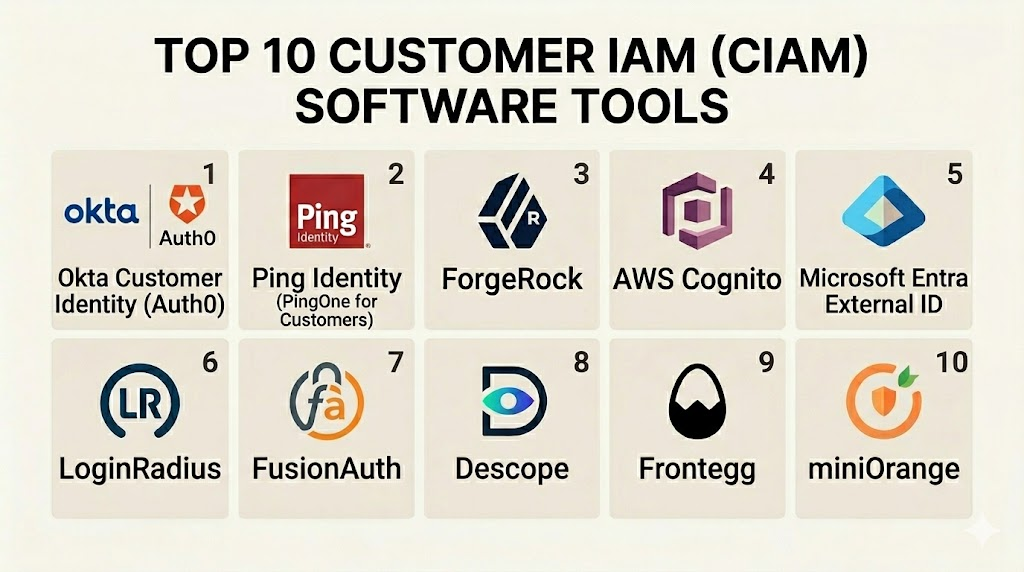
Introduction
Customer Identity and Access Management (CIAM) is a specialized category of security technology. It allows organizations to manage how customers and external users sign up, log in, and manage their profiles. Unlike traditional IAM, which focuses on employee access to internal tools, CIAM is built for scale and user experience. It turns the login process into a gateway for digital engagement. These platforms ensure that millions of users can access services securely while keeping their personal data private.
In the modern digital economy, identity is the foundation of the customer relationship. A poor login experience leads to abandoned shopping carts and lost revenue. CIAM platforms solve this by offering social logins, biometric authentication, and seamless “single sign-on” across multiple web and mobile apps. These tools are no longer just security features. They are now core components of the marketing and sales stack.
Real-world use cases:
- Retail and E-commerce: Allowing shoppers to use social accounts for quick checkout and personalized loyalty programs.
- Financial Services: Providing secure, multi-factor authentication for banking apps without ruining the mobile experience.
- Healthcare Portals: Managing patient access to sensitive medical records while complying with strict privacy laws.
- Media and Streaming: Handling massive spikes in traffic during major events and managing family-shared account permissions.
- SaaS and B2B Portals: Managing external partners and vendors who need limited access to internal portals.
Evaluation criteria for buyers:
- Scalability: The ability to handle millions of user identities without performance lags.
- User Experience (UX): Support for passwordless login, social identities, and custom branding.
- Security Controls: Inclusion of Multi-Factor Authentication (MFA) and adaptive risk-based access.
- Privacy and Consent: Tools for managing GDPR, CCPA, and general user consent for marketing.
- Integration Ease: Availability of SDKs and APIs for web, mobile, and legacy systems.
- Progressive Profiling: Gathering user data slowly over time rather than all at once during sign-up.
- Omni-channel Support: Maintaining a single user identity across web, mobile, and IoT devices.
- Fraud Prevention: Built-in protection against bot attacks and credential stuffing.
- Reporting and Analytics: Dashboards that show user registration trends and login success rates.
- Total Cost of Ownership: The balance between per-user licensing fees and implementation costs.
Mandatory Paragraph
- Best for: Large e-commerce brands, global financial institutions, healthcare providers, and high-growth SaaS companies that need to manage millions of external users securely.
- Not ideal for: Small internal teams looking only for employee login tools or static websites that do not require user accounts.
Key Trends in Customer IAM (CIAM)
- Passwordless Authentication: A shift toward using biometrics, magic links, and passkeys to remove the friction of traditional passwords.
- Decentralized Identity: Allowing users to own and control their own identity data via digital wallets rather than storing it in a central database.
- AI-Driven Risk Scoring: Using machine learning to detect unusual login behavior and trigger extra security steps only when necessary.
- Progressive Trust: A model where users are asked for more information only as they access higher-value features of an application.
- Privacy-by-Design: Building consent management directly into the registration flow to meet global regulatory standards automatically.
- Omni-channel Continuity: Ensuring a user can start an action on a mobile app and finish it on a desktop without re-authenticating.
- Identity Orchestration: The use of low-code tools to build complex authentication flows that connect different security services.
- Bot and Fraud Convergence: The integration of bot detection and identity verification to stop automated account creation.
How We Selected These Tools (Methodology)
The selection of the top 10 CIAM platforms was based on an objective analysis of market presence and technical depth. The evaluation logic followed these parameters:
- Market Adoption: We analyzed which tools are used by the world’s largest consumer-facing websites and applications.
- Feature Completeness: The tools selected must offer full identity lifecycles, from registration to data deletion.
- Reliability Signals: We reviewed the historical uptime and performance of these cloud-hosted identity providers.
- Security Posture: Evaluation was based on the presence of advanced MFA, threat detection, and encryption standards.
- Developer Experience: We prioritized tools with extensive documentation, modern SDKs, and flexible APIs.
- Customer Fit: The list includes a balance of enterprise suites, developer-first platforms, and industry-specific solutions.
Top 10 Customer IAM (CIAM) Software Tools
#1 — Okta CIAM
Short description: A cloud-native identity platform that provides a secure and scalable foundation for building customer-facing applications.
Key Features
- Okta Identity Engine: Allows for highly customizable and extensible authentication sequences.
- Social Login: Out-of-the-box support for Google, Facebook, Apple, and LinkedIn.
- Adaptive MFA: Uses context like location and device health to determine when to challenge a user.
- User Management: A centralized directory that can scale to hundreds of millions of users.
- Progressive Profiling: Collects user attributes across multiple sessions to minimize sign-up friction.
- Identity Orchestration: A low-code workflow tool to connect identity events to other business systems.
Pros
- Extremely high reliability and global presence for enterprise-scale needs.
- One of the best developer portals with clear documentation and SDK support.
Cons
- Pricing can be higher than competitors as user volume increases.
- Advanced customization may require more technical resources to implement.
Platforms / Deployment
- Cloud / Hybrid
- SaaS
Security & Compliance
- SSO, SAML, OIDC, MFA, RBAC.
- SOC 2, ISO 27001, HIPAA, FedRAMP, GDPR.
Integrations & Ecosystem
Okta features a massive integration network that connects to almost any modern software.
- Salesforce and HubSpot
- AWS, Azure, and GCP
- Splunk and Datadog
- Slack and Microsoft Teams
Support & Community
Okta provides a robust knowledge base, professional services, and multiple tiers of 24/7 technical support for global clients.
#2 — Ping Identity
Short description: A leader in identity orchestration that focuses on providing large enterprises with total control over their customer identity flows.
Key Features
- PingOne DaVinci: A drag-and-drop orchestration engine for building complex user journeys.
- Passwordless Experience: Deep support for FIDO2 and biometric-based authentication.
- Fraud Detection: Integrated tools to identify bot behavior and account takeover attempts.
- Privacy Management: Dedicated modules for managing user data consent and preferences.
- High-Scale Directory: Capable of managing billions of identities across global data centers.
- Hybrid Deployment: One of the few platforms that offers equal power for on-prem and cloud setups.
Pros
- Unmatched flexibility for complex, multi-brand enterprise architectures.
- Strong focus on high-security environments like banking and government.
Cons
- The platform can be complex to learn and configure for smaller teams.
- Setup times can be longer due to the depth of orchestration options.
Platforms / Deployment
- Web / Windows / Linux
- Cloud / Self-hosted / Hybrid
Security & Compliance
- SAML, OIDC, OAuth, MFA, RBAC.
- SOC 2, ISO 27001, HIPAA, PCI DSS.
Integrations & Ecosystem
Ping Identity is designed to act as the “connective tissue” between various enterprise tools.
- ForgeRock and SailPoint
- Adobe Experience Manager
- Azure Active Directory
- ServiceNow
Support & Community
Comprehensive support with dedicated account managers and a strong network of certified implementation partners.
#3 — Microsoft Entra External ID
Short description: A developer-focused CIAM solution integrated into the Microsoft Azure ecosystem, designed for building secure and branded user experiences.
Key Features
- Custom Branding: Allows for full control over the look and feel of the sign-in pages.
- Social and Local Accounts: Support for external identities like Microsoft, Google, and Facebook.
- Conditional Access: Uses Microsoft’s global threat intelligence to block risky login attempts.
- Native SDKs: Specialized libraries for mobile and web developers to speed up integration.
- User Flows: Pre-defined templates for common tasks like sign-up and password reset.
- Built-in MFA: Highly reliable multi-factor authentication via SMS, email, or authenticator apps.
Pros
- Seamless integration for businesses already using Azure and Microsoft services.
- Competitive pricing for organizations with existing Microsoft enterprise agreements.
Cons
- Can be difficult to navigate for developers who are not familiar with the Azure portal.
- Some advanced features require a more complex “Identity Experience Framework” setup.
Platforms / Deployment
- Web / Windows / macOS / iOS / Android
- Cloud
Security & Compliance
- MFA, Conditional Access, SSO.
- SOC 2, ISO 27001, HIPAA, GDPR, FedRAMP.
Integrations & Ecosystem
Deeply connected to the Microsoft 365 and Azure environments.
- Azure Functions and Logic Apps
- Microsoft Dynamics 365
- Power BI
- Visual Studio
Support & Community
Extensive documentation and support through the standard Microsoft Azure technical tiers.
#4 — Auth0 (by Okta)
Short description: A developer-first CIAM platform that prioritizes ease of use and rapid implementation for modern web and mobile applications.
Key Features
- Extensibility: Features “Actions” which allow developers to write custom code to modify any part of the login flow.
- Universal Login: A secure, hosted login page that works across all devices and platforms.
- Social Connections: One-click integration with dozens of social and enterprise identity providers.
- Anomalous Activity Detection: Automatically blocks brute-force and credential stuffing attacks.
- User Management Dashboard: A simple interface for managing user profiles and metadata.
- Logs and Analytics: Real-time visibility into authentication events for debugging and auditing.
Pros
- The fastest time-to-market for developers building new applications.
- High level of flexibility via custom code without needing to manage servers.
Cons
- Pricing is based on Monthly Active Users (MAU) and can become expensive at massive scale.
- The platform is now part of Okta, which may lead to future consolidation of features.
Platforms / Deployment
- Web / iOS / Android
- Cloud / Private Cloud
Security & Compliance
- MFA, SSO, RBAC, Encryption.
- SOC 2, ISO 27001, HIPAA, PCI DSS.
Integrations & Ecosystem
Auth0 is designed to “just work” with modern developer stacks.
- GitHub and GitLab
- React, Angular, and Vue
- Firebase
- Slack
Support & Community
A very strong developer community and a detailed knowledge base. Professional support is available for enterprise tiers.
#5 — SAP Customer Data Cloud
Short description: Formerly known as Gigya, this platform focuses on turning customer identity into actionable marketing data while ensuring compliance.
Key Features
- Enterprise Preference Management: Tools for managing complex user subscriptions and consents.
- Identity Sync: Automatically pushes user data to marketing and CRM systems.
- Risk-Based Authentication: Adjusts security based on user behavior and context.
- Social Registration: Sophisticated tools for gathering social data with user consent.
- Global Compliance: Automated handling of regional data residency and privacy laws.
- Profile Management: A self-service portal for users to manage their own data.
Pros
- Superior tools for marketing teams looking to monetize and analyze customer data.
- Strong focus on data privacy and global regulatory compliance.
Cons
- Can be more difficult for developers to integrate compared to developer-first platforms.
- Best suited for large enterprises already in the SAP ecosystem.
Platforms / Deployment
- Web / Mobile
- Cloud
Security & Compliance
- MFA, RBAC, SSO.
- SOC 2, ISO 27001, GDPR.
Integrations & Ecosystem
Integrates deeply with the SAP C/4HANA suite and other marketing tools.
- SAP S/4HANA
- Salesforce and HubSpot
- Marketo and Adobe Marketing Cloud
- Google Analytics
Support & Community
Enterprise-grade support through the SAP global service network.
#6 — Transmit Security
Short description: A modern CIAM platform that specializes in passwordless authentication and advanced identity orchestration.
Key Features
- Native Passwordless: Built from the ground up to replace passwords with biometric and device-based security.
- Identity Orchestration: A visual journey builder to manage all authentication and fraud services.
- Device Binding: Securely links a user’s identity to their specific hardware.
- Real-time Fraud Prevention: Detects account takeovers and automated bot activity during login.
- SDK-First Approach: Focused on giving developers the tools to build custom mobile experiences.
- Consolidated Identity: Merges fragmented user identities into a single, secure profile.
Pros
- Leading-edge technology for organizations wanting to eliminate passwords entirely.
- Very strong focus on security and fraud prevention for high-risk transactions.
Cons
- A newer player in the market with a smaller community than Okta or Microsoft.
- May be more specialized than organizations looking for a general-purpose directory.
Platforms / Deployment
- iOS / Android / Web
- Cloud
Security & Compliance
- FIDO2, Biometrics, MFA, RBAC.
- SOC 2 Type II, ISO 27001.
Integrations & Ecosystem
Focuses on connecting with the broader security and fraud ecosystem.
- Salesforce
- AWS and Azure
- ThreatMetrix
- Splunk
Support & Community
Professional support with a focus on high-security enterprise deployments.
#7 — IBM Security Verify
Short description: A comprehensive identity platform that offers both workforce and customer IAM with a focus on AI-driven threat detection.
Key Features
- AI-Based Risk Assessment: Uses IBM’s security intelligence to score the risk of every login.
- Adaptive MFA: Dynamically changes the authentication requirements based on calculated risk.
- Consent Management: Built-in tools for tracking and managing user privacy preferences.
- Digital Trust: Focused on building secure and transparent relationships with users.
- Scalable Directory: Enterprise-ready directory capable of supporting global user bases.
- Low-code Integration: Tools to speed up the deployment of identity services across apps.
Pros
- Strong backing from IBM’s global security research and threat intelligence.
- Good for large enterprises that need a single vendor for all identity needs.
Cons
- The user interface can feel more industrial and less “modern” than startup competitors.
- Can be complex to price and license for specific CIAM use cases.
Platforms / Deployment
- Web / Mobile
- Cloud / Hybrid / On-premises
Security & Compliance
- MFA, SSO, RBAC.
- SOC 2, ISO 27001, HIPAA, GDPR.
Integrations & Ecosystem
Part of the broad IBM Security and Cloud ecosystem.
- IBM QRadar
- IBM Cloud Pak for Security
- Microsoft Azure
- Salesforce
Support & Community
Extensive global support network and deep professional services expertise.
#8 — LoginRadius
Short description: A dedicated CIAM platform designed to help businesses manage customer identity, security, and data at scale.
Key Features
- Standardized API: Offers a unified API for all identity functions.
- Social Login: Support for over 40 social identity providers.
- User Management: A simplified dashboard for viewing and editing customer data.
- Privacy and Consent: Built-in workflows for GDPR and CCPA compliance.
- Custom Login Interfaces: Tools for building branded and responsive login screens.
- Data Migration: Specialized services for moving identities from legacy systems.
Pros
- High focus on “out-of-the-box” functionality for mid-market and enterprise firms.
- Strong emphasis on customer data analytics and marketing integration.
Cons
- Less developer “flexibility” for custom code compared to Auth0 or Okta.
- The community and third-party plugin ecosystem is smaller than industry leaders.
Platforms / Deployment
- Web / Mobile
- Cloud
Security & Compliance
- MFA, SSO, RBAC.
- SOC 2, ISO 27001, HIPAA, GDPR.
Integrations & Ecosystem
Focuses on marketing and CRM connections.
- Mailchimp
- Salesforce and Dynamics 365
- Google Analytics
- Klaviyo
Support & Community
Good technical support and a dedicated success team for enterprise clients.
#9 — Akamai Identity Cloud
Short description: Part of the Akamai security suite, this CIAM focuses on providing high-performance identity services for global digital brands.
Key Features
- Global Scale: Leverages Akamai’s edge network for low-latency identity checks.
- Data Residency: Automatically stores user data in the correct region to meet local laws.
- Social Registration: Streamlined flows for capturing user data from social platforms.
- Security Monitoring: Built-in protection against automated attacks and scrapers.
- Profile Analytics: Insights into user demographics and engagement patterns.
- Consent Management: Unified management of user permissions across all digital properties.
Pros
- Excellent for brands with a massive global footprint and regional data requirements.
- Integrated with Akamai’s broader web performance and security tools.
Cons
- Typically only available to existing Akamai customers or large enterprises.
- Developer experience is often cited as less intuitive than specialized CIAM tools.
Platforms / Deployment
- Web / Mobile
- Cloud
Security & Compliance
- MFA, SSO, RBAC.
- SOC 2, ISO 27001, PCI DSS.
Integrations & Ecosystem
Strongest for companies using the Akamai Intelligent Edge.
- Akamai WAF
- Adobe Experience Manager
- Salesforce
- Google Cloud
Support & Community
High-end professional support and managed services for enterprise customers.
#10 — ForgeRock
Short description: An identity platform known for its flexibility in handling complex identity relationships across users, devices, and things.
Key Features
- Intelligent Access: A visual designer for creating dynamic authentication trees.
- IoT Identity: Specialized tools for managing identities for connected devices.
- Hybrid Cloud: Supports deployment in any cloud environment or on-premises.
- Data Sovereignty: Allows organizations to control exactly where their identity data is stored.
- Social and Enterprise ID: Connects to both consumer and corporate identity sources.
- Consent and Privacy: Deep tools for managing the entire user data lifecycle.
Pros
- One of the most flexible platforms for non-standard or complex identity needs.
- Strong support for IoT and machine-to-machine identity.
Cons
- Now owned by Ping Identity, creating some uncertainty about future product paths.
- Requires significant expertise to manage and configure effectively.
Platforms / Deployment
- Web / Mobile / IoT
- Cloud / Self-hosted / Hybrid
Security & Compliance
- MFA, SSO, RBAC.
- SOC 2, ISO 27001, HIPAA.
Integrations & Ecosystem
Highly extensible and designed to integrate into large-scale environments.
- SAP and Oracle
- AWS and GCP
- Microsoft Azure
- ServiceNow
Support & Community
Mature support organization and a professional training academy.
Comparison Table (Top 10)
| Tool Name | Best For | Platform(s) Supported | Deployment | Standout Feature | Public Rating |
|---|---|---|---|---|---|
| Okta CIAM | Enterprise Scale | Web, Mobile | Cloud | Identity Orchestration | 4.7/5 |
| Ping Identity | Complex Workflows | Web, Mobile, On-prem | Hybrid | PingOne DaVinci | 4.6/5 |
| Auth0 | Developer Flexibility | Web, Mobile | Cloud | Actions (Extensibility) | 4.8/5 |
| Microsoft Entra | Microsoft Ecosystem | Web, Mobile, Windows | Cloud | Conditional Access | 4.5/5 |
| SAP Customer Data | Marketing/CRM Focus | Web, Mobile | Cloud | Preference Management | 4.2/5 |
| Transmit Security | Passwordless Focus | Web, Mobile | Cloud | Biometric Native | N/A |
| IBM Security Verify | AI-Driven Security | Web, Mobile, On-prem | Hybrid | AI Risk Assessment | 4.3/5 |
| LoginRadius | Mid-Market Analytics | Web, Mobile | Cloud | Customer Analytics | 4.1/5 |
| Akamai Identity | Global Data Residency | Web, Mobile | Cloud | Global Data Privacy | 4.2/5 |
| ForgeRock | IoT and Complex ID | Web, Mobile, IoT | Hybrid | Access Trees | 4.4/5 |
Evaluation & Scoring of Customer IAM (CIAM)
The following scoring model evaluates these tools based on their performance in a professional, high-scale digital environment.
| Tool Name | Core (25%) | Ease (15%) | Integrations (15%) | Security (10%) | Performance (10%) | Support (10%) | Value (15%) | Weighted Total |
|---|---|---|---|---|---|---|---|---|
| Okta CIAM | 10 | 8 | 10 | 9 | 10 | 9 | 7 | 8.90 |
| Ping Identity | 9 | 6 | 9 | 10 | 9 | 9 | 7 | 8.40 |
| Auth0 | 9 | 10 | 10 | 9 | 9 | 8 | 8 | 8.95 |
| Microsoft Entra | 8 | 7 | 9 | 10 | 9 | 9 | 9 | 8.55 |
| SAP Customer Data | 7 | 6 | 8 | 9 | 8 | 8 | 6 | 7.15 |
| Transmit Security | 8 | 7 | 7 | 10 | 9 | 7 | 7 | 7.75 |
| IBM Security Verify | 8 | 6 | 9 | 10 | 8 | 8 | 7 | 7.90 |
| LoginRadius | 7 | 8 | 7 | 8 | 8 | 8 | 8 | 7.55 |
| Akamai Identity | 8 | 6 | 7 | 9 | 10 | 8 | 6 | 7.45 |
| ForgeRock | 9 | 5 | 9 | 9 | 9 | 8 | 6 | 7.70 |
Scoring Model Interpretation:
- Weighted Total: A score of 8.5 or higher indicates a top-tier tool that excels in nearly every professional category.
- Ease vs. Core: Notice that tools like Auth0 prioritize “Ease,” while Ping Identity and ForgeRock prioritize “Core” technical depth and flexibility.
- Value Score: This reflects the balance of feature density against the market price and implementation effort.
Which Customer IAM (CIAM) Tool Is Right for You?
Solo / Freelancer
If you are building a new application as a solo developer, Auth0 is the most practical choice. Its free tier is generous, and the speed at which you can implement a secure login flow is unmatched.
SMB
Small and medium businesses with a focus on Microsoft technology should prioritize Microsoft Entra External ID. For those looking for a developer-friendly platform that grows with them, Auth0 or Okta are excellent alternatives.
Mid-Market
Companies that need a balance of security and marketing analytics should evaluate LoginRadius. If the focus is purely on high-end security and developer flexibility, Okta CIAM is the industry standard.
Enterprise
Global enterprises with complex regulatory needs should choose Okta, Ping Identity, or SAP Customer Data Cloud. These platforms provide the scale and compliance tools necessary for managing tens of millions of users across different regions.
Budget vs Premium
- Budget: Microsoft Entra External ID (for Azure users), Auth0 (Free tier for starters).
- Premium: Okta, Ping Identity, SAP Customer Data Cloud.
Feature Depth vs Ease of Use
- Deep Depth: Ping Identity, ForgeRock.
- Easy to Use: Auth0, LoginRadius.
Integrations & Scalability
- Top Integrations: Okta, Auth0.
- Top Scalability: Ping Identity, Akamai Identity Cloud.
Security & Compliance Needs
Organizations in banking or government should prioritize Ping Identity or IBM Security Verify, as they offer the most robust hybrid security and compliance histories.
Frequently Asked Questions (FAQs)
- What is the difference between IAM and CIAM?
IAM (Identity and Access Management) is designed for employees to access internal tools. CIAM (Customer IAM) is built for external customers, focusing on scale, user experience, and privacy.
- Can I use my existing employee IAM tool for my customers?
While possible, it is not recommended. Employee IAM tools lack the social login features, marketing integrations, and massive scalability required for millions of customers.
- How does CIAM improve the user experience?
CIAM allows for social logins (like Google), passwordless authentication, and progressive profiling, which makes the sign-up and login process much faster for the user.
- Is CIAM necessary for GDPR and CCPA compliance?
Yes, CIAM platforms include built-in tools for managing user consent, data residency, and the right to be forgotten, which are essential for meeting global privacy laws.
- What is progressive profiling in CIAM?
Progressive profiling is the practice of asking for user information in small steps over time rather than requiring a long form during the initial registration.
- Does CIAM protect against account takeover (ATO)?
Yes, modern CIAM tools use AI and behavioral analytics to detect suspicious login attempts and block automated bot attacks before they reach the user’s account.
- How does passwordless authentication work in CIAM?
It uses device-based biometrics (like FaceID), magic links sent to email, or one-time codes (OTP) sent to mobile devices to verify a user without a password.
- Can CIAM platforms handle billions of users?
High-end platforms like Ping Identity and Okta are specifically architected to scale to billions of identities across globally distributed data centers.
- What are the common pricing models for CIAM?
Most CIAM tools charge based on Monthly Active Users (MAU). Some also charge per-login or offer flat enterprise tiers for unlimited users.
- How long does it take to implement a CIAM solution?
Developer-first tools like Auth0 can be implemented in a few days. Large enterprise migrations involving complex orchestration can take several months.
Conclusion
Customer IAM (CIAM) has evolved from a simple login box into a comprehensive platform for building digital trust. While Okta and Auth0 provide the best developer experience and speed, Ping Identity and SAP Customer Data Cloud offer the depth required for complex enterprise and marketing needs.The right choice depends on your organization’s technical maturity and user volume. For those starting out, a developer-centric tool is best. For global brands, a platform with strong privacy and orchestration features is a necessity. Shortlist two or three tools from this list and run a pilot project to validate the user experience before making a final decision.

Very well written and easy to follow. This blog added real value.
A practical gap to add is CIAM migration and account-linking risk. Moving millions of customer identities between platforms can create duplicate accounts, broken consent records, and login failures, so rollback planning, staged migration, and session validation should be part of the selection criteria.