MOTOSHARE 🚗🏍️
Rent Bikes & Cars Directly from Owners
Motoshare connects vehicle owners with people who need bikes and cars on rent. Owners earn from idle vehicles, and renters get flexible ride options.
Visit Motoshare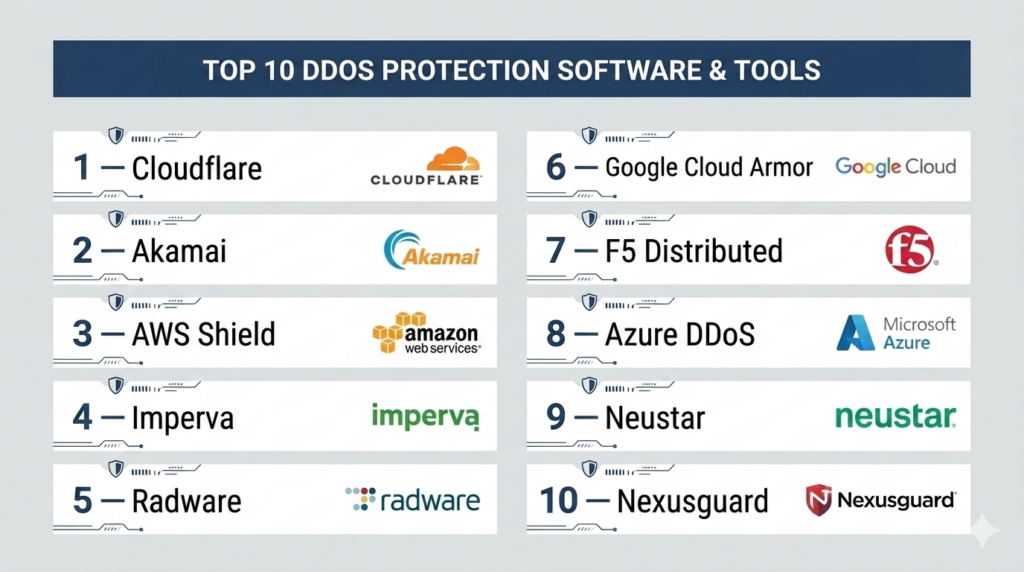
Introduction
DDoS (Distributed Denial of Service) protection tools are specialized cybersecurity solutions designed to safeguard networks, websites, and online services from malicious attempts to overwhelm them with a flood of internet traffic. These attacks utilize thousands of compromised systems (botnets) to saturate a target’s bandwidth or exhaust its server resources, leading to service outages. Protection tools act as a sophisticated filter, distinguishing between legitimate user traffic and malicious bot-driven spikes, ensuring that genuine requests reach the server while the “noise” is discarded.
In the digital landscape, the scale and frequency of DDoS attacks have reached unprecedented levels. With the proliferation of unsecure IoT devices and the rise of “DDoS-as-a-Service,” even small businesses are targets. Modern protection focuses on the “edge,” intercepting attacks before they ever reach the internal infrastructure. For any organization with an online presence, these tools are no longer optional extras; they are fundamental requirements for maintaining availability and user trust.
Real-world use cases:
- E-commerce Availability: Protecting retail sites during high-traffic events like Black Friday from competitors or extortionists.
- Online Gaming: Preventing “lag-outs” and service disruptions caused by rival players or malicious actors targeting game servers.
- Financial Services: Ensuring banking portals remain accessible to customers while mitigating sophisticated Layer 7 (application layer) attacks.
- Government Infrastructure: Safeguarding public service websites from politically motivated “hacktivism.”
- SaaS Platforms: Protecting multi-tenant environments where a single attack on one customer could potentially degrade service for all.
Evaluation criteria for buyers:
- Mitigation Capacity: The total bandwidth (typically in Terabits per second) the provider can scrub during an attack.
- Time to Mitigate (TTM): How quickly the tool identifies and blocks an attack (zero-second or “always-on” is ideal).
- Layer 3, 4, and 7 Coverage: Ability to block both volumetric (network) and complex (application) attacks.
- Network Footprint: The number and distribution of global scrubbing centers to reduce latency.
- False Positive Rate: The accuracy of the tool in not blocking legitimate users during an attack.
- Deployment Model: Options for Cloud-based, On-premises, or Hybrid protection.
- WAF Integration: Whether the tool includes a Web Application Firewall for deeper packet inspection.
- Pricing Structure: Flat-rate “unmetered” protection vs. “pay-as-you-grow” based on clean traffic.
- Reporting and Analytics: The depth of real-time visibility into attack traffic and mitigation actions.
- Support and SLA: 24/7 access to a Security Operations Center (SOC) and guaranteed uptime.
Best for: IT managers, security engineers, website owners, and hosting providers who need to ensure 100% uptime for critical online assets.
Not ideal for: Internal-only applications with no public internet presence or very small, static sites where the cost of premium protection outweighs the risk of brief downtime.
Key Trends in DDoS Protection Tools
- AI-Powered Behavioral Analysis: Moving away from static “signatures” to machine learning models that identify attacks based on abnormal traffic patterns and intent.
- Zero-Day Attack Mitigation: The ability to block previously unknown attack vectors by analyzing packet anomalies in real-time.
- Edge-Side Scrubbing: Pushing mitigation to the extreme edge of the network (PoPs) to ensure malicious traffic never enters the provider’s core network.
- Automated Signature Generation: Tools that can automatically create and deploy filter rules within seconds of a new attack starting.
- API-First Protection: Specialized shielding for API endpoints, which are increasingly targeted by botnets to bypass traditional web protections.
- Unmetered Mitigation Models: A shift toward fixed-fee pricing regardless of the size or duration of the attack, providing budget predictability.
- Hyper-Localized Scrubbing: The expansion of data centers in emerging markets to keep latency low for regional users during mitigation.
- Integrated Bot Management: Distinguishing between “good bots” (search engines) and “bad bots” (scrapers/attackers) as part of the DDoS defense layer.
How We Selected These Tools (Methodology)
To determine the top 10 DDoS protection tools, we evaluated the current market leaders based on technical efficacy and global infrastructure. Our methodology included:
- Network Capacity: We prioritized providers with multi-terabit scrubbing capacities to handle modern “mega-attacks.”
- Mitigation Speed: Preference was given to “always-on” solutions that offer near-instantaneous detection.
- Feature Breadth: We looked for tools that provide a “full stack” of security, including WAF and CDN capabilities.
- Global Reach: We assessed the geographical distribution of scrubbing centers to ensure low-latency protection for global users.
- Customer Trust: Analyzing adoption rates among Fortune 500 companies and high-risk industries like finance and gaming.
- Security Innovation: Evaluating the integration of AI and automated response mechanisms within the platform.
Top 10 DDoS Protection Software Tools
#1 — Cloudflare
Short description: A global leader in web security, Cloudflare provides an unmetered, always-on DDoS protection service that leverages one of the world’s largest networks.
Key Features
- Unmetered Mitigation: Protection against any size or duration of attack without extra charges.
- Global Anycast Network: Spreads attack traffic across 300+ cities to neutralize it locally.
- Layer 7 Protection: Sophisticated rules to block application-specific attacks like HTTP floods.
- WAF Integration: Seamlessly works with their Web Application Firewall for deep packet inspection.
- Magic Transit: Extends DDoS protection to entire IP prefixes for on-premise and cloud networks.
- Real-time Analytics: Highly detailed dashboard showing attack types and geographic origins.
Pros
- Extremely easy to set up with simple DNS changes.
- Includes a powerful CDN that improves site performance while securing it.
Cons
- Advanced security features are locked behind high-tier “Enterprise” plans.
- The “always-on” nature can sometimes trigger false positives (CAPTCHAs) for legitimate users.
Platforms / Deployment
- Web / Windows / macOS / Linux / iOS / Android
- Cloud
Security & Compliance
- SSO/SAML, MFA, RBAC.
- PCI DSS, SOC 2 Type II, ISO 27001, HIPAA.
Integrations & Ecosystem
Cloudflare integrates with virtually every modern cloud and infrastructure tool.
- AWS / GCP / Azure
- Terraform
- Splunk / Datadog
- WordPress / Shopify
Support & Community
Massive community support and a world-class 24/7/365 global SOC for Enterprise customers.
#2 — Akamai App & API Protector
Short description: Akamai is a pioneer in the CDN space, offering highly sophisticated, adaptive security tailored for large enterprises and complex web applications.
Key Features
- Adaptive Security Engine: Uses machine learning to automatically tune protections based on evolving threats.
- API Discovery & Protection: Automatically finds and shields hidden APIs from malicious traffic.
- Prolexic Routed: A dedicated scrubbing service for protecting all ports and protocols (not just web).
- Bot Manager: Integrated high-end bot detection to block scrapers and credential stuffers.
- Zero-Second SLA: Guaranteed instantaneous mitigation for known attack vectors.
- Edge DNS: Protects the DNS layer from exhaustion attacks to ensure resolution remains active.
Pros
- Massive scrubbing capacity capable of handling the largest recorded volumetric attacks.
- Superior protection for complex, high-traffic global enterprises.
Cons
- One of the most expensive solutions on the market.
- The interface and configuration can be complex for smaller IT teams.
Platforms / Deployment
- Web
- Cloud / Hybrid
Security & Compliance
- MFA, SSO, Fine-grained RBAC.
- SOC 2, ISO 27001, PCI DSS, FedRAMP.
Integrations & Ecosystem
Designed for enterprise-level orchestration.
- ServiceNow
- IBM QRadar
- Splunk
- Major Cloud Providers
Support & Community
Premium support with dedicated security architects and 24/7 global SOC access.
#3 — AWS Shield
Short description: A managed DDoS protection service that safeguards applications running on Amazon Web Services, available in Standard and Advanced tiers.
Key Features
- AWS Shield Standard: Automatic protection for common Layer 3 and 4 attacks at no extra cost.
- AWS Shield Advanced: Enhanced protection for EC2, ELB, CloudFront, and Route 53.
- DDoS Response Team (DRT): Direct access to AWS experts during an active attack.
- Cost Protection: Provides credits for scaling charges incurred during a DDoS attack.
- WAF Inclusion: Advanced tier includes AWS WAF at no additional subscription cost.
- Global Threat Dashboard: Visibility into the threat landscape across the entire AWS network.
Pros
- Seamlessly integrated into the AWS console; no DNS changes required for AWS assets.
- Standard tier is free for all AWS customers.
Cons
- Advanced tier has a high fixed monthly cost ($3,000+).
- Limited protection for assets hosted outside of the AWS environment.
Platforms / Deployment
- Web
- Cloud
Security & Compliance
- IAM roles, MFA, SSO.
- FedRAMP, HIPAA, PCI DSS, SOC 1/2/3.
Integrations & Ecosystem
Deeply integrated with the AWS ecosystem.
- Amazon CloudFront
- Amazon Route 53
- AWS Firewall Manager
- AWS CloudWatch
Support & Community
Standard AWS support for basic; 24/7 specialized DRT support for Advanced subscribers.
#4 — Imperva DDoS Protection
Short description: Imperva offers a comprehensive security stack known for its high-performance scrubbing centers and 3-second mitigation guarantee.
Key Features
- 3-Second Mitigation SLA: One of the fastest guaranteed response times in the industry.
- Application & Network Layer: Comprehensive shielding for both web traffic and entire IP ranges.
- Behavioral Analysis: Distinguishes between legitimate traffic spikes and botnet attacks.
- Global Scrubbing Network: High-capacity centers located strategically around the world.
- Integrated WAF: Industry-leading web application firewall included.
- DNS Protection: Dedicated shielding for DNS servers to prevent resolution failures.
Pros
- Excellent balance of performance and security features.
- Very strong reporting and visualization of attack data.
Cons
- Can be expensive for mid-sized businesses.
- Onboarding process for network-level protection can be technical.
Platforms / Deployment
- Web
- Cloud / Hybrid / On-Premise
Security & Compliance
- SSO, MFA, RBAC.
- PCI DSS, SOC 2, ISO 27001, HIPAA.
Integrations & Ecosystem
- SIEM tools (Splunk, ArcSight)
- Terraform
- AWS / Azure
- API Security tools
Support & Community
Professional services and a 24/7 SOC. Known for proactive threat research.
#5 — Radware DefensePro
Short description: Radware specializes in hardware and cloud-based DDoS protection, utilizing unique behavioral algorithms to block “low and slow” attacks.
Key Features
- Behavioral-Based Detection: Identifies attacks without relying on signatures, perfect for zero-day threats.
- Hardware Scrubbing: High-performance physical appliances for on-premise data centers.
- Cloud DDoS Service: A massive global scrubbing network for cloud-native protection.
- Burst Protection: Handles sudden, massive spikes in traffic without degrading latency.
- SSL Attack Mitigation: Inspects encrypted traffic for threats without compromising privacy.
- Emergency Response Team (ERT): Expert assistance available 24/7 for active mitigations.
Pros
- Exceptional at detecting sophisticated, non-volumetric attacks.
- Ideal for hybrid environments needing both hardware and cloud protection.
Cons
- The hardware-focused roots mean the cloud UI can feel less “modern” than Cloudflare.
- High total cost of ownership for hardware deployments.
Platforms / Deployment
- Windows / Linux / Hardware
- Cloud / Self-hosted / Hybrid
Security & Compliance
- MFA, RBAC, encrypted management.
- FIPS 140-2 (Hardware), SOC 2, HIPAA.
Integrations & Ecosystem
- Cisco / Check Point
- Microsoft Azure
- Splunk
- VMware
Support & Community
Robust 24/7 ERT support. Highly regarded for technical expertise in the banking sector.
#6 — Google Cloud Armor
Short description: Built on the same infrastructure that protects Google’s own services, Cloud Armor provides massive scale and ML-based protection for GCP users.
Key Features
- Adaptive Protection: Uses machine learning to detect and stop high-volume Layer 7 attacks.
- Pre-configured WAF Rules: Ready-made rules to mitigate OWASP Top 10 risks.
- Global Load Balancing: Integrated directly into Google’s global network edge.
- Bot Management: Sophisticated reCAPTCHA Enterprise integration to stop bots.
- IP-Based Control: Granular filtering based on geographic location or IP reputation.
- Preview Mode: Test new rules against live traffic without blocking users.
Pros
- Leverages Google’s massive global network for near-infinite scalability.
- Easy “one-click” deployment for existing GCP projects.
Cons
- Primarily effective only for assets hosted within Google Cloud.
- The logging and monitoring costs can add up for high-traffic sites.
Platforms / Deployment
- Web
- Cloud
Security & Compliance
- IAM, MFA, SSO.
- FedRAMP, SOC 1/2/3, ISO 27001, HIPAA.
Integrations & Ecosystem
- Google Cloud Console
- Cloud Logging / Cloud Monitoring
- reCAPTCHA Enterprise
- GKE (Google Kubernetes Engine)
Support & Community
Standard GCP support tiers. Massive documentation library.
#7 — F5 Distributed Cloud DDoS Mitigation
Short description: F5, a leader in application delivery, offers high-tier protection focusing on application availability and integrated security services.
Key Features
- Unified Security: Combines DDoS, WAF, and API security into a single edge platform.
- L3-L7 Protection: Shields against volumetric, protocol, and application-layer attacks.
- Global Scrubbing PoPs: High-performance points of presence for local mitigation.
- Programmable Rules: High degree of customization for unique application needs.
- Real-time Monitoring: Advanced telemetry for deep visibility into traffic health.
- Hybrid Flexibility: Easily managed across multi-cloud and on-premise environments.
Pros
- Excellent for businesses already using F5 BIG-IP hardware.
- Very strong at mitigating application-specific (Layer 7) threats.
Cons
- Licensing and pricing can be complex.
- Steep learning curve for administrators not familiar with the F5 ecosystem.
Platforms / Deployment
- Web / Hardware
- Cloud / Hybrid / Self-hosted
Security & Compliance
- SSO, MFA, Advanced RBAC.
- SOC 2, ISO 27001, PCI DSS.
Integrations & Ecosystem
- F5 BIG-IP
- Kubernetes / NGINX
- AWS / Azure / GCP
- Ansible / Terraform
Support & Community
Expert 24/7 SOC support. Strong enterprise community.
#8 — Azure DDoS Protection
Short description: Microsoft’s native protection for Azure resources, providing automatic tuning and integrated security monitoring.
Key Features
- Adaptive Tuning: Learns your application’s normal traffic patterns to reduce false positives.
- DDoS Rapid Response: Access to Microsoft experts during active attacks.
- Cost Guarantee: Financial protection for scaling costs during an attack.
- Azure Monitor Integration: Native logging and alerting through standard Azure tools.
- L3-L7 Shielding: Comprehensive protection across the network and application layers.
- Metrics & Alerts: Real-time visibility into mitigation status via the Azure portal.
Pros
- “Set it and forget it” simplicity for Azure environments.
- Excellent financial protection policies for resource spikes.
Cons
- Expensive monthly flat fee ($2,900+) regardless of traffic size.
- Zero value for assets hosted outside of Microsoft Azure.
Platforms / Deployment
- Web
- Cloud
Security & Compliance
- Azure AD, MFA, SSO.
- ISO 27001, FedRAMP, HIPAA, SOC 1/2/3.
Integrations & Ecosystem
- Azure Application Gateway
- Azure Firewall
- Azure Sentinel (SIEM)
- Azure Traffic Manager
Support & Community
Standard Azure support. Deeply integrated into the Microsoft security ecosystem.
#9 — Neustar UltraDDoS Protect
Short description: A high-capacity, cloud-based scrubbing service known for its massive network and precision in mitigating complex attacks.
Key Features
- 15+ Tbps Capacity: One of the largest scrubbing networks available.
- Flexible Deployment: Supports DNS redirection, BGP, and GRE tunneling.
- Always-On or On-Demand: Choose based on your risk profile and budget.
- Sophisticated Scrubbing: Precision filters that remove malicious traffic without affecting users.
- WAF and Bot Integration: Optional layers for complete web security.
- Detailed Post-Attack Reports: Comprehensive analysis of the attack vector and mitigation.
Pros
- Massive scale; capable of stopping the largest volumetric floods.
- Very flexible deployment options for diverse infrastructure.
Cons
- Enterprise-only focus; not suitable for small businesses.
- The UI is functional but lacks the modern “polish” of Cloudflare.
Platforms / Deployment
- Web
- Cloud / Hybrid
Security & Compliance
- MFA, RBAC.
- PCI DSS, SOC 2, ISO 27001.
Integrations & Ecosystem
- BGP Peering
- Major SIEM platforms
- API-based management
Support & Community
Highly specialized 24/7 SOC. Known for white-glove service.
#10 — Nexusguard
Short description: A specialized provider focusing on service providers and enterprises, offering tailored DDoS mitigation and managed security services.
Key Features
- Origin Protection: Specifically shields backend infrastructure from being discovered and attacked.
- Service Provider Platform: Tools for ISPs to offer DDoS protection to their own customers.
- Application Protection: Dedicated shielding for web and mobile apps.
- Clean Pipe Service: Delivers scrubbed, malicious-free traffic directly to your data center.
- Custom Mitigation Rules: High degree of flexibility for non-standard protocols.
- Cyber-Intelligence Integration: Uses global threat feeds to block known malicious botnets.
Pros
- Excellent for ISPs and large-scale hosting providers.
- Strong focus on maintaining low latency for Asian and global markets.
Cons
- Brand recognition is lower than Cloudflare or Akamai in Western markets.
- Documentation can be less comprehensive than major cloud vendors.
Platforms / Deployment
- Web
- Cloud / Hybrid
Security & Compliance
- MFA, RBAC.
- PCI DSS, SOC 2.
Integrations & Ecosystem
- BGP / GRE
- API-driven orchestration
- Partner portal for MSPs
Support & Community
24/7 specialized support. Strong focus on partnership with service providers.
Comparison Table (Top 10)
| Tool Name | Best For | Platform(s) Supported | Deployment | Standout Feature | Public Rating |
| Cloudflare | All-sized Businesses | Web, Win, Mac, Linux | Cloud | Unmetered Mitigation | 4.8/5 |
| Akamai | Large Enterprises | Web | Cloud/Hybrid | Adaptive Security Engine | 4.7/5 |
| AWS Shield | AWS Customers | Web | Cloud | Cost Protection Guarantee | 4.6/5 |
| Imperva | High Performance | Web | Cloud/Hybrid | 3-Second Mitigation SLA | 4.6/5 |
| Radware | Hybrid/Hardware | Hardware, Win, Linux | Hybrid/Self | Behavioral-Based Detection | 4.5/5 |
| Google Cloud Armor | GCP Customers | Web | Cloud | ML-based Protection | 4.5/5 |
| F5 Distributed | App Delivery focus | Web, Hardware | Hybrid/Edge | Unified Edge Security | 4.4/5 |
| Azure DDoS | Azure Customers | Web | Cloud | Adaptive Tuning | 4.4/5 |
| Neustar | Massive Scale | Web | Cloud/Hybrid | 15+ Tbps Capacity | 4.5/5 |
| Nexusguard | Service Providers | Web | Cloud/Hybrid | Origin Protection | 4.3/5 |
Evaluation & Scoring of DDoS Protection Tools
This scoring model evaluates the effectiveness of these tools in a production environment based on technical capability and operational value.
| Tool Name | Core (25%) | Ease (15%) | Integrations (15%) | Security (10%) | Performance (10%) | Support (10%) | Value (15%) | Weighted Total |
| Cloudflare | 10 | 10 | 9 | 9 | 10 | 9 | 10 | 9.65 |
| Akamai | 10 | 6 | 9 | 10 | 10 | 10 | 7 | 8.70 |
| AWS Shield | 8 | 9 | 10 | 9 | 8 | 9 | 8 | 8.55 |
| Imperva | 9 | 8 | 9 | 9 | 9 | 9 | 8 | 8.70 |
| Radware | 9 | 5 | 8 | 10 | 9 | 10 | 7 | 7.95 |
| Google Armor | 8 | 9 | 9 | 9 | 9 | 8 | 8 | 8.45 |
| F5 Distributed | 9 | 6 | 9 | 9 | 9 | 8 | 7 | 7.90 |
| Azure DDoS | 8 | 9 | 10 | 9 | 8 | 8 | 7 | 8.30 |
| Neustar | 10 | 6 | 8 | 9 | 9 | 9 | 7 | 8.25 |
| Nexusguard | 8 | 7 | 8 | 9 | 8 | 9 | 8 | 8.05 |
How to interpret these scores:
- Weighted Total: A score of 8.5+ indicates a market leader capable of protecting the most critical assets.
- Core (25%): Reflects pure scrubbing capacity and mitigation technology.
- Ease (15%): Important for smaller teams who need fast, simple deployment.
- Value (15%): Balances feature set against cost—Cloudflare scores highly here due to its free/low-cost tiers.
Which DDoS Protection Tool Is Right for You?
Solo / Freelancer
If you are managing a personal site or a small client project, Cloudflare (Free/Pro) is the industry standard. It provides robust protection and performance benefits at zero or very low cost, with a setup time of under five minutes.
SMB
Small to medium businesses should look at Cloudflare Business or Imperva. These offer more granular control over WAF rules and better reporting without the massive price tag of enterprise solutions.
Mid-Market
Companies with substantial traffic but not quite Fortune 500 scale should consider Imperva or AWS Shield Advanced (if already on AWS). These provide dedicated support and cost protection which is vital for growing businesses.
Enterprise
Large-scale global organizations should choose between Akamai, Neustar, or Cloudflare Enterprise. These providers offer the multi-terabit capacity and dedicated security architects required to defend against state-sponsored or high-end criminal attacks.
Budget vs Premium
- Budget: Cloudflare (Free/Standard AWS Shield).
- Premium: Akamai App & API Protector, Neustar UltraDDoS.
Feature Depth vs Ease of Use
- High Depth: Radware DefensePro, Akamai.
- High Ease: Cloudflare, Azure DDoS Protection.
Integrations & Scalability
- Best Integrations: Cloudflare, AWS Shield.
- Best Scalability: Akamai, Google Cloud Armor.
Security & Compliance Needs
Organizations in banking or government should prioritize Radware, Akamai, or Imperva, as they offer the most advanced behavioral analysis and long-standing compliance certifications for regulated sectors.
Frequently Asked Questions (FAQs)
1. What is the difference between “Always-On” and “On-Demand” protection?
Always-on protection constantly routes your traffic through a scrubbing center, ensuring zero-second mitigation. On-demand protection only activates when a spike is detected, which can be cheaper but may result in a few minutes of downtime during the switch.
2. Does a CDN automatically provide DDoS protection?
While many CDNs offer basic protection, a dedicated DDoS tool provides deeper inspection (Layer 7) and larger scrubbing capacity. A CDN is for speed; a DDoS tool is for security, though many modern platforms combine both.
3. Can DDoS protection slow down my website?
If configured correctly, it should actually speed up your site by using global edge networks. However, poorly configured tools or routing traffic to a distant scrubbing center can increase latency slightly.
4. What is a “volumetric” attack vs. an “application” attack?
Volumetric attacks (Layer 3/4) try to overwhelm your bandwidth with sheer volume. Application attacks (Layer 7) are smaller but more complex, trying to crash your server by making it perform heavy tasks like database queries.
5. Do I need DDoS protection if I’m on a major cloud provider like AWS?
Yes. While AWS provides basic protection (Shield Standard), it only covers common infrastructure attacks. You need Advanced protection or a third-party tool to shield your specific application logic and prevent “billing attacks” caused by scaling.
6. What is “scrubbing”?
Scrubbing is the process of analyzing traffic in a specialized data center to separate “dirty” (malicious) packets from “clean” (legitimate) packets. Only the clean traffic is then passed to your actual server.
7. Can these tools protect against “Zero-Day” DDoS attacks?
The best tools (like Radware or Akamai) use behavioral analysis rather than just known signatures. This allows them to identify and block new, previously unseen attack methods based on abnormal behavior.
8. What is the importance of “Unmetered Mitigation”?
Some providers charge based on the size of the attack they blocked. Unmetered mitigation means you pay a flat fee, so even if you are hit by a record-breaking attack, your security bill won’t bankrupt you.
9. Is it possible to protect an on-premise data center with cloud tools?
Yes. Using technologies like GRE tunneling or BGP, cloud providers can “pull” your traffic into their scrubbing network, clean it, and then send it back to your physical data center.
10. What is a “False Positive” in DDoS protection?
A false positive occurs when the tool incorrectly identifies a legitimate user as an attacker. This usually results in the user seeing a CAPTCHA or being blocked entirely, which is why “tuning” the tool is important.
Conclusion
DDoS attacks are a permanent fixture of the modern internet, but they no longer have to mean disaster for your business. Whether you choose the user-friendly approach of Cloudflare, the integrated power of AWS Shield, or the enterprise-grade precision of Akamai, the key is to have a defense in place before the attack starts.For most users, an “Always-On” cloud-based solution provides the best balance of security and performance. As a next step, we recommend auditing your current traffic levels and choosing a provider that offers unmetered mitigation to ensure your costs remain predictable even under fire.

I found this article very helpful and relevant. Thanks for sharing your knowledge.
Beyond choosing a DDoS tool, teams should validate whether the origin servers can still be reached directly. Blocking direct-to-origin traffic, testing DNS/BGP failover, and running attack-response drills are often what separate real protection from a dashboard-only setup.