MOTOSHARE 🚗🏍️
Rent Bikes & Cars Directly from Owners
Motoshare connects vehicle owners with people who need bikes and cars on rent. Owners earn from idle vehicles, and renters get flexible ride options.
Visit Motoshare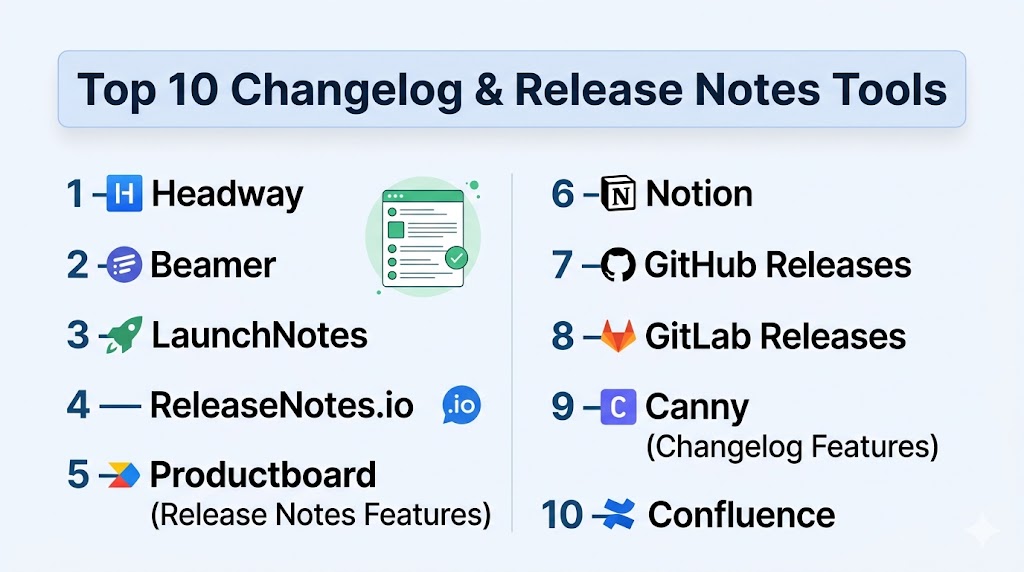
Introduction
Changelog & Release Notes Tools help teams document, manage, and communicate product updates in a structured and user-friendly way. Instead of scattered updates across emails or internal docs, these tools centralize release notes and make them accessible to customers, stakeholders, and internal teams.
As products evolve rapidly with continuous deployment and agile workflows, keeping users informed has become critical. Clear release notes improve transparency, reduce support queries, and enhance user trust. Modern tools now go beyond simple changelogs by offering automation, audience targeting, in-app notifications, and analytics.
Common use cases:
- Publishing product updates and feature releases
- Notifying users about bug fixes and improvements
- Managing internal and external release communication
- Automating changelog generation from commits
- Tracking user engagement with updates
What buyers should evaluate:
- Ease of creating and publishing release notes
- Automation from Git or CI/CD pipelines
- Customization and branding options
- Audience segmentation and targeting
- In-app notifications and widgets
- Integration with product and support tools
- Analytics and engagement tracking
- Collaboration features for teams
- Security and access controls
- Pricing and scalability
Best for: Product managers, SaaS founders, developers, marketing teams, and customer success teams managing user communication across product updates.
Not ideal for: Teams with very infrequent releases or those using simple documentation tools without needing structured user communication.
Key Trends in Changelog & Release Notes Tools
- AI-assisted release note generation: Auto-generating summaries from commits and tickets
- In-app communication: Delivering updates directly inside products
- User segmentation: Personalized release notes based on user roles or behavior
- Integration with DevOps pipelines: Syncing updates automatically from Git and CI/CD
- Interactive changelogs: Rich media, visuals, and embedded demos
- Feedback loops: Collecting user reactions and feedback on releases
- Multi-channel distribution: Email, in-app, and web-based announcements
- Product-led growth alignment: Using changelogs as engagement tools
- Analytics-driven insights: Measuring which updates users care about
- No-code customization: Easy editing and publishing without developers
How We Selected These Tools (Methodology)
- Evaluated market popularity and adoption among SaaS companies
- Assessed feature depth for changelog creation and distribution
- Reviewed automation capabilities and integrations
- Considered ease of use and UI/UX quality
- Analyzed security and access control features
- Checked scalability for growing teams
- Compared customization and branding flexibility
- Evaluated analytics and user engagement tracking
- Included tools for both technical and non-technical teams
- Balanced enterprise-grade and startup-friendly options
Top 10 Changelog & Release Notes Tools
#1 — Headway
Short description: A dedicated changelog and notification tool designed to keep users informed through in-app widgets and announcements.
Key Features
- Public changelog pages
- In-app notification widgets
- User feedback collection
- Custom branding
- Audience targeting
- Analytics tracking
Pros
- Easy to set up and use
- Strong focus on user engagement
Cons
- Limited advanced automation
- May not suit complex enterprise workflows
Platforms / Deployment
Web / Cloud
Security & Compliance
Not publicly stated
Integrations & Ecosystem
Headway integrates with product and communication tools to streamline update distribution.
- Slack
- Intercom
- APIs
Support & Community
Good documentation and responsive support.
#2 — Beamer
Short description: A changelog and notification platform focused on driving user engagement with product updates.
Key Features
- Newsfeed and changelog
- Push notifications
- User segmentation
- Feedback collection
- Analytics dashboard
Pros
- Strong engagement features
- Easy integration
Cons
- Limited customization in lower tiers
- Pricing can scale quickly
Platforms / Deployment
Web / Cloud
Security & Compliance
Not publicly stated
Integrations & Ecosystem
- Slack
- Intercom
- Zapier
- APIs
Support & Community
Solid support and onboarding resources.
#3 — LaunchNotes
Short description: A product communication platform designed for managing release notes and stakeholder updates.
Key Features
- Public and private release notes
- Audience segmentation
- Roadmap sharing
- Scheduled announcements
- Stakeholder communication
Pros
- Strong for internal and external communication
- Flexible audience targeting
Cons
- Learning curve for new users
- Premium pricing
Platforms / Deployment
Web / Cloud
Security & Compliance
RBAC (others not publicly stated)
Integrations & Ecosystem
- Jira
- Slack
- APIs
Support & Community
Enterprise-grade support and documentation.
#4 — ReleaseNotes.io
Short description: A simple tool for creating and sharing product release notes with minimal setup.
Key Features
- Changelog creation
- Markdown support
- Public pages
- Version tracking
- Simple UI
Pros
- Easy to use
- Lightweight
Cons
- Limited advanced features
- Basic analytics
Platforms / Deployment
Web / Cloud
Security & Compliance
Not publicly stated
Integrations & Ecosystem
- GitHub
- APIs
Support & Community
Basic documentation and support.
#5 — Productboard (Release Notes Features)
Short description: A product management platform with release note and feature announcement capabilities.
Key Features
- Feature tracking
- Release note publishing
- Customer feedback integration
- Roadmap sharing
- Prioritization tools
Pros
- Strong product management integration
- Unified workflow
Cons
- Not a dedicated changelog tool
- Can be expensive
Platforms / Deployment
Web / Cloud
Security & Compliance
SSO, RBAC (others not publicly stated)
Integrations & Ecosystem
- Jira
- Slack
- APIs
Support & Community
Strong documentation and enterprise support.
#6 — Notion
Short description: A flexible workspace tool often used for creating and managing changelogs and release notes.
Key Features
- Customizable pages
- Templates for changelogs
- Collaboration tools
- Version history
- Rich content support
Pros
- Highly flexible
- Easy collaboration
Cons
- Not purpose-built for release notes
- Requires manual setup
Platforms / Deployment
Web / Windows / macOS / iOS / Android
Security & Compliance
SSO, RBAC (others not publicly stated)
Integrations & Ecosystem
- Slack
- APIs
- Third-party tools
Support & Community
Large user community and resources.
#7 — GitHub Releases
Short description: Built-in release management feature within GitHub for publishing release notes directly from repositories.
Key Features
- Automated release notes
- Tag-based versioning
- Markdown support
- Integration with commits
- Asset attachments
Pros
- Native integration with Git workflows
- Free to use
Cons
- Limited non-technical customization
- Not ideal for non-developer audiences
Platforms / Deployment
Web / Cloud
Security & Compliance
Varies / Not publicly stated
Integrations & Ecosystem
- GitHub ecosystem
- APIs
Support & Community
Strong developer community.
#8 — GitLab Releases
Short description: Integrated release management feature within GitLab with automation and CI/CD support.
Key Features
- Release automation
- Version tagging
- CI/CD integration
- Changelog generation
- Asset management
Pros
- Fully integrated DevOps workflow
- Automation capabilities
Cons
- Limited marketing-focused features
- Complex for non-technical users
Platforms / Deployment
Web / Cloud / Self-hosted
Security & Compliance
SSO, RBAC (others not publicly stated)
Integrations & Ecosystem
- GitLab CI/CD
- APIs
Support & Community
Active community and documentation.
#9 — Canny (Changelog Features)
Short description: Customer feedback platform with changelog and release note capabilities.
Key Features
- Changelog publishing
- User feedback tracking
- Feature voting
- Roadmap sharing
- Notifications
Pros
- Strong feedback integration
- Good for product-led growth
Cons
- Limited advanced automation
- Not fully release-focused
Platforms / Deployment
Web / Cloud
Security & Compliance
Not publicly stated
Integrations & Ecosystem
- Slack
- Intercom
- APIs
Support & Community
Good support and documentation.
#10 — Confluence
Short description: Team collaboration and documentation tool often used for internal release notes.
Key Features
- Documentation management
- Collaboration tools
- Templates
- Version control
- Permissions management
Pros
- Strong internal documentation
- Flexible content creation
Cons
- Not ideal for external-facing changelogs
- Requires manual updates
Platforms / Deployment
Web / Cloud / Self-hosted
Security & Compliance
SSO, RBAC (others not publicly stated)
Integrations & Ecosystem
- Jira
- Slack
- APIs
Support & Community
Large community and enterprise support.
Comparison Table (Top 10)
| Tool Name | Best For | Platform(s) Supported | Deployment | Standout Feature | Public Rating |
|---|---|---|---|---|---|
| Headway | SaaS teams | Web | Cloud | In-app widgets | N/A |
| Beamer | User engagement | Web | Cloud | Newsfeed updates | N/A |
| LaunchNotes | Stakeholder communication | Web | Cloud | Audience targeting | N/A |
| ReleaseNotes.io | Simple changelogs | Web | Cloud | Lightweight UI | N/A |
| Productboard | Product teams | Web | Cloud | Feature tracking | N/A |
| Notion | Flexible docs | Web/App | Cloud | Custom pages | N/A |
| GitHub Releases | Developers | Web | Cloud | Git integration | N/A |
| GitLab Releases | DevOps teams | Web | Cloud/Self-hosted | CI/CD automation | N/A |
| Canny | Feedback-driven teams | Web | Cloud | User voting | N/A |
| Confluence | Internal teams | Web | Cloud/Self-hosted | Documentation | N/A |
Evaluation & Scoring of Changelog & Release Notes Tools
| Tool Name | Core | Ease | Integrations | Security | Performance | Support | Value | Weighted Total |
|---|---|---|---|---|---|---|---|---|
| Headway | 8 | 9 | 7 | 6 | 8 | 8 | 8 | 8.0 |
| Beamer | 8 | 8 | 8 | 6 | 8 | 8 | 7 | 7.9 |
| LaunchNotes | 9 | 7 | 8 | 7 | 8 | 8 | 7 | 8.1 |
| ReleaseNotes.io | 7 | 9 | 6 | 6 | 7 | 7 | 8 | 7.5 |
| Productboard | 9 | 7 | 8 | 7 | 8 | 8 | 6 | 7.9 |
| Notion | 7 | 9 | 7 | 7 | 8 | 9 | 9 | 8.2 |
| GitHub Releases | 8 | 8 | 9 | 7 | 9 | 9 | 9 | 8.6 |
| GitLab Releases | 9 | 7 | 9 | 8 | 9 | 8 | 8 | 8.5 |
| Canny | 8 | 8 | 7 | 6 | 8 | 8 | 7 | 7.8 |
| Confluence | 8 | 7 | 8 | 8 | 8 | 9 | 7 | 8.0 |
How to interpret scores:
These scores provide a relative comparison across key evaluation criteria. Higher scores indicate stronger overall capabilities, but the “best” tool depends on your specific use case. For example, developer-focused teams may prioritize integrations, while product teams may focus on usability and communication features. Use this as a guide, not a final verdict.
Which Changelog & Release Notes Tool Is Right for You?
Solo / Freelancer
Use simple tools like Notion or GitHub Releases for lightweight needs.
SMB
Headway, Beamer, and Canny offer good balance between usability and engagement.
Mid-Market
LaunchNotes and Productboard provide structured communication and scalability.
Enterprise
GitLab, Confluence, and LaunchNotes are suitable for governance and collaboration.
Budget vs Premium
- Budget: GitHub Releases, Notion
- Premium: LaunchNotes, Productboard
Feature Depth vs Ease of Use
- Deep features: LaunchNotes, Productboard
- Easy to use: Headway, ReleaseNotes.io
Integrations & Scalability
GitLab and GitHub Releases offer strong integration ecosystems.
Security & Compliance Needs
Enterprises should prioritize tools with RBAC, SSO, and audit capabilities.
Frequently Asked Questions (FAQs)
1. What is a changelog tool?
A changelog tool helps track and publish updates, improvements, and bug fixes in a structured format.
2. Are release notes and changelogs the same?
They are similar, but release notes are often more detailed and user-focused.
3. Can these tools automate updates?
Yes, many integrate with Git and CI/CD pipelines to automate changelog creation.
4. Are these tools suitable for non-technical users?
Yes, many offer no-code interfaces for product and marketing teams.
5. Do these tools support in-app notifications?
Some tools like Headway and Beamer offer in-app update notifications.
6. What are common mistakes?
Not segmenting users and overloading release notes with technical details.
7. Are these tools secure?
Security varies; check for RBAC, SSO, and access controls.
8. Can I customize release notes?
Yes, most tools offer branding and formatting options.
9. Do they support analytics?
Many tools provide engagement tracking and user insights.
10. What alternatives exist?
Documentation tools, blogs, or email newsletters.
Conclusion
Changelog and release notes tools have evolved from simple documentation platforms into powerful communication systems that play a key role in product transparency and user engagement. As software delivery becomes faster and more continuous, keeping users informed is no longer optional—it is a strategic advantage. Each tool in this list serves different needs, from developer-centric automation to customer-facing communication and feedback loops. The right choice depends on your team’s workflow, audience, and integration requirements. Instead of choosing based on popularity alone, focus on how well the tool aligns with your release process and communication goals. A smart next step is to shortlist a few tools, test them in real scenarios, and evaluate how effectively they improve both internal coordination and user communication

Good overview of changelog and release notes tools. One practical challenge missing is keeping release notes automatically aligned with fast CI/CD deployments, especially when multiple teams ship changes simultaneously across microservices.
A practical gap is release note governance inside CI/CD. Teams should define who approves customer-facing notes, how breaking changes are flagged, and how rollback or hotfix notes are handled so communication stays accurate during fast production releases.