MOTOSHARE 🚗🏍️
Rent Bikes & Cars Directly from Owners
Motoshare connects vehicle owners with people who need bikes and cars on rent. Owners earn from idle vehicles, and renters get flexible ride options.
Visit Motoshare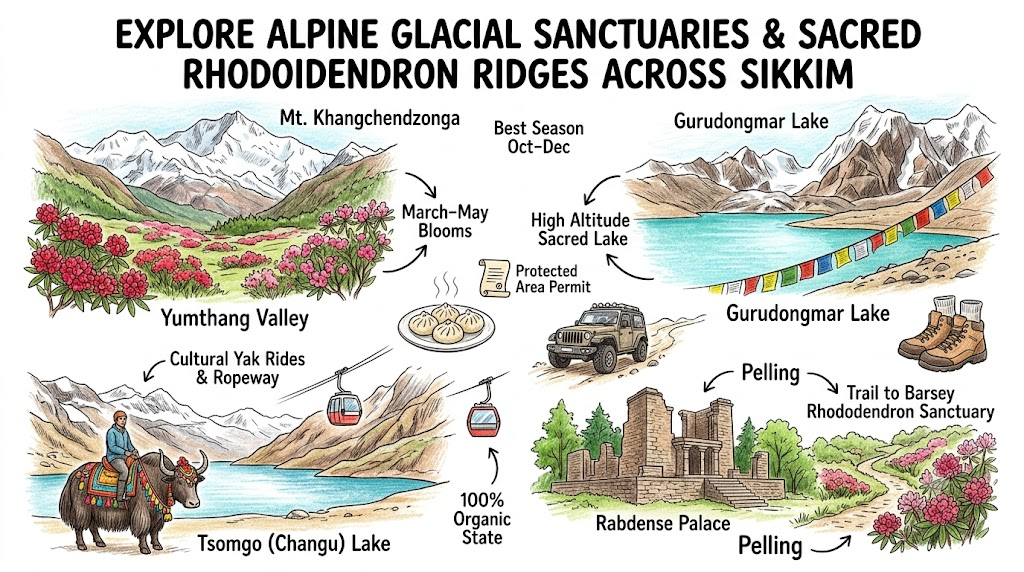
Introduction
Most holiday itineraries funnel travelers into crowded hill stations where traffic snarls replace tranquility and concrete overlooks drown out birdsong. Sikkim offers an entirely different Himalayan reality. Tucked beneath the colossal shadow of Mount Khangchendzonga, India’s first fully organic state guards alpine sanctuaries where ancient spruce forests dissolve into glacier-carved valleys.
Here, travel is defined by intimate connection rather than commercial spectacle. Fluttering Buddhist prayer flags break mountain winds, mist rolls across holy glacial waters, and traditional Lepcha, Bhutia, and Nepali hospitality welcomes travelers into quiet high-altitude settlements. For nature lovers yearning for untouched wilderness, profound quietude, and pure alpine air, Sikkim is an authentic Himalayan haven.
Why Sikkim is a must-visit city
Sikkim functions as a living ecological sanctuary that spans sub-tropical bamboo jungles in the south to frozen Tibetan-plateau borderlands in the north. Historically an independent Buddhist kingdom ruled by the Chogyals, the state integrated into India while keeping its spiritual reverence for nature intact. Mount Khangchendzonga is not merely a mountain here; it is revered as the state’s guardian deity.
Reaching Sikkim has transformed in recent years. Travelers arrive via Pakyong Airport near Gangtok or through Bagdogra International Airport and New Jalpaiguri Railway Station (NJP) in neighboring West Bengal. Well-paved Himalayan highways connect the southern lowlands to high mountain passes, supported by a network of registered 4×4 transport operators and eco-lodges.
The classic travel circuit is divided into four distinct geographical zones: East Sikkim (the cultural and transit center of Gangtok, alpine lakes, and border passes), North Sikkim (rugged, restricted valleys and sacred glacial basins), West Sikkim (historic capitals, deep trekking gateways, and premier Kanchenjunga viewpoints), and South Sikkim (serene tea estates, sacred biodiversity parks, and scenic river confluences).
| Key Indicator | Detail |
|---|---|
| State Capital | Gangtok (Elevation: 1,650 m / 5,410 ft) |
| Highest Peak | Mt. Khangchendzonga (8,586 m / 28,169 ft) |
| Geographic Zones | East, West, North, and South Sikkim |
| Best Travel Seasons | March to May (Rhododendrons & mild weather) & October to mid-December (Crystal skies & snow peaks) |
| Key Entry Transit Hubs | Bagdogra Airport (IXB), Pakyong Airport (PYG), New Jalpaiguri Junction (NJP) |
| Permit Requirements | Protected Area Permit (PAP) required for North Sikkim, Tsomgo, and border passes |
| Special Ecological Status | 100% Certified Organic State; UNESCO Khangchendzonga National Park |
Best Places or Experiences
Spring rhododendrons in Yumthang Valley.
Yumthang Valley of Flowers
Yumthang Valley sits at an elevation of 3,564 meters, cradled by snow-crested ridges in North Sikkim. Carved by the winding waters of the Lachung Chu River, this alpine valley transforms every spring into a botanical amphitheater within the Shingba Rhododendron Sanctuary. Over twenty-four distinct rhododendron species ignite the tree line in rich hues of crimson, mauve, and soft blush pink.
Beyond spring’s floral bloom, the valley serves as a winter wonderland where alpine yaks graze on golden pastures flanked by weeping conifers. Natural sulfur hot springs bubble along the riverbanks, offering therapeutic mineral warmth against the biting Himalayan winds. It stands as one of the most serene high-altitude valleys in Asia.
- Location: Mangan District, North Sikkim; approximately 135 km from Gangtok (via Lachung).
- Why it is worth visiting: Unmatched botanical biodiversity where rare alpine shrubs, wildflowers, and primeval pine forests line a glacier-fed riverbed.
- Best things to do: Walk the natural trails of Shingba Rhododendron Sanctuary, soak your feet in the riverside sulfur hot springs, and sample piping hot momos at the valley staging market.
- Best time to visit: April to late May for blooming wildflowers; December to February for pristine snowscapes.
- Ideal for whom: Botanists, landscape photographers, couples, and dedicated outdoor naturalists.
- Travel tip: High-altitude weather shifts swiftly by mid-afternoon; reach the valley floor by 8:00 AM to enjoy crisp visibility before cloud cover settles.
Gurudongmar Lake
Perched at a breathless altitude of 5,430 meters (17,800 ft), Gurudongmar Lake is among the highest accessible freshwater bodies on Earth. Flanked by barren, windswept peaks of the Tibetan plateau, this sacred body of water holds deep reverence for both Buddhists and Hindus. According to enduring folklore, Guru Padmasambhava blessed the lake so that a dedicated central section never fully freezes, granting winter drinking water to locals.
The sensory experience here is otherworldly. Cobalt-blue waters mirror snow-clad summits, prayer flags snap against ferocious winds, and the stark alpine desert stretches seamlessly toward the trans-Himalayan horizon. It provides a humbling glimpse into the high Himalayas’ raw, elemental scale.
Sacred high-altitude Gurudongmar Lake.
- Location: Far North Sikkim; roughly 175 km from Gangtok via the transit base camp of Lachen.
- Why it is worth visiting: One of the planet’s highest sacred glacial lakes, offering striking trans-Himalayan vistas and stark desert terrain.
- Best things to do: Circumambulate the sacred prayer flag perimeter, witness the unfreezing holy waters, and photograph the glacial face of Mount Siniolchu along the ascent.
- Best time to visit: October to November for clear skies and pristine roads, or April to June for open routes.
- Ideal for whom: High-altitude adventure travelers, cultural photography buffs, and spiritual pilgrims.
- Travel tip: Strictly avoid running or exerting yourself at the lake perimeter; spend no longer than 45 minutes at the water’s edge to avoid severe Acute Mountain Sickness (AMS).
Tsomgo Lake and the Old Silk Route
Enclosed by steep, rocky cliffs at 3,753 meters, Tsomgo Lake (locally known as Changu Lake) is an oval-shaped glacial wonder along the historic trade highway toward Nathu La. Fed directly by melting snowfields, the lake changes colors across seasons, shifting from sapphire blue in autumn to milky aquamarine in spring and an icy sheet through mid-winter.
Himalayan Glacier Adventures
The route leading to Tsomgo winds through jagged mountain switchbacks adorned with native primulas and dwarf juniper shrubs. Buddhist lamas once read future portents by studying the reflections and hues on the water’s surface. Today, it remains an ecological and cultural jewel of East Sikkim.
Snow-clad shores of Tsomgo Lake. Source: eSikkim Tourism
- Location: Gangtok District, East Sikkim; 38 km east of Gangtok.
- Why it is worth visiting: A culturally sacred glacial lake reachable within a two-hour drive from the state capital, offering breathtaking high-alpine sights.
- Best things to do: Take an eco-friendly ropeway ride soaring above the lake basin, photograph the decorated local domestic yaks, and birdwatch for winter migratory waterfowl.
- Best time to visit: October to December for vibrant skies; January to March for full-basin snow.
- Ideal for whom: Traveling families, day-trippers, couples, and mountain photography enthusiasts.
- Travel tip: Indian travelers must obtain a Protected Area Permit (PAP) through a registered Sikkim operator at least a day ahead; carry physical passport-sized photos and valid photo IDs (Voter ID or Passport). Discover with Dheeraj
Pelling and the Khangchendzonga Horizons
Pelling, tucked away in the forested ridges of West Sikkim at 2,150 meters, offers an up-close, unobstructed panorama of Mount Khangchendzonga. Surrounded by dense forests of oak, chestnut, and alpine fir, this tranquil settlement balances sweeping views with quiet forest sanctuaries. The morning sun strikes the snowfields with golden dawn light hours before warming the valleys below.
Beyond its scenic ridges, Pelling is a center of historical and ecological heritage. Walking through the moss-draped ruins of Rabdentse Palace—the 17th-century royal capital—leads through a secluded chestnut forest inhabited by laughingthrushes and rare Himalayan birds, linking royal history directly to the wild landscape.
Unobstructed Himalayan views at Pelling.
- Location: Gyalshing District, West Sikkim; 130 km west of Gangtok.
- Why it is worth visiting: The most expansive, close-range visual perspective of the Kanchenjunga mountain range set beside ancient monarchical ruins.
- Best things to do: Walk through the secluded moss-draped stone paths of Rabdentse Ruins, walk the transparent Pelling Skywalk facing Chenrezig, and birdwatch near sacred Khecheopalri Lake.
- Best time to visit: September to December for crystal-clear mountain horizons; March to May for blooming forest canopies.
- Ideal for whom: Solitary nature writers, heritage buffs, trekking groups, and honeymooners.
- Travel tip: Wake up by 5:15 AM; the premier alpenglow on the Kanchenjunga ridge typically peaks before 6:00 AM before light clouds move in.
Barsey Rhododendron Sanctuary
Spanning across the Singalila Ridge along the southwestern border of Sikkim, the Barsey Rhododendron Sanctuary covers 104 square kilometers of pristine montane wet temperate forest. Sheltered from commercial vehicle traffic, Barsey is accessible only by trekking along pine-needle trails starting from the quiet village of Hilley.
The sanctuary acts as a critical wildlife corridor, sheltering the elusive Red Panda, Himalayan Black Bear, and barking deer beneath towering canopies of silver fir and bamboo thickets. In the spring months, the entire forest floor and overhead canopy turn into an unbroken corridor of scarlet blossoms, framed by views of snow-dusted peaks along the Nepal border.
- Location: Soreng District, West/Southwest Sikkim; 140 km from Gangtok (trailhead at Hilley).
- Why it is worth visiting: An uncommercialized trekking haven featuring one of the dense stands of pure rhododendron forests anywhere in the world.
- Best things to do: Hike the easy 4-kilometer trail from Hilley to the Guras Kunj forest lodge, spot native hill birds like the crimson-horned tragopan, and camp under star-filled skies.
- Best time to visit: Mid-March to late April for prime flower season.
- Ideal for whom: Backpackers, forest trekkers, birdwatchers, and solo wilderness lovers.
- Travel tip: Wear sturdy, slip-resistant waterproof trekking boots; melting snow and early spring rains can turn forest trails slick.
Offbeat Exploration: Hidden Gems Tourists Miss
Dzongu Lepcha Reserve
Designated exclusively for the indigenous Lepcha tribe, Dzongu is an untouched river valley in North Sikkim filled with terraced farms, bamboo suspension bridges, and rushing glacial streams. Visiting requires a special tribal area permit, which protects the reserve from mass tourism. Spending time here means learning traditional bamboo weaving, drinking natural herbal broths, and hiking to hidden waterfalls that see only a handful of outside travelers each month.
The Sacred Wish-Fulfilling Khecheopalri Lake
Hidden in a dense sal forest near Pelling, Khecheopalri Lake is revered by both Buddhists and Hindus. Local folklore holds that birds actively pluck away every stray leaf that falls onto the water’s surface, keeping the glassy pool spotless. A quiet morning walk along its prayer-wheel boardwalk offers an atmosphere of forest solitude and spiritual reverence.
Borong Hot Springs and Ralang Monasteries
Located in the quiet foothills of South Sikkim, Borong features natural hot mineral springs along the banks of the Rangit River. A short hike through pine-clad trails connects the thermal baths to the ancient Old Ralang Monastery, where travelers can listen to morning Buddhist chanting accompanied by traditional Tibetan longhorns, far away from tourist buses.
Detailed Practical Guidance for Travelers
| Destination | Standard Entry Fee | General Timings | Best Local Food Options Nearby | Recommended Nearby Attractions |
|---|---|---|---|---|
| Yumthang Valley | Included in North Sikkim PAP package | 6:00 AM – 3:00 PM | Steaming thukpa and butter tea at Lachung village homestays | Zero Point (Yumesamdong), Shingba Sanctuary |
| Gurudongmar Lake | Free (PAP vehicle permit required) | 7:00 AM – 11:30 AM (Strict exit by noon) | Hot Maggi and Tibetan bread at Thangu valley military huts | Chopta Valley, Lachen Monastery |
| Tsomgo Lake | Permit fees: ~₹200/person (cable car extra) | 7:30 AM – 2:30 PM | Steamed pork and veg momos with fermented chili chutney | Baba Harbhajan Singh Mandir, Nathu La Pass |
| Pelling (Skywalk & Ruins) | ₹50 (Ruins) / ₹100 (Skywalk) | 8:00 AM – 5:00 PM | Local fermented Gundruk soup, Sel Roti, and nettle tea | Pemayangtse Monastery, Singshore Bridge |
| Barsey Sanctuary | ₹50 per person (Sanctuary entry) | 6:00 AM – 4:00 PM | Home-cooked organic Nepali dal bhat at Hilley homestays | Okhrey village, Varsey Rhododendron Ridge |
Logistics & On-Ground Navigation
Local Transport Options
- 4×4 Mountain Jeeps (Bolero / Scorpio): Essential for traversing North and East Sikkim’s steep terrain; regular hatchbacks cannot navigate the rocky routes to Gurudongmar or Yumthang. We Care Holidays
- Point-to-Point Shared Taxis: The budget traveler’s best friend. Shared Sumo taxis depart regularly from Gangtok’s taxi stands to Pelling, Ravangla, Namchi, and Siliguri.
- Private Car Hire: Ideal for South and West Sikkim loops. Book registered Sikkim vehicles through authorized agencies in Gangtok.
- Walking and Hiking: Gangtok’s MG Marg is entirely pedestrianized, and nearby villages like Yuksom and Pelling are best explored on foot.
Budget Planning
- Budget / Backpacker Tier: ₹1,800 – ₹2,500 per day. Covers shared Sumo jeeps, cozy family homestay dorms or basic rooms, and hearty street-side plates of momos, thukpa, and local dal bhat.
- Mid-Range / Comfort Tier: ₹5,000 – ₹8,500 per day. Includes private SUV hire, boutique heritage hotel stays, guided day treks, entry permits, and dining at local organic cafes.
Safety and Inclusivity Tips
- Families: Maintain relaxed schedules with built-in rest periods. Avoid carrying children under 6 to extreme elevations like Gurudongmar (5,400+ meters) to prevent altitude sickness. Stick to Pelling, Ravangla, and Gangtok. Nexplore Travel+ 1
- Couples: Choose serene village stays in Borong or Yuksom over crowded central towns for uninterrupted views, private balconies, and quiet nature walks.
- General Safety: Mountain roads can experience sudden landslides during rainy periods. Keep a buffer day in your travel plans, always carry emergency motion sickness tablets, and keep your phone charged with power banks during cold spells.
Strategic Travel Planning Guardrails
Travel Planning Tips for Sikkim
- Book North Sikkim Through Authorized Agencies: Protected Area Permits (PAP) must be issued through registered local travel agents at least 24–48 hours ahead. Glacier Treks And Adventure
- Keep Physical Identity Documents: Always pack at least 6 physical passport-sized photographs and hard photocopies of a government-issued Voter ID or Passport; digital copies on smartphones are not accepted at army checkpoints, and Aadhaar cards are frequently rejected for border permits. EasoTrip
- Carry Hard Cash: ATMs beyond Gangtok and Namchi frequently run dry or lose satellite connectivity; carry enough cash to cover homestay payments and transit fees.
- Pack Thermal Layering: Temperatures drop quickly at higher elevations. Bring merino wool base layers, windproof down jackets, and insulated gloves, even during summer visits to alpine lakes.
- Respect Eco-Rules: Sikkim has a strict ban on single-use plastic water bottles; carry reusable insulated flasks that you can refill with boiled water at homestays.
Common Mistakes to Avoid
- Skipping Acclimatization: Rushing straight from sea level to 4,000+ meters without spending an acclimatization night in Gangtok or Lachen risks severe mountain sickness.
- Assuming Ride-Hailing Apps Work: Services like Uber and Ola do not operate in Sikkim; rely on registered local taxi stands and pre-booked operators instead.
- Overcrowding Single Days: Mountain driving takes roughly twice as long as driving on plains. Never plan more than one major attraction per morning.
- Skipping Indigenous Cuisine: Don’t default to generic hotel menus; sample local dishes like Chhurpi soup, fermented bamboo shoot curries, and millet beer (Tongba).
- Littering or Disturbing Sacred Sites: Never step across prayer flags or shout near holy lakes; local communities protect these ecosystems with deep spiritual care.
Suggested Itinerary Blueprints
1. 3-Day Quick Dash (East Sikkim Alpine Highlights)
Designed for travelers with limited time looking to experience high-altitude views without a long journey north.
- Day 1: Arrive from Bagdogra/NJP, check into Gangtok, stroll through the pedestrian-only MG Marg, and visit Enchey Monastery. Himalayan Glacier Adventures
- Day 2: Early morning departure to Tsomgo Lake and the high-altitude viewpoint near Baba Mandir; return to Gangtok by late afternoon for cafe hopping. Himalayan Glacier Adventures
- Day 3: Sunrise at Tashi Viewpoint overlooking Kanchenjunga, explore the Namgyal Institute of Tibetology, and descend back toward Siliguri.
2. 5-Day Deep-Dive (North Sikkim Wilderness Circuit)
Ideal for serious nature lovers seeking dramatic alpine valleys, rhododendron blooms, and high-altitude glacial lakes.
- Day 1: Drive from Gangtok to Lachen (6–7 hours), pausing at Seven Sister Waterfalls and high-altitude river viewpoints.
- Day 2: 4:00 AM drive to Gurudongmar Lake; descend to Lachen for lunch and transfer across to the village of Lachung.
- Day 3: Explore the rhododendron-lined slopes of Yumthang Valley and Zero Point; return to Gangtok by evening. Nexplore Travel
- Day 4: Restful morning in Gangtok, visiting Rumtek Monastery and Do-Drul Chorten. Himalayan Glacier Adventures
- Day 5: Leisurely farm-to-table breakfast and departure to NJP/Bagdogra.
3. Complete Weekend Travel Plan (West Sikkim Heritage & Forests)
A scenic, low-stress circuit focusing on mountain horizons, ancient monasteries, and forest trails.
- Friday: Drive directly from Siliguri/Bagdogra to Pelling via the Teesta River valley; catch the sunset behind Mount Kanchenjunga.
- Saturday: Morning walk through the Rabdentse Ruins, visit Pemayangtse Monastery, and take an afternoon hike around Khecheopalri Lake.
- Sunday: Early sunrise at Pelling Skywalk, followed by a scenic drive back to NJP through the organic tea gardens of Temi in South Sikkim.
Common Tourist Mistakes to Avoid
Geographic Blunders: Don’t try to visit North Sikkim (Lachung/Gurudongmar) and West Sikkim (Pelling) on back-to-back days without an overnight stop in Gangtok. Mountain roads wind along river valleys, requiring you to loop through central hubs. Trying to traverse these zones in one day leaves you stuck in a car for 12 hours.
Commercial Traps: Don’t spend valuable daytime hours browsing souvenir markets in central Gangtok. Use daylight for forest hikes, monastery visits, and viewpoint walks. Save shopping for evening strolls along MG Marg once the mist rolls in.
Neglecting Modern/Alternative Zones: Many visitors stick entirely to the main vehicular route and miss quiet hillside hubs. Areas like Development Area in Gangtok or the upper ridges of Pelling feature charming, modern organic cafes, independent craft roasters, and local art galleries run by young Sikkimese creators.
Transport Overpayment: Always book your shared or private cabs directly at official government taxi stands or through your homestay host. Unlicensed street brokers at entry checkposts often inflate vehicle prices by 30–50%.
Luxury Dining Bias: Sticking to buffet meals in multi-cuisine hotels misses the essence of Sikkimese cuisine. Small, family-run roadside kitchens serve authentic delicacies like freshly rolled tingmo (steamed bread), spicy dalle khursani pickles, and wild seasonal fiddlehead fern curries.
Frequently Asked Questions
1. Do Indian citizens need special permits to visit Sikkim?
Indian travelers do not need a permit to enter Gangtok, Pelling, Ravangla, or Namchi. However, a Protected Area Permit (PAP) is legally mandatory for restricted border regions, including Tsomgo Lake, Nathu La Pass, and North Sikkim (Lachen, Lachung, Yumthang, and Gurudongmar Lake).
2. Are foreign nationals allowed to visit Gurudongmar Lake and Nathu La?
No, foreign passport holders (including OCI holders) are strictly barred from visiting Gurudongmar Lake, Zero Point, and Nathu La Pass due to military border restrictions. Foreigners can, however, explore Gangtok, Pelling, and Yumthang Valley with a valid Restricted Area Permit (RAP) and Protected Area Permit arranged in groups.
3. What is the single best month to see rhododendron blooms in Sikkim?
Mid-April through early May is the ideal window to experience blooming rhododendrons. During this period, the Shingba Rhododendron Sanctuary in Yumthang and the Barsey Rhododendron Sanctuary in West Sikkim showcase vibrant red, pink, and white floral canopies.
4. How severe is altitude sickness at Gurudongmar Lake, and how can it be avoided?
Gurudongmar Lake sits above 5,400 meters, where thin air can cause Acute Mountain Sickness (AMS). To minimize symptoms, acclimatize with an overnight stay in Lachen (2,700 m), drink plenty of water, avoid alcohol, move at a steady pace, and limit your stay at the lake to under 45 minutes.
5. Which airport provides the easiest air connectivity into Sikkim?
Pakyong Airport (PYG) is the closest airport, located about 30 km from Gangtok. However, flights can be delayed or canceled due to low-lying clouds and mountain weather. Bagdogra International Airport (IXB) in West Bengal offers the most reliable flight connections, followed by a scenic 4.5-hour drive into Sikkim.
6. Is an Aadhaar card valid for securing border area travel permits?
No, an Aadhaar card is frequently rejected at army checkpoints for Protected Area Permits. You should carry your original physical Voter ID card or Indian Passport, along with at least 4 to 6 passport-sized photographs and printed paper photocopies.
7. Can I rent a self-drive car or drive my personal hatchback to North Sikkim?
Self-drive rentals from other states face tight restrictions, and hatchbacks or low-clearance sedans cannot navigate the rough terrain of North Sikkim. High-clearance 4×4 SUVs like Scorpios or Boleros driven by experienced local drivers are essential for reaching Lachen, Gurudongmar, and Lachung safely.
8. What makes Sikkim’s agricultural produce and food culture special?
Sikkim is India’s first 100% certified organic state. Every vegetable, grain, and dairy product grown locally is cultivated without synthetic fertilizers or pesticides, giving traditional dishes like buckwheat pancakes, stinging nettle broth, and fermented leafy greens (gundruk) exceptional flavor and nutritional value.
9. Are credit cards and UPI digital payments widely accepted throughout Sikkim?
UPI and credit cards are widely accepted across hotels, cafes, and shops in Gangtok and Pelling. However, once you travel into high-altitude areas like North Sikkim, Dzongu, or rural homestays, cell signals weaken significantly. Always carry sufficient cash for food, local purchases, and emergency transport.
10. What clothes should I pack for a spring trip to Sikkim?
Spring mornings can be cool and afternoons pleasant, but alpine passes remain near freezing. Pack a modular layering system: thermal innerwear, fleece sweaters, breathable hiking pants, and a waterproof, wind-resistant outer down jacket. Sturdy walking shoes with reliable grip are also essential.
11. Is Sikkim safe for solo female travelers and backpackers?
Sikkim is widely recognized as one of the safest regions in India for solo female travelers and independent backpackers. Local communities maintain a welcoming and respectful culture, violent crime is exceptionally rare, and solo travelers regularly find warm hospitality in village homestays.
12. When does it snow in Sikkim, and where are the best places to see it?
Snowfall typically begins in late December and continues through March. Tsomgo Lake, Nathu La Pass, Yumthang Valley, and Katao offer the most reliable winter snowscapes. During heavy winter storms, some high-altitude roads may close temporarily for snow clearance.
Conclusion
Choosing Sikkim over a conventional tourist retreat is a commitment to experiencing nature in its purest form. Standing beside the prayer-flag-lined shores of a silent glacial lake, listening to the wind sweep down from Khangchendzonga, or walking through mossy rhododendron forests offers a rare, grounded sense of peace. Sikkim invites travelers not just to sightsee, but to slow down, breathe crisp mountain air, and reconnect with the wild beauty of the eastern Himalayas.
