MOTOSHARE 🚗🏍️
Rent Bikes & Cars Directly from Owners
Motoshare connects vehicle owners with people who need bikes and cars on rent. Owners earn from idle vehicles, and renters get flexible ride options.
Visit Motoshare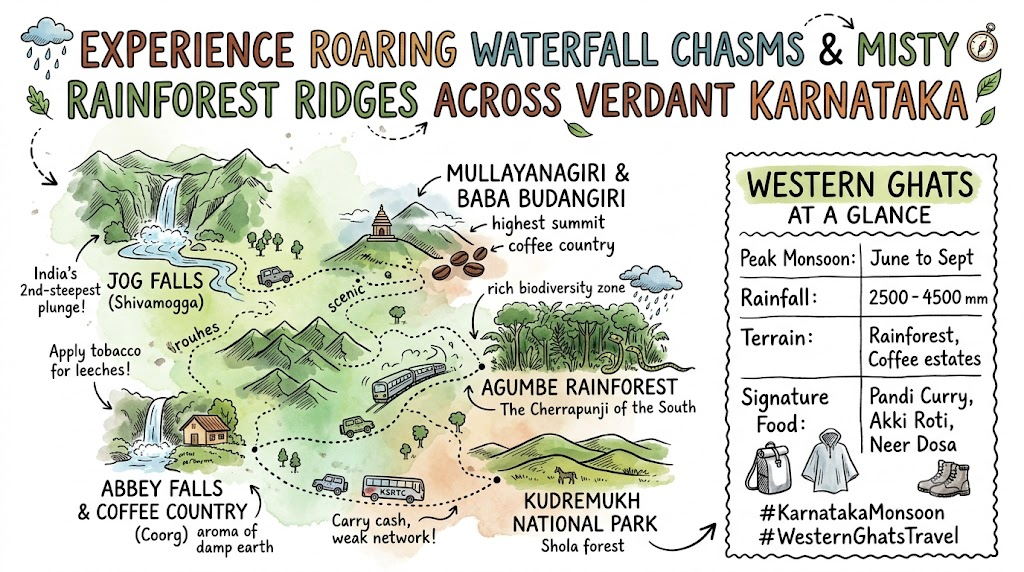
Introduction
Mainstream vacations often herd travelers into scorched plains, synthetic amusement parks, and congested urban promenades. In stark contrast, monsoon in the Western Ghats of Karnataka peels back modernity to reveal an ancient, brooding rainforest paradise soaked in primal energy.
When the southwest monsoon breaks across the Malnad ridge, the parched red earth erupts into vibrant emerald shades, moss blankets centuries-old stone temples, and wild rivers roar down sheer granite cliffs. This season does not demand frantic sightseeing; it invites slow, immersive stillness where morning mist rolls across coffee plantations and authentic local hospitality warms your spirit.
Why Karnataka is a must-visit destination
Karnataka commands a remarkable geographic duality: a jagged, UNESCO-recognized biodiversity hotspot along the Western Ghats dropping precipitously down to the Arabian Sea. In the wet season, this entire stretch becomes an ecological marvel, holding deep spiritual and indigenous agrarian roots where monsoon rains dictate the rhythm of life, spice harvesting, and temple celebrations.
Accessibility across the Western Ghats remains smooth for all travel styles, backed by well-maintained national highways (NH-75 and NH-275), scenic rail routes running through Sakleshpur, and cozy homestays welcoming everyone from solo backpackers to multi-generational families.
The prime monsoon travel circuit cuts directly through the Malnad and coastal belts: Coorg (Kodagu) down south, advancing through the cloud-kissed ridges of Chikmagalur, weaving past the rainforest sanctuaries of Agumbe, and culminating at the thunderous waterfalls of Shivamogga.
| Metric / Dimension | Regional Specification |
| Peak Monsoon Months | Late June to September |
| Average Rainfall | 2,500 mm to 4,500 mm across the Western Ghats |
| Primary Hub Airports | Mangaluru International Airport (IXE), Kempegowda Bengaluru (BLR) |
| Key Railheads | Hassan Junction, Shivamogga Town, Udupi |
| Signature Micro-Cuisine | Pandi Curry, Akki Roti, Pathrode, Neer Dosa |
| Terrain Profile | Montane rainforest, coffee estates, river canyons, granite ghats |
Best Places or Experiences
Jog Falls (Shivamogga)
Jog Falls is a dramatic sight during peak monsoon when the Sharavathi River plummets over an 830-foot drop. The river fragments into four distinct cascades—Raja, Roarer, Rocket, and Rani—crashing into a chasm wrapped in rolling mist and thunderous sound.
Viewing platforms maintained around the canyon rim reveal dramatic vistas as gusts of wind temporarily part the dense fog. The surrounding Sharavathi Valley Wildlife Sanctuary sparkles with freshly washed foliage, making the approach road via Sagara an unforgettable drive.
- Location: Siddapur taluk, Shivamogga District; ~380 km northwest of Bengaluru.
- Why it is worth visiting: It is India’s second-steepest plunge waterfall, flowing at full, roaring capacity only during the monsoon.
- Best things to do: Observe the synchronized fury from the British Bungalow viewpoint, photograph rainbow refractions over the gorge during brief sunny breaks, and savor roasted sweet corn from local vendors.
- Best time to visit: Late July to early September; early mornings between 7:30 AM and 10:00 AM provide the clearest visibility before dense cloud covers the valley.
- Ideal for whom: Nature lovers, road-trippers, and landscape photographers.
- Travel tip: Avoid descending the 1,400 steps to the base when gates are slippery or closed due to heavy water discharge.
Mullayanagiri & Baba Budangiri (Chikmagalur)
Standing as Karnataka’s highest summit at 1,930 meters, Mullayanagiri transforms into an ethereal realm during the monsoon. The winding mountain roads test driving nerves as swirling clouds reduce visibility, while mountain grasses ripple under continuous, crisp monsoon breezes.
The adjacent Baba Budangiri ridge holds historic resonance as the legendary birthplace of Indian coffee cultivation, where Sufi saint Baba Budan first planted smuggled beans in the 17th century. Streams crisscross the red laterite tracks, feeding hidden mountain brooks around every bend.
- Location: Chikkamagaluru District; ~245 km west of Bengaluru.
- Why it is worth visiting: Dramatic high-altitude cliffside trails flanked by endless rolling grasslands veiled in mist.
- Best things to do: Trek the final ridge staircase up to the summit temple, sample single-origin Arabica at a roadside planter shack, and drive through the hairpin curves toward Jhari Falls.
- Best time to visit: July to September; midday between 11:00 AM and 2:00 PM for the best balance of daylight and atmospheric mist.
- Ideal for whom: Adventure enthusiasts, trekkers, and couples.
- Travel tip: Heavy fog makes high-beam headlights ineffective; use low-beam yellow fog lamps and drive slowly along the single-lane ghat ascent.
Abbey Falls & Coffee Country (Coorg / Kodagu)
Coorg during the monsoon is an intoxicating sensory journey where the rich aroma of damp red soil blends with flowering coffee shrubs and peppery vines. Abbey Falls roars through private estate grounds, fed by mountain runoffs that converge into a raging torrent tumbling over granite boulders into the Cauvery River system.
The surrounding Kodava heartland offers an authentic glimpse into an egalitarian martial culture that has farmed these slopes for centuries. Staying on an ancestral estate reveals quiet evenings broken only by the steady drumbeat of rain hitting tiled roofs.
- Location: Madikeri, Kodagu District; ~260 km southwest of Bengaluru.
- Why it is quick to reach: Seamless highway access through Mysuru paired with iconic, lush plantation views.
- Best things to do: Stand on the suspension bridge facing Abbey Falls, take an estate walk with an umbrella to observe pepper cultivation, and tour Madikeri Fort’s stone ramparts.
- Best time to visit: July to late October; early morning hours (8:00 AM to 10:30 AM) before day-tripper buses arrive from Mysuru.
- Ideal for whom: Cultural travelers, culinary enthusiasts, and families.
- Travel tip: Apply raw tobacco powder or eucalyptus oil around your ankles to ward off harmless but persistent monsoon forest leeches.
Agumbe Rainforest & Barkana Viewpoint (Thirthahalli)
Known as the “Cherrapunji of the South,” Agumbe is a dense montane rainforest perched atop the Someshwara Ghat. It serves as the primary habitat of the King Cobra and houses India’s premier rainforest research station, pioneering ecological conservation.
In monsoon, Agumbe receives torrential downpours, turning every forest gully into a gushing brook. The dense canopy overhead shelters rare amphibians, bioluminescent fungi, and flying lizards, creating a haven for wildlife lovers.
- Location: Thirthahalli taluk, Shivamogga District; ~350 km from Bengaluru, ~90 km from Udupi.
- Why it is worth visiting: One of India’s richest biodiversity zones offering an authentic wet-rainforest experience.
- Best things to do: Visit the Agumbe Rainforest Research Station (ARRS) with prior permission, view the distant Barkana waterfall cascading into the valley, and watch the monsoon sunset over the Arabian Sea from the ghat viewpoint on clear evenings.
- Best time to visit: June to September for full monsoon force; late afternoons for moody photography.
- Ideal for whom: Naturalists, wildlife photographers, and serious eco-travelers.
- Travel tip: Keep spare electronic batteries in waterproof, silica-packed dry bags; the ambient humidity stays near 100%.
Kudremukh National Park & Shola Grasslands (Chikkamagaluru)
Shaped like a horse’s face—giving the peak its name—Kudremukh is a vast sanctuary of montane Shola forests and undulating grasslands. Monsoon rains turn these rolling mountains a brilliant, velvety green that rivals high-altitude alpine meadows.
Because commercialization is strictly restricted here, the trails remain pure and wild. Clear rivers like the Tunga, Bhadra, and Netravati trace their origins to these pristine highlands, cutting paths through ancient shola tree groves.
- Location: Mudigere taluk, Chikkamagaluru District; ~310 km west of Bengaluru.
- Why it is worth visiting: Unspoiled montane Shola ecosystems protected by strict daily trek quotas.
- Best things to do: Complete the guided trek to Kudremukh peak under wet conditions, explore nearby Hanumangundi Falls, and spot Malabar giant squirrels in the dense canopy.
- Best time to visit: August to October when trekking trails reopen with vibrant green slopes.
- Ideal for whom: Fit hikers, backcountry trekkers, and solitude seekers.
- Travel tip: Forest department trek permits are strictly capped per day; register via the Karnataka Forest Department portal well in advance.
Offbeat Exploration: Hidden Gems Tourists Miss
Kyatanamakki Off-Road Ridge (Horanadu)
While crowds flock to Mullayanagiri, Kyatanamakki sits tucked away near the temple town of Horanadu. This raw, windswept ridge is accessible only by sturdy 4×4 vehicles or on foot. During the monsoon, the ridgeline offers panoramic views of rolling hills shrouded in swirling white clouds.
Arasinagundi Falls Deep in Mookambika Sanctuary
Tucked inside the deep forests near Kollur, Arasinagundi requires an adventurous 3-kilometer hike through dense Western Ghats jungle. The cascade drops straight into a natural rock pool, filling the valley with mist and amber-tinted waters named after the wild turmeric growing along the banks.
Barkana Hidden Falls Trail
Most tourists stop at the roadside platforms of Agumbe, bypassing the inner Barkana trail that winds down to Sita River’s upper tributaries. Led by authorized local guides, this trek weaves through damp leaf litter where giant tree ferns and rare moss species carpet the old-growth forest.
Detailed Practical Guidance for Travelers
| Destination | Standard Entry Fee | General Timings | Best Local Food Options Nearby | Recommended Nearby Attractions |
| Jog Falls | ₹50 per adult; parking ₹50–100 | 7:30 AM – 6:30 PM | KSTDC Mayura Gerusoppa restaurant; hot Mirchi Bajji stalls | Linganamakki Dam, Honnemaradu backwaters |
| Mullayanagiri | Free entry; checkpost parking ₹20 | 6:00 AM – 6:00 PM | Siri Coffee outlet, town messes in Chikkamagaluru | Baba Budangiri, Z Point Kemmangundi |
| Abbey Falls | ₹15 per person; parking ₹40 | 9:00 AM – 5:00 PM | Raintree Restaurant, Coorg Cuisine (Madikeri) | Raja’s Seat, Madikeri Fort, Omkareshwara Temple |
| Agumbe Rainforest | Free at viewpoint; ARRS fee applies | Sunrise to Sunset | Hotel Dodda Mane (traditional Malnad meals), local canteens | Onake Abbi Falls, Kavaledurga Fort |
| Kudremukh Peak | ₹500 forest permit + guide fees | 6:00 AM – 5:00 PM (Entry shuts early) | Homestays in Kalasa and Kudremukh village | Kalaseshwara Temple, Hanumangundi Falls |
Logistics & On-Ground Navigation
Local Transport Options
- State Transport Buses (KSRTC): Highly reliable Airavat (Volvo) and Rajahamsa buses connect Bengaluru and Mysuru to district centers like Madikeri, Shivamogga, and Chikkamagaluru. Red rural buses effortlessly climb wet mountain roads.
- Self-Drive Cars & Taxis: An SUV with dependable ground clearance is best for navigating waterlogged rural roads and potholes. Local taxi drivers are well-versed in handling tricky ghat hairpin bends.
- Local Auto-Rickshaws: Great for quick hops within town limits like Madikeri or Chikkamagaluru, though they rarely run by meter; agree on the fare before hopping in.
- Scenic Trains: The Bengaluru-to-Karwar/Mangaluru VistaDome train route offers breathtaking views as it glides past misty valleys, waterfalls, and viaducts along the Sakleshpur stretch.
Budget Planning
- Backpacker / Budget Tier: ₹1,200 to ₹1,800 per day. Covers clean dormitory or homestay bunks, KSRTC bus hops, and satisfying South Indian meals at local messes.
- Comfort / Mid-Range Tier: ₹4,000 to ₹7,500 per day. Includes private heritage plantation homestays, self-drive rentals or private cabs, guided estate walks, and authentic local family-style dinners.
Safety and Inclusivity Tips
- For Families: Stick to easily accessible lookouts with sturdy railings like Raja’s Seat and primary Jog Falls decks; stay clear of slick rock pools and rushing streams with younger kids.
- For Couples: Choose secluded plantation stays in Mudigere, Madikeri, or Sakleshpur that offer warm indoor fireplaces, verified hosts, and cozy, peaceful privacy.
- General Safety: Steer clear of swift river currents and flash-flood zones. Always carry a personal safety kit with antiseptic wipes, mosquito repellent, and salt or lime powder for forest leeches.
Strategic Travel Planning Guardrails
Travel Planning Tips for Karnataka
- Book heritage estate homestays 4 to 6 weeks in advance; prime monsoon dates fill up fast with road-trippers from Bengaluru.
- Always keep ₹2,000 to ₹3,000 in cash handy, as remote ghats often have weak mobile data connections, causing UPI terminals to fail.
- Pack quick-drying synthetic clothing, water-resistant hiking shoes with deep lugs, and a heavy-duty rain poncho instead of a flimsy umbrella.
- Carry a sturdy waterproof dry bag to safeguard your cameras, phones, and vehicle documents against sudden mountain downpours.
- Treat sacred temple traditions with respect by removing footwear at designated entry steps and adhering to local dress guidelines.
Common Mistakes to Avoid
- Don’t underestimate narrow ghat roads; driving 60 kilometers can easily take over two hours in dense fog and rain.
- Avoid stepping onto smooth, wet granite boulders near waterfalls—they are coated in slick algae and offer zero grip.
- Don’t skip authentic regional messes just to hunt down generic multi-cuisine cafe food.
- Never hike unmapped forest trails without a local guide, as heavy monsoon mist can easily disorient you.
- Don’t leave plastic wrappers or bottles behind along pristine mountain routes and forest checkpoints.
Suggested Itinerary Blueprints
1. 2-Day Quick Dash (The Coffee & Cloud Route)
Target Audience: Weekend road-trippers from Bengaluru seeking misty drives and relaxation.
- Day 1: Depart Bengaluru at 5:00 AM via NH-75 toward Chikkamagaluru. Check into a plantation stay by noon. Head up to Mullayanagiri in the afternoon to catch the rolling clouds, then wrap up with a fresh Arabica brew tasting in town.
- Day 2: Take an early morning walk through the estate, drive to the scenic Baba Budangiri ridge, grab an authentic Malnad lunch in Mudigere, and begin the drive back via Hassan before dark.
2. 4-Day Deep-Dive (The Rainforest & Falls Odyssey)
Target Audience: Photographers, nature lovers, and cultural explorers.
- Day 1: Arrive in Shivamogga via express rail or road. Drive through lush greenery to Jog Falls; check into a forest lodge and admire the swollen cascades under evening light.
- Day 2: Journey toward Thirthahalli alongside the Tunga River. Visit Agumbe, explore rain ecology around the research station, and stay at a warm traditional village homestay.
- Day 3: Drive across the scenic Agumbe Ghats toward Kudremukh / Kalasa. Hike to Hanumangundi Falls and settle into a quiet valley stay.
- Day 4: Take a misty morning tour of tea and coffee gardens in Kalasa, visit the historic Kalaseshwara Temple, and head out via Mangaluru or Bengaluru.
3. Complete Weekend Travel Plan (The Kodagu Heritage Loop)
Target Audience: Couples and families looking for comfort, cultural depth, and monsoon food.
- Friday: Drive from Bengaluru or Mysuru into Madikeri. Unwind at a legacy estate homestay with hot steaming cups of filter coffee and authentic Akki Roti.
- Saturday: Spend the morning exploring Abbey Falls before the crowds arrive. Head to Raja’s Seat in the afternoon for misty valley views, and conclude with an authentic Kodava dinner featuring rich Pandi Curry and Kadambuttu.
- Sunday: Visit the Dubare Elephant Camp along the swollen Cauvery River, pick up single-origin spices and homemade chocolates in the market, and return by late evening.
Common Tourist Mistakes to Avoid
- Geographic Blunders: Don’t attempt to cover Coorg, Chikkamagaluru, and Jog Falls in a single weekend. These spots sit on separate mountain ranges; racing between them leaves you stuck in a car on winding roads all day.
- Commercial Traps: Skip the generic souvenir shops on central highways. Buy your freshly ground coffee, cardamom, and black pepper directly from local grower cooperatives or estate counters in town.
- Neglecting Alternative Zones: Don’t limit your trip to popular town centers. Drive out to quieter coffee pockets like Somwarpet, Mudigere, or Thirthahalli to enjoy authentic heritage, calm vibes, and fewer crowds.
- Transport Overpayment: Agree on auto-rickshaw fares beforehand or ask your homestay hosts to arrange dependable local drivers, protecting yourself from steep tourist markups.
- Luxury Dining Bias: Resist the habit of eating only at hotel buffets. Step into modest family-run messes for freshly prepared neer dosas, koli saaru, and bamboo shoot curries that capture the real flavor of the region.
Frequently Asked Questions
1. Is it safe to drive to Karnataka hill stations during peak monsoon?
Yes, driving is generally safe if you take basic precautions. National highways like NH-75 and NH-275 remain well-paved, but mountain roads demand careful driving. Watch for occasional fallen branches, maintain low speeds on blind curves, and avoid late-night travel through remote ghats prone to heavy fog and runoff.
2. Which month sees the heaviest rainfall in the Western Ghats of Karnataka?
July and August consistently receive the highest rainfall of the southwest monsoon. During this window, major rivers swell, waterfalls like Jog and Abbey hit peak volume, and mist blankets the hills. For slightly gentler showers with lush green landscapes, early September is a great alternative.
3. What should I pack for a monsoon trip to Coorg or Chikkamagaluru?
Pack quick-drying synthetic clothes, a sturdy waterproof jacket or poncho, and water-resistant trekking shoes with deep tread. Include multiple pairs of socks, a waterproof bag for electronics, a compact torch, and skin-safe mosquito repellents. Don’t forget salt or eucalyptus oil for forest leeches.
4. Are trekking trails in Kudremukh open during the monsoon?
Trekking regulations depend on current rain intensity and safety advisories from the Karnataka Forest Department. Some high-altitude sections close temporarily during severe weather to prevent accidents. Always check the official forest portal for up-to-date permits and trail openings before heading out.
5. How do I protect myself from leeches while walking in plantations?
Leeches are common in damp grass and leaf litter throughout the monsoon. While harmless, their bites bleed freely due to natural anticoagulants. Wear calf-length leech socks, tuck trousers into your shoes, and rub snuff powder, raw salt, or neem-eucalyptus oil over your footwear to keep them at bay.
6. Can Jog Falls be viewed clearly during foggy monsoon days?
Dense valley fog frequently rolls across the canyon, hiding the four cascades from view. However, strong mountain winds routinely sweep the gorge clear within minutes. Patience is key: wait at the observation decks for 15 to 30 minutes, and the mist will usually part to reveal the falls.
7. Which airport provides the closest access to the Malnad monsoon circuit?
Mangaluru International Airport (IXE) is the closest aviation gateway for Agumbe, Kudremukh, and western Coorg, located roughly 2 to 3.5 hours away by road. For Chikkamagaluru and northern Kodagu, Kempegowda International Airport (BLR) in Bengaluru provides smooth highway connectivity via four-lane expressways.
8. What authentic local dishes should I try during the monsoon in Malnad?
Savor warm, comforting staples like Akki Roti paired with bamboo shoot curry (Kalale), Pandi Curry in Coorg, spicy chicken saaru, steamed Kadambuttu (rice dumplings), and colocasia leaf wraps (Pathrode). Wash it down with fresh ginger tea or piping hot, freshly brewed chicory-laced filter coffee.
9. Are ATMs and digital payments reliable across the Western Ghats?
Town hubs like Madikeri, Sagara, and Chikkamagaluru offer reliable UPI coverage and ATMs. However, deep ghat stretches, rural plantation stays, and roadside viewpoints often suffer from network drops. Always carry ₹2,000 to ₹3,000 in physical cash to pay for local snacks, parking, and forest permits.
10. What vehicle is best suited for exploring Karnataka’s monsoon roads?
A car with good ground clearance (180 mm or more) is ideal for rural roads, minor water accumulation, and unpaved estate tracks. While standard hatchbacks manage primary state highways comfortably, a 4×4 or SUV is definitely recommended for off-road trails like Kyatanamakki or deeper homestay locations.
11. Can children and senior citizens comfortably travel during this season?
Yes, provided the itinerary stays flexible and focuses on comfortable homestays rather than strenuous hiking. Scenic plantation stays, short viewpoints with rail-guarded decks like Raja’s Seat, and gentle drives offer memorable experiences without exposing family members to slippery tracks or difficult climbs.
12. Do I need special permits to enter reserved forest areas in Agumbe?
Casual viewpoints along state highways require no permits. However, entering core reserve zones, staying at the Agumbe Rainforest Research Station (ARRS), or hiking to inner waterfalls like Barkana requires permissions from the local Range Forest Office. Your homestay host or an authorized naturalist can easily arrange these.
Conclusion
Heading into the heart of Karnataka during the monsoon is far more than a typical weekend escape; it is a refreshing pause for the senses. Trading crowded tourist spots for mist-laden ghats lets you reconnect with nature’s raw power and discover authentic warmth in secluded plantation homes. Listening to rain drumming against tiled roofs with a cup of hot Malnad coffee rekindles a deep sense of wonder that busy city life so often obscures.
