MOTOSHARE 🚗🏍️
Rent Bikes & Cars Directly from Owners
Motoshare connects vehicle owners with people who need bikes and cars on rent. Owners earn from idle vehicles, and renters get flexible ride options.
Visit Motoshare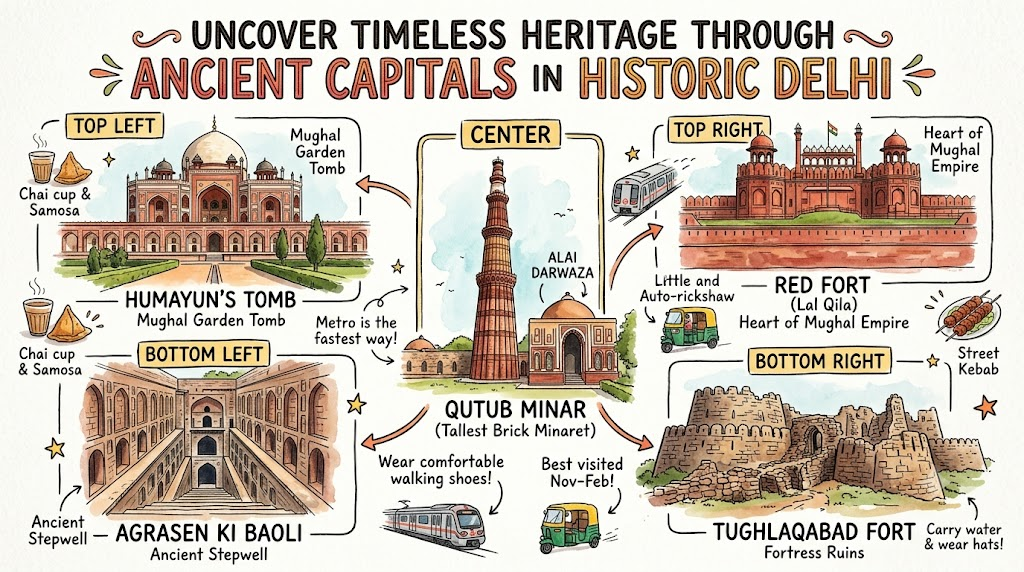
Introduction
Most vacation spots offer manicured escapes engineered to distract you, yet few places demand your presence quite like the living palimpsest of Delhi. While mass tourism shuttles crowds between generic souvenir arcades and artificial resorts, Delhi roots you directly into centuries of human ambition, poetry, triumph, and ruin. Here, everyday life does not pause for the past; it breathes right beside it.
Wandering down an unpaved alleyway might lead you straight into a fourteenth-century Sufi shrine where incense blends with sizzling kebabs. The city invites you to trade cookie-cutter sightseeing for raw, unapologetic authenticity. For the devoted history lover, every cracked stone wall whisper secrets of dynasties that rose, ruled, and turned to dust beneath modern asphalt.
Why Delhi is a must-visit city
Delhi is not merely a single city; it is an accretion of at least eight distinct historical capitals, each layered over the remnants of its predecessors. From the early Rajput fortifications of Qila Rai Pithora to the grandeur of Mughal Shahjahanabad and the imperial geometry of Lutyens’ New Delhi, this geographic hub on the banks of the Yamuna River has determined the political destiny of the Indian subcontinent for a millennium. Its central location makes it the ultimate gateway to the iconic Golden Triangle, connecting smoothly to Agra and Jaipur via high-speed expressways and rapid rail corridors.
Modern Delhi bridges its immense heritage with accessible contemporary infrastructure. The world-class Delhi Metro network connects peripheral medieval bastions directly to the diplomatic heart of the capital. Whether you are an independent backpacker relying on pocket-friendly rapid transit or a luxury traveler booking heritage hotel suites, the city welcomes every archetype with seasoned North Indian hospitality.
| Feature | Key Fact & Detail |
|---|---|
| Geographic Coordinates | 28.6139° N, 77.2090° E (Northern Plains of India) |
| Historical Eras Represented | Tomara Rajputs, Delhi Sultanate, Mughals, British Colonial, Post-Independence India |
| Primary Transit Hubs | Indira Gandhi International Airport (DEL), New Delhi Railway Station (NDLS) |
| Dominant Architectural Styles | Indo-Islamic, Sultanate red sandstone, Mughal Charbagh, Neo-Classical Colonial |
| Local Culinary Heritage | Mughlai curries, Tandoori street barbecue, Chandni Chowk chaat, Old Delhi sweets |
| Heritage Conservation Body | Archaeological Survey of India (ASI) & INTACH |
Best Places to Visit in Delhi for History Lovers
Humayun’s Tomb
Commissioned in 1558 by Empress Bega Begum, this sprawling mausoleum represents the genesis of monumental Mughal architecture in India. Persian architect Mirak Mirza Ghiyas synthesized Timurid geometry with local red sandstone craftsmanship, creating the prototype that would inspire the Taj Mahal decades later. As you cross the grand ceremonial gateway, the double-domed tomb rises symmetrically above sunken waterways that once mirrored paradise.
The surrounding Charbagh garden is divided into four geometric quadrants, symbolizing the four rivers of paradise described in Islamic theology. Walking through the quiet perimeter corridors, you will discover the resting places of over a hundred Mughal royals, earning the monument its moniker, the “Dormitory of the House of Timur.” The play of late afternoon sunlight through stone jali screens produces intricate, shifting geometric shadows across marble floors.
Humayun’s Tomb symmetrical Mughal architecture.
- Location: Nizamuddin East, Central-South Delhi (Approx. 8 km from Connaught Place).
- Why it is worth visiting: It is India’s first garden-tomb and a designated UNESCO World Heritage site showcasing early Mughal proportions.
- Best things to do: Admire the delicate latticework of Isa Khan’s octagonal tomb complex near the entrance, photograph the water reflections at sunset, and visit the subterranean site museum.
- Best time to visit: October to March; plan your entry between 3:30 PM and 5:30 PM for golden-hour photography.
- Ideal for whom: Architecture purists, landscape photographers, couples, and solo heritage wanderers.
- Travel tip: Buy your ASI ticket online using the QR boards at the gate to skip long ticket counter queues.
Qutub Minar Complex
Towering over the ruins of Mehrauli, the Qutub Minar stands as a 72.5-meter red sandstone victory tower started in 1199 by Qutb-ud-din Aibak. Its five distinct, tapering storeys are carved with intricate Arabic calligraphy and alternating fluted surfaces. The monument commemorates the establishment of the Delhi Sultanate, marking a transformative architectural transition in North India.
The surrounding complex is an open-air museum of architectural assimilation. In the courtyard of the Quwwat-ul-Islam Mosque stands the famous 4th-century Iron Pillar of Chandragupta II, which has resisted rust and environmental corrosion for over 1,600 years through advanced ancient metallurgy. Walking among the carved colonnades, you see indigenous temple pillars repurposed to build northern India’s earliest surviving mosque.
Qutub Minar victory tower in Mehrauli.
- Location: Mehrauli, South West Delhi (Approx. 15 km from Central Delhi).
- Why it is worth visiting: The world’s tallest brick minaret and a living showcase of early Indo-Islamic engineering.
- Best things to do: Examine the metallurgical miracle of the Iron Pillar, walk past the incomplete base of the ambitious Alai Minar, and decode ancient inscriptions on the sandstone facade.
- Best time to visit: Early morning around 7:30 AM before bus tours arrive, or after sunset to see the complex lit up.
- Ideal for whom: Archaeology enthusiasts, epigraphers, families, and walking-tour groups.
- Travel tip: Pair this visit with the nearby Mehrauli Archaeological Park, located right across the road, which most tourists overlook.
Red Fort (Lal Qila)
Built by Emperor Shah Jahan when he shifted his imperial capital from Agra to Shahjahanabad in 1638, the Red Fort served as the nerve center of the Mughal Empire for two centuries. Its massive octagonal sandstone ramparts stretch across two kilometers, towering above the frenzy of Old Delhi. Entering through the monumental Lahori Gate, visitors pass into Chhatta Chowk, a covered vaulted bazaar where jewelers and weavers once catered to imperial royalty.
Beyond the military fortifications lie the serene marble pavilions of the Diwan-i-Aam and Diwan-i-Khas. In the Diwan-i-Khas, the imperial Persian inscription famously reads: “If there be a paradise on earth, it is here, it is here, it is here.” The complex withstood the sacking by Nadir Shah, colonial plundering after the 1857 uprising, and witnessed the dawn of India’s independence when the national flag was hoisted from its ramparts in 1947.
Historic Lahori Gate of the Red Fort.
- Location: Netaji Subhash Marg, Chandni Chowk, Old Delhi (Approx. 5 km north of Connaught Place).
- Why it is worth visiting: The symbolic pinnacle of Mughal power and the historic stage for modern India’s Independence Day celebrations.
- Best things to do: Visit the barracks repurposed into modern museums (Kranti Mandir), explore the marble carvings of the Rang Mahal, and attend the evening sound-and-light show.
- Best time to visit: Weekday mornings at 9:00 AM to avoid the crushing weekend crowds.
- Ideal for whom: Military history buffs, students, culture enthusiasts, and first-time travelers to India.
- Travel tip: The complex is strictly closed on Mondays; always plan your visit for Tuesday through Sunday.
Agrasen ki Baoli
Hidden amidst the glass skyscrapers and diplomatic lanes of central New Delhi, Agrasen ki Baoli is an ancient stepwell containing 108 steep stone steps descending into the earth. While historical legend attributes its original founding to King Agrasen during the Mahabharata era, its existing 60-meter-long architectural form reflects fourteenth-century Tughlaq or Lodi-era construction. Its subterranean layout served as both a community cooling reservoir and a vital freshwater reservoir along ancient trade trails.
Descending the stone levels, you experience an immediate temperature drop and a sudden muffling of urban traffic noise. The symmetrical stone arches lining both flanks frame deep recessed alcoves where travelers once rested. It stands as an exceptional showcase of traditional water harvesting techniques that allowed medieval civilizations to flourish in semi-arid northern climates.
Subterranean stepwell of Agrasen ki Baoli.
- Location: Hailey Road, near Connaught Place, Central Delhi (Walking distance from Barakhamba Metro).
- Why it is worth visiting: A masterclass in medieval subterranean water architecture tucked within a bustling modern business district.
- Best things to do: Sit on the upper stone terraces to study the repeating archways, photograph the geometric perspective looking downward, and observe urban wildlife like resting pigeons and fruit bats.
- Best time to visit: 11:00 AM to 1:00 PM when the midday sun illuminates the bottom basin for clear photography.
- Ideal for whom: Solitary explorers, urban sketchers, architecture students, and film lovers.
- Travel tip: Wear sturdy footwear with good grip; the centuries-old stone steps are uneven and worn smooth.
Tughlaqabad Fort
Constructed by Ghiyas-ud-din Tughlaq in 1321, this formidable fortress city rises over southern Delhi’s rocky Aravalli ridges like an indestructible stone leviathan. Built to fend off recurring Mongol invasions, its massive stone walls, battered ramparts, and circular bastions reach up to fifteen meters high. The entire citadel was built, occupied, and abandoned within six short years, cursed by the famous Sufi saint Hazrat Nizamuddin Auliya: “Ya rahe ujjar, ya base Gujjar” (May it stay desolate, or be inhabited by nomads).
Wandering through its vast, weed-strewn stone corridors reveals underground granaries, secret escape tunnels, and defensive arrow slits. Directly across a stone causeway sits the emperor’s fortified mausoleum, an unusual pentagonal tomb crowned by a white marble dome and framed by thick, sloping red sandstone walls. The sheer silence here stands in stark contrast to the bustling central monuments of Delhi.
- Location: Tughlaqabad, South Delhi (Approx. 20 km from Connaught Place).
- Why it is worth visiting: The rawest, most intact medieval military outpost in Delhi, showcasing sheer defensive scale over delicate ornamentation.
- Best things to do: Walk the high battlement walkways for panoramic views of southern Delhi, explore the vaulted stone tunnels, and visit the fortified tomb across the causeway.
- Best time to visit: Winter mornings between 8:00 AM and 11:00 AM when crisp air makes climbing the rocky terrain pleasant.
- Ideal for whom: Adventure travelers, hardcore medieval historians, and hikers.
- Travel tip: Wear full-coverage hiking clothes and carry drinking water; the terrain is rough and monkeys roam freely among the ruins.
Offbeat Exploration: Hidden Gems Tourists Miss
Mehrauli Archaeological Park
Tucked behind the Qutub Minar complex, this 200-acre forested heritage park contains over 1,000 years of continuous habitation with more than 100 preserved monuments. You can walk undisturbed among the tombs of Sultan Ghiyas-ud-din Balban, the elegant sixteenth-century Jamali Kamali mosque, and the deep, tiered steps of Rajon ki Baoli. It offers a rare, tranquil experience where ancient stone domes sit quietly beneath ancient neem trees.
Hauz Khas Complex and Madrasa
While most visitors only know the adjoining village for its hipster dining and nightlife, the medieval ruins of Hauz Khas house the fourteenth-century royal reservoir built by Alauddin Khalji and the madrasa built by Firoz Shah Tughlaq. The L-shaped two-story college structures overlook the quiet water tank, offering an atmospheric spot to study stone jharokhas (balconies) and cenotaphs while listening to the evening bird calls.
Nizamuddin Dargah Thursday Qawwalis
For an authentic living cultural ritual, enter the narrow, rose-scented alleys of Basti Hazrat Nizamuddin on a Thursday evening. Here, the ancestral musicians (Qawwals) gather in the marble courtyard of Sufi saint Hazrat Nizamuddin Auliya’s shrine to sing mystical devotional verses passed down through centuries. The collective energy, synchronised clapping, and soaring harmonium music create a spiritual atmosphere that has remained unbroken since the thirteenth century.
Detailed Practical Guidance for Travelers
| Destination | Standard Entry Fee | General Timings | Best Local Food Options Nearby | Recommended Nearby Attractions |
|---|---|---|---|---|
| Humayun’s Tomb | ₹50 (Indians), ₹600 (Foreigners) | 6:00 AM – 6:00 PM (Daily) | Mughlai kebabs at Karim’s Nizamuddin, Haleem at Ghalib Kabab Corner | Sunder Nursery, National Zoological Park, Hazrat Nizamuddin Dargah |
| Qutub Minar | ₹50 (Indians), ₹600 (Foreigners) | 7:00 AM – 9:00 PM (Daily) | Olive Bar & Kitchen (European), Rooh (Modern Indian), street rolls at Mehrauli | Mehrauli Archaeological Park, Jamali Kamali Tomb, Garden of Five Senses |
| Red Fort | ₹50 (Indians), ₹600 (Foreigners) | 9:30 AM – 4:30 PM (Tue–Sun) | Daulat ki Chaat, Paranthe Wali Gali, spicy jalebis at Old Famous Jalebi Wala | Jama Masjid, Chandni Chowk spice market, Sis Ganj Sahib Gurudwara |
| Agrasen ki Baoli | Free Entry | 9:00 AM – 5:30 PM (Daily) | Saravana Bhavan (South Indian), Wenger’s Bakery patties, street chaat at CP | Jantar Mantar, Connaught Place inner circle, National Museum |
| Tughlaqabad Fort | ₹25 (Indians), ₹300 (Foreigners) | 7:00 AM – 5:00 PM (Daily) | Local tea stalls and dhabas along Mehrauli-Badarpur Road | Asola Bhatti Wildlife Sanctuary, Surajkund Lake, Adilabad Fort ruins |
Logistics & On-Ground Navigation
Local Transport Options
- Delhi Metro: The fastest, cleanest, and most affordable way to travel. Use the Yellow Line for Old Delhi and Qutub Minar, and the Violet Line for heritage corridors like Delhi Gate and Kalkaji.
- Auto-Rickshaws: Excellent for short 2–5 km hops between metro stations and monuments; insist on running the meter or negotiate a firm fare before stepping inside.
- App-Based Cabs (Uber/Ola): Highly reliable, air-conditioned, and cashless; ideal for cross-town travel during morning and late evening hours.
- Cycle & E-Rickshaws: Essential for navigating the narrow, crowded lanes of Chandni Chowk and Old Delhi where larger vehicles cannot enter.
Budget Planning
- Budget/Backpacker Tier (₹1,500 – ₹2,500 per day): Stay in boutique hostels around South Delhi; use the Delhi Metro exclusively; eat at local dhabas and historical street vendors; visit ASI monuments using domestic/online booking portals.
- Mid-Range/Comfort Tier (₹5,500 – ₹10,000 per day): Stay in 3-to-4 star boutique hotels or heritage bed-and-breakfasts; travel via private app cabs; dine at historic restaurants like Karim’s and upscale regional spots like Cafe Lota; book accredited heritage walking guides.
Safety and Inclusivity Tips
- For Families: Stick to open garden monuments like Humayun’s Tomb and Sunder Nursery during afternoon hours where children have room to walk safely; carry filtered water and wet wipes.
- For Couples: Public monuments and heritage parks are generally welcoming; maintain standard modest public conduct, especially inside active religious sanctuaries like shrines, mosques, and temples.
- General Safety: Avoid carrying open cash or expensive electronics loosely in crowded markets like Chandni Chowk; download offline metro maps, and rely on official app-booked cabs when traveling after 10:00 PM.
Strategic Travel Planning Guardrails
Travel Planning Tips for Delhi
- Target the Winter Window: Plan your trip strictly between November and February when crisp sunny days make long monument explorations comfortable.
- Go Digital for Monument Tickets: Avoid standing in long queues by scanning ASI online QR codes directly on your smartphone for discounted and faster access.
- Carry Small Denomination Cash: While digital UPI payments work at most stalls, carry small ₹10, ₹20, and ₹100 banknotes for cycle-rickshaws, shoe handlers outside shrines, and remote street carts.
- Dress Modestly for Shrines: Carry a scarf or light shawl to cover your head and wear clothes covering shoulders and knees when visiting Nizamuddin Dargah, Jama Masjid, or Gurudwara Bangla Sahib.
- Wear Slip-Off Walking Shoes: You will walk thousands of steps over stone flagstones and will need to remove your shoes frequently when entering sanctums and active religious sites.
Common Mistakes to Avoid
- Overloading Daily Schedules: Do not attempt to visit more than two or three major monuments per day; Delhi traffic and monument scales cause fast travel fatigue.
- Ignoring Monument Closing Days: Always remember that the Red Fort and Akshardham are closed on Mondays, while the National Museum is also shut at the start of the week.
- Falling for Touts Outside Stations: Ignore aggressive individuals claiming government tourist offices have moved or that your pre-booked hotel has burned down; walk directly to official prepaid counters or app pickup zones.
- Skipping Street Food Out of Fear: Missing local delicacies out of hygiene anxiety is unnecessary; simply pick busy stalls with high customer turnover where oil and food are continuously boiling hot.
- Underestimating Sun Exposure: Even in pleasant winters, the dry afternoon sun can dehydrate you quickly; carry a reusable insulated water bottle.
Suggested Itinerary Blueprints
1-Day Quick Dash (The Imperial Showcase Route)
Designed for business travelers or short-layover tourists who want to experience the defining peaks of Delhi’s imperial timeline without getting stuck in traffic.
- Morning (8:30 AM – 11:30 AM): Take the Yellow Line to Chandni Chowk; walk past the red sandstone ramparts of the Red Fort and tour the grand courtyard of Jama Masjid. Grab a quick breakfast of stuffed parathas.
- Afternoon (1:00 PM – 3:30 PM): Catch a cab south along the Rajpath boulevard past India Gate to Agrasen ki Baoli for a cool subterranean descent, followed by lunch at Connaught Place.
- Late Afternoon & Sunset (4:00 PM – 6:00 PM): End your day at Humayun’s Tomb, watching the evening sun bathe the marble and red sandstone dome in fiery gold.
2-Day Deep-Dive (The Seven Cities Chronicle Route)
A comprehensive weekend route designed for cultural enthusiasts wanting a balanced mix of medieval ruins, culinary landmarks, and living traditions.
- Day 1: Sultanate Foundations & Mystic South
- Morning: Arrive early at Qutub Minar to beat the crowds, then walk across into the forested trails of Mehrauli Archaeological Park to visit Jamali Kamali and Rajon ki Baoli.
- Afternoon: Savor South Indian delicacies at nearby Olive or regional curries at Hauz Khas Village, followed by an exploration of Firoz Shah’s lakeside madrasa.
- Evening: Head to Tughlaqabad Fort for sunset among its rugged battlements, followed by an evening tea stop near Saket.
- Day 2: Mughal Magnificence & Colonial Corridors
- Morning: Explore Humayun’s Tomb early, then stroll next door through the restored sixteenth-century Mughal waterways and gardens of Sunder Nursery.
- Afternoon: Dive into Old Delhi via metro; feast on aromatic biryani and seekh kebabs in Nizamuddin or Chandni Chowk; explore the historic spice market of Khari Baoli.
- Evening: Settle in for the sunset qawwali session at Hazrat Nizamuddin Dargah, soaking in centuries-old spiritual poetry.
3-Day Complete Weekend Travel Plan (The Grand Delhi Living Heritage Loop)
The definitive itinerary for travelers seeking an immersive dive into royal citadels, colonial institutions, culinary gems, and offbeat ruins.
- Friday: Ancient Roots & Forgotten Fortresses
- Start at the rugged fourteenth-century ramparts of Tughlaqabad Fort; continue north to explore the stone stepwell of Agrasen ki Baoli and finish with evening colonial architecture walks and shopping along the colonnades of Connaught Place.
- Day 2 (Saturday): High Empires & Scholarly Enclaves
- Spend the early morning touring the Qutub Minar Complex; walk the quiet grounds of Mehrauli Archaeological Park; visit the National Museum in Central Delhi to view 5,000-year-old Indus Valley artifacts; enjoy dinner at the heritage-inspired Cafe Lota.
- Day 3 (Sunday): The Grand Mughal Climax
- Explore the vast courts of the Red Fort at opening time; wander the spice alleys of Chandni Chowk; take an afternoon breather among the fountains of Humayun’s Tomb and Sunder Nursery; end your journey with late-evening kebabs outside Jama Masjid.
Common Tourist Mistakes to Avoid
Geographic Blunders
The most frequent mistake first-time travelers make is trying to pair Old Delhi sights like the Red Fort and Chandni Chowk with South Delhi attractions like Qutub Minar on the same afternoon. Delhi covers nearly 1,500 square kilometers; crossing the city during peak hours can swallow two to three hours in traffic. Always group your itinerary geographically: Old and Central Delhi on one day, and South Delhi heritage circuits on another.
Commercial Traps
Many tourists spend precious hours trapped inside overpriced, Western-style air-conditioned shopping malls in suburban Gurgaon or Saket, confusing them with genuine Delhi culture. These malls offer the same global retail chains found in any international airport. Instead, invest your time wandering through historic artisan quarters, such as the open-air craft stalls of Dilli Haat INA or the ancient paper and book markets of Old Delhi.
Neglecting Modern/Alternative Zones
History buffs frequently fixate solely on ancient ruins while ignoring Delhi’s fascinating twentieth-century artistic and residential quarters. Missing areas like the Lodhi Art District, where vibrant street murals decorate government residential blocks, or ignoring the craft galleries of Pragati Maidan deprives you of understanding how contemporary Delhi builds upon its historical legacy.
Transport Overpayment
Unsuspecting travelers often agree to exorbitant flat rates demanded by roadside auto-rickshaw drivers waiting right outside monument exit gates. Always ask the driver to turn on the electronic fare meter, or pull out your phone and book an auto or cab via apps like Uber or Ola. The digital app price serves as an undisputed benchmark for fair pricing across the city.
Luxury Dining Bias
Confining your meals entirely to five-star hotel buffets strips away Delhi’s most celebrated heritage feature: its vibrant culinary culture. Iconic recipes like slow-cooked nihari, crisp bedmi puris, and hand-churned kulfi have been perfected across multiple generations in humble family-run Old Delhi shops. Skipping street-level culinary heritage means missing the living heartbeat of the city.
Frequently Asked Questions
1. What is the single best month of the year to visit Delhi for a heritage trip?
November is the best month to visit Delhi. The harsh summer heat has passed, day temperatures average a comfortable 25°C, and the heavy winter fog of late December has not yet set in. This weather provides ideal conditions for walking through outdoor archaeological complexes and garden monuments.
2. Is it safe to explore Old Delhi’s historic monuments independently?
Yes, exploring Old Delhi independently is safe provided you exercise ordinary city awareness. Keep personal bags zipped in front of you through crowded alleys, avoid flashing expensive jewelry, and use the air-conditioned Delhi Metro to avoid getting trapped in traffic jams or overwhelmed by pushy local touts.
3. Are monument tickets in Delhi payable by international credit cards at the gate?
Physical ticket counters often face connectivity issues with international cards. It is far more reliable to scan the ASI official QR codes displayed prominently at monument gates using your smartphone to purchase digital e-tickets instantly, or book them in advance through the official Archaeological Survey of India ticketing portal.
4. How many days are genuinely required to explore Delhi’s key historical monuments?
A minimum of three full days is necessary to cover the top historical monuments without rushing. This timeframe allows you to explore Old Delhi, Central colonial monuments, and South Delhi’s medieval Sultanate ruins comfortably, while leaving time to sample the city’s legendary food scene without fatigue.
5. What is the most reliable mode of public transportation between distant historical monuments?
The Delhi Metro is unequivocally the fastest, safest, and most dependable way to travel between distant monuments. It is fully air-conditioned, runs frequently, and avoids Delhi’s legendary road traffic, dropping you within walking or short e-rickshaw distance of sites like Qutub Minar, Red Fort, and Humayun’s Tomb.
6. Do I need to book an official guide to understand Delhi’s historical complexes?
While not mandatory, hiring an ASI-licensed guide or booking an established walking tour adds immense value. Delhi’s ruins span multiple distinct empires; an informed storyteller helps decode Persian wall epigraphy, hidden architectural features, and complex dynasty successions that plain signage often glosses over.
7. What dress codes apply when entering historical monuments that function as religious sites?
Active religious monuments like Nizamuddin Dargah, Jama Masjid, and Gurudwara Bangla Sahib require both men and women to dress conservatively. Ensure your shoulders and knees are fully covered, carry a head covering such as a scarf or handkerchief, and prepare to remove your footwear at the outer boundary.
8. Can I photograph monuments in Delhi using professional camera equipment and tripods?
Standard handheld still and mobile photography is permitted across all ASI monuments without extra fees. However, tripods, lighting stands, and commercial filmmaking setups are strictly prohibited unless you have secured formal, written permits from the Archaeological Survey of India headquarters well in advance.
9. Are historical monuments in Delhi accessible for travelers using wheelchairs?
Major UNESCO World Heritage sites like Humayun’s Tomb and Qutub Minar offer paved main pathways, shallow ramps, and accessible restroom facilities near their entrances. However, older Sultanate outposts like Tughlaqabad Fort and deep stepwells like Agrasen ki Baoli feature steep, uneven stone steps that are difficult to access.
10. What is the best strategy to avoid massive tourist crowds at popular monuments?
Arrive right at opening time, usually around 6:00 AM to 7:00 AM for garden tombs, or visit during standard weekday lunch hours between 1:00 PM and 2:30 PM. Never visit marquee monuments like the Red Fort on weekends or public national holidays unless you enjoy shoulder-to-shoulder crowds.
11. Where can I experience the best authentic culinary heritage after visiting monuments?
Head straight to the lanes surrounding Jama Masjid and Chandni Chowk for legendary Mughal kebabs, fragrant biryani, and crispy jalebis. For South Indian flavors or multi-regional Indian cuisine in a cleaner, curated environment, visit the state bhavan canteens along Copernicus Marg or the open food stalls at Dilli Haat.
12. Is tap water safe to drink at public water points inside heritage monuments?
No, visitors should avoid drinking unboiled, unfiltered tap water from public monument coolers. Always carry your own reusable bottle filled with filtered water from your hotel, or purchase sealed, branded mineral water bottles from authorized concession stands located inside ticketed premises.
Conclusion
Choosing to explore Delhi’s historical monuments is not an ordinary sightseeing vacation; it is an intimate encounter with the rise and fall of human ambition. Standing beneath the soaring stone arches of the Qutub complex or watching the evening light illuminate the marble domes of Humayun’s Tomb grounds you in centuries of art, empire, and resilience. Delhi challenges travelers to look past its bustling exterior to discover quiet moments of wonder in its ancient courtyards. For those who listen closely to its weathered red stones, the capital rewards your curiosity with a deep, unforgettable connection to India’s timeless soul.
