MOTOSHARE 🚗🏍️
Rent Bikes & Cars Directly from Owners
Motoshare connects vehicle owners with people who need bikes and cars on rent. Owners earn from idle vehicles, and renters get flexible ride options.
Visit Motoshare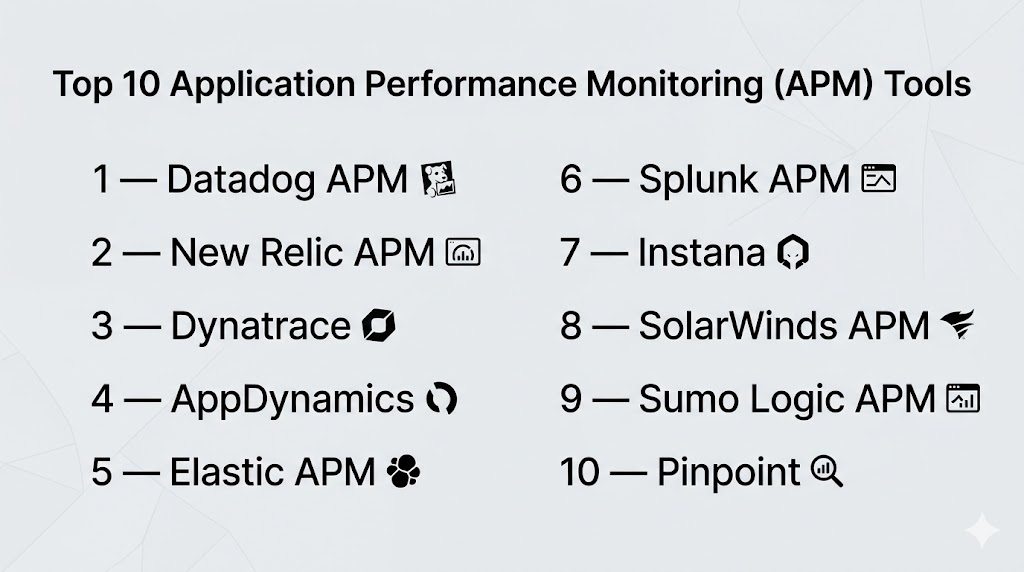
Introduction
Application Performance Monitoring (APM) Tools are designed to track, analyze, and optimize the performance of software applications in real time. They help teams monitor how applications behave across environments—whether it’s backend services, APIs, databases, or user-facing interfaces—so issues can be detected and resolved before they impact users.
In modern architectures powered by microservices, cloud infrastructure, and distributed systems, performance bottlenecks are harder to identify. APM tools provide deep visibility into application behavior, enabling teams to quickly diagnose latency, errors, and system inefficiencies. This is critical for maintaining uptime, delivering smooth user experiences, and scaling reliably.
Common use cases:
- Monitoring application response times and uptime
- Identifying performance bottlenecks in APIs and services
- Debugging errors in production environments
- Tracking user experience and frontend performance
- Optimizing infrastructure and resource usage
What buyers should evaluate:
- End-to-end transaction tracing
- Real-time monitoring and alerting
- Root cause analysis capabilities
- Integration with cloud and DevOps tools
- Support for microservices and containers
- Ease of deployment and usability
- Visualization and dashboards
- Security and access controls
- Scalability and performance under load
- Pricing based on usage or data
Best for: DevOps engineers, SREs, developers, and IT teams managing production applications that require high performance and reliability.
Not ideal for: Static websites or small applications where basic monitoring tools are sufficient.
Key Trends in Application Performance Monitoring (APM)
- AI-driven performance insights for faster root cause detection
- Shift toward full-stack observability beyond traditional APM
- Cloud-native monitoring for Kubernetes and serverless apps
- Real-user monitoring (RUM) gaining importance
- Synthetic monitoring integration for proactive testing
- OpenTelemetry adoption for standardized data collection
- Shift-left performance testing in development pipelines
- Business-centric monitoring linking performance to revenue
- Cost optimization visibility in cloud environments
- Unified dashboards across infrastructure and applications
How We Selected These Tools (Methodology)
- Evaluated market adoption and industry leadership
- Assessed depth of APM capabilities (tracing, RUM, analytics)
- Reviewed scalability and performance in real-world use
- Considered security and compliance features
- Analyzed integration ecosystems and extensibility
- Compared ease of use and onboarding experience
- Included both enterprise and developer-friendly tools
- Evaluated support quality and community strength
- Focused on modern cloud-native compatibility
- Ensured coverage across different company sizes
Top 10 Application Performance Monitoring (APM) Tools
#1 — Datadog APM
Short description: A leading cloud-native APM solution offering deep visibility into application performance and infrastructure.
Key Features
- Distributed tracing
- Real-time performance monitoring
- Error tracking and analytics
- AI-driven anomaly detection
- Integration with infrastructure monitoring
- Custom dashboards
Pros
- Comprehensive observability platform
- Extensive integrations
Cons
- Pricing can increase quickly
- Requires tuning for optimization
Platforms / Deployment
Web / Cloud
Security & Compliance
SSO, RBAC, encryption (others not publicly stated)
Integrations & Ecosystem
Datadog integrates with modern DevOps and cloud ecosystems seamlessly.
- AWS, Azure, GCP
- Kubernetes
- CI/CD tools
- APIs
Support & Community
Strong enterprise support and documentation.
#2 — New Relic APM
Short description: A widely used APM tool providing detailed performance insights and analytics for applications.
Key Features
- End-to-end transaction tracing
- Real-user monitoring
- Log and metric correlation
- AI insights
- Custom dashboards
Pros
- Developer-friendly interface
- Flexible pricing model
Cons
- UI complexity for beginners
- Data ingestion costs
Platforms / Deployment
Web / Cloud
Security & Compliance
SSO, RBAC (others not publicly stated)
Integrations & Ecosystem
- Kubernetes
- Cloud platforms
- APIs
- DevOps tools
Support & Community
Large community and documentation.
#3 — Dynatrace
Short description: AI-powered APM platform designed for enterprise-scale environments with automated insights.
Key Features
- Automatic dependency mapping
- AI-based root cause analysis
- Full-stack monitoring
- Real-user monitoring
- Cloud-native support
Pros
- Advanced automation
- Enterprise scalability
Cons
- Premium pricing
- Learning curve
Platforms / Deployment
Cloud / Hybrid
Security & Compliance
SSO, RBAC (others not publicly stated)
Integrations & Ecosystem
- Cloud providers
- Kubernetes
- APIs
Support & Community
Enterprise-level support.
#4 — AppDynamics
Short description: Enterprise APM tool focused on linking application performance with business metrics.
Key Features
- Transaction monitoring
- Business performance tracking
- Root cause analysis
- Real-time alerts
- Cloud monitoring
Pros
- Strong business insights
- Enterprise-ready
Cons
- Expensive
- Complex setup
Platforms / Deployment
Cloud / On-premises
Security & Compliance
SSO, RBAC (others not publicly stated)
Integrations & Ecosystem
- Cloud platforms
- APIs
Support & Community
Enterprise support.
#5 — Elastic APM
Short description: APM solution built into the Elastic stack for unified logging and monitoring.
Key Features
- Distributed tracing
- Log correlation
- Custom dashboards
- Machine learning insights
- Open-source core
Pros
- Flexible and customizable
- Strong integration with ELK
Cons
- Setup complexity
- Resource-intensive
Platforms / Deployment
Cloud / Self-hosted
Security & Compliance
RBAC (others not publicly stated)
Integrations & Ecosystem
- Elasticsearch
- Beats
- APIs
Support & Community
Strong open-source community.
#6 — Splunk APM
Short description: Part of Splunk Observability Cloud, offering real-time application performance insights.
Key Features
- Distributed tracing
- Real-time analytics
- AI-driven insights
- Log correlation
- Performance monitoring
Pros
- Strong analytics capabilities
- Enterprise-grade
Cons
- High cost
- Complex configuration
Platforms / Deployment
Cloud
Security & Compliance
SSO, RBAC (others not publicly stated)
Integrations & Ecosystem
- Cloud platforms
- APIs
- DevOps tools
Support & Community
Enterprise-level support.
#7 — Instana
Short description: Automated APM tool focused on real-time observability and performance monitoring.
Key Features
- Automatic instrumentation
- Real-time monitoring
- Dependency mapping
- AI insights
- Kubernetes support
Pros
- Fast setup
- Real-time insights
Cons
- Premium pricing
- Limited customization
Platforms / Deployment
Cloud / Self-hosted
Security & Compliance
SSO, RBAC (others not publicly stated)
Integrations & Ecosystem
- Kubernetes
- Cloud platforms
- APIs
Support & Community
Enterprise support.
#8 — SolarWinds APM
Short description: APM solution designed for monitoring applications and infrastructure in hybrid environments.
Key Features
- Application monitoring
- Infrastructure visibility
- Performance analytics
- Alerts and dashboards
- Root cause analysis
Pros
- Easy to use
- Good for hybrid environments
Cons
- Limited advanced features
- Scaling limitations
Platforms / Deployment
Cloud / On-premises
Security & Compliance
Not publicly stated
Integrations & Ecosystem
- Cloud tools
- APIs
Support & Community
Moderate support and documentation.
#9 — Sumo Logic APM
Short description: Cloud-native APM platform integrated with observability and security analytics.
Key Features
- Distributed tracing
- Log analytics
- Real-time monitoring
- Machine learning insights
- Cloud-native support
Pros
- Scalable architecture
- Integrated analytics
Cons
- Learning curve
- Pricing complexity
Platforms / Deployment
Cloud
Security & Compliance
SSO, RBAC (others not publicly stated)
Integrations & Ecosystem
- AWS, Azure
- Kubernetes
- APIs
Support & Community
Good support resources.
#10 — Pinpoint
Short description: Open-source APM tool focused on distributed systems and transaction tracing.
Key Features
- Distributed tracing
- Code-level visibility
- Performance monitoring
- JVM-focused insights
- Real-time data
Pros
- Free and open-source
- Detailed tracing
Cons
- Limited language support
- Requires setup effort
Platforms / Deployment
Self-hosted
Security & Compliance
Varies / Not publicly stated
Integrations & Ecosystem
- Java ecosystem
- APIs
Support & Community
Active open-source community.
Comparison Table (Top 10)
| Tool Name | Best For | Platform(s) Supported | Deployment | Standout Feature | Public Rating |
|---|---|---|---|---|---|
| Datadog APM | Full-stack monitoring | Web | Cloud | Unified observability | N/A |
| New Relic APM | Developers | Web | Cloud | Real-user monitoring | N/A |
| Dynatrace | Enterprise AI monitoring | Web | Cloud/Hybrid | AI automation | N/A |
| AppDynamics | Business insights | Web | Cloud/On-prem | Business metrics | N/A |
| Elastic APM | ELK users | Web | Cloud/Self-hosted | Log correlation | N/A |
| Splunk APM | Enterprise analytics | Web | Cloud | Real-time insights | N/A |
| Instana | Automated monitoring | Web | Cloud/Self-hosted | Auto instrumentation | N/A |
| SolarWinds APM | Hybrid environments | Web | Cloud/On-prem | Simplicity | N/A |
| Sumo Logic APM | Cloud-native teams | Web | Cloud | ML insights | N/A |
| Pinpoint | Open-source users | Web | Self-hosted | Distributed tracing | N/A |
Evaluation & Scoring of Application Performance Monitoring (APM) Tools
| Tool Name | Core | Ease | Integrations | Security | Performance | Support | Value | Weighted Total |
|---|---|---|---|---|---|---|---|---|
| Datadog | 9 | 7 | 10 | 8 | 9 | 9 | 7 | 8.6 |
| New Relic | 9 | 7 | 9 | 8 | 9 | 9 | 8 | 8.7 |
| Dynatrace | 10 | 7 | 9 | 9 | 10 | 9 | 6 | 8.8 |
| AppDynamics | 9 | 6 | 8 | 9 | 9 | 9 | 6 | 8.3 |
| Elastic | 8 | 6 | 8 | 7 | 8 | 8 | 8 | 7.9 |
| Splunk | 9 | 6 | 9 | 9 | 9 | 9 | 6 | 8.4 |
| Instana | 9 | 8 | 8 | 8 | 9 | 8 | 7 | 8.3 |
| SolarWinds | 7 | 8 | 7 | 6 | 7 | 7 | 7 | 7.2 |
| Sumo Logic | 8 | 7 | 8 | 8 | 8 | 8 | 7 | 7.9 |
| Pinpoint | 7 | 6 | 6 | 6 | 7 | 7 | 10 | 7.3 |
How to interpret scores:
These scores are comparative and reflect overall capability across weighted criteria. Higher scores indicate stronger platforms, but the best choice depends on your use case. Enterprises may prioritize AI and scalability, while startups may focus on cost and simplicity.
Which Application Performance Monitoring (APM) Tool Is Right for You?
Solo / Freelancer
Use lightweight tools like Pinpoint or free tiers of New Relic.
SMB
New Relic and Instana provide strong performance monitoring with ease of use.
Mid-Market
Datadog and Elastic offer scalability and integration depth.
Enterprise
Dynatrace, Splunk, and AppDynamics are ideal for large-scale environments.
Budget vs Premium
- Budget: Pinpoint, Elastic
- Premium: Dynatrace, Datadog
Feature Depth vs Ease of Use
- Advanced: Dynatrace, Splunk
- Easy: New Relic, Instana
Integrations & Scalability
Datadog and New Relic lead in integrations.
Security & Compliance Needs
Choose tools with RBAC, encryption, and audit features.
Frequently Asked Questions (FAQs)
1. What is APM?
APM tools monitor and optimize application performance in real time.
2. Why is APM important?
It helps detect and resolve performance issues before they impact users.
3. How is APM different from observability?
APM focuses on applications, while observability covers entire systems.
4. Are APM tools expensive?
Costs vary based on usage and data volume.
5. Do APM tools support microservices?
Yes, most modern tools are built for microservices.
6. What is distributed tracing?
It tracks requests across multiple services to identify bottlenecks.
7. Can startups use APM tools?
Yes, many tools offer free tiers.
8. What are common mistakes?
Ignoring alerts and collecting unnecessary data.
9. Do APM tools integrate with DevOps tools?
Yes, integration is a core feature.
10. Are APM tools secure?
Security varies; check for RBAC and encryption.
Conclusion
Application Performance Monitoring tools are essential for ensuring modern applications run smoothly, efficiently, and reliably in increasingly complex environments. As systems evolve with microservices, cloud-native architectures, and distributed workloads, having deep visibility into application performance becomes critical for maintaining user satisfaction and business continuity. The tools covered in this guide offer a range of capabilities—from open-source flexibility to advanced AI-driven enterprise platforms—each suited for different needs and scales. There is no single best solution, only the one that aligns with your infrastructure, team expertise, and performance goals. To make the right choice, shortlist a few tools, test them in real scenarios, and evaluate how effectively they help you detect issues, optimize performance, and scale confidently.

Good APM tools comparison. One real gap is how teams handle performance overhead and still get clean, usable signals during high-traffic incidents—especially when logs and traces aren’t well correlated.
A useful operational angle is APM instrumentation governance. Teams should define tracing standards, sampling rules, high-cardinality tag limits, and overhead testing, otherwise APM can become costly, noisy, and even impact application performance during peak traffic.