MOTOSHARE 🚗🏍️
Rent Bikes & Cars Directly from Owners
Motoshare connects vehicle owners with people who need bikes and cars on rent. Owners earn from idle vehicles, and renters get flexible ride options.
Visit Motoshare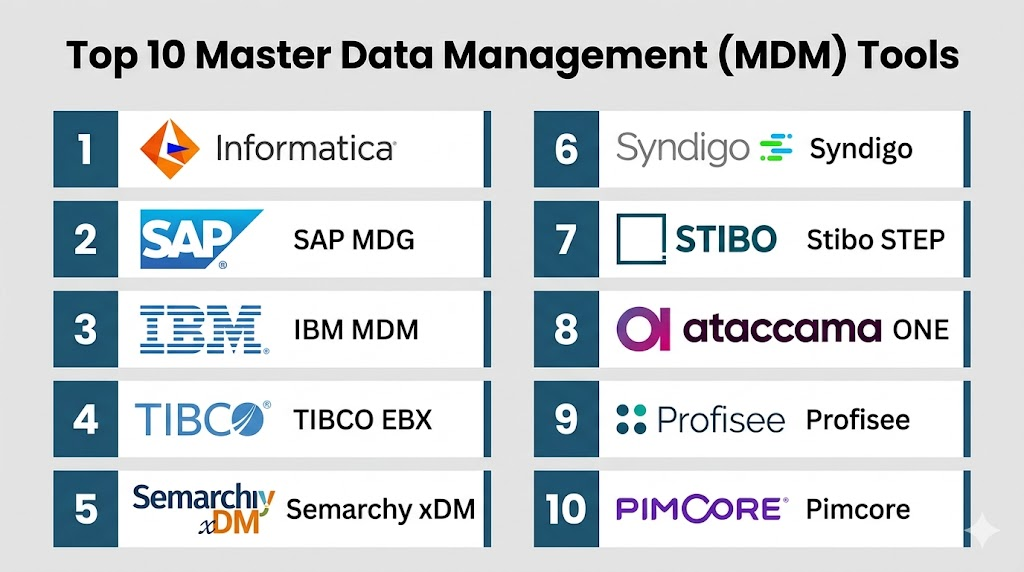
Introduction
Master Data Management (MDM) tools represent a category of enterprise software designed to create and maintain a single, consistent, and accurate “single source of truth” for an organization’s most critical data assets. This data, known as master data, typically includes information about customers, products, suppliers, employees, and locations. Without MDM, this information often resides in disconnected silos—such as CRM, ERP, and localized spreadsheets—leading to duplication, errors, and operational inefficiencies. MDM platforms resolve these conflicts by consolidating data, cleaning it, and synchronizing it across the entire technology stack.
In the modern data-driven economy, the ability to maintain high-quality master data is the foundation of digital transformation. Whether an organization is looking to implement advanced AI, improve customer personalization, or streamline a global supply chain, the success of these initiatives depends on the reliability of the underlying data. MDM tools provide the governance framework and technical infrastructure required to ensure that every department—from marketing to finance—is working with the same validated information.
Real-world use cases:
- Customer 360: Creating a unified view of a customer by merging records from sales, support, and marketing to provide personalized experiences.
- Product Information Management: Centralizing product specifications, digital assets, and pricing for consistent distribution across e-commerce channels.
- Supplier Risk Management: Consolidating supplier data to monitor performance, compliance, and spending across a global network.
- Regulatory Compliance: Ensuring accurate reporting for mandates like GDPR or CCPA by having a clear record of data lineage and consent.
- Asset Management: Tracking heavy machinery, IT equipment, or real estate assets across multiple locations to optimize maintenance and depreciation.
Evaluation criteria for buyers:
- Multi-domain Support: The ability to handle multiple data types (Customer, Product, Location) within a single platform.
- Data Quality & Cleansing: Built-in tools for deduplication, address validation, and data enrichment.
- Matching & Merging: Sophistication of algorithms used to identify duplicate records across different systems.
- Workflow & Stewardship: Tools for data stewards to review, approve, and manage data changes.
- Integration Capabilities: Robustness of APIs and pre-built connectors for ERP, CRM, and cloud storage.
- Scalability: The platform’s ability to handle millions of records without performance degradation.
- Data Governance: Support for lineage, audit trails, and policy enforcement.
- Ease of Use: The intuitiveness of the interface for non-technical business users.
- Deployment Flexibility: Availability of cloud-native, on-premises, or hybrid options.
- Time to Value: How quickly the platform can be implemented and show measurable ROI.
Mandatory paragraph
- Best for: Large enterprises with complex data landscapes, multi-national organizations with siloed systems, and data-intensive industries like retail, finance, and healthcare.
- Not ideal for: Small businesses with simple data needs, organizations with a single unified ERP system that handles all data, or teams without the resources for ongoing data stewardship.
Key Trends in Master Data Management (MDM) Tools
- AI-Driven Automated Matching: Modern platforms are moving beyond rule-based matching to utilize machine learning for identifying duplicate records with higher precision and less manual effort.
- Multi-domain MDM Convergence: Organizations are moving away from niche PIM or Customer MDM tools toward unified platforms that manage all master data domains in one place.
- Cloud-Native Microservices: A shift toward modular, cloud-based architectures that allow for faster updates and more flexible scaling compared to legacy monolithic installs.
- Self-Service Data Stewardship: Integration of “low-code” interfaces that allow business users to manage data quality without constant intervention from the IT department.
- Graph Technology for Relationships: Utilizing graph databases to visualize and manage complex relationships between data points, such as “household” views or supply chain hierarchies.
- Real-time Data Synchronization: The move from nightly batch processing to real-time updates that ensure the “golden record” is updated instantly across all systems.
- Data Fabric Integration: MDM is increasingly becoming a core component of the broader data fabric, connecting seamlessly with data catalogs and governance suites.
- Augmented Data Quality: Using AI to suggest data fixes and identify anomalies before they enter the master record.
How We Selected These Tools (Methodology)
To identify the top 10 MDM platforms, we conducted a rigorous analysis based on the requirements of high-scale enterprise environments. Our selection methodology included:
- Architectural Robustness: We prioritized tools that can handle multi-domain data at extreme scales.
- Market Presence: We evaluated platforms used by global leaders in retail, banking, and manufacturing.
- Innovation Velocity: We looked for vendors that have consistently integrated AI and cloud-native features over recent years.
- Customer Success Signals: We analyzed implementation times, user satisfaction, and the strength of the professional services ecosystem.
- Governance Depth: We favored tools that offer built-in auditing, versioning, and compliance features.
- Integration Flexibility: We selected tools that provide extensive API support and native connectivity to standard enterprise systems.
Top 10 Master Data Management (MDM) Tools
#1 — Informatica Intelligent MDM
Short description: A market-leading, AI-powered MDM solution that provides a unified, multi-domain platform for managing complex data environments at scale.
Key Features
- CLAIRE AI Engine: Uses machine learning to automate data discovery, matching, and mapping tasks.
- All-in-One Multi-domain Support: Manages customer, product, supplier, and location data in a single interface.
- Cloud-Native Architecture: Built on a microservices-based framework for high scalability and rapid updates.
- Clean and Trusted Data: Integrated data quality tools for profiling, cleansing, and enrichment.
- 360-Degree Views: Pre-built business applications for Customer 360, Product 360, and Supplier 360.
- Data Governance Integration: Seamlessly connects with Informatica’s governance and privacy suites.
Pros
- Deepest set of features for large-scale, complex enterprise data landscapes.
- Exceptional AI automation that reduces the manual burden on data stewards.
Cons
- High total cost of ownership compared to entry-level tools.
- Requires significant training and expertise for complex implementations.
Platforms / Deployment
- Cloud / Hybrid
- SaaS
Security & Compliance
- SSO/SAML, MFA, RBAC, Encryption at rest and transit.
- SOC 2 Type II, ISO 27001, HIPAA, GDPR.
Integrations & Ecosystem
Informatica boasts one of the largest connector libraries in the industry.
- Salesforce / Microsoft Dynamics
- SAP / Oracle / Workday
- AWS / Azure / Google Cloud
- Snowflake / Databricks
Support & Community
Extensive global support network, a mature community forum, and “Informatica University” for professional certification.
#2 — SAP Master Data Governance (MDG)
Short description: A robust MDM solution designed primarily for organizations heavily invested in the SAP ecosystem, offering deep integration with SAP ERP and S/4HANA.
Key Features
- Unified Master Data Governance: Centralized management for finance, material, and business partner data.
- Standard SAP Integration: Built-in hooks for SAP S/4HANA and legacy ERP systems.
- Consolidation and Central Governance: Supports both centralized data creation and decentralized consolidation.
- Workflow Management: Sophisticated rule-based workflows for data approval and stewardship.
- Mass Processing: Tools for updating thousands of master data records simultaneously with validation.
- Data Quality Management: Integrated rules for monitoring and remediating data quality issues.
Pros
- Unrivaled integration for SAP-centric organizations, reducing implementation friction.
- Strong financial and material master data capabilities.
Cons
- Can be rigid and difficult to adapt for non-SAP data sources.
- Requires a specialized team with SAP-specific technical knowledge.
Platforms / Deployment
- On-premises / Cloud / Hybrid
- Private Cloud Edition
Security & Compliance
- SAP standard security (SSO, RBAC, Encryption).
- SOC 2, ISO certifications (at the SAP Cloud level).
Integrations & Ecosystem
Focused on the SAP universe but supports standard API-based connections.
- SAP S/4HANA / SAP Ariba
- SAP SuccessFactors
- Third-party systems via SAP Cloud Platform Integration
Support & Community
Access to the global SAP support network and the massive SAP Community ecosystem.
#3 — IBM InfoSphere Master Data Management
Short description: A veteran, highly scalable MDM platform designed for extreme volumes and complex hierarchical data structures.
Key Features
- Virtual and Physical MDM: Supports various implementation styles from registry-only to centralized storage.
- Probabilistic Matching Engine: Sophisticated algorithms for identifying relationships in messy data.
- Machine Learning Integration: Uses IBM Watson features for data discovery and quality scoring.
- Entity Resolution: Advanced capabilities for finding hidden connections between entities.
- Consent Management: Built-in features for managing privacy preferences and regulatory compliance.
- Hierarchy Management: Robust tools for managing complex corporate or product structures.
Pros
- Capable of handling the highest volumes of data in the banking and government sectors.
- Extremely flexible and customizable for unique business requirements.
Cons
- Can feel “heavy” and traditional compared to modern SaaS-first platforms.
- Interface for business users is less intuitive than modern competitors.
Platforms / Deployment
- On-premises / Cloud / Hybrid
- IBM Cloud
Security & Compliance
- Enterprise-grade security (SSO, MFA, Advanced Encryption).
- SOC 2, ISO 27001, HIPAA.
Integrations & Ecosystem
Integrates with IBM’s broader data and AI portfolio.
- IBM Cloud Pak for Data
- Hadoop / Spark
- Mainframe systems
- Major ERP and CRM suites
Support & Community
Comprehensive IBM professional services and a vast network of global system integrators.
#4 — TIBCO EBX (now part of Cloud Software Group)
Short description: A pioneer in multi-domain MDM, EBX is renowned for its user-friendly approach to managing any type of master data in a single tool.
Key Features
- Single Multi-domain Platform: Manages customer, product, asset, and reference data without needing multiple installs.
- User-Centric Interface: Designed to be accessible for business data stewards and managers.
- Collaborative Workflows: Strong tools for human-in-the-loop data approval processes.
- Version Control: Unique “Git-like” versioning for master data, allowing users to compare states over time.
- Data Modeling: Flexible modeling tools that don’t require deep database coding.
- Reference Data Management: Best-in-class features for managing lists of codes and hierarchies.
Pros
- High flexibility to adapt to any domain without extensive customization.
- Stronger “business user” adoption than many other enterprise MDM tools.
Cons
- Requires careful configuration to maintain performance at extreme scales.
- Support and development roadmap have undergone shifts due to corporate acquisitions.
Platforms / Deployment
- On-premises / Cloud
- AWS / Azure / GCP
Security & Compliance
- Standard RBAC, SSO, SSL/TLS.
- Not publicly stated.
Integrations & Ecosystem
Well-connected to the TIBCO integration and analytics stack.
- TIBCO Spotfire / TIBCO BusinessWorks
- REST / SOAP APIs
- Java API for custom extensions
Support & Community
Active TIBCO community and professional support tiers for enterprise customers.
#5 — Semarchy xDM
Short description: An “Intelligent MDM” platform that emphasizes agility, allowing businesses to start small and scale their data governance rapidly.
Key Features
- Agile MDM: Focuses on quick iterations and rapid prototyping of data models.
- Unified Data Platform: Combines MDM, data quality, and data integration in one environment.
- Data Discovery: Automated tools to find and profile master data in source systems.
- Smart Matching: Uses a hybrid approach of rules and machine learning for entity resolution.
- Dashboard Builder: Built-in tools for creating data quality visualizations and stewardship reports.
- Rest APIs: Fully API-driven architecture for modern application development.
Pros
- Faster “time to value” compared to traditional enterprise MDM projects.
- Extremely flexible data modeling that can change as the business evolves.
Cons
- May lack some of the deepest industry-specific pre-built models found in Informatica.
- Smaller professional services ecosystem than IBM or SAP.
Platforms / Deployment
- Cloud / On-premises / Hybrid
- SaaS (Semarchy Cloud)
Security & Compliance
- RBAC, SSO, MFA.
- SOC 2, ISO 27001.
Integrations & Ecosystem
Designed to be “plug and play” in modern cloud data stacks.
- Azure / AWS / Google Cloud
- Salesforce / HubSpot
- Snowflake
- Matillion / Fivetran
Support & Community
Strong technical support and a growing community of agile data practitioners.
#6 — Syndigo (formerly Riversand)
Short description: A leading platform specializing in Product Information Management (PIM) and multi-domain MDM, primarily for retail and consumer goods.
Key Features
- Product Experience Management (PXM): Deep focus on creating high-quality content for e-commerce.
- Cloud-Native Multi-domain: Scalable architecture for managing product, supplier, and customer data.
- Content Syndication: Built-in ability to push product data directly to thousands of global retailers.
- Data Governance: Sophisticated rules for ensuring product data meets channel-specific requirements.
- Digital Asset Management (DAM): Integrated management of images, videos, and documents.
- Self-Service Portals: Allows suppliers to upload and manage their own product data.
Pros
- Best-in-class for retail and manufacturing organizations focused on product data.
- Powerful content distribution and syndication features.
Cons
- Less focused on complex “Customer 360” scenarios compared to Informatica.
- Interface is heavily optimized for product management, which may not suit finance users.
Platforms / Deployment
- Cloud-native
- SaaS
Security & Compliance
- MFA, SSO, RBAC.
- SOC 2 Type II.
Integrations & Ecosystem
Excellent connectivity to the global retail and e-commerce world.
- Shopify / Magento / BigCommerce
- Amazon / Walmart / Target (via syndication)
- ERP systems like SAP and Oracle
Support & Community
Good professional support and specialized training for retail and supply chain users.
#7 — Stibo Systems STEP
Short description: A mature multi-domain MDM platform that provides a strong foundation for managing product, customer, and location data in complex environments.
Key Features
- STEP Platform: A single, integrated platform for all master data domains.
- Product MDM: Strong hierarchy and attribute management for complex product lines.
- Customer MDM: Tools for deduplication and building a unified customer view.
- Supplier MDM: Managing supplier onboarding and performance metrics.
- Reference Data: Centralized control over industry standards and internal code sets.
- Print and Digital Output: Features for generating catalogs and digital feeds from master data.
Pros
- Extremely stable and proven in the manufacturing and retail sectors.
- Strong multi-domain capabilities that are truly integrated.
Cons
- The platform can be complex to configure initially.
- The UI feels more functional than “modern” compared to some newer SaaS rivals.
Platforms / Deployment
- On-premises / Cloud / Hybrid
- SaaS
Security & Compliance
- RBAC, SSO, Audit trails.
- SOC 2, ISO 27001.
Integrations & Ecosystem
Broad integration support for enterprise ERP and PLM systems.
- SAP / Oracle / Microsoft Dynamics
- InDesign (for catalog creation)
- Various e-commerce platforms
Support & Community
Reliable global support and a long-standing user community.
#8 — Ataccama ONE
Short description: An AI-powered data management platform that integrates MDM with data quality and data governance in a single “self-driving” environment.
Key Features
- Self-Driving MDM: Uses AI to automate the configuration of data quality and matching rules.
- Multi-domain & Reference Data: Manages any data domain with a unified logic.
- Automated Data Quality: Continuous monitoring and remediation of master data issues.
- Data Catalog Integration: Automatically syncs master data with the broader enterprise data assets.
- Collaborative Stewardship: User-friendly interfaces for data experts to manage exceptions.
- Authoritative Source Management: Clear identification of where master data originates.
Pros
- High level of automation reduces the need for manual rule-writing.
- Unified approach to quality and MDM prevents data silos within the platform.
Cons
- Relatively newer entrant in the “heavyweight” MDM space compared to IBM or SAP.
- Pricing can be high for the full automated suite.
Platforms / Deployment
- SaaS / Cloud / On-premises
- Hybrid
Security & Compliance
- SSO, MFA, RBAC.
- SOC 2 Type II, ISO 27001, HIPAA.
Integrations & Ecosystem
Excellent connectivity to modern cloud and data science tools.
- Snowflake / Databricks
- AWS / Azure / GCP
- Slack / Teams for notifications
Support & Community
Active development and a highly responsive technical support team.
#9 — Profisee
Short description: An affordable and scalable MDM platform that is particularly well-suited for organizations within the Microsoft Azure ecosystem.
Key Features
- Fast Track Implementation: Focuses on getting MDM up and running in weeks, not months.
- Microsoft Native: Built to work seamlessly with Azure Data Factory, Purview, and Power BI.
- Multi-domain Modeling: Flexible modeling for any master data type.
- Matching and Stewardship: Clean interfaces for managing duplicates and exceptions.
- Governance Integration: Directly feeds master data into enterprise governance tools.
- Bi-directional Sync: Ensures data flows both into and out of the MDM hub.
Pros
- The best choice for organizations standardized on the Microsoft stack.
- More affordable and faster to deploy than many “Top Tier” rivals.
Cons
- Less global “mindshare” in non-Microsoft environments.
- Lacks some of the advanced AI features found in Informatica or Ataccama.
Platforms / Deployment
- Azure Native
- SaaS / Cloud / On-premises
Security & Compliance
- Leverages Azure security (SSO, MFA, RBAC).
- SOC 2, ISO 27001.
Integrations & Ecosystem
Optimized for the Microsoft ecosystem.
- Microsoft Azure Purview / Data Factory
- Microsoft Dynamics 365
- Power BI
- SQL Server
Support & Community
Good support and strong partnership with Microsoft’s professional services.
#10 — Pimcore
Short description: An open-source, multi-domain platform that uniquely combines MDM, PIM, DAM, and e-commerce capabilities in a single stack.
Key Features
- Open Source Core: Offers a free community edition for maximum flexibility and cost control.
- Multi-domain MDM: Manages product, customer, vendor, and asset data.
- Integrated PIM/DAM: High-end tools for managing product information and digital media.
- Customer Data Platform (CDP): Specialized features for building unified customer profiles.
- Web Content Management: Allows master data to be used directly to power websites.
- Data Quality Suite: Tools for validating and cleaning data as it is ingested.
Pros
- Unbeatable price-to-performance ratio, especially for the community edition.
- High flexibility for developers to build custom workflows and UIs.
Cons
- Requires a strong internal development team to manage and customize.
- Lacks the “out-of-the-box” AI automation of high-end SaaS platforms.
Platforms / Deployment
- Self-hosted / Cloud
- Pimcore Cloud
Security & Compliance
- RBAC, MFA, standard web security.
- Not publicly stated.
Integrations & Ecosystem
Massive plugin marketplace and developer ecosystem.
- SAP / Microsoft Dynamics
- Amazon / eBay / Facebook (via plugins)
- GraphQL / REST APIs
Support & Community
Huge open-source community and professional enterprise support tiers for paid customers.
Comparison Table (Top 10)
| Tool Name | Best For | Platform(s) Supported | Deployment | Standout Feature | Public Rating |
|---|---|---|---|---|---|
| #1 Informatica | Global Enterprise | Multi-cloud, SaaS | Hybrid | CLAIRE AI Engine | 4.6/5 |
| #2 SAP MDG | SAP Ecosystem | On-prem, Cloud | Hybrid | S/4HANA Integration | 4.4/5 |
| #3 IBM MDM | High-Volume / Govt | On-prem, IBM Cloud | Hybrid | Probabilistic Matching | 4.3/5 |
| #4 TIBCO EBX | Reference Data | Multi-cloud, On-prem | Hybrid | Version Control | 4.5/5 |
| #5 Semarchy xDM | Agile MDM | Multi-cloud, SaaS | Hybrid | Rapid Prototyping | 4.7/5 |
| #6 Syndigo | Retail / Product | Cloud Native | SaaS | Content Syndication | 4.6/5 |
| #7 Stibo STEP | Manufacturing | On-prem, Cloud | Hybrid | STEP Platform | 4.2/5 |
| #8 Ataccama ONE | Data Quality + MDM | Multi-cloud, SaaS | Hybrid | Self-Driving AI | 4.7/5 |
| #9 Profisee | Microsoft Users | Azure Native | SaaS | Azure Purview Link | 4.5/5 |
| #10 Pimcore | Developers / SMB | Self-hosted, Cloud | Hybrid | Open Source Core | 4.6/5 |
Evaluation & Scoring of MDM Tools
| Tool Name | Core (25%) | Ease (15%) | Integrations (15%) | Security (10%) | Performance (10%) | Support (10%) | Value (15%) | Weighted Total |
|---|---|---|---|---|---|---|---|---|
| Informatica | 10 | 6 | 10 | 9 | 10 | 9 | 6 | 8.60 |
| SAP MDG | 9 | 5 | 8 | 9 | 9 | 9 | 6 | 7.75 |
| IBM MDM | 9 | 4 | 8 | 10 | 10 | 9 | 6 | 7.70 |
| TIBCO EBX | 9 | 8 | 8 | 8 | 8 | 7 | 7 | 7.95 |
| Semarchy | 8 | 9 | 8 | 8 | 8 | 8 | 8 | 8.15 |
| Syndigo | 9 | 7 | 9 | 8 | 9 | 8 | 7 | 8.15 |
| Stibo STEP | 8 | 6 | 8 | 9 | 8 | 8 | 7 | 7.45 |
| Ataccama | 9 | 8 | 9 | 9 | 9 | 8 | 8 | 8.60 |
| Profisee | 7 | 9 | 9 | 8 | 8 | 8 | 9 | 8.05 |
| Pimcore | 8 | 7 | 7 | 7 | 8 | 7 | 10 | 7.75 |
Scoring Model Interpretation:
- Core features (25%): Data modeling, matching, merging, and stewardship capabilities.
- Ease of use (15%): Business user interface and implementation complexity.
- Integrations (15%): Strength of the connector ecosystem and APIs.
- Weighted Total: A comparative 0–10 score calculated by $Total = \sum (Criterion \times Weight)$.
Which Master Data Management (MDM) Tool Is Right for You?
Solo / Freelancer
MDM is rarely a requirement for individuals. However, if you are a consultant building a proof of concept, Pimcore is the best choice. Its open-source core allows you to explore MDM principles without upfront licensing costs.
SMB
Small to medium businesses should prioritize ease of deployment and cost. Profisee (if on Microsoft) or Semarchy (if platform-agnostic) offer the fastest time-to-value. They allow you to solve specific data problems (like Customer 360) without a multi-year enterprise project.
Mid-Market
Companies that are growing quickly and have multiple departments should consider Ataccama ONE or TIBCO EBX. Ataccama is ideal if you have existing data quality issues, while EBX is excellent if you need to manage a wide variety of different data types beyond just customers and products.
Enterprise
Global enterprises with massive, legacy data footprints should look at Informatica or SAP MDG. Informatica is the most versatile for complex, multi-cloud environments, while SAP MDG is the logical choice for organizations where SAP is the primary business engine.
Frequently Asked Questions (FAQs)
1. What is the difference between a Data Warehouse and MDM?
A Data Warehouse is for reporting and historical analysis of transactional data, whereas MDM is for creating and managing a live, “golden record” of critical business entities (like a customer) to be used by operational systems.
2. How long does a typical MDM implementation take?
Early MDM projects used to take 12–18 months. Modern SaaS-based tools and agile methodologies have reduced this to 3–6 months for an initial domain, though global enterprise rollouts still take longer.
3. Does MDM replace the CRM or ERP?
No. MDM acts as a hub that sits in the middle. It takes data from the CRM and ERP, cleans it, identifies duplicates, and then sends the “clean” version back to those systems so they all agree on the data.
4. What is a “Golden Record”?
A Golden Record is the single, version-of-truth for an entity. For example, if a customer has different addresses in the CRM and the Billing system, the MDM tool uses rules to decide which one is correct and creates the one “Golden” profile.
5. Why is Data Stewardship important in MDM?
No AI or rule is 100% perfect. A Data Steward is a person who reviews the “exceptions” that the MDM tool flags (e.g., “Are these two similar names the same person?”) to ensure the data remains accurate.
6. Can MDM tools help with GDPR compliance?
Yes. By having a single, accurate view of a customer and their consent status, MDM tools make it much easier to respond to “Right to be Forgotten” requests and ensure data privacy across all systems.
7. What is Multi-domain MDM?
Multi-domain refers to the ability of one platform to manage different types of data—such as Customer, Product, Supplier, and Employee—instead of needing a separate tool for each.
8. Is Open Source MDM a viable option for enterprises?
Yes, platforms like Pimcore are very viable, but they require a strong internal engineering team to build and maintain the logic that commercial tools like Informatica provide out-of-the-box.
9. How do MDM tools handle duplicate records?
They use “Matching Engines” that look for similarities in names, addresses, emails, and IDs. They use “fuzzy matching” (e.g., recognizing that “Jon Doe” and “Jonathan Doe” at the same address are likely the same person).
10. What is the biggest challenge in MDM projects?
The challenge is rarely technical; it is usually about “Data Governance” and cultural change—getting different departments to agree on who “owns” the data and what the standard definitions should be.
Conclusion
Master Data Management is the technical bedrock upon which modern, data-intelligent businesses are built. While the “big three” of Informatica, SAP, and IBM continue to dominate the high-end enterprise market, the rise of AI-first platforms like Ataccama and agile tools like Semarchy has made MDM more accessible and faster to deploy.The “best” tool for your organization will depend on your existing infrastructure and the specific data domains you need to master. We recommend starting with a small, high-impact project—such as a unified supplier list or a product catalog—to demonstrate value before expanding to a full multi-domain MDM strategy.

I found this article very helpful and clear.