MOTOSHARE 🚗🏍️
Rent Bikes & Cars Directly from Owners
Motoshare connects vehicle owners with people who need bikes and cars on rent. Owners earn from idle vehicles, and renters get flexible ride options.
Visit Motoshare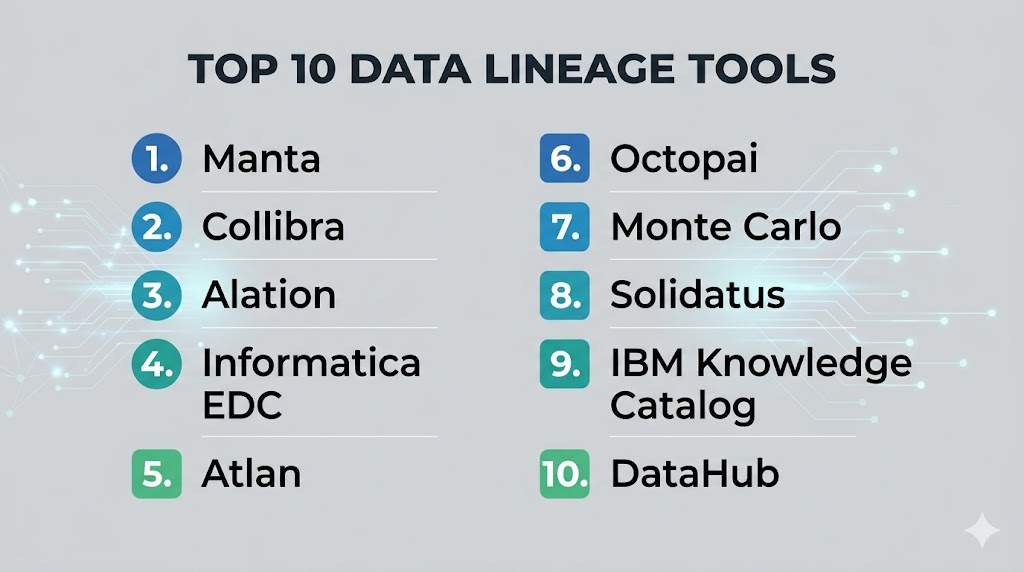
Introduction
Data lineage tools provide a visual map of the data’s journey, showing where data originates, how it is transformed, and where it ultimately resides. In plain English, it is the “family tree” of your data. Understanding this path is critical because data today is no longer static; it flows through complex pipelines, shifting from raw sensors and databases into processed reports and machine learning models. Without a clear map, organizations struggle to trust their reports, fix broken pipelines, or comply with strict data privacy regulations.
In the current data landscape, lineage matters more than ever. As organizations adopt decentralized architectures like Data Mesh, the complexity of data movement has increased exponentially. Data lineage tools allow teams to perform “impact analysis”—seeing exactly which downstream dashboards will break if a source table is modified. They also facilitate “root cause analysis,” helping data engineers trace a faulty number in a CEO’s dashboard back to a specific error in an ETL script that occurred hours earlier.
Real-World Use Cases:
- Regulatory Compliance: Providing auditors with a clear audit trail of how sensitive financial or personal data was handled and transformed to meet GDPR or BCBS 239 requirements.
- Impact Analysis: Assessing the potential consequences of changing a data schema by identifying every downstream application, report, or model that relies on that specific data point.
- Data Trust and Quality: Enabling business users to click on a metric in a BI tool and see the entire history of where that data came from, building confidence in the insights provided.
- Cloud Migration: Mapping legacy on-premise systems to ensure that all critical data dependencies are accounted for before moving workloads to a cloud data warehouse.
- System Troubleshooting: Reducing the “mean time to resolution” (MTTR) by quickly identifying where a data pipeline failed and what specific transformation logic caused the data anomaly.
Buyer Evaluation Criteria:
- Level of Granularity: Whether the tool provides lineage at the table level, column level, or even the cell level.
- Automation vs. Manual Entry: The tool’s ability to automatically parse SQL, ETL code, and BI metadata versus requiring manual mapping.
- Parsing Depth: How effectively the tool handles complex, nested SQL scripts and various proprietary ETL languages.
- Temporal Lineage: The ability to view how lineage looked at a specific point in the past to compare changes over time.
- Integration Breadth: Compatibility with the existing data stack, including modern cloud warehouses, legacy mainframes, and BI tools.
- User Interface and Visualization: How intuitive the lineage graphs are for both technical engineers and business stakeholders.
- Active Metadata Capabilities: Whether the tool can trigger alerts or actions in other systems based on lineage changes.
- Scalability: The capacity to handle millions of metadata objects without degrading performance.
Best for: Large-scale enterprises, highly regulated industries (banking, healthcare), and data engineering teams managing complex, multi-layered data pipelines. It is essential for organizations undergoing digital transformation or cloud migration projects.
Not ideal for: Small businesses with simple, single-source data setups where a manual spreadsheet or simple documentation might suffice. It is also not a replacement for basic data documentation for teams that do not have complex transformations.
Key Trends in Data Lineage Tools
- Automated SQL Parsing: Modern tools are shifting away from manual tagging toward sophisticated natural language and code parsers that “read” SQL scripts and ETL logs to build lineage automatically.
- Column-Level Lineage: There is a move toward extreme granularity, where users can trace an individual column through hundreds of transformations to see exactly how its value was derived.
- Integration with Data Observability: Lineage is no longer a standalone feature; it is being integrated into observability platforms to show the “blast radius” of data quality issues.
- Active Metadata Management: Tools are using lineage to automatically update documentation, propagate security tags (like “PII”), and even suggest fixes for broken pipelines.
- Data Mesh Support: As organizations decentralize, lineage tools are evolving to track data “contracts” and flows between different independent business domains.
- AI-Assisted Mapping: Artificial Intelligence is being used to predict missing links in lineage maps and to translate complex code into human-readable business logic.
- Shift-Left Lineage: Developers are now viewing lineage during the CI/CD process to see the impact of their code changes before they are even deployed to production.
- Regulatory-Driven Traceability: With the rise of AI regulations, lineage tools are increasingly used to track the training data used for specific AI models to ensure ethical compliance.
How We Selected These Tools (Methodology)
- Market Adoption and Mindshare: We analyzed industry leadership and the frequency with which these tools appear in enterprise-scale data architecture discussions.
- Automated Ingestion Capabilities: Preference was given to tools that reduce manual effort through robust metadata harvesters and code scanners.
- Visualization Depth: We evaluated the clarity of the lineage graphs and the ability for users to “drill down” into specific technical details.
- Cross-Platform Support: We selected tools that bridge the gap between legacy on-premise systems and modern cloud-native environments.
- Metadata Integration: We looked for tools that do not just show a map, but also integrate lineage with data catalogs and governance workflows.
- Customer Feedback and Reliability: We considered signals regarding the stability of the software and the quality of customer support.
- Breadth of Connectors: The number of out-of-the-box integrations for common ETL, BI, and database platforms was a major factor.
- Technical Scalability: The ability of the tool to maintain responsiveness when mapping massive, complex enterprise environments.
Top 10 Data Lineage Tools
#1 — Manta
Manta is a specialized data lineage platform that focuses on “deep lineage.” It is designed to provide an incredibly detailed view of data flows by parsing various code types, including complex SQL and legacy ETL scripts. It acts as a “map” that other data governance tools use to understand the technical plumbing of an organization. It is primarily built for technical data engineers and architects who need to see the exact logic behind every data transformation.
Key Features
- Automated Code Parsing: Scans SQL, ETL tools, and BI reports to build maps automatically.
- Column-Level Granularity: Shows precisely how data moves from one specific column to another across systems.
- Historical Lineage: Allows users to travel back in time to see how data structures looked on previous dates.
- Impact and Root Cause Analysis: Dedicated views to see what will break or why something failed.
- Indirect Lineage: Tracks data dependencies even when the data isn’t directly moved, such as in “WHERE” clauses.
Pros
- Unrivaled depth in parsing complex, nested SQL and legacy systems.
- Integrates seamlessly with major data governance platforms like Collibra and Alation.
- Highly accurate, reducing the need for manual lineage verification.
Cons
- The user interface is very technical and can be overwhelming for business users.
- Initial setup and configuration of scanners can be time-consuming.
Platforms / Deployment
- Web / Windows / Linux
- Self-hosted / Cloud / Hybrid
Security & Compliance
- SSO/SAML, RBAC, Encryption-at-rest.
- SOC 2, ISO 27001, GDPR compliant.
Integrations & Ecosystem
Manta acts as a metadata provider for many other high-level governance tools.
- Collibra, Alation, and Informatica.
- Informatica PowerCenter, IBM DataStage, Microsoft SSIS.
- Snowflake, Teradata, Oracle, and AWS Redshift.
Support & Community
Professional enterprise support with dedicated engineers. Documentation is highly technical and comprehensive.
#2 — Collibra
Collibra is an industry-leading Data Intelligence platform that provides a wide suite of governance, catalog, and lineage features. Its lineage capabilities are designed to connect technical metadata with business context. It is the go-to solution for large enterprises that need a centralized “system of record” for data governance and want to ensure that lineage is accessible to everyone from engineers to compliance officers.
Key Features
- Business User Friendly: Visualizes lineage in a way that non-technical users can understand.
- Automated Metadata Ingestion: Connects to various sources to pull in schema and lineage info automatically.
- Direct & Indirect Lineage: Shows both the flow of data and the logic that influences its path.
- Integration with Data Catalog: Links lineage maps directly to business glossaries and ownership details.
- Traceability Reports: Generates automated reports for regulatory compliance audits.
Pros
- Excellent for bridging the gap between IT and business stakeholders.
- Part of a comprehensive governance suite, reducing the need for multiple tools.
- Strong focus on data privacy and stewardship workflows.
Cons
- Very expensive, making it less accessible for mid-market companies.
- The platform is large and complex, requiring dedicated administrators.
Platforms / Deployment
- Web
- Cloud (Fully Managed)
Security & Compliance
- SSO, MFA, RBAC, Audit logs.
- SOC 2, ISO 27001, FedRAMP, HIPAA.
Integrations & Ecosystem
Collibra has a vast ecosystem of certified integrations across the entire data stack.
- Manta (for deep technical lineage).
- Tableau, PowerBI, and Looker.
- Databricks, Snowflake, and Azure Data Factory.
Support & Community
World-class enterprise support and an extensive “Collibra University” for training and certification.
#3 — Alation
Alation was a pioneer in the data catalog space and has since built out robust, automated lineage capabilities. It uses “Active Metadata” to help users discover and trust data. Its lineage is particularly strong at showing how data moves into and through BI tools, making it ideal for organizations that want to improve the accuracy of their analytics and reporting.
Key Features
- Automated Lineage Generation: Scans query logs to build lineage based on actual data movement.
- Column-Level Impact Analysis: Shows the downstream effects of changing a specific field.
- Trust Flags: Displays warnings or endorsements directly on the lineage graph.
- Integration with BI Tools: Deep lineage into platforms like Tableau and PowerBI.
- Stewardship Dashboards: Helps data stewards identify areas where lineage is missing or broken.
Pros
- Superior user experience with a focus on search and discovery.
- Uses machine learning to “learn” lineage from existing SQL logs.
- Fosters collaboration through social features and comments.
Cons
- While improving, it may not be as deep as Manta for legacy ETL code parsing.
- Performance can slow down slightly with extremely massive metadata volumes.
Platforms / Deployment
- Web
- Cloud / Hybrid
Security & Compliance
- SSO/SAML, RBAC, Encryption.
- SOC 2, ISO 27001, GDPR.
Integrations & Ecosystem
Focuses on the modern data stack and business intelligence tools.
- Snowflake, Databricks, and AWS S3.
- Tableau, PowerBI, and MicroStrategy.
- Fivetran and dbt.
Support & Community
Active user community and strong professional support services. Documentation is user-friendly.
#4 — Informatica Enterprise Data Catalog (EDC)
Informatica EDC is a heavy-duty metadata management tool that provides “end-to-end” lineage across the entire enterprise. Leveraging Informatica’s long history in ETL, EDC is capable of scanning nearly any system, from 40-year-old mainframes to modern cloud warehouses. It is built for the world’s largest organizations with highly heterogeneous data environments.
Key Features
- Claire AI: Uses artificial intelligence to automatically identify and tag PII data across the lineage.
- Extensive Scanner Library: Hundreds of connectors for databases, ETL, BI, and mainframe systems.
- System-Level Lineage: Provides high-level maps of data movement between different applications.
- Open Metadata API: Allows for custom integrations and exporting lineage data to other systems.
- Semantic Search: Helps users find data assets and their lineage using natural language.
Pros
- Unrivaled connectivity for organizations with a mix of old and new technology.
- Powerful AI features that automate many governance tasks.
- Highly stable and designed for massive-scale enterprise environments.
Cons
- Complex to implement and requires specialized expertise.
- The user interface can feel dated compared to newer, cloud-native tools.
Platforms / Deployment
- Windows / Linux / Web
- Cloud / Self-hosted / Hybrid
Security & Compliance
- SSO, MFA, RBAC, Audit logs.
- SOC 2, ISO 27001, HIPAA.
Integrations & Ecosystem
Informatica EDC is part of the Intelligent Data Management Cloud (IDMC).
- Informatica PowerCenter and IICS.
- SAP, Oracle, and Microsoft SQL Server.
- Major Cloud providers (AWS, Azure, GCP).
Support & Community
Extensive global support network and a large community of certified Informatica developers.
#5 — Atlan
Atlan is a “modern data catalog” designed for teams using cloud-native tools like Snowflake and dbt. Its lineage is highly automated and focuses on collaboration. Atlan stands out for its “embedded lineage,” which means lineage information follows the data into the tools that people are already using, like Slack or BI dashboards.
Key Features
- Automated Column-Level Lineage: Automatically builds maps from SQL logs and modern ETL tools.
- Embedded Lineage: Shows lineage information directly inside tools like Tableau or Chrome via a plugin.
- Open API Architecture: Built for the “modern data stack” with easy extensibility.
- Automated PII Tagging: Propagates security tags downstream automatically based on lineage.
- Collaboration Features: Integration with Slack and Microsoft Teams for discussing data issues.
Pros
- Very fast time-to-value for teams already on the modern cloud data stack.
- Exceptional, modern user interface that users actually enjoy using.
- Transparent and competitive pricing compared to legacy giants.
Cons
- Fewer connectors for legacy on-premise systems and mainframes.
- May lack some of the deepest technical parsing found in Manta.
Platforms / Deployment
- Web
- Cloud (Fully Managed SaaS)
Security & Compliance
- SSO/SAML, RBAC, Encryption-at-rest.
- SOC 2 Type II, HIPAA, GDPR.
Integrations & Ecosystem
Deeply integrated with the modern data stack (MDS).
- Snowflake, Databricks, and BigQuery.
- dbt, Fivetran, and Airbyte.
- Slack and GitHub.
Support & Community
Very responsive support and a rapidly growing community of modern data practitioners.
#6 — Octopai
Octopai is a highly automated data lineage and discovery platform specifically designed for BI and analytics teams. It focuses on the “middle and end” of the data journey, helping users understand how data moves from ETL into reports. Octopai is known for its ability to go live in very short periods because its scanners are highly specialized for common BI stacks.
Key Features
- Automated Discovery: Instantly scans the entire BI landscape to find every data movement.
- Cross-Platform Lineage: Shows how data moves from one vendor’s ETL into another’s BI tool.
- Business Lineage: A simplified view for non-technical managers.
- Impact Analysis: One-click views to see which reports will break if a database changes.
- Source-to-Target Mapping: Clear visualization of data migrations.
Pros
- Incredibly fast implementation (often within 24–48 hours).
- Excellent for teams struggling specifically with BI report accuracy.
- Simple, intuitive interface that doesn’t require deep training.
Cons
- Not as deep in “code parsing” for custom-written Python or Java ETL scripts.
- Primarily focused on the BI/Analytics layer rather than the full engineering stack.
Platforms / Deployment
- Web
- Cloud (SaaS)
Security & Compliance
- SSO/SAML, RBAC, Encryption.
- SOC 2 compliant.
Integrations & Ecosystem
Strongest connectors are in the traditional and modern BI space.
- Microsoft SSIS, SSRS, and PowerBI.
- Informatica, DataStage, and Talend.
- Oracle, Snowflake, and Teradata.
Support & Community
Direct professional support with a focus on quick onboarding. Documentation is clear and practical.
#7 — Monte Carlo
Monte Carlo is primarily a “Data Observability” platform, but lineage is a core component of its offering. It uses lineage to determine the “blast radius” of data quality incidents. If a table has a schema change or a data freshness issue, Monte Carlo uses lineage to show exactly which dashboards and users are affected.
Key Features
- Automated Lineage Discovery: Builds maps without any manual configuration by analyzing query logs.
- Blast Radius Analysis: Shows exactly how many reports are impacted by a data quality issue.
- Incident Management: Alerts users when lineage breaks or changes unexpectedly.
- Data Health Dashboards: Combines lineage with data quality metrics for a holistic view.
- End-to-End Visibility: Links data sources through the warehouse and into the BI layer.
Pros
- Uniquely focuses on “Operational Lineage” (what is breaking right now).
- Requires zero manual tagging to get started.
- Highly effective for data engineering teams focused on reliability.
Cons
- Lineage is a means to an end (observability), not a standalone governance tool.
- Lacks the deep compliance and stewardship features of Collibra.
Platforms / Deployment
- Web
- Cloud (SaaS)
Security & Compliance
- SSO, RBAC, Audit logging.
- SOC 2, GDPR.
Integrations & Ecosystem
Tightly integrated with the modern data and observability stack.
- Snowflake, BigQuery, and Databricks.
- Airflow, dbt, and Prefect.
- Tableau and Looker.
Support & Community
Very high-touch support from data reliability experts. Extensive documentation on data observability.
#8 — Solidatus
Solidatus is an award-winning data lineage and modeling platform that focuses on high-level visualization and regulatory reporting. It is particularly popular in the financial services industry because it allows organizations to model their data flows in a very precise, audited way. It is designed for “active” lineage, where the map is used to drive business decisions and regulatory compliance.
Key Features
- High-Definition Lineage: Allows for extremely detailed modeling of complex data flows.
- Regulatory Reporting: Templates specifically designed for BCBS 239 and other regulations.
- Data Modeling Integration: Combines lineage with physical and logical data models.
- Collaborative Design: Allows multiple users to work on the data map simultaneously.
- Impact Modeling: Test “what-if” scenarios by simulating changes in the lineage map.
Pros
- The most visually flexible and powerful modeling interface.
- Specifically built to handle the rigorous requirements of global banks.
- Capable of mapping both data and business processes.
Cons
- Requires a higher level of manual modeling compared to fully automated scanners.
- Less “plug-and-play” than some of the modern SaaS-first competitors.
Platforms / Deployment
- Web
- Cloud / Self-hosted
Security & Compliance
- SSO/SAML, MFA, RBAC.
- SOC 2, ISO 27001, GDPR.
Integrations & Ecosystem
Focused on enterprise governance and technical metadata management.
- Collibra and Alation.
- Enterprise databases (SQL Server, Oracle).
- Custom API for data ingestion.
Support & Community
Expert-level support with a focus on large financial institutions.
#9 — IBM Knowledge Catalog
Part of the IBM Cloud Pak for Data, this tool provides a robust catalog and lineage environment infused with IBM’s Watson AI. It is designed to automate the discovery of metadata and the generation of lineage across hybrid cloud environments. It is a natural choice for organizations that are already using the IBM data ecosystem.
Key Features
- Watson-Powered Discovery: Automatically classifies data and builds lineage maps using ML.
- Hybrid Cloud Visibility: Maps data across on-premise and multiple cloud environments.
- Policy Enforcement: Automatically applies security policies based on data lineage.
- Integrated Quality Scores: Shows the health of data assets directly on the lineage graph.
- Collaborative Governance: Tools for stewards to manage and approve lineage maps.
Pros
- Strong AI integration that saves significant manual labor.
- Very reliable for large-scale, complex enterprise deployments.
- Excellent integration with IBM’s broader AI and Data stack.
Cons
- Can be complex to navigate for teams outside the IBM ecosystem.
- License management can be difficult to track.
Platforms / Deployment
- Web / Linux
- Cloud / Hybrid (Cloud Pak for Data)
Security & Compliance
- SSO, MFA, RBAC, Encryption.
- SOC 2, ISO 27001, HIPAA, GDPR.
Integrations & Ecosystem
Centrally integrated with the IBM data portfolio.
- IBM InfoSphere Information Server.
- Db2, Netezza, and Cloud Object Storage.
- Watson Studio for AI.
Support & Community
Comprehensive global enterprise support. Extensive technical documentation and training.
#10 — DataHub
DataHub is an open-source metadata platform originally developed at LinkedIn. It is designed for modern, high-growth tech companies that need a highly extensible and developer-friendly lineage solution. Because it is open-source, it allows organizations to build custom scanners and integrate lineage deeply into their internal engineering workflows.
Key Features
- Push-Based Architecture: Allows systems to “push” lineage changes as they happen.
- Extensible Schema: Easily add custom metadata fields to lineage objects.
- Column-Level Lineage: Detailed tracking of field-level transformations.
- Impact Analysis UI: Dedicated interface for developers to see downstream dependencies.
- Full-Text Search: Powerful search across the entire metadata graph.
Pros
- Completely free and open-source (software cost).
- Highly flexible and customizable for unique engineering needs.
- Strong developer community and active development.
Cons
- Requires significant engineering resources to host, manage, and customize.
- Lacks the “out-of-the-box” polished user experience of paid SaaS tools.
Platforms / Deployment
- Linux / macOS (Docker/Kubernetes)
- Self-hosted / Cloud (Managed via Acryl Data)
Security & Compliance
- OIDC/SAML, RBAC, Encryption.
- SOC 2 (via Acryl Data).
Integrations & Ecosystem
Strongest support is for the modern, open-source data stack.
- Airflow, dbt, and Kafka.
- Snowflake, BigQuery, and Postgres.
- Looker and Superset.
Support & Community
Thriving open-source community on Slack and GitHub. Commercial support is available via Acryl Data.
Comparison Table (Top 10)
| Tool Name | Best For | Platform(s) Supported | Deployment | Standout Feature | Public Rating |
| Manta | Deep SQL Parsing | Win, Linux, Web | Hybrid | Automated Deep Parsing | N/A |
| Collibra | Enterprise Governance | Web | Cloud | Business-Ready Lineage | N/A |
| Alation | Data Discovery | Web | Hybrid | Active Metadata Maps | 4.5/5 |
| Informatica EDC | Legacy + Modern Stack | Win, Linux, Web | Hybrid | Claire AI Automation | N/A |
| Atlan | Modern Data Teams | Web | Cloud | Embedded Lineage | 4.8/5 |
| Octopai | BI & Analytics | Web | Cloud | 24hr Implementation | N/A |
| Monte Carlo | Data Reliability | Web | Cloud | Blast Radius Analysis | 4.7/5 |
| Solidatus | Financial Compliance | Web | Hybrid | Visual Modeling Depth | N/A |
| IBM Knowledge Cat. | IBM Ecosystem | Linux, Web | Hybrid | Watson AI Integration | N/A |
| DataHub | Open Source / Devs | Linux, Mac | Self-hosted | Extensible Metadata Graph | 4.6/5 |
Evaluation & Scoring of Data Lineage Tools
| Tool Name | Core (25%) | Ease (15%) | Integrations (15%) | Security (10%) | Performance (10%) | Support (10%) | Value (15%) | Weighted Total |
| Manta | 10 | 4 | 9 | 9 | 10 | 8 | 7 | 8.15 |
| Collibra | 9 | 7 | 10 | 10 | 8 | 10 | 6 | 8.35 |
| Alation | 9 | 9 | 9 | 9 | 8 | 9 | 8 | 8.70 |
| Informatica EDC | 10 | 4 | 10 | 10 | 8 | 9 | 6 | 7.90 |
| Atlan | 9 | 10 | 9 | 9 | 9 | 9 | 9 | 9.15 |
| Octopai | 7 | 10 | 7 | 8 | 9 | 8 | 8 | 7.90 |
| Monte Carlo | 8 | 9 | 10 | 9 | 10 | 9 | 8 | 8.85 |
| Solidatus | 9 | 5 | 7 | 9 | 9 | 8 | 7 | 7.55 |
| IBM Knowledge Cat. | 9 | 6 | 8 | 10 | 8 | 9 | 7 | 8.05 |
| DataHub | 8 | 5 | 9 | 8 | 10 | 6 | 10 | 7.70 |
Interpretation:
The weighted total reflects a market where Ease of Use and Time-to-Value are becoming just as important as technical depth. Tools with a score over 8.5 are typically modern platforms that offer high automation and a great user experience. Scores between 7.5 and 8.4 often represent high-end, specialized enterprise tools that are extremely powerful but require significant investment in time and expertise. Scores below 7.5 are usually for niche tools or those requiring extensive manual modeling.
Which Data Lineage Tool Is Right for You?
Solo / Freelancer
For a single data consultant, a full enterprise lineage platform is usually overkill. DataHub (Open Source) is a great way to build your own skills, or if you have a budget, Atlan offers a lower barrier to entry. If you are working primarily on a specific stack like Snowflake, the built-in lineage features within Snowflake itself may be enough to start.
SMB
Small to medium businesses should prioritize automation and ease of use. Atlan and Octopai are the top contenders here. Atlan is better for a comprehensive view of the modern data stack, while Octopai is ideal if your primary pain point is simply understanding how your BI reports are built and why they break.
Mid-Market
Mid-market companies with growing data teams should look for a tool that scales without requiring a full-time administrator. Alation provides a great balance of automation and user-friendly discovery. If your focus is primarily on preventing data brokenness, Monte Carlo is the better choice as it combines lineage with active monitoring.
Enterprise
For global organizations with a mix of legacy and cloud tech, Informatica EDC or Collibra (integrated with Manta) are the gold standards. These tools are designed to handle the complexity of thousands of databases and provide the audit-level reporting required by major regulatory bodies.
Budget vs Premium
Budget: DataHub is the clear winner if you have the engineering talent to maintain it. For a low-cost paid option, Octopai offers a very specific value proposition for the price.
Premium: Collibra and Informatica are the premium “all-in-one” solutions, offering white-glove service and comprehensive feature sets at a high price point.
Feature Depth vs Ease of Use
If you need to know exactly what is happening in a 500-line stored procedure, Manta is the only tool for the job. If you want your business analysts to be able to find data and see where it comes from without a manual, Alation or Atlan are far superior.
Integrations & Scalability
Atlan and Monte Carlo lead the pack for integration with modern cloud warehouses. For massive on-premise scalability, Informatica has a multi-decade track record of handling the world’s largest data environments.
Security & Compliance Needs
Financial and healthcare organizations should prioritize Solidatus or Collibra. These tools are built from the ground up to support the precise modeling and strict auditing required for high-stakes regulatory compliance.
Frequently Asked Questions (FAQs)
1. What is the difference between a data catalog and a data lineage tool?
A data catalog is like a library index; it tells you what data you have, where it is, and what it means. A data lineage tool is like a map of the roads between those libraries; it shows you how the data moved from one place to another and how it changed along the way. Most modern platforms now combine both features into a single interface.
2. Is manual data lineage still worth doing?
Manual lineage is extremely slow and prone to error, but it is sometimes necessary for business processes that don’t involve code (like a human manually moving data between spreadsheets). For technical systems, manual lineage is no longer viable at scale, and automated tools are the only way to ensure accuracy and up-to-date information.
3. Can data lineage tools help with GDPR and CCPA compliance?
Yes, these tools are essential for “The Right to Be Forgotten.” If a customer asks you to delete their data, you need lineage to find every copy of that data across your entire environment. Lineage also helps you prove to regulators that you are handling personal data (PII) according to your documented policies.
4. Does data lineage slow down my production databases?
Most modern lineage tools do not touch the data itself; they only read “metadata” or logs. This means they have zero or negligible impact on the performance of your production systems. They are “read-only” observers of your environment.
5. How long does it take to implement a data lineage tool?
Implementation can range from a few hours (for SaaS tools like Atlan or Octopai) to several months (for enterprise systems like Informatica EDC). The timeline depends on the number of systems you want to scan and how complex your custom code is.
6. What is “Column-Level Lineage” and why is it important?
Column-level lineage shows the path of a single data field (like “Social Security Number”) rather than a whole table. This is important because a single table might have 100 columns, but only 5 of them are sensitive. Knowing exactly where those 5 sensitive columns go is critical for security and precise troubleshooting.
7. Can lineage tools handle custom-written Python or Java ETL code?
Only the most advanced tools like Manta or Informatica can effectively parse custom-written programming code. Most standard lineage tools focus on SQL or common ETL vendors. If your organization uses heavy amounts of custom code, you will need a tool with deep “technical lineage” capabilities.
8. Is lineage useful for Machine Learning and AI?
Lineage is critical for “Model Reproducibility.” If an AI model starts giving strange results, you need lineage to see exactly which version of which dataset was used to train it. Lineage also helps ensure that “poisoned” or biased data is not entering your AI pipelines.
9. What is the “blast radius” in data lineage?
Blast radius refers to the downstream impact of a change or a failure. If a source table in your database crashes, the “blast radius” is the list of every dashboard, report, and ML model that will now show incorrect or missing data as a result of that crash.
10. Do I need to buy a separate lineage tool if I use Snowflake or Databricks?
Both Snowflake and Databricks have built-in lineage features, but they are often limited to what happens inside their own platforms. If you have data coming from an external SQL server and ending up in a Tableau report, you will likely need a third-party tool to see the “end-to-end” journey across those different vendors.
Conclusion
In an era where data complexity is the new normal, data lineage tools have transformed from “nice-to-have” documentation utilities into mission-critical infrastructure. The ability to visualize the flow and transformation of information is the difference between a data-driven organization and one that is simply drowning in data it doesn’t trust. As we have seen, the “best” tool depends entirely on your specific landscape—whether you are a high-growth startup on a modern cloud stack or a legacy enterprise managing decades of technical debt.For most organizations, the path forward starts with a clear understanding of the “blast radius” of their data issues. By moving away from manual spreadsheets and adopting automated lineage, you not only ensure regulatory compliance but also empower your data engineers to move faster and with more confidence. Before making a final choice, run a pilot on your most complex pipeline, validate the tool’s ability to parse your specific SQL dialect, and ensure the resulting map is something both your engineers and business stakeholders can actually use.

Interesting read, kept me focused till the end.