MOTOSHARE 🚗🏍️
Rent Bikes & Cars Directly from Owners
Motoshare connects vehicle owners with people who need bikes and cars on rent. Owners earn from idle vehicles, and renters get flexible ride options.
Visit Motoshare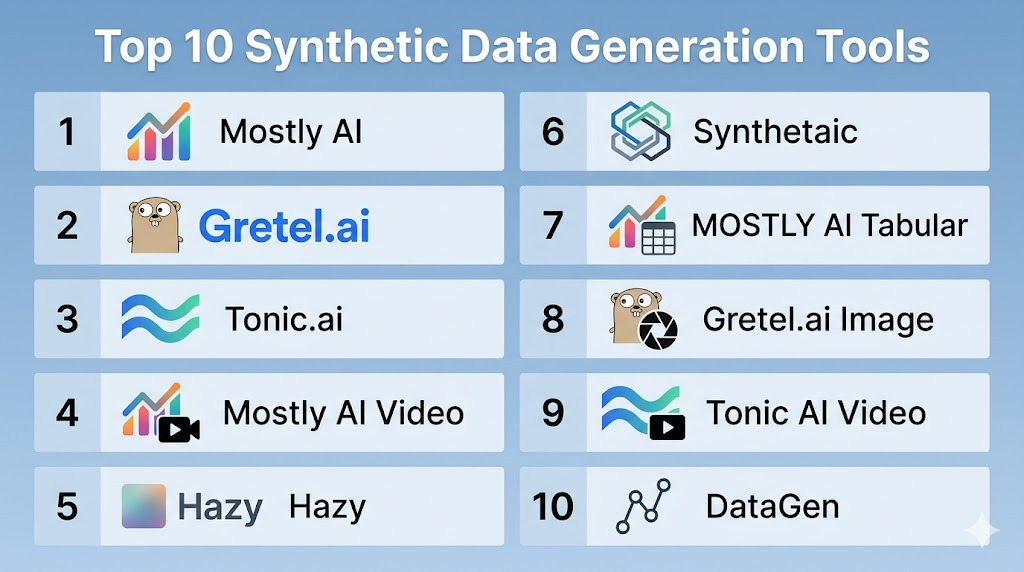
Introduction
Synthetic Data Generation Tools create artificial datasets that mimic real-world data while preserving privacy and statistical properties. They are critical for training machine learning models, testing systems, and sharing data without exposing sensitive information. In 2026, with increasing regulations and privacy concerns, synthetic data helps organizations accelerate AI development, mitigate bias, and reduce dependency on costly real-world data.
Real-world applications include generating anonymized healthcare datasets for clinical research, creating synthetic transaction data for financial fraud detection, producing customer behavior data for e-commerce personalization, simulating sensor data for autonomous vehicles, and producing datasets for AI model testing where real data is limited or sensitive.
When evaluating synthetic data platforms, buyers should consider:
- Data types supported (tabular, image, text, time-series)
- Quality and realism of generated data
- Privacy guarantees (differential privacy, anonymization)
- Integration with ML and analytics pipelines
- Scalability and multi-dataset support
- Automation and API access for generation workflows
- Visualization and validation tools
- Compliance with data protection regulations
- Pricing and total cost of ownership
- Support and community strength
Best for: AI/ML teams, data scientists, compliance teams, enterprises handling sensitive data, industries like healthcare, finance, and autonomous systems.
Not ideal for: Organizations with abundant real-world datasets and minimal privacy constraints; simpler anonymization methods may suffice without synthetic generation.
Key Trends in Synthetic Data Generation Tools
- Adoption of AI-driven generative models (GANs, VAEs, Diffusion Models) for high-fidelity data.
- Emphasis on privacy-preserving techniques, including differential privacy.
- Multi-modal support: tabular, image, video, audio, and text data generation.
- Integration with ML pipelines for automated synthetic dataset creation.
- Cloud and hybrid deployment options for scalable workloads.
- Evaluation tools for data quality, bias, and distribution similarity.
- Open-source frameworks alongside commercial SaaS platforms.
- Industry-specific templates and domain-adapted synthetic generation.
- Subscription and usage-based pricing models for SMB adoption.
- Emphasis on regulatory compliance for sensitive sectors.
How We Selected These Tools (Methodology)
- Evaluated market adoption and industry recognition.
- Assessed feature completeness, including multi-modal support and privacy guarantees.
- Reviewed quality, realism, and fidelity of generated datasets.
- Examined performance and reliability in production workflows.
- Verified security and compliance capabilities.
- Checked integrations with ML, analytics, and testing pipelines.
- Considered customer fit across enterprise, SMB, and developer teams.
- Analyzed documentation, SDKs, and API accessibility.
- Prioritized scalability and support for multi-dataset management.
- Factored in pricing models relative to features and value.
Top 10 Synthetic Data Generation Tools
#1 — Mostly AI
Short description : Mostly AI generates realistic tabular and transactional data with strong privacy protection. Ideal for enterprises needing high-quality synthetic datasets for ML and analytics.
Key Features
- Tabular and transactional data generation
- Differential privacy guarantees
- Automated data profiling and validation
- Multi-dataset support
- API and SDK integration
- Compliance reporting for GDPR and HIPAA
Pros
- High realism for sensitive datasets
- Strong regulatory compliance support
Cons
- Enterprise pricing may be high
- Learning curve for complex workflows
Platforms / Deployment
- Web, Cloud
Security & Compliance
- GDPR, HIPAA, SOC 2, encryption
Integrations & Ecosystem
Supports Python SDK, REST APIs, ML pipelines, data warehouses.
- Tableau/Power BI connectors
- CI/CD and ML pipeline integration
- Cloud storage connectors
Support & Community
Enterprise onboarding and support, detailed documentation, community forum.
#2 — Gretel.ai
Short description : Gretel.ai offers privacy-preserving synthetic data generation for tabular, time-series, and structured datasets. Suitable for developers and ML teams.
Key Features
- Synthetic data with differential privacy
- Multi-format support
- API-driven generation
- Validation and metrics for quality
- Python SDK for integration
Pros
- Developer-friendly and flexible
- Strong privacy controls
Cons
- Enterprise features require paid tiers
- Limited visualizations for non-technical users
Platforms / Deployment
- Web, Cloud
Security & Compliance
- SOC 2, GDPR, encryption
Integrations & Ecosystem
Python SDK, REST APIs, CI/CD integration, cloud storage connectors.
Support & Community
Documentation, developer community, and enterprise support.
#3 — Tonic.ai
Short description : Tonic.ai generates synthetic data for enterprise applications, emphasizing realistic tabular datasets with automated privacy and compliance.
Key Features
- Tabular synthetic data generation
- Privacy-preserving transformations
- Automated dataset validation
- Integration with ML pipelines
- Versioned dataset management
Pros
- Enterprise-ready with compliance focus
- Easy-to-use platform with API support
Cons
- Limited to tabular and structured data
- Pricing may be high for small teams
Platforms / Deployment
- Web, Cloud
Security & Compliance
- GDPR, HIPAA, SOC 2, encryption
Integrations & Ecosystem
Python SDK, REST APIs, cloud data pipelines, CI/CD integration.
Support & Community
Enterprise support and onboarding, detailed documentation.
#4 — Mostly AI Video
Short description : Focused on synthetic video and image data generation, Mostly AI Video provides high-fidelity datasets for training computer vision models.
Key Features
- Video and image synthetic data
- Privacy-preserving generative models
- Multi-format export
- Automated validation tools
- API and SDK support
Pros
- High-quality media datasets
- Strong privacy and compliance
Cons
- Specialized for video/image
- Higher computational requirements
Platforms / Deployment
- Web, Cloud
Security & Compliance
- GDPR, SOC 2
Integrations & Ecosystem
Python SDK, REST APIs, cloud pipelines, ML frameworks like PyTorch and TensorFlow.
Support & Community
Professional onboarding, enterprise support, documentation.
#5 — Hazy
Short description : Hazy specializes in synthetic tabular data for finance and enterprise AI, focusing on privacy-preserving generation and compliance automation.
Key Features
- Privacy-preserving synthetic tabular data
- Compliance automation (GDPR, CCPA)
- Automated data validation
- Versioning and lineage tracking
- Python SDK and APIs
Pros
- Enterprise-ready privacy tools
- Compliance-focused features
Cons
- Limited non-tabular support
- Enterprise pricing model
Platforms / Deployment
- Web, Cloud
Security & Compliance
- GDPR, SOC 2, encryption
Integrations & Ecosystem
Python SDK, REST APIs, ML pipelines, data warehouses.
Support & Community
Enterprise support, documentation, onboarding services.
#6 — Synthetaic
Short description : Synthetaic generates synthetic image and video datasets for computer vision model training, focusing on realism and data diversity.
Key Features
- Synthetic images and videos
- Diverse scenarios and contexts
- API-based generation
- Validation and metrics for quality
- Dataset management
Pros
- Realistic datasets for computer vision
- Flexible generation scenarios
Cons
- Limited tabular support
- Computationally intensive for large datasets
Platforms / Deployment
- Web, Cloud
Security & Compliance
- Not publicly stated
Integrations & Ecosystem
API integration, Python SDK, ML frameworks like PyTorch and TensorFlow.
Support & Community
Enterprise support, documentation, customer success.
#7 — MOSTLY AI Tabular
Short description : Focused on structured tabular datasets, MOSTLY AI Tabular delivers privacy-preserving synthetic data with automated feature generation for ML pipelines.
Key Features
- Tabular data with differential privacy
- Automated feature generation
- API/SDK support
- Validation and metrics
- Dataset versioning
Pros
- Realistic tabular datasets
- Enterprise-grade privacy
Cons
- Limited media data support
- Higher cost for small teams
Platforms / Deployment
- Web, Cloud
Security & Compliance
- GDPR, SOC 2, encryption
Integrations & Ecosystem
Python SDK, REST APIs, ML pipelines, CI/CD integration.
Support & Community
Enterprise onboarding, support, documentation.
#8 — Gretel.ai Image
Short description : Gretel.ai Image focuses on synthetic image and visual data, providing privacy-preserving media datasets for AI and computer vision.
Key Features
- Synthetic images with privacy guarantees
- Multi-format export
- API and SDK access
- Validation and metrics
- Multi-dataset management
Pros
- Privacy-preserving image datasets
- Developer-friendly API
Cons
- Limited to visual data
- Requires computational resources for large datasets
Platforms / Deployment
- Web, Cloud
Security & Compliance
- SOC 2, GDPR
Integrations & Ecosystem
Python SDK, REST APIs, cloud pipelines, ML frameworks.
Support & Community
Documentation, enterprise support, developer resources.
#9 — Tonic AI Video
Short description : Tonic AI Video generates synthetic video datasets for AI model training, focusing on realism, diversity, and compliance.
Key Features
- Synthetic video generation
- API-based workflows
- Validation metrics for quality
- Multi-format export
- Dataset versioning
Pros
- Realistic video datasets for training
- Enterprise-grade privacy
Cons
- Limited tabular support
- High computational demands
Platforms / Deployment
- Web, Cloud
Security & Compliance
- GDPR, SOC 2
Integrations & Ecosystem
Python SDK, REST APIs, ML pipelines, cloud storage connectors.
Support & Community
Enterprise onboarding, documentation, professional support.
#10 — DataGen
Short description : DataGen creates synthetic image and video datasets for computer vision AI, focusing on realism and controlled variability for model training.
Key Features
- High-fidelity image/video generation
- Scenario control and variability
- API/SDK access
- Validation and quality metrics
- Dataset versioning
Pros
- Realistic, diverse datasets
- Developer and enterprise-friendly
Cons
- No tabular data support
- Computationally intensive for large datasets
Platforms / Deployment
- Web, Cloud
Security & Compliance
- Not publicly stated
Integrations & Ecosystem
Python SDK, REST APIs, ML frameworks, cloud pipelines.
Support & Community
Documentation, enterprise support, customer success.
Comparison Table (Top 10)
| Tool Name | Best For | Platform(s) Supported | Deployment | Standout Feature | Public Rating |
|---|---|---|---|---|---|
| Mostly AI | Enterprise tabular | Web | Cloud | High-fidelity tabular data | N/A |
| Gretel.ai | Developer, tabular/time-series | Web | Cloud | Differential privacy | N/A |
| Tonic.ai | Enterprise tabular | Web | Cloud | Automated compliance | N/A |
| Mostly AI Video | Video/image data | Web | Cloud | High-fidelity video generation | N/A |
| Hazy | Enterprise finance | Web | Cloud | Privacy automation | N/A |
| Synthetaic | CV AI training | Web | Cloud | Diverse synthetic images/videos | N/A |
| MOSTLY AI Tabular | Structured ML datasets | Web | Cloud | Automated feature generation | N/A |
| Gretel.ai Image | Image generation | Web | Cloud | Privacy-preserving visuals | N/A |
| Tonic AI Video | Video datasets | Web | Cloud | Realistic video generation | N/A |
| DataGen | CV model training | Web | Cloud | Controlled variability | N/A |
Evaluation & Scoring of Synthetic Data Generation Tools
| Tool Name | Core (25%) | Ease (15%) | Integrations (15%) | Security (10%) | Performance (10%) | Support (10%) | Value (15%) | Weighted Total (0–10) |
|---|---|---|---|---|---|---|---|---|
| Mostly AI | 9 | 8 | 8 | 9 | 9 | 8 | 7 | 8.5 |
| Gretel.ai | 8 | 8 | 8 | 9 | 8 | 8 | 7 | 8.0 |
| Tonic.ai | 8 | 8 | 7 | 9 | 8 | 8 | 7 | 7.9 |
| Mostly AI Video | 9 | 7 | 7 | 8 | 9 | 8 | 7 | 8.0 |
| Hazy | 8 | 7 | 7 | 8 | 8 | 7 | 7 | 7.5 |
| Synthetaic | 8 | 7 | 7 | 7 | 8 | 7 | 7 | 7.4 |
| MOSTLY AI Tabular | 8 | 8 | 7 | 8 | 8 | 7 | 7 | 7.7 |
| Gretel.ai Image | 8 | 8 | 7 | 8 | 8 | 7 | 7 | 7.7 |
| Tonic AI Video | 8 | 7 | 7 | 8 | 8 | 7 | 7 | 7.5 |
| DataGen | 8 | 7 | 7 | 7 | 8 | 7 | 7 | 7.4 |
Interpretation: Higher weighted totals indicate stronger feature completeness, privacy support, and enterprise-readiness. Scores are comparative across tools.
Which Synthetic Data Generation Tool Is Right for You?
Solo / Freelancer
Open-source or lightweight tools like Gretel.ai or Synthetaic provide flexibility and cost-effective access to synthetic data generation.
SMB
Tonic.ai, Hazy, and MOSTLY AI Tabular provide privacy-preserving automation, versioning, and integration for mid-sized teams.
Mid-Market
Mostly AI, Gretel.ai Image, and Synthetaic deliver enterprise-grade quality, multi-dataset support, and compliance features.
Enterprise
Mostly AI, Tonic.ai Video, and DataGen excel for large-scale deployments with strong privacy, governance, and regulatory compliance.
Budget vs Premium
Open-source tools lower upfront costs but may need more engineering. Premium platforms provide automation, compliance, and enterprise support.
Feature Depth vs Ease of Use
Developer tools focus on flexibility and API integration; enterprise platforms provide dashboards, monitoring, and governance for broader stakeholders.
Integrations & Scalability
Select platforms compatible with your ML pipelines, cloud storage, and analytics systems. Enterprise deployments require multi-model support and scalability.
Security & Compliance Needs
High-risk industries should prioritize differential privacy, SOC 2, GDPR compliance, and encrypted data storage.
Frequently Asked Questions (FAQs)
1. What is synthetic data and why use it?
Synthetic data is artificially generated data that mimics real datasets. It allows AI development without exposing sensitive information, ensuring privacy and compliance.
2. Do synthetic data tools support multiple data types?
Yes, most platforms support tabular, image, video, text, and time-series datasets for diverse ML use cases.
3. Are these tools secure for sensitive data?
Commercial tools often include differential privacy, SOC 2, GDPR compliance, and encryption. Open-source tools may require additional configuration.
4. Can synthetic data replace real data entirely?
Synthetic data is useful for augmentation, testing, and privacy-sensitive scenarios, but real data may still be needed for model accuracy in production.
5. How do I validate synthetic data quality?
Platforms provide metrics comparing distributions, statistical properties, and model performance to ensure realism and usefulness.
6. How do these tools integrate with ML pipelines?
Most provide Python SDKs, REST APIs, and cloud connectors for automated data generation and integration with training pipelines.
7. Are open-source tools sufficient for enterprises?
Open-source tools are flexible and cost-effective but may require engineering effort for scaling and compliance compared to premium SaaS platforms.
8. What are typical applications?
Fraud detection, medical research, e-commerce personalization, autonomous vehicles, computer vision training, and testing AI models.
9. What pricing models exist?
Commercial platforms offer subscription or usage-based pricing. Open-source platforms may only incur infrastructure and operational costs.
10. Can synthetic data help reduce bias?
Yes, controlled synthetic generation allows balancing datasets and improving representation to mitigate model bias.
Conclusion
Synthetic Data Generation Tools enable organizations to develop AI systems efficiently while preserving privacy and compliance. Open-source tools like Gretel.ai and Synthetaic provide flexibility and lower costs for developers and SMBs. Enterprise solutions such as Mostly AI, Tonic.ai, and DataGen offer advanced automation, multi-modal support, and regulatory compliance for high-stakes applications. Key considerations include data types, privacy guarantees, integration, scalability, and total cost. Organizations should shortlist platforms, run pilots on critical workflows, validate compliance and data quality, and scale across teams for safe, efficient AI development

A well-structured and easy-to-understand article.