MOTOSHARE 🚗🏍️
Rent Bikes & Cars Directly from Owners
Motoshare connects vehicle owners with people who need bikes and cars on rent. Owners earn from idle vehicles, and renters get flexible ride options.
Visit Motoshare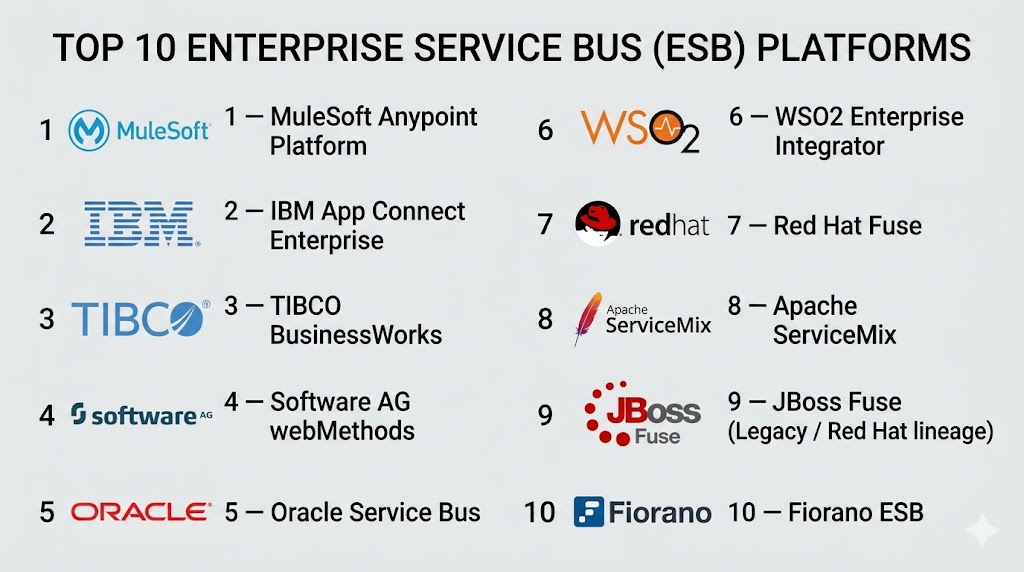
Introduction
Enterprise Service Bus (ESB) platforms help organizations connect applications, systems, databases, and services through a centralized integration layer. Instead of building many one-to-one integrations between tools, an ESB manages communication, routing, transformation, and orchestration in one structured platform. This reduces complexity and improves scalability as systems grow. ESB remains relevant because many enterprises still run hybrid environments that combine cloud apps, on-premise systems, legacy ERP software, and modern APIs. Industry sources continue to describe ESB as a practical architectural pattern for centralized integration in complex environments.
Common use cases include:
- Connecting ERP, CRM, HR, and finance systems
- Data transformation between old and new applications
- Workflow orchestration across departments
- B2B integrations with partners and vendors
- Event-driven messaging across enterprise systems
What buyers should evaluate:
- Integration connectors
- Scalability
- Security controls
- Monitoring and analytics
- Deployment flexibility
- Ease of development
- API support
- Reliability
- Vendor ecosystem
- Total cost of ownership
Best for: Enterprises, government organizations, banks, healthcare networks, manufacturers, and large IT teams managing many systems.
Not ideal for: Very small businesses, startups with only SaaS apps, or teams needing lightweight automation only. In those cases, iPaaS or API-first tools may be simpler.
Key Trends in Enterprise Service Bus (ESB) Platforms
- Hybrid integration is replacing pure on-premise deployments.
- ESB platforms increasingly include API management capabilities.
- AI-assisted mapping and workflow creation are growing.
- Low-code integration designers reduce dependency on specialists.
- Event streaming support is becoming standard.
- Security and zero-trust architecture are higher priorities.
- Real-time analytics and observability dashboards are expected.
- Containerized deployment with Kubernetes support is expanding.
- Legacy modernization projects keep ESB demand active.
- Organizations are combining ESB + iPaaS strategies.
How We Selected These Tools (Methodology)
We selected these platforms based on:
- Strong market recognition
- Enterprise deployment history
- Breadth of connectors and adapters
- Workflow orchestration capabilities
- Security features and governance options
- Hybrid cloud support
- Reliability and scalability reputation
- Developer experience and documentation
- Ecosystem maturity
- Suitability across multiple company sizes
Top 10 Enterprise Service Bus (ESB) Platforms
#1 — MuleSoft Anypoint Platform
Short description: One of the best-known enterprise integration platforms combining ESB, APIs, automation, and connectors for large organizations.
Key Features
- Enterprise-grade ESB runtime
- API lifecycle management
- Large connector library
- Data transformation tools
- Hybrid deployment
- Monitoring dashboards
- Reusable integration assets
Pros
- Very strong enterprise ecosystem
- Excellent for large-scale integrations
- Strong governance capabilities
Cons
- Premium pricing
- Learning curve for new teams
- Can require specialist resources
Platforms / Deployment
Web / Cloud / Hybrid / Self-hosted
Security & Compliance
SSO, RBAC, encryption, audit logs, MFA, GDPR support. Other certifications vary.
Integrations & Ecosystem
Strong integration ecosystem across SaaS, ERP, databases, and legacy systems.
- Salesforce
- SAP
- Oracle
- AWS
- ServiceNow
- REST/SOAP APIs
Support & Community
Strong documentation, partner network, enterprise support tiers.
#2 — IBM App Connect Enterprise
Short description: Enterprise integration solution from IBM focused on application connectivity, messaging, and transformation.
Key Features
- Message routing
- Data transformation
- API integration
- Event-driven architecture
- Cloud Pak compatibility
- Monitoring tools
- High-volume processing
Pros
- Strong for regulated enterprises
- Reliable at scale
- Deep IBM ecosystem fit
Cons
- Complex setup
- Premium enterprise pricing
- Best value inside IBM stack
Platforms / Deployment
Windows / Linux / Cloud / Hybrid
Security & Compliance
Enterprise IAM support, encryption, RBAC, audit controls.
Integrations & Ecosystem
Works well with IBM middleware, MQ, and enterprise apps.
- IBM MQ
- Db2
- SAP
- Oracle
- APIs
Support & Community
Enterprise-grade support with strong documentation.
#3 — TIBCO BusinessWorks
Short description: Mature integration suite used for enterprise connectivity and process automation.
Key Features
- Visual workflow design
- Broad adapters
- Real-time integration
- Event processing
- Process orchestration
- Monitoring tools
- Hybrid deployment
Pros
- Strong enterprise history
- Good for complex workflows
- Reliable performance
Cons
- Can feel legacy compared with newer tools
- Licensing costs
- Specialized skills helpful
Platforms / Deployment
Windows / Linux / Cloud / Hybrid
Security & Compliance
Encryption, RBAC, enterprise authentication support.
Integrations & Ecosystem
Good enterprise adapter ecosystem.
- SAP
- Oracle
- JMS
- Databases
- APIs
Support & Community
Strong vendor support, moderate community visibility.
#4 — Software AG webMethods
Short description: Established enterprise integration platform with ESB, B2B, and API capabilities.
Key Features
- ESB connectivity
- B2B integration
- API management
- Workflow automation
- Monitoring dashboards
- Hybrid support
- Governance tools
Pros
- Strong for large enterprises
- Good B2B features
- Broad integration coverage
Cons
- Complex licensing
- Enterprise-focused pricing
- Learning curve
Platforms / Deployment
Web / Cloud / Hybrid / Self-hosted
Security & Compliance
SSO, RBAC, encryption, governance features.
Integrations & Ecosystem
Strong connectors for enterprise systems and partner networks.
Support & Community
Professional support and enterprise onboarding.
#5 — Oracle Service Bus
Short description: Oracle-focused ESB platform built for enterprises already invested in Oracle infrastructure.
Key Features
- Service mediation
- Message routing
- Oracle integration
- Security policies
- Monitoring
- Workflow orchestration
- Scalability tools
Pros
- Great for Oracle environments
- Strong governance
- Mature platform
Cons
- Less attractive outside Oracle ecosystem
- Complexity
- Licensing costs
Platforms / Deployment
Web / Linux / Cloud / Hybrid
Security & Compliance
Enterprise security controls, RBAC, encryption.
Integrations & Ecosystem
Best fit with Oracle products and enterprise systems.
Support & Community
Strong vendor support.
#6 — WSO2 Enterprise Integrator
Short description: Popular open-source-friendly integration platform with ESB capabilities and API support.
Key Features
- Open-source foundation
- API integration
- Message brokering
- Data mapping
- Cloud-native support
- Monitoring
- Extensibility
Pros
- Lower cost potential
- Flexible deployment
- Strong for technical teams
Cons
- Requires technical expertise
- Smaller ecosystem than top enterprise vendors
- UI less polished for some users
Platforms / Deployment
Web / Linux / Cloud / Self-hosted / Hybrid
Security & Compliance
SSO, RBAC, encryption. Certifications vary by deployment.
Integrations & Ecosystem
Strong standards-based integrations.
Support & Community
Good community plus paid enterprise support.
#7 — Red Hat Fuse
Short description: Integration platform built on Apache Camel and open technologies.
Key Features
- Camel routing engine
- Container support
- API connectivity
- Microservices integration
- Open-source base
- Kubernetes friendly
- Messaging support
Pros
- Great for developers
- Strong cloud-native story
- Open standards approach
Cons
- Requires technical skills
- Less business-user friendly
- Best with Red Hat ecosystem knowledge
Platforms / Deployment
Linux / Cloud / Hybrid / Self-hosted
Security & Compliance
Enterprise controls via Red Hat stack.
Integrations & Ecosystem
Strong if using OpenShift and container platforms.
Support & Community
Good enterprise support and open-source community.
#8 — Apache ServiceMix
Short description: Open-source ESB built on Apache projects.
Key Features
- OSGi architecture
- Messaging support
- Camel routing
- Open-source flexibility
- Extensible components
- Standards support
- Self-hosted control
Pros
- No license cost
- Highly customizable
- Good for advanced teams
Cons
- Requires expertise
- Smaller commercial ecosystem
- Less polished UX
Platforms / Deployment
Linux / Self-hosted
Security & Compliance
Depends on implementation.
Integrations & Ecosystem
Works well with Apache stack tools.
Support & Community
Community-driven support.
#9 — JBoss Fuse (Legacy / Red Hat lineage)
Short description: Former enterprise integration platform widely used in legacy environments.
Key Features
- Camel-based routing
- Messaging
- Connectors
- Hybrid deployment
- Open-source roots
- Monitoring
- Extensibility
Pros
- Proven platform
- Flexible architecture
- Good migration path
Cons
- Legacy positioning
- Modern alternatives available
- Requires technical skill
Platforms / Deployment
Linux / Hybrid / Self-hosted
Security & Compliance
Varies by deployment.
Integrations & Ecosystem
Good open-source integration support.
Support & Community
Depends on Red Hat support lifecycle.
#10 — Fiorano ESB
Short description: Specialized integration platform focused on real-time enterprise messaging and workflows.
Key Features
- Real-time messaging
- Workflow orchestration
- Adapter library
- Monitoring
- Scalability
- Event-driven architecture
- Integration tools
Pros
- Strong real-time focus
- Good enterprise workflows
- Reliable messaging
Cons
- Smaller market presence
- Fewer community resources
- Niche positioning
Platforms / Deployment
Windows / Linux / Cloud / Hybrid
Security & Compliance
Standard enterprise security features.
Integrations & Ecosystem
Supports common enterprise systems and APIs.
Support & Community
Vendor-led support model.
Comparison Table
| Tool Name | Best For | Platforms | Deployment | Standout Feature | Public Rating |
|---|---|---|---|---|---|
| MuleSoft | Large enterprises | Web | Cloud/Hybrid | API + ESB combined | N/A |
| IBM App Connect | Regulated enterprises | Windows/Linux | Hybrid | Strong IBM ecosystem | N/A |
| TIBCO BusinessWorks | Complex workflows | Windows/Linux | Hybrid | Process orchestration | N/A |
| webMethods | B2B enterprises | Web | Hybrid | B2B integration | N/A |
| Oracle Service Bus | Oracle customers | Linux/Web | Hybrid | Oracle stack fit | N/A |
| WSO2 | Cost-conscious enterprises | Web/Linux | Hybrid | Open-source flexibility | N/A |
| Red Hat Fuse | Developers | Linux | Hybrid | Camel + containers | N/A |
| ServiceMix | Advanced teams | Linux | Self-hosted | Full customization | N/A |
| JBoss Fuse | Legacy modernization | Linux | Hybrid | Proven architecture | N/A |
| Fiorano | Real-time operations | Windows/Linux | Hybrid | Real-time messaging | N/A |
Evaluation & Scoring
| Tool | Core | Ease | Integrations | Security | Performance | Support | Value | Weighted Total |
|---|---|---|---|---|---|---|---|---|
| MuleSoft | 9.5 | 8 | 10 | 9 | 9 | 9 | 7 | 8.8 |
| IBM App Connect | 9 | 7 | 8.5 | 9 | 9 | 9 | 7 | 8.4 |
| TIBCO | 8.5 | 7 | 8 | 8 | 8.5 | 8 | 7 | 8.0 |
| webMethods | 8.5 | 7 | 8.5 | 8 | 8 | 8 | 7 | 8.0 |
| Oracle SB | 8 | 7 | 8 | 8 | 8 | 8 | 7 | 7.8 |
| WSO2 | 8 | 7 | 8 | 8 | 8 | 7.5 | 8.5 | 8.0 |
| Red Hat Fuse | 8 | 6.5 | 8 | 8 | 8 | 8 | 8 | 7.9 |
| ServiceMix | 7 | 5.5 | 7 | 7 | 7 | 6 | 9 | 7.0 |
| JBoss Fuse | 7 | 6 | 7 | 7 | 7 | 7 | 8 | 7.1 |
| Fiorano | 7.5 | 6.5 | 7 | 7.5 | 8 | 7 | 7.5 | 7.3 |
Scores are comparative, not absolute. Higher scores suggest stronger all-around fit, but the best choice depends on budget, skills, and architecture needs.
Which ESB Tool Is Right for You?
Solo / Freelancer
Usually unnecessary. Consider lightweight automation instead.
SMB
WSO2 or Red Hat Fuse if you need serious integration without premium licensing.
Mid-Market
TIBCO, webMethods, or IBM App Connect depending on workflows and compliance needs.
Enterprise
MuleSoft, IBM App Connect, Oracle Service Bus, or webMethods for large-scale governance.
Budget vs Premium
- Budget: WSO2, ServiceMix
- Premium: MuleSoft, IBM, Oracle
Feature Depth vs Ease of Use
- Deep features: MuleSoft, IBM
- More flexible for engineers: Red Hat Fuse, WSO2
Integrations & Scalability
Choose MuleSoft or webMethods for broad ecosystems.
Security & Compliance Needs
IBM and MuleSoft are strong choices for governance-heavy environments.
Frequently Asked Questions
What is an ESB platform?
It is middleware that helps applications communicate through centralized routing, transformation, and orchestration.
Is ESB still relevant?
Yes, especially in enterprises with legacy systems and hybrid IT environments.
ESB vs iPaaS?
ESB often focuses on enterprise integration architecture; iPaaS is usually cloud-first and simpler to adopt.
Is ESB only for large companies?
Mostly useful for medium to large organizations with many systems.
Can ESB work with APIs?
Yes. Many modern ESB tools include API management features.
Is coding required?
Usually some technical skill is needed, though low-code tools are improving.
Are open-source ESB tools good enough?
They can be excellent for skilled teams with internal support capacity.
What is the biggest ESB challenge?
Complexity, governance, and long implementation cycles.
How do I choose the right ESB?
Match the platform to your architecture, budget, compliance needs, and team skills.
Should I migrate from legacy ESB?
Possibly. Many organizations modernize gradually using APIs and hybrid integration.
Conclusion
Enterprise Service Bus platforms remain valuable for organizations managing many systems, legacy applications, and mission-critical workflows. While newer API and iPaaS approaches are growing, ESB still solves real enterprise integration challenges. The best platform depends on your environment, skills, governance requirements, and budget. Shortlist two or three options, test real integrations, and validate security and scalability before committing.

One consideration worth adding is that selecting an ESB platform should involve evaluating its long-term architectural impact, not just its integration features. As integration landscapes grow, there’s a real risk of the ESB becoming a central point where business logic, routing rules, and transformations accumulate, making changes slower and increasing operational complexity. Organizations should assess how well a platform supports versioned integrations, distributed observability, message tracing, automated testing, and coexistence with API gateways, event streaming, and microservices. This helps ensure the ESB remains an integration backbone rather than evolving into a monolithic bottleneck that’s difficult to scale and maintain.