MOTOSHARE 🚗🏍️
Rent Bikes & Cars Directly from Owners
Motoshare connects vehicle owners with people who need bikes and cars on rent. Owners earn from idle vehicles, and renters get flexible ride options.
Visit Motoshare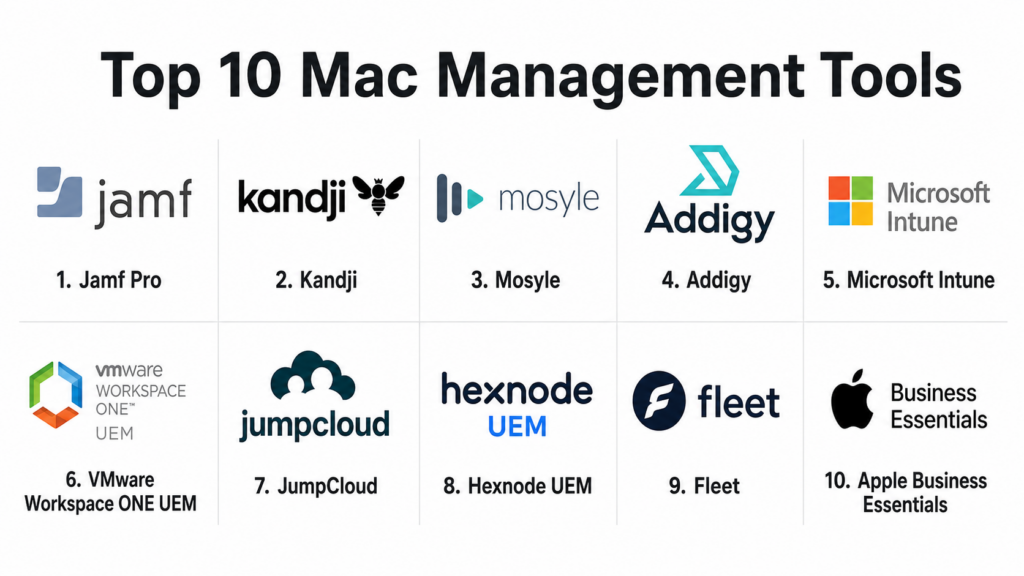
Introduction
Mac Management Tools help IT teams deploy, configure, secure, monitor, update, and support Apple Mac devices across an organization. In simple terms, these platforms allow administrators to manage macOS settings, apps, security policies, device enrollment, user permissions, compliance rules, software updates, scripts, and inventory from a central console.Mac management matters because Macs are now common across startups, creative teams, software engineering teams, education, enterprises, and remote-first organizations. Manual setup is no longer practical when teams manage hundreds or thousands of MacBooks across different locations. IT teams need zero-touch deployment, Apple Business Manager integration, patching, endpoint security alignment, FileVault control, app lifecycle management, and compliance reporting.
Real world use cases include Mac onboarding, remote device enrollment, app deployment, OS update enforcement, security baseline management, inventory tracking, lost device actions, employee offboarding, compliance audits, and helpdesk support. Buyers should evaluate Apple MDM support, automated enrollment, app management, patching, scripting, identity integration, security controls, reporting, user experience, scalability, and admin effort.
Best for: Mac Management Tools are best for IT administrators, endpoint teams, security teams, education IT teams, MSPs, startups, creative agencies, software companies, regulated businesses, and enterprises that manage Apple devices at scale.
Not ideal for: These tools may not be necessary for individuals or very small teams with only a few Macs and simple security needs. In those cases, Apple’s built-in settings, basic device tracking, manual app installation, or lightweight endpoint management may be enough.
Key Trends in Mac Management Tools
- Zero-touch deployment is now expected: Organizations want Macs shipped directly to employees and automatically enrolled through Apple Business Manager or Apple School Manager without manual IT setup.
- Apple silicon support is standard: Modern tools must manage Apple silicon Macs effectively, including OS updates, security settings, app compatibility, and recovery workflows.
- Security baseline automation is growing: IT teams want prebuilt security templates for FileVault, firewall, password rules, Gatekeeper, privacy permissions, and compliance checks.
- Declarative device management is becoming more important: Apple’s newer management approach is pushing vendors toward faster, more reliable device state reporting and policy enforcement.
- Patch management is a major buyer priority: Organizations need better control over macOS updates, third-party app updates, browser updates, and security patches.
- Identity-first Mac management is rising: Mac management is increasingly tied to identity providers, SSO, conditional access, local account management, and password synchronization.
- Employee experience matters: IT teams want secure Mac management without creating frustrating setup steps, excessive prompts, or slow user workflows.
- Remote support is becoming essential: Distributed teams need remote commands, inventory visibility, scripting, app installs, lock or wipe actions, and troubleshooting without physical access.
- Security and MDM convergence is increasing: Mac management tools are integrating with endpoint detection, compliance platforms, vulnerability tools, SIEM, and identity systems.
- MSP and multi-tenant management is expanding: Service providers need Mac management tools that support multiple clients, automated workflows, reporting, and remote administration.
How We Selected These Tools
The tools in this list were selected based on their relevance to macOS device management, Apple MDM capabilities, deployment automation, patching, inventory, security policy enforcement, identity integration, and enterprise endpoint operations. The list includes Mac-focused platforms, unified endpoint management tools, MSP-friendly platforms, and Apple ecosystem management solutions.
Selection logic included:
- Recognition and adoption in Apple device management and macOS administration.
- Support for Apple Business Manager, automated device enrollment, and Apple MDM frameworks.
- Ability to manage macOS settings, apps, updates, scripts, profiles, inventory, and security baselines.
- Support for FileVault, firewall, Gatekeeper, privacy preferences, certificates, Wi-Fi, VPN, and compliance rules.
- Integration with identity providers, endpoint security, ITSM, directory services, and automation workflows.
- Suitability for SMB, mid-market, enterprise, education, and MSP environments.
- Reporting depth for device inventory, compliance status, app status, OS version, and security posture.
- Administrative controls such as RBAC, audit logs, SSO, permissions, and policy governance.
- Ease of deployment and experience for IT admins and end users.
- Overall value for reducing manual Mac setup, improving security, and scaling Apple device operations.
Top 10 Mac Management Tools
1- Jamf Pro
Short description:
Jamf Pro is one of the most recognized Apple device management platforms for enterprises, education, and organizations with large Mac fleets. It is designed specifically for Apple ecosystems and supports macOS, iOS, iPadOS, and tvOS management. Jamf Pro helps IT teams automate enrollment, configure policies, deploy apps, enforce security settings, manage inventory, and run scripts. It is best suited for organizations that want deep Apple management capabilities and mature enterprise workflows.
Key Features
- Apple-focused MDM for macOS and other Apple devices.
- Automated device enrollment through Apple Business Manager or Apple School Manager.
- App deployment, patch management, and configuration profiles.
- FileVault, firewall, privacy, certificates, and security policy controls.
- Smart groups and policy automation.
- Inventory reporting for hardware, software, users, and compliance.
- Scripting and advanced Mac admin workflows.
Pros
- Very strong Apple ecosystem depth.
- Mature platform for large Mac fleets and complex environments.
- Strong community and admin knowledge base.
Cons
- Can require experienced Mac administration skills.
- May be more advanced than small teams need.
- Cost and complexity should be evaluated for smaller environments.
Platforms / Deployment
Web / macOS management
Cloud / Self-hosted options may vary
Security & Compliance
Jamf Pro supports enterprise security controls such as role-based access, SSO options, audit logs, FileVault management, configuration profiles, and policy governance. Specific compliance coverage should be validated based on deployment, contract, and configuration.
Integrations & Ecosystem
Jamf Pro integrates deeply with Apple services and many enterprise security, identity, and IT operations tools. It is especially strong for organizations standardizing Apple device lifecycle management.
- Apple Business Manager
- Apple School Manager
- Identity providers
- Endpoint security tools
- ITSM platforms
- Security and compliance workflows
Support & Community
Jamf provides documentation, customer support, training resources, professional services, and a large Apple admin community. Its ecosystem is one of the strongest in Mac management.
2- Kandji
Short description:
Kandji is a modern Apple device management platform focused on automation, security, compliance, app deployment, and user-friendly Mac administration. It is designed to simplify Apple device management for growing companies and enterprises that want strong security baselines without excessive manual scripting. Kandji supports automated enrollment, prebuilt security controls, app management, and compliance workflows. It is especially useful for startups, mid-market companies, and security-conscious Apple-first organizations.
Key Features
- Apple MDM for macOS, iOS, iPadOS, and tvOS.
- Automated device enrollment and zero-touch deployment.
- Prebuilt security templates and compliance controls.
- App deployment and patch management.
- FileVault, firewall, privacy, and OS update management.
- Device inventory and compliance reporting.
- Automation for enforcement and remediation.
Pros
- Clean and modern admin experience.
- Strong automation and security baseline approach.
- Good fit for fast-growing Apple-focused companies.
Cons
- May offer less low-level customization than some highly technical tools.
- Best value depends on Apple-first environment needs.
- Advanced use cases should be validated before purchase.
Platforms / Deployment
Web / macOS management
Cloud
Security & Compliance
Kandji provides enterprise security features such as SSO options, role-based administration, audit logs, FileVault management, and compliance-focused device controls. Specific certifications and compliance coverage should be validated during procurement.
Integrations & Ecosystem
Kandji integrates with identity, security, and IT workflows to support Apple device lifecycle management. It is useful when Mac compliance and automation need to connect with broader security operations.
- Apple Business Manager
- Identity providers
- Endpoint security tools
- SIEM workflows
- ITSM platforms
- Compliance reporting processes
Support & Community
Kandji provides documentation, onboarding, support, customer success resources, and Apple management guidance. Its community is especially strong among modern IT teams and Apple-first companies.
3- Mosyle
Short description:
Mosyle is an Apple device management platform with solutions for business, education, and MSP environments. It supports macOS, iOS, iPadOS, and Apple TV management with capabilities for enrollment, app deployment, security, identity, filtering, and endpoint protection depending on product package. Mosyle is often considered by schools, SMBs, and Apple-focused organizations looking for strong value and practical Apple management. It is especially useful for teams that want Apple MDM with security and workflow features in one platform.
Key Features
- Apple device management for Mac, iPad, iPhone, and Apple TV.
- Automated enrollment through Apple management programs.
- App deployment and device configuration.
- Security and compliance policy support.
- Inventory and reporting dashboards.
- Identity and access-related capabilities depending on package.
- Education and business-focused workflows.
Pros
- Strong value for Apple device management.
- Good fit for education and SMB environments.
- Combines management and security-oriented capabilities.
Cons
- Enterprise customization depth should be validated for complex environments.
- Feature availability depends on selected package.
- Organizations with heavy scripting needs should evaluate flexibility.
Platforms / Deployment
Web / macOS management
Cloud
Security & Compliance
Mosyle provides Apple-focused security and management controls, including profile management, device restrictions, FileVault-related management, and administrative governance. Specific compliance certifications and package-level security features should be validated with the vendor.
Integrations & Ecosystem
Mosyle integrates with Apple deployment services, identity workflows, app management, and education or business systems. It is especially useful for Apple-centric teams that want simplified deployment and device control.
- Apple Business Manager
- Apple School Manager
- App deployment workflows
- Identity systems
- Education systems
- Security management workflows
Support & Community
Mosyle provides documentation, customer support, onboarding resources, and education-focused guidance. Its community is particularly relevant for schools, SMBs, and Apple-first organizations.
4- Addigy
Short description:
Addigy is a cloud-based Apple device management platform popular with MSPs, IT service providers, and organizations managing distributed Mac fleets. It supports Apple MDM, remote commands, inventory, software deployment, scripting, compliance policies, and multi-tenant management. Addigy is especially useful for teams that need flexible remote Mac administration and automation across multiple customers or business units. It is a strong fit for MSPs and IT teams that need real-time visibility and responsive device operations.
Key Features
- Apple MDM and device lifecycle management.
- Multi-tenant management for MSPs and service providers.
- Remote commands, scripting, and automation.
- Software deployment and patching workflows.
- Device inventory and compliance reporting.
- Automated enrollment through Apple Business Manager.
- Security policies and configuration profile management.
Pros
- Strong fit for MSPs and distributed Mac environments.
- Flexible scripting and automation capabilities.
- Useful for remote support and multi-client administration.
Cons
- Admin experience may require Mac management expertise.
- Smaller teams may not need advanced MSP-oriented features.
- Buyers should validate patching and reporting needs against workflows.
Platforms / Deployment
Web / macOS management
Cloud
Security & Compliance
Addigy provides administrative controls, policy management, auditability, and Apple MDM security capabilities. Specific compliance coverage, SSO support, and security documentation should be validated during procurement.
Integrations & Ecosystem
Addigy integrates with Apple services, IT operations workflows, automation tools, and MSP systems. It is especially useful for organizations needing multi-tenant or remote management workflows.
- Apple Business Manager
- MSP workflow tools
- Identity systems
- ITSM platforms
- Remote support workflows
- Security and compliance processes
Support & Community
Addigy provides documentation, customer support, onboarding, training resources, and MSP-focused enablement. Its community is strongest among Apple-focused MSPs and IT administrators.
5- Microsoft Intune
Short description:
Microsoft Intune is a unified endpoint management platform that supports macOS management along with Windows, iOS, Android, and other endpoint workflows. It is especially useful for organizations already using Microsoft 365, Microsoft Entra ID, Defender, and conditional access. Intune helps IT teams enroll Macs, deploy apps, enforce compliance policies, manage settings, and integrate Mac management with broader endpoint governance. It is a strong choice for mixed-device enterprises that want one management platform across operating systems.
Key Features
- macOS device enrollment and configuration management.
- App deployment and compliance policies.
- Integration with Microsoft Entra ID and conditional access.
- Security baseline and device compliance reporting.
- Support for Windows, macOS, iOS, and Android endpoints.
- Remote actions such as wipe, lock, and device sync.
- Integration with Microsoft Defender and endpoint security workflows.
Pros
- Strong fit for Microsoft-centered organizations.
- Useful for mixed Windows and Mac environments.
- Integrates well with identity and conditional access.
Cons
- Mac-specific depth may not match dedicated Apple-first platforms.
- Some workflows may require additional scripting or complementary tools.
- Best value depends on Microsoft ecosystem adoption.
Platforms / Deployment
Web / macOS / Windows / iOS / Android
Cloud
Security & Compliance
Microsoft Intune supports enterprise security controls such as role-based administration, conditional access alignment, compliance policies, identity integration, device encryption policies, and remote actions. Specific compliance coverage depends on licensing and tenant configuration.
Integrations & Ecosystem
Intune integrates deeply with Microsoft 365, Entra ID, Defender, Purview, Autopilot for Windows, and endpoint security workflows. It is especially useful when Mac management must align with Microsoft identity and security policy.
- Microsoft 365
- Microsoft Entra ID
- Microsoft Defender
- Microsoft Purview
- Conditional access
- Endpoint security workflows
Support & Community
Microsoft provides documentation, enterprise support, learning resources, partner services, and a large administrator community. Support strength is high for organizations already using Microsoft enterprise platforms.
6- VMware Workspace ONE UEM
Short description:
VMware Workspace ONE UEM is a unified endpoint management platform that supports macOS along with Windows, iOS, Android, and other device types. It helps IT teams manage device enrollment, profiles, apps, security policies, compliance rules, and remote actions across mixed environments. For Mac management, it is useful in enterprises that already use Workspace ONE for endpoint and digital workspace operations. It is best suited for larger organizations that need cross-platform management and access control alignment.
Key Features
- Unified endpoint management across multiple operating systems.
- macOS enrollment, profiles, restrictions, and configuration.
- App deployment and lifecycle management.
- Compliance policies and conditional access alignment.
- Remote commands and device actions.
- Inventory and reporting dashboards.
- Integration with digital workspace and identity workflows.
Pros
- Strong fit for mixed-device enterprise environments.
- Useful for organizations already using Workspace ONE.
- Supports broad endpoint and workspace management scenarios.
Cons
- Mac-specific depth should be validated against dedicated Apple tools.
- Implementation can be complex for smaller teams.
- Platform changes and licensing should be reviewed carefully during procurement.
Platforms / Deployment
Web / macOS / Windows / iOS / Android
Cloud / Hybrid options may vary
Security & Compliance
Workspace ONE UEM provides enterprise security controls such as role-based access, compliance policies, device restrictions, encryption-related settings, and identity integration. Specific compliance coverage depends on deployment and contract.
Integrations & Ecosystem
Workspace ONE integrates with identity, endpoint, security, app, and workspace systems. It is useful when organizations want Mac management as part of broader digital workspace governance.
- Identity providers
- Workspace ONE ecosystem
- Endpoint security tools
- App management workflows
- ITSM platforms
- Compliance reporting systems
Support & Community
VMware by Broadcom provides enterprise support, documentation, partner services, and technical resources. Buyers should validate current support model, roadmap, and licensing fit during evaluation.
7- JumpCloud
Short description:
JumpCloud is an open directory and device management platform that supports Mac management, identity, access, SSO, MFA, directory services, and cross-platform endpoint control. It is especially useful for organizations that want to connect Mac device management with identity and user lifecycle workflows. JumpCloud can help IT teams manage users, enforce device policies, deploy commands, and control access across Mac, Windows, and Linux environments. It is a strong fit for cloud-first SMB and mid-market companies.
Key Features
- Mac, Windows, and Linux device management.
- Cloud directory and identity management.
- SSO, MFA, and conditional access-style workflows.
- Device commands and policy enforcement.
- User lifecycle and access management.
- Inventory and device reporting.
- Cross-platform endpoint visibility.
Pros
- Strong identity plus device management combination.
- Good fit for cloud-first and mixed-OS teams.
- Useful for companies without traditional on-prem directory infrastructure.
Cons
- Deep Apple-specific management may require validation.
- Complex enterprise Mac workflows may need complementary tools.
- Best value depends on identity and device strategy alignment.
Platforms / Deployment
Web / macOS / Windows / Linux
Cloud
Security & Compliance
JumpCloud provides security capabilities such as MFA, SSO, device policies, identity controls, directory governance, and administrative access management. Specific compliance certifications and controls should be validated based on plan and procurement requirements.
Integrations & Ecosystem
JumpCloud integrates with identity, SaaS, device, directory, and security workflows. It is especially useful when Mac management must connect with user access, authentication, and cloud directory needs.
- Identity providers
- SaaS applications
- SSO workflows
- MFA policies
- Device management workflows
- Directory services
Support & Community
JumpCloud provides documentation, support resources, training materials, and community guidance. Its community is strong among cloud-first IT teams and mixed operating system environments.
8- Hexnode UEM
Short description:
Hexnode UEM is a unified endpoint management platform that supports macOS, Windows, iOS, Android, tvOS, and other device environments. It helps organizations manage device enrollment, configuration profiles, app deployment, security settings, compliance policies, and remote actions. For Mac management, Hexnode is useful for SMBs, mid-market teams, education, and organizations that need multi-OS endpoint management. It is a practical option for teams that want broad device management from one console.
Key Features
- macOS MDM and cross-platform endpoint management.
- Device enrollment and configuration profiles.
- App deployment and app management.
- Security policies and restrictions.
- Remote lock, wipe, and device actions.
- Inventory and compliance reporting.
- Support for multiple operating systems.
Pros
- Good value for mixed-device management.
- Practical for SMB and mid-market IT teams.
- Broad platform support beyond macOS.
Cons
- Advanced Mac-specific workflows should be validated.
- May not match the depth of Apple-only management platforms.
- Complex automation and scripting needs should be tested.
Platforms / Deployment
Web / macOS / Windows / iOS / Android / tvOS
Cloud
Security & Compliance
Hexnode provides security controls such as device restrictions, compliance policies, remote actions, app controls, and administrative settings. Specific certifications and compliance coverage should be validated during vendor review.
Integrations & Ecosystem
Hexnode integrates with Apple deployment workflows, identity services, app management systems, and endpoint operations processes. It is useful for organizations managing multiple device types from one platform.
- Apple Business Manager
- Identity providers
- App deployment workflows
- Endpoint management processes
- Directory services
- IT operations workflows
Support & Community
Hexnode provides documentation, customer support, onboarding resources, and product guidance. Its community is relevant for SMBs, education teams, and multi-OS endpoint administrators.
9- Fleet
Short description:
Fleet is an open-source device management and endpoint visibility platform built around osquery. It helps teams query, monitor, and manage devices across macOS, Windows, and Linux environments. Fleet is especially useful for security and IT teams that want flexible endpoint visibility, compliance checks, and scriptable device intelligence. For Mac management, it is best suited for technical teams that value open-source tooling, endpoint queries, and security-focused workflows.
Key Features
- Endpoint visibility using osquery.
- Support for macOS, Windows, and Linux.
- Inventory, compliance, and device query capabilities.
- Policy checks and reporting.
- Software inventory and device data collection.
- Open-source and API-driven workflows.
- Useful for security and compliance monitoring.
Pros
- Strong for technical endpoint visibility and querying.
- Open-source foundation with flexible workflows.
- Useful for security and compliance teams.
Cons
- Not a traditional full Apple MDM replacement by itself.
- Requires technical expertise to manage effectively.
- App deployment and Mac lifecycle workflows may require complementary tools.
Platforms / Deployment
Web / macOS / Windows / Linux
Cloud / Self-hosted options may vary
Security & Compliance
Fleet provides endpoint visibility and policy reporting capabilities. Security and compliance controls depend on deployment, configuration, identity integration, access policies, and operational governance.
Integrations & Ecosystem
Fleet integrates with security, endpoint, compliance, and automation workflows. It is useful when organizations want osquery-based visibility connected to broader security operations.
- osquery workflows
- SIEM tools
- Security operations workflows
- Endpoint compliance processes
- APIs and automation
- Reporting systems
Support & Community
Fleet has open-source community support, documentation, and commercial support options depending on edition. Its community is strongest among security engineers, endpoint teams, and technical IT administrators.
10- Apple Business Essentials
Short description:
Apple Business Essentials is Apple’s own device management and business services offering for small businesses using Apple devices. It supports device management, app deployment, onboarding workflows, iCloud storage options, and support-related capabilities depending on availability and plan. For Mac management, it is most useful for smaller organizations that want a simple Apple-native way to manage devices without adopting a complex enterprise MDM platform. It is best suited for small businesses with straightforward Apple device management needs.
Key Features
- Apple-native device management for small businesses.
- Device enrollment and basic configuration management.
- App deployment and account support.
- Integration with Apple Business Manager-style workflows.
- Employee onboarding support.
- iCloud storage and Apple service alignment depending on plan.
- Simple administration for Apple devices.
Pros
- Apple-native and simple for small business needs.
- Good fit for organizations with straightforward Mac and Apple device management.
- Reduces need for heavy third-party MDM in very small environments.
Cons
- Not designed for complex enterprise Mac management.
- Advanced scripting, deep automation, and security workflows may be limited.
- Availability and feature scope should be validated by region and plan.
Platforms / Deployment
Web / macOS / iOS / iPadOS
Cloud
Security & Compliance
Apple provides Apple ID, device management, account, and platform security controls within its business ecosystem. Specific compliance coverage, admin controls, and regional availability should be validated during procurement.
Integrations & Ecosystem
Apple Business Essentials is most useful inside Apple’s own business device and account ecosystem. It works best for simple Apple-first environments where heavy third-party integrations are not required.
- Apple Business Manager
- Managed Apple Accounts
- App deployment workflows
- Apple device setup
- iCloud services
- Apple support workflows
Support & Community
Apple provides business support resources, documentation, and service options depending on plan and region. Community strength is strongest among small Apple-first businesses and Apple administrators.
Comparison Table Top 10
| Tool Name | Best For | Platform Supported | Deployment | Standout Feature | Public Rating |
|---|---|---|---|---|---|
| Jamf Pro | Enterprise Apple device management | Web, macOS management | Cloud / Self-hosted options may vary | Deep Apple-focused MDM and automation | N/A |
| Kandji | Modern Apple-first security and automation | Web, macOS management | Cloud | Automated security baselines and Mac compliance | N/A |
| Mosyle | Education, SMB, and Apple-focused teams | Web, macOS management | Cloud | Apple MDM with strong value and security features | N/A |
| Addigy | MSPs and distributed Mac fleets | Web, macOS management | Cloud | Multi-tenant Apple management and remote workflows | N/A |
| Microsoft Intune | Microsoft-centered mixed-device environments | Web, macOS, Windows, iOS, Android | Cloud | Mac management tied to Microsoft identity and compliance | N/A |
| VMware Workspace ONE UEM | Enterprise unified endpoint management | Web, macOS, Windows, iOS, Android | Cloud / Hybrid options may vary | Cross-platform endpoint and workspace management | N/A |
| JumpCloud | Identity plus Mac and device management | Web, macOS, Windows, Linux | Cloud | Cloud directory with device management | N/A |
| Hexnode UEM | SMB and mid-market multi-OS management | Web, macOS, Windows, iOS, Android, tvOS | Cloud | Unified endpoint management across many device types | N/A |
| Fleet | Open-source endpoint visibility and compliance | Web, macOS, Windows, Linux | Cloud / Self-hosted options may vary | osquery-based device visibility | N/A |
| Apple Business Essentials | Small business Apple device management | Web, macOS, iOS, iPadOS | Cloud | Apple-native management for simple environments | N/A |
Evaluation and Scoring of Mac Management Tools
The scoring below is comparative and based on Mac management depth, ease of use, integrations, security posture signals, performance, support expectations, and overall value. These are not public ratings and should be used as directional evaluation scores only. A tool with a lower score may still be the best choice if it fits your company size, Apple maturity, security requirements, and existing technology stack.
| Tool Name | Core 25% | Ease 15% | Integrations 15% | Security 10% | Performance 10% | Support 10% | Value 15% | Weighted Total 0–10 |
|---|---|---|---|---|---|---|---|---|
| Jamf Pro | 10 | 7 | 9 | 9 | 9 | 9 | 7 | 8.65 |
| Kandji | 9 | 9 | 8 | 9 | 9 | 8 | 8 | 8.65 |
| Mosyle | 8 | 8 | 8 | 8 | 8 | 8 | 9 | 8.15 |
| Addigy | 9 | 8 | 8 | 8 | 8 | 8 | 8 | 8.25 |
| Microsoft Intune | 8 | 8 | 10 | 9 | 8 | 9 | 9 | 8.65 |
| VMware Workspace ONE UEM | 8 | 7 | 9 | 8 | 8 | 8 | 7 | 7.85 |
| JumpCloud | 8 | 8 | 8 | 8 | 8 | 8 | 8 | 8.00 |
| Hexnode UEM | 7 | 8 | 8 | 8 | 8 | 8 | 9 | 7.95 |
| Fleet | 7 | 6 | 8 | 8 | 8 | 7 | 9 | 7.45 |
| Apple Business Essentials | 6 | 9 | 7 | 8 | 8 | 8 | 8 | 7.55 |
These scores should be interpreted based on your environment. Jamf Pro is strong for deep Apple administration, Kandji is strong for automation and security baselines, Addigy is strong for MSPs and distributed fleets, and Intune is strong for Microsoft-centered mixed-device organizations. Mosyle and Hexnode can provide strong value for SMB and education environments, while Fleet is useful for technical visibility and compliance. Apple Business Essentials is practical for small businesses but may not replace enterprise-grade MDM.
Which Mac Management Tool Is Right for You?
Solo / Freelancer
Solo professionals usually do not need a full Mac management platform. Built-in macOS security settings, FileVault, software update controls, password management, and Apple account protection may be enough. If a freelancer manages multiple client Macs, Apple Business Essentials, Mosyle, Hexnode, or JumpCloud may be useful depending on scale. The priority should be basic security, app control, backup discipline, and simple inventory rather than complex enterprise automation.
SMB
SMBs should prioritize ease of use, zero-touch deployment, app installation, FileVault enforcement, inventory, and simple compliance reporting. Kandji, Mosyle, Hexnode, JumpCloud, Apple Business Essentials, and Intune can be practical depending on the existing stack. Microsoft-heavy SMBs may prefer Intune, while Apple-first teams may prefer Kandji or Mosyle. Small teams should avoid overbuilding complex policies too early. Start with enrollment, encryption, app deployment, updates, and device inventory.
Mid-Market
Mid-market companies often need stronger automation, identity integration, patch management, security baselines, reporting, and remote support. Jamf Pro, Kandji, Addigy, Mosyle, Intune, JumpCloud, and Hexnode are strong candidates depending on environment. Apple-first companies may prioritize Jamf or Kandji. MSPs or distributed teams may prefer Addigy. Mixed-OS companies may prefer Intune, Workspace ONE, JumpCloud, or Hexnode. Mid-market buyers should test app deployment, OS update management, and compliance workflows.
Enterprise
Enterprises usually need deep policy management, automated enrollment, security compliance, RBAC, audit logs, identity integration, scripting, inventory, patching, and scalable reporting. Jamf Pro, Kandji, Intune, Workspace ONE, and Addigy are strong enterprise candidates depending on architecture. Jamf Pro is often strong for Apple-focused enterprises, while Intune and Workspace ONE fit broader unified endpoint management strategies. Enterprise buyers should validate security controls, integrations, support model, and regional requirements before selection.
Budget vs Premium
Budget-focused teams can consider Mosyle, Hexnode, Apple Business Essentials, Fleet, or existing Microsoft Intune licensing if already available. These options may provide strong value for basic to moderate Mac management needs. Premium Apple-focused platforms like Jamf Pro and Kandji may justify cost when automation, compliance, security baselines, and scale are important. Buyers should compare total cost, including admin time, support, implementation, training, security tooling, and long-term maintenance.
Feature Depth vs Ease of Use
Feature depth matters when teams need advanced scripting, smart groups, complex app deployment, compliance reporting, custom profiles, identity integration, and security enforcement. Jamf Pro, Kandji, Addigy, Intune, and Workspace ONE provide strong depth in different ways. Ease of use matters when teams have limited Mac admin expertise. Kandji, Mosyle, Hexnode, Apple Business Essentials, and JumpCloud may be easier for some teams to start with. The right balance depends on admin skill and Mac fleet complexity.
Integrations and Scalability
Mac management becomes more valuable when integrated with Apple Business Manager, identity providers, endpoint security, ITSM, SIEM, compliance tools, and automation workflows. Device enrollment should connect cleanly with user identity, app deployment, security baselines, and helpdesk processes. Scaling also requires clear device naming, inventory tagging, policy grouping, update rings, and exception management. Buyers should test integrations and policy behavior before wide deployment.
Security and Compliance Needs
Mac management tools help enforce FileVault, firewall settings, password policies, OS updates, app restrictions, certificates, privacy preferences, and device compliance rules. Buyers should evaluate SSO, RBAC, audit logs, encryption management, compliance reporting, remote lock or wipe, and endpoint security integrations. Regulated organizations should validate reporting quality and evidence export. A strong Mac management strategy should prove that devices are enrolled, encrypted, updated, monitored, and compliant.
Frequently Asked Questions FAQs
1. What is a Mac Management Tool?
A Mac Management Tool is software that helps IT teams deploy, configure, secure, update, monitor, and support Mac devices across an organization. It usually works through Apple MDM frameworks and integrates with Apple Business Manager for automated enrollment. These tools can manage apps, profiles, FileVault, Wi-Fi, VPN, certificates, updates, scripts, and compliance rules. They reduce manual setup and improve security consistency. Mac management is especially important for remote and growing teams.
2. How is Mac management different from general endpoint management?
Mac management focuses specifically on Apple’s management framework, macOS settings, Apple security features, app deployment behavior, privacy controls, and Apple device lifecycle workflows. General endpoint management platforms manage multiple operating systems such as Windows, macOS, iOS, Android, and Linux. Dedicated Apple tools often provide deeper Mac-specific workflows, while unified endpoint tools provide broader cross-platform coverage. The right choice depends on whether the organization is Apple-first or mixed-device. Many enterprises use both approaches together.
3. What pricing models are common for Mac Management Tools?
Mac Management Tools commonly use subscription pricing based on number of devices, users, modules, features, or support tiers. Apple-focused platforms may charge per device, while unified endpoint platforms may bundle Mac management into broader endpoint licensing. Some tools provide custom enterprise pricing based on fleet size and requirements. Buyers should ask about onboarding, support, patch management, security modules, identity integrations, storage, and implementation services. Total cost should include admin time and operational complexity.
4. How long does implementation usually take?
Implementation time depends on fleet size, Apple Business Manager readiness, identity integration, app packaging, security policies, and migration from existing tools. A small company can start with basic enrollment and profiles faster than an enterprise with complex security baselines and compliance needs. The most important steps include connecting Apple Business Manager, defining enrollment workflows, building app deployment policies, testing FileVault, and piloting with users. A phased rollout is safer than enrolling every Mac at once. Teams should test on different Mac models and macOS versions.
5. What are common mistakes when choosing a Mac management platform?
A common mistake is choosing a tool without understanding Mac-specific requirements. Some teams assume Windows endpoint management processes will work the same way on macOS, which can create gaps. Another mistake is ignoring app packaging, patch management, privacy permissions, and user experience. Some companies also skip Apple Business Manager setup, making zero-touch deployment harder. Buyers should test real onboarding, app deployment, OS update, encryption, and offboarding workflows before purchasing.
6. Are Mac Management Tools secure?
Mac Management Tools can improve security by enforcing encryption, password policies, firewall settings, app controls, OS updates, certificates, privacy permissions, and compliance rules. Security depends on correct configuration, admin access control, and integration with identity and endpoint security tools. Buyers should evaluate SSO, RBAC, audit logs, FileVault management, remote lock or wipe, and reporting. It is also important to limit admin privileges and monitor policy changes. Strong Mac management helps reduce endpoint risk.
7. Can Mac Management Tools support remote employees?
Yes, Mac Management Tools are especially valuable for remote employees. With automated enrollment, companies can ship Macs directly to users and have the device configure itself during setup. IT teams can deploy apps, enforce security settings, run scripts, check inventory, and issue remote commands without physical access. Remote support depends on the tool’s capabilities and network access. For distributed teams, zero-touch deployment and remote troubleshooting are major buying factors.
8. Can Mac Management Tools integrate with identity providers?
Yes, many Mac Management Tools integrate with identity providers such as cloud directories, SSO systems, and enterprise authentication platforms. Identity integration helps connect users to devices, enforce access rules, support password workflows, and improve compliance reporting. Some tools also help manage local accounts or align device compliance with conditional access. Integration depth varies by platform. Buyers should test login, enrollment, user assignment, password sync, and access enforcement workflows before rollout.
9. What alternatives exist if a full Mac management platform is not needed?
Alternatives include Apple Business Essentials, basic Apple Business Manager workflows, manual macOS configuration, endpoint security tools, scripts, spreadsheets, or unified endpoint management already available in the organization. These may work for very small teams with limited Macs. However, they become harder to manage as devices, users, apps, and security requirements grow. A dedicated Mac management platform becomes valuable when repeatable deployment, compliance, patching, and remote support matter. The right alternative depends on Mac fleet size and risk level.
10. How should buyers evaluate Mac Management Tools?
Buyers should evaluate Apple MDM depth, automated enrollment, app deployment, patch management, FileVault control, scripting, reporting, identity integration, security controls, and user experience. They should test real workflows such as onboarding a new Mac, deploying required apps, enforcing encryption, updating macOS, removing a user, and wiping a device. It is also important to involve IT, security, compliance, and end users during the pilot. The best tool is the one that secures Macs without making administration or employee experience painful.
Conclusion
Mac Management Tools help organizations bring structure, security, automation, and consistency to Apple device operations. The right platform depends on Mac fleet size, existing identity stack, security requirements, admin expertise, budget, and whether the organization is Apple-first or mixed-platform. Jamf Pro is strong for deep Apple administration, Kandji is strong for modern automation and security baselines, Mosyle offers practical Apple-focused value, Addigy is strong for MSPs and distributed fleets, Intune and Workspace ONE fit mixed-device enterprise strategies, JumpCloud connects device management with identity, Hexnode supports broad UEM needs, Fleet is useful for technical endpoint visibility, and Apple Business Essentials can fit small Apple-first businesses. There is no single best option for every organization because a startup, school, MSP, enterprise, and Microsoft-centered company will all have different requirements.

Launching comprehensive bespoke Apple device cluster ecosystem administrator architecture software optimizes corporate workstation network mechanics, ensuring rapid centralized operating platform policy verification auditing and frictionless desktop asset software configuration methodologies.