MOTOSHARE 🚗🏍️
Rent Bikes & Cars Directly from Owners
Motoshare connects vehicle owners with people who need bikes and cars on rent. Owners earn from idle vehicles, and renters get flexible ride options.
Visit Motoshare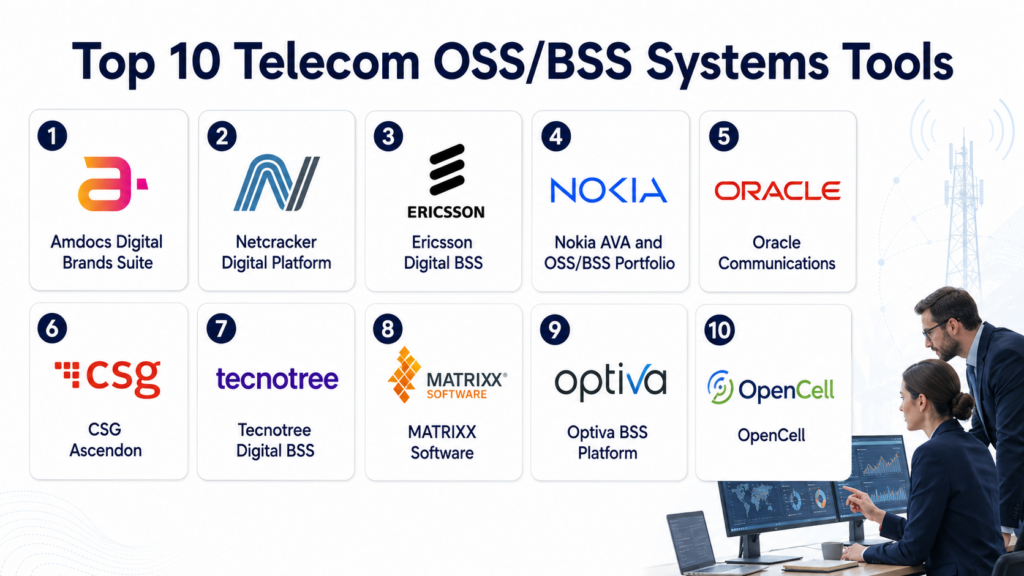
Introduction
Telecom OSS/BSS systems are the operational and business software platforms that help communication service providers run networks, manage customers, launch services, handle billing, monitor service quality, automate provisioning, and support revenue operations. In simple terms, OSS focuses on network operations, service assurance, inventory, provisioning, and performance, while BSS focuses on customers, billing, charging, orders, products, partners, and revenue management.
Telecom operators, broadband providers, MVNOs, fiber companies, satellite communication providers, and digital service providers rely on OSS/BSS platforms to move from legacy, manual operations toward automated, API-driven, cloud-ready service delivery. The category matters now because telecom businesses are under pressure to support 5G, fiber expansion, IoT, private networks, digital billing, real-time charging, AI operations, and faster product launches.
Real-world use cases include:
- Customer onboarding and order management: Automating customer signup, eligibility checks, order capture, provisioning, and activation.
- Billing and revenue management: Handling prepaid, postpaid, hybrid billing, partner settlements, and usage-based charging.
- Network inventory and service assurance: Tracking network assets, service dependencies, incidents, and performance.
- 5G and IoT monetization: Supporting new pricing models, slices, device plans, and partner ecosystems.
- Digital self-service: Enabling customer portals, mobile apps, digital payments, and automated support workflows.
Evaluation Criteria for Buyers:
- OSS and BSS coverage: Check whether the platform covers billing, charging, CRM, ordering, assurance, inventory, and provisioning.
- Cloud readiness: Evaluate cloud-native, hybrid, and private cloud deployment options.
- Integration flexibility: Look for open APIs, TM Forum alignment, event-driven architecture, and partner ecosystem maturity.
- Scalability: Validate support for high transaction volumes, real-time charging, and large subscriber bases.
- Automation depth: Review workflow automation, closed-loop operations, AI-assisted assurance, and zero-touch provisioning.
- Security controls: Assess RBAC, audit logs, encryption, SSO, MFA, and compliance support.
- Implementation complexity: Understand migration effort, customization needs, data cleansing, and integration timelines.
- Product catalog strength: Ensure flexible product modeling for telecom, broadband, enterprise, IoT, and bundled services.
- Vendor support: Review implementation partners, managed services, documentation, and telecom domain expertise.
- Total cost of ownership: Compare licensing, implementation, customization, support, and upgrade costs.
Best for: Telecom operators, CSPs, ISPs, MVNOs, broadband providers, digital service providers, and enterprise telecom teams that need scalable customer, network, billing, service assurance, and revenue operations. These systems are especially useful for mid-market and enterprise providers managing complex services, high subscriber volumes, multi-channel sales, and regulated telecom operations.
Not ideal for: Very small businesses, simple VoIP resellers, or startups that only need lightweight billing, CRM, or helpdesk software. If the business does not manage telecom-grade provisioning, subscriber lifecycle, service assurance, charging, or network inventory, a simpler CRM, billing, or subscription management platform may be easier and more cost-effective.
Key Trends in Telecom OSS/BSS Systems
- Cloud-native OSS/BSS modernization: Telecom providers are shifting away from monolithic legacy systems toward modular, API-first, cloud-native platforms that support faster upgrades and flexible scaling.
- AI-driven operations: AI is increasingly used for anomaly detection, customer churn prediction, network fault correlation, ticket prioritization, fraud detection, and service assurance.
- Real-time charging and monetization: Modern BSS platforms are supporting real-time usage rating for 5G, IoT, private networks, streaming, edge services, and flexible subscription bundles.
- Open API and TM Forum alignment: Buyers are prioritizing platforms that support standardized APIs, reusable integration patterns, and interoperability across network, billing, CRM, and partner systems.
- Converged OSS and BSS workflows: Telecom providers want order-to-activate, trouble-to-resolve, usage-to-cash, and catalog-to-fulfillment workflows that connect business and network operations.
- Digital customer experience: Self-service portals, mobile apps, automated notifications, digital payments, and omnichannel support are becoming core expectations rather than optional add-ons.
- Network automation and zero-touch provisioning: OSS platforms are becoming more automated, especially for fiber, 5G, SD-WAN, IoT, and enterprise connectivity services.
- Partner and ecosystem monetization: Telecom operators are using BSS systems to support marketplaces, partner settlements, revenue sharing, wholesale services, and bundled digital products.
- Security and regulatory pressure: Telecom environments require stronger access controls, auditability, data protection, fraud monitoring, and compliance-ready architecture.
- Hybrid deployment models: Many telecom companies still need hybrid OSS/BSS because critical legacy systems, regulated data, and network systems cannot always move fully to public cloud immediately.
How We Selected These Tools
The following Telecom OSS/BSS systems were selected using a practical evaluation approach focused on telecom relevance, market recognition, platform breadth, and enterprise readiness.
- Market adoption and mindshare: Preference was given to platforms widely recognized in telecom, CSP, broadband, MVNO, and digital service provider environments.
- OSS/BSS feature completeness: Tools were evaluated for billing, charging, ordering, product catalog, CRM, provisioning, inventory, assurance, and network operations coverage.
- Enterprise and mid-market fit: The list balances large enterprise telecom platforms with systems suitable for digital operators, MVNOs, and growing service providers.
- Integration ecosystem: API availability, telecom standards alignment, partner ecosystem, and interoperability with CRM, ERP, network, and data platforms were considered.
- Scalability and performance signals: Platforms known for handling subscriber scale, high transaction volumes, or complex telecom operations were prioritized.
- Security posture signals: Security-related capabilities such as RBAC, SSO, audit logs, encryption, and enterprise access control were considered where publicly known.
- Cloud and deployment flexibility: Cloud, hybrid, and self-hosted options were considered because telecom buyers often have mixed infrastructure needs.
- Operational automation: Tools with stronger automation, workflow orchestration, AI operations, and closed-loop management capabilities received stronger consideration.
- Customer lifecycle coverage: Platforms that connect customer management, order management, billing, fulfillment, and service assurance were ranked higher.
- Practical buyer relevance: Each tool was reviewed for where it fits best, including enterprise CSPs, MVNOs, broadband operators, wholesale providers, and digital-first telecom companies.
Top 10 Telecom OSS/BSS Systems Tools
#1 — Amdocs Digital Brands Suite
Short description:
Amdocs Digital Brands Suite is a telecom-focused OSS/BSS platform designed for communication service providers that need digital customer engagement, monetization, billing, catalog, ordering, and operational workflows. It is commonly associated with large-scale telecom transformation programs and complex subscriber environments. The platform supports digital channels, product lifecycle management, customer care, and revenue operations. It is best suited for established telecom providers looking to modernize legacy systems while supporting new digital services.
Key Features
- Digital customer engagement and self-service capabilities
- Product catalog and offer management for telecom services
- Billing, charging, and revenue management workflows
- Order management and service fulfillment support
- Customer lifecycle and care management capabilities
- Support for telecom-scale subscriber operations
- Integration with broader Amdocs telecom software ecosystem
Pros
- Strong telecom domain depth for large and complex service providers
- Broad BSS coverage across customer, product, order, and revenue workflows
- Suitable for digital transformation and legacy modernization programs
Cons
- Implementation can be complex for smaller telecom providers
- May require significant customization and professional services
- Total cost of ownership can be high for limited-scope use cases
Platforms / Deployment
Cloud / Hybrid / Varies by implementation
Security & Compliance
Enterprise access control, role-based permissions, and audit capabilities are typically expected in deployments. Specific certifications, compliance scope, and security controls vary by customer environment and implementation. SOC 2, ISO 27001, GDPR, HIPAA: Not publicly stated for all deployments.
Integrations & Ecosystem
Amdocs is typically used in complex telecom environments where integration with network systems, CRM, ERP, payment gateways, data platforms, and customer channels is required. It is often deployed as part of a broader transformation ecosystem with vendor, system integrator, and operator-specific integrations.
- CRM and customer care systems
- Charging and billing platforms
- Network provisioning and service activation systems
- Payment and revenue management systems
- Data analytics and reporting platforms
- Digital channels such as web and mobile apps
Support & Community
Amdocs provides enterprise-grade support, implementation services, consulting, and partner-led delivery for telecom operators. Documentation and onboarding are generally managed through enterprise engagement. Community-style open forums are limited compared with developer-first platforms.
#2 — Netcracker Digital Platform
Short description:
Netcracker Digital Platform is a widely recognized OSS/BSS solution suite for telecom operators, cable providers, MVNOs, and digital service providers. It combines BSS, OSS, orchestration, automation, analytics, and customer engagement capabilities. The platform is often used by providers that need end-to-end digital transformation across products, services, network operations, and monetization. It is especially relevant for operators managing complex service portfolios and multi-domain networks.
Key Features
- End-to-end OSS and BSS platform capabilities
- Digital customer engagement and omnichannel experience
- Product catalog, order management, and fulfillment
- Revenue management, charging, and billing support
- Service orchestration and network automation
- Partner ecosystem and marketplace enablement
- Analytics and AI-assisted operational insights
Pros
- Strong coverage across both OSS and BSS domains
- Suitable for large telecom providers with complex operating models
- Good fit for digital service provider transformation initiatives
Cons
- Enterprise implementation can require long planning cycles
- May be too broad for smaller providers with simple needs
- Customization and integration effort should be carefully scoped
Platforms / Deployment
Cloud / Hybrid / Self-hosted options vary by customer deployment
Security & Compliance
Enterprise security features such as access controls, role management, and auditability are expected in telecom-grade deployments. Specific certification coverage varies by contract, region, and deployment. SOC 2, ISO 27001, GDPR, HIPAA: Not publicly stated for all deployments.
Integrations & Ecosystem
Netcracker is commonly used in environments that require integration across business systems, network systems, cloud platforms, partner ecosystems, and customer channels. Its ecosystem is particularly relevant for operators pursuing service orchestration and digital marketplace models.
- CRM and customer experience platforms
- Network inventory and provisioning systems
- Billing, mediation, and charging systems
- Cloud and virtual network platforms
- Partner management and marketplace systems
- Business intelligence and data platforms
Support & Community
Netcracker offers enterprise support, consulting, managed services, and implementation assistance. Support is generally structured around telecom transformation programs, project delivery, and long-term operator partnerships.
#3 — Ericsson Digital BSS
Short description:
Ericsson Digital BSS is designed for telecom providers that need customer management, catalog, order management, charging, billing, and digital monetization capabilities. It fits operators looking to support 5G, enterprise services, IoT, and complex pricing models. Ericsson’s telecom ecosystem makes it especially relevant for operators already using Ericsson network technology or seeking tight alignment between network and business operations. It is typically suited for enterprise-grade CSP environments.
Key Features
- Customer management and digital experience support
- Product catalog and offer lifecycle management
- Charging, billing, and revenue management capabilities
- Order management and fulfillment workflows
- 5G and IoT monetization support
- Enterprise and consumer service monetization
- Integration with telecom network and operations ecosystems
Pros
- Strong telecom heritage and CSP focus
- Useful for operators modernizing monetization and charging models
- Suitable for 5G and advanced digital service use cases
Cons
- Best suited for larger telecom environments
- Deployment and transformation projects may require specialist support
- Smaller providers may find the platform more complex than needed
Platforms / Deployment
Cloud / Hybrid / Varies by implementation
Security & Compliance
Ericsson enterprise deployments commonly include telecom-grade security expectations such as access control, operational auditability, and secure integration patterns. Specific certifications and compliance details depend on deployment and contract scope. SOC 2, ISO 27001, GDPR, HIPAA: Not publicly stated for all deployments.
Integrations & Ecosystem
Ericsson Digital BSS is often deployed alongside telecom network systems, charging platforms, customer systems, and digital channels. It is particularly relevant where BSS needs to support 5G, network slicing, IoT, and advanced service monetization.
- Ericsson telecom ecosystem integrations
- CRM and digital experience systems
- Charging and billing platforms
- Network provisioning and service activation
- Enterprise service management tools
- Analytics and reporting systems
Support & Community
Ericsson offers enterprise support, telecom consulting, managed services, and implementation expertise. Support models are typically designed for CSP-scale deployments rather than lightweight self-service usage.
#4 — Nokia AVA and Nokia OSS/BSS Portfolio
Short description:
Nokia provides OSS, network automation, service assurance, analytics, and telecom operations capabilities through its broader software portfolio, including Nokia AVA. The platform is particularly relevant for operators focused on network intelligence, automation, assurance, and service operations. While Nokia is often recognized for network infrastructure, its software capabilities support operational transformation across network and service management. It is best suited for telecom providers that need strong network operations and assurance depth.
Key Features
- AI-assisted network operations and service assurance
- Network analytics and operational intelligence
- Fault, performance, and service quality management
- Automation support for telecom network workflows
- Support for multi-domain and complex network environments
- Integration with broader Nokia telecom ecosystem
- Suitable for 5G, broadband, and enterprise network operations
Pros
- Strong network operations and assurance capabilities
- Good fit for telecom providers focused on automation and reliability
- Useful in complex network environments with performance visibility needs
Cons
- BSS depth may depend on selected Nokia modules and partner integrations
- May require telecom operations expertise to implement effectively
- Not ideal as a lightweight billing-first system
Platforms / Deployment
Cloud / Hybrid / Self-hosted options vary by module and customer deployment
Security & Compliance
Telecom-grade security capabilities are expected in enterprise deployments, including access controls and operational auditability. Specific compliance claims vary by product, deployment, and customer contract. SOC 2, ISO 27001, GDPR, HIPAA: Not publicly stated for all deployments.
Integrations & Ecosystem
Nokia OSS and AVA solutions are typically integrated with network infrastructure, service assurance systems, orchestration platforms, and analytics environments. They are especially useful where network data must support operational decision-making.
- Network monitoring and assurance platforms
- Inventory and provisioning systems
- Data lakes and analytics platforms
- Service orchestration tools
- Network infrastructure platforms
- Trouble ticketing and incident systems
Support & Community
Nokia provides enterprise telecom support, professional services, and operator-focused implementation assistance. Support strength is strongest in telecom network operations contexts.
#5 — Oracle Communications
Short description:
Oracle Communications offers a broad set of telecom OSS/BSS capabilities covering billing, revenue management, policy, charging, service orchestration, network inventory, and customer operations. It is commonly used by telecom operators that need enterprise-scale revenue management and integration with broader Oracle technology environments. The platform is suitable for providers with complex billing models, high transaction volumes, and enterprise-grade operational requirements. It can support both traditional telecom and digital service monetization.
Key Features
- Billing and revenue management capabilities
- Charging and policy management support
- Product and service lifecycle management
- Network inventory and service orchestration options
- Customer and account management integration
- Enterprise-grade scalability for large telecom operations
- Integration with Oracle cloud, database, and enterprise systems
Pros
- Strong fit for revenue management and billing-heavy telecom environments
- Mature enterprise software ecosystem
- Useful for complex subscriber, account, and service models
Cons
- Implementation may require specialized Oracle and telecom expertise
- Can be complex for smaller operators or narrow use cases
- Licensing and services cost should be carefully evaluated
Platforms / Deployment
Cloud / Hybrid / Self-hosted options vary by Oracle product and deployment model
Security & Compliance
Oracle enterprise platforms generally support security capabilities such as identity integration, access control, encryption, and audit logging depending on product and deployment. Specific telecom module compliance varies. SOC 2, ISO 27001, GDPR, HIPAA: Not publicly stated for all deployments.
Integrations & Ecosystem
Oracle Communications is often integrated with Oracle databases, cloud infrastructure, ERP systems, CRM tools, network systems, and third-party telecom platforms. It is suitable for operators with strong enterprise IT architecture requirements.
- Oracle Cloud and database systems
- CRM and customer care tools
- Payment and financial systems
- Mediation, charging, and billing platforms
- Network inventory and orchestration systems
- Analytics, data warehouse, and reporting tools
Support & Community
Oracle provides enterprise support, documentation, training, consulting, and partner implementation services. Community resources are stronger around Oracle technology generally, while telecom-specific support is usually enterprise-led.
#6 — CSG Ascendon
Short description:
CSG Ascendon is a cloud-based digital BSS platform focused on monetization, subscription management, billing, customer engagement, and revenue operations. It is well suited for telecom, media, digital services, and subscription-driven providers that need flexible product packaging and customer lifecycle management. The platform is often used for modern digital services where speed, customer experience, and flexible monetization are important. It is especially relevant for providers building new digital brands or modernizing customer-facing revenue systems.
Key Features
- Cloud-based digital monetization platform
- Subscription billing and customer lifecycle management
- Product catalog and offer management
- Digital customer experience support
- Payment and revenue operations capabilities
- Support for telecom, media, and digital service models
- Partner and ecosystem monetization support
Pros
- Strong fit for digital-first monetization and subscription models
- Cloud delivery can support faster innovation cycles
- Useful for telecom-adjacent digital service businesses
Cons
- OSS capabilities may require integration with separate network systems
- May not be a complete replacement for full legacy OSS environments
- Fit depends on complexity of telecom provisioning requirements
Platforms / Deployment
Cloud / Hybrid options vary by implementation
Security & Compliance
Enterprise access controls, auditability, and secure customer data handling are expected in deployments. Specific certifications and compliance claims should be validated directly during procurement. SOC 2, ISO 27001, GDPR, HIPAA: Not publicly stated for all deployments.
Integrations & Ecosystem
CSG Ascendon is typically integrated with digital channels, payment systems, CRM, analytics, identity systems, and service platforms. It is useful where providers need to connect product packaging with billing and customer engagement.
- Payment gateways and financial systems
- CRM and customer support platforms
- Digital portals and mobile applications
- Identity and access management systems
- Analytics and reporting platforms
- Partner and marketplace systems
Support & Community
CSG provides enterprise support, onboarding, and implementation services. Support is generally vendor-led, with telecom and digital subscription expertise available through professional services.
#7 — Tecnotree Digital BSS
Short description:
Tecnotree Digital BSS is a telecom-focused platform designed for digital customer management, charging, billing, order management, product catalog, partner management, and omnichannel engagement. It is relevant for CSPs, MVNOs, and digital service providers looking for flexible BSS modernization. The platform supports customer-facing operations and monetization workflows across telecom and digital services. It is a strong fit for providers looking to improve digital experience while supporting telecom billing and customer lifecycle processes.
Key Features
- Digital customer management and omnichannel engagement
- Product catalog and order management
- Charging, billing, and revenue management
- Partner and marketplace support
- Customer self-service and digital experience workflows
- Support for telecom and digital service monetization
- API-driven integration capabilities
Pros
- Good balance of telecom BSS and digital experience capabilities
- Suitable for CSPs, MVNOs, and digital service providers
- Strong fit for customer lifecycle and monetization modernization
Cons
- OSS depth may depend on integrations with network platforms
- Implementation scope should be carefully defined
- Public technical details may vary by module and customer deployment
Platforms / Deployment
Cloud / Hybrid / Varies by implementation
Security & Compliance
Security controls such as access management, user permissions, and secure customer data workflows are expected in enterprise deployments. Specific certifications and regulatory compliance support should be validated with the vendor. SOC 2, ISO 27001, GDPR, HIPAA: Not publicly stated for all deployments.
Integrations & Ecosystem
Tecnotree Digital BSS is typically integrated with telecom networks, payment systems, CRM, customer channels, partner platforms, and analytics environments. Its ecosystem is relevant for providers building digital customer journeys and partner-led offerings.
- CRM and customer care systems
- Charging and billing platforms
- Payment gateways
- Digital self-service portals
- Partner management systems
- Analytics and reporting tools
Support & Community
Tecnotree provides vendor-led support, implementation assistance, and telecom-focused onboarding. Community resources are more enterprise-vendor oriented than open-source driven.
#8 — MATRIXX Software
Short description:
MATRIXX Software is a cloud-native monetization and charging platform designed for telecom providers that need real-time rating, charging, billing support, and flexible pricing for digital services. It is especially relevant for 5G, prepaid, postpaid, hybrid, IoT, and usage-based business models. The platform focuses strongly on monetization rather than being a full OSS suite. It is best for providers that want modern charging and revenue agility without replacing every operational system at once.
Key Features
- Real-time charging and rating engine
- Support for prepaid, postpaid, and hybrid models
- 5G and digital service monetization capabilities
- Usage-based pricing and dynamic offer support
- Cloud-native architecture
- API-first integration approach
- Customer and partner monetization workflows
Pros
- Strong real-time charging and monetization capabilities
- Good fit for 5G, IoT, and usage-based telecom services
- Cloud-native approach supports modern digital operations
Cons
- Not a complete OSS/BSS replacement by itself
- Requires integration with CRM, OSS, billing, and customer systems
- Best suited for organizations with clear monetization modernization goals
Platforms / Deployment
Cloud / Hybrid / Varies by implementation
Security & Compliance
Enterprise-grade access control, secure API patterns, and auditability are commonly expected in telecom monetization deployments. Specific certifications and compliance coverage should be validated directly. SOC 2, ISO 27001, GDPR, HIPAA: Not publicly stated for all deployments.
Integrations & Ecosystem
MATRIXX typically integrates with existing telecom BSS, CRM, policy, network, customer care, and digital channel systems. Its value is strongest when connected into a broader telecom architecture for real-time monetization.
- CRM and customer management platforms
- Policy control and network systems
- Billing and invoicing platforms
- Digital customer applications
- Payment systems
- Data analytics and reporting tools
Support & Community
MATRIXX provides enterprise support, implementation guidance, and telecom-focused onboarding. Support is generally vendor-led and project-based rather than community-led.
#9 — Optiva BSS Platform
Short description:
Optiva BSS Platform is designed for telecom operators, MVNOs, and digital service providers that need charging, billing, customer management, and revenue operations. It is often positioned around cloud-native BSS modernization and flexible telecom monetization. The platform can support prepaid, postpaid, hybrid, and digital service models depending on deployment scope. It is especially relevant for operators looking to modernize legacy billing and charging environments.
Key Features
- Charging, billing, and revenue management capabilities
- Support for prepaid, postpaid, and hybrid telecom models
- Product and offer management
- Customer lifecycle support
- Cloud-native BSS approach
- API-based integration options
- Support for digital service monetization
Pros
- Strong focus on telecom billing and charging modernization
- Suitable for MVNOs and operators with monetization needs
- Cloud-native direction can support flexible scaling
Cons
- OSS capabilities may require separate tools or integrations
- Best results depend on careful migration planning
- Public details can vary by product module and deployment model
Platforms / Deployment
Cloud / Hybrid / Varies by implementation
Security & Compliance
Security controls such as access management, data protection, and auditability are expected in enterprise telecom deployments. Specific compliance certifications should be validated directly with the vendor. SOC 2, ISO 27001, GDPR, HIPAA: Not publicly stated for all deployments.
Integrations & Ecosystem
Optiva BSS Platform typically integrates with telecom network systems, mediation platforms, CRM tools, customer channels, and payment systems. It fits well into environments where monetization modernization is the primary priority.
- Mediation and usage collection systems
- CRM and customer care platforms
- Payment and financial systems
- Digital self-service applications
- Network and policy systems
- Reporting and analytics platforms
Support & Community
Optiva offers vendor-led enterprise support, implementation assistance, and telecom-focused services. Community support is limited compared with open-source platforms, but vendor expertise is central to deployment success.
#10 — OpenCell
Short description:
OpenCell is an open-source monetization and billing platform that can be used by telecom, SaaS, IoT, utilities, and subscription-based businesses. While it is not as broad as enterprise OSS/BSS suites, it is relevant for providers looking for flexible billing, rating, and subscription management capabilities. It may appeal to smaller providers, digital operators, or teams that want more control and customization. It is best viewed as a billing and monetization component rather than a complete telecom OSS/BSS replacement.
Key Features
- Open-source billing and monetization platform
- Subscription and usage-based billing support
- Product catalog and pricing management
- Rating and invoicing capabilities
- API-based extensibility
- Multi-tenant and multi-currency capabilities may vary by edition
- Useful for telecom-adjacent and digital service billing use cases
Pros
- More flexible and accessible than many enterprise telecom suites
- Useful for smaller providers and teams with technical resources
- Open-source model can support customization and transparency
Cons
- Not a full OSS platform for network inventory, assurance, and provisioning
- Requires technical expertise for deployment and customization
- Enterprise support and telecom-specific depth may vary by edition
Platforms / Deployment
Web / Linux / Cloud / Self-hosted / Hybrid options vary by edition and implementation
Security & Compliance
Security capabilities depend on deployment, configuration, hosting model, and edition. Access controls and secure implementation practices should be validated before production use. SOC 2, ISO 27001, GDPR, HIPAA: Not publicly stated.
Integrations & Ecosystem
OpenCell is typically integrated through APIs with CRM systems, payment gateways, customer portals, ERP tools, and service platforms. It is useful for organizations that need configurable billing workflows and have internal development capacity.
- CRM platforms
- Payment gateways
- ERP and accounting systems
- Customer self-service portals
- Data and reporting tools
- Custom applications through APIs
Support & Community
Support varies by edition, implementation partner, and internal capability. Community strength is better than many closed enterprise platforms because of its open-source orientation, but production telecom deployments may still require expert implementation support.
Comparison Table
| Tool Name | Best For | Platform(s) Supported | Deployment | Standout Feature | Public Rating |
|---|---|---|---|---|---|
| Amdocs Digital Brands Suite | Large CSPs and telecom transformation programs | Web / Varies | Cloud / Hybrid | Broad BSS and digital customer lifecycle coverage | N/A |
| Netcracker Digital Platform | Enterprise telecom OSS/BSS modernization | Web / Varies | Cloud / Hybrid / Self-hosted | End-to-end OSS, BSS, orchestration, and automation | N/A |
| Ericsson Digital BSS | CSPs modernizing charging, catalog, and 5G monetization | Web / Varies | Cloud / Hybrid | Strong telecom monetization and network ecosystem alignment | N/A |
| Nokia AVA and OSS/BSS Portfolio | Network operations, assurance, and automation | Web / Varies | Cloud / Hybrid / Self-hosted | AI-assisted service assurance and network intelligence | N/A |
| Oracle Communications | Billing, charging, revenue management, and enterprise telecom IT | Web / Varies | Cloud / Hybrid / Self-hosted | Mature revenue management and Oracle ecosystem integration | N/A |
| CSG Ascendon | Digital monetization and subscription-driven services | Web / Varies | Cloud / Hybrid | Cloud-based customer and subscription monetization | N/A |
| Tecnotree Digital BSS | CSPs and MVNOs modernizing digital BSS | Web / Varies | Cloud / Hybrid | Omnichannel customer and partner monetization workflows | N/A |
| MATRIXX Software | Real-time charging and 5G monetization | Web / Varies | Cloud / Hybrid | Real-time rating, charging, and usage-based monetization | N/A |
| Optiva BSS Platform | Billing and charging modernization for CSPs and MVNOs | Web / Varies | Cloud / Hybrid | Cloud-native charging and revenue operations | N/A |
| OpenCell | Smaller providers needing flexible billing and monetization | Web / Linux | Cloud / Self-hosted / Hybrid | Open-source billing and monetization flexibility | N/A |
Evaluation & Scoring of Telecom OSS/BSS Systems
| Tool Name | Core (25%) | Ease (15%) | Integrations (15%) | Security (10%) | Performance (10%) | Support (10%) | Value (15%) | Weighted Total (0–10) |
|---|---|---|---|---|---|---|---|---|
| Netcracker Digital Platform | 9.5 | 7.5 | 9.0 | 8.5 | 9.0 | 9.0 | 8.0 | 8.70 |
| Amdocs Digital Brands Suite | 9.5 | 7.0 | 8.8 | 8.5 | 9.0 | 9.0 | 7.8 | 8.58 |
| Oracle Communications | 9.0 | 7.0 | 8.8 | 8.8 | 8.8 | 8.5 | 7.8 | 8.43 |
| Ericsson Digital BSS | 8.8 | 7.2 | 8.5 | 8.5 | 8.8 | 8.8 | 7.8 | 8.34 |
| Nokia AVA and OSS/BSS Portfolio | 8.5 | 7.2 | 8.5 | 8.5 | 9.0 | 8.5 | 7.8 | 8.29 |
| Tecnotree Digital BSS | 8.2 | 7.8 | 8.0 | 8.0 | 8.0 | 8.0 | 8.2 | 8.05 |
| CSG Ascendon | 8.0 | 8.0 | 8.0 | 8.0 | 8.0 | 8.0 | 8.0 | 8.00 |
| MATRIXX Software | 8.0 | 8.0 | 8.2 | 8.0 | 8.5 | 8.0 | 8.0 | 8.09 |
| Optiva BSS Platform | 8.0 | 7.8 | 7.8 | 8.0 | 8.0 | 7.8 | 8.2 | 7.96 |
| OpenCell | 6.8 | 7.5 | 7.2 | 6.8 | 7.0 | 6.8 | 8.5 | 7.21 |
These scores are comparative, not absolute. A higher weighted total does not automatically mean the tool is the best choice for every telecom provider. Enterprise CSPs may value scale, support, and transformation depth more than simplicity, while smaller providers may prioritize cost, flexibility, and faster deployment. Buyers should treat this scoring table as a starting point, then validate product fit through demos, architecture workshops, proof-of-concept testing, security reviews, and integration planning.
Which Telecom OSS/BSS Systems Tool Is Right for You?
Solo / Freelancer
Solo consultants, telecom advisors, and independent technical teams usually do not need a full enterprise OSS/BSS suite. These platforms are built for organizations managing subscribers, services, billing, provisioning, and network operations at scale. For small consulting projects, OpenCell may be useful for billing experiments, proof-of-concept work, or monetization modeling. Freelancers helping telecom clients should focus on tools that are easy to test, API-accessible, and suitable for demos rather than large transformation programs.
SMB
Small and growing telecom providers, MVNOs, ISPs, and digital service providers should focus on platforms that provide strong billing, customer lifecycle, and monetization capabilities without excessive complexity. OpenCell, Optiva, Tecnotree, and CSG Ascendon may be practical options depending on technical maturity and budget. SMBs should avoid choosing the most feature-heavy enterprise platform unless they have the implementation resources to support it. The best choice is usually a system that improves billing accuracy, order handling, customer management, and service launch speed without overwhelming internal teams.
Mid-Market
Mid-market telecom operators need a balance between enterprise-grade functionality and practical implementation. Tecnotree Digital BSS, Optiva BSS Platform, CSG Ascendon, MATRIXX Software, and Oracle Communications can fit different mid-market scenarios. If the main pain point is billing and charging, MATRIXX or Optiva may be strong candidates. If the priority is digital customer experience and product catalog modernization, Tecnotree or CSG may be more relevant. If the business already uses Oracle infrastructure, Oracle Communications may offer ecosystem alignment.
Enterprise
Large CSPs, national telecom operators, cable providers, and multi-country service providers should evaluate Amdocs, Netcracker, Ericsson, Nokia, and Oracle closely. These platforms are better suited for complex subscriber bases, multi-service portfolios, 5G monetization, network assurance, product lifecycle management, and large-scale transformation. Enterprises should not evaluate OSS/BSS only as software; they should assess vendor delivery capability, migration methodology, partner ecosystem, data model flexibility, and long-term roadmap alignment.
Budget vs Premium
Budget-conscious teams should avoid overbuying. OpenCell can be attractive where technical teams can self-host, customize, and manage integration work. Optiva, Tecnotree, and CSG may offer a more focused path for providers modernizing BSS without buying a full enterprise OSS/BSS suite. Premium buyers with complex operations should look at Amdocs, Netcracker, Oracle, Ericsson, and Nokia because they offer broader capabilities, enterprise support, and transformation depth. The real cost is not only licensing; implementation, migration, customization, testing, and operations can be larger cost drivers.
Feature Depth vs Ease of Use
Feature-rich platforms such as Amdocs, Netcracker, Oracle, Ericsson, and Nokia offer deep telecom functionality but require stronger implementation planning. They are powerful, but they are not plug-and-play tools. More focused platforms such as MATRIXX, Optiva, CSG Ascendon, and Tecnotree may be easier to align around specific business goals such as charging, billing, or digital customer experience. OpenCell can be easier to experiment with but may require more internal technical ownership.
Integrations & Scalability
Telecom OSS/BSS success depends heavily on integration. Buyers should map required connections to CRM, ERP, payment gateways, mediation, network inventory, provisioning, policy control, customer portals, analytics, identity systems, and ticketing tools before choosing a platform. Netcracker, Amdocs, Oracle, Ericsson, and Nokia are better suited for highly integrated enterprise environments. MATRIXX, Optiva, CSG, and Tecnotree can be strong when focused integration scope is clearly defined. OpenCell works best where the buyer has technical resources for API-based customization.
Security & Compliance Needs
Telecom providers handle sensitive subscriber data, billing records, network information, identity data, and regulated communications workflows. Security evaluation should include encryption, SSO, MFA, RBAC, audit logs, data residency, privacy controls, access governance, and incident response processes. Enterprise telecom providers should request detailed security documentation during procurement instead of relying on generic claims. If compliance requirements are strict, choose vendors that can provide strong contractual, technical, and operational evidence for your region and service model.
Frequently Asked Questions
1. What is the difference between OSS and BSS in telecom?
OSS stands for Operations Support Systems, while BSS stands for Business Support Systems. OSS usually handles network inventory, provisioning, service assurance, fault management, and operational workflows. BSS usually manages customers, billing, charging, orders, products, payments, and revenue. In modern telecom, the two areas are increasingly connected because customer orders must flow smoothly into network activation and billing.
2. How much does a Telecom OSS/BSS system cost?
Pricing varies widely based on vendor, subscriber volume, deployment model, modules, customization, integrations, and support requirements. Enterprise OSS/BSS projects can involve licensing, cloud infrastructure, implementation services, migration, testing, training, and long-term support costs. Smaller platforms or focused billing solutions may cost less, but still require integration effort. Buyers should request a full total-cost-of-ownership estimate rather than comparing only license pricing.
3. How long does OSS/BSS implementation usually take?
Implementation timelines depend on project scope, legacy system complexity, data quality, integration needs, and business process redesign. A focused billing or charging deployment may be faster than a full OSS/BSS transformation. Large telecom modernization programs can take significant planning, phased migration, and parallel operation before full rollout. A practical approach is to start with high-impact workflows such as catalog, order management, billing, or service assurance before expanding.
4. What are the most common mistakes when choosing an OSS/BSS platform?
One common mistake is buying a platform based only on feature count instead of business fit. Another mistake is underestimating data migration, integration complexity, and process change. Some buyers also fail to involve network, billing, finance, customer care, and security teams early enough. The best selection process should include technical validation, user workflow review, security assessment, and realistic implementation planning.
5. Are cloud-based OSS/BSS systems secure enough for telecom providers?
Cloud-based OSS/BSS systems can be secure when properly designed, configured, and governed. Buyers should evaluate encryption, identity controls, RBAC, audit logs, data residency, backup, monitoring, and incident response processes. Telecom companies should also verify whether the deployment model matches regulatory and internal compliance requirements. Security depends not only on the vendor but also on configuration, operations, access governance, and integration practices.
6. Can small telecom providers use enterprise OSS/BSS platforms?
Small providers can use enterprise OSS/BSS platforms, but they should be careful about complexity and cost. Large platforms may offer excellent capabilities, but they often require specialized implementation, integration, training, and support. Smaller providers may benefit more from focused BSS, billing, or monetization platforms that solve immediate problems. The right approach is to choose a system that matches business scale, internal skills, and growth plans.
7. What integrations are most important for OSS/BSS systems?
Important integrations include CRM, payment gateways, ERP, mediation systems, network inventory, provisioning platforms, policy control, customer portals, data warehouses, identity systems, and ticketing tools. For telecom providers, integration between order management, service activation, billing, and assurance is especially critical. Poor integration can lead to delayed activations, billing errors, customer complaints, and operational inefficiency. Buyers should create an integration map before vendor selection.
8. How do Telecom OSS/BSS systems support 5G and IoT?
Modern OSS/BSS platforms support 5G and IoT through flexible product catalogs, real-time charging, usage-based pricing, partner management, device lifecycle workflows, and service orchestration. They can help telecom providers monetize new services such as private networks, connected devices, network slicing, and edge-based offerings. However, not every OSS/BSS platform has equal 5G depth. Buyers should validate specific use cases instead of assuming all modern platforms support advanced 5G monetization.
9. Is open-source OSS/BSS a good option?
Open-source or open-core platforms can be useful for smaller providers, technical teams, and organizations that want more control over customization. They may reduce vendor lock-in and allow experimentation, but they also require stronger internal technical ownership. Open-source billing tools may not provide full telecom-grade OSS capabilities such as assurance, inventory, and provisioning. Buyers should evaluate support, security, scalability, and maintenance before using open-source platforms in production.
10. How difficult is it to switch from one OSS/BSS system to another?
Switching OSS/BSS systems can be complex because these platforms often hold customer data, billing rules, product catalogs, service records, network dependencies, and operational workflows. Migration requires data cleansing, mapping, validation, integration rebuilding, testing, and user training. A phased migration is usually safer than a big-bang replacement. Buyers should plan rollback processes, parallel runs, and business continuity controls before switching.
Conclusion
Telecom OSS/BSS systems are central to how modern communication service providers operate, monetize, and scale their services. The best platform is not simply the one with the longest feature list; it is the one that fits your subscriber model, network complexity, billing requirements, integration landscape, security expectations, and long-term transformation roadmap. Large telecom operators may benefit most from broad enterprise platforms such as Amdocs, Netcracker, Oracle, Ericsson, and Nokia, while digital-first providers, MVNOs, and growing operators may prefer focused platforms such as Tecnotree, CSG Ascendon, MATRIXX, Optiva, or OpenCell. Buyers should evaluate OSS/BSS systems through real workflows such as order-to-activate, usage-to-cash, trouble-to-resolve, and product-to-market. Before making a final decision, shortlist three to five tools, validate integrations, review security documentation, estimate migration effort, and run a focused pilot with real business scenarios.

Utilizing comprehensive network operations business support infrastructure software optimizes corporate telecommunications service logistics, ensuring accelerated subscriber billing lifecycle tracking and seamless architectural provisioning workflows.
For OSS/BSS selection, testing a real order-to-activation and billing migration flow with sample production data can reveal integration gaps much earlier than feature compar