MOTOSHARE 🚗🏍️
Rent Bikes & Cars Directly from Owners
Motoshare connects vehicle owners with people who need bikes and cars on rent. Owners earn from idle vehicles, and renters get flexible ride options.
Visit Motoshare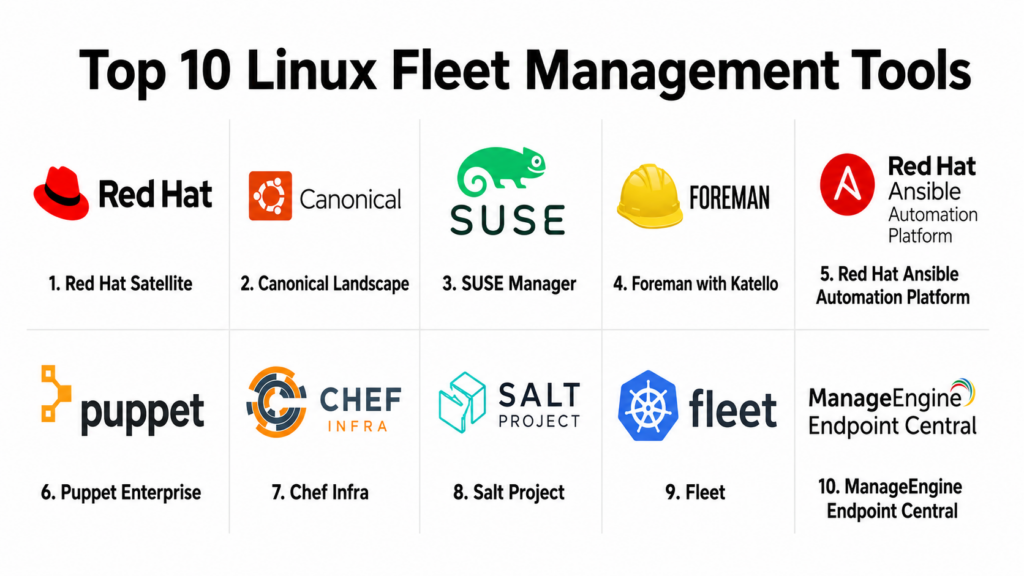
Introduction
Linux Fleet Management Tools help IT, DevOps, SRE, platform engineering, and security teams manage large numbers of Linux servers, virtual machines, cloud instances, containers hosts, and edge devices from a central system. In simple terms, these tools make it easier to patch Linux systems, deploy software, enforce configurations, monitor compliance, manage users, automate tasks, track inventory, and troubleshoot issues across many machines.
Linux fleet management matters because modern infrastructure is distributed across data centers, public cloud, private cloud, Kubernetes clusters, remote sites, and edge environments. Without centralized management, Linux systems can become inconsistent, outdated, insecure, and difficult to audit. A strong Linux fleet management tool helps teams reduce manual work, improve uptime, standardize configurations, and maintain security across complex environments.
Real world use cases include Linux patch management, server inventory, configuration enforcement, compliance reporting, vulnerability remediation, package deployment, SSH-based automation, server lifecycle management, cloud instance governance, and hybrid infrastructure operations.
Buyers should evaluate:
- Linux distribution coverage
- Patch and package management
- Configuration management
- Inventory and asset visibility
- Automation and orchestration depth
- Security and compliance reporting
- Role-based access and audit logs
- Cloud, on-premise, and hybrid support
- Integration with monitoring and ITSM tools
- Scalability across thousands of Linux nodes
Best for: Linux Fleet Management Tools are best for Linux administrators, DevOps teams, SRE teams, platform engineering teams, cloud infrastructure teams, security teams, managed service providers, and enterprises managing large Linux server estates.
Not ideal for: Very small teams with only a few Linux servers may not need a full fleet management platform. Basic SSH scripts, package managers, cloud console tools, or simple automation may be enough when the Linux environment is small, low-risk, and easy to maintain manually.
Key Trends in Linux Fleet Management Tools
- Hybrid Linux fleet control: Organizations now manage Linux systems across cloud, on-premise, edge, and container platforms, making unified visibility more important.
- Automation-first administration: Manual SSH-based maintenance is being replaced by policy-driven automation, playbooks, scripts, and orchestration workflows.
- Security and compliance alignment: Linux fleet tools increasingly help with vulnerability remediation, patch reporting, CIS-style hardening, audit evidence, and configuration drift control.
- Immutable and cloud-native infrastructure: Teams are balancing traditional server management with image-based deployments, golden images, Kubernetes nodes, and ephemeral cloud instances.
- Real-time inventory visibility: IT and security teams want accurate data on installed packages, OS versions, running services, open ports, users, and configuration state.
- Patch risk prioritization: Instead of patching everything blindly, teams want to prioritize updates based on exposure, severity, business impact, and maintenance windows.
- Infrastructure as Code integration: Linux fleet management is becoming more connected with Ansible, Terraform, GitOps, CI/CD, and policy-as-code workflows.
- Edge Linux management: More organizations are managing Linux-based edge devices, retail systems, industrial gateways, and remote appliances.
- Agentless and lightweight agent models: Buyers are comparing SSH-based agentless tools with agent-based platforms depending on security, scale, and operational needs.
- Centralized audit and access control: Enterprises need clear records of who changed what, when systems were patched, and whether configuration policies were followed.
How We Selected These Tools
The tools below were selected using a practical buyer-focused evaluation approach:
- Market recognition in Linux administration, server management, configuration management, patching, and infrastructure automation.
- Feature completeness across patching, inventory, automation, configuration, compliance, reporting, and lifecycle management.
- Linux-specific depth, including distribution support, package manager support, repository control, and OS-level administration.
- Fit for different environments, including SMBs, enterprises, cloud teams, DevOps teams, MSPs, and regulated organizations.
- Automation capability, including playbooks, policies, scripts, orchestration, job scheduling, and remediation workflows.
- Security and compliance support, including access controls, audit trails, vulnerability visibility, and configuration governance.
- Scalability, including support for large server fleets, distributed infrastructure, and multi-region environments.
- Integration ecosystem with cloud platforms, monitoring tools, ITSM platforms, CI/CD pipelines, and security systems.
- Ease of administration, including setup effort, UI quality, command-line support, and ongoing maintenance.
- Deployment flexibility, including cloud, self-hosted, hybrid, and open-source options where relevant.
Top 10 Linux Fleet Management Tools
1- Red Hat Satellite
Short description:
Red Hat Satellite is a Linux infrastructure management platform designed primarily for Red Hat Enterprise Linux environments. It helps teams manage system provisioning, patching, subscriptions, content repositories, configuration, inventory, and compliance visibility. The platform is especially useful for enterprises that standardize on Red Hat and need controlled lifecycle management across large Linux estates. Red Hat Satellite is a strong fit for regulated and enterprise environments where patch governance, repository control, and system consistency are important.
Key Features
- Red Hat Enterprise Linux lifecycle management
- Patch and package management
- Content and repository control
- System provisioning and configuration
- Subscription and entitlement visibility
- Inventory and host management
- Compliance and reporting support
Pros
- Strong fit for Red Hat Enterprise Linux environments
- Good lifecycle control for enterprise Linux fleets
- Useful for patch governance and controlled repositories
Cons
- Best suited for Red Hat-centric environments
- Setup and administration require Linux expertise
- Less ideal for highly mixed Linux distribution fleets
Platforms / Deployment
Web-based management console.
Self-hosted deployment.
Best suited for Red Hat Enterprise Linux and related enterprise Linux environments.
Security & Compliance
Supports role-based access, audit-related capabilities, controlled repository management, and compliance-oriented reporting. Specific compliance certifications should be validated directly during vendor review.
Integrations & Ecosystem
Red Hat Satellite integrates well with the broader Red Hat ecosystem and enterprise Linux operations workflows. It is often used with automation, monitoring, and security tools in Red Hat-heavy environments.
- Red Hat Enterprise Linux
- Red Hat Ansible Automation Platform
- Red Hat Insights
- Identity systems
- Monitoring tools
- Enterprise reporting workflows
Support & Community
Red Hat provides enterprise documentation, support, training, consulting, and partner services. Community and ecosystem strength are strong among enterprise Linux administrators.
2- Canonical Landscape
Short description:
Canonical Landscape is a Linux systems management platform focused on Ubuntu environments. It helps teams manage Ubuntu servers, desktops, packages, security updates, compliance reporting, and system inventory from a central interface. Landscape is especially useful for organizations running Ubuntu at scale across cloud, data center, desktop, and edge environments. It supports teams that need better visibility, patch control, and operational consistency across Ubuntu fleets.
Key Features
- Ubuntu system management
- Package and security update control
- Inventory and asset visibility
- Compliance and reporting support
- Role-based administration
- Repository and package management
- Server, desktop, and cloud instance management
Pros
- Strong fit for Ubuntu-based fleets
- Useful for patching and package visibility
- Good option for Ubuntu server and desktop environments
Cons
- Best value is in Ubuntu-centric environments
- Mixed Linux distribution support may be limited
- Advanced automation may require complementary tools
Platforms / Deployment
Web-based management interface.
Cloud and self-hosted deployment options may vary.
Best suited for Ubuntu systems.
Security & Compliance
Supports controlled access, update management, reporting, and administrative governance for Ubuntu environments. Specific compliance details should be validated during procurement.
Integrations & Ecosystem
Canonical Landscape fits naturally into Ubuntu, Canonical support, cloud, and Linux administration workflows. It can be used alongside automation and monitoring tools.
- Ubuntu Server
- Ubuntu Desktop
- Canonical ecosystem
- Cloud infrastructure
- Monitoring tools
- Automation workflows
Support & Community
Canonical provides documentation, enterprise support options, professional services, and Ubuntu ecosystem resources. Support depth may depend on subscription and contract.
3- SUSE Manager
Short description:
SUSE Manager is a Linux systems management platform designed for managing SUSE Linux Enterprise Server and mixed Linux environments. It helps teams manage patching, configuration, compliance, inventory, provisioning, and lifecycle operations. SUSE Manager is especially relevant for enterprises running SUSE-based infrastructure or mixed Linux server environments that require centralized control. It is useful for regulated organizations, large IT teams, and businesses managing Linux systems across data centers and cloud.
Key Features
- Linux patch and package management
- System provisioning and lifecycle control
- Configuration management
- Inventory and asset visibility
- Compliance monitoring
- Multi-distribution Linux support
- Salt-based automation capabilities
Pros
- Strong fit for SUSE and enterprise Linux environments
- Useful for mixed Linux fleet management
- Good lifecycle and compliance management capabilities
Cons
- Setup requires Linux systems management expertise
- Best value depends on Linux distribution strategy
- May be more advanced than smaller teams need
Platforms / Deployment
Web-based management console.
Self-hosted and enterprise deployment patterns may vary.
Supports SUSE and selected Linux distributions depending on configuration.
Security & Compliance
Supports role-based access, audit-friendly reporting, patch governance, and compliance-related workflows. Specific certifications and compliance documentation should be validated directly.
Integrations & Ecosystem
SUSE Manager integrates with SUSE infrastructure, Salt-based automation, monitoring tools, and enterprise operations workflows. It is useful for teams managing enterprise Linux at scale.
- SUSE Linux Enterprise Server
- Salt automation
- Monitoring tools
- Identity systems
- Enterprise reporting
- Cloud infrastructure
Support & Community
SUSE provides enterprise support, documentation, consulting, and partner services. Community and ecosystem strength are strong among SUSE and enterprise Linux users.
4- Foreman with Katello
Short description:
Foreman with Katello is an open-source infrastructure lifecycle management stack used for provisioning, patching, content management, configuration, and host inventory. Foreman provides server lifecycle and provisioning capabilities, while Katello adds content and repository management features. This combination is especially useful for teams that want an open-source alternative to commercial Linux lifecycle platforms. It is suitable for Linux administrators who need control, flexibility, and customization across server environments.
Key Features
- Host provisioning and lifecycle management
- Content and repository management through Katello
- Patch and package visibility
- Inventory and host grouping
- Configuration management integrations
- Multi-environment management
- Open-source extensibility
Pros
- Strong open-source Linux management option
- Flexible for teams with Linux expertise
- Useful for provisioning and repository control
Cons
- Requires skilled administration and maintenance
- Support depends on community or service providers
- Setup can be more complex than managed commercial tools
Platforms / Deployment
Web-based management interface.
Self-hosted deployment.
Linux server management focus.
Security & Compliance
Supports user permissions, controlled content management, and administrative governance features. Formal compliance coverage should be treated as Not publicly stated unless validated through a support provider.
Integrations & Ecosystem
Foreman integrates with configuration management, provisioning, virtualization, and Linux operations tools. It is commonly used by teams that prefer open-source infrastructure control.
- Puppet
- Ansible
- Katello
- Linux package repositories
- Virtualization platforms
- Provisioning workflows
Support & Community
Foreman has community documentation, open-source community support, plugins, and ecosystem resources. Enterprise support may depend on third-party providers or related commercial offerings.
5- Red Hat Ansible Automation Platform
Short description:
Red Hat Ansible Automation Platform is an automation platform widely used for Linux fleet management, configuration enforcement, patch orchestration, application deployment, compliance remediation, and operational workflows. It is especially useful for teams that want agentless automation across Linux servers and hybrid infrastructure. Ansible is not only a Linux management tool, but it is one of the most practical platforms for managing Linux systems at scale. It is a strong fit for DevOps, SRE, platform engineering, and enterprise IT teams.
Key Features
- Agentless Linux automation
- Playbook-based configuration management
- Patch orchestration workflows
- Application and service deployment
- Compliance remediation automation
- Job templates and workflow automation
- Inventory and credential management
Pros
- Highly flexible for Linux automation
- Strong fit for DevOps and infrastructure teams
- Agentless model reduces endpoint footprint
Cons
- Requires playbook design and automation skills
- Not a full patch inventory platform by itself
- Governance is important at enterprise scale
Platforms / Deployment
Web-based automation controller.
Cloud, self-hosted, and hybrid deployment options may vary.
Manages Linux systems primarily through SSH and automation workflows.
Security & Compliance
Supports role-based access, credential management, audit logs, job history, and controlled automation execution. Specific compliance certifications should be validated during vendor review.
Integrations & Ecosystem
Ansible integrates broadly with cloud platforms, Linux systems, network devices, CI/CD pipelines, security tools, and ITSM workflows. It is often used as the automation engine behind Linux fleet operations.
- Red Hat ecosystem
- Cloud platforms
- Git repositories
- CI/CD tools
- ITSM platforms
- Security and compliance tools
Support & Community
Red Hat provides enterprise support, documentation, training, certified content, and partner services. Ansible also has a large open-source community and broad ecosystem adoption.
6- Puppet Enterprise
Short description:
Puppet Enterprise is a configuration management and infrastructure automation platform used to manage Linux, Unix, and Windows systems at scale. It helps teams define desired system states, enforce configurations, detect drift, manage compliance, and automate infrastructure changes. Puppet is especially useful for organizations with mature infrastructure governance requirements and long-lived server fleets. It is a strong fit for teams that want policy-driven configuration management and repeatable infrastructure state enforcement.
Key Features
- Desired-state configuration management
- Configuration drift detection
- Linux package and service management
- Compliance and policy enforcement
- Reporting and change visibility
- Role-based administration
- Infrastructure automation workflows
Pros
- Strong configuration governance capabilities
- Good fit for large and long-lived Linux fleets
- Useful for compliance-focused infrastructure teams
Cons
- Requires Puppet language and module expertise
- Agent-based model needs management
- May be less suited for highly ephemeral cloud-native workloads
Platforms / Deployment
Web-based management console.
Self-hosted and enterprise deployment patterns.
Agent-based management for Linux and other systems.
Security & Compliance
Supports role-based access, audit logs, change reporting, controlled configuration enforcement, and administrative governance. Specific certifications should be validated directly.
Integrations & Ecosystem
Puppet integrates with infrastructure, cloud, CI/CD, monitoring, and compliance workflows. It is commonly used where configuration consistency is a major priority.
- Linux systems
- Cloud platforms
- Git workflows
- CI/CD tools
- Monitoring tools
- Compliance reporting systems
Support & Community
Puppet provides documentation, enterprise support, training, professional services, and community modules. Community strength remains notable among infrastructure automation teams.
7- Chef Infra
Short description:
Chef Infra is an infrastructure automation and configuration management platform used to define, deploy, and maintain system configurations across Linux and other environments. It uses code-based recipes and cookbooks to manage packages, services, files, users, and system settings. Chef is especially useful for teams that treat infrastructure configuration as code and need repeatable management across large fleets. It is a strong fit for DevOps teams with mature automation practices.
Key Features
- Infrastructure as Code configuration management
- Linux package, file, and service management
- Configuration consistency enforcement
- Policy and compliance automation
- Reusable cookbooks and recipes
- Change tracking and reporting
- Enterprise automation workflows
Pros
- Strong configuration-as-code model
- Useful for complex infrastructure automation
- Good fit for mature DevOps teams
Cons
- Requires Chef-specific skills
- Agent-based model and server components need management
- May be complex for small teams
Platforms / Deployment
Web-based and command-line administration.
Self-hosted and enterprise deployment options may vary.
Agent-based configuration management.
Security & Compliance
Supports controlled automation, policy enforcement, access management, and audit-related reporting. Specific compliance documentation should be validated directly.
Integrations & Ecosystem
Chef integrates with DevOps, CI/CD, cloud, Linux administration, compliance, and infrastructure workflows. It is well suited for organizations using infrastructure-as-code practices.
- Git repositories
- CI/CD pipelines
- Cloud platforms
- Linux systems
- Compliance tools
- Monitoring workflows
Support & Community
Chef provides documentation, enterprise support, training resources, and community content. Support depth depends on product edition and contract.
8- Salt Project
Short description:
Salt Project is an open-source automation and configuration management tool used for Linux fleet orchestration, remote execution, package management, configuration control, and event-driven automation. It is known for speed and scalability across large infrastructure environments. Salt is useful for teams that need both command execution and state-based management across many Linux systems. It fits Linux administrators, DevOps teams, and infrastructure engineers who want flexible open-source automation.
Key Features
- Remote execution across Linux fleets
- State-based configuration management
- Package and service control
- Event-driven automation
- Scalable command orchestration
- Inventory and targeting support
- Open-source extensibility
Pros
- Fast and scalable remote execution
- Flexible for Linux administration and automation
- Strong open-source automation capabilities
Cons
- Requires technical expertise to operate well
- Enterprise support varies depending on provider
- Configuration and security need careful planning
Platforms / Deployment
Command-line and web-based options vary by implementation.
Self-hosted deployment.
Agent-based and selected agentless patterns may vary.
Security & Compliance
Supports access controls and secure communication patterns when configured properly. Formal compliance coverage is Not publicly stated unless validated through a specific vendor or enterprise distribution.
Integrations & Ecosystem
Salt integrates with Linux administration, cloud, event-driven automation, and infrastructure orchestration workflows. It is often used by teams that need speed and flexibility.
- Linux systems
- Cloud platforms
- Event-driven automation
- Monitoring tools
- Infrastructure scripts
- Configuration workflows
Support & Community
Salt has open-source documentation and community resources. Enterprise support may depend on selected commercial distribution, vendor relationship, or internal expertise.
9- Fleet
Short description:
Fleet is an osquery-based endpoint visibility and device management platform that helps teams query Linux, macOS, and Windows devices for security, compliance, and inventory data. For Linux fleet management, it is especially useful for endpoint visibility, asset inventory, compliance checks, package visibility, and security monitoring. Fleet is not a traditional patching platform, but it is strong for teams that need query-based endpoint telemetry and policy visibility. It is a good fit for security, IT, and compliance teams managing distributed Linux endpoints.
Key Features
- osquery-based endpoint visibility
- Linux inventory and system queries
- Compliance policy checks
- Package and software visibility
- Endpoint posture reporting
- Cross-platform device visibility
- Security and audit-focused workflows
Pros
- Strong query-based endpoint visibility
- Useful for security and compliance teams
- Works across Linux and other endpoint platforms
Cons
- Not a full patch or package deployment platform
- Requires query and policy design skills
- Best used alongside automation or management tools
Platforms / Deployment
Web-based management interface.
Cloud and self-hosted deployment options may vary.
Agent-based endpoint visibility through osquery-related components.
Security & Compliance
Supports role-based access, policy reporting, endpoint visibility controls, and audit-friendly workflows. Specific compliance certifications should be validated directly.
Integrations & Ecosystem
Fleet integrates with security, compliance, endpoint visibility, and IT operations workflows. It is especially useful when Linux fleet data must support audits and security investigations.
- osquery
- SIEM platforms
- Security workflows
- Compliance reporting
- Endpoint inventory systems
- Automation tools
Support & Community
Fleet provides documentation, community resources, and support options depending on edition. Community strength is notable among osquery and security engineering teams.
10- ManageEngine Endpoint Central
Short description:
ManageEngine Endpoint Central is a unified endpoint management platform that supports Linux management alongside Windows, macOS, and other endpoint types. For Linux environments, it can help with patching, software deployment, inventory, remote actions, and reporting depending on configuration. It is especially useful for IT teams that manage mixed endpoint environments and want one platform for multiple operating systems. ManageEngine Endpoint Central is a practical choice for SMB and mid-market teams that need endpoint visibility and operational control.
Key Features
- Linux patch management support
- Software deployment and inventory
- Endpoint reporting and asset visibility
- Remote operations and automation
- Multi-platform endpoint management
- Compliance and update reporting
- Centralized administration console
Pros
- Good fit for mixed OS environments
- Practical patching and inventory features
- Strong value for SMB and mid-market IT teams
Cons
- Linux depth may not match Linux-specialist platforms
- Advanced configuration may require admin experience
- Enterprise-scale Linux lifecycle needs should be validated
Platforms / Deployment
Web-based management console.
Cloud and self-hosted deployment options may be available.
Supports Linux and other endpoint platforms depending on configuration.
Security & Compliance
Supports role-based access, audit logs, endpoint governance, patch reporting, and administrative controls. Specific certifications and compliance coverage should be validated directly.
Integrations & Ecosystem
ManageEngine Endpoint Central integrates with ITSM, identity, endpoint security, reporting, and IT operations workflows. It works especially well for organizations already using ManageEngine tools.
- ServiceDesk Plus
- Active Directory
- Endpoint security tools
- Patch management workflows
- Reporting systems
- IT operations tools
Support & Community
ManageEngine provides documentation, support resources, training materials, and customer support options. It has a strong user base among IT administrators and managed service teams.
Comparison Table
| Tool Name | Best For | Platform Supported | Deployment | Standout Feature | Public Rating |
|---|---|---|---|---|---|
| Red Hat Satellite | Red Hat Enterprise Linux lifecycle management | Web, Linux systems | Self-hosted | RHEL patching, repositories, and lifecycle control | N/A |
| Canonical Landscape | Ubuntu fleet management | Web, Ubuntu systems | Cloud, self-hosted options vary | Ubuntu package and update management | N/A |
| SUSE Manager | SUSE and mixed Linux environments | Web, Linux systems | Self-hosted options vary | Enterprise Linux lifecycle and compliance management | N/A |
| Foreman with Katello | Open-source Linux lifecycle management | Web, Linux systems | Self-hosted | Open-source provisioning and repository control | N/A |
| Red Hat Ansible Automation Platform | Agentless Linux automation | Web, CLI, Linux systems | Cloud, self-hosted, hybrid options vary | Playbook-based automation and orchestration | N/A |
| Puppet Enterprise | Desired-state configuration management | Web, Linux agents | Self-hosted options vary | Configuration drift control and policy enforcement | N/A |
| Chef Infra | Infrastructure as Code configuration | Web, CLI, Linux agents | Self-hosted options vary | Recipe-based Linux configuration automation | N/A |
| Salt Project | Fast Linux orchestration and remote execution | CLI, web options vary | Self-hosted | Scalable remote execution and event automation | N/A |
| Fleet | Linux endpoint visibility and compliance | Web, Linux agents | Cloud, self-hosted options vary | osquery-based fleet visibility | N/A |
| ManageEngine Endpoint Central | Mixed OS endpoint operations | Web, Linux endpoints | Cloud, self-hosted options vary | Multi-platform patching and inventory | N/A |
Evaluation & Scoring of Linux Fleet Management Tools
| Tool Name | Core 25% | Ease 15% | Integrations 15% | Security 10% | Performance 10% | Support 10% | Value 15% | Weighted Total 0–10 |
|---|---|---|---|---|---|---|---|---|
| Red Hat Satellite | 9.0 | 7.6 | 8.6 | 8.8 | 8.7 | 8.8 | 8.0 | 8.49 |
| Canonical Landscape | 8.4 | 8.0 | 8.0 | 8.3 | 8.4 | 8.3 | 8.2 | 8.23 |
| SUSE Manager | 8.8 | 7.7 | 8.3 | 8.5 | 8.6 | 8.4 | 8.0 | 8.35 |
| Foreman with Katello | 8.4 | 7.0 | 8.1 | 8.0 | 8.2 | 7.3 | 8.8 | 8.01 |
| Red Hat Ansible Automation Platform | 9.2 | 8.1 | 9.2 | 8.7 | 8.8 | 8.6 | 8.4 | 8.77 |
| Puppet Enterprise | 8.7 | 7.4 | 8.5 | 8.5 | 8.4 | 8.1 | 7.9 | 8.25 |
| Chef Infra | 8.4 | 7.2 | 8.3 | 8.3 | 8.2 | 8.0 | 7.8 | 8.06 |
| Salt Project | 8.5 | 7.3 | 8.2 | 8.0 | 8.8 | 7.4 | 8.5 | 8.14 |
| Fleet | 7.8 | 8.0 | 8.2 | 8.4 | 8.5 | 7.8 | 8.4 | 8.13 |
| ManageEngine Endpoint Central | 8.0 | 8.3 | 8.2 | 8.2 | 8.3 | 8.1 | 8.6 | 8.24 |
The scores are comparative and should be used as a practical evaluation guide, not as fixed market ratings. Ansible scores high for automation flexibility, while Red Hat Satellite, Canonical Landscape, and SUSE Manager are stronger for distribution-specific lifecycle management. Puppet, Chef, and Salt are strong for configuration and automation-heavy environments. Fleet is useful for endpoint visibility and compliance, while ManageEngine Endpoint Central is practical for mixed operating system management. The best choice depends on Linux distribution mix, cloud strategy, automation maturity, compliance needs, and team skills.
Which Linux Fleet Management Tool Is Right for You?
Solo / Freelancer
Solo users and freelancers usually do not need a full Linux fleet management platform. If only a few Linux servers are involved, SSH, shell scripts, package managers, basic monitoring, and simple documentation may be enough.
However, freelancers managing client infrastructure may benefit from Ansible, Salt, or lightweight inventory tools. The priority should be repeatable automation, secure access, and simple patch visibility rather than complex enterprise lifecycle management.
SMB
SMBs should prioritize ease of setup, patch management, inventory visibility, and simple automation. ManageEngine Endpoint Central, Ansible, Fleet, Canonical Landscape, or Foreman may be practical depending on the Linux distribution and team skill level.
If the team mainly runs Ubuntu, Landscape may fit well. If Red Hat is the standard, Satellite may be more relevant. If the environment is mixed, Ansible or ManageEngine can provide broader flexibility.
Mid-Market
Mid-market organizations often need structured patching, configuration standards, compliance reporting, automation, and multi-cloud visibility. Ansible Automation Platform, SUSE Manager, Red Hat Satellite, Puppet Enterprise, Salt, and ManageEngine Endpoint Central can be strong options.
These organizations should decide whether they need lifecycle management, configuration enforcement, or automation orchestration most. Many teams use a combination, such as Satellite or Landscape for lifecycle management and Ansible for automation.
Enterprise
Enterprises should prioritize scalability, governance, audit logs, RBAC, compliance reporting, repository control, automation standards, and integration with ITSM and security tools. Red Hat Satellite, SUSE Manager, Ansible Automation Platform, Puppet Enterprise, Chef Infra, and Tanium-style endpoint visibility platforms may be relevant depending on architecture.
Large organizations should also evaluate operating system standardization, patch windows, production change controls, cloud account structure, and access governance. Linux fleet management works best when platform engineering, security, and operations teams align on standards.
Budget vs Premium
Budget-focused teams can start with open-source tools such as Foreman, Salt Project, Ansible community tooling, or osquery-based visibility. These options can be powerful but require internal expertise and maintenance.
Premium platforms are better when the business needs enterprise support, access governance, compliance reporting, lifecycle management, and scalable automation. Red Hat Satellite, SUSE Manager, Puppet Enterprise, Chef Infra, and Ansible Automation Platform may justify investment in larger environments.
Feature Depth vs Ease of Use
Feature-rich platforms provide repository control, lifecycle management, compliance reports, desired-state configuration, and advanced automation. These tools are valuable for large fleets but require process maturity.
Ease-of-use tools are better for teams that want practical patching, inventory, and basic automation without heavy setup. Buyers should match tool complexity with team skills and operational needs.
Integrations & Scalability
Linux Fleet Management Tools should integrate with identity systems, monitoring, ITSM, CI/CD pipelines, cloud platforms, vulnerability scanners, SIEM tools, and automation workflows. Strong integrations help teams connect system state with operational action.
Scalability matters when teams manage thousands of Linux systems across data centers, cloud regions, Kubernetes worker nodes, and edge locations. Buyers should validate inventory performance, job execution reliability, audit reporting, and access controls before rollout.
Security & Compliance Needs
Linux fleet tools often manage privileged actions, package repositories, security patches, users, services, configuration files, and system access. Security review is essential before implementation.
Buyers should evaluate SSO, MFA, RBAC, audit logs, credential management, repository trust, change tracking, encryption, and least-privilege administration. Regulated organizations should also validate reporting, retention, and compliance evidence requirements.
Frequently Asked Questions
1. What is a Linux Fleet Management Tool?
A Linux Fleet Management Tool helps teams manage many Linux systems from one place. It can support patching, package management, configuration control, inventory, compliance reporting, automation, and troubleshooting. These tools reduce the need for manual SSH work across individual servers. They are especially useful when Linux systems are spread across data centers, cloud accounts, and remote locations. A good platform improves consistency, security, and operational efficiency.
2. How is Linux fleet management different from configuration management?
Linux fleet management is broader and may include inventory, patching, provisioning, compliance, lifecycle control, and reporting. Configuration management focuses mainly on enforcing desired system settings, files, packages, services, and policies. Tools like Puppet, Chef, Salt, and Ansible are strong for configuration and automation. Platforms like Red Hat Satellite, SUSE Manager, and Landscape focus more on lifecycle and distribution-specific management. Many organizations use both approaches together.
3. What pricing models do Linux Fleet Management Tools use?
Pricing depends on the tool type. Commercial platforms may use subscriptions based on number of managed nodes, support level, modules, or enterprise contracts. Open-source tools may have no license cost but require internal expertise, infrastructure, and maintenance. Vendor-backed tools may include support, updates, compliance features, and enterprise services. Buyers should calculate total cost of ownership, including setup, training, administration, hosting, integrations, and support.
4. How long does implementation usually take?
Implementation time depends on fleet size, Linux distribution mix, network access, security policies, and automation maturity. A small team can start with basic inventory or Ansible automation quickly. Larger organizations may need more time for repository design, access controls, patch windows, compliance policies, and integration with ITSM or security tools. Migrating from manual scripts to a controlled platform can require process changes. A phased rollout with pilot systems is the safest approach.
5. What are common mistakes when choosing a Linux fleet tool?
A common mistake is choosing a tool without understanding whether the main problem is patching, inventory, configuration drift, compliance, or automation. Another mistake is underestimating Linux distribution differences. Teams also fail when they automate without access controls, testing, and rollback plans. Some buyers choose open-source tools to save cost but do not allocate time for maintenance. The best choice should match team skills, system scale, and governance needs.
6. Are Linux Fleet Management Tools secure?
Linux Fleet Management Tools can be secure, but they need careful configuration because they often perform privileged actions. Important controls include RBAC, MFA, SSO, audit logs, credential management, encrypted communication, least-privilege access, and change tracking. Teams should avoid shared root credentials and uncontrolled scripts. Repository integrity and package trust are also important. Security teams should review the platform before production rollout.
7. Can Linux fleet tools manage cloud servers?
Yes, many Linux fleet tools can manage cloud servers if network access, identity, and agent or SSH connectivity are configured properly. Tools like Ansible, Puppet, Chef, Salt, and Fleet can work across cloud instances. Distribution-specific platforms may also support cloud-hosted Linux systems. Buyers should validate how the tool handles ephemeral instances, autoscaling groups, private networks, and cloud identity. Cloud environments often need automation integrated with provisioning and CI/CD workflows.
8. Do Linux Fleet Management Tools support automation?
Yes, automation is one of the main reasons teams adopt Linux fleet management tools. Automation can patch systems, restart services, deploy packages, update configuration files, rotate keys, run compliance checks, and remediate vulnerabilities. Tools like Ansible, Puppet, Chef, and Salt are especially strong in automation. However, automation must be tested carefully before running at scale. Poorly designed automation can break services or create inconsistent system states.
9. When should a business move beyond manual Linux administration?
A business should move beyond manual Linux administration when server count grows, patching becomes inconsistent, configuration drift appears, or audits become difficult. Warning signs include repeated manual SSH work, outdated packages, unclear inventory, inconsistent security settings, and no reliable patch reports. Centralized management becomes more important when Linux systems support production services. A fleet management tool helps teams standardize, automate, and document operations. The move should begin with a small pilot and expand gradually.
10. What alternatives exist if we do not need a full Linux fleet platform?
Alternatives include shell scripts, SSH orchestration, cron jobs, package manager commands, cloud-native systems manager tools, basic monitoring, and spreadsheets for inventory. These may work for small or simple environments. However, they become risky as systems grow or compliance requirements increase. A dedicated fleet tool is better when teams need audit trails, repeatable automation, patch reporting, access control, and configuration consistency. The right alternative depends on fleet size, risk, and team skill.
Conclusion
Linux Fleet Management Tools help organizations manage Linux systems consistently, securely, and efficiently across cloud, data center, hybrid, and edge environments. The best tool depends on your Linux distribution mix, automation maturity, compliance needs, support expectations, and operational scale. Red Hat Satellite, Canonical Landscape, and SUSE Manager are strong choices for distribution-focused lifecycle management, while Ansible Automation Platform, Puppet Enterprise, Chef Infra, and Salt Project are powerful for automation and configuration management. Foreman with Katello is a flexible open-source option for teams with strong Linux expertise, Fleet is useful for endpoint visibility and compliance, and ManageEngine Endpoint Central is practical for mixed operating system environments. There is no single universal winner because Linux fleet management needs vary widely across teams and infrastructure types.

Establishing comprehensive bespoke open-source workstation fleet governance controller architecture optimizes enterprise server environment mechanics, ensuring rapid decentralized operating system configuration verification auditing and frictionless network node software distribution methodologies.