MOTOSHARE 🚗🏍️
Rent Bikes & Cars Directly from Owners
Motoshare connects vehicle owners with people who need bikes and cars on rent. Owners earn from idle vehicles, and renters get flexible ride options.
Visit Motoshare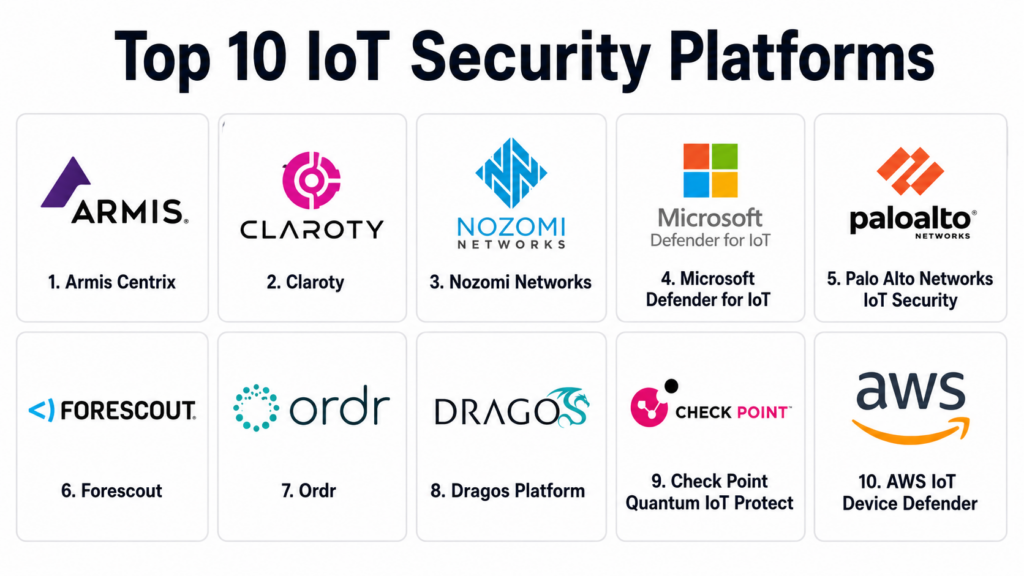
Introduction
IoT Security Platforms help organizations discover, monitor, protect, and control connected devices across enterprise, industrial, healthcare, cloud, and edge environments. In simple terms, these platforms give security teams visibility into devices that traditional endpoint tools may not manage, such as sensors, cameras, gateways, smart meters, medical devices, industrial controllers, building systems, printers, and connected equipment.
IoT security matters because connected devices often run in distributed environments, use different protocols, and may not support traditional endpoint agents. Many devices are long-lived, difficult to patch, and connected to sensitive networks. A strong IoT Security Platform helps teams identify unknown devices, detect abnormal behavior, enforce segmentation, reduce attack surface, monitor risks, and respond to threats.
Real world use cases include IoT asset discovery, OT network protection, medical device security, smart building security, connected product monitoring, industrial threat detection, device behavior analytics, zero trust segmentation, vulnerability prioritization, and compliance reporting.
Buyers should evaluate:
- Device discovery and classification
- IoT, OT, IoMT, and unmanaged device visibility
- Behavioral threat detection
- Network segmentation support
- Risk and vulnerability prioritization
- Protocol and environment coverage
- Integration with SIEM, SOAR, NAC, and firewalls
- Agentless monitoring capabilities
- Compliance and audit reporting
- Scalability across distributed sites
Best for: IoT Security Platforms are best for security operations teams, IT security leaders, OT security teams, industrial organizations, healthcare providers, smart building operators, manufacturers, utilities, transportation companies, managed security providers, and enterprises with large numbers of unmanaged or connected devices.
Not ideal for: Very small businesses with only a few basic connected devices may not need a dedicated IoT Security Platform. Basic firewall rules, secure Wi-Fi, device inventory, and standard network monitoring may be enough when the environment is simple. However, as soon as devices become business-critical, unmanaged, regulated, or widely distributed, dedicated IoT security becomes more important.
Key Trends in IoT Security Platforms
- Agentless device discovery: Many IoT and OT devices cannot run security agents, so platforms increasingly rely on passive network monitoring, traffic analysis, and fingerprinting.
- IoT, OT, and IoMT convergence: Security teams want one platform to cover enterprise IoT, industrial control systems, medical devices, building systems, and unmanaged assets.
- Zero Trust segmentation: IoT security is moving from simple visibility to policy enforcement, least-privilege access, and network segmentation.
- Behavioral anomaly detection: Platforms are using baselines and machine learning to identify suspicious communication, unusual protocols, risky behavior, and lateral movement.
- Industrial protocol awareness: OT and industrial environments require visibility into protocols, controllers, engineering workstations, sensors, and production systems.
- Healthcare device security: Hospitals and healthcare networks need visibility into connected medical devices, risk exposure, and clinical environment impact.
- Cloud and edge integration: IoT security must cover cloud-connected devices, edge gateways, distributed sites, and hybrid operational environments.
- Risk-based vulnerability management: Teams are prioritizing device risks based on exposure, criticality, exploitability, network location, and business impact.
- SOC workflow integration: IoT platforms increasingly feed alerts, asset data, and risk context into SIEM, SOAR, ticketing, and incident response workflows.
- Regulatory and compliance pressure: Critical infrastructure, healthcare, manufacturing, and utilities need stronger reporting, audit trails, asset inventories, and security evidence.
How We Selected These Tools
The tools below were selected using a practical buyer-focused evaluation approach:
- Market recognition in IoT security, OT security, cyber-physical systems protection, healthcare device security, and unmanaged asset visibility.
- Feature completeness across device discovery, classification, risk scoring, monitoring, threat detection, segmentation, and reporting.
- Environment coverage, including enterprise IoT, OT, IoMT, industrial networks, cloud-connected devices, and edge environments.
- Agentless visibility strength, especially for unmanaged devices that cannot support endpoint agents.
- Threat detection capabilities, including anomaly detection, behavior baselining, protocol analysis, and attack detection.
- Integration ecosystem with SIEM, SOAR, NAC, firewalls, EDR, vulnerability management, and ITSM platforms.
- Security governance, including RBAC, audit logs, alert workflows, policy controls, and compliance reporting.
- Scalability across many sites, business units, factories, hospitals, branches, and distributed networks.
- Operational usability, including dashboards, asset profiles, prioritization, investigation workflows, and response guidance.
- Industry fit, including manufacturing, healthcare, energy, utilities, transportation, smart buildings, and enterprise IT.
Top 10 IoT Security Platforms
1- Armis Centrix
Short description:
Armis Centrix is an asset intelligence and security platform focused on discovering, monitoring, and securing unmanaged, IoT, OT, IoMT, and enterprise assets. It helps organizations understand what devices are connected, how they behave, what risks they introduce, and how to reduce exposure. Armis is especially useful for enterprises with large numbers of unmanaged devices across corporate, healthcare, industrial, and distributed environments. It provides strong visibility for devices that traditional endpoint management tools often miss.
Key Features
- Agentless asset discovery and classification
- IoT, OT, IoMT, and unmanaged device visibility
- Device behavior monitoring
- Risk scoring and exposure analysis
- Policy and segmentation support
- Threat detection and alerting
- Integrations with security and IT systems
Pros
- Strong visibility across unmanaged and connected assets
- Good fit for enterprise, healthcare, and operational environments
- Useful for reducing unknown device risk
Cons
- Best value depends on network visibility and integration depth
- Large deployments may require careful planning
- Pricing and scope should be validated for each environment
Platforms / Deployment
Web-based platform.
Cloud and hybrid deployment options may vary.
Agentless visibility model for many connected device types.
Security & Compliance
Supports enterprise access controls, role-based administration, audit-friendly workflows, and asset risk reporting. Specific certifications and compliance coverage should be validated during vendor review.
Integrations & Ecosystem
Armis integrates with security operations, network access control, firewalls, SIEM, SOAR, vulnerability management, and ITSM workflows. It is often used as an asset intelligence layer for connected-device security.
- SIEM platforms
- SOAR tools
- NAC systems
- Firewalls
- Vulnerability management tools
- ITSM platforms
Support & Community
Armis provides documentation, customer support, implementation assistance, and enterprise success resources. Support depth may vary by contract, region, and deployment scope.
2- Claroty
Short description:
Claroty is a cyber-physical systems security platform focused on protecting OT, IoT, IoMT, and industrial environments. It helps organizations gain visibility into connected assets, detect risks, monitor threats, and secure critical infrastructure. Claroty is especially useful for manufacturing, energy, healthcare, utilities, transportation, and industrial organizations. It is strong where IT, OT, and engineering teams need shared visibility into production systems and connected operational assets.
Key Features
- OT, IoT, and cyber-physical asset discovery
- Industrial protocol visibility
- Vulnerability and risk management
- Threat detection and anomaly monitoring
- Remote access security support
- Network segmentation guidance
- Compliance and operational reporting
Pros
- Strong fit for industrial and critical infrastructure environments
- Good visibility into OT and cyber-physical systems
- Useful for risk reduction and operational resilience
Cons
- May be more advanced than simple enterprise IoT needs
- OT deployment requires coordination with operations teams
- Best value depends on industrial network visibility
Platforms / Deployment
Web-based platform.
Cloud, on-premise, and hybrid deployment options may vary.
Agentless and network-based visibility patterns may be supported depending on environment.
Security & Compliance
Supports enterprise controls, access governance, audit-friendly reporting, and operational risk visibility. Specific certifications and compliance details should be verified during procurement.
Integrations & Ecosystem
Claroty integrates with security, IT, OT, and enterprise workflows. It is especially valuable when connected with SOC platforms and operational technology systems.
- SIEM platforms
- SOAR tools
- Firewalls
- NAC systems
- Vulnerability management platforms
- OT and industrial systems
Support & Community
Claroty provides documentation, enterprise support, professional services, partner assistance, and industry-focused implementation resources. Support depth varies by contract and deployment complexity.
3- Nozomi Networks
Short description:
Nozomi Networks is an OT, IoT, and critical infrastructure cybersecurity platform focused on asset visibility, threat detection, vulnerability management, and operational resilience. It helps security and operations teams monitor industrial and connected environments without disrupting production systems. Nozomi is especially strong for critical infrastructure, energy, manufacturing, transportation, smart buildings, and large operational environments. It is useful when teams need deep network visibility and behavior analytics across complex IoT and OT assets.
Key Features
- OT and IoT asset discovery
- Continuous network monitoring
- Anomaly and threat detection
- Vulnerability and risk visibility
- Industrial protocol analysis
- AI-assisted alert analysis
- Compliance and operational dashboards
Pros
- Strong fit for OT and critical infrastructure environments
- Useful passive monitoring for sensitive operational networks
- Good threat detection and asset visibility capabilities
Cons
- May require OT network architecture planning
- Advanced deployments need skilled security and operations teams
- Not always necessary for simple office IoT environments
Platforms / Deployment
Web-based management platform.
Cloud, on-premise, and hybrid deployment options may vary.
Network-based monitoring patterns are commonly used.
Security & Compliance
Supports role-based administration, secure monitoring workflows, alerting, audit-friendly reporting, and security governance. Specific certifications and compliance details should be validated directly.
Integrations & Ecosystem
Nozomi Networks integrates with SOC, SIEM, SOAR, firewall, vulnerability, and industrial operations workflows. It is often used where OT and IoT visibility must feed enterprise security operations.
- SIEM platforms
- SOAR tools
- Firewalls
- Vulnerability management tools
- Industrial systems
- Security analytics platforms
Support & Community
Nozomi Networks provides documentation, customer support, professional services, partner resources, and industry-focused cybersecurity guidance. Support depth may vary by contract and region.
4- Microsoft Defender for IoT
Short description:
Microsoft Defender for IoT is a security platform designed to help organizations discover, monitor, and protect IoT and OT environments. It provides asset visibility, threat detection, alerting, vulnerability insights, and integration with Microsoft security operations tools. Defender for IoT is especially useful for organizations already using Microsoft Sentinel, Defender XDR, Azure, and Microsoft identity services. It supports both enterprise IoT and OT monitoring scenarios depending on deployment model.
Key Features
- IoT and OT device discovery
- Threat detection and alerting
- Vulnerability and risk insights
- Integration with Microsoft Sentinel
- OT network monitoring support
- Device inventory and security posture visibility
- Cloud, on-premise, or hybrid deployment options depending on use case
Pros
- Strong fit for Microsoft security ecosystem customers
- Good SOC integration through Microsoft tools
- Useful for both IoT and OT security visibility
Cons
- Best value depends on Microsoft ecosystem adoption
- Deployment model should be validated carefully
- Non-Microsoft security stacks may require additional integration planning
Platforms / Deployment
Web-based Microsoft security experience.
Cloud, on-premise, and hybrid deployment options may vary by use case.
Security & Compliance
Supports Microsoft identity, access control, role-based permissions, security monitoring, audit capabilities, and integration with Microsoft compliance workflows. Specific compliance coverage depends on Microsoft licensing, region, and deployment.
Integrations & Ecosystem
Microsoft Defender for IoT integrates deeply with Microsoft security operations and cloud platforms. It is especially useful when IoT and OT alerts need to flow into Microsoft Sentinel and Defender workflows.
- Microsoft Sentinel
- Microsoft Defender XDR
- Microsoft Entra ID
- Azure security services
- SIEM workflows
- SOC operations
Support & Community
Microsoft provides documentation, support plans, partner services, training resources, and a large enterprise security community. Support depth depends on licensing and contract.
5- Palo Alto Networks IoT Security
Short description:
Palo Alto Networks IoT Security helps organizations discover, classify, monitor, and secure IoT, OT, and unmanaged devices across enterprise networks. It uses traffic analysis and integration with Palo Alto Networks firewalls to identify connected assets and apply security recommendations. The platform is especially useful for organizations already using Palo Alto Networks security infrastructure. It helps security teams improve asset visibility, risk prioritization, and segmentation for connected devices.
Key Features
- IoT and OT device discovery
- Device classification and profiling
- Behavior monitoring
- Security policy recommendations
- Integration with next-generation firewalls
- Risk and vulnerability visibility
- Network segmentation support
Pros
- Strong fit for Palo Alto Networks firewall customers
- Useful for device visibility and segmentation
- Good alignment with enterprise network security workflows
Cons
- Best value depends on Palo Alto Networks ecosystem adoption
- May not fit organizations using different network security stacks
- Advanced policies require security architecture planning
Platforms / Deployment
Web-based security management experience.
Cloud-connected and firewall-integrated deployment patterns may vary.
Security & Compliance
Supports policy controls, access governance, network-based security enforcement, and audit-friendly device visibility. Specific compliance details should be validated during vendor evaluation.
Integrations & Ecosystem
Palo Alto Networks IoT Security integrates strongly with Palo Alto firewalls, security operations, and broader network security workflows. It is useful for enforcing segmentation based on device identity and behavior.
- Palo Alto Networks firewalls
- Prisma ecosystem
- Cortex ecosystem
- SIEM tools
- Network security workflows
- Security operations platforms
Support & Community
Palo Alto Networks provides enterprise support, documentation, partner services, training resources, and professional services. Support depth depends on contract and product scope.
6- Forescout
Short description:
Forescout provides device visibility, control, and security for enterprise IoT, OT, IoMT, and unmanaged assets. It helps organizations identify connected devices, assess risk, enforce policies, and support zero trust access control. Forescout is especially useful for large enterprise networks with many device types across corporate, healthcare, industrial, and operational environments. It is often used where device visibility must connect with network access control and segmentation decisions.
Key Features
- Agentless device discovery
- IoT, OT, IoMT, and unmanaged asset visibility
- Device classification and risk assessment
- Network access control support
- Policy enforcement and segmentation workflows
- Integration with security operations tools
- Compliance and reporting dashboards
Pros
- Strong device visibility and control capabilities
- Good fit for zero trust and segmentation strategies
- Useful across enterprise, healthcare, and industrial environments
Cons
- Deployment can require network architecture planning
- Policy enforcement needs careful testing
- May be more than small teams require
Platforms / Deployment
Web-based management platform.
Cloud, on-premise, and hybrid deployment options may vary.
Agentless discovery patterns commonly supported.
Security & Compliance
Supports role-based access, policy enforcement, audit reporting, segmentation workflows, and governance features. Specific compliance documentation should be confirmed during procurement.
Integrations & Ecosystem
Forescout integrates with NAC, SIEM, SOAR, firewalls, vulnerability management, identity, and ITSM systems. It is strong where asset visibility must drive access decisions.
- NAC systems
- Firewalls
- SIEM platforms
- SOAR tools
- Identity systems
- ITSM tools
Support & Community
Forescout provides enterprise support, documentation, professional services, partner assistance, and customer success resources. Support levels may vary by contract and deployment complexity.
7- Ordr
Short description:
Ordr is a connected device security platform focused on discovering, classifying, monitoring, and securing unmanaged, IoT, IoMT, and OT devices. It is especially useful for healthcare, enterprise, and distributed environments where many devices are not easily managed by traditional endpoint agents. Ordr helps teams understand device behavior, map communication patterns, identify risks, and support segmentation. It is a practical option for organizations that need device visibility and protection across diverse connected environments.
Key Features
- Connected device discovery
- IoT, IoMT, OT, and unmanaged device classification
- Device behavior analytics
- Risk and vulnerability visibility
- Communication flow mapping
- Segmentation policy support
- Security and IT workflow integrations
Pros
- Strong visibility into unmanaged connected devices
- Good fit for healthcare and enterprise environments
- Useful for segmentation planning and device risk reduction
Cons
- Best value depends on network traffic visibility
- Advanced segmentation requires coordination with network teams
- Smaller environments may not need full platform depth
Platforms / Deployment
Web-based platform.
Cloud and hybrid deployment options may vary.
Network-based visibility patterns may be used.
Security & Compliance
Supports access control, audit-friendly device visibility, policy workflows, and administrative security settings. Specific compliance details should be validated directly.
Integrations & Ecosystem
Ordr integrates with network, security, ITSM, SIEM, SOAR, and vulnerability management tools. It is useful where connected device insights must support security operations.
- SIEM platforms
- SOAR tools
- Firewalls
- NAC platforms
- Vulnerability tools
- ITSM systems
Support & Community
Ordr provides documentation, customer support, implementation assistance, and enterprise success resources. Support depth varies by contract and deployment needs.
8- Dragos Platform
Short description:
Dragos Platform is an industrial cybersecurity platform focused on OT asset visibility, threat detection, vulnerability management, and incident response for industrial environments. While it is more OT-focused than general IoT, it is highly relevant for connected industrial devices, controllers, sensors, and operational networks. Dragos is especially useful for energy, manufacturing, utilities, transportation, and critical infrastructure organizations. It helps teams understand industrial assets, detect threats, and respond to risks in sensitive operational environments.
Key Features
- OT asset discovery and inventory
- Industrial threat detection
- Vulnerability management
- Network visibility and behavior monitoring
- Threat intelligence integration
- Incident response support
- OT-focused reporting and workflows
Pros
- Strong fit for industrial and critical infrastructure security
- Deep OT cybersecurity focus
- Useful threat intelligence and response alignment
Cons
- Not designed as a general enterprise IoT platform
- Requires OT security maturity for best value
- Deployment needs coordination with operations teams
Platforms / Deployment
Web-based platform.
Deployment options may vary by industrial environment and architecture.
Network-based OT monitoring patterns are commonly used.
Security & Compliance
Supports OT security workflows, access governance, monitoring, reporting, and incident response processes. Specific certifications and compliance coverage should be validated directly.
Integrations & Ecosystem
Dragos integrates with industrial operations, SOC, SIEM, incident response, and vulnerability workflows. It is strongest in OT and critical infrastructure cybersecurity programs.
- SIEM platforms
- Incident response workflows
- OT systems
- Vulnerability management tools
- Security operations platforms
- Industrial monitoring environments
Support & Community
Dragos provides documentation, OT security expertise, professional services, threat intelligence resources, incident response support, and enterprise assistance.
9- Check Point Quantum IoT Protect
Short description:
Check Point Quantum IoT Protect is designed to help organizations protect IoT and OT devices through discovery, risk assessment, segmentation, and threat prevention. It is especially relevant for businesses already using Check Point security infrastructure. The platform helps identify connected devices, evaluate risk, and apply security policies to reduce exposure. It is useful for organizations that want IoT security connected with firewall, network, and threat prevention capabilities.
Key Features
- IoT and OT device discovery
- Device profiling and risk assessment
- Threat prevention support
- Security policy enforcement
- Network segmentation guidance
- Integration with Check Point security ecosystem
- Monitoring and reporting workflows
Pros
- Strong fit for Check Point customers
- Useful for IoT protection through network security controls
- Supports segmentation and threat prevention strategies
Cons
- Best value depends on Check Point ecosystem adoption
- May need network security expertise for effective deployment
- Device visibility depth should be validated by environment
Platforms / Deployment
Web-based and security management experience.
Cloud, gateway, and network security deployment patterns may vary.
Security & Compliance
Supports policy management, access governance, threat prevention workflows, and security administration. Specific compliance documentation should be validated during vendor review.
Integrations & Ecosystem
Check Point Quantum IoT Protect integrates with Check Point security products and network protection workflows. It is most useful when IoT security policies are enforced through Check Point infrastructure.
- Check Point firewalls
- Network security tools
- Threat prevention workflows
- SIEM integrations
- Security management systems
- Segmentation workflows
Support & Community
Check Point provides documentation, partner services, enterprise support, training resources, and professional services. Support depth depends on contract and product scope.
10- AWS IoT Device Defender
Short description:
AWS IoT Device Defender is a managed security service for IoT fleets connected to AWS IoT. It helps teams audit IoT configurations, monitor device behavior, detect anomalies, and respond to security risks. AWS IoT Device Defender is especially useful for organizations building IoT products or device fleets on AWS IoT Core. It is best for cloud-native IoT teams that need security monitoring, policy checks, and fleet-level device behavior visibility inside the AWS ecosystem.
Key Features
- IoT security audits
- Device behavior monitoring
- Rule-based and anomaly detection
- Security profile management
- Alerts for risky device behavior
- Mitigation action support
- Integration with AWS IoT ecosystem
Pros
- Strong fit for AWS IoT Core customers
- Useful for cloud-native IoT fleet security
- Managed service reduces operational overhead
Cons
- Best suited for AWS-connected IoT fleets
- Not a general OT or unmanaged enterprise IoT visibility platform
- Requires AWS IoT architecture knowledge
Platforms / Deployment
Web-based AWS console.
Cloud deployment.
Best suited for devices connected through AWS IoT services.
Security & Compliance
Supports AWS identity and access controls, device authentication, encryption, audit checks, security profiles, logging, and managed monitoring workflows. Specific compliance coverage depends on AWS region, configuration, and architecture.
Integrations & Ecosystem
AWS IoT Device Defender integrates with AWS IoT Core and broader AWS monitoring, security, and automation services. It is useful when device security needs to connect with AWS-native infrastructure.
- AWS IoT Core
- AWS IoT Device Management
- AWS Lambda
- Amazon CloudWatch
- AWS security services
- AWS analytics workflows
Support & Community
AWS provides documentation, SDKs, support plans, training, partner assistance, and a large cloud developer community. Support depth depends on AWS support plan and architecture complexity.
Comparison Table
| Tool Name | Best For | Platform Supported | Deployment | Standout Feature | Public Rating |
|---|---|---|---|---|---|
| Armis Centrix | Enterprise unmanaged device visibility | Web, network-connected devices | Cloud, hybrid options vary | Agentless asset intelligence across IoT, OT, and IoMT | N/A |
| Claroty | Cyber-physical and industrial environments | Web, OT and IoT networks | Cloud, on-premise, hybrid options vary | Cyber-physical systems security | N/A |
| Nozomi Networks | OT, IoT, and critical infrastructure | Web, OT and IoT networks | Cloud, on-premise, hybrid options vary | OT and IoT visibility with threat detection | N/A |
| Microsoft Defender for IoT | Microsoft security ecosystem customers | Web, IoT and OT environments | Cloud, on-premise, hybrid options vary | IoT and OT monitoring integrated with Microsoft SOC tools | N/A |
| Palo Alto Networks IoT Security | Palo Alto firewall customers | Web, network-connected devices | Cloud-connected and firewall-integrated options vary | Device discovery with security policy recommendations | N/A |
| Forescout | Device visibility and zero trust access | Web, connected assets | Cloud, on-premise, hybrid options vary | Agentless device visibility and control | N/A |
| Ordr | Healthcare and unmanaged device security | Web, connected assets | Cloud, hybrid options vary | Device behavior analytics and segmentation support | N/A |
| Dragos Platform | Industrial OT security | Web, OT networks | Deployment options vary | OT threat detection and industrial response workflows | N/A |
| Check Point Quantum IoT Protect | Check Point security environments | Web, network security systems | Cloud, gateway, network options vary | IoT protection through network security controls | N/A |
| AWS IoT Device Defender | AWS IoT fleets | Web, AWS-connected IoT devices | Cloud | Managed IoT fleet audit and behavior monitoring | N/A |
Evaluation & Scoring of IoT Security Platforms
| Tool Name | Core 25% | Ease 15% | Integrations 15% | Security 10% | Performance 10% | Support 10% | Value 15% | Weighted Total 0–10 |
|---|---|---|---|---|---|---|---|---|
| Armis Centrix | 9.2 | 8.2 | 8.8 | 9.0 | 8.8 | 8.5 | 8.0 | 8.65 |
| Claroty | 9.1 | 7.8 | 8.7 | 9.0 | 8.8 | 8.6 | 7.9 | 8.55 |
| Nozomi Networks | 9.0 | 8.0 | 8.6 | 8.9 | 8.8 | 8.5 | 8.0 | 8.53 |
| Microsoft Defender for IoT | 8.6 | 8.1 | 9.0 | 9.0 | 8.6 | 8.5 | 8.2 | 8.57 |
| Palo Alto Networks IoT Security | 8.5 | 8.0 | 9.0 | 9.0 | 8.6 | 8.4 | 8.0 | 8.50 |
| Forescout | 8.8 | 7.9 | 8.8 | 8.8 | 8.5 | 8.3 | 8.0 | 8.46 |
| Ordr | 8.4 | 8.1 | 8.5 | 8.6 | 8.4 | 8.2 | 8.1 | 8.35 |
| Dragos Platform | 8.8 | 7.5 | 8.3 | 9.0 | 8.7 | 8.7 | 7.7 | 8.36 |
| Check Point Quantum IoT Protect | 8.2 | 7.9 | 8.6 | 8.8 | 8.5 | 8.3 | 8.0 | 8.31 |
| AWS IoT Device Defender | 8.0 | 8.0 | 9.0 | 9.0 | 8.7 | 8.6 | 8.5 | 8.49 |
The scores are comparative and should be used as a practical evaluation guide, not as fixed market ratings. Armis, Forescout, and Ordr are strong for unmanaged device visibility and segmentation planning. Claroty, Nozomi Networks, and Dragos are stronger for OT, industrial, and critical infrastructure security. Microsoft Defender for IoT, Palo Alto Networks IoT Security, Check Point Quantum IoT Protect, and AWS IoT Device Defender are strong when organizations already use those vendor ecosystems. The best choice depends on environment type, device diversity, risk exposure, integrations, and security maturity.
Which IoT Security Platform Is Right for You?
Solo / Freelancer
Solo professionals usually do not need a dedicated enterprise IoT Security Platform unless they manage security for client device fleets or industrial environments. For small labs or prototypes, secure device configuration, strong passwords, encrypted communication, patching, and network isolation may be enough.
If a freelancer supports connected devices for clients, cloud-native options like AWS IoT Device Defender or basic device monitoring may be more practical than a full enterprise platform. The priority should be secure design, inventory, and update discipline.
SMB
SMBs should prioritize device inventory, basic risk visibility, network segmentation, and easy integration with existing firewalls or cloud platforms. AWS IoT Device Defender, Microsoft Defender for IoT, Check Point, or Palo Alto Networks options may be practical if the business already uses those ecosystems.
Smaller businesses should avoid overbuying a complex OT security platform unless they operate industrial or regulated environments. The best SMB approach is usually to start with visibility, then enforce access control and monitoring.
Mid-Market
Mid-market companies often need stronger discovery, risk scoring, vulnerability visibility, and SOC integration. Armis, Ordr, Forescout, Microsoft Defender for IoT, Palo Alto Networks IoT Security, and Nozomi Networks can be strong options depending on environment.
If the company operates factories or industrial sites, Claroty, Nozomi, or Dragos may be more relevant. If the main challenge is unmanaged enterprise IoT across offices, Armis, Forescout, Ordr, or firewall-integrated platforms may fit better.
Enterprise
Enterprises should prioritize scalability, multi-site visibility, agentless discovery, segmentation, OT and IoT protocol awareness, SIEM integration, compliance reporting, and incident response workflows. Armis, Claroty, Nozomi Networks, Microsoft Defender for IoT, Palo Alto Networks, Forescout, Ordr, and Dragos are strong candidates.
Large organizations should also define ownership between IT, OT, security, network, facilities, biomedical engineering, and operations teams. IoT security succeeds when asset visibility leads to policy action, risk reduction, and measurable control improvement.
Budget vs Premium
Budget-focused buyers should start by identifying the highest-risk device groups and existing tools that can provide partial visibility. Cloud-native fleets may benefit from AWS IoT Device Defender or Microsoft Defender for IoT if already connected to those ecosystems.
Premium platforms are better when device environments are large, unmanaged, regulated, industrial, or critical to operations. Platforms like Armis, Claroty, Nozomi, Forescout, Ordr, and Dragos can justify investment when unknown assets and operational risk are significant.
Feature Depth vs Ease of Use
Feature-rich platforms offer deeper protocol visibility, device classification, anomaly detection, vulnerability prioritization, segmentation guidance, and compliance reporting. These are valuable for complex environments but require stakeholder alignment.
Ease-of-use platforms may be better for smaller teams that need asset visibility and basic monitoring quickly. Buyers should balance operational maturity with platform complexity.
Integrations & Scalability
IoT Security Platforms should integrate with SIEM, SOAR, EDR, NAC, firewalls, vulnerability scanners, cloud security tools, ITSM, and identity platforms. Without integrations, IoT security insights may remain isolated and difficult to act on.
Scalability matters when organizations manage multiple factories, hospitals, offices, branches, cloud fleets, or remote sites. Buyers should validate device discovery accuracy, alert volume, deployment model, dashboard performance, and policy enforcement at scale.
Security & Compliance Needs
IoT Security Platforms handle sensitive data about devices, network behavior, vulnerabilities, operational systems, and sometimes clinical or industrial environments. Security and governance should be reviewed carefully.
Buyers should evaluate SSO, MFA, RBAC, audit logs, encryption, data retention, network access controls, alert history, compliance reporting, and third-party risk documentation. Regulated industries should involve security, legal, compliance, operations, and risk teams early.
Frequently Asked Questions
1. What is an IoT Security Platform?
An IoT Security Platform helps organizations discover, monitor, protect, and control connected devices that may not be covered by traditional endpoint security tools. These devices can include sensors, cameras, medical devices, industrial controllers, smart meters, printers, gateways, and building systems. The platform usually provides asset discovery, device classification, risk scoring, threat detection, and security policy support. It helps teams understand what is connected and whether those devices behave safely. This visibility is essential for reducing unmanaged device risk.
2. How is IoT security different from traditional endpoint security?
Traditional endpoint security usually protects laptops, desktops, and servers using installed agents. IoT security often relies on network-based and agentless monitoring because many connected devices cannot support endpoint agents. IoT devices may also use special protocols, limited hardware, old firmware, or long operational lifecycles. This makes patching and monitoring more difficult. IoT Security Platforms focus on discovery, behavior analysis, segmentation, and risk visibility rather than only malware protection.
3. What pricing models do IoT Security Platforms use?
Pricing varies by vendor and deployment model. Some platforms charge based on number of devices, monitored assets, sites, sensors, modules, data volume, or enterprise contracts. Cloud-native services may charge based on usage, messages, or connected fleet activity. Industrial and healthcare deployments may include professional services, sensors, implementation, and support costs. Buyers should evaluate total cost of ownership, including deployment, integrations, tuning, training, and ongoing operations. The cheapest option may not provide enough visibility for complex environments.
4. How long does implementation usually take?
Implementation depends on network complexity, number of sites, device types, traffic visibility, deployment method, and integration needs. A small cloud-connected IoT fleet may be onboarded faster than a multi-site industrial environment. OT and healthcare deployments often require careful planning to avoid disruption. Teams may need to configure sensors, network taps, firewall integrations, asset groups, alert routing, and SIEM connections. A phased rollout is best, starting with high-risk sites or device groups.
5. What are common mistakes when choosing an IoT security platform?
A common mistake is choosing a platform without knowing whether the main need is enterprise IoT, OT, IoMT, cloud IoT, or industrial security. Another mistake is focusing only on asset discovery without planning enforcement or response workflows. Some teams also underestimate the importance of network visibility and stakeholder ownership. IoT security often involves IT, security, network, facilities, operations, and engineering teams. Buyers should define scope, success metrics, integrations, and response ownership before deployment.
6. Are IoT Security Platforms secure?
IoT Security Platforms can be secure, but buyers must evaluate vendor controls carefully. These platforms may collect sensitive device inventory, network behavior, vulnerability data, and operational context. Important security features include SSO, MFA, RBAC, encryption, audit logs, administrator controls, data retention, and secure deployment architecture. For industrial or healthcare environments, access governance is especially important. Buyers should validate security documentation and involve risk teams before production rollout.
7. Can IoT Security Platforms integrate with SIEM and SOAR tools?
Yes, many IoT Security Platforms integrate with SIEM and SOAR tools. SIEM integration helps centralize alerts, asset context, and device behavior data for security analysts. SOAR integration can automate ticket creation, enrichment, investigation steps, and response workflows. These integrations are important because IoT alerts should not remain isolated from the broader SOC. Buyers should validate whether integrations are native, API-based, connector-based, or custom. Integration quality affects how quickly teams can respond to threats.
8. Do IoT Security Platforms support Zero Trust?
Many IoT Security Platforms support Zero Trust strategies by helping identify devices, classify risk, map communications, and recommend or enforce segmentation. Zero Trust for IoT means devices should only communicate with the systems they truly need. This requires accurate inventory, behavior baselines, policy enforcement, and continuous monitoring. Some platforms integrate with NAC, firewalls, and segmentation tools to apply controls. Buyers should validate whether the platform only recommends policy or can help enforce it through integrations.
9. When should a business adopt a dedicated IoT Security Platform?
A business should consider a dedicated platform when connected devices become numerous, unmanaged, business-critical, regulated, or connected to sensitive networks. Warning signs include unknown devices on the network, outdated firmware, no device owner records, limited patch visibility, and no monitoring for abnormal behavior. The need becomes stronger in healthcare, manufacturing, utilities, transportation, smart buildings, and critical infrastructure. A dedicated platform helps reduce blind spots and improve response readiness. It is best to adopt before a major incident exposes unmanaged device risk.
10. What alternatives exist if we do not need a full IoT Security Platform?
Alternatives include network monitoring tools, firewall logs, vulnerability scanners, NAC systems, cloud IoT security services, manual inventories, and device management dashboards. These may work for small or simple environments. However, they often lack deep device classification, protocol awareness, behavior analytics, and connected-device risk scoring. A dedicated IoT Security Platform is better when device diversity, scale, compliance, or operational risk is high. The right alternative depends on device count, business criticality, and security maturity.
Conclusion
IoT Security Platforms help organizations reduce blind spots across connected devices, unmanaged assets, OT systems, healthcare equipment, smart building systems, and cloud-connected fleets. The best platform depends on the environment being protected, the device types involved, existing security tools, network architecture, compliance needs, and operational risk. Armis, Forescout, and Ordr are strong choices for broad unmanaged device visibility and enterprise IoT security, while Claroty, Nozomi Networks, and Dragos are especially relevant for OT, industrial, and critical infrastructure environments. Microsoft Defender for IoT, Palo Alto Networks IoT Security, Check Point Quantum IoT Protect, and AWS IoT Device Defender are practical choices when organizations already use those ecosystems. There is no single universal winner because IoT security requirements vary widely across industries and device fleets.

Deploying comprehensive unified connected hardware device perimeter defense architecture software optimizes corporate distributed sensor ecosystem logistics, ensuring accelerated enterprise endpoint threat mitigation tracking and seamless network layer telemetry isolation workflows.