MOTOSHARE 🚗🏍️
Rent Bikes & Cars Directly from Owners
Motoshare connects vehicle owners with people who need bikes and cars on rent. Owners earn from idle vehicles, and renters get flexible ride options.
Visit Motoshare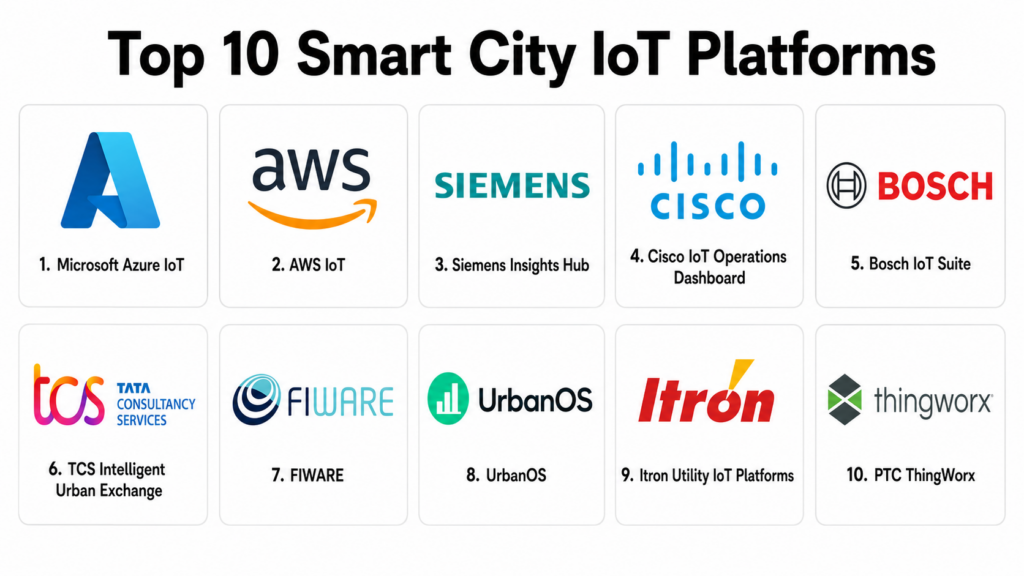
Introduction
Smart City IoT Platforms help cities, municipalities, utilities, transport agencies, and infrastructure operators connect urban devices, sensors, applications, and data systems into one manageable digital layer. In simple terms, these platforms collect data from streetlights, traffic signals, parking sensors, cameras, waste bins, water meters, air quality sensors, public transport systems, energy grids, and emergency services so city teams can monitor operations and make better decisions.
Smart city IoT matters because cities are under pressure to improve public safety, reduce congestion, optimize energy usage, manage waste, improve citizen services, and maintain aging infrastructure with limited resources. IoT platforms give city leaders real-time visibility into urban operations and help automate actions across departments.
Real world use cases include smart street lighting, traffic management, smart parking, waste collection optimization, air quality monitoring, water leakage detection, public safety analytics, digital twin planning, smart utilities, and integrated command centers.
Buyers should evaluate device connectivity, data ingestion, open APIs, edge support, security, interoperability, analytics, digital twin capability, vendor ecosystem, citizen privacy controls, scalability, and integration with existing city systems.
Best for: Smart City IoT Platforms are best for municipal governments, smart city mission teams, urban planners, utilities, transport authorities, public safety teams, infrastructure operators, system integrators, and enterprises building city-scale IoT solutions.
Not ideal for: These platforms may not be necessary for small organizations managing only one isolated use case such as a few sensors or a single building. In those cases, a focused IoT solution, SCADA system, facility platform, or basic cloud dashboard may be easier and more cost-effective.
Key Trends in Smart City IoT Platforms
- AI-powered city operations are growing: Smart city platforms are adding AI for traffic prediction, crowd monitoring, anomaly detection, public safety alerts, waste route optimization, and infrastructure maintenance.
- Urban digital twins are becoming practical: Cities are using 3D maps, GIS layers, sensor data, and simulation models to plan roads, utilities, flood response, zoning, and emergency operations.
- Smart lighting remains a major entry point: Street lighting is often one of the first smart city use cases because it can reduce energy cost, improve maintenance, and create a connected pole network.
- Edge computing is expanding: Cameras, intersections, transport hubs, and utility sites increasingly process data locally to reduce latency and bandwidth use.
- Open data and interoperability matter: Cities want platforms that avoid vendor lock-in and support open APIs, open data portals, GIS systems, and multiple device vendors.
- Cybersecurity and privacy are critical: Smart city systems may handle citizen movement, public safety data, utility usage, camera feeds, and critical infrastructure signals, so governance is essential.
- Sustainability reporting is becoming important: Cities increasingly track emissions, energy usage, air quality, water consumption, and waste metrics through connected platforms.
- Integrated command centers are becoming common: Municipal teams want centralized dashboards that combine traffic, utilities, safety, environment, weather, events, and emergency response.
- Public-private partnerships are increasing: Many smart city projects involve technology vendors, telecom operators, utilities, universities, system integrators, and city agencies.
- Outcome-based procurement is rising: Cities are moving from buying sensors only to buying measurable outcomes such as reduced congestion, lower energy cost, faster repairs, and better citizen service response.
How We Selected These Tools
The tools in this list were selected based on their relevance to smart city IoT, urban operations, device connectivity, IoT data management, digital twins, edge analytics, infrastructure monitoring, and municipal service modernization.
Selection logic included:
- Recognition in IoT, smart city, urban data, industrial IoT, cloud IoT, or city operations platforms.
- Ability to connect sensors, gateways, devices, applications, and municipal systems.
- Support for real-time monitoring, analytics, alerts, dashboards, and automation.
- Fit for smart lighting, traffic, parking, utilities, waste, environment, safety, and infrastructure use cases.
- Integration with GIS, command centers, cloud platforms, APIs, edge devices, and data lakes.
- Security controls such as device identity, encryption, access controls, audit logs, and policy governance.
- Scalability for city-wide, regional, utility, campus, and infrastructure deployments.
- Support for open standards, multi-vendor devices, and ecosystem partnerships.
- Practical value for city departments, utilities, system integrators, and smart infrastructure operators.
- Ability to support long-term smart city maturity beyond one pilot project.
Top 10 Smart City IoT Platforms
1- Microsoft Azure IoT
Short description:
Microsoft Azure IoT is a broad cloud IoT platform that helps cities connect devices, manage telemetry, process data, build dashboards, and integrate IoT insights with analytics, AI, and business applications. It is especially useful for municipalities and integrators already using Microsoft cloud, data, and identity services. Azure IoT can support smart lighting, traffic monitoring, water systems, public infrastructure, and connected city applications. It is a strong choice for city projects that need scalable cloud infrastructure and enterprise-grade governance.
Key Features
- IoT device connectivity and telemetry ingestion.
- Device identity and cloud-based device management.
- Integration with analytics, AI, and data services.
- Edge computing support through Azure IoT Edge.
- Monitoring and alerting for connected assets.
- APIs and integration with enterprise applications.
- Strong identity and governance alignment through Microsoft ecosystem.
Pros
- Strong fit for Microsoft-centered public sector and enterprise environments.
- Scales well for multiple smart city use cases.
- Good ecosystem for data, AI, security, and integration.
Cons
- Requires cloud and IoT architecture expertise.
- Smart city applications often need integrator or custom solution development.
- Cost governance is important as device and data volume grows.
Platforms / Deployment
Web / IoT devices / Edge gateways
Cloud / Edge / Hybrid options may vary
Security & Compliance
Azure IoT supports device identity, certificates, encrypted communication, access controls, monitoring, and Microsoft cloud security governance. Specific compliance coverage depends on region, tenant configuration, architecture, and connected services.
Integrations & Ecosystem
Azure IoT integrates with Microsoft cloud, analytics, AI, identity, and operations tools. It is useful when cities want a flexible platform for building multiple smart city applications.
- Azure IoT Hub
- Azure IoT Edge
- Azure Data services
- Microsoft Power BI
- Microsoft Entra ID
- Azure AI and analytics workflows
Support & Community
Microsoft provides documentation, enterprise support, partner services, public sector expertise, training resources, and a large developer community. Successful smart city deployment usually requires strong solution architecture and implementation partners.
2- AWS IoT
Short description:
AWS IoT is a cloud IoT platform that helps organizations connect, secure, manage, and analyze data from large fleets of devices. For smart cities, it can support connected sensors, edge gateways, traffic systems, smart meters, lighting controllers, environmental sensors, and city applications. AWS IoT is especially useful for teams that want scalable cloud services, edge processing, device management, and data analytics. It is a strong option for smart city projects that need flexibility and cloud-native development.
Key Features
- Secure device connectivity and messaging.
- Device registry and fleet management.
- Rules-based routing for IoT data.
- Edge processing through AWS IoT Greengrass.
- Integration with analytics, storage, and AI services.
- Device authentication and certificate-based security.
- Monitoring and operations support through AWS services.
Pros
- Strong scalability for large IoT device fleets.
- Flexible cloud and edge ecosystem.
- Useful for custom smart city and infrastructure applications.
Cons
- Requires technical expertise to design city-grade solutions.
- Smart city domain applications may need partners or custom development.
- Cost and operational governance should be planned carefully.
Platforms / Deployment
Web / IoT devices / Gateways / Edge devices
Cloud / Edge / Hybrid options may vary
Security & Compliance
AWS IoT supports device certificates, identity policies, encrypted communication, fleet provisioning, access controls, and AWS security governance. Specific compliance coverage depends on region, architecture, account configuration, and services used.
Integrations & Ecosystem
AWS IoT integrates with AWS analytics, AI, storage, security, edge, and application services. It is useful for cities and integrators building custom smart infrastructure platforms.
- AWS IoT Core
- AWS IoT Greengrass
- Amazon S3
- AWS Lambda
- Amazon CloudWatch
- AI and analytics services
Support & Community
AWS provides documentation, enterprise support, training, public sector partners, professional services, and a large developer community. Successful projects require strong cloud, IoT, and cybersecurity planning.
3- Siemens Insights Hub
Short description:
Siemens Insights Hub is an industrial IoT and data platform used to connect assets, collect operational data, monitor performance, and enable analytics across industrial and infrastructure environments. For smart cities, it is relevant to utilities, buildings, transport systems, energy assets, water infrastructure, and connected urban operations. Siemens is especially strong where smart city projects overlap with industrial automation and critical infrastructure. It is a good fit for cities and utilities that need asset-centric monitoring and operational intelligence.
Key Features
- Industrial IoT asset connectivity.
- Operational data collection and analytics.
- Asset performance monitoring.
- Integration with industrial and infrastructure systems.
- Dashboards for asset health and operational visibility.
- Support for edge and cloud-connected industrial scenarios.
- APIs and applications for data-driven operations.
Pros
- Strong fit for industrial infrastructure and utility-heavy smart city projects.
- Useful for asset monitoring and performance optimization.
- Good ecosystem for automation, buildings, energy, and infrastructure.
Cons
- May be more industrial-focused than citizen engagement-focused.
- Custom smart city applications may require solution partners.
- Best value depends on Siemens ecosystem and infrastructure use cases.
Platforms / Deployment
Web / Industrial assets / IoT gateways
Cloud / Edge / Hybrid options may vary
Security & Compliance
Siemens provides industrial-grade security and access governance capabilities across its digital platforms. Specific compliance coverage, data protection controls, and regional requirements should be validated during procurement.
Integrations & Ecosystem
Siemens Insights Hub integrates with industrial automation, building, energy, and infrastructure systems. It is useful when smart city IoT must connect with operational technology and asset management.
- Industrial automation systems
- Building management systems
- Energy infrastructure
- Edge gateways
- Data analytics tools
- Asset performance workflows
Support & Community
Siemens provides enterprise support, industrial consulting, documentation, partner services, and domain expertise. Its ecosystem is strong in industrial, utility, energy, and infrastructure sectors.
4- Cisco IoT Operations Dashboard
Short description:
Cisco IoT Operations Dashboard helps organizations manage industrial IoT devices, connectivity, edge gateways, and operational environments. For smart cities, Cisco’s IoT and networking ecosystem can support connected transport, public safety, utilities, smart lighting, and city infrastructure networks. It is especially useful when secure connectivity, network visibility, and edge operations are central to the smart city architecture. Cisco is a strong fit for cities and agencies that need network-first IoT operations and infrastructure-grade security.
Key Features
- IoT device and gateway operations visibility.
- Secure connectivity and industrial network management.
- Remote management for distributed IoT environments.
- Integration with Cisco networking and security ecosystem.
- Monitoring for connected infrastructure.
- Support for edge and industrial deployments.
- Policy and operations visibility for IoT networks.
Pros
- Strong networking and secure connectivity foundation.
- Useful for city infrastructure and industrial IoT environments.
- Good fit for organizations already using Cisco networks.
Cons
- May need complementary platforms for city analytics or citizen apps.
- Best value depends on Cisco infrastructure alignment.
- Complex smart city deployments may require systems integration.
Platforms / Deployment
Web / IoT gateways / Network infrastructure
Cloud / Edge / Hybrid options may vary
Security & Compliance
Cisco provides enterprise and industrial security controls across networking, identity, and IoT operations. Specific compliance coverage, encryption controls, and data governance details should be validated during procurement.
Integrations & Ecosystem
Cisco IoT operations tools integrate with Cisco networking, security, industrial connectivity, and edge systems. They are useful where reliable network infrastructure is the backbone of smart city IoT.
- Cisco networking platforms
- Industrial gateways
- Security operations tools
- Edge infrastructure
- Network monitoring systems
- IoT connectivity workflows
Support & Community
Cisco provides enterprise support, documentation, training, partner services, and a large network engineering community. Its ecosystem is especially strong in networking, public sector, industrial, and infrastructure environments.
5- Bosch IoT Suite
Short description:
Bosch IoT Suite is a family of IoT services for device management, data management, and edge connectivity. It supports connected devices across industries including buildings, mobility, energy, urban infrastructure, and industrial environments. For smart cities, Bosch IoT Suite is relevant to connected buildings, sensors, infrastructure devices, mobility systems, and city-wide IoT applications. It is a good option for organizations that need mature IoT building blocks and device management capabilities.
Key Features
- IoT device management and connectivity.
- IoT data management and messaging.
- Edge and gateway support.
- Device lifecycle and operations workflows.
- Support for connected infrastructure and building use cases.
- APIs and modular IoT services.
- Integration with industrial and urban IoT solutions.
Pros
- Strong IoT engineering and connected device background.
- Useful for infrastructure, building, and mobility-oriented city projects.
- Modular services can support different IoT use cases.
Cons
- Smart city-specific solutions may require integration and customization.
- Buyers should validate current service availability and roadmap.
- Best value depends on device and solution architecture.
Platforms / Deployment
Web / IoT devices / Gateways / Edge systems
Cloud / Edge options may vary
Security & Compliance
Bosch IoT Suite provides IoT device management and communication controls. Specific security certifications, compliance coverage, and data governance details should be validated with Bosch during procurement.
Integrations & Ecosystem
Bosch IoT Suite integrates with connected devices, industrial systems, gateways, and IoT applications. It is useful for organizations building smart infrastructure solutions around connected assets.
- IoT devices
- Gateways
- Building systems
- Mobility solutions
- Industrial systems
- Data and analytics platforms
Support & Community
Bosch provides IoT documentation, enterprise support, engineering expertise, and solution assistance. Its ecosystem is strongest in connected devices, mobility, buildings, and industrial IoT.
6- TCS Intelligent Urban Exchange
Short description:
TCS Intelligent Urban Exchange is a smart city and urban operations platform designed to help cities manage services such as lighting, waste, transport, utilities, public safety, and civic operations. It is especially relevant for municipalities and government agencies that need an integrated urban command and control layer. The platform focuses on connecting city systems and using analytics to improve operational efficiency. It is a strong fit for smart city programs that require system integration and city-scale service management.
Key Features
- Smart city command and operations platform.
- Integration across urban services and departments.
- Smart lighting, waste, transport, and utility use case support.
- Analytics and dashboards for city operations.
- Event monitoring and workflow coordination.
- Citizen service and municipal operations alignment.
- Support for large-scale smart city deployments.
Pros
- Strong fit for municipal and public sector smart city programs.
- Useful for multi-service urban operations.
- Backed by large system integration capability.
Cons
- Implementation is likely project-specific and partner-led.
- Pricing and deployment scope are usually custom.
- Buyers should validate product modules and integration requirements carefully.
Platforms / Deployment
Web / City systems / IoT devices
Cloud / Hybrid / Project-specific deployment options may vary
Security & Compliance
Security controls depend on project architecture, hosting model, data types, and integration scope. Buyers should validate identity access, encryption, audit logs, citizen data governance, and public sector compliance requirements during procurement.
Integrations & Ecosystem
TCS Intelligent Urban Exchange is designed to integrate multiple city systems, IoT devices, and municipal workflows. It is useful when smart city projects require cross-department coordination.
- Smart lighting systems
- Waste management systems
- Transport systems
- Utility platforms
- Command centers
- Municipal service workflows
Support & Community
TCS provides enterprise implementation, consulting, managed services, and public sector delivery support. Support strength depends on project scope, contract model, and city deployment requirements.
7- FIWARE
Short description:
FIWARE is an open-source framework and ecosystem for building smart city, IoT, and data-driven applications using open standards and APIs. It is widely associated with smart city projects that need interoperability, context data management, and vendor-neutral architecture. FIWARE is especially useful for cities that want to avoid vendor lock-in and build open urban data platforms. It is a strong option for public sector innovation teams, universities, integrators, and smart city ecosystems.
Key Features
- Open-source smart city and IoT framework.
- Context information management.
- Open APIs and interoperability focus.
- Support for data sharing and urban applications.
- Modular architecture for smart city solutions.
- Ecosystem of generic enablers and components.
- Suitable for open data and multi-vendor city projects.
Pros
- Strong open standards and interoperability approach.
- Useful for avoiding vendor lock-in.
- Good fit for public sector innovation and open data ecosystems.
Cons
- Requires technical expertise and integration effort.
- Not a plug-and-play commercial city platform by itself.
- Enterprise support depends on partners and implementation model.
Platforms / Deployment
Web / APIs / IoT platforms / Urban data systems
Self-hosted / Cloud deployment options may vary
Security & Compliance
FIWARE security depends on implementation, hosting, identity controls, access policies, and selected components. Specific compliance coverage depends on the integrator, deployment model, and city governance requirements.
Integrations & Ecosystem
FIWARE is built around open APIs and modular components, making it suitable for smart city ecosystems that need data interoperability and multi-vendor participation.
- IoT devices and gateways
- Open data platforms
- Urban applications
- GIS systems
- APIs and data brokers
- Smart city service platforms
Support & Community
FIWARE has an open-source community, documentation, ecosystem partners, and smart city implementation experience. Formal support depends on selected partners and deployment approach.
8- UrbanOS
Short description:
UrbanOS is a smart city platform concept and implementation approach focused on integrating city data, services, IoT systems, and urban applications into a connected operating layer. It is often used to describe city platforms that unify data from multiple departments and service providers. For smart city IoT programs, UrbanOS-style platforms can support data integration, dashboards, command centers, and service orchestration. It is best suited for cities that want a flexible urban operating system approach rather than a single-purpose IoT tool.
Key Features
- Urban data integration across systems.
- IoT and city service connectivity.
- Dashboards and operational visibility.
- Support for command center and city operations use cases.
- API-based integration approach.
- Multi-department service coordination.
- Data-driven planning and analytics support.
Pros
- Useful for cities seeking an integrated operating layer.
- Supports cross-department visibility and data sharing.
- Flexible for multiple smart city applications.
Cons
- Product scope can vary depending on vendor or implementation.
- Requires strong data governance and integration planning.
- Buyers should validate actual platform capabilities carefully.
Platforms / Deployment
Web / IoT devices / City data platforms
Cloud / Hybrid / Custom deployment options may vary
Security & Compliance
Security controls depend on implementation architecture, identity model, data governance, and hosting environment. Buyers should validate access control, audit logs, privacy, encryption, and municipal compliance needs.
Integrations & Ecosystem
UrbanOS-style platforms typically integrate with GIS, IoT devices, municipal systems, public safety tools, transport platforms, utilities, and citizen service applications.
- GIS systems
- IoT sensor networks
- Public safety platforms
- Transport systems
- Utility platforms
- Open data portals
Support & Community
Support depends on the vendor, integrator, or city technology partner implementing the UrbanOS approach. Buyers should validate service-level commitments, partner maturity, and long-term roadmap.
9- Itron Temetra and Itron Utility IoT Platforms
Short description:
Itron provides utility-focused IoT and smart infrastructure platforms for metering, energy, water, grid, and city service use cases. Its solutions are especially relevant for smart cities where connected utilities, smart metering, water management, and grid intelligence are central priorities. Itron helps utilities and municipalities collect device data, monitor infrastructure, manage field operations, and improve resource efficiency. It is a strong fit for cities where smart utility operations are a major part of the digital transformation plan.
Key Features
- Smart metering and utility IoT support.
- Water, energy, and grid data collection.
- Device and infrastructure monitoring.
- Analytics for consumption, operations, and planning.
- Support for field service and utility workflows.
- Integration with utility systems.
- Smart city and resource management use cases.
Pros
- Strong utility and metering domain expertise.
- Useful for smart water, energy, and grid modernization.
- Good fit for municipalities and utility operators.
Cons
- More utility-focused than general-purpose smart city platforms.
- Broader city command center use cases may need complementary tools.
- Implementation depends on infrastructure and utility system readiness.
Platforms / Deployment
Web / Utility devices / Smart meters / Field systems
Cloud / Hybrid options may vary
Security & Compliance
Itron provides utility-grade security and operational controls across its solutions. Specific compliance coverage, data protection practices, and regulatory requirements should be validated during procurement.
Integrations & Ecosystem
Itron integrates with utility operations, metering infrastructure, field systems, analytics platforms, and municipal resource management workflows.
- Smart meters
- Utility billing systems
- Water management systems
- Energy grid platforms
- Field service workflows
- Analytics and reporting systems
Support & Community
Itron provides utility-focused support, implementation guidance, documentation, and industry expertise. Its ecosystem is strongest among utilities, municipalities, and smart infrastructure operators.
10- PTC ThingWorx
Short description:
PTC ThingWorx is an industrial IoT platform used to connect devices, build IoT applications, analyze operational data, and support connected asset use cases. While it is not exclusively a smart city platform, it can support smart infrastructure, connected utilities, mobility systems, buildings, and asset monitoring use cases. ThingWorx is especially useful where smart city projects overlap with industrial IoT and connected asset management. It is a strong fit for infrastructure operators and integrators building custom smart city applications.
Key Features
- IoT application development platform.
- Device and asset connectivity.
- Operational data visualization and analytics.
- Industrial and infrastructure use case support.
- Integration with enterprise and industrial systems.
- Application templates and development tools.
- Support for connected asset monitoring.
Pros
- Strong industrial IoT and connected asset capabilities.
- Useful for custom smart infrastructure applications.
- Good fit for integrators and asset-heavy organizations.
Cons
- Smart city-specific features may require custom development.
- Not primarily a municipal command center product.
- Buyers should validate current modules, integrations, and deployment needs.
Platforms / Deployment
Web / IoT devices / Industrial systems
Cloud / On-premise / Hybrid options may vary
Security & Compliance
PTC ThingWorx provides enterprise security controls, user permissions, authentication options, and governance capabilities. Specific compliance coverage and data protection details should be validated during procurement.
Integrations & Ecosystem
ThingWorx integrates with industrial systems, enterprise platforms, IoT devices, analytics tools, and connected asset workflows. It is useful when smart city projects require custom applications on top of connected infrastructure.
- Industrial systems
- IoT gateways
- Enterprise applications
- Analytics platforms
- Asset management systems
- Custom smart infrastructure apps
Support & Community
PTC provides documentation, enterprise support, professional services, partner ecosystem resources, and industrial IoT expertise. Its community is strongest among industrial IoT and connected product teams.
Comparison Table Top 10
| Tool Name | Best For | Platform Supported | Deployment | Standout Feature | Public Rating |
|---|---|---|---|---|---|
| Microsoft Azure IoT | Cloud-based smart city IoT applications | Web, IoT devices, edge gateways | Cloud / Edge / Hybrid options may vary | Scalable IoT, analytics, and AI ecosystem | N/A |
| AWS IoT | Custom IoT and smart infrastructure applications | Web, IoT devices, gateways, edge devices | Cloud / Edge / Hybrid options may vary | Secure device connectivity and cloud-native IoT scale | N/A |
| Siemens Insights Hub | Industrial infrastructure and smart utilities | Web, industrial assets, IoT gateways | Cloud / Edge / Hybrid options may vary | Asset-centric industrial IoT analytics | N/A |
| Cisco IoT Operations Dashboard | Network-first smart city IoT operations | Web, IoT gateways, network infrastructure | Cloud / Edge / Hybrid options may vary | Secure connectivity and industrial network visibility | N/A |
| Bosch IoT Suite | Connected urban devices and infrastructure | Web, IoT devices, gateways, edge systems | Cloud / Edge options may vary | Modular IoT device and data services | N/A |
| TCS Intelligent Urban Exchange | Municipal smart city command operations | Web, city systems, IoT devices | Cloud / Hybrid / Project-specific options may vary | Integrated urban service management | N/A |
| FIWARE | Open smart city data and interoperability | Web, APIs, IoT platforms, urban data systems | Self-hosted / Cloud options may vary | Open-source context data and interoperability framework | N/A |
| UrbanOS | Integrated city operating layer | Web, IoT devices, city data platforms | Cloud / Hybrid / Custom options may vary | Multi-department urban data integration | N/A |
| Itron Utility IoT Platforms | Smart metering, water, energy, and utilities | Web, utility devices, smart meters, field systems | Cloud / Hybrid options may vary | Utility-grade IoT and smart infrastructure management | N/A |
| PTC ThingWorx | Custom industrial and smart infrastructure apps | Web, IoT devices, industrial systems | Cloud / On-premise / Hybrid options may vary | Industrial IoT application development | N/A |
Evaluation and Scoring of Smart City IoT Platforms
The scoring below is comparative and based on smart city IoT fit, core capability depth, ease of use, integration ecosystem, security posture signals, performance, support expectations, and overall value. These are not public ratings and should be used as directional evaluation scores only.
| Tool Name | Core 25% | Ease 15% | Integrations 15% | Security 10% | Performance 10% | Support 10% | Value 15% | Weighted Total 0–10 |
|---|---|---|---|---|---|---|---|---|
| Microsoft Azure IoT | 9 | 7 | 10 | 9 | 9 | 9 | 8 | 8.70 |
| AWS IoT | 9 | 7 | 10 | 9 | 9 | 9 | 8 | 8.70 |
| Siemens Insights Hub | 8 | 7 | 8 | 9 | 9 | 9 | 7 | 8.10 |
| Cisco IoT Operations Dashboard | 8 | 7 | 9 | 9 | 9 | 9 | 7 | 8.20 |
| Bosch IoT Suite | 8 | 7 | 8 | 8 | 8 | 8 | 8 | 7.80 |
| TCS Intelligent Urban Exchange | 9 | 7 | 8 | 8 | 8 | 9 | 8 | 8.15 |
| FIWARE | 8 | 6 | 9 | 7 | 8 | 7 | 10 | 7.95 |
| UrbanOS | 8 | 7 | 8 | 8 | 8 | 7 | 8 | 7.75 |
| Itron Utility IoT Platforms | 8 | 7 | 8 | 9 | 9 | 9 | 7 | 8.10 |
| PTC ThingWorx | 8 | 7 | 8 | 8 | 8 | 8 | 7 | 7.65 |
These scores should be interpreted by use case. Azure IoT and AWS IoT are strong for cloud-native smart city platforms and custom development. Siemens, Cisco, Bosch, Itron, and PTC are stronger where smart city projects overlap with infrastructure, utilities, industrial systems, and connected assets. TCS Intelligent Urban Exchange is relevant for integrated municipal operations. FIWARE is valuable when open standards and interoperability are priorities. UrbanOS-style platforms fit cities that want a unified urban operating layer.
Which Smart City IoT Platform Is Right for You?
Solo / Freelancer
Solo professionals usually do not need a full smart city IoT platform unless they are building prototypes, dashboards, or proof-of-concept projects for municipalities or integrators. AWS IoT, Azure IoT, FIWARE, or open-source components can be practical starting points for pilots. The goal should be to prove a focused use case such as air quality monitoring, parking sensors, or streetlight telemetry. A freelancer should avoid complex city-scale platforms unless working with a public sector client or system integrator.
SMB
SMBs working in smart city projects should focus on platforms that help them build scalable solutions without needing to operate everything manually. Azure IoT, AWS IoT, Bosch IoT Suite, FIWARE, or PTC ThingWorx may be useful depending on the solution type. Hardware vendors and sensor companies should prioritize device management, APIs, security, and data integration. SMBs should also ensure their platform can integrate with city systems, GIS tools, and open data requirements.
Mid-Market
Mid-market organizations such as regional utilities, transport operators, infrastructure service providers, and smart building operators need stronger analytics, device management, dashboards, and integration. Siemens Insights Hub, Cisco IoT Operations Dashboard, Itron, PTC ThingWorx, Azure IoT, and AWS IoT can be strong options. Utility-focused organizations may prefer Itron or Siemens. Infrastructure and networking-heavy teams may prefer Cisco. Cloud-native teams may prefer Azure or AWS.
Enterprise
Enterprises, national infrastructure operators, telecom companies, system integrators, and large municipal programs need scalable, secure, and interoperable platforms. Azure IoT, AWS IoT, Siemens, Cisco, TCS Intelligent Urban Exchange, Itron, FIWARE, and PTC ThingWorx can all fit depending on scope. Enterprises should evaluate governance, integration architecture, cybersecurity, service-level support, data ownership, privacy, resilience, and multi-department workflows. Large smart city programs usually require a combination of platform, domain solution, and implementation partner.
Budget vs Premium
Budget-focused teams can start with open-source frameworks such as FIWARE, focused IoT cloud services, or smaller pilot platforms. However, large city-wide deployments require long-term investment in security, integration, support, device lifecycle management, and operational governance. Premium platforms such as Azure IoT, AWS IoT, Siemens, Cisco, TCS, Itron, and PTC may justify cost when the project affects critical infrastructure or public services. Buyers should compare total cost across devices, data, cloud usage, integration, support, and maintenance.
Feature Depth vs Ease of Use
Feature depth matters when a city needs device management, command centers, analytics, AI, digital twins, utility integration, GIS, citizen services, and emergency response workflows. Azure IoT, AWS IoT, Siemens, Cisco, TCS, Itron, and PTC provide strong depth in different areas. Ease of use matters for pilots and smaller municipal projects. FIWARE and cloud IoT services can be flexible, but they require technical skill. Buyers should select based on the specific urban problem, not only the broadest feature list.
Integrations and Scalability
Smart city IoT platforms must integrate with sensors, gateways, GIS, SCADA, utility systems, public safety tools, traffic systems, data lakes, dashboards, APIs, and citizen service platforms. Scalability is not only about device count. It also includes data volume, department access, security governance, uptime, maintenance, and vendor support. Cities should validate interoperability and avoid building isolated systems that cannot share data. Open APIs and clear data ownership are essential for long-term success.
Security and Compliance Needs
Smart city platforms may handle public safety data, camera feeds, traffic patterns, utility consumption, location data, citizen requests, and critical infrastructure signals. Buyers should evaluate encryption, device identity, certificate management, RBAC, audit logs, network segmentation, incident response, privacy masking, data retention, and regulatory compliance. Cities should also define who owns data and how it may be shared. Cybersecurity must be designed from the start because smart city systems can become critical public infrastructure.
Frequently Asked Questions FAQs
1. What is a Smart City IoT Platform?
A Smart City IoT Platform is software that connects sensors, devices, applications, and city systems so municipal teams can monitor and manage urban services. It collects data from infrastructure such as traffic lights, streetlights, meters, cameras, waste bins, water systems, and environmental sensors. The platform helps city teams analyze conditions, detect problems, automate workflows, and improve services. It can support dashboards, alerts, digital twins, analytics, and citizen-facing applications. The goal is to make city operations more efficient, safer, and more data-driven.
2. How is a smart city platform different from a regular IoT platform?
A regular IoT platform mainly focuses on connecting and managing devices, collecting telemetry, and processing IoT data. A smart city platform usually adds urban operations, municipal workflows, GIS integration, citizen services, command centers, and cross-department coordination. Smart city platforms often need to connect many public systems across transport, utilities, safety, environment, and infrastructure. Some cities use general IoT platforms to build smart city applications, while others use purpose-built urban management platforms. The right choice depends on project scope and city maturity.
3. What pricing models are common for Smart City IoT Platforms?
Pricing varies widely because smart city projects differ in size and complexity. Vendors may charge based on devices, data volume, modules, cloud usage, users, support, implementation services, or custom project scope. Municipal command center platforms are often priced through enterprise or government contracts. Cloud IoT platforms may charge based on messages, storage, analytics, and related services. Buyers should evaluate total cost across sensors, connectivity, software, integration, cybersecurity, maintenance, and long-term support.
4. How long does implementation usually take?
Implementation depends on use case, device count, city departments involved, data integration needs, connectivity, procurement, and governance requirements. A small pilot such as smart lighting or air quality monitoring can be launched faster than a city-wide command center or digital twin project. The most time-consuming parts are usually system integration, device deployment, data cleaning, stakeholder alignment, and cybersecurity review. Cities should start with a focused pilot and measurable outcomes. After proving value, they can expand to more departments and use cases.
5. What are common mistakes in smart city IoT projects?
A common mistake is starting with technology instead of clearly defining the city problem to solve. Another mistake is deploying sensors without planning data governance, maintenance, security, or department ownership. Some projects also fail because systems are built in silos and cannot share data. Cities may also underestimate long-term operating costs, connectivity issues, and citizen privacy concerns. Successful smart city programs focus on measurable outcomes, interoperability, public trust, and sustainable operations.
6. Are Smart City IoT Platforms secure?
Smart City IoT Platforms can be secure when designed with strong device identity, encryption, access controls, network segmentation, audit logs, and continuous monitoring. However, security risks are serious because these platforms may connect critical infrastructure and public systems. Buyers should evaluate certificate management, device authentication, API security, incident response, vulnerability management, and data privacy controls. Camera, mobility, and citizen data require special governance. Cybersecurity should be included from the planning stage, not added later.
7. Can smart city platforms support digital twins?
Yes, many smart city platforms can support digital twin use cases directly or through integration with GIS, 3D mapping, simulation, and data analytics tools. A digital twin can help cities model traffic flow, flood risk, construction impact, utility networks, public events, and infrastructure maintenance. The value depends on data quality and integration with real-time sensors. A digital twin is most useful when it supports decisions, not just visualization. Cities should connect digital twin work with practical operations and planning goals.
8. Can these platforms integrate with legacy city systems?
Yes, many platforms can integrate with legacy systems through APIs, middleware, gateways, data connectors, and system integrators. Common legacy systems include SCADA, GIS, traffic control, utility billing, public safety tools, asset management, and citizen service systems. Integration can be difficult if old systems lack open interfaces or clean data. Cities should assess integration readiness before buying a platform. A strong integration strategy helps avoid disconnected smart city pilots.
9. What alternatives exist if a full smart city platform is not needed?
Alternatives include focused IoT dashboards, utility-specific platforms, traffic management systems, building management systems, SCADA tools, GIS platforms, open-source data platforms, or cloud IoT services. These can work well for single-use cases such as smart lighting, water monitoring, parking, or air quality. A full smart city platform becomes more useful when multiple departments and systems need to share data. The right alternative depends on project scope, budget, and long-term city strategy. Starting small is often better than buying a large platform too early.
10. How should buyers evaluate Smart City IoT Platforms?
Buyers should evaluate device support, interoperability, security, APIs, analytics, GIS integration, digital twin capability, scalability, support, and public sector experience. They should test the platform with real devices, real city data, and real workflows. It is also important to involve IT, operations, public safety, utilities, planning, legal, finance, and citizen service teams. Cities should ask how data ownership, privacy, and long-term maintenance will work. A pilot with measurable outcomes is the safest way to validate fit.
Conclusion
Smart City IoT Platforms help cities connect infrastructure, devices, data, and departments into a more intelligent operating model. The right platform depends on whether the main priority is smart lighting, utilities, traffic, environment, command centers, digital twins, public safety, open data, or industrial infrastructure. Azure IoT and AWS IoT are strong for flexible cloud-native smart city applications, Siemens and PTC are useful for industrial and infrastructure-heavy projects, Cisco is strong where secure connectivity and network operations matter, Bosch supports connected device and urban infrastructure solutions, TCS Intelligent Urban Exchange fits integrated municipal operations, FIWARE supports open and interoperable city data models, UrbanOS-style platforms support cross-department urban operating layers, and Itron is strong for utility-focused smart city programs. There is no single universal best platform because every city has different infrastructure, budgets, governance models, data maturity, and public service priorities.

Deploying comprehensive unified urban sensor telemetry infrastructure orchestration software optimizes corporate municipal ecosystem logistics, ensuring accelerated decentralized civic asset utility tracking and seamless public infrastructure automation workflows.