MOTOSHARE 🚗🏍️
Rent Bikes & Cars Directly from Owners
Motoshare connects vehicle owners with people who need bikes and cars on rent. Owners earn from idle vehicles, and renters get flexible ride options.
Visit Motoshare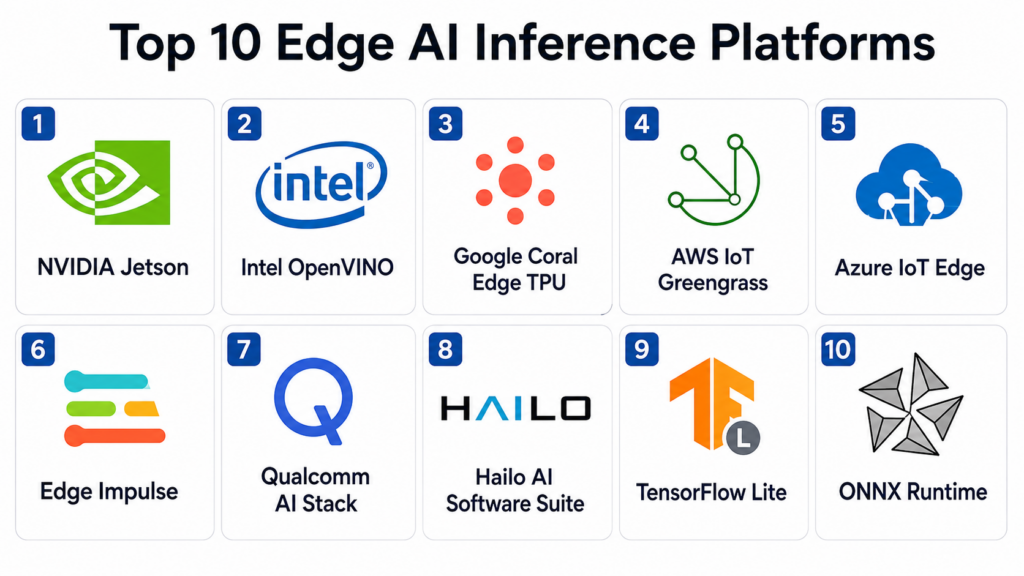
Introduction
Edge AI Inference Platforms help organizations run trained artificial intelligence models directly on edge devices instead of sending every request to the cloud. These platforms support real-time decision-making on devices such as cameras, robots, IoT gateways, factory machines, medical devices, drones, vehicles, retail systems, smart city sensors, and embedded hardware. In simple terms, they help AI models make predictions locally, closer to where data is created.
Edge AI inference matters because many modern applications need low latency, better privacy, reduced bandwidth cost, and reliable operation even when internet connectivity is limited. Cloud AI is powerful, but it may not be ideal for real-time safety systems, industrial inspection, offline devices, or privacy-sensitive environments. Edge inference helps organizations process video, audio, sensor, and operational data locally while still syncing insights with cloud platforms when needed.
Real world use cases include computer vision inspection, predictive maintenance, smart cameras, autonomous robots, driver assistance, retail analytics, healthcare devices, industrial safety monitoring, agriculture sensors, and smart city traffic systems.
Buyers should evaluate model performance, hardware compatibility, power usage, model optimization, supported frameworks, deployment workflows, security controls, offline capability, fleet management, cloud integration, developer experience, and long-term hardware support.
Best for: Edge AI Inference Platforms are best for AI engineers, IoT teams, embedded developers, robotics teams, manufacturing teams, healthcare device makers, smart city operators, retail analytics teams, automotive teams, and enterprises building low-latency AI applications.
Not ideal for: These platforms may not be necessary for teams running simple analytics, low-volume AI workloads, or applications where cloud inference latency and bandwidth are not a concern. In those cases, cloud AI APIs, standard ML platforms, or basic server-side inference may be easier and more cost-effective.
Key Trends in Edge AI Inference Platforms
- Computer vision remains the leading edge AI use case: Manufacturing inspection, smart cameras, traffic monitoring, retail analytics, safety detection, and robotics continue to drive edge inference demand.
- AI accelerators are becoming more specialized: GPUs, NPUs, TPUs, VPUs, and dedicated inference chips are increasingly optimized for low-power, high-throughput AI workloads.
- TinyML and microcontroller AI are expanding: More models are being optimized to run on very small devices such as sensors, wearables, and battery-powered embedded systems.
- Containerized edge AI deployment is growing: Teams increasingly deploy inference services as containers so updates, rollback, and scaling are easier across fleets.
- Model optimization is a major differentiator: Quantization, pruning, compilation, hardware-specific acceleration, and runtime optimization are now critical for production edge AI.
- Cloud-to-edge workflows are becoming standard: Organizations want to train in the cloud, optimize models, deploy to edge devices, and monitor performance centrally.
- Privacy-sensitive AI is moving to the edge: Healthcare, surveillance, industrial, and public sector use cases often prefer local inference to reduce raw data transfer.
- Edge AI fleet management is becoming more important: Running one demo device is easy, but managing thousands of AI-enabled devices requires updates, observability, security, and version tracking.
- Multimodal edge AI is emerging: Devices increasingly combine camera, audio, vibration, temperature, location, and other sensor data for richer local decisions.
- Security and model governance are growing concerns: Buyers need secure boot, signed models, encrypted communication, access control, model versioning, and protection against tampering.
How We Selected These Tools
The tools in this list were selected based on their relevance to edge AI inference, model deployment, embedded AI hardware, inference optimization, cloud-to-edge workflows, IoT device integration, and production AI operations.
Selection logic included:
- Recognition in edge AI, embedded inference, IoT AI, robotics, computer vision, or edge deployment.
- Ability to run AI models locally on edge devices, gateways, accelerators, or embedded systems.
- Support for common AI frameworks such as TensorFlow, PyTorch, ONNX, TensorFlow Lite, or OpenVINO where applicable.
- Hardware acceleration through GPUs, TPUs, NPUs, VPUs, or optimized CPU runtimes.
- Deployment support for containers, edge runtimes, SDKs, model packaging, or device fleet workflows.
- Suitability for industrial, retail, robotics, healthcare, smart city, automotive, and IoT use cases.
- Security controls such as secure deployment, device identity, signed updates, access control, and policy governance.
- Developer experience, documentation, SDK maturity, and ecosystem support.
- Scalability from prototype to production edge fleets.
- Overall value for reducing latency, improving privacy, and enabling real-time AI decisions.
Top 10 Edge AI Inference Platforms
1- NVIDIA Jetson
Short description:
NVIDIA Jetson is one of the most recognized platforms for high-performance edge AI inference, especially for computer vision, robotics, autonomous machines, smart cameras, industrial automation, and AI-enabled embedded systems. It combines NVIDIA GPU acceleration, JetPack SDK, CUDA, TensorRT, DeepStream, and a large developer ecosystem. Jetson devices are used when teams need strong AI performance in a compact edge form factor. It is best suited for vision-heavy and performance-sensitive edge AI workloads.
Key Features
- GPU-accelerated AI inference for edge devices.
- JetPack SDK with CUDA, TensorRT, and developer tools.
- Support for computer vision, robotics, and autonomous systems.
- DeepStream support for video analytics pipelines.
- Compatibility with major AI frameworks through optimized runtimes.
- Strong ecosystem of developer kits, modules, partners, and libraries.
- Suitable for industrial, smart city, healthcare, and robotics use cases.
Pros
- Very strong performance for computer vision and deep learning workloads.
- Mature developer ecosystem and strong software acceleration stack.
- Good fit for production-grade edge AI applications.
Cons
- Power and thermal design require planning for embedded products.
- Cost may be higher than microcontroller or low-power accelerator options.
- Best results require GPU, CUDA, and inference optimization skills.
Platforms / Deployment
Linux / Embedded edge devices / NVIDIA Jetson modules
Edge hardware / SDK-based deployment
Security & Compliance
NVIDIA Jetson provides platform security capabilities depending on module, software stack, and deployment design. Buyers should validate secure boot, signed software, device hardening, access controls, and lifecycle support for their production environment.
Integrations & Ecosystem
NVIDIA Jetson integrates with AI frameworks, robotics tools, computer vision SDKs, cloud workflows, and industrial edge systems. It is especially useful when GPU acceleration and video analytics are central to the use case.
- TensorRT
- CUDA
- DeepStream
- PyTorch and TensorFlow workflows
- Robotics frameworks
- Edge camera and sensor systems
Support & Community
NVIDIA provides documentation, developer forums, SDKs, training materials, hardware partners, and enterprise ecosystem support. Community strength is very high among robotics, computer vision, and embedded AI developers.
2- Intel OpenVINO
Short description:
Intel OpenVINO is a toolkit for optimizing and deploying AI inference across Intel CPUs, integrated GPUs, VPUs, and edge hardware. It is especially useful for teams that want to run computer vision, language, and AI workloads efficiently on Intel-based edge systems without relying only on dedicated GPUs. OpenVINO helps convert and optimize models for faster inference. It is a strong fit for industrial PCs, retail systems, smart cameras, healthcare devices, and edge servers using Intel hardware.
Key Features
- Model optimization and inference acceleration.
- Support for Intel CPUs, GPUs, and acceleration hardware.
- Model conversion from common AI frameworks.
- Optimized runtime for edge and on-premise systems.
- Strong support for computer vision workloads.
- Deployment flexibility across Linux and Windows environments.
- Useful for industrial and enterprise edge systems.
Pros
- Strong performance optimization for Intel hardware.
- Good fit for CPU-based and industrial edge deployments.
- Useful when dedicated GPU hardware is not preferred.
Cons
- Best value depends on Intel hardware alignment.
- Developers may need model conversion and optimization expertise.
- Hardware-specific tuning can require testing.
Platforms / Deployment
Windows / Linux / Intel edge devices
SDK / Runtime-based deployment
Security & Compliance
OpenVINO security depends on the underlying hardware, operating system, deployment architecture, and application controls. Buyers should validate device hardening, secure updates, model protection, and access controls for production environments.
Integrations & Ecosystem
OpenVINO integrates with AI frameworks, Intel hardware, edge applications, and computer vision workflows. It is especially useful for organizations standardizing on Intel-based edge infrastructure.
- TensorFlow
- PyTorch
- ONNX workflows
- Intel CPUs and GPUs
- Industrial PCs
- Computer vision applications
Support & Community
Intel provides documentation, developer resources, examples, community forums, and enterprise ecosystem support. OpenVINO has strong adoption among developers optimizing inference for Intel-based systems.
3- Google Coral Edge TPU
Short description:
Google Coral Edge TPU is an edge AI hardware and software platform designed for fast, low-power machine learning inference using TensorFlow Lite models. It is especially useful for embedded AI, smart cameras, sensors, small gateways, and low-power computer vision systems. Coral devices provide dedicated TPU acceleration for models compiled for the Edge TPU. It is best suited for teams that need efficient inference in compact or power-constrained devices.
Key Features
- Edge TPU accelerator for low-power AI inference.
- TensorFlow Lite model support.
- USB, PCIe, and module-style hardware options.
- Model compiler for Edge TPU optimization.
- Good fit for embedded computer vision and IoT devices.
- Low-latency inference for compatible models.
- Developer tools for prototyping and deployment.
Pros
- Strong low-power inference performance.
- Practical for embedded AI and compact device use cases.
- Good option for TensorFlow Lite-based workflows.
Cons
- Model compatibility and compilation constraints must be checked.
- Less flexible than GPU-based platforms for larger models.
- Ecosystem availability and hardware sourcing should be validated.
Platforms / Deployment
Embedded Linux / Edge TPU hardware / IoT devices
Edge hardware / TensorFlow Lite deployment
Security & Compliance
Google Coral security depends on device design, host operating system, application controls, and deployment architecture. Buyers should validate secure boot, update process, model protection, and physical device security.
Integrations & Ecosystem
Google Coral integrates with TensorFlow Lite workflows and embedded Linux systems. It is useful for teams building compact AI devices with efficient local inference.
- TensorFlow Lite
- Edge TPU compiler
- Embedded Linux systems
- Camera-based AI devices
- IoT gateways
- Prototyping hardware
Support & Community
Google provides documentation and developer resources for Coral. Community support exists among embedded AI and TensorFlow Lite developers, but buyers should validate long-term hardware and support needs for production.
4- AWS IoT Greengrass
Short description:
AWS IoT Greengrass is an edge runtime that allows organizations to run local compute, messaging, and machine learning inference on edge devices while staying integrated with AWS cloud services. It is especially useful for IoT teams that need to deploy AI models, process sensor data locally, and synchronize with AWS when connected. Greengrass can run components and workloads on gateways and edge devices. It is best suited for AWS-centered IoT and edge AI deployments.
Key Features
- Local edge runtime for compute and AI workloads.
- Deployment of components to edge devices.
- Integration with AWS IoT Core and cloud services.
- Local messaging and offline operation support.
- Machine learning inference workflows at the edge.
- Fleet grouping and managed deployments.
- Security based on AWS IoT identities and policies.
Pros
- Strong fit for AWS-based IoT and edge AI architectures.
- Useful for local processing and cloud-to-edge deployment.
- Scales well for connected device fleets.
Cons
- Best value depends on AWS ecosystem adoption.
- Requires cloud, IoT, and device security expertise.
- Hardware-specific inference acceleration may require extra setup.
Platforms / Deployment
Linux edge devices / IoT gateways / Containers
Cloud-managed edge runtime
Security & Compliance
AWS IoT Greengrass uses device identities, certificates, encrypted communication, AWS policies, and cloud governance controls. Specific compliance coverage depends on AWS region, service configuration, and implementation design.
Integrations & Ecosystem
AWS IoT Greengrass integrates with AWS IoT, storage, analytics, monitoring, serverless, and AI services. It is useful when edge AI must work with cloud-based training, data pipelines, and operations.
- AWS IoT Core
- AWS Lambda
- Amazon SageMaker workflows
- Amazon CloudWatch
- Amazon S3
- Edge device components
Support & Community
AWS provides documentation, enterprise support, training resources, partner services, and a large developer community. Production success depends on strong IoT architecture and device lifecycle planning.
5- Azure IoT Edge
Short description:
Azure IoT Edge is Microsoft’s edge runtime for deploying containerized workloads, AI models, and cloud services to edge devices. It allows teams to run inference locally while managing modules through Azure IoT Hub. Azure IoT Edge is especially useful for enterprises using Azure Machine Learning, Azure IoT Hub, Microsoft security, and industrial IoT workflows. It is a strong fit for organizations that want container-based AI inference connected to Microsoft cloud services.
Key Features
- Containerized module deployment at the edge.
- Local AI inference and analytics support.
- Management through Azure IoT Hub.
- Integration with Azure Machine Learning and Azure services.
- Offline operation and local processing.
- Device twin and module twin configuration.
- Security based on Azure IoT identity and governance.
Pros
- Strong fit for Azure-first enterprise environments.
- Good container-based deployment model for edge AI.
- Useful for industrial, smart city, and enterprise IoT use cases.
Cons
- Requires Azure IoT and container expertise.
- Debugging distributed edge modules can be complex.
- Best value depends on Microsoft ecosystem alignment.
Platforms / Deployment
Linux / Windows edge devices / Containers
Cloud-managed edge runtime
Security & Compliance
Azure IoT Edge works with Azure IoT identity, certificates, encrypted communication, access policies, and Microsoft cloud governance. Specific compliance coverage depends on tenant setup, region, and deployment architecture.
Integrations & Ecosystem
Azure IoT Edge integrates with Microsoft cloud, AI, analytics, security, and monitoring tools. It is useful when edge inference must connect with Azure data and operations workflows.
- Azure IoT Hub
- Azure Machine Learning
- Azure Stream Analytics
- Azure Monitor
- Microsoft Defender for IoT
- Container registries
Support & Community
Microsoft provides documentation, enterprise support, training resources, partner services, and a large Azure developer community. Strong Azure and IoT operations expertise improves adoption.
6- Edge Impulse
Short description:
Edge Impulse is an edge AI development platform that helps teams collect data, build datasets, train models, optimize models, and deploy AI to embedded and edge devices. It is especially useful for TinyML, sensor-based AI, embedded computer vision, audio classification, anomaly detection, and production edge ML workflows. Edge Impulse is designed to simplify the path from data collection to optimized deployment. It is best suited for teams building intelligent devices and embedded AI products.
Key Features
- Dataset collection, labeling, and management.
- Model training and optimization for edge devices.
- Support for sensor, audio, vision, and anomaly detection use cases.
- Deployment to embedded hardware and supported runtimes.
- Model testing and performance profiling.
- Developer-friendly workflow for embedded ML.
- Tools for TinyML and constrained device inference.
Pros
- Strong end-to-end workflow for embedded AI.
- Useful for teams without deep ML infrastructure.
- Good fit for sensor and TinyML applications.
Cons
- Not a full general-purpose fleet management platform by itself.
- Advanced production deployment may require integration with device management tools.
- Hardware support should be validated for each project.
Platforms / Deployment
Web / Embedded devices / Microcontrollers / Edge hardware
Cloud development platform with edge deployment workflows
Security & Compliance
Edge Impulse provides platform controls for model development and deployment workflows. Specific security, compliance, and enterprise governance details should be validated based on project and deployment model.
Integrations & Ecosystem
Edge Impulse integrates with embedded hardware, cloud services, and edge AI deployment workflows. It is especially useful when teams need to move from raw sensor data to optimized inference.
- Microcontrollers
- Embedded Linux devices
- Sensor platforms
- Computer vision devices
- AWS and Azure edge workflows
- Developer toolchains
Support & Community
Edge Impulse provides documentation, developer resources, community support, training content, and enterprise assistance options. Its community is strong among embedded AI, TinyML, IoT, and edge ML developers.
7- Qualcomm AI Stack
Short description:
Qualcomm AI Stack is a software stack for deploying optimized AI workloads on Qualcomm-powered devices, including mobile, IoT, automotive, XR, robotics, and edge platforms. It helps developers run AI inference efficiently on Qualcomm CPUs, GPUs, DSPs, and NPUs. Qualcomm AI Stack is especially relevant for device manufacturers and embedded developers building products on Snapdragon or Qualcomm edge platforms. It is best suited for power-efficient AI workloads on connected and mobile edge devices.
Key Features
- AI inference optimization for Qualcomm hardware.
- Support for CPUs, GPUs, DSPs, and NPUs.
- Model conversion and deployment tools.
- Support for mobile, IoT, automotive, and XR use cases.
- Hardware-aware performance optimization.
- Developer tools for embedded AI applications.
- Integration with Qualcomm device ecosystem.
Pros
- Strong fit for Qualcomm-based edge and mobile devices.
- Useful for power-efficient embedded inference.
- Good option for product teams building connected devices.
Cons
- Best value depends on Qualcomm hardware adoption.
- Developers must validate model compatibility and toolchain fit.
- Less general-purpose than cloud-agnostic AI platforms.
Platforms / Deployment
Qualcomm-powered devices / Android / Embedded Linux environments
SDK-based edge deployment
Security & Compliance
Security depends on Qualcomm hardware capabilities, operating system, application design, and deployment controls. Buyers should validate secure boot, model protection, update workflows, and device hardening for production use.
Integrations & Ecosystem
Qualcomm AI Stack integrates with Qualcomm chipsets, embedded development workflows, and AI model toolchains. It is useful for companies building products around Qualcomm silicon.
- Snapdragon platforms
- Qualcomm edge hardware
- Mobile AI workflows
- IoT devices
- Automotive platforms
- Embedded AI applications
Support & Community
Qualcomm provides developer resources, documentation, partner programs, and ecosystem support. Strong embedded development expertise is useful for successful production deployment.
8- Hailo AI Software Suite
Short description:
Hailo AI Software Suite supports deployment and optimization of neural networks on Hailo AI processors and accelerators. It is especially relevant for computer vision, smart cameras, industrial automation, robotics, retail analytics, and low-power edge AI systems. Hailo focuses on high-performance AI acceleration with efficient power usage. It is best suited for teams building embedded products that require dedicated AI acceleration in compact environments.
Key Features
- AI model optimization for Hailo accelerators.
- Support for computer vision inference workloads.
- Model compilation and deployment tools.
- Runtime support for edge AI applications.
- Low-power inference acceleration.
- Developer tools for embedded AI products.
- Suitable for smart cameras and industrial edge systems.
Pros
- Strong performance per watt for supported workloads.
- Good fit for compact AI vision devices.
- Useful for embedded products needing dedicated inference acceleration.
Cons
- Best value depends on Hailo hardware adoption.
- Model compatibility and optimization should be tested early.
- Ecosystem may be narrower than larger GPU platforms.
Platforms / Deployment
Linux / Hailo AI accelerators / Embedded systems
Hardware-accelerated edge deployment
Security & Compliance
Security depends on system design, host device, software deployment, and access controls. Buyers should validate firmware security, update management, model protection, and production support requirements.
Integrations & Ecosystem
Hailo integrates with embedded Linux, computer vision pipelines, and supported AI framework conversion workflows. It is most useful when teams design products around Hailo accelerators.
- Hailo accelerators
- Embedded Linux systems
- Computer vision pipelines
- AI model conversion tools
- Camera-based edge devices
- Industrial AI systems
Support & Community
Hailo provides documentation, developer tools, partner support, and hardware ecosystem resources. Buyers should validate long-term hardware availability and support requirements for production.
9- TensorFlow Lite
Short description:
TensorFlow Lite is a lightweight inference framework for running machine learning models on mobile, embedded, and edge devices. It supports optimized inference on Android, iOS, microcontrollers, Linux devices, and hardware accelerators through delegates. TensorFlow Lite is especially useful for teams that want broad device support and a mature model deployment workflow. It is best suited for mobile AI, embedded inference, TinyML, and cross-platform edge applications.
Key Features
- Lightweight ML inference runtime.
- Support for mobile, embedded, and microcontroller devices.
- Model conversion from TensorFlow.
- Quantization and optimization tools.
- Hardware acceleration through delegates.
- TensorFlow Lite for Microcontrollers support.
- Broad developer and hardware ecosystem.
Pros
- Broad support across edge and mobile devices.
- Strong fit for lightweight and embedded inference.
- Large developer community and ecosystem.
Cons
- Production device management is not included by itself.
- Model conversion and optimization can require tuning.
- Best suited for supported model architectures and runtimes.
Platforms / Deployment
Android / iOS / Embedded Linux / Microcontrollers
Runtime / SDK-based deployment
Security & Compliance
TensorFlow Lite security depends on the host device, application architecture, model storage, update process, and deployment controls. Buyers should validate model integrity, secure updates, and device hardening.
Integrations & Ecosystem
TensorFlow Lite integrates with TensorFlow workflows, mobile apps, embedded systems, hardware delegates, and microcontroller environments. It is useful when teams need lightweight inference across many device types.
- TensorFlow
- Android and iOS apps
- Microcontrollers
- Edge TPU delegate
- Embedded Linux
- Mobile and IoT applications
Support & Community
TensorFlow Lite has extensive documentation, open-source community support, examples, and broad developer adoption. Formal enterprise support depends on implementation partners or internal expertise.
10- ONNX Runtime
Short description:
ONNX Runtime is a high-performance inference engine for running machine learning models in the Open Neural Network Exchange format across CPUs, GPUs, and hardware accelerators. It is useful for edge AI because it supports cross-framework model portability and optimized inference on many deployment targets. ONNX Runtime is especially relevant for teams using PyTorch, TensorFlow, scikit-learn, or other frameworks and needing flexible deployment. It is best suited for technical teams building custom edge inference pipelines across heterogeneous hardware.
Key Features
- High-performance inference runtime.
- Support for ONNX model format.
- Execution providers for different hardware accelerators.
- Cross-platform deployment flexibility.
- Support for CPUs, GPUs, and edge devices.
- Useful for models from multiple training frameworks.
- Optimization tools for inference performance.
Pros
- Strong model portability across frameworks and hardware.
- Useful for custom edge AI deployment pipelines.
- Good fit for technical teams needing flexible runtimes.
Cons
- Not a complete device management or fleet platform.
- Requires engineering expertise for optimization and deployment.
- Hardware-specific performance should be benchmarked.
Platforms / Deployment
Windows / Linux / macOS / Mobile / Edge devices
Runtime / SDK-based deployment
Security & Compliance
ONNX Runtime security depends on the application, operating system, model storage, deployment process, and hardware environment. Buyers should validate secure model delivery, update workflows, and runtime hardening.
Integrations & Ecosystem
ONNX Runtime integrates with multiple AI frameworks, hardware execution providers, cloud workflows, and edge applications. It is especially useful for teams that want portable inference.
- PyTorch workflows
- TensorFlow workflows
- ONNX model pipelines
- CPU and GPU targets
- Hardware accelerators
- Custom edge applications
Support & Community
ONNX Runtime has strong open-source community support, documentation, examples, and ecosystem adoption. Enterprise support depends on vendor ecosystem, internal engineering, or platform provider.
Comparison Table Top 10
| Tool Name | Best For | Platform Supported | Deployment | Standout Feature | Public Rating |
|---|---|---|---|---|---|
| NVIDIA Jetson | High-performance edge computer vision and robotics | Linux, Jetson modules | Edge hardware / SDK-based | GPU-accelerated inference with TensorRT and DeepStream | N/A |
| Intel OpenVINO | Intel-based edge inference optimization | Windows, Linux, Intel devices | SDK / Runtime-based | Optimized inference across Intel hardware | N/A |
| Google Coral Edge TPU | Low-power embedded AI inference | Embedded Linux, Edge TPU hardware | Edge hardware / TensorFlow Lite | Efficient TPU acceleration for compact devices | N/A |
| AWS IoT Greengrass | AWS-connected IoT edge AI | Linux, IoT gateways, containers | Cloud-managed edge runtime | Local compute and ML inference tied to AWS IoT | N/A |
| Azure IoT Edge | Azure-based containerized edge AI | Linux, Windows, containers | Cloud-managed edge runtime | Containerized AI modules managed through Azure IoT Hub | N/A |
| Edge Impulse | TinyML and embedded AI development | Web, embedded devices, microcontrollers | Cloud development with edge deployment | End-to-end model building and deployment for edge devices | N/A |
| Qualcomm AI Stack | Qualcomm-powered mobile and IoT edge devices | Qualcomm devices, Android, embedded Linux | SDK-based edge deployment | Hardware-aware inference on Qualcomm processors | N/A |
| Hailo AI Software Suite | Low-power AI vision accelerators | Linux, Hailo accelerators, embedded systems | Hardware-accelerated edge deployment | Efficient inference acceleration for vision devices | N/A |
| TensorFlow Lite | Lightweight mobile and embedded inference | Android, iOS, embedded Linux, microcontrollers | Runtime / SDK-based | Broad lightweight inference runtime | N/A |
| ONNX Runtime | Portable inference across frameworks and hardware | Windows, Linux, macOS, mobile, edge devices | Runtime / SDK-based | Cross-framework ONNX model deployment | N/A |
Evaluation and Scoring of Edge AI Inference Platforms
The scoring below is comparative and based on inference capability, ease of use, integrations, security posture signals, performance, support expectations, and overall value. These are not public ratings and should be used as directional evaluation scores only.
| Tool Name | Core 25% | Ease 15% | Integrations 15% | Security 10% | Performance 10% | Support 10% | Value 15% | Weighted Total 0–10 |
|---|---|---|---|---|---|---|---|---|
| NVIDIA Jetson | 10 | 7 | 9 | 8 | 10 | 9 | 8 | 8.80 |
| Intel OpenVINO | 9 | 8 | 8 | 8 | 9 | 8 | 9 | 8.50 |
| Google Coral Edge TPU | 8 | 7 | 7 | 7 | 9 | 7 | 9 | 7.85 |
| AWS IoT Greengrass | 8 | 7 | 10 | 9 | 8 | 9 | 8 | 8.40 |
| Azure IoT Edge | 8 | 7 | 10 | 9 | 8 | 9 | 8 | 8.40 |
| Edge Impulse | 8 | 9 | 8 | 8 | 8 | 8 | 9 | 8.30 |
| Qualcomm AI Stack | 8 | 7 | 8 | 8 | 9 | 8 | 8 | 8.05 |
| Hailo AI Software Suite | 8 | 7 | 7 | 8 | 9 | 8 | 8 | 7.85 |
| TensorFlow Lite | 8 | 8 | 9 | 7 | 8 | 8 | 10 | 8.25 |
| ONNX Runtime | 8 | 7 | 9 | 7 | 8 | 8 | 10 | 8.10 |
These scores should be interpreted by use case. NVIDIA Jetson is strongest for high-performance edge AI and vision-heavy workloads. OpenVINO is strong for Intel-based optimization. Google Coral and Hailo are strong for low-power accelerated inference. AWS IoT Greengrass and Azure IoT Edge are strong for cloud-to-edge AI operations. Edge Impulse is excellent for embedded AI development, while TensorFlow Lite and ONNX Runtime are strong runtime choices for flexible deployment.
Which Edge AI Inference Platform Is Right for You?
Solo / Freelancer
Solo developers and freelancers should prioritize ease of development, hardware availability, documentation, and low setup cost. Edge Impulse, TensorFlow Lite, Google Coral, ONNX Runtime, and NVIDIA Jetson developer kits can be practical starting points. If the project involves computer vision, Jetson may be powerful but more complex. If the project involves sensors or TinyML, Edge Impulse or TensorFlow Lite may be easier. The best choice depends on whether the goal is a prototype, embedded product, or production-grade AI device.
SMB
SMBs should focus on platforms that reduce engineering complexity while providing enough performance for real workloads. Edge Impulse can help teams move from data collection to deployment faster. NVIDIA Jetson is strong for vision-heavy use cases such as inspection, safety, and automation. OpenVINO is useful if the company already uses Intel edge systems. AWS IoT Greengrass or Azure IoT Edge may be better when the business already uses those clouds for IoT operations.
Mid-Market
Mid-market organizations often need stronger deployment workflows, monitoring, model versioning, security, and hardware planning. NVIDIA Jetson, Intel OpenVINO, AWS IoT Greengrass, Azure IoT Edge, Hailo, and Qualcomm AI Stack can be strong options depending on hardware strategy. Teams should test power usage, inference speed, thermal behavior, and remote update workflows. If the project is moving beyond pilots, fleet management and model lifecycle governance become very important.
Enterprise
Enterprises usually need secure deployment, model governance, device identity, cloud integration, observability, fleet management, long-term support, and compliance documentation. NVIDIA Jetson, AWS IoT Greengrass, Azure IoT Edge, OpenVINO, Qualcomm AI Stack, and Hailo can all fit different enterprise use cases. Enterprises should validate model signing, secure boot, update rollback, device monitoring, hardware lifecycle, support commitments, and integration with existing MLOps and IoT platforms.
Budget vs Premium
Budget-focused teams can start with TensorFlow Lite, ONNX Runtime, OpenVINO, Edge Impulse, or Google Coral depending on device requirements. These options can deliver strong value for prototypes and constrained devices. Premium hardware-accelerated options such as NVIDIA Jetson, Hailo, Qualcomm-based platforms, and enterprise cloud edge runtimes may justify cost when performance, reliability, support, and production operations matter. Buyers should compare hardware cost, power cost, engineering effort, and long-term maintainability.
Feature Depth vs Ease of Use
Feature depth matters when teams need video analytics, robotics, multi-model inference, edge orchestration, cloud integration, and hardware acceleration. NVIDIA Jetson, OpenVINO, AWS IoT Greengrass, Azure IoT Edge, and Qualcomm AI Stack offer strong depth in different areas. Ease of use matters when teams need fast model creation and deployment. Edge Impulse, TensorFlow Lite, and Google Coral can be easier for many embedded teams. The right balance depends on project maturity and engineering skill.
Integrations and Scalability
Edge AI inference becomes more valuable when integrated with cameras, sensors, IoT platforms, MLOps workflows, container registries, observability tools, cloud storage, and device management systems. A model should not only run locally; it should be versioned, monitored, updated, and rolled back safely. Buyers should validate integrations with existing cloud, data, and device operations systems. Scalability also means managing different hardware models, OS versions, and network conditions across many locations.
Security and Compliance Needs
Edge AI systems may process sensitive video, audio, biometric, industrial, medical, or location data. Buyers should evaluate secure boot, encrypted storage, model signing, access controls, device identity, certificate management, data retention, and remote update security. Privacy controls are especially important when raw video or personal data is processed locally. Enterprises should also define how models are approved, deployed, monitored, and retired. Security must be part of the architecture from the start.
Frequently Asked Questions FAQs
1. What is an Edge AI Inference Platform?
An Edge AI Inference Platform helps run trained AI models directly on local devices instead of sending every input to the cloud. It may include hardware accelerators, software runtimes, SDKs, model optimization tools, and deployment workflows. These platforms are used for computer vision, sensor analytics, audio detection, robotics, smart cameras, and industrial automation. The main benefit is faster local decision-making. Edge inference also helps reduce bandwidth usage and improve privacy.
2. How is edge inference different from cloud inference?
Cloud inference sends data to a remote cloud service for model prediction, while edge inference runs the model locally on the device or gateway. Edge inference is better when latency, privacy, bandwidth, or offline operation matters. Cloud inference can be easier to scale centrally and may support larger models. Many organizations use both approaches together. For example, the edge device may run real-time detection locally and send summaries to the cloud for analytics.
3. What pricing models are common for Edge AI Inference Platforms?
Pricing varies by platform type. Hardware platforms are usually priced by device, module, accelerator, or development kit. Cloud edge runtimes may involve device management, message volume, cloud storage, and related service costs. Software platforms may charge by users, devices, projects, deployments, or enterprise agreements. Open-source runtimes may reduce license cost but require more engineering work. Buyers should compare hardware, software, cloud usage, support, power, and maintenance costs together.
4. How long does implementation usually take?
Implementation time depends on model complexity, hardware availability, data quality, framework compatibility, optimization needs, and deployment architecture. A prototype can be built quickly, but production edge AI requires testing across devices, lighting conditions, sensor noise, network reliability, thermal limits, and update workflows. The most important steps include model training, optimization, hardware benchmarking, integration, security design, and field testing. Teams should test with real-world data, not only lab samples. Production rollout should be phased.
5. What are common mistakes when choosing an edge AI platform?
A common mistake is choosing hardware before understanding model requirements. Another mistake is testing only accuracy and ignoring latency, power usage, heat, memory, and deployment complexity. Some teams also forget about remote updates, monitoring, model versioning, and rollback. A platform that works for one prototype may fail at fleet scale. Buyers should benchmark real models on real hardware under real operating conditions before final selection.
6. Are Edge AI Inference Platforms secure?
Edge AI platforms can be secure when designed with device identity, secure boot, signed updates, encrypted storage, access controls, and protected communication. However, edge devices are often physically exposed and may operate in uncontrolled environments. Buyers should protect models, keys, certificates, and sensitive data on the device. Security teams should also review how updates are delivered and how compromised devices are revoked. Edge security must cover both hardware and software.
7. Can edge AI work without internet connectivity?
Yes, one major benefit of edge AI is that inference can continue even when internet connectivity is unavailable. The device can process sensor data, images, audio, or machine signals locally. However, some functions such as cloud synchronization, remote monitoring, and model updates may require connectivity. Buyers should test offline behavior carefully. A strong edge AI design should define what happens when devices lose connection and how data sync resumes later.
8. What hardware is needed for edge AI inference?
The required hardware depends on the model type, latency target, power budget, and workload. Simple sensor models may run on microcontrollers, while computer vision models may require GPUs, TPUs, NPUs, or dedicated AI accelerators. NVIDIA Jetson is common for vision-heavy workloads, Coral and Hailo are useful for low-power acceleration, and OpenVINO works well with Intel hardware. Teams should benchmark actual models before selecting hardware. Hardware choice affects cost, power, heat, and product design.
9. What alternatives exist if a full edge AI platform is not needed?
Alternatives include cloud inference, mobile app inference, simple TensorFlow Lite deployments, ONNX Runtime, local Python scripts, embedded rules engines, or standard IoT platforms without AI acceleration. These may be enough for small projects or non-real-time workloads. A full edge AI platform becomes more useful when teams need low latency, offline operation, device-scale deployment, and secure model updates. The right alternative depends on whether AI must run locally and reliably at scale.
10. How should buyers evaluate Edge AI Inference Platforms?
Buyers should evaluate model compatibility, inference speed, power usage, thermal behavior, memory needs, hardware availability, deployment tooling, security, fleet management, and support. They should benchmark real models on real devices using realistic inputs. It is also important to test update workflows, rollback, logging, monitoring, and offline operation. AI, embedded, DevOps, security, and product teams should all participate in evaluation. A field pilot is the safest way to validate production readiness.
Conclusion
Edge AI Inference Platforms help organizations bring intelligence closer to devices, machines, sensors, cameras, and users by running AI models locally where data is generated. The right platform depends on performance needs, hardware constraints, AI framework, power budget, security requirements, cloud strategy, and production scale. NVIDIA Jetson is strong for high-performance computer vision and robotics, Intel OpenVINO is strong for Intel-based optimization, Google Coral and Hailo are useful for low-power acceleration, AWS IoT Greengrass and Azure IoT Edge support cloud-connected edge AI operations, Edge Impulse is excellent for embedded ML development, Qualcomm AI Stack is useful for Qualcomm-powered devices, TensorFlow Lite is strong for lightweight mobile and embedded inference, and ONNX Runtime provides flexible model portability. There is no universal best platform because a smart camera, robot, factory sensor, medical device, and retail gateway all have different requirements.

Deploying comprehensive unified local artificial intelligence model execution infrastructure software optimizes corporate distributed perimeter intelligence logistics, ensuring accelerated enterprise decentralized deep learning calculation tracking and seamless operational edge analytics workflows.