MOTOSHARE 🚗🏍️
Rent Bikes & Cars Directly from Owners
Motoshare connects vehicle owners with people who need bikes and cars on rent. Owners earn from idle vehicles, and renters get flexible ride options.
Visit Motoshare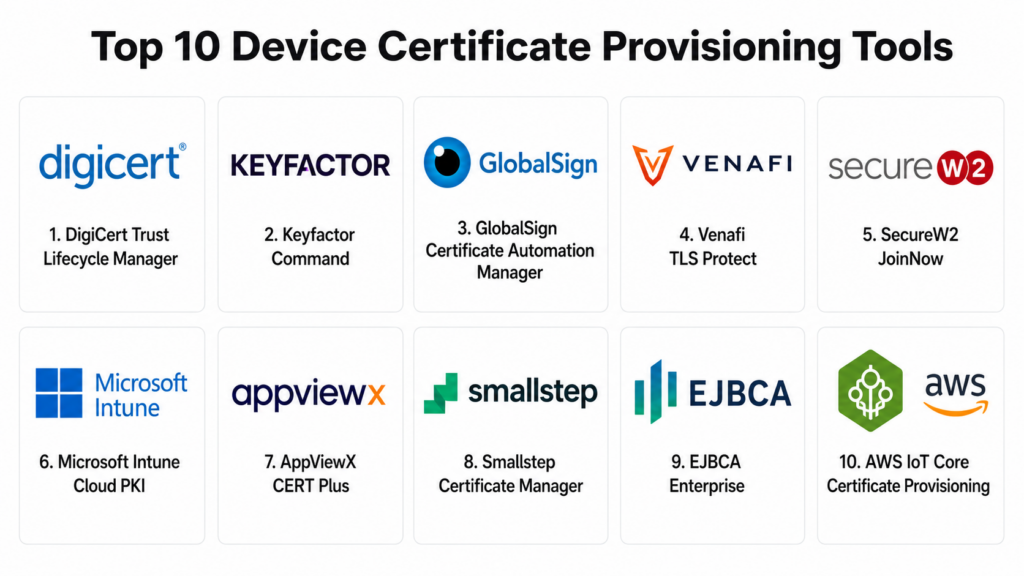
Introduction
Device Certificate Provisioning Tools help organizations issue, install, renew, revoke, and manage digital certificates for devices such as laptops, smartphones, tablets, IoT devices, servers, network equipment, printers, gateways, and industrial endpoints. In simple terms, these tools give every trusted device a unique digital identity so it can authenticate securely to Wi-Fi, VPN, applications, APIs, cloud services, and internal networks.
Device certificate provisioning matters because passwords alone are no longer enough for secure access. Modern enterprises manage remote employees, BYOD, IoT fleets, zero trust networks, cloud workloads, and machine identities at scale. Manual certificate handling can lead to expired certificates, access outages, weak authentication, compliance gaps, and security risks.
Real world use cases include Wi-Fi certificate authentication, VPN access, device onboarding, MDM certificate deployment, IoT device identity, mutual TLS, certificate renewal automation, machine identity management, NAC integration, and secure access for managed devices.
Buyers should evaluate PKI support, SCEP and EST support, MDM integration, certificate lifecycle automation, CA flexibility, device compatibility, revocation workflows, reporting, audit logs, scalability, identity integration, and security controls.
Best for: Device Certificate Provisioning Tools are best for IT security teams, PKI teams, endpoint administrators, network access teams, IoT teams, zero trust architects, DevOps teams, compliance teams, and enterprises managing large numbers of device identities.
Not ideal for: These tools may not be necessary for very small teams with only a few manually managed devices and simple access needs. In those cases, basic MDM certificate profiles, built-in CA tools, or manual certificate installation may be enough until scale, compliance, or automation needs increase.
Key Trends in Device Certificate Provisioning Tools
- Zero trust device identity is growing: Organizations increasingly require every trusted device to prove its identity before accessing networks, apps, APIs, and cloud services.
- Passwordless network access is expanding: Certificate-based authentication is replacing shared Wi-Fi passwords and weak credential-based access for enterprise networks.
- SCEP, EST, and ACME automation are important: Buyers want standards-based certificate enrollment so devices, servers, applications, and workloads can request certificates automatically.
- MDM-driven certificate provisioning is now common: Platforms increasingly integrate with Intune, Jamf, Kandji, Workspace ONE, Google endpoint management, and other MDM tools.
- IoT certificate provisioning is becoming critical: Connected devices, sensors, gateways, cameras, and industrial endpoints need unique identities at manufacturing, onboarding, or first boot.
- Certificate lifecycle automation is a major priority: Expired certificates can cause outages, so teams need automated discovery, renewal, revocation, and reporting.
- Machine identity management is expanding: Certificates are no longer only for websites. They now secure devices, workloads, containers, APIs, services, and internal systems.
- Private PKI and managed PKI are both growing: Some organizations want full control of internal PKI, while others prefer managed cloud PKI to reduce operational burden.
- Compliance reporting is becoming stronger: Security teams need audit trails showing which devices received certificates, when they were renewed, and whether revoked devices lost access.
- Post-quantum readiness is entering planning: While most deployments still use traditional PKI, security teams are starting to evaluate long-term certificate agility and cryptographic modernization.
How We Selected These Tools
The tools in this list were selected based on their relevance to device certificate provisioning, PKI automation, certificate lifecycle management, machine identity, IoT identity, endpoint certificate deployment, and enterprise security operations.
Selection logic included:
- Recognition in PKI, certificate lifecycle management, machine identity, device identity, or IoT security.
- Ability to issue, renew, revoke, and manage certificates for devices or machine identities.
- Support for enrollment standards such as SCEP, EST, ACME, APIs, or MDM certificate workflows.
- Integration with MDM, identity providers, network access control, Wi-Fi, VPN, and endpoint platforms.
- Support for private PKI, public CA services, managed PKI, or CA-agnostic certificate management.
- Reporting and visibility for certificate inventory, expiry, ownership, and compliance.
- Security controls such as RBAC, audit logs, key protection, certificate policies, and approval workflows.
- Fit across SMB, mid-market, enterprise, IoT, cloud, and regulated environments.
- Automation capabilities for large device fleets and high-volume certificate operations.
- Overall value for reducing manual PKI work, preventing outages, and strengthening device trust.
Top 10 Device Certificate Provisioning Tools
1- DigiCert Trust Lifecycle Manager
Short description:
DigiCert Trust Lifecycle Manager is a digital trust and certificate lifecycle management platform designed to help organizations discover, issue, manage, automate, and govern certificates across users, devices, servers, workloads, and enterprise environments. It supports certificate lifecycle visibility and PKI operations for organizations that need stronger control over digital identities. It is especially useful for enterprises managing large certificate estates across multiple systems. DigiCert is a strong fit for teams that want certificate lifecycle management backed by a major certificate authority ecosystem.
Key Features
- Certificate discovery and lifecycle management.
- Certificate issuance, renewal, and revocation workflows.
- Support for PKI services and certificate governance.
- Automation for certificate operations across environments.
- Visibility into certificate inventory, expiry, and risk.
- Integration with enterprise systems and security workflows.
- Policy management for digital trust operations.
Pros
- Strong fit for enterprise certificate lifecycle management.
- Useful for organizations that need CA-backed digital trust operations.
- Helps reduce certificate expiry and manual renewal risk.
Cons
- May be more advanced than small organizations need.
- Implementation depends on certificate estate complexity.
- Buyers should validate device-specific provisioning workflows for their environment.
Platforms / Deployment
Web
Cloud / Enterprise deployment options may vary
Security & Compliance
DigiCert provides enterprise-grade certificate management, PKI services, access controls, auditability, and governance capabilities. Specific compliance coverage, encryption details, and regional requirements should be validated during procurement.
Integrations & Ecosystem
DigiCert Trust Lifecycle Manager can integrate with enterprise certificate, PKI, DevOps, IT, and security workflows. It is useful when certificates need to be managed across devices, applications, infrastructure, and cloud systems.
- MDM and endpoint workflows
- PKI and CA operations
- ITSM systems
- DevOps pipelines
- Cloud environments
- Security operations tools
Support & Community
DigiCert provides documentation, enterprise support, professional services, and certificate authority expertise. Its ecosystem is strong among PKI, security, and digital trust teams.
2- Keyfactor Command
Short description:
Keyfactor Command is a certificate lifecycle automation and machine identity management platform that helps organizations discover, manage, automate, and secure certificates across enterprise environments. It supports certificate issuance, renewal, policy enforcement, reporting, and integration with different CAs and systems. Keyfactor is especially useful for enterprises with complex PKI environments, hybrid infrastructure, IoT needs, and many certificate-dependent systems. It is a strong option for teams that need CA-agnostic certificate automation.
Key Features
- Certificate discovery and inventory.
- Certificate lifecycle automation.
- CA-agnostic certificate management.
- Renewal, revocation, and policy workflows.
- Machine identity and PKI governance.
- Integration with enterprise applications and infrastructure.
- Reporting for certificate risk, expiry, and compliance.
Pros
- Strong certificate lifecycle automation depth.
- Useful for complex multi-CA environments.
- Good fit for enterprise machine identity management.
Cons
- Requires PKI process maturity for best results.
- May be too advanced for simple certificate use cases.
- Implementation effort depends on certificate estate size and integrations.
Platforms / Deployment
Web
Cloud / Self-hosted / Hybrid options may vary
Security & Compliance
Keyfactor provides enterprise controls for certificate lifecycle automation, policy governance, auditability, and access management. Specific compliance certifications and deployment-level controls should be validated with the vendor.
Integrations & Ecosystem
Keyfactor integrates with CAs, MDMs, DevOps platforms, cloud systems, load balancers, network devices, and security tools. It is especially useful when device and machine certificates are spread across many environments.
- Certificate authorities
- MDM platforms
- DevOps systems
- Cloud platforms
- Network appliances
- Security operations workflows
Support & Community
Keyfactor provides enterprise support, documentation, professional services, training, and PKI expertise. Its community is strong among machine identity, PKI, and security automation teams.
3- GlobalSign Certificate Automation Manager
Short description:
GlobalSign Certificate Automation Manager helps organizations automate certificate provisioning, deployment, renewal, and management across users, devices, and endpoints. It is especially relevant for teams that need PKI automation and device certificate deployment through enterprise systems. GlobalSign is often considered by organizations that want managed PKI services with automation and certificate lifecycle visibility. It is a good fit for enterprises needing certificate provisioning for endpoints, mobile devices, and network access.
Key Features
- Certificate provisioning and automation.
- Certificate lifecycle management for users, devices, and endpoints.
- Support for enterprise PKI workflows.
- SCEP support for device and mobile certificate issuance.
- Integration with MDM and endpoint management tools.
- Certificate renewal and replacement workflows.
- Reporting and administrative visibility.
Pros
- Strong fit for managed PKI and endpoint certificate provisioning.
- Useful for Wi-Fi, VPN, and device authentication use cases.
- Helps reduce manual certificate deployment work.
Cons
- Buyers should validate specific device and MDM compatibility.
- Advanced workflows may require PKI planning.
- Best value depends on certificate scale and automation needs.
Platforms / Deployment
Web
Cloud / Enterprise deployment options may vary
Security & Compliance
GlobalSign provides PKI-based certificate services, automation, and administrative controls. Specific compliance coverage, audit capabilities, and data protection details should be validated during procurement.
Integrations & Ecosystem
GlobalSign works with enterprise PKI, MDM, mobile device, and endpoint certificate provisioning workflows. It is especially useful for organizations deploying certificates at scale through management platforms.
- Microsoft Intune
- Jamf
- MDM platforms
- Active Directory environments
- Wi-Fi and VPN systems
- Enterprise PKI workflows
Support & Community
GlobalSign provides documentation, enterprise support, PKI guidance, and implementation assistance. Its ecosystem is strongest among organizations needing certificate authority and managed PKI expertise.
4- Venafi TLS Protect
Short description:
Venafi TLS Protect is a machine identity management platform focused on discovering, managing, automating, and protecting TLS certificates across enterprise environments. While it is often used for server and application certificates, it is also relevant for device and machine identity programs where certificates are used to authenticate systems and services. Venafi helps reduce certificate outages, enforce policy, and improve visibility across certificate estates. It is best suited for large enterprises with complex machine identity requirements.
Key Features
- TLS certificate discovery and inventory.
- Certificate lifecycle automation and renewal.
- Policy enforcement for machine identities.
- Certificate risk and expiry visibility.
- CA integration and certificate governance.
- Workflow automation for certificate operations.
- Reporting for security and compliance teams.
Pros
- Strong machine identity management capabilities.
- Useful for reducing certificate outage risk.
- Good fit for large enterprise certificate estates.
Cons
- Device-specific provisioning workflows should be validated.
- May be more focused on TLS and machine identity than MDM provisioning.
- Enterprise implementation can require planning and process alignment.
Platforms / Deployment
Web
Cloud / Enterprise deployment options may vary
Security & Compliance
Venafi provides enterprise machine identity security, policy controls, certificate lifecycle governance, and auditability. Specific compliance coverage and security documentation should be validated during procurement.
Integrations & Ecosystem
Venafi integrates with CAs, DevOps tools, cloud platforms, security systems, and IT workflows. It is useful when certificates must be governed across infrastructure, services, devices, and applications.
- Certificate authorities
- DevOps pipelines
- Cloud platforms
- ITSM tools
- Security platforms
- Load balancers and infrastructure systems
Support & Community
Venafi provides enterprise support, documentation, professional services, training, and machine identity expertise. Its ecosystem is strong among large security and PKI teams.
5- SecureW2 JoinNow
Short description:
SecureW2 JoinNow is a cloud-based PKI and certificate-based network access platform focused on Wi-Fi authentication, device onboarding, certificate provisioning, and passwordless network access. It helps organizations issue certificates to managed and BYOD devices through user-friendly enrollment workflows. SecureW2 is especially useful for education, enterprise Wi-Fi, remote access, and organizations moving away from password-based network access. It is a strong fit for teams that want simplified certificate provisioning for network authentication.
Key Features
- Cloud PKI for device certificate issuance.
- Certificate-based Wi-Fi and network authentication.
- BYOD and managed device onboarding workflows.
- Integration with identity providers and MDM tools.
- Automated certificate renewal and revocation workflows.
- RADIUS and network access support.
- User-friendly self-service enrollment.
Pros
- Strong fit for certificate-based Wi-Fi authentication.
- Useful for BYOD and managed device onboarding.
- Helps replace weak shared passwords with certificate access.
Cons
- More network access-focused than broad enterprise CLM platforms.
- Fit should be validated for non-Wi-Fi certificate use cases.
- Complex enterprise PKI needs may require complementary tools.
Platforms / Deployment
Web
Cloud
Security & Compliance
SecureW2 provides PKI-based authentication, certificate issuance, identity integration, and network access controls. Specific compliance certifications and enterprise security requirements should be validated with the vendor.
Integrations & Ecosystem
SecureW2 integrates with identity providers, MDM platforms, network infrastructure, RADIUS workflows, and cloud directories. It is especially valuable when certificates are used for Wi-Fi and secure network access.
- Microsoft Entra ID
- Google Workspace
- Okta
- Jamf
- Microsoft Intune
- RADIUS and Wi-Fi infrastructure
Support & Community
SecureW2 provides documentation, onboarding guidance, customer support, and network access expertise. Its community is strong among education, enterprise Wi-Fi, and identity-based access teams.
6- Microsoft Intune Cloud PKI
Short description:
Microsoft Intune Cloud PKI helps organizations issue and manage certificates for Intune-managed devices without building a traditional on-premise PKI environment. It is especially useful for Microsoft-centered organizations that need certificates for Wi-Fi, VPN, authentication, and device trust workflows. Intune can work with certificate profiles, SCEP-style enrollment approaches, and device compliance policies. It is a strong fit for enterprises already using Microsoft Intune, Entra ID, and Microsoft endpoint security.
Key Features
- Certificate issuance for Intune-managed devices.
- Integration with Microsoft Intune device management.
- Support for Wi-Fi, VPN, and authentication certificate scenarios.
- Cloud-based PKI management approach.
- Device compliance and conditional access alignment.
- Certificate profiles and policy deployment.
- Integration with Microsoft identity and endpoint ecosystem.
Pros
- Strong fit for Microsoft endpoint environments.
- Reduces need for some on-premise PKI complexity.
- Useful for managed device certificate deployment.
Cons
- Best value depends on Microsoft ecosystem adoption.
- Advanced non-Microsoft or IoT certificate needs may require other tools.
- Buyers should validate certificate templates, supported device types, and lifecycle requirements.
Platforms / Deployment
Web / Windows / macOS / iOS / Android managed devices
Cloud
Security & Compliance
Microsoft Intune Cloud PKI works with Microsoft identity, endpoint management, access policies, and cloud security controls. Specific compliance coverage depends on licensing, tenant configuration, and regional requirements.
Integrations & Ecosystem
Intune Cloud PKI integrates with Microsoft Intune, Entra ID, endpoint compliance, VPN, Wi-Fi, and device policy workflows. It is most useful for organizations managing endpoints through Microsoft.
- Microsoft Intune
- Microsoft Entra ID
- Windows endpoints
- macOS endpoints
- iOS and Android devices
- VPN and Wi-Fi profiles
Support & Community
Microsoft provides documentation, enterprise support, partner services, learning resources, and a large endpoint administrator community. Support strength is highest for Microsoft-centered organizations.
7- AppViewX CERT Plus
Short description:
AppViewX CERT Plus is a certificate lifecycle management and automation platform that helps organizations discover, provision, renew, revoke, and manage certificates across hybrid enterprise environments. It supports certificate automation for applications, infrastructure, devices, and security operations. AppViewX is especially useful for teams that want centralized visibility and automation across certificates issued from different sources. It is a good fit for enterprises with large certificate inventories and compliance requirements.
Key Features
- Certificate discovery and inventory management.
- Certificate issuance, renewal, and revocation automation.
- Multi-CA support and certificate policy governance.
- Workflow automation and approval processes.
- Certificate expiry alerts and risk visibility.
- Integration with infrastructure and DevOps tools.
- Reporting for compliance and audit teams.
Pros
- Strong certificate lifecycle automation capabilities.
- Useful for hybrid enterprise certificate estates.
- Helps reduce manual certificate renewal and outage risk.
Cons
- Device-specific provisioning workflows should be validated.
- Requires certificate process mapping for best results.
- May be more advanced than small teams need.
Platforms / Deployment
Web
Cloud / Self-hosted options may vary
Security & Compliance
AppViewX provides certificate governance, access control, policy workflows, and auditability for certificate management. Specific certifications and compliance coverage should be validated during procurement.
Integrations & Ecosystem
AppViewX integrates with certificate authorities, application delivery controllers, cloud systems, DevOps tools, and IT operations workflows. It is valuable when certificate automation must span applications, devices, and infrastructure.
- Certificate authorities
- Load balancers
- Cloud platforms
- DevOps pipelines
- ITSM tools
- Security operations systems
Support & Community
AppViewX provides documentation, enterprise support, implementation services, and certificate automation guidance. Its community is strongest among PKI, NetOps, DevOps, and security teams.
8- Smallstep Certificate Manager
Short description:
Smallstep Certificate Manager is a modern certificate management platform focused on internal PKI, workload identity, device identity, SSH certificates, and automated certificate issuance. It is especially useful for teams that want developer-friendly PKI automation and short-lived certificates for devices, services, and infrastructure. Smallstep supports modern certificate workflows and can help organizations replace manual internal certificate handling with automated issuance. It is a strong option for cloud-native, DevOps, infrastructure, and security teams.
Key Features
- Internal PKI and certificate authority workflows.
- Automated certificate issuance and renewal.
- Support for device, service, and workload identities.
- SSH certificate support.
- ACME-style automation support depending on setup.
- Developer-friendly tooling and APIs.
- Certificate visibility and policy management.
Pros
- Strong fit for modern internal PKI and DevOps workflows.
- Useful for short-lived certificates and automation.
- Good option for technical teams needing flexible certificate issuance.
Cons
- Requires PKI and infrastructure expertise.
- Traditional enterprise MDM provisioning may require integration planning.
- Best suited for technical teams comfortable with automation.
Platforms / Deployment
Web / Linux / Infrastructure environments
Cloud / Self-hosted options may vary
Security & Compliance
Smallstep provides certificate authority controls, policy management, identity-based certificate workflows, and secure issuance patterns. Specific compliance coverage should be validated based on deployment and contract.
Integrations & Ecosystem
Smallstep integrates with infrastructure, DevOps, cloud-native systems, identity workflows, and certificate automation processes. It is useful when certificate provisioning needs to be programmable.
- Kubernetes
- ACME workflows
- SSH access
- DevOps pipelines
- Cloud infrastructure
- Internal services and workloads
Support & Community
Smallstep provides documentation, community resources, commercial support options, and technical guidance. Its ecosystem is strong among cloud-native, DevOps, and infrastructure security teams.
9- EJBCA Enterprise
Short description:
EJBCA Enterprise is an enterprise PKI and certificate authority platform used to issue and manage digital certificates across users, devices, applications, IoT systems, and infrastructure. It supports flexible CA deployment, certificate profiles, enrollment protocols, and enterprise PKI operations. EJBCA is especially relevant for organizations that want to operate their own private PKI with deep control over certificate policies and issuance. It is a strong fit for regulated, IoT, government, telecom, and security-sensitive environments.
Key Features
- Enterprise certificate authority platform.
- Certificate issuance and lifecycle management.
- Support for SCEP, EST, ACME, CMP, and other enrollment protocols depending on configuration.
- Certificate profiles and policy control.
- Support for user, device, server, and IoT certificates.
- High-availability and scalable PKI deployment options.
- Integration with enterprise security and identity workflows.
Pros
- Strong private PKI and CA control.
- Useful for regulated and security-sensitive environments.
- Supports many certificate enrollment and automation use cases.
Cons
- Requires PKI expertise to operate effectively.
- More infrastructure-heavy than managed PKI services.
- Implementation and maintenance must be planned carefully.
Platforms / Deployment
Web / Server infrastructure
Self-hosted / Cloud deployment options may vary
Security & Compliance
EJBCA Enterprise provides enterprise PKI controls, certificate profiles, role-based access, audit capabilities, and CA governance. Specific compliance coverage depends on deployment architecture and operational controls.
Integrations & Ecosystem
EJBCA integrates with MDMs, IoT platforms, identity systems, network access systems, and enterprise infrastructure. It is useful when organizations need full control of internal certificate issuance.
- MDM platforms
- SCEP and EST workflows
- IoT platforms
- Network access control
- Identity systems
- Enterprise applications
Support & Community
EJBCA Enterprise provides commercial support, documentation, professional services, and PKI expertise through its vendor ecosystem. Its community is strong among PKI architects, security engineers, and regulated organizations.
10- AWS IoT Core Certificate Provisioning
Short description:
AWS IoT Core provides certificate-based device identity and provisioning workflows for IoT devices connecting to AWS. It supports device certificates, policies, fleet provisioning, just-in-time provisioning patterns, and secure device authentication. It is especially useful for teams building connected products, gateways, industrial devices, and cloud-connected IoT fleets on AWS. AWS IoT Core is a strong fit for IoT teams that need scalable certificate-backed device onboarding and cloud access control.
Key Features
- X.509 certificate-based device authentication.
- IoT device identity and policy management.
- Fleet provisioning for large device onboarding.
- Just-in-time provisioning patterns.
- Secure connection to AWS IoT services.
- Device registry and thing management.
- Integration with AWS security and monitoring services.
Pros
- Strong fit for AWS-connected IoT device fleets.
- Supports scalable certificate-backed device onboarding.
- Useful for connected products and edge gateways.
Cons
- Best value depends on AWS IoT architecture.
- Not a general enterprise endpoint certificate platform.
- Requires careful device manufacturing and provisioning process design.
Platforms / Deployment
IoT devices / Gateways / Embedded systems
Cloud
Security & Compliance
AWS IoT Core uses certificate-based authentication, IoT policies, encrypted communication, device identities, and AWS access controls. Specific compliance coverage depends on AWS region, account configuration, and architecture.
Integrations & Ecosystem
AWS IoT Core integrates with AWS cloud services, edge platforms, security monitoring, analytics, and device fleet workflows. It is most useful when device certificates are part of an AWS IoT architecture.
- AWS IoT Core
- AWS IoT Greengrass
- Amazon CloudWatch
- AWS Lambda
- Amazon S3
- AWS security services
Support & Community
AWS provides documentation, enterprise support, training, partner services, and a large developer community. Successful adoption requires IoT security, cloud architecture, and device provisioning expertise.
Comparison Table Top 10
| Tool Name | Best For | Platform Supported | Deployment | Standout Feature | Public Rating |
|---|---|---|---|---|---|
| DigiCert Trust Lifecycle Manager | Enterprise digital trust and certificate lifecycle management | Web | Cloud / Enterprise options may vary | Unified certificate lifecycle and PKI services | N/A |
| Keyfactor Command | CA-agnostic machine identity automation | Web | Cloud / Self-hosted / Hybrid options may vary | Enterprise certificate lifecycle automation | N/A |
| GlobalSign Certificate Automation Manager | Managed PKI and endpoint certificate provisioning | Web | Cloud / Enterprise options may vary | Certificate provisioning for users, devices, and endpoints | N/A |
| Venafi TLS Protect | Enterprise machine identity and TLS certificate control | Web | Cloud / Enterprise options may vary | Machine identity governance and certificate automation | N/A |
| SecureW2 JoinNow | Wi-Fi and network certificate onboarding | Web | Cloud | Certificate-based network access provisioning | N/A |
| Microsoft Intune Cloud PKI | Microsoft-managed endpoint certificate deployment | Web, Windows, macOS, iOS, Android | Cloud | Cloud PKI tied to Intune device management | N/A |
| AppViewX CERT Plus | Hybrid enterprise certificate automation | Web | Cloud / Self-hosted options may vary | Multi-CA certificate lifecycle automation | N/A |
| Smallstep Certificate Manager | Developer-friendly internal PKI and workload certificates | Web, Linux, infrastructure environments | Cloud / Self-hosted options may vary | Modern internal PKI and short-lived certificates | N/A |
| EJBCA Enterprise | Private PKI and enterprise CA control | Web, server infrastructure | Self-hosted / Cloud options may vary | Flexible enterprise certificate authority platform | N/A |
| AWS IoT Core Certificate Provisioning | AWS-connected IoT device identity | IoT devices, gateways, embedded systems | Cloud | Fleet provisioning with X.509 device certificates | N/A |
Evaluation and Scoring of Device Certificate Provisioning Tools
The scoring below is comparative and based on certificate provisioning depth, ease of use, integrations, security posture signals, performance, support expectations, and overall value. These are not public ratings and should be used as directional evaluation scores only.
| Tool Name | Core 25% | Ease 15% | Integrations 15% | Security 10% | Performance 10% | Support 10% | Value 15% | Weighted Total 0–10 |
|---|---|---|---|---|---|---|---|---|
| DigiCert Trust Lifecycle Manager | 9 | 8 | 9 | 9 | 9 | 9 | 8 | 8.70 |
| Keyfactor Command | 10 | 7 | 10 | 9 | 9 | 9 | 8 | 8.85 |
| GlobalSign Certificate Automation Manager | 8 | 8 | 8 | 9 | 8 | 8 | 8 | 8.15 |
| Venafi TLS Protect | 9 | 7 | 9 | 9 | 9 | 9 | 7 | 8.30 |
| SecureW2 JoinNow | 8 | 9 | 8 | 8 | 8 | 8 | 9 | 8.35 |
| Microsoft Intune Cloud PKI | 8 | 8 | 10 | 9 | 8 | 9 | 9 | 8.65 |
| AppViewX CERT Plus | 9 | 7 | 9 | 9 | 8 | 8 | 8 | 8.25 |
| Smallstep Certificate Manager | 8 | 7 | 9 | 8 | 8 | 8 | 9 | 8.10 |
| EJBCA Enterprise | 9 | 6 | 9 | 9 | 9 | 8 | 8 | 8.20 |
| AWS IoT Core Certificate Provisioning | 8 | 7 | 10 | 9 | 9 | 9 | 8 | 8.50 |
These scores should be interpreted by use case. Keyfactor, DigiCert, Venafi, and AppViewX are strong for enterprise certificate lifecycle management. SecureW2 is strong for Wi-Fi and device onboarding. Microsoft Intune Cloud PKI is best for Microsoft-managed endpoints. EJBCA is strong for private PKI control, Smallstep is strong for modern internal PKI and developer workflows, and AWS IoT Core is strongest for AWS-connected IoT device provisioning.
Which Device Certificate Provisioning Tool Is Right for You?
Solo / Freelancer
Solo professionals usually do not need a full enterprise certificate provisioning platform. If the use case is small lab infrastructure, local development, or a few devices, Smallstep, EJBCA community-style deployments, or basic CA tools may be enough. If the freelancer manages IoT prototypes on AWS, AWS IoT Core certificate provisioning may be useful. The priority should be simplicity, secure key handling, and reliable renewal reminders.
SMB
SMBs should prioritize ease of use, managed PKI options, MDM integration, and simple certificate onboarding. SecureW2, Microsoft Intune Cloud PKI, GlobalSign Certificate Automation Manager, and DigiCert can be practical depending on the environment. Microsoft-heavy SMBs may prefer Intune Cloud PKI, while Wi-Fi-focused teams may prefer SecureW2. SMBs should avoid complex self-managed PKI unless they have internal expertise.
Mid-Market
Mid-market organizations often need certificate automation across endpoints, Wi-Fi, VPN, servers, applications, and cloud services. DigiCert, Keyfactor, GlobalSign, AppViewX, SecureW2, and Microsoft Intune Cloud PKI can be strong candidates. If the organization has multiple certificate authorities or hybrid environments, Keyfactor or AppViewX may be useful. If endpoint certificate deployment is the main need, MDM-integrated options may be more practical.
Enterprise
Enterprises need scalable certificate lifecycle management, auditability, policy enforcement, CA integration, identity integration, reporting, and automation across many device and machine identities. Keyfactor, DigiCert, Venafi, AppViewX, EJBCA Enterprise, and Microsoft Intune Cloud PKI are strong enterprise options depending on architecture. Enterprises should validate multi-CA support, enrollment protocols, revocation workflows, high availability, compliance reporting, and integration depth before selection.
Budget vs Premium
Budget-focused teams may start with Microsoft Intune Cloud PKI if they already use Microsoft licensing, Smallstep for internal PKI workflows, or AWS IoT Core for AWS-based IoT devices. Premium platforms such as Keyfactor, DigiCert, Venafi, GlobalSign, and AppViewX may justify cost when certificate estates are large, complex, and compliance-sensitive. Buyers should compare license cost, CA cost, implementation effort, support, automation savings, and outage prevention value.
Feature Depth vs Ease of Use
Feature depth matters when organizations need multi-CA support, advanced policy controls, certificate discovery, expiration monitoring, revocation workflows, API automation, and audit trails. Keyfactor, Venafi, DigiCert, AppViewX, and EJBCA provide strong depth. Ease of use matters when the goal is simpler device onboarding or Wi-Fi certificate deployment. SecureW2, Intune Cloud PKI, and managed PKI offerings may be easier for many IT teams to adopt.
Integrations and Scalability
Certificate provisioning becomes more valuable when integrated with MDM, identity providers, Wi-Fi, VPN, NAC, IoT platforms, DevOps tools, cloud platforms, and ITSM workflows. A certificate should be issued, renewed, revoked, and audited automatically based on device status and access policy. Buyers should test SCEP, EST, ACME, API, and MDM workflows before committing. Scalability matters because certificate failure at scale can cause major access disruption.
Security and Compliance Needs
Device certificates are part of the trust foundation for network and application access. Buyers should evaluate key storage, certificate templates, revocation, audit logs, RBAC, approval workflows, encryption, CA protection, certificate policies, and lifecycle reporting. Regulated organizations should ensure they can prove which devices received certificates and when certificates were revoked. Security teams should also validate how lost, stolen, retired, or non-compliant devices are handled.
Frequently Asked Questions FAQs
1. What is a Device Certificate Provisioning Tool?
A Device Certificate Provisioning Tool automates the process of issuing and installing digital certificates on devices. These certificates allow devices to prove their identity when connecting to Wi-Fi, VPN, applications, APIs, or cloud services. The tool may also manage renewal, revocation, reporting, and lifecycle tracking. It reduces manual certificate handling and improves security. Device certificate provisioning is especially important for zero trust access and large device fleets.
2. How is device certificate provisioning different from certificate lifecycle management?
Device certificate provisioning focuses specifically on getting certificates onto devices such as laptops, phones, tablets, IoT devices, and gateways. Certificate lifecycle management is broader and includes discovering, issuing, renewing, revoking, monitoring, and governing certificates across devices, servers, applications, APIs, and workloads. Some tools do both. A company may need device provisioning for endpoint access and lifecycle management for the full certificate estate. The right choice depends on scope and complexity.
3. What pricing models are common for Device Certificate Provisioning Tools?
Pricing varies by vendor and may be based on certificates, devices, users, certificate authorities, modules, managed PKI services, or enterprise contract size. MDM-integrated tools may be included in broader endpoint licensing, while enterprise CLM platforms often use custom pricing. IoT platforms may price based on devices, messages, or cloud usage. Buyers should ask about CA costs, certificate volume, support, implementation, integrations, and renewal pricing. Total cost should include administration and outage prevention value.
4. How long does implementation usually take?
Implementation depends on device types, MDM environment, identity provider, PKI architecture, certificate templates, network access systems, and security requirements. A simple Wi-Fi certificate rollout through an MDM may be faster than enterprise-wide PKI automation across devices, servers, IoT, and applications. Important steps include defining certificate policies, enrollment flows, revocation rules, renewal windows, and integration testing. Teams should run a pilot with real devices before broad rollout. Certificate mistakes can break access, so testing is critical.
5. What are common mistakes in device certificate provisioning?
A common mistake is issuing certificates without a clear lifecycle plan for renewal and revocation. Another mistake is failing to integrate certificate issuance with device compliance or MDM status. Some organizations also use long-lived certificates without proper monitoring, which increases risk. Poor certificate templates and weak naming standards can make audits difficult. A strong provisioning process should define ownership, expiry, renewal, revocation, and reporting from the start.
6. Are Device Certificate Provisioning Tools secure?
These tools can improve security by enabling certificate-based authentication, device identity, encrypted communication, and automated revocation. However, security depends on correct PKI design, key protection, access controls, and policy enforcement. Buyers should evaluate RBAC, audit logs, CA protection, private key handling, enrollment authorization, and certificate revocation workflows. Lost or non-compliant devices should lose access quickly. Security teams should review the full certificate lifecycle, not only issuance.
7. Can these tools integrate with MDM platforms?
Yes, many Device Certificate Provisioning Tools integrate with MDM platforms to deliver certificates automatically to managed devices. Common use cases include Wi-Fi authentication, VPN profiles, email security, application access, and device trust. Integration may use SCEP, APIs, connectors, or cloud PKI services. Buyers should test certificate delivery, renewal, revocation, and device compliance behavior across all operating systems. MDM integration is one of the most important requirements for endpoint certificate provisioning.
8. Can device certificates be used for IoT security?
Yes, device certificates are widely used for IoT security because they allow each device to authenticate securely to cloud services, gateways, brokers, and APIs. Certificates can help prevent unauthorized devices from connecting to an IoT platform. They are also useful for mutual TLS, secure firmware updates, and device identity at scale. IoT certificate provisioning must consider manufacturing, first boot, rotation, revocation, and device retirement. Poor IoT certificate design can create long-term security problems.
9. What alternatives exist if a full provisioning platform is not needed?
Alternatives include manual certificate installation, built-in MDM certificate profiles, Microsoft AD CS, simple private CA tools, cloud CA services, or scripts using ACME or SCEP workflows. These can work for small environments or technical teams with limited device counts. However, they become harder to manage as device volume, compliance needs, and certificate types increase. A dedicated provisioning or lifecycle platform becomes valuable when automation, reporting, renewal, and revocation matter. The right alternative depends on scale and risk.
10. How should buyers evaluate Device Certificate Provisioning Tools?
Buyers should evaluate certificate issuance workflows, MDM integration, CA compatibility, SCEP and EST support, ACME support, revocation handling, renewal automation, reporting, audit logs, and security controls. They should test real device onboarding, Wi-Fi authentication, VPN access, certificate renewal, device retirement, and lost-device revocation. IT, security, network, endpoint, and compliance teams should all participate in evaluation. A pilot is essential because certificate provisioning errors can disrupt access at scale.
Conclusion
Device Certificate Provisioning Tools help organizations build stronger device trust by automating certificate issuance, renewal, revocation, and lifecycle control across endpoints, IoT devices, servers, applications, and machine identities. The right tool depends on whether the main need is Wi-Fi authentication, MDM-based endpoint certificates, enterprise certificate lifecycle management, private PKI, IoT onboarding, or DevOps certificate automation. DigiCert, Keyfactor, Venafi, GlobalSign, and AppViewX are strong for enterprise certificate lifecycle and PKI automation, SecureW2 is strong for certificate-based network onboarding, Microsoft Intune Cloud PKI is practical for Microsoft-managed endpoints, Smallstep is useful for modern internal PKI, EJBCA Enterprise is strong for private CA control, and AWS IoT Core is best for AWS-connected IoT device identity. There is no universal best platform because every organization has different device types, identity systems, network access models, and certificate governance needs.

Deploying comprehensive unified public key infrastructure identity credential enrollment software optimizes corporate connected hardware ecosystem logistics, ensuring accelerated enterprise cryptographic asset validation tracking and seamless network endpoint authentication workflows.