MOTOSHARE 🚗🏍️
Rent Bikes & Cars Directly from Owners
Motoshare connects vehicle owners with people who need bikes and cars on rent. Owners earn from idle vehicles, and renters get flexible ride options.
Visit Motoshare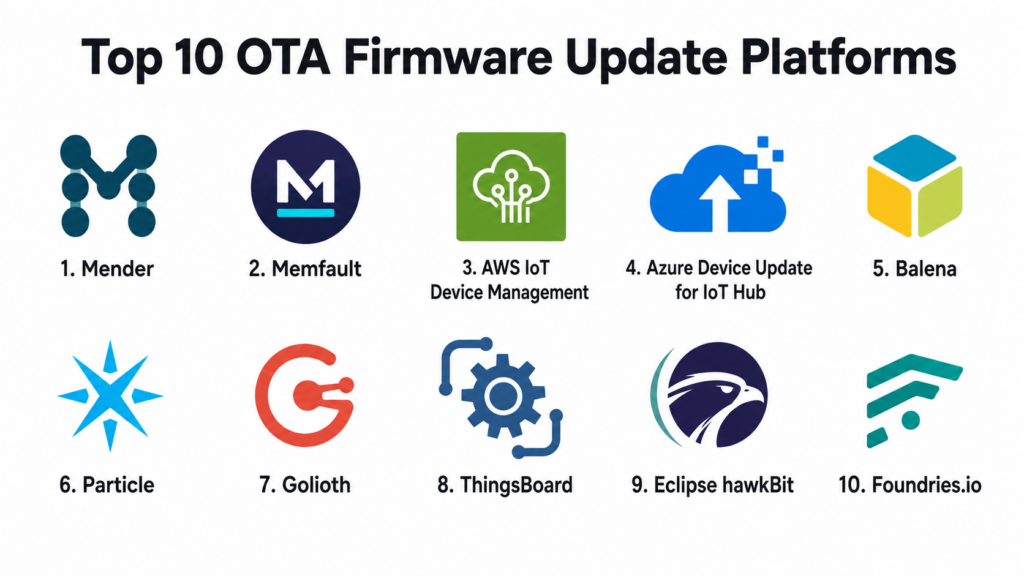
Introduction
OTA Firmware Update Platforms help businesses remotely deliver, install, monitor, and manage firmware or software updates on connected devices without physically touching them. In simple terms, these platforms allow product, engineering, IoT, and operations teams to update devices in the field through secure internet or network-based delivery.
OTA updates matter because connected devices are often deployed in homes, factories, vehicles, hospitals, retail sites, farms, cities, and remote industrial locations. Manual updates are expensive, slow, and risky when thousands or millions of devices are already deployed. A strong OTA firmware update platform helps teams fix bugs, patch security vulnerabilities, release features, control rollout speed, monitor failures, and reduce the risk of bricked devices.
Real world use cases include connected product updates, industrial IoT firmware delivery, smart meter updates, medical device software maintenance, automotive edge device updates, Linux gateway updates, embedded device patches, security fixes, and remote product lifecycle management.
Buyers should evaluate:
- Secure update delivery
- Firmware signing and verification
- Rollback and recovery support
- Staged rollout controls
- Device grouping and targeting
- Update campaign monitoring
- Embedded Linux and RTOS support
- Cloud, self-hosted, and edge deployment options
- APIs, SDKs, and developer workflow
- Compliance, audit logs, and fleet reporting
Best for: OTA Firmware Update Platforms are best for IoT product teams, embedded engineers, firmware teams, device manufacturers, industrial IoT teams, automotive technology teams, smart building vendors, energy companies, healthcare device teams, edge computing teams, and enterprises managing connected devices at scale.
Not ideal for: Very small prototype projects with only a few test devices may not need a dedicated OTA platform. A simple manual flashing process, local update script, or basic cloud storage download workflow may be enough during early experimentation. However, once devices move into production or customer environments, structured OTA update management becomes much more important.
Key Trends in OTA Firmware Update Platforms
- Security-first OTA delivery: Firmware signing, encryption, secure boot alignment, certificate-based identity, and update verification are now essential requirements.
- Staged and controlled rollouts: Teams want gradual deployment by device group, region, model, version, customer tier, or risk level instead of updating all devices at once.
- Rollback and fail-safe updates: A/B partitioning, dual-bank firmware, recovery images, and automatic rollback are becoming critical to avoid bricked devices.
- Edge and embedded Linux growth: More OTA tools now support Linux gateways, industrial edge devices, kiosks, routers, robotics systems, and containerized edge applications.
- RTOS and constrained device support: Lightweight OTA workflows are important for microcontrollers, sensors, low-power devices, and bandwidth-limited environments.
- Fleet observability during updates: Teams need real-time visibility into success rates, failed updates, offline devices, version distribution, and update health.
- Integration with IoT device management: OTA updates are increasingly bundled with device monitoring, telemetry, remote configuration, and fleet lifecycle tools.
- Compliance and audit trails: Regulated industries need records of update approvals, firmware versions, deployment history, rollback events, and security patch status.
- Developer workflow integration: Teams want OTA pipelines connected with CI/CD, artifact storage, release approvals, test groups, and version management.
- Open-source and commercial balance: Many teams evaluate open-source OTA frameworks for flexibility but choose commercial platforms when support, scale, and compliance matter.
How We Selected These Tools
The tools below were selected using a practical buyer-focused evaluation approach:
- Market recognition in OTA updates, IoT device management, embedded systems, Linux edge management, and connected product operations.
- Feature completeness across firmware delivery, rollout control, rollback support, device grouping, monitoring, and reporting.
- Security capabilities, including firmware signing, update verification, device identity, access controls, and audit-friendly workflows.
- Device and OS fit, including embedded Linux, RTOS, microcontrollers, gateways, edge devices, and connected product fleets.
- Deployment flexibility, including cloud-hosted, self-hosted, hybrid, open-source, and developer-friendly options.
- Scalability, including support for small product fleets, enterprise deployments, industrial devices, and global IoT operations.
- Developer experience, including APIs, SDKs, CLI workflows, CI/CD compatibility, and documentation.
- Operational visibility, including update campaign dashboards, failure tracking, version reporting, and fleet health monitoring.
- Integration ecosystem, including IoT platforms, cloud services, telemetry tools, device management systems, and observability tools.
- Implementation practicality, including hardware compatibility, agent requirements, embedded engineering effort, and long-term maintainability.
Top 10 OTA Firmware Update Platforms
1- Mender
Short description:
Mender is a widely used OTA software update platform built for embedded Linux and IoT device fleets. It helps teams deliver secure, reliable, and controlled software updates to devices in the field. Mender is especially strong for embedded Linux products where rollback, update integrity, and fleet visibility are important. It is a good fit for connected product companies, industrial IoT teams, medical device builders, smart building vendors, and edge device manufacturers.
Key Features
- OTA updates for embedded Linux devices
- A/B partition update model support
- Automatic rollback support
- Device grouping and staged rollouts
- Artifact-based update management
- Hosted and self-managed deployment options
- Fleet visibility and update status tracking
Pros
- Strong fit for embedded Linux OTA updates
- Good rollback and fail-safe update model
- Open-source foundation with commercial options
Cons
- Best suited for Linux-based devices rather than all constrained microcontrollers
- Requires embedded integration work
- Advanced fleet operations may require commercial features
Platforms / Deployment
Web-based management console.
Cloud and self-hosted deployment options may be available.
Best suited for embedded Linux devices and gateways.
Security & Compliance
Supports secure update workflows, artifact verification, access controls, and controlled deployment processes. Specific certifications and compliance documentation should be validated directly during vendor review.
Integrations & Ecosystem
Mender can integrate with embedded Linux build systems, IoT workflows, CI/CD pipelines, and device lifecycle processes. It is often used by engineering teams that need reliable software delivery to production devices.
- Yocto-based systems
- Embedded Linux workflows
- CI/CD pipelines
- Device manufacturing workflows
- Custom APIs
- IoT fleet operations
Support & Community
Mender provides documentation, community resources, open-source materials, commercial support, and enterprise assistance depending on edition and contract.
2- Memfault
Short description:
Memfault is an IoT reliability platform that combines OTA firmware updates with device observability, crash reporting, metrics, logs, and debugging workflows. It is especially useful for embedded engineering teams that want to ship updates with confidence and understand device health before and after deployment. Memfault helps teams detect firmware issues, monitor rollout impact, and debug field failures. It is a strong fit for connected product teams managing embedded devices at production scale.
Key Features
- OTA firmware update management
- Device health monitoring
- Crash and fault diagnostics
- Metrics, logs, and coredump analysis
- Controlled rollout workflows
- Firmware version tracking
- Embedded device debugging tools
Pros
- Combines OTA updates with observability
- Strong fit for embedded engineering teams
- Useful for monitoring update quality after release
Cons
- Requires embedded SDK integration
- Best value depends on telemetry quality and engineering adoption
- May be more engineering-focused than general IoT operations tools
Platforms / Deployment
Web-based platform.
Cloud deployment.
Supports embedded device integration through SDKs and firmware-side components.
Security & Compliance
Supports secure update and device data workflows, access controls, and administrative settings. Specific certifications and compliance requirements should be validated directly during procurement.
Integrations & Ecosystem
Memfault integrates with embedded development workflows, CI/CD, issue tracking, and device observability processes. It is designed to support engineering teams across development, release, and post-release monitoring.
- Embedded SDKs
- CI/CD pipelines
- Issue tracking tools
- Firmware build systems
- Device telemetry workflows
- Engineering dashboards
Support & Community
Memfault provides documentation, developer resources, implementation guidance, and support options. Support depth may vary by plan and customer requirements.
3- AWS IoT Device Management Jobs
Short description:
AWS IoT Device Management Jobs helps teams remotely run operations on connected devices, including firmware updates, application updates, reboots, configuration changes, and troubleshooting tasks. It is part of the AWS IoT ecosystem and is useful for teams already building IoT applications on AWS. The platform supports controlled remote operations across device groups and can be used for OTA update workflows when paired with the right device-side update logic. It is a strong fit for cloud-native IoT teams that want scalable update orchestration.
Key Features
- Remote job execution for connected devices
- OTA firmware and software update orchestration
- Device group targeting
- Job status tracking
- Deployment velocity control
- Integration with AWS IoT Core
- Support for broader remote operations beyond updates
Pros
- Strong fit for AWS-based IoT architectures
- Scales well for large connected device fleets
- Flexible for many remote device operations
Cons
- Requires AWS IoT architecture knowledge
- OTA implementation may need custom device-side logic
- Cost and service design should be planned carefully
Platforms / Deployment
Web-based AWS console.
Cloud deployment.
Device-side support depends on firmware, agents, and AWS IoT integration.
Security & Compliance
Supports AWS identity and access controls, device authentication, policies, encryption, logging, and secure remote job orchestration. Specific compliance coverage depends on AWS configuration, region, and architecture.
Integrations & Ecosystem
AWS IoT Device Management Jobs integrates with AWS IoT Core and the broader AWS cloud ecosystem. It is useful when OTA workflows need to connect with data, storage, analytics, monitoring, and serverless services.
- AWS IoT Core
- AWS Lambda
- Amazon S3
- Amazon CloudWatch
- AWS IoT Greengrass
- AWS security and identity services
Support & Community
AWS provides documentation, SDKs, support plans, training resources, partner assistance, and a large developer ecosystem. Support depth depends on AWS support plan and implementation complexity.
4- Azure Device Update for IoT Hub
Short description:
Azure Device Update for IoT Hub is a Microsoft Azure service for deploying OTA updates to IoT devices connected through Azure IoT Hub. It helps teams publish, distribute, and manage device updates in cloud-based IoT solutions. The platform is especially useful for organizations already using Azure IoT Hub, Azure IoT Edge, Azure security tools, and Microsoft cloud services. It supports update orchestration for connected devices where update governance and cloud integration are important.
Key Features
- OTA update deployment for IoT devices
- Integration with Azure IoT Hub
- Device grouping and update targeting
- Update deployment monitoring
- Device update agent reference implementation
- Support for cloud-based IoT solutions
- Azure ecosystem integration
Pros
- Strong fit for Azure IoT environments
- Good integration with Microsoft cloud services
- Useful for centralized update orchestration
Cons
- Best suited for Azure IoT Hub customers
- Device agent integration and validation are required
- Full production readiness depends on device-side implementation
Platforms / Deployment
Web-based Azure portal.
Cloud deployment.
Device-side update support depends on Azure Device Update agent and device implementation.
Security & Compliance
Supports Azure identity, access control, device authentication, secure communication, logging, and cloud governance. Specific compliance coverage should be validated based on Azure region, architecture, and customer requirements.
Integrations & Ecosystem
Azure Device Update integrates with Azure IoT Hub and broader Azure IoT, monitoring, security, and analytics services. It is best for teams already building device management on Microsoft cloud.
- Azure IoT Hub
- Azure IoT Edge
- Azure Monitor
- Azure Storage
- Microsoft identity services
- Azure analytics services
Support & Community
Microsoft provides documentation, reference implementations, support plans, partner services, and developer resources. Support depth depends on Azure contract and enterprise agreement.
5- Balena
Short description:
Balena is an edge and IoT device management platform focused on deploying, managing, and updating containerized applications on Linux-based device fleets. It is especially useful for teams managing Raspberry Pi devices, gateways, kiosks, industrial edge devices, robotics systems, and remote Linux hardware. Balena helps developers push updates, manage fleets, monitor device state, and operate containerized workloads at the edge. It is a strong fit for IoT teams that want application-level OTA updates for Linux edge devices.
Key Features
- OTA updates for containerized edge applications
- Linux edge device fleet management
- Remote deployment and rollback support
- Device health and status monitoring
- Fleet grouping and release management
- Developer-friendly workflows
- Support for edge application lifecycle management
Pros
- Strong fit for Linux edge device fleets
- Developer-friendly update workflow
- Good for containerized IoT and edge applications
Cons
- Best suited for Linux-based edge devices
- Not ideal for all microcontroller firmware use cases
- Hardware and OS compatibility should be validated early
Platforms / Deployment
Web-based platform.
Cloud deployment with edge device agents.
Focused on Linux-based edge devices.
Security & Compliance
Supports secure fleet access, controlled deployments, device access management, and update workflows. Specific certifications and compliance details should be validated during vendor review.
Integrations & Ecosystem
Balena integrates with developer workflows, container-based deployment processes, edge device fleets, and custom APIs. It is especially useful for teams building Linux-based connected products.
- Linux edge devices
- Container workflows
- Git-based deployment flows
- Developer APIs
- Device monitoring
- Edge gateways
Support & Community
Balena provides documentation, community resources, developer support, and commercial support options. Community strength is notable among edge developers and IoT builders.
6- Particle
Short description:
Particle is an IoT platform that combines connected hardware, device cloud services, fleet management, and OTA firmware update capabilities. It is especially useful for product teams building connected devices using Particle-compatible hardware and connectivity. Particle supports remote firmware updates, device events, fleet monitoring, APIs, and product lifecycle workflows. It is a strong fit for connected product teams that want a more integrated hardware-to-cloud update experience.
Key Features
- OTA firmware updates
- Device fleet monitoring
- Integrated hardware and cloud ecosystem
- Cellular and Wi-Fi device support
- Firmware version management
- Device event routing
- APIs for connected product workflows
Pros
- Strong device-to-cloud development experience
- Useful OTA workflow for connected products
- Good for teams using Particle hardware ecosystem
Cons
- Best fit depends on Particle-compatible hardware
- Less ideal for arbitrary industrial device fleets
- Enterprise integration needs should be validated
Platforms / Deployment
Web-based platform.
Cloud deployment.
Device support depends on Particle hardware and ecosystem compatibility.
Security & Compliance
Supports secure device communication, device identity, fleet access controls, and administrative management. Specific compliance documentation should be validated directly.
Integrations & Ecosystem
Particle integrates with cloud services, webhooks, APIs, and connected product workflows. It is designed to help teams move from firmware development to production device operations.
- Particle hardware ecosystem
- Webhooks
- REST APIs
- Cloud applications
- Firmware workflows
- Data platforms
Support & Community
Particle provides documentation, developer resources, community support, and commercial support options. Its community is strong among connected device builders and product teams.
7- Golioth
Short description:
Golioth is an IoT cloud platform designed for embedded developers building connected devices, especially microcontroller-based and constrained devices. It provides device connectivity, OTA firmware updates, device management, data routing, remote procedure calls, and secure device communication. Golioth is especially useful for teams building modern embedded products that need a developer-friendly cloud backend. It fits connected sensors, low-power devices, industrial endpoints, smart products, and embedded firmware teams.
Key Features
- OTA firmware updates for embedded devices
- Secure device connectivity
- Device management and fleet visibility
- Remote procedure calls
- Data routing and device telemetry
- Developer-friendly APIs and SDKs
- Support for constrained device workflows
Pros
- Strong fit for embedded and MCU-based IoT teams
- Developer-friendly approach
- Useful for constrained device management
Cons
- Best value depends on supported device stack
- May require embedded firmware integration work
- Broader enterprise workflows should be validated
Platforms / Deployment
Web-based platform.
Cloud deployment.
Device-side support depends on embedded SDKs and supported firmware stack.
Security & Compliance
Supports secure device communication, identity-oriented workflows, and controlled device operations. Specific certifications and compliance documentation should be validated directly.
Integrations & Ecosystem
Golioth integrates with embedded firmware workflows, cloud services, device telemetry, and developer tooling. It is especially relevant for teams building connected products on modern embedded stacks.
- Embedded SDKs
- Zephyr-based workflows
- Device telemetry pipelines
- Cloud applications
- Developer APIs
- Firmware build systems
Support & Community
Golioth provides documentation, developer guides, technical resources, and support options. Community strength is notable among embedded developers and modern IoT builders.
8- ThingsBoard
Short description:
ThingsBoard is an open-source IoT platform that supports device management, telemetry collection, dashboards, rule processing, and OTA-style device operations depending on implementation. It is especially useful for teams that want a customizable platform for IoT dashboards, device grouping, alerts, and remote workflows. While it is broader than firmware update management alone, it can support connected device operations and update-related orchestration when configured properly. It is a practical option for teams that want flexibility and self-hosting.
Key Features
- Device management and fleet grouping
- Telemetry collection and dashboards
- Rule engine for update-related workflows
- Remote procedure call support
- Asset and device modeling
- Cloud and self-hosted deployment options
- Custom API and integration support
Pros
- Flexible and customizable IoT platform
- Open-source option available
- Useful for dashboards and device operations
Cons
- OTA firmware workflows may require custom implementation
- Requires technical expertise to set up and scale
- Advanced lifecycle controls may need configuration
Platforms / Deployment
Web-based platform.
Cloud and self-hosted deployment options may be available.
Security & Compliance
Supports authentication, access control, tenant isolation, and administrative settings. Specific compliance coverage should be validated based on edition and deployment model.
Integrations & Ecosystem
ThingsBoard integrates with devices, protocols, data systems, APIs, and custom applications. It is often used by technical teams building tailored IoT operations platforms.
- MQTT devices
- HTTP devices
- CoAP devices
- Custom APIs
- Databases and analytics systems
- Edge gateways
Support & Community
ThingsBoard provides open-source community resources, documentation, and commercial support options depending on edition. Community strength is strong among IoT developers and system integrators.
9- Eclipse hawkBit
Short description:
Eclipse hawkBit is an open-source backend framework for rolling out software updates to constrained edge devices, gateways, and connected systems. It is designed to support scalable software update management for device fleets and can be used as part of a custom OTA architecture. hawkBit is especially useful for engineering teams that want open-source update management and have the capability to build device-side integration. It fits teams that need flexibility, control, and customization rather than a fully managed commercial platform.
Key Features
- Open-source software update backend
- Device target management
- Rollout campaign support
- Update assignment and status tracking
- APIs for device and management integration
- Suitable for custom OTA architectures
- Scalable update coordination model
Pros
- Flexible open-source OTA backend
- Useful for custom device update architectures
- Good fit for engineering teams needing control
Cons
- Requires device-side integration and platform engineering
- Not a complete plug-and-play OTA product by itself
- Support depends on community or implementation partners
Platforms / Deployment
Web-based backend and APIs.
Self-hosted deployment.
Device-side support depends on custom integration.
Security & Compliance
Security depends on deployment architecture, authentication, access controls, and device integration design. Formal compliance coverage is Not publicly stated unless provided by a specific commercial implementation or support provider.
Integrations & Ecosystem
Eclipse hawkBit can integrate with custom device agents, IoT platforms, backend systems, and update delivery pipelines. It is best for teams building their own OTA infrastructure.
- Custom device agents
- IoT platforms
- CI/CD pipelines
- Artifact repositories
- Backend APIs
- Edge device workflows
Support & Community
Eclipse hawkBit has open-source community resources and documentation. Enterprise support depends on internal expertise, implementation partners, or commercial service providers.
10- Foundries.io
Short description:
Foundries.io provides a platform for building, securing, deploying, and updating Linux-based IoT and edge devices. It focuses on secure device software lifecycle management, including OTA updates, Linux platform maintenance, container updates, and device fleet operations. Foundries.io is especially useful for product teams building secure connected Linux devices that need long-term maintainability. It is a strong fit for industrial IoT, edge gateways, connected products, and embedded Linux fleets.
Key Features
- Secure OTA updates for Linux devices
- Linux platform and container update workflows
- Device fleet management
- Secure software supply chain support
- Continuous delivery for embedded Linux
- Device lifecycle and version tracking
- Edge and connected product support
Pros
- Strong fit for secure Linux-based IoT products
- Useful for long-term device software maintenance
- Good alignment with modern DevOps-style embedded workflows
Cons
- Best suited for Linux edge and embedded device teams
- Requires platform engineering and embedded Linux expertise
- May be more advanced than simple IoT update needs
Platforms / Deployment
Web-based platform and developer workflows.
Cloud-connected device lifecycle model.
Focused on Linux-based edge and IoT devices.
Security & Compliance
Supports secure update workflows, software supply chain controls, device lifecycle governance, and controlled deployment practices. Specific certifications and compliance documentation should be validated directly.
Integrations & Ecosystem
Foundries.io integrates with embedded Linux development, container workflows, CI/CD, device lifecycle management, and secure software delivery processes.
- Embedded Linux workflows
- Containerized edge applications
- CI/CD pipelines
- Device fleet operations
- Software supply chain workflows
- Edge gateways
Support & Community
Foundries.io provides documentation, developer resources, commercial support, and implementation assistance depending on customer needs and contract.
Comparison Table
| Tool Name | Best For | Platform Supported | Deployment | Standout Feature | Public Rating |
|---|---|---|---|---|---|
| Mender | Embedded Linux OTA updates | Web, embedded Linux devices | Cloud, self-hosted options vary | A/B updates with rollback support | N/A |
| Memfault | OTA plus device observability | Web, embedded devices | Cloud | OTA updates with crash and health monitoring | N/A |
| AWS IoT Device Management Jobs | AWS-based IoT fleets | Web, device SDKs, AWS IoT devices | Cloud | Scalable remote jobs and update orchestration | N/A |
| Azure Device Update for IoT Hub | Azure IoT device fleets | Web, Azure IoT devices | Cloud | OTA updates integrated with Azure IoT Hub | N/A |
| Balena | Linux edge application updates | Web, Linux edge devices | Cloud with edge agents | Container-based edge OTA deployments | N/A |
| Particle | Connected products using Particle ecosystem | Web, Particle-compatible devices | Cloud | Integrated hardware-to-cloud OTA workflow | N/A |
| Golioth | Embedded and constrained devices | Web, embedded devices | Cloud | Developer-friendly OTA for embedded IoT | N/A |
| ThingsBoard | Custom IoT operations platforms | Web, IoT devices, APIs | Cloud, self-hosted options vary | Flexible rule engine and dashboards | N/A |
| Eclipse hawkBit | Custom open-source OTA backend | Web, APIs, custom device agents | Self-hosted | Open-source rollout backend for device updates | N/A |
| Foundries.io | Secure Linux edge lifecycle management | Web, Linux edge devices | Cloud-connected model | Secure Linux and container update pipeline | N/A |
Evaluation & Scoring of OTA Firmware Update Platforms
| Tool Name | Core 25% | Ease 15% | Integrations 15% | Security 10% | Performance 10% | Support 10% | Value 15% | Weighted Total 0–10 |
|---|---|---|---|---|---|---|---|---|
| Mender | 9.2 | 8.0 | 8.3 | 8.8 | 8.8 | 8.3 | 8.4 | 8.56 |
| Memfault | 8.8 | 8.4 | 8.4 | 8.5 | 8.7 | 8.4 | 8.2 | 8.50 |
| AWS IoT Device Management Jobs | 8.7 | 7.7 | 9.4 | 9.0 | 9.0 | 8.6 | 8.3 | 8.67 |
| Azure Device Update for IoT Hub | 8.6 | 7.9 | 9.2 | 9.0 | 8.8 | 8.6 | 8.2 | 8.58 |
| Balena | 8.5 | 8.6 | 8.2 | 8.3 | 8.5 | 8.1 | 8.5 | 8.43 |
| Particle | 8.2 | 8.7 | 8.0 | 8.2 | 8.3 | 8.1 | 8.3 | 8.29 |
| Golioth | 8.3 | 8.4 | 8.1 | 8.3 | 8.2 | 8.0 | 8.4 | 8.29 |
| ThingsBoard | 7.7 | 7.9 | 8.2 | 8.0 | 8.2 | 7.7 | 8.7 | 8.03 |
| Eclipse hawkBit | 8.0 | 7.0 | 8.0 | 7.8 | 8.3 | 7.0 | 8.8 | 7.88 |
| Foundries.io | 8.6 | 7.8 | 8.3 | 8.8 | 8.6 | 8.2 | 8.1 | 8.35 |
The scores are comparative and should be used as a practical evaluation guide, not as fixed market ratings. Mender is strong for embedded Linux OTA updates, while Memfault is especially useful when update delivery must be connected with device health and diagnostics. AWS and Azure are strong for cloud-native IoT fleets, while Balena and Foundries.io are strong for Linux edge devices. Golioth and Particle fit embedded product teams, ThingsBoard fits custom IoT operations, and Eclipse hawkBit is valuable for teams that want open-source OTA backend control.
Which OTA Firmware Update Platform Is Right for You?
Solo / Freelancer
Solo developers and freelancers should start with a simple OTA approach that matches their hardware and development workflow. If the project uses Linux edge devices, Balena or Mender may be practical. If the project uses embedded devices or microcontrollers, Golioth, Particle, or Memfault may be more relevant.
For prototypes, a full enterprise OTA platform may be unnecessary. The focus should be safe updates, version tracking, and basic rollback planning before devices reach customers.
SMB
SMBs should prioritize ease of integration, secure update delivery, rollback support, and simple fleet visibility. Mender, Memfault, Particle, Balena, Golioth, and ThingsBoard can be practical depending on device type.
If the team has limited embedded engineering capacity, choosing a platform with strong documentation and managed services can save time. SMBs should avoid building a custom OTA system unless they have the engineering resources to maintain it.
Mid-Market
Mid-market companies usually need stronger rollout controls, update monitoring, staged deployments, device grouping, and security reporting. Mender, Memfault, AWS IoT Device Management Jobs, Azure Device Update, Balena, and Foundries.io can be strong options.
These organizations should define update policies clearly. Important decisions include how updates are approved, how devices are grouped, how failures are handled, and how rollback is triggered.
Enterprise
Enterprises should prioritize security, compliance, audit logs, staged rollouts, device identity, long-term support, integration with IoT platforms, and global fleet visibility. AWS, Azure, Mender, Memfault, Foundries.io, and enterprise IoT platforms are strong candidates.
Large organizations should also evaluate device lifecycle governance, secure software supply chain, regional deployment controls, field failure management, and compliance documentation. OTA updates should be treated as a controlled production release process.
Budget vs Premium
Budget-focused teams can explore open-source or developer-friendly options such as Mender open-source components, Eclipse hawkBit, ThingsBoard, or custom workflows. These can reduce license cost but require stronger internal engineering ownership.
Premium platforms are better when the business needs managed hosting, support, compliance, observability, rollback automation, and enterprise update governance. The right choice depends on whether saving engineering time is more important than saving subscription cost.
Feature Depth vs Ease of Use
Feature-rich platforms provide staged rollouts, rollback, secure artifacts, observability, device grouping, update monitoring, and API-based automation. They are better for production fleets but may take more time to integrate.
Ease-of-use platforms help smaller teams launch OTA updates quickly. Buyers should not choose the most complex platform if their fleet is simple, but they should also avoid weak update workflows for customer-facing devices.
Integrations & Scalability
OTA Firmware Update Platforms should integrate with CI/CD systems, artifact repositories, cloud platforms, IoT device registries, telemetry tools, observability platforms, and issue tracking systems. Strong integration makes firmware releases more controlled and repeatable.
Scalability matters when devices are spread across customers, regions, hardware models, firmware versions, and network conditions. Buyers should test rollout groups, bandwidth usage, offline device behavior, retry logic, and failure reporting before production rollout.
Security & Compliance Needs
OTA updates can directly affect device safety, security, and customer trust. A weak update process can introduce vulnerabilities, brick devices, or disrupt operations.
Buyers should evaluate firmware signing, encryption, secure boot alignment, device identity, access controls, audit logs, rollback, approval workflows, and vulnerability response processes. Regulated industries should involve security, legal, compliance, and product safety teams early.
Frequently Asked Questions
1. What is an OTA Firmware Update Platform?
An OTA Firmware Update Platform helps businesses remotely deliver firmware or software updates to connected devices. It allows teams to fix bugs, patch vulnerabilities, add features, and improve device performance without physically accessing each device. These platforms usually include update packaging, device targeting, rollout monitoring, rollback support, and fleet reporting. OTA platforms are essential for production IoT and embedded devices deployed in the field. They reduce maintenance cost and improve long-term device reliability.
2. How is OTA firmware updating different from normal software deployment?
OTA firmware updating is more sensitive because it often modifies low-level device software that controls hardware behavior. If an update fails, the device may stop working or become difficult to recover. Normal software deployment usually happens on systems with more storage, compute, and recovery options. OTA firmware updates must consider power loss, network interruption, flash memory limits, hardware variants, and rollback design. This is why safe OTA platforms focus heavily on verification, staged rollout, and recovery.
3. What pricing models do OTA Firmware Update Platforms use?
Pricing models vary by platform. Some charge based on number of devices, monthly active devices, update volume, data transfer, support level, deployment model, or enterprise contract. Open-source tools may have no license cost but require internal hosting, maintenance, integration, and support effort. Cloud providers may charge through IoT messages, storage, compute, and related services. Buyers should estimate total cost based on real fleet size, update frequency, telemetry volume, and engineering effort. The lowest license cost is not always the lowest total cost.
4. How long does OTA platform implementation usually take?
Implementation time depends on hardware, operating system, firmware architecture, bootloader, connectivity, security requirements, and update format. A Linux gateway may be easier to integrate than a constrained microcontroller with limited flash and bandwidth. Teams must design update packaging, signing, delivery, validation, rollback, and monitoring workflows. Production rollout also requires testing across hardware revisions and network conditions. A safe approach is to start with development devices, then internal test fleets, then small customer groups, and only then full deployment.
5. What are common mistakes when choosing an OTA platform?
A common mistake is focusing only on update delivery and ignoring rollback, failure recovery, security, and fleet monitoring. Another mistake is building a custom OTA system without considering long-term maintenance and edge cases. Some teams also fail to test updates under poor network, low battery, power loss, or interrupted download conditions. Others deploy to all devices at once instead of using staged rollout groups. A good OTA strategy must assume failures will happen and design safe recovery paths before production release.
6. Are OTA Firmware Update Platforms secure?
OTA platforms can be secure, but security depends on architecture and implementation. Important controls include firmware signing, secure boot compatibility, encrypted communication, device identity, access control, audit logs, and update verification. Teams should ensure devices reject unauthorized or modified firmware. Admin access should be limited through role-based permissions and MFA where available. Security testing should include rollback attacks, downgrade prevention, key protection, and compromised device scenarios. OTA security should be designed from the beginning, not added later.
7. Can OTA platforms support offline or unreliable devices?
Many OTA platforms can support devices that are intermittently connected, but capabilities vary. Devices may need retry logic, resume support, local validation, and safe failure handling. For remote environments, update campaigns should account for weak networks, low bandwidth, power loss, and delayed check-ins. Offline devices should receive updates when they reconnect, but rollout dashboards must clearly show pending, failed, and successful states. Buyers should test update behavior under real field conditions before choosing a platform. This is especially important for industrial, vehicle, and remote sensor deployments.
8. Do OTA platforms support rollback?
Many strong OTA platforms support rollback, but the method depends on device architecture. Embedded Linux devices often use A/B partitioning or dual-root filesystem approaches. Microcontrollers may use dual-bank firmware, bootloader-managed recovery, or backup image methods. Rollback is critical because a failed update can make a device unusable. Buyers should validate rollback behavior carefully, including power-loss scenarios and partial downloads. A platform without reliable rollback may be risky for customer-facing or remote devices.
9. When should a business move from manual firmware updates to an OTA platform?
A business should move to an OTA platform before devices are widely deployed in customer or remote environments. Warning signs include growing device volume, field service costs, security patch pressure, inconsistent firmware versions, and no reliable way to fix bugs remotely. Manual updates may work during prototypes but become risky in production. OTA platforms help teams manage versions, deployments, failures, and security patches at scale. The earlier the OTA architecture is designed into the product, the easier and safer future updates become.
10. What alternatives exist if we do not need a full OTA platform?
Alternatives include manual flashing, local update tools, custom download scripts, cloud storage-based update delivery, MQTT-triggered update workflows, or open-source OTA backends. These may work for prototypes, lab devices, or small internal fleets. However, they may lack rollback, audit logs, staged rollouts, security controls, and fleet visibility. A dedicated OTA platform is better when devices are deployed at scale or used by customers. The right alternative depends on fleet size, device risk, engineering capacity, and support expectations.
Conclusion
OTA Firmware Update Platforms are essential for connected device businesses that need to maintain, secure, and improve devices after deployment. The best platform depends on device type, operating system, hardware limits, security requirements, rollout strategy, engineering maturity, and cloud ecosystem. Mender is a strong choice for embedded Linux OTA updates, Memfault is valuable when updates must be connected with device diagnostics, and AWS or Azure are practical for cloud-native IoT fleets. Balena and Foundries.io fit Linux edge and containerized device workflows, while Particle and Golioth are strong for connected product and embedded device teams. ThingsBoard and Eclipse hawkBit are useful when teams want flexibility, customization, or open-source control. There is no single universal winner because OTA update requirements vary widely across products, industries, and hardware architectures.

Deploying comprehensive unified wireless hardware software distribution delivery architecture software optimizes corporate connected device ecosystem logistics, ensuring accelerated enterprise remote revision package deployment tracking and seamless fleet edge firmware maintenance workflows.