MOTOSHARE 🚗🏍️
Rent Bikes & Cars Directly from Owners
Motoshare connects vehicle owners with people who need bikes and cars on rent. Owners earn from idle vehicles, and renters get flexible ride options.
Visit Motoshare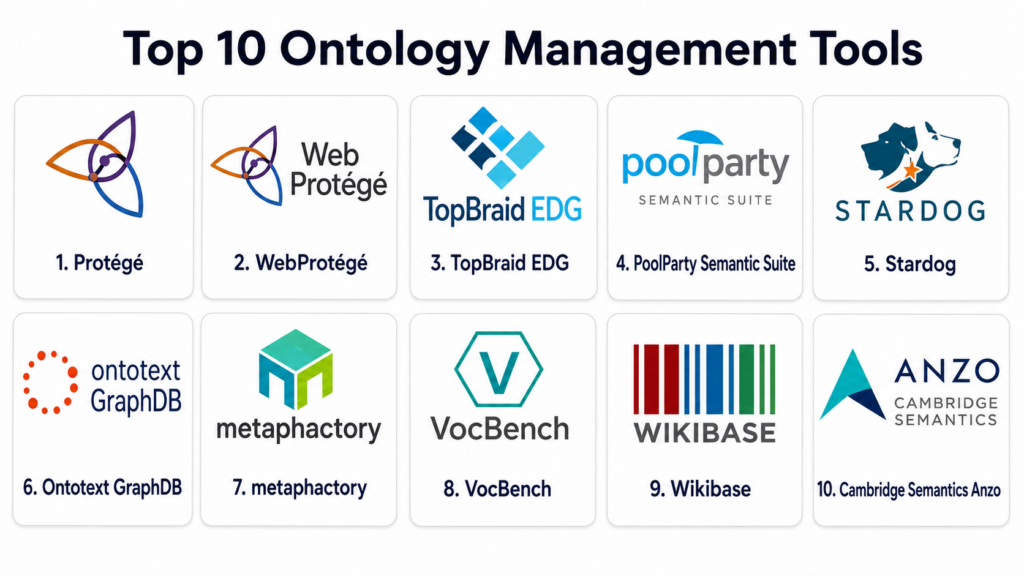
Introduction
Ontology Management Tools help organizations create, manage, govern, publish, and reuse structured knowledge models that define business concepts, relationships, rules, classifications, and meanings. In simple terms, these tools help teams describe what things mean in a domain and how those things relate to each other.
Ontology management matters because enterprises are dealing with fragmented data, inconsistent terminology, AI readiness challenges, complex compliance rules, and growing knowledge graph adoption. Without well-managed ontologies, teams may use different names for the same concepts, connect data incorrectly, or build AI systems on unclear business meaning. A strong ontology management tool helps improve semantic consistency, data governance, knowledge graph quality, metadata alignment, and explainable AI outcomes.
Real world use cases include enterprise knowledge graphs, semantic data catalogs, AI and RAG grounding, regulatory taxonomies, product classification, biomedical vocabularies, financial industry models, data governance glossaries, master data semantics, and business rule modeling.
Buyers should evaluate:
- Ontology editing and modeling support
- OWL, RDF, RDFS, SKOS, and SHACL support
- Collaboration and governance workflows
- Version control and change tracking
- Reasoning and validation capabilities
- Knowledge graph integration
- Import, export, and publishing options
- Security, access control, and audit logs
- Enterprise scalability
- Usability for technical and business users
Best for: Ontology Management Tools are best for data architects, knowledge engineers, semantic web teams, data governance teams, AI teams, enterprise architects, research organizations, librarians, taxonomy managers, compliance teams, and organizations building knowledge graphs or semantic data layers.
Not ideal for: Small teams with simple metadata needs may not need a full ontology management platform. A spreadsheet, basic business glossary, lightweight taxonomy tool, or simple data catalog may be enough when relationships are simple, governance is informal, and reasoning or semantic interoperability is not required.
Key Trends in Ontology Management Tools
- AI-ready semantic layers: Ontologies are increasingly used to give AI systems trusted context, business meaning, and explainable relationships.
- Knowledge graph adoption: Enterprises are using ontologies as the schema layer for knowledge graphs that connect customers, products, assets, risks, policies, and documents.
- SHACL-based validation: Teams are using shapes and constraints to validate graph data quality and enforce semantic rules.
- Business and technical collaboration: Modern tools are improving usability so domain experts, not only ontology engineers, can contribute to models.
- Data catalog integration: Ontologies are becoming connected with data catalogs, metadata platforms, lineage tools, and governance workflows.
- Industry ontology reuse: Teams are reusing domain ontologies in finance, healthcare, life sciences, manufacturing, government, and research.
- Governed vocabulary management: Taxonomies, thesauri, glossaries, and ontologies are increasingly managed together under shared governance.
- Graph-based RAG support: Ontologies help improve retrieval accuracy by defining concepts, relationships, entity types, and semantic constraints.
- Versioning and lifecycle governance: Enterprises need approval workflows, model version history, impact analysis, and controlled publishing.
- Hybrid open-source and enterprise adoption: Many teams prototype with open-source editors and later adopt enterprise platforms for governance, collaboration, and scale.
How We Selected These Tools
The tools below were selected using a practical buyer-focused evaluation approach:
- Market recognition in ontology management, semantic web, knowledge graphs, taxonomy management, and enterprise semantics.
- Feature completeness across ontology editing, governance, validation, reasoning, collaboration, publishing, and integration.
- Support for semantic standards, including RDF, OWL, RDFS, SKOS, SPARQL, and SHACL where relevant.
- Enterprise readiness, including role-based access, versioning, workflows, auditability, scalability, and support.
- Knowledge graph compatibility, including graph databases, semantic repositories, APIs, and data integration patterns.
- Business usability, especially for domain experts, taxonomy managers, data stewards, and governance users.
- Developer experience, including APIs, import/export, automation, scripting, and integration with data pipelines.
- Collaboration features, including review workflows, comments, approvals, and multi-user editing.
- Deployment flexibility, including desktop, web, cloud, self-hosted, and open-source options.
- Practical adoption fit, including learning curve, documentation, community, support, and long-term maintainability.
Top 10 Ontology Management Tools
1- Protégé
Short description:
Protégé is one of the most widely used open-source ontology editors for creating and maintaining OWL ontologies. It is commonly used in academia, research, healthcare, life sciences, semantic web projects, and ontology prototyping. Protégé provides a strong foundation for modeling classes, properties, individuals, restrictions, and reasoning workflows. It is best for technical users and knowledge engineers who need a flexible desktop ontology development environment.
Key Features
- OWL ontology editing
- Class, property, and individual modeling
- Reasoner integration support
- Plugin ecosystem
- Ontology import and export
- Visualization options through plugins
- Strong academic and research adoption
Pros
- Free and open-source
- Strong support for OWL ontology modeling
- Large community and long-standing usage
Cons
- Desktop-focused experience may not suit enterprise collaboration
- Learning curve for non-technical users
- Governance and workflow features are limited compared with enterprise tools
Platforms / Deployment
Desktop application.
Windows, macOS, and Linux.
Self-managed local deployment.
Security & Compliance
Not publicly stated for enterprise compliance. Security depends on local environment, file storage, and organizational controls.
Integrations & Ecosystem
Protégé works well in semantic web and ontology engineering workflows. It can be used to create ontologies that are later loaded into graph databases or enterprise knowledge graph platforms.
- OWL and RDF workflows
- Reasoners
- Graph databases
- Semantic web tools
- Research environments
- Plugin-based extensions
Support & Community
Protégé has strong community support, academic usage, documentation, mailing lists, and plugin resources. Enterprise support is not the primary model.
2- WebProtégé
Short description:
WebProtégé is a web-based ontology editing and collaboration tool that allows teams to create, review, and manage ontologies through a browser. It is useful for distributed ontology projects where multiple contributors need to work together. WebProtégé is especially helpful for academic groups, research teams, standards projects, and organizations that want collaborative ontology editing without relying only on desktop files. It is best for teams that need shared access and basic governance around ontology development.
Key Features
- Web-based ontology editing
- Collaborative ontology development
- Comments and discussion support
- Change tracking capabilities
- Class and property management
- Browser-based access
- Support for shared ontology projects
Pros
- Good for collaborative ontology development
- Easier access than desktop-only tools
- Useful for distributed research and standards teams
Cons
- Enterprise governance depth may be limited
- Advanced integration requirements may need customization
- Less feature-rich than some commercial ontology platforms
Platforms / Deployment
Web-based platform.
Cloud or self-hosted deployment options may vary.
Security & Compliance
Basic access control and collaboration features may be available depending on deployment. Formal enterprise compliance details are Not publicly stated.
Integrations & Ecosystem
WebProtégé is commonly used in ontology collaboration workflows and can support models that later move into graph repositories, semantic platforms, or data governance systems.
- OWL ontology workflows
- Research projects
- Collaborative modeling
- Semantic web repositories
- Shared vocabulary projects
- Export and import workflows
Support & Community
WebProtégé benefits from academic and semantic web community support, documentation, and open-source ecosystem resources. Enterprise support depends on deployment and service provider.
3- TopBraid EDG
Short description:
TopBraid EDG is an enterprise knowledge graph and semantic data governance platform used for taxonomy, ontology, data governance, metadata, and semantic model management. It helps organizations create governed vocabularies, ontologies, business glossaries, reference data models, and connected semantic assets. TopBraid EDG is especially useful for enterprises that need collaboration, workflow governance, SHACL validation, metadata alignment, and reusable semantic models. It is a strong fit for data governance, knowledge graph, and AI-readiness programs.
Key Features
- Taxonomy and ontology management
- Knowledge graph governance
- SHACL validation support
- Business glossary and metadata modeling
- Workflow and approval management
- Data asset and semantic relationship management
- Enterprise access control and publishing
Pros
- Strong enterprise governance capabilities
- Good fit for taxonomy, ontology, and semantic data management
- Useful for AI-ready knowledge graph programs
Cons
- Requires semantic modeling maturity
- Enterprise setup may need specialist expertise
- May be too advanced for simple glossary needs
Platforms / Deployment
Web-based enterprise platform.
Cloud, self-hosted, and hybrid deployment options may vary.
Security & Compliance
Supports enterprise access controls, role-based governance, workflow controls, and audit-friendly administration. Specific certifications and compliance details should be validated directly.
Integrations & Ecosystem
TopBraid EDG integrates with semantic data, metadata, governance, and enterprise knowledge graph workflows. It is often used as a central semantic governance layer.
- RDF and OWL repositories
- SHACL validation workflows
- Data catalogs
- Governance systems
- Knowledge graph platforms
- Enterprise metadata systems
Support & Community
TopQuadrant provides documentation, enterprise support, implementation assistance, training, and professional services. Support depth depends on contract and deployment scope.
4- PoolParty Semantic Suite
Short description:
PoolParty Semantic Suite is an enterprise semantic platform for taxonomy management, ontology management, knowledge graphs, text mining, and semantic AI use cases. It helps organizations build controlled vocabularies, ontologies, enterprise knowledge graphs, and semantic models that improve discovery, governance, and AI readiness. PoolParty is especially useful for content-heavy enterprises, data governance teams, knowledge management teams, and organizations building semantic layers for search, classification, and AI applications.
Key Features
- Taxonomy and ontology management
- SKOS and RDF-based vocabulary modeling
- Enterprise knowledge graph support
- Text mining and semantic enrichment
- Linked data management
- Governance and publishing workflows
- Semantic search and AI enablement support
Pros
- Strong for taxonomy-to-ontology workflows
- Useful for content, knowledge, and semantic AI use cases
- Good enterprise governance and knowledge graph alignment
Cons
- Requires semantic strategy and governance planning
- May be more than simple taxonomy teams need
- Advanced use cases may need integration work
Platforms / Deployment
Web-based enterprise platform.
Cloud, self-hosted, and hybrid deployment options may vary.
Security & Compliance
Supports enterprise access controls, role-based administration, governance workflows, and secure knowledge model management. Specific compliance documentation should be validated directly.
Integrations & Ecosystem
PoolParty integrates with content systems, search platforms, knowledge graphs, data catalogs, AI workflows, and enterprise applications.
- Content management systems
- Search platforms
- RDF repositories
- Data catalogs
- AI and NLP workflows
- Enterprise knowledge systems
Support & Community
Semantic Web Company provides documentation, enterprise support, training, consulting, and implementation services. Support depth depends on contract and project scope.
5- Stardog
Short description:
Stardog is an enterprise knowledge graph and semantic layer platform that supports ontology-driven data modeling, reasoning, graph queries, data virtualization, and semantic integration. It is useful for organizations that want to connect data across silos and create a semantic layer for analytics, AI, and knowledge discovery. Stardog is especially strong where ontology management is part of a broader knowledge graph strategy. It fits enterprises building semantic data layers, AI-ready knowledge graphs, and governed data access models.
Key Features
- Knowledge graph platform
- Ontology-based semantic modeling
- Reasoning and inference support
- SPARQL and graph query capabilities
- Data virtualization and federation
- Enterprise semantic layer support
- Integration with analytics and AI workflows
Pros
- Strong for enterprise knowledge graph and semantic layer use cases
- Useful reasoning and virtualization capabilities
- Good fit for AI and analytics context modeling
Cons
- Not only an ontology editor
- Requires graph and semantic modeling expertise
- Best value comes from broader knowledge graph adoption
Platforms / Deployment
Web-based platform and graph database environment.
Cloud, self-hosted, and hybrid deployment options may vary.
Security & Compliance
Supports enterprise access controls, authentication integration, permissions, and administrative governance. Specific compliance details should be validated during procurement.
Integrations & Ecosystem
Stardog integrates with enterprise data systems, BI tools, graph workflows, data virtualization patterns, and AI applications.
- Data warehouses
- Databases and data lakes
- BI tools
- Semantic applications
- Knowledge graph workflows
- AI and analytics systems
Support & Community
Stardog provides documentation, enterprise support, customer success resources, training, and implementation assistance. Support depth depends on contract and deployment scope.
6- Ontotext GraphDB
Short description:
Ontotext GraphDB is an RDF graph database and semantic repository used for knowledge graphs, linked data, semantic search, and ontology-backed data management. While it is not only an ontology editor, it plays a major role in storing, querying, validating, and using ontologies within enterprise knowledge graph environments. GraphDB is especially useful for teams that need scalable RDF storage, SPARQL querying, reasoning, and semantic graph management. It fits life sciences, publishing, government, finance, and enterprise knowledge graph projects.
Key Features
- RDF graph database
- SPARQL querying
- Reasoning and inference support
- Ontology and linked data storage
- SHACL validation support depending on setup
- Graph analytics and semantic search support
- Enterprise knowledge graph deployment
Pros
- Strong RDF and knowledge graph foundation
- Useful for ontology-backed graph applications
- Good fit for linked data and semantic search use cases
Cons
- Not a full collaborative ontology governance platform by itself
- Ontology editing may require complementary tools
- Requires semantic web and graph expertise
Platforms / Deployment
Web-based administration and graph database interfaces.
Cloud, self-hosted, and enterprise deployment options may vary.
Security & Compliance
Supports access controls, repository management, authentication options, and administrative governance. Specific certifications and compliance details should be validated directly.
Integrations & Ecosystem
GraphDB integrates with semantic applications, data integration tools, knowledge graph platforms, SPARQL clients, and ontology editing workflows.
- RDF and OWL workflows
- SPARQL applications
- Semantic search
- Data integration tools
- Knowledge graph applications
- Ontology editors
Support & Community
Ontotext provides documentation, enterprise support, training, consulting, and semantic technology expertise. Support depth depends on contract and deployment model.
7- metaphactory
Short description:
metaphactory is an enterprise knowledge graph platform focused on semantic knowledge modeling, discovery, exploration, and application development. It helps organizations build user-facing applications on top of semantic knowledge graphs and ontologies. metaphactory is especially useful when ontology management is connected with knowledge discovery, decision intelligence, semantic applications, and business-friendly graph exploration. It fits enterprises that want to make knowledge graphs more usable for domain experts and business users.
Key Features
- Knowledge graph application platform
- Semantic modeling support
- Ontology-backed exploration
- Search and discovery interfaces
- Configurable knowledge graph applications
- AI-assisted knowledge graph interaction capabilities
- Integration with RDF graph databases
Pros
- Strong for knowledge graph application delivery
- Helps business users explore semantic data
- Good fit for decision intelligence and knowledge discovery
Cons
- Not a standalone desktop ontology editor
- Best used with graph repositories and semantic infrastructure
- Implementation may require semantic application design expertise
Platforms / Deployment
Web-based enterprise platform.
Cloud, self-hosted, and hybrid deployment options may vary.
Security & Compliance
Supports enterprise access controls, application-level permissions, and administrative governance. Specific compliance documentation should be validated directly.
Integrations & Ecosystem
metaphactory integrates with RDF graph databases, semantic repositories, knowledge graph systems, search workflows, and enterprise applications.
- RDF graph databases
- Knowledge graph repositories
- Semantic search
- SPARQL endpoints
- Enterprise applications
- AI and discovery workflows
Support & Community
metaphacts provides documentation, professional support, implementation assistance, and enterprise services. Support depth depends on contract and deployment scope.
8- VocBench
Short description:
VocBench is an open-source web-based platform for managing thesauri, code lists, taxonomies, and ontologies. It supports collaborative development of controlled vocabularies and semantic resources using standards such as SKOS, RDF, and OWL. VocBench is especially useful for public sector, research, library, cultural heritage, and standards organizations that need open-source vocabulary and ontology management. It is a strong fit for teams that want collaborative semantic asset management without immediately adopting a commercial enterprise suite.
Key Features
- Web-based vocabulary and ontology management
- SKOS, RDF, and OWL support
- Collaborative editing workflows
- Multilingual vocabulary management
- Validation and publication support
- Role-based project management
- Open-source deployment
Pros
- Open-source and standards-oriented
- Strong for taxonomies, thesauri, and vocabularies
- Good fit for public and research organizations
Cons
- Requires technical setup and maintenance
- Enterprise support depends on internal or third-party expertise
- May need complementary tools for advanced enterprise integration
Platforms / Deployment
Web-based platform.
Self-hosted deployment.
Security & Compliance
Supports user roles and project-level access controls depending on configuration. Formal enterprise compliance details are Not publicly stated unless provided through a specific managed deployment.
Integrations & Ecosystem
VocBench integrates with semantic web workflows, RDF repositories, vocabulary publication systems, and standards-based metadata environments.
- SKOS vocabularies
- RDF repositories
- Ontology publication workflows
- Research data platforms
- Public sector semantic systems
- Multilingual terminology workflows
Support & Community
VocBench has open-source documentation, community resources, and adoption in research and public-sector semantic projects. Support depends on internal expertise or third-party providers.
9- Wikibase
Short description:
Wikibase is an open-source knowledge base platform best known as the software behind Wikidata-style structured knowledge systems. It helps teams create collaborative, entity-centric knowledge bases with statements, properties, references, and multilingual labels. While it is not a traditional OWL ontology editor, it is useful for managing structured domain knowledge, controlled concepts, and linked data-style knowledge models. Wikibase is especially useful for public knowledge projects, cultural heritage, research, and collaborative data communities.
Key Features
- Collaborative structured knowledge management
- Entity and property modeling
- Multilingual labels and descriptions
- References and provenance-style statements
- Linked data-friendly publishing
- Community editing workflows
- Open-source knowledge base foundation
Pros
- Strong for collaborative knowledge bases
- Good fit for linked open data and community knowledge projects
- Flexible entity-centric modeling
Cons
- Not a full OWL ontology management platform
- Reasoning and formal ontology features are limited
- Enterprise governance may require additional tooling
Platforms / Deployment
Web-based platform.
Self-hosted deployment.
Security & Compliance
Access controls depend on deployment configuration and surrounding infrastructure. Formal enterprise compliance details are Not publicly stated.
Integrations & Ecosystem
Wikibase integrates with linked data workflows, SPARQL endpoints, open knowledge projects, data import/export tools, and community data platforms.
- Wikidata-style workflows
- SPARQL endpoints
- Linked open data systems
- Cultural heritage data
- Research knowledge bases
- Community data projects
Support & Community
Wikibase has a strong open-source and Wikimedia ecosystem community. Enterprise support depends on implementation partners, internal teams, or third-party providers.
10- Cambridge Semantics Anzo
Short description:
Cambridge Semantics Anzo is an enterprise knowledge graph and data discovery platform that helps organizations connect, model, analyze, and govern data using semantic graph approaches. It is relevant for ontology management because enterprise knowledge graphs often depend on semantic models, entity relationships, and governed business meaning. Anzo is especially useful for large enterprises that need data discovery, semantic integration, and knowledge graph-driven analytics. It fits financial services, life sciences, manufacturing, and other data-rich industries.
Key Features
- Enterprise knowledge graph platform
- Semantic data modeling
- Data discovery and integration
- Graph-based analytics
- Relationship and entity modeling
- Governance and access controls
- Business-friendly graph exploration
Pros
- Strong enterprise knowledge graph orientation
- Useful for semantic analytics and data discovery
- Good fit for complex data-rich industries
Cons
- Not primarily a standalone ontology editor
- Implementation requires semantic and data architecture expertise
- Best value depends on broader knowledge graph strategy
Platforms / Deployment
Web-based enterprise platform.
Cloud, self-hosted, and hybrid deployment options may vary.
Security & Compliance
Supports enterprise access controls, administrative governance, and secure data management features. Specific certifications and compliance details should be validated directly.
Integrations & Ecosystem
Anzo integrates with enterprise data sources, analytics workflows, semantic models, and knowledge graph applications.
- Enterprise databases
- Data lakes and warehouses
- BI and analytics tools
- Knowledge graph workflows
- Semantic applications
- Data governance systems
Support & Community
Cambridge Semantics provides enterprise support, professional services, documentation, and implementation assistance. Support depth depends on contract and deployment scope.
Comparison Table
| Tool Name | Best For | Platform Supported | Deployment | Standout Feature | Public Rating |
|---|---|---|---|---|---|
| Protégé | Technical OWL ontology editing | Windows, macOS, Linux | Desktop, self-managed | Free OWL ontology editor with reasoning support | N/A |
| WebProtégé | Collaborative ontology editing | Web | Cloud or self-hosted options vary | Browser-based ontology collaboration | N/A |
| TopBraid EDG | Enterprise semantic governance | Web | Cloud, self-hosted, hybrid options vary | Ontology, taxonomy, and governance workflows | N/A |
| PoolParty Semantic Suite | Taxonomy and ontology-driven knowledge graphs | Web | Cloud, self-hosted, hybrid options vary | Semantic suite for vocabularies and knowledge graphs | N/A |
| Stardog | Enterprise knowledge graph semantic layer | Web, graph database tools | Cloud, self-hosted, hybrid options vary | Ontology-driven knowledge graph and reasoning | N/A |
| Ontotext GraphDB | RDF storage and ontology-backed graphs | Web, SPARQL, RDF tools | Cloud, self-hosted options vary | RDF graph database with reasoning support | N/A |
| metaphactory | Knowledge graph applications and discovery | Web | Cloud, self-hosted, hybrid options vary | Semantic application layer for knowledge graphs | N/A |
| VocBench | Open-source vocabulary and ontology management | Web | Self-hosted | Collaborative SKOS and ontology management | N/A |
| Wikibase | Collaborative structured knowledge bases | Web | Self-hosted | Entity-centric linked knowledge management | N/A |
| Cambridge Semantics Anzo | Enterprise semantic analytics | Web | Cloud, self-hosted, hybrid options vary | Knowledge graph-driven data discovery | N/A |
Evaluation & Scoring of Ontology Management Tools
| Tool Name | Core 25% | Ease 15% | Integrations 15% | Security 10% | Performance 10% | Support 10% | Value 15% | Weighted Total 0–10 |
|---|---|---|---|---|---|---|---|---|
| Protégé | 8.5 | 6.8 | 7.5 | 6.0 | 7.2 | 8.0 | 9.5 | 7.73 |
| WebProtégé | 7.8 | 7.4 | 7.0 | 6.8 | 7.0 | 7.5 | 8.8 | 7.48 |
| TopBraid EDG | 9.2 | 7.8 | 8.7 | 8.8 | 8.4 | 8.6 | 7.8 | 8.52 |
| PoolParty Semantic Suite | 8.8 | 8.0 | 8.5 | 8.5 | 8.3 | 8.5 | 7.9 | 8.40 |
| Stardog | 8.6 | 7.4 | 8.8 | 8.6 | 8.8 | 8.4 | 8.0 | 8.36 |
| Ontotext GraphDB | 8.2 | 7.3 | 8.5 | 8.3 | 8.7 | 8.3 | 8.2 | 8.23 |
| metaphactory | 8.2 | 7.8 | 8.3 | 8.4 | 8.3 | 8.2 | 7.8 | 8.15 |
| VocBench | 7.8 | 7.2 | 7.6 | 7.0 | 7.5 | 7.4 | 8.8 | 7.75 |
| Wikibase | 7.2 | 7.5 | 7.8 | 7.0 | 7.8 | 7.6 | 8.7 | 7.69 |
| Cambridge Semantics Anzo | 8.3 | 7.4 | 8.4 | 8.5 | 8.4 | 8.2 | 7.6 | 8.12 |
The scores are comparative and should be used as a practical evaluation guide, not as fixed market ratings. Protégé and WebProtégé are strong for open-source ontology editing and collaboration. TopBraid EDG and PoolParty are strong enterprise options for governed taxonomy, ontology, and semantic model management. Stardog, GraphDB, metaphactory, and Anzo are stronger when ontology management is part of a broader knowledge graph strategy. VocBench and Wikibase are useful for open-source, standards-based, and collaborative knowledge projects.
Which Ontology Management Tool Is Right for You?
Solo / Freelancer
Solo users should usually start with Protégé because it is free, widely used, and strong for formal OWL ontology modeling. It is especially useful for learning ontology engineering, building prototypes, and testing reasoning workflows.
If the work involves collaborative editing or client review, WebProtégé may be better. Freelancers working on linked data or public knowledge projects may also consider VocBench or Wikibase depending on whether the project is vocabulary-focused or entity-focused.
SMB
SMBs should avoid overbuilding semantic infrastructure too early. If the main need is a basic glossary or taxonomy, a lightweight taxonomy tool or data catalog may be enough.
If the SMB is building AI search, product classification, semantic content enrichment, or a small knowledge graph, PoolParty, GraphDB, Stardog, or TopBraid may be relevant. The key is to start with one clear use case rather than modeling the entire business at once.
Mid-Market
Mid-market organizations often need stronger collaboration, governance, publishing, validation, and integration. TopBraid EDG, PoolParty, Stardog, GraphDB, metaphactory, and VocBench can be strong candidates depending on use case.
If the team needs governed vocabularies and semantic data governance, TopBraid or PoolParty may fit well. If the team needs ontology-backed graph storage and querying, Stardog or GraphDB may be better. If business users need graph exploration, metaphactory may be useful.
Enterprise
Enterprises should prioritize governance, workflows, auditability, scale, integration, security, model lifecycle management, and support. TopBraid EDG, PoolParty, Stardog, GraphDB, metaphactory, and Cambridge Semantics Anzo are strong enterprise candidates.
Large organizations should define ownership between data governance, knowledge engineering, AI, analytics, business domains, and IT architecture. Ontology management works best when models are treated as living governed assets, not one-time diagrams.
Budget vs Premium
Budget-focused teams can start with Protégé, WebProtégé, VocBench, Wikibase, or open-source graph tools. These options are useful for learning, prototyping, and standards-based projects.
Premium platforms are better when organizations need role-based governance, approval workflows, enterprise support, metadata integration, validation, publishing, and knowledge graph deployment. The investment is easier to justify when ontologies support AI, compliance, governance, or enterprise data products.
Feature Depth vs Ease of Use
Feature-rich platforms provide governance, validation, workflow approval, semantic integration, reasoning, publishing, and enterprise access controls. These are valuable for large organizations but require semantic modeling maturity.
Ease-of-use tools are better for small teams that need fast modeling or vocabulary development. Buyers should match tool complexity to the team’s semantic skills and business readiness.
Integrations & Scalability
Ontology Management Tools should integrate with graph databases, data catalogs, BI tools, AI platforms, search systems, content systems, APIs, and governance platforms. Integration matters because ontologies become more valuable when they connect to real data and applications.
Scalability matters when ontologies grow across domains, languages, departments, data products, and AI use cases. Buyers should test collaboration, versioning, validation, publishing, and query performance before broad rollout.
Security & Compliance Needs
Ontologies may define sensitive business rules, compliance concepts, customer relationships, product classifications, medical terms, financial risk structures, or internal data models. Security should be reviewed before enterprise rollout.
Buyers should evaluate SSO, MFA, RBAC, audit logs, approval workflows, change history, environment separation, and model publication controls. Regulated organizations should involve legal, compliance, data governance, and security teams early.
Frequently Asked Questions
1. What is an Ontology Management Tool?
An Ontology Management Tool helps teams create, edit, govern, validate, and publish formal models of concepts and relationships. These models define business meaning in a structured way so people, systems, and AI applications can understand data consistently. Ontology tools often support standards such as RDF, OWL, SKOS, SPARQL, and SHACL. They are used in knowledge graphs, semantic search, data governance, AI, research, and enterprise metadata programs. A good tool helps maintain semantic consistency over time.
2. How is an ontology different from a taxonomy?
A taxonomy usually organizes terms in a hierarchy, such as broader and narrower categories. An ontology goes further by defining rich relationships, properties, constraints, rules, and meaning between concepts. For example, a taxonomy may say that “electric car” is a type of “vehicle,” while an ontology can also define owners, manufacturers, battery types, charging relationships, and regulatory rules. Taxonomies are simpler and easier to manage. Ontologies are more powerful when systems need deeper reasoning and semantic interoperability.
3. What pricing models do Ontology Management Tools use?
Pricing varies widely by tool type. Open-source tools such as Protégé, WebProtégé, VocBench, and Wikibase may have no license cost but require internal setup, hosting, support, and expertise. Enterprise platforms may charge by users, modules, servers, graph size, deployment model, support level, or enterprise contract. Buyers should consider total cost of ownership, including training, modeling work, governance design, integration, and maintenance. The best value depends on whether ontology management supports real business outcomes.
4. How long does ontology management implementation usually take?
Implementation time depends on domain complexity, existing vocabularies, stakeholder alignment, tool choice, and governance requirements. A small ontology prototype can be built quickly by an experienced modeler. Enterprise ontology programs take longer because teams must define ownership, modeling standards, review workflows, versioning rules, and integration patterns. The hardest part is often agreeing on business meaning, not using the software. A phased rollout by domain or use case is usually the safest approach.
5. What are common mistakes when choosing an ontology tool?
A common mistake is choosing a tool before defining the modeling purpose. Some teams need OWL reasoning, while others need taxonomy governance, graph storage, semantic search, or business glossary alignment. Another mistake is building a highly complex ontology that business users cannot understand or maintain. Teams also fail when they do not assign owners or review processes. The best tool should match the use case, skill level, standards requirements, and governance maturity.
6. Are Ontology Management Tools secure?
Ontology Management Tools can be secure, but security depends on deployment and configuration. Enterprise tools may support role-based access, authentication integration, audit logs, approval workflows, and model publishing controls. Open-source or desktop tools may rely more on local infrastructure and file-level security. Security matters because ontologies can describe sensitive business structures, rules, and data relationships. Organizations should review access controls, change history, and publication workflows before enterprise adoption.
7. Can ontology tools support AI and generative AI?
Yes, ontology tools can support AI by providing structured business meaning, entity relationships, constraints, and trusted context. Ontologies can improve search, recommendation, RAG systems, data discovery, and explainable AI by giving models a clearer semantic foundation. They can also reduce ambiguity in enterprise data and metadata. However, an ontology alone does not make AI reliable. It must be connected to high-quality data, governance workflows, and well-designed knowledge graph infrastructure.
8. Do ontology tools work with knowledge graphs?
Yes, ontology tools are often used to design the schema or semantic model behind knowledge graphs. The ontology defines the types of things in the graph and the relationships between them. Graph databases and RDF stores then hold instances, facts, relationships, and linked data. Tools such as Stardog, GraphDB, TopBraid, PoolParty, metaphactory, and Anzo are often used in knowledge graph environments. The best setup depends on whether the team needs modeling, storage, querying, governance, or business exploration.
9. When should a business adopt an ontology management platform?
A business should consider ontology management when it needs consistent business meaning across data, systems, AI models, or teams. Warning signs include inconsistent terminology, duplicated definitions, poor search relevance, unclear metadata, weak AI grounding, and difficulty connecting data across domains. Ontology management is especially useful for data governance, knowledge graphs, compliance, product classification, healthcare, finance, and research use cases. The platform becomes more valuable when semantic models must be maintained collaboratively over time. Starting with one high-value domain is usually best.
10. What alternatives exist if we do not need a full ontology platform?
Alternatives include spreadsheets, business glossaries, data catalogs, taxonomy tools, controlled vocabulary tools, ER diagrams, UML models, and simple metadata repositories. These may work for smaller teams with basic classification or glossary needs. However, they may not support reasoning, semantic validation, graph integration, or rich relationship modeling. A full ontology platform is better when formal semantics, standards, governance, and knowledge graph integration matter. The right alternative depends on complexity, scale, and business need.
Conclusion
Ontology Management Tools help organizations create and govern shared meaning across data, knowledge graphs, AI systems, business vocabularies, and enterprise metadata. The best tool depends on whether the organization needs formal OWL modeling, collaborative vocabulary management, semantic governance, graph database integration, AI grounding, or enterprise knowledge graph applications. Protégé and WebProtégé are strong starting points for open-source ontology editing and collaboration, while VocBench and Wikibase are useful for open-source vocabulary and structured knowledge projects. TopBraid EDG and PoolParty are strong enterprise choices for governed taxonomy, ontology, and semantic model management. Stardog, Ontotext GraphDB, metaphactory, and Cambridge Semantics Anzo are best evaluated when ontology management is part of a broader knowledge graph and semantic data strategy. There is no single universal winner because ontology needs vary by domain, standards, governance maturity, and technical architecture.

Deploying specialized formal knowledge structure organization infrastructure software optimizes corporate digital semantic definition logistics, ensuring accelerated conceptual schema mapping tracking and seamless data interoperability alignment workflows.