MOTOSHARE 🚗🏍️
Rent Bikes & Cars Directly from Owners
Motoshare connects vehicle owners with people who need bikes and cars on rent. Owners earn from idle vehicles, and renters get flexible ride options.
Visit Motoshare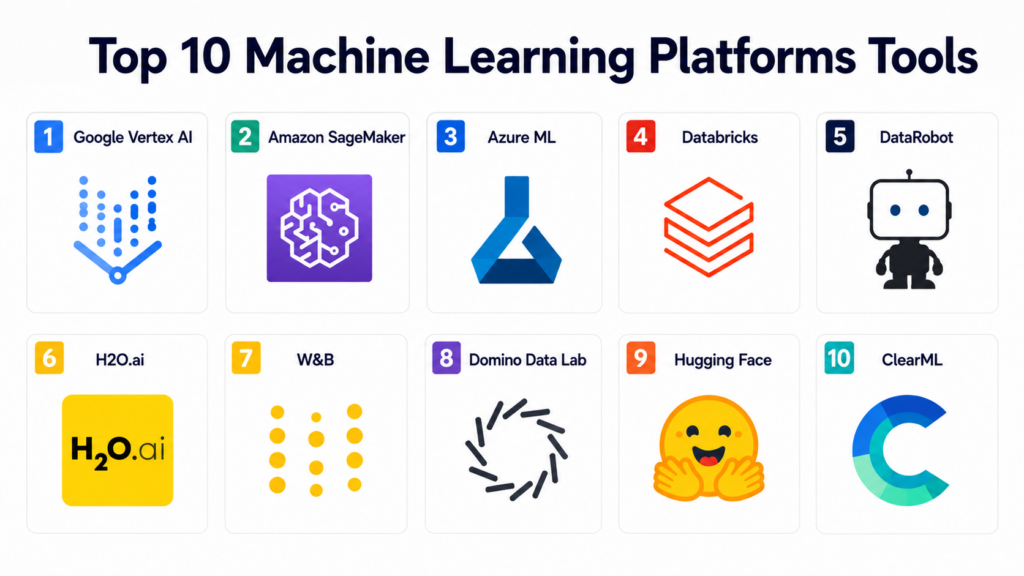
Introduction
Machine Learning (ML) Platforms are integrated environments that provide the necessary tools, infrastructure, and workflows to build, train, deploy, and manage machine learning models. In plain English, these platforms are the digital factories where raw data is transformed into intelligent algorithms capable of making predictions, recognizing patterns, or generating content. Instead of a data scientist having to manually configure servers, install libraries, and manage version control for every project, a platform centralizes these tasks into a single workspace. This allows teams to focus on the logic of their models rather than the plumbing of the infrastructure.
In the current technological landscape, these platforms have become the backbone of enterprise intelligence. As organizations move away from simple experimental projects toward production-grade Artificial Intelligence, the need for a stable, scalable, and secure environment is paramount. These platforms solve the “it works on my laptop” problem by ensuring that a model developed in a laboratory environment can handle millions of real-world requests without failing. They provide the computational power—often utilizing specialized hardware like GPUs—required to process the massive datasets that define modern AI.
Real-world use cases:
- Predictive Maintenance in Manufacturing: Analyzing sensor data from factory equipment to predict mechanical failures before they happen, saving millions in downtime.
- Fraud Detection in Banking: Processing millions of transactions in real-time to identify and block suspicious activity before a payment is finalized.
- Personalized Healthcare: Assisting doctors by analyzing medical imaging or genomic data to suggest tailored treatment plans for patients.
- Supply Chain Demand Forecasting: Using historical sales data and external factors like weather to optimize inventory levels across global warehouses.
Buyer evaluation criteria:
- End-to-End Workflow: Whether the platform covers everything from data preparation and labeling to model deployment and monitoring.
- Scalability: The ability to handle massive training jobs across hundreds or thousands of compute nodes.
- Infrastructure Flexibility: Support for various hardware types, including specific GPUs, and the ability to run on-premise or in the cloud.
- Framework Compatibility: Support for standard libraries such as PyTorch, TensorFlow, and Scikit-learn.
- AutoML Capabilities: Tools that help non-experts build high-quality models by automatically testing different algorithms.
- Model Governance: Features for tracking model versions, audit logs, and ensuring compliance with data privacy laws.
- Collaboration Tools: Shared notebooks and project management features that allow distributed teams to work together.
- Cost Management: Granular visibility into spending, with the ability to set budgets and automatically shut down idle resources.
Best for: Data scientists, machine learning engineers, and large enterprise IT teams who need to standardize their AI development lifecycle and deploy models into production environments at scale.
Not ideal for: Small businesses with very basic data needs that can be solved with standard spreadsheets, or individual hobbyists who do not require the massive computational power or governance of an enterprise-grade platform.
Key Trends in Machine Learning Platforms
- LLMOps Integration: Platforms are rapidly evolving to include specialized tools for managing Large Language Models, focusing on fine-tuning, prompt engineering, and vector database connectivity.
- Serverless Training Models: A shift toward “zero-infrastructure” training where the platform automatically handles all resource provisioning, allowing users to pay only for the exact seconds of computation used.
- Ethical AI and Bias Detection: Built-in toolkits that automatically scan datasets and models for bias, helping organizations meet new global standards for responsible AI.
- Edge AI Specialization: New features designed to compress large models so they can run efficiently on mobile devices, sensors, and other low-power hardware at the “edge” of the network.
- Low-Code/No-Code Expansion: The democratization of AI through drag-and-drop interfaces that allow business analysts to create predictive models without writing a single line of Python code.
- Hybrid-Cloud Orchestration: The ability to train models on a private cloud for maximum security and then deploy them to a public cloud for global accessibility and low latency.
- Real-time Feature Stores: Centralized repositories that serve fresh data to models in milliseconds, ensuring that predictions are based on the most current information available.
- Automated Data Labeling: Utilizing “teacher” models to automatically label vast amounts of unstructured data, drastically reducing the time and cost of preparing training sets.
How We Selected These Tools (Methodology)
- Market Adoption: We prioritized platforms that are widely used by the global data science community and have significant enterprise footprints.
- Workflow Integration: Each tool was evaluated on its ability to handle the entire machine learning lifecycle from start to finish.
- Performance Benchmarks: We looked for platforms that consistently deliver high-speed training and low-latency inference under heavy workloads.
- Security Posture: Preference was given to tools that offer enterprise-grade encryption, role-based access control, and industry-standard compliance certifications.
- Developer Experience: We assessed the quality of the documentation, the intuitiveness of the interface, and the strength of the API/SDK ecosystem.
- Innovation Velocity: We focused on vendors that are leading the charge in Generative AI, MLOps, and automated model management.
Top 10 Machine Learning Platforms Tools
1 — Google Vertex AI
Short description:
Google Vertex AI is a unified machine learning platform that allows users to build, deploy, and scale AI models using the same infrastructure that powers Google’s own search and YouTube services. It is designed to bring together all of Google Cloud’s ML services into a single environment, offering a seamless experience for both developers and data scientists. The platform is particularly noted for its strength in handling Large Language Models and its native support for specialized hardware like TPUs.
Key Features
- Model Garden: A centralized library where users can discover and deploy a wide variety of first-party and open-source models.
- AutoML: High-performance automated modeling for vision, text, and tabular data that requires minimal coding.
- Vertex AI Search and Conversation: Specialized tools for building generative AI applications like chatbots and custom search engines.
- Custom Training: Advanced support for distributed training using Google’s proprietary Tensor Processing Units (TPUs).
- Managed Pipelines: Tools to automate and monitor ML workflows, ensuring reproducibility and reliability in production.
Pros
- Unrivaled access to Google’s latest foundation models and high-performance hardware.
- Deep integration with BigQuery, allowing users to build models directly on their data warehouse.
Cons
- Can be complex to navigate for teams not already familiar with the Google Cloud ecosystem.
- Pricing for specialized hardware can be high if not closely monitored by administrators.
Platforms / Deployment
- Web / API / CLI
- Cloud (GCP)
Security & Compliance
- SSO/SAML, MFA, VPC Service Controls, Encryption at rest and in transit.
- SOC 2, ISO 27001, HIPAA, FedRAMP.
Integrations & Ecosystem
Vertex AI is the heart of the Google Cloud data stack, connecting seamlessly with almost every other GCP service.
- BigQuery for data storage and SQL-based ML.
- Google Cloud Storage for datasets.
- Looker for visualizing model outputs and predictions.
Support & Community
Professional support is available through Google Cloud’s standard and premium tiers. The platform is supported by a massive global community and extensive technical documentation.
2 — Amazon SageMaker
Short description:
Amazon SageMaker is a fully managed service that provides every developer and data scientist with the ability to build, train, and deploy machine learning models quickly. It removes the heavy lifting from each step of the machine learning process to make it easier to develop high-quality models. It is widely considered the most feature-complete platform on the market, offering specialized tools for every niche of the ML lifecycle.
Key Features
- SageMaker Studio: A web-based visual interface that serves as a complete IDE for machine learning development.
- Data Wrangler: A tool that simplifies the process of data preparation and feature engineering with over 300 built-in transformations.
- Autopilot: Automatically builds, trains, and tunes the best machine learning models based on your data.
- Clarify: Provides developers with visibility into their training data and models so they can identify and limit bias.
- JumpStart: A hub for pre-built solutions and one-click deployment of popular open-source models.
Pros
- The most extensive set of specialized MLOps tools available in a single environment.
- Exceptional scaling capabilities and a wide variety of instance types to choose from.
Cons
- The sheer number of features can lead to a steep learning curve for new users.
- Management of “always-on” resources is required to avoid unexpected monthly costs.
Platforms / Deployment
- Web / Windows / macOS / Linux
- Cloud (AWS)
Security & Compliance
- IAM roles, VPC isolation, KMS encryption, Multi-factor authentication.
- SOC 2, ISO 27001, HIPAA, PCI-DSS, FedRAMP.
Integrations & Ecosystem
SageMaker is deeply integrated into the Amazon Web Services ecosystem, making it a natural choice for AWS users.
- Amazon S3 for data storage.
- AWS Glue for data integration and cataloging.
- Amazon Redshift for analytical data querying.
Support & Community
AWS offers multiple tiers of enterprise support with strict SLAs. There is a vast community of AWS-certified professionals and third-party consultants available.
3 — Azure Machine Learning
Short description:
Azure Machine Learning is Microsoft’s enterprise-grade service for the end-to-end machine learning lifecycle. It is designed to help data scientists and engineers build, deploy, and manage models with a focus on high security and responsible AI. The platform is especially powerful for organizations that are already deeply invested in the Microsoft software stack, providing a familiar and integrated experience.
Key Features
- Azure AI Foundry: A unified portal for building AI solutions that simplifies the management of various AI models.
- Prompt Flow: A development tool designed to streamline the entire development cycle of AI applications powered by LLMs.
- Designer: A drag-and-drop interface for building and deploying machine learning models without writing code.
- Automated ML: Identifies the best algorithms and hyperparameters for your data automatically.
- Responsible AI Dashboard: A centralized tool to assess model fairness, explainability, and error analysis.
Pros
- Industry-leading focus on security, compliance, and governance features.
- Native integration with Azure DevOps, making it easy to implement robust CI/CD for AI.
Cons
- The user interface can sometimes feel fragmented across different Azure portals.
- Some advanced features may require a deep understanding of the Azure networking environment.
Platforms / Deployment
- Web / Windows / macOS / Linux
- Cloud (Azure)
Security & Compliance
- Entra ID integration, RBAC, Data masking, VNET support.
- SOC 2, ISO 27001, HIPAA, GDPR, FedRAMP High.
Integrations & Ecosystem
Azure Machine Learning serves as a core component of the Microsoft Cloud.
- Power BI for data visualization and reporting.
- Azure Synapse for big data analytics.
- Microsoft 365 and Teams for collaborative workflows.
Support & Community
Microsoft provides 24/7 enterprise support. The community is large, particularly within corporate IT sectors, and offers extensive training resources.
4 — Databricks (Mosaic AI)
Short description:
Databricks provides a unified platform for data and AI built on top of the open-source Apache Spark framework. Through its Mosaic AI suite, it offers a specialized environment for building and deploying machine learning models at massive scale. It is the platform of choice for organizations that need to process petabytes of data before feeding it into their machine learning pipelines, emphasizing the “Lakehouse” architecture.
Key Features
- Unity Catalog: A unified governance layer for all data and AI assets across the entire organization.
- MLflow Integration: Built-in support for the industry-standard tool for experiment tracking and model versioning.
- Mosaic AI Model Serving: A serverless environment for deploying models with high availability and low latency.
- Delta Lake: A storage layer that brings reliability and performance to data lakes used for machine learning.
- Collaborative Notebooks: Shared workspaces that allow multiple users to write and execute code in real-time.
Pros
- Unrivaled performance for data-heavy machine learning and engineering tasks.
- Strong commitment to open-source standards, reducing the risk of vendor lock-in.
Cons
- The pricing model can be complex and expensive for smaller organizations.
- Advanced configuration often requires deep expertise in Spark and distributed computing.
Platforms / Deployment
- Web
- Cloud (AWS, Azure, GCP)
Security & Compliance
- SSO/SAML, MFA, Fine-grained access control, Encryption.
- SOC 2, ISO 27001, HIPAA, GDPR.
Integrations & Ecosystem
Databricks is highly flexible and integrates with a wide variety of modern data tools.
- Spark and Delta Lake for data processing.
- dbt for data transformations.
- Tableau and Power BI for analytical reporting.
Support & Community
Databricks offers premium enterprise support. It has a very active community centered around the Spark and MLflow open-source projects.
5 — DataRobot
Short description:
DataRobot is an enterprise AI platform that focuses on accelerating the time-to-value for machine learning projects. It is a pioneer in the AutoML space, designed to help business analysts and data scientists alike build and deploy highly accurate models with minimal manual effort. It emphasizes “Value-Driven AI,” providing tools that connect technical model metrics to actual business outcomes.
Key Features
- Automated Machine Learning: Rapidly discovers and tunes the best models for any given dataset.
- MLOps Hub: A centralized dashboard for monitoring model health, accuracy, and drift in real-time.
- AI App Builder: Allows users to create custom applications based on their models without writing code.
- Governance Workflows: Built-in review and approval processes to ensure models meet corporate standards.
- Time Series Pro: Specialized tools for high-accuracy forecasting in complex business environments.
Pros
- Extremely fast deployment times for organizations with limited data science staff.
- Strong focus on the business impact and explainability of every prediction.
Cons
- Less flexibility for researchers who want to write custom low-level training code.
- Cost can be significantly higher than basic cloud-native services for small teams.
Platforms / Deployment
- Web
- Cloud / Self-hosted / Hybrid
Security & Compliance
- SSO, RBAC, Encryption-at-rest and in-transit.
- SOC 2, ISO 27001, HIPAA.
Integrations & Ecosystem
DataRobot is designed to sit on top of existing data warehouses.
- Snowflake and BigQuery for data ingestion.
- Salesforce for operationalizing predictions.
- Tableau for visualization.
Support & Community
DataRobot provides high-touch customer success and technical support. It has a growing community of business-focused AI professionals.
6 — H2O.ai
Short description:
H2O.ai is a leading open-source machine learning platform known for its high-performance distributed algorithms. Its flagship product, Driverless AI, uses automation to accomplish many of the most difficult tasks in data science, such as feature engineering and model tuning. It is highly respected in the financial and insurance sectors for its ability to produce accurate, explainable models on structured data.
Key Features
- Driverless AI: An automated machine learning platform that mimics a master data scientist’s workflow.
- H2O Wave: A low-code framework for building real-time AI applications with Python.
- H2O-3: The core open-source distributed machine learning engine.
- Hydrogen Torch: A specialized tool for fine-tuning deep learning models for vision and text.
- MLOps Integration: Tools to deploy and monitor models across diverse infrastructure.
Pros
- Exceptional performance for large-scale tabular and structured datasets.
- Strongest “Explainable AI” features, providing detailed reports on how models work.
Cons
- The enterprise version is a significant investment compared to the open-source core.
- The learning curve for the advanced automation features can be steep for beginners.
Platforms / Deployment
- Web / Windows / macOS / Linux
- Cloud / Self-hosted / Hybrid
Security & Compliance
- LDAP/Active Directory, Encryption, RBAC.
- Varies / Not publicly stated for all versions.
Integrations & Ecosystem
H2O.ai integrates well with the broader data science stack.
- Python and R for development.
- Spark via the Sparkling Water integration.
- Snowflake and Databricks for data.
Support & Community
H2O.ai has a vibrant open-source community. Enterprise customers receive dedicated support and professional services.
7 — Weights & Biases
Short description:
Weights & Biases (W&B) is a developer-first platform designed to help machine learning teams track their experiments, version their data, and collaborate more effectively. Unlike many platforms that provide compute, W&B is the “system of record” that sits on top of your existing training code. It has become the industry standard for researchers and engineers working on the cutting edge of AI and LLMs.
Key Features
- Experiment Tracking: Automatically logs every detail of a training run, from loss curves to system metrics.
- Artifacts: A dataset and model versioning system that ensures every experiment is reproducible.
- Sweeps: A tool for automated hyperparameter optimization that runs across any infrastructure.
- Reports: Collaborative dashboards that allow teams to share their research and findings visually.
- Model Registry: A centralized hub for managing the transition of models from research to production.
Pros
- Extremely lightweight and works with almost any Python-based ML code.
- The most elegant and useful visualization tools in the entire machine learning market.
Cons
- Does not provide the actual GPUs or CPUs; you must have your own compute power.
- Can become a significant cost for large teams as the number of users grows.
Platforms / Deployment
- Web / API / CLI
- Cloud / Self-hosted (Private Instance)
Security & Compliance
- SSO, MFA, Encryption-at-rest.
- SOC 2 Type II.
Integrations & Ecosystem
W&B is the most connected tool in the AI research space.
- PyTorch, TensorFlow, and Hugging Face.
- AWS, GCP, and Azure for compute.
- Kubernetes and Docker for orchestration.
Support & Community
Weights & Biases has a massive community of AI researchers and developers. They offer high-quality technical support via Slack and email.
8 — Domino Data Lab
Short description:
Domino Data Lab is an enterprise-grade platform designed for organizations that require the highest levels of governance, reproducibility, and security. It centralizes data science work into a unified environment, making it easy for teams to collaborate while ensuring that every piece of research is auditable. It is particularly popular in the pharmaceutical, insurance, and financial services industries.
Key Features
- Reproducibility Engine: Automatically captures the code, data, and environment for every single run.
- Managed Environments: Allows data scientists to access Jupyter, RStudio, or VS Code with one click.
- Model Sentry: A governance framework that manages the review and approval process for all models.
- Hybrid/Multi-Cloud Orchestration: Allows workloads to run seamlessly on any cloud or on-premise hardware.
- Knowledge Center: A searchable repository of all past research and projects within the organization.
Pros
- Unmatched for long-term auditability and reproducibility of scientific research.
- Excellent for managing diverse teams using different languages (R, Python, SAS).
Cons
- The infrastructure requirements for a self-hosted installation are significant.
- The user interface focuses more on governance than on “nimble” developer features.
Platforms / Deployment
- Web
- Cloud / Self-hosted / Hybrid
Security & Compliance
- SSO, MFA, RBAC, Support for air-gapped environments.
- SOC 2, ISO 27001, HIPAA, GDPR.
Integrations & Ecosystem
Domino is built for the enterprise IT landscape.
- Snowflake, Oracle, and Teradata for data.
- GitHub, GitLab, and Bitbucket for code.
- SAS and MATLAB support.
Support & Community
Domino provides professional enterprise support and a dedicated customer success model. The community is highly specialized in regulated industries.
9 — Hugging Face (Enterprise Hub)
Short description:
Hugging Face is the central hub of the modern AI revolution, often called the “GitHub of Machine Learning.” While it is famous for its open-source libraries, the Enterprise Hub provides companies with a secure, private environment to host models, datasets, and apps. It is the primary platform for teams working with Transformers, Large Language Models, and Generative AI.
Key Features
- Private Model Hub: A secure repository for your organization’s internal machine learning models.
- Inference Endpoints: A managed service for deploying models into production with high availability.
- Spaces: A platform for hosting and sharing machine learning demo applications.
- AutoTrain: A no-code environment for fine-tuning models on your own data.
- Dataset Hub: Secure hosting and versioning for massive amounts of training data.
Pros
- The most direct access to the world’s largest collection of pre-trained AI models.
- Incredible ease of use for moving from an experimental demo to a production API.
Cons
- Less focused on traditional “tabular” business data compared to deep learning.
- Governance features are still catching up to long-established players like SageMaker.
Platforms / Deployment
- Web / API / CLI
- Cloud (Hugging Face Cloud)
Security & Compliance
- SSO/SAML, Private Hub instances, Encryption.
- SOC 2 Type II.
Integrations & Ecosystem
Hugging Face is integrated into almost every part of the modern AI stack.
- Native support in PyTorch and TensorFlow.
- Integrations with SageMaker and Azure for training.
- Weights & Biases for experiment tracking.
Support & Community
Hugging Face has the largest community in the machine learning world. Enterprise Hub customers receive dedicated “Expert Support” directly from their team.
10 — ClearML
Short description:
ClearML is an open-source, end-to-end MLOps platform that emphasizes ease of use and flexibility. It provides experiment tracking, orchestration, data management, and model serving in a single package. It is designed for engineering-heavy teams that want to build a powerful machine learning environment without being tied to a single cloud provider’s proprietary tools.
Key Features
- Experiment Manager: Automatically tracks everything from code and git diffs to logs and metrics.
- Orchestrator: A tool that allows you to turn any machine with a GPU into a managed worker node.
- Data Management: Version-controlled data management that works with any cloud or local storage.
- Model Serving: A scalable environment for deploying and managing inference endpoints.
- Hyperparameter Optimization: Built-in tools for automated model tuning and search.
Pros
- Extremely easy to set up and start using with existing Python code.
- The open-source version is incredibly powerful and feature-rich for small teams.
Cons
- The user interface is functional but lacks the polish of high-end enterprise competitors.
- Support for “citizen” data scientists is limited compared to DataRobot.
Platforms / Deployment
- Web / API / CLI
- Cloud / Self-hosted / Hybrid
Security & Compliance
- RBAC, SSO (Enterprise version), Encryption.
- Varies / Not publicly stated.
Integrations & Ecosystem
ClearML is built for the modern DevOps and engineering landscape.
- Kubernetes and Slurm for orchestration.
- S3, GCS, and Azure Blob Storage for data.
- Standard ML libraries like PyTorch and Scikit-learn.
Support & Community
ClearML has an active Slack community and a strong open-source presence on GitHub. Commercial support is available for the Pro and Enterprise tiers.
Comparison Table (Top 10)
| Tool Name | Best For | Platform(s) Supported | Deployment | Standout Feature | Public Rating |
| 1 — Google Vertex AI | GCP Power Users | Web, API | Cloud | TPU Native Access | N/A |
| 2 — Amazon SageMaker | AWS Enterprises | Web, Win, Mac | Cloud | Studio IDE Suite | N/A |
| 3 — Azure ML | Microsoft Shops | Web, Win, Mac | Cloud | Prompt Flow & Responsible AI | N/A |
| 4 — Databricks | High-Volume Data | Web | Cloud | Unity Catalog Governance | 4.5/5 |
| 5 — DataRobot | Fast Business Value | Web | Hybrid | AutoML Automation | 4.6/5 |
| 6 — H2O.ai | Tabular/Financial Data | Web, Linux | Hybrid | Explainable AI Reports | 4.5/5 |
| 7 — W&B | Research & Tracking | Web, API | Hybrid | Visual Experiment Logging | 4.8/5 |
| 8 — Domino Data Lab | Regulated Research | Web | Hybrid | Reproducibility Engine | 4.4/5 |
| 9 — Hugging Face | Generative AI & LLMs | Web, API | Cloud | Model & App Hub | N/A |
| 10 — ClearML | Engineering Agility | Web, API | Hybrid | Resource Orchestrator | 4.7/5 |
Evaluation & Scoring of Machine Learning Platforms
| Tool Name | Core (25%) | Ease (15%) | Integrations (15%) | Security (10%) | Performance (10%) | Support (10%) | Value (15%) | Weighted Total |
| Vertex AI | 10 | 6 | 9 | 10 | 10 | 9 | 8 | 8.85 |
| SageMaker | 10 | 5 | 10 | 10 | 10 | 9 | 7 | 8.70 |
| Azure ML | 9 | 7 | 10 | 10 | 9 | 9 | 8 | 8.75 |
| Databricks | 9 | 6 | 9 | 9 | 10 | 8 | 7 | 8.25 |
| DataRobot | 8 | 9 | 8 | 8 | 8 | 8 | 6 | 7.75 |
| H2O.ai | 8 | 7 | 8 | 8 | 9 | 7 | 8 | 7.70 |
| W&B | 7 | 10 | 10 | 9 | 8 | 9 | 8 | 8.45 |
| Domino | 8 | 6 | 7 | 10 | 8 | 9 | 7 | 7.75 |
| Hugging Face | 9 | 9 | 9 | 8 | 9 | 9 | 9 | 8.90 |
| ClearML | 8 | 8 | 8 | 7 | 8 | 7 | 10 | 8.05 |
Interpretation:
The weighted total reflects a balance between feature depth, accessibility, and ROI. A score above 8.5 indicates a market leader with comprehensive capabilities. Scores between 7.5 and 8.4 denote specialized tools that are exceptional in specific scenarios—such as research tracking or engineering—but may not offer a complete “all-in-one” environment for every enterprise role.
Which Machine Learning Platforms Tool Is Right for You?
Solo / Freelancer
If you are working alone, you want a tool that is easy to set up and cost-effective. Hugging Face is the clear winner for accessing pre-trained models quickly. Pairing it with Weights & Biases for experiment tracking (which has a generous free tier for individuals) provides a world-class setup without the need for an enterprise budget.
SMB
Small to medium businesses should look for automation to save on expensive data science headcount. DataRobot is ideal for getting high-quality models into production quickly. If your team is more technically inclined and wants to save on software costs, ClearML provides an incredible amount of power in its open-source version.
Mid-Market
For companies that have a growing data team and need to start standardizing their processes, Databricks or H2O.ai are excellent choices. These platforms provide the necessary scale for large datasets while offering the collaborative features needed as teams expand beyond a few individuals.
Enterprise
Large corporations with strict security requirements and established cloud relationships should choose the platform native to their cloud: Vertex AI for Google users, SageMaker for AWS shops, and Azure Machine Learning for Microsoft environments. If you operate in a highly regulated industry like Pharmaceuticals, Domino Data Lab is a strong contender for its focus on reproducibility.
Budget vs Premium
- Budget: ClearML and the open-source core of H2O.ai provide the most power for the lowest software cost.
- Premium: DataRobot and Snowflake (Cortex) offer “white-glove” automated experiences that are more expensive but can significantly reduce the time-to-market.
Feature Depth vs Ease of Use
If you need the deepest possible technical control, SageMaker or Apache Spark on Databricks are the best choices. If you prioritize “Ease of Use” so that your team can focus on results rather than infrastructure, Hugging Face and DataRobot lead the market.
Integrations & Scalability
Vertex AI and Databricks offer the most robust integrations with modern data lakes and warehouses. For pure scalability in terms of raw compute power, the major cloud providers (AWS, GCP, Azure) are unrivaled due to their vast global data centers.
Security & Compliance Needs
For organizations where security is the #1 priority, Azure Machine Learning and Domino Data Lab provide the most detailed governance dashboards, audit trails, and compliance certifications currently available.
Frequently Asked Questions (FAQs)
1. What is the main difference between an ML platform and a data science notebook?
A data science notebook (like Jupyter) is a tool for writing and executing code locally or on a single server. A Machine Learning Platform is a complete environment that manages the infrastructure, data versioning, model deployment, and monitoring. While notebooks are used within a platform, the platform provides the “glue” that turns that code into a production-ready application.
2. Do I need specialized GPUs to use these platforms?
While you can train simple models on standard CPUs, most modern machine learning—especially deep learning and Large Language Models—requires GPUs (Graphics Processing Units). Most of these platforms provide managed access to powerful GPUs like the NVIDIA H100, allowing you to pay for them by the second rather than buying them yourself.
3. What is MLOps and why is it part of an ML platform?
MLOps is a set of practices designed to deploy and maintain machine learning models in production reliably. It includes features like experiment tracking, model monitoring, and automated retraining. Platforms include these features to ensure that once a model is built, it continues to perform accurately over time as the real-world data changes.
4. How long does it take to set up an enterprise machine learning platform?
Cloud-native services like Vertex AI or SageMaker can be activated instantly. However, configuring the security, data connectors, and team workflows typically takes several weeks of coordination between data science and IT teams. On-premise or hybrid installations (like Domino or H2O) may take longer due to hardware provisioning.
5. Can I use these platforms for Generative AI and LLMs?
Yes, almost every platform on this list has added specific features for Generative AI. This includes “Model Gardens” for selecting pre-trained models, tools for fine-tuning models like Llama or Mistral on your own data, and “Vector Database” integrations for building search-based AI applications.
6. Is my data safe when using a cloud-based ML platform?
Major providers use enterprise-grade encryption and offer Virtual Private Cloud (VPC) isolation to ensure your data is never exposed. However, you should always check the vendor’s policy on whether they use your data to train their own internal models. Most enterprise versions of these platforms include a “Zero Data Retention” guarantee.
7. Can an ML platform replace the need for a data scientist?
While “AutoML” features can handle many technical tasks like picking algorithms and tuning parameters, you still need a data scientist or analyst to understand the business problem, ensure the data is high-quality, and interpret the results to ensure the model is ethical and unbiased.
8. What is the total cost of ownership for these platforms?
The total cost includes the software license (if applicable), the cost of the compute (GPUs/CPUs), storage costs for datasets, and the human cost of managing the platform. It is common for mid-sized teams to spend anywhere from $2,000 to $15,000 per month, depending on how many models they are training and serving.
9. What is “model drift” and how do platforms handle it?
Model drift occurs when the accuracy of a model decreases because the real-world data it is seeing has changed since it was trained. Most platforms include monitoring tools that send alerts when accuracy drops below a certain threshold, and some can even trigger an automatic retraining process to fix the issue.
10. Is it better to build an internal platform or buy a commercial one?
Building your own platform using open-source tools (like Kubernetes and MLflow) offers maximum flexibility and lower software costs but requires a highly skilled “Platform Engineering” team to maintain. Buying a commercial platform allows your data science team to start producing results immediately without worrying about the underlying infrastructure.
Conclusion
The selection of a machine learning platform is one of the most critical decisions an organization will make in its journey toward AI maturity. For those deeply embedded in the major cloud ecosystems, the native tools provided by Google, Amazon, and Microsoft offer an unparalleled level of integration and security. However, the rise of developer-focused tools like Weights & Biases and the open-source community surrounding Hugging Face demonstrates that flexibility and community support are equally vital in a rapidly changing market.
Ultimately, the best platform is the one that removes the most friction between a data scientist’s idea and a production-ready model. Whether you prioritize the extreme automation of DataRobot, the research-grade visualization of W&B, or the massive data-processing power of Databricks, the goal remains the same: transforming raw information into actionable intelligence. As a next step, we recommend identifying your primary data source and testing the integration of two platforms from this list that best align with your existing IT infrastructure.

I like how clearly this topic is explained.