MOTOSHARE 🚗🏍️
Rent Bikes & Cars Directly from Owners
Motoshare connects vehicle owners with people who need bikes and cars on rent. Owners earn from idle vehicles, and renters get flexible ride options.
Visit Motoshare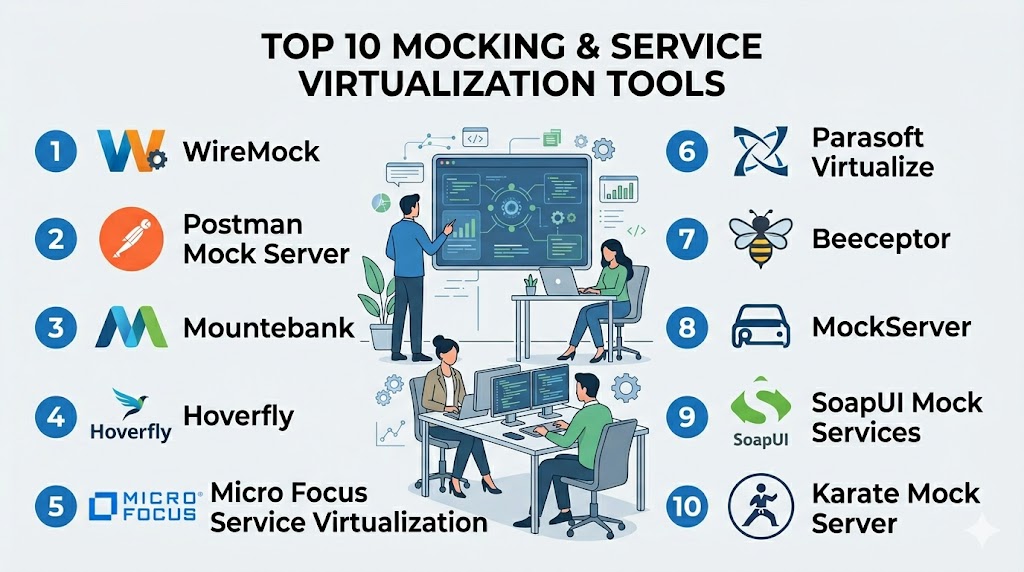
Introduction
Mocking & Service Virtualization Tools help developers and QA teams simulate APIs, services, and external dependencies during development and testing. Instead of relying on real systems—which may be unavailable, slow, costly, or unstable—these tools create controlled virtual environments that mimic real-world behavior.
In modern software development, especially with microservices, distributed systems, and API-first architectures, these tools are no longer optional. They enable faster development cycles, parallel testing, and reduced dependency bottlenecks. As organizations move toward continuous delivery and DevOps practices, service virtualization becomes critical for maintaining speed without compromising quality.
Common use cases include:
- API testing without backend availability
- Simulating third-party services (payment gateways, APIs)
- Performance and load testing environments
- CI/CD pipeline automation testing
- Early-stage frontend development
What buyers should evaluate:
- Protocol support (REST, SOAP, GraphQL, gRPC)
- Ease of setup and usability
- Scalability and performance simulation
- Integration with CI/CD tools
- Security and compliance features
- Cloud vs on-prem deployment flexibility
- Cost structure and licensing model
- Team collaboration capabilities
Best for: Developers, QA engineers, DevOps teams, and enterprises building API-driven or microservices-based applications.
Not ideal for: Small projects with minimal external dependencies or teams that rely solely on live environments for testing.
Key Trends in Mocking & Service Virtualization Tools and Beyond
- AI-driven simulation: Tools increasingly auto-generate mocks from API schemas and usage patterns.
- Shift-left testing adoption: Teams integrate virtualization earlier in development pipelines.
- Cloud-native virtualization: SaaS-based platforms dominate with scalable mock environments.
- API-first development: Tight integration with OpenAPI, GraphQL, and contract testing tools.
- Security-focused simulation: Masking sensitive data and compliance-ready environments.
- Self-service testing environments: Developers can spin up mocks without DevOps dependency.
- Performance simulation at scale: Realistic latency and failure condition modeling.
- Integration with CI/CD pipelines: Native support for GitHub Actions, Jenkins, GitLab.
- Low-code/no-code mock creation: Simplified UI-based mock building for non-developers.
How We Selected These Tools (Methodology)
- Evaluated market adoption and industry recognition
- Assessed feature completeness across mocking and virtualization
- Considered developer experience and usability
- Reviewed performance and scalability capabilities
- Checked security posture and enterprise readiness
- Analyzed integration ecosystem and extensibility
- Included tools suitable for SMB to enterprise use cases
- Balanced open-source and commercial offerings
Top 10 Mocking & Service Virtualization Tools
#1 — WireMock
Short description: A popular open-source tool for mocking HTTP-based APIs, widely used by developers and testers.
Key Features
- REST API mocking and stubbing
- Record and playback functionality
- JSON-based configuration
- Fault injection and latency simulation
- Docker support
- Extensible with plugins
Pros
- Highly flexible and developer-friendly
- Strong community support
Cons
- Limited UI (primarily code-driven)
- Setup complexity for beginners
Platforms / Deployment
Cloud / Self-hosted
Security & Compliance
Not publicly stated
Integrations & Ecosystem
Integrates with CI/CD pipelines and testing frameworks.
- Jenkins
- Docker
- REST clients
- Test frameworks
Support & Community
Strong open-source community with extensive documentation.
#2 — Postman Mock Server
Short description: Built into Postman, it allows easy creation of mock APIs for testing and collaboration.
Key Features
- Mock servers from collections
- API schema support
- Collaboration tools
- Cloud-based hosting
- Request matching rules
Pros
- Very easy to use
- Integrated with API development workflow
Cons
- Limited advanced simulation
- Not ideal for complex enterprise scenarios
Platforms / Deployment
Cloud
Security & Compliance
SSO, RBAC (varies by plan)
Integrations & Ecosystem
Part of Postman ecosystem.
- API testing tools
- CI/CD pipelines
- API documentation
Support & Community
Large user base and strong documentation.
#3 — Mountebank
Short description: Open-source service virtualization tool supporting multiple protocols.
Key Features
- Multi-protocol support (HTTP, TCP)
- Configurable stubs
- Fault injection
- CLI and API control
- Lightweight architecture
Pros
- Protocol flexibility
- Open-source and extensible
Cons
- Minimal UI
- Requires technical setup
Platforms / Deployment
Self-hosted
Security & Compliance
Not publicly stated
Integrations & Ecosystem
Works with testing frameworks.
- Node.js ecosystem
- CI/CD tools
- REST clients
Support & Community
Moderate community support.
#4 — Hoverfly
Short description: API simulation tool focused on performance testing and service virtualization.
Key Features
- HTTP simulation
- Capture and replay traffic
- Middleware support
- Lightweight deployment
- Performance testing capabilities
Pros
- Fast and efficient
- Good for performance scenarios
Cons
- Limited enterprise features
- UI limitations
Platforms / Deployment
Self-hosted
Security & Compliance
Not publicly stated
Integrations & Ecosystem
- CI/CD pipelines
- Docker
- REST tools
Support & Community
Active open-source community.
#5 — Micro Focus Service Virtualization
Short description: Enterprise-grade service virtualization platform for complex environments.
Key Features
- Broad protocol support
- Enterprise integrations
- Performance simulation
- Test automation support
- Centralized management
Pros
- Enterprise-ready
- Highly scalable
Cons
- Expensive
- Complex setup
Platforms / Deployment
Cloud / On-prem
Security & Compliance
Enterprise-grade controls (details vary)
Integrations & Ecosystem
- ALM tools
- CI/CD systems
- Enterprise apps
Support & Community
Enterprise support with professional services.
#6 — Parasoft Virtualize
Short description: Advanced service virtualization tool focused on testing and DevOps integration.
Key Features
- API simulation
- Data modeling
- Performance testing
- Continuous testing integration
- Service orchestration
Pros
- Strong enterprise capabilities
- Excellent test automation support
Cons
- Learning curve
- Cost considerations
Platforms / Deployment
Cloud / On-prem
Security & Compliance
RBAC, enterprise security features
Integrations & Ecosystem
- CI/CD tools
- Test automation frameworks
- DevOps pipelines
Support & Community
Strong enterprise support.
#7 — Beeceptor
Short description: Lightweight API mocking tool for quick endpoint testing.
Key Features
- Instant mock endpoints
- Request inspection
- Custom rules
- No setup required
- Cloud-based
Pros
- Very simple to use
- Quick setup
Cons
- Limited advanced features
- Not for large-scale testing
Platforms / Deployment
Cloud
Security & Compliance
Not publicly stated
Integrations & Ecosystem
- REST tools
- API testing tools
Support & Community
Basic support, growing community.
#8 — MockServer
Short description: Developer-focused tool for mocking HTTP and HTTPS services.
Key Features
- HTTP/HTTPS mocking
- Proxy and record
- Verification support
- Flexible configuration
- Docker support
Pros
- Highly configurable
- Good for automation
Cons
- Steep learning curve
- Limited UI
Platforms / Deployment
Self-hosted
Security & Compliance
Not publicly stated
Integrations & Ecosystem
- CI/CD tools
- Java ecosystem
- Test frameworks
Support & Community
Active developer community.
#9 — SoapUI Mock Services
Short description: Mocking feature within SoapUI for API testing.
Key Features
- SOAP and REST mocking
- Data-driven testing
- GUI-based setup
- API validation
- Integration with test suites
Pros
- Easy GUI
- Good for API testers
Cons
- Limited scalability
- UI can feel outdated
Platforms / Deployment
Windows / macOS / Linux
Security & Compliance
Not publicly stated
Integrations & Ecosystem
- API testing tools
- CI/CD integration
Support & Community
Strong legacy user base.
#10 — Karate Mock Server
Short description: Part of Karate DSL, enabling API mocking alongside testing.
Key Features
- API mocking with DSL
- Integration with test automation
- Lightweight
- Supports REST APIs
- Easy scripting
Pros
- Developer-friendly
- Unified testing + mocking
Cons
- Limited enterprise features
- Requires scripting knowledge
Platforms / Deployment
Self-hosted
Security & Compliance
Not publicly stated
Integrations & Ecosystem
- CI/CD tools
- Test frameworks
Support & Community
Growing open-source community.
Comparison Table (Top 10)
| Tool Name | Best For | Platform(s) Supported | Deployment | Standout Feature | Public Rating |
|---|---|---|---|---|---|
| WireMock | Developers | Cross-platform | Hybrid | Flexible API mocking | N/A |
| Postman Mock Server | API teams | Web | Cloud | Easy mock creation | N/A |
| Mountebank | Dev teams | Cross-platform | Self-hosted | Multi-protocol support | N/A |
| Hoverfly | Performance testing | Cross-platform | Self-hosted | Traffic replay | N/A |
| Micro Focus SV | Enterprises | Cross-platform | Hybrid | Enterprise virtualization | N/A |
| Parasoft Virtualize | QA teams | Cross-platform | Hybrid | Continuous testing | N/A |
| Beeceptor | Quick testing | Web | Cloud | Instant endpoints | N/A |
| MockServer | Developers | Cross-platform | Self-hosted | Proxy + mocking | N/A |
| SoapUI Mock | API testers | Cross-platform | Self-hosted | GUI-based mocking | N/A |
| Karate Mock | Automation teams | Cross-platform | Self-hosted | DSL-based mocking | N/A |
Evaluation & Scoring of Mocking & Service Virtualization Tools
| Tool Name | Core | Ease | Integrations | Security | Performance | Support | Value | Weighted Total |
|---|---|---|---|---|---|---|---|---|
| WireMock | 9 | 7 | 8 | 6 | 8 | 8 | 9 | 8.1 |
| Postman | 8 | 9 | 9 | 7 | 7 | 9 | 8 | 8.3 |
| Mountebank | 7 | 6 | 7 | 6 | 7 | 6 | 8 | 6.9 |
| Hoverfly | 7 | 7 | 7 | 6 | 8 | 7 | 8 | 7.3 |
| Micro Focus SV | 9 | 6 | 9 | 9 | 9 | 9 | 6 | 8.4 |
| Parasoft | 9 | 7 | 9 | 8 | 9 | 9 | 7 | 8.5 |
| Beeceptor | 6 | 9 | 6 | 5 | 6 | 6 | 9 | 6.9 |
| MockServer | 8 | 6 | 8 | 6 | 8 | 7 | 8 | 7.5 |
| SoapUI | 7 | 8 | 7 | 6 | 7 | 8 | 7 | 7.3 |
| Karate | 7 | 7 | 7 | 6 | 7 | 7 | 8 | 7.2 |
How to interpret scores:
These scores are comparative and based on relative strengths across criteria. Higher scores indicate stronger overall capability but may not reflect your specific needs. Enterprise tools score higher in security and performance, while lightweight tools excel in ease of use and value.
Which Mocking & Service Virtualization Tool Is Right for You?
Solo / Freelancer
- Best: Beeceptor, Postman
- Focus on simplicity and speed
SMB
- Best: WireMock, MockServer
- Balance between features and cost
Mid-Market
- Best: Postman, Karate
- Integration and automation focus
Enterprise
- Best: Parasoft, Micro Focus
- Advanced features and scalability
Budget vs Premium
- Budget: Open-source tools
- Premium: Enterprise platforms
Feature Depth vs Ease of Use
- Simple: Postman, Beeceptor
- Advanced: Parasoft, Micro Focus
Integrations & Scalability
- Choose tools with CI/CD integration and API ecosystem
Security & Compliance Needs
- Enterprises should prioritize tools with RBAC, SSO, audit logs
Frequently Asked Questions (FAQs)
What are mocking tools used for?
They simulate APIs and services so developers can test without real dependencies.
What is service virtualization?
It creates realistic virtual versions of external systems for testing.
Are mocking tools free?
Some are open-source, while enterprise tools are paid.
Can I use these tools in CI/CD?
Yes, most tools integrate with CI/CD pipelines.
Do these tools support REST APIs?
Yes, almost all support REST APIs.
Are they suitable for performance testing?
Some tools support performance simulation.
Do they support security testing?
Limited; specialized tools may be needed.
Can I switch tools easily?
Depends on complexity and integrations.
Are cloud-based tools better?
They are easier to manage but may have limitations.
What are alternatives?
Real environment testing or sandbox APIs.
Conclusion
Mocking & Service Virtualization Tools have become essential for modern development workflows, especially in API-driven and microservices architectures. They help teams reduce dependencies, accelerate testing cycles, and improve overall software quality without waiting on external systems. While lightweight tools are ideal for quick testing and smaller teams, enterprise-grade platforms offer advanced simulation, scalability, and governance capabilities. The right choice depends heavily on your team size, technical requirements, and integration needs. Instead of searching for a single “best” tool, it is more effective to shortlist two or three options that align with your workflow and test them in a real environment. A pilot approach helps validate performance, usability, and integration fit before full adoption.

One challenge I’ve seen teams run into is keeping virtual services aligned with rapidly changing APIs. A mock that’s a few sprints behind can create false confidence in testing, so contract validation and automated synchronization are just as important as the virtualization tool itself.