MOTOSHARE 🚗🏍️
Rent Bikes & Cars Directly from Owners
Motoshare connects vehicle owners with people who need bikes and cars on rent. Owners earn from idle vehicles, and renters get flexible ride options.
Visit Motoshare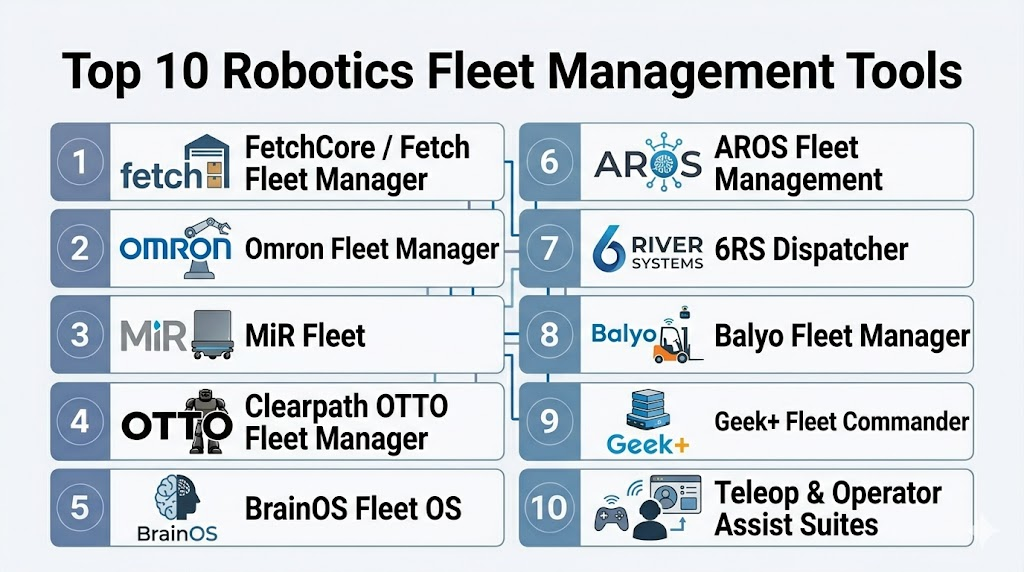
Introduction
Robotics Fleet Management Tools are software platforms that enable organizations to coordinate, monitor, and optimize large groups of robots working together. These systems provide centralized dashboards, real‑time state visibility, task orchestration, performance tracking, analytics, and automation workflows — all designed to ensure safe, efficient, and reliable operation for multi‑robot environments. Whether deployed in warehouses, factories, hospitals, or delivery services, robotic fleets require specialized tools to manage fleets of autonomous mobile robots (AMRs), autonomous guided vehicles (AGVs), drones, or service robots at scale.
With the rise of Industry 4.0, logistics automation, and autonomous applications, robotics fleet management tools have become essential in supervising distributed robot deployments. By providing capabilities such as task allocation, real‑time health monitoring, predictive maintenance, fleet analytics, and integration with business systems (ERP, WMS, MES), fleet managers can reduce downtime, raise utilization rates, and maintain operational safety.
Real‑world use cases include:
- Coordinating warehouse robots for picking, packing, and transport.
- Monitoring healthcare automation fleets in hospitals for deliveries, cleaning, and assistance tasks.
- Managing autonomous delivery robots across urban zones.
- Supervising drones performing inspections or inventory checks.
- Orchestrating multi‑robot teams in manufacturing lines.
Evaluation Criteria for Buyers:
- Scalability for large multi‑robot fleets
- Real‑time tracking and health monitoring
- Task allocation and automated workflows
- Sensor integration, localization, and map sharing
- Analytics and performance dashboards
- Safety controls and geofencing rules
- Integration with business systems (WMS, ERP, IoT)
- Deployment flexibility and connectivity (cloud vs edge)
- Support for heterogeneous robot types
- Security, access control, and compliance
Best for: Robotics operations leaders, automation engineers, fleet managers, logistics and supply‑chain teams, and enterprises deploying fleets of autonomous systems.
Not ideal for: Single robot or small scale robotics experimentation where fleet orchestration is unnecessary.
Key Trends in Robotics Fleet Management Tools
- Cloud and edge hybrid orchestration for responsive, scalable operations
- AI‑driven task planning and predictive maintenance
- Digital twin integration for real‑time simulation and agenda forecasting
- Detailed teleoperation support for remote interventions
- Fleet analytics and business KPI dashboards
- Multi‑vendor robot interoperability using common APIs or middleware
- Real‑time mapping and localization sharing across fleets
- Security features such as RBAC, encryption, and auditing
- Autonomous navigation updates pushed over‑the‑air (OTA)
How We Selected These Tools (Methodology)
- Market presence and adoption in industrial and commercial robotics
- Feature completeness across orchestration, monitoring, and analytics
- Performance and uptime signals in real‑world deployments
- Security posture and enterprise readiness
- Integration versatility with robotics middleware, IoT, business systems
- Scalability for fleets of varying sizes
- Ease of deployment and operational maintenance
- Documentation, support quality, and ecosystem strength
Top 10 Robotics Fleet Management Tools
#1 — FetchCore / Fetch Fleet Manager
Short description:
FetchCore from Fetch Robotics (now part of Zebra Technologies) is a centralized fleet manager for autonomous mobile robots that orchestrates tasks, manages robot health, and integrates with warehouse systems.
Key Features
- Centralized task orchestration for AMRs
- Real‑time fleet monitoring dashboards
- Task templates and automation workflows
- Integration with WMS and ERP systems
- APIs for custom extensions
Pros
- Strong warehouse automation capabilities
- Real‑time visibility and alerts
- Proven in large commercial deployments
Cons
- Focused on Fetch robotic models
- Licensing can be expensive
Platforms / Deployment
- Web, Cloud
Security & Compliance
- Role‑based access control; encryption
Integrations & Ecosystem
- Warehouse systems (WMS, ERP)
- APIs for robotics middleware and IoT
- Data analytics export
Support & Community
- Professional support, documentation, onboarding teams
#2 — Omron Fleet Manager
Short description:
Omron Fleet Manager is a tool for coordinating Omron autonomous mobile robots across logistics and manufacturing environments.
Key Features
- Task sequencing and dispatching
- Fleet mapping and navigation monitoring
- Safety zones and virtual barriers
- Integration with factory automation systems
- Performance dashboards
Pros
- Strong industrial automation pedigree
- Safety and constraint configurations
- Integration with automation workflows
Cons
- Best suited for Omron hardware
- Limited support for third‑party robots
Platforms / Deployment
- Web, Cloud
Security & Compliance
- Not publicly stated
Integrations & Ecosystem
- PLC and factory systems
- APIs for dispatch and task APIs
Support & Community
- Commercial support and documentation
#3 — Mobile Industrial Robots (MiR) Fleet
Short description:
MiR Fleet software manages autonomous mobile robots across manufacturing and logistics, facilitating task assignment, route planning, and status tracking.
Key Features
- Real‑time robotic dashboards
- Automated path planning and obstacles handling
- Task assignment and queueing
- Battery and health monitoring
- Multi‑robot coordination
Pros
- Intuitive interface
- Strong AMR pathing and safety rules
- Good for mid‑size fleets
Cons
- MiR‑specific ecosystem
- Limited advanced analytics
Platforms / Deployment
- Web, Cloud
Security & Compliance
- Not publicly stated
Integrations & Ecosystem
- APIs for WMS/MES
- Navigation maps share
Support & Community
- Manufacturer support and documentation
#4 — Clearpath OTTO Fleet Manager
Short description:
Clearpath Robotics’ OTTO Fleet Manager orchestrates large fleets of autonomous mobile vehicles across warehouses and industrial settings with robust controls and monitoring.
Key Features
- Automated task queues and dispatch
- Fleet health and diagnostics
- Dynamic route optimization
- Safety and geofencing controls
- Integration with external dispatch systems
Pros
- Scales to large fleet deployments
- Strong diagnostics and error handling
- Customizable workflows
Cons
- Primarily aligned with Clearpath robots
- Complexity can require specialized training
Platforms / Deployment
- Web, Cloud
Security & Compliance
- Not publicly stated
Integrations & Ecosystem
- APIs for enterprise systems (ERP/WMS)
- External sensor integrations
Support & Community
- Commercial support and documentation
#5 — BrainOS Fleet Operating System (Brain Corp)
Short description:
BrainOS Fleet Operating System provides a unified orchestration platform for autonomous mobile robots, particularly in commercial cleaning, delivery, and logistics.
Key Features
- Central fleet dashboard and analytics
- Task scheduling and optimization
- OTA updates for robots
- Health and battery analytics
- Integration with business workflows
Pros
- Designed for heterogeneous robot fleets
- Analytics‑centric dashboards
- OTA and remote updates
Cons
- Growing ecosystem but still emerging
- Less industrial automation focus
Platforms / Deployment
- Web, Cloud
Security & Compliance
- Not publicly stated
Integrations & Ecosystem
- APIs for backend systems
- Fleet telemetry exports
Support & Community
- Vendor support, documentation
#6 — ROS Fleet Management (Open Source)
Short description:
Open‑source fleet management stacks built on ROS/ROS2 provide customizable frameworks for coordinating robots, task allocation, and state synchronization across distributed systems.
Key Features
- Middleware‑centric orchestration (ROS/ROS2)
- Task distribution frameworks
- Map and localization sharing
- Sensor and state streaming
- Customizable open codebase
Pros
- Free and highly customizable
- Community contributions
- Best for research or tailored fleets
Cons
- Requires engineering expertise
- Lacks turnkey dashboards
Platforms / Deployment
- Web, Self‑hosted
Security & Compliance
- Not publicly stated
Integrations & Ecosystem
- ROS tooling, nav stacks
- Plugin‑based extensions
Support & Community
- Strong open‑source community
#7 — 6 River Systems (6RS) Dispatcher
Short description:
6RS Dispatcher manages multi‑robot deployments from 6 River Systems in warehouse and fulfillment environments with optimized task routing and operator coordination.
Key Features
- Workflow orchestration
- Real‑time state dashboards
- Priority and batch task management
- Worker integration support
- Analytics and performance metrics
Pros
- Enterprise warehouse focus
- Clear operator tools
- Strong data tracking
Cons
- Tied to 6RS robots
- Limited third‑party flexibility
Platforms / Deployment
- Web, Cloud
Security & Compliance
- Not publicly stated
Integrations & Ecosystem
- WMS and fulfillment systems
- API connectivity
Support & Community
- Vendor support and enterprise onboarding
#8 — Balyo Fleet Manager
Short description:
Balyo Fleet Manager orchestrates automated guided vehicles with real‑time monitoring, safety, and task coordination in industrial logistics.
Key Features
- Real‑time fleet visualization
- Task scheduling and dispatch
- Safety zones and collision avoidance
- Performance and utilization metrics
- Integrations with ERP/WMS
Pros
- Strong AGV support
- Industrial focus
- Safety‑centric controls
Cons
- Focused on Balyo hardware
- Less open ecosystem
Platforms / Deployment
- Web, Cloud
Security & Compliance
- Not publicly stated
Integrations & Ecosystem
- ERP/WMS connectors
- Dashboard export APIs
Support & Community
- Commercial support
#9 — Geek+ Fleet Commander
Short description:
Geek+ Fleet Commander manages robotic fleets, particularly for intralogistics and e‑commerce fulfillment, providing task routing, status monitoring, and performance dashboards.
Key Features
- Task routing and scheduling
- Battery and health monitoring
- Real‑time fleet optimization
- Safety and collision controls
- Analytics dashboards
Pros
- Optimized for fulfillment centers
- User‑friendly dashboards
- Strong performance metrics
Cons
- Focused on Geek+ robots
- Limited external extensibility
Platforms / Deployment
- Web, Cloud
Security & Compliance
- Not publicly stated
Integrations & Ecosystem
- WMS and logistics connectors
Support & Community
- Vendor documentation and support
#10 — Teleop & Operator Assist Suites (Integrated Platforms)
Short description:
Various operator assist tools and teleoperation suites (e.g., cloud‑based dashboards plus remote control) augment fleet managers with human intervention, diagnostics, and remote operations.
Key Features
- Remote joystick and screen control
- Live feed monitoring
- Fleet health diagnostics
- Operator task assignment overrides
- Alerts and notifications
Pros
- Adds safety and human‑in‑loop control
- Useful for edge scenarios and exceptions
Cons
- Not a standalone fleet manager
- Requires integration with underlying fleet tool
Platforms / Deployment
- Web, Cloud
Security & Compliance
- Not publicly stated
Integrations & Ecosystem
- Common APIs to underlying fleet manager
- Remote telemetry stacks
Support & Community
- Varies by implementation
Comparison Table (Top 10)
| Tool Name | Best For | Platform(s) Supported | Deployment | Standout Feature | Public Rating |
|---|---|---|---|---|---|
| FetchCore / Fetch Fleet Manager | Warehouse AMR orchestration | Web | Cloud | Central task automation | N/A |
| Omron Fleet Manager | Industrial AMR fleets | Web | Cloud | Safety zones & mapping | N/A |
| MiR Fleet | Mid‑size AMR operations | Web | Cloud | Path planning | N/A |
| Clearpath OTTO Fleet Manager | Large fleet orchestration | Web | Cloud | Dynamic optimization | N/A |
| BrainOS Fleet OS | Heterogeneous fleets | Web | Cloud | Analytics & OTA | N/A |
| ROS Fleet Management | Custom fleet stacks | Web | Self‑hosted | Open customization | N/A |
| 6RS Dispatcher | Fulfillment workflows | Web | Cloud | Operator integration | N/A |
| Balyo Fleet Manager | AGV orchestration | Web | Cloud | Safety‑centric controls | N/A |
| Geek+ Fleet Commander | Fulfillment fleets | Web | Cloud | Optimization & metrics | N/A |
| Teleop & Operator Assist Suites | Remote intervention | Web | Cloud | Human‑in‑loop support | N/A |
Evaluation & Scoring of Robotics Fleet Management Tools
| Tool Name | Core (25%) | Ease (15%) | Integrations (15%) | Security (10%) | Performance (10%) | Support (10%) | Value (15%) | Weighted Total (0–10) |
|---|---|---|---|---|---|---|---|---|
| FetchCore | 9 | 8 | 8 | 7 | 8 | 8 | 7 | 8.1 |
| Omron Fleet Manager | 8 | 8 | 7 | 7 | 8 | 7 | 7 | 7.7 |
| MiR Fleet | 8 | 9 | 7 | 7 | 8 | 8 | 7 | 8.0 |
| Clearpath OTTO Fleet | 9 | 8 | 8 | 7 | 8 | 8 | 7 | 8.1 |
| BrainOS Fleet OS | 8 | 8 | 8 | 7 | 8 | 7 | 7 | 7.8 |
| ROS Fleet Management | 8 | 7 | 9 | 7 | 7 | 8 | 8 | 7.9 |
| 6RS Dispatcher | 8 | 8 | 7 | 7 | 8 | 7 | 7 | 7.7 |
| Balyo Fleet Manager | 8 | 8 | 7 | 7 | 8 | 7 | 7 | 7.7 |
| Geek+ Fleet Commander | 8 | 8 | 7 | 7 | 8 | 7 | 7 | 7.7 |
| Teleop & Operator Assist | 7 | 7 | 7 | 7 | 7 | 7 | 7 | 7.1 |
Interpretation: Higher weighted totals point to stronger overall capability in orchestrating, monitoring, and scaling robotic fleets, balancing ease, security, and integrations.
Which Robotics Fleet Management Tool Is Right for You?
Solo / Freelancer
Open‑source frameworks like ROS Fleet Management stacks provide the flexibility and low cost needed to prototype custom orchestration without vendor lock‑in.
SMB
Tools like MiR Fleet and BrainOS Fleet OS offer solid dashboards, automation, and analytics without heavy engineering overhead.
Mid‑Market
Platforms such as FetchCore and Clearpath OTTO Fleet Manager bring scalability and enterprise‑ready controls to growing multi‑robot fleets.
Enterprise
Large deployments benefit from robust orchestration, safety controls, and integration with business systems — FetchCore, Clearpath OTTO, and Balyo Fleet Manager are strong candidates.
Budget vs Premium
Open‑source options reduce license costs but require development make‑up; commercial fleets offer packaged maintenance, analytics, and enterprise support.
Feature Depth vs Ease of Use
Commercial fleet managers provide intuitive dashboards and alerts, while ROS‑based custom stacks provide unmatched extensibility.
Integrations & Scalability
Enterprise needs often include WMS, ERP, IoT platforms, and API‑driven workflows, making integrated fleets more valuable in dynamic environments.
Security & Compliance Needs
Deploying fleets in regulated or public spaces should include strong access controls, telemetry safeguards, and encrypted communication.
Frequently Asked Questions (FAQs)
1. What is a robotics fleet management tool?
It’s software that orchestrates, monitors, and optimizes the operation of many robots working together in real‑time.
2. Do these tools support heterogeneous fleets?
Some platforms (e.g., BrainOS) support multiple robot types; many others focus on specific OEM ecosystems.
3. Can fleet tools integrate with business systems?
Yes — WMS, ERP, MES, IoT platforms are common integrations for automated workflows and telemetry.
4. Are open‑source options viable?
Yes — ROS‑based stacks provide strong flexibility but require embedding into production systems.
5. Do fleet managers handle safety constraints?
Enterprise tools offer safety zones, geofencing, and collision avoidance rules as part of orchestration.
6. Is predictive maintenance included?
Advanced platforms include analytics for health and battery predictions, reducing downtime.
7. Can these systems scale?
Commercial fleet tools are designed to handle large deployments with real‑time tracking and task routing.
8. How do I choose a fleet manager?
Evaluate robot types, integration needs, scale, safety requirements, and operational KPIs.
9. Do fleet managers support teleoperation?
Many platforms support human‑in‑loop remote control or operator intervention for exceptions.
10. What KPIs should I monitor?
Common metrics include task completion time, utilization percentage, error rates, and fleet availability.
Conclusion
Robotics Fleet Management Tools are foundational to orchestrating large multi‑robot deployments across logistics, manufacturing, service, and autonomous environments. From OEM‑specific solutions like MiR Fleet and FetchCore to open‑source ROS‑based orchestrators, organizations can find options tailored to scale, flexibility, and integration needs. Fleet management accelerates deployment by centralizing control, minimizing downtime through analytics, and enabling automated workflows that align operational goals with real‑world execution. For successful adoption, start with defining use cases, validate integration requirements with existing systems, run pilots on representative fleet sizes, and scale toward full‑production operations with monitoring, safety, and business KPIs closely tracked.

The article covers the topic nicely without making it complicated.