MOTOSHARE 🚗🏍️
Rent Bikes & Cars Directly from Owners
Motoshare connects vehicle owners with people who need bikes and cars on rent. Owners earn from idle vehicles, and renters get flexible ride options.
Visit Motoshare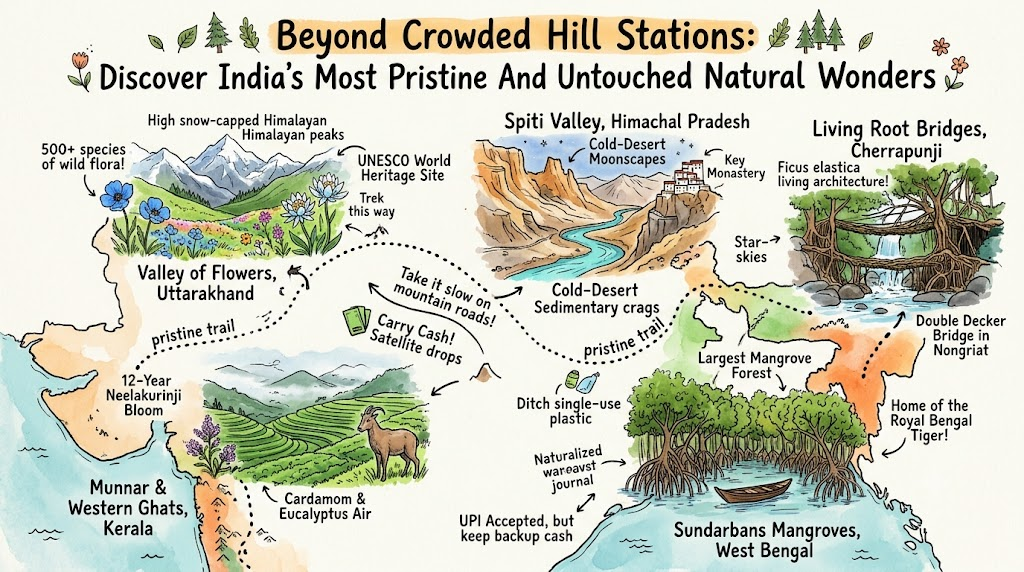
Introduction
Mainstream travel often funnels people into congested hill stations choked with tour buses, souvenir stalls, and identical concrete hotels. Stepping off that beaten track reveals an India where ancient living root bridges weave across rushing cloud-forest gorges and silent Himalayan high-altitude deserts touch violet skies.
This subcontinent holds geographical drama rarely matched anywhere on Earth, grounded in sacred ecological traditions where rivers, peaks, and ancient trees are revered as kin. Choosing these pristine sanctuaries connects you directly with communities who have stewarded their wilderness with fierce care for generations.
Why India is a must-visit destination
India represents an extraordinary biogeographical convergence, housing four global biodiversity hotspots within its borders. From the ancient volcanic plateaus and misty crests of the Western Ghats to the young, jagged fold mountains of the Great Himalayas, its landscapes challenge conventional travel boundaries. Modern infrastructure makes these raw ecosystems remarkably accessible, with world-class mountain highways, extensive broad-gauge railway corridors, and eco-homestays welcoming backpackers, families, and solo trekkers alike.
The primary scenic circuits divide naturally into distinct geographical corridors:
- The Northern Himalayan Circuit (Ladakh, Himachal Pradesh, Uttarakhand) delivers high-altitude deserts, alpine meadows, and glacial origins.
- The Northeastern Rainforest Corridor (Meghalaya, Sikkim, Assam) cradles ancient living architecture, sacred groves, and limestone river gorges.
- The Southern Tropical Arc (Western Ghats, Kerala, Nilgiris) showcases emerald tea plantations, high-altitude montane shola-grassland complexes, and serene backwaters.
| Key Metric | Details |
|---|---|
| Best Travel Season | October to April (Peninsula/Plains); June to September (Ladakh/Spiti); July to August (Alpine Meadows) |
| Primary Entry Gateways | New Delhi (DEL), Mumbai (BOM), Bengaluru (BLR), Guwahati (GAU), Kochi (COK) |
| Transit Networks | Indian Railways (Vande Bharat/Express lines), National Highway corridors, regional cab networks |
| Local Currencies & Payments | Indian Rupee (INR); UPI digital payments accepted extensively, cash essential in deep interior valleys |
| Permit Requirements | Inner Line Permit (ILP) required for designated border districts (parts of Ladakh, Sikkim, Northeast) |
Best Places or Experiences
Valley of Flowers National Park, Uttarakhand
High within the Chamoli district, this glacial cradle remains buried under deep snow for eight months each year before bursting into explosive bloom. Over five hundred species of wild alpine flora, including the elusive blue poppy and the sacred Brahma Kamal, carpet the Pushpawati river basin beneath sheer hanging glaciers.
The valley feels untamed because human settlement is strictly prohibited within its boundaries. Reaching the threshold requires an invigorating trek along roaring glacial torrents, delivering travelers straight into an alpine meadow that feels entirely removed from civilization.
Valley of Flowers in full bloom.
- Location: Chamoli District, Uttarakhand; roughly 500 km northeast of New Delhi via Rishikesh and Govindghat.
- Why it is worth visiting: A UNESCO World Heritage site preserving rare high-altitude alpine biodiversity and medicinal herbs untouched by grazing.
- Best things to do: Spot the endemic Himalayan musk deer, photograph morning dew on wild blue poppies, and walk to the memorial stone of botanist Joan Margaret Legge.
- Best time to visit: Mid-July to late August when monsoon showers trigger peak flowering across the meadows.
- Ideal for whom: Trekkers, landscape photographers, botanists, and nature enthusiasts comfortable with moderate uphill walking.
- Travel tip: Start your hike from Ghangaria check-post at 6:00 AM sharp; daytime entry closes by early afternoon to ensure all visitors exit before dusk.
Spiti Valley, Himachal Pradesh
Carved between Tibet and India, Spiti is a cold-desert wilderness defined by dramatic canyonlands, moonscapes, and wind-sculpted sedimentary crags. Ancient mud-brick monasteries cling precariously to razor-thin cliffs above the braided channels of the turquoise Spiti River.
Life here moves to the rhythm of ancient pastoral traditions. Crisp mountain air carries the scent of roasted barley and burning juniper, framing villages that sit higher than 4,000 meters under unpolluted, star-studded skies.
High-altitude majesty of Spiti Valley.
- Location: Lahaul and Spiti District, Himachal Pradesh; roughly 420 km from Shimla and 200 km from Manali.
- Why it is worth visiting: Extraordinary trans-Himalayan geological formations paired with undisturbed millennium-old Tibetan Buddhist heritage.
- Best things to do: Camp near the crescent-shaped Chandra Taal lake, post a letter from the world’s highest post office at Hikkim, and observe dawn chants inside Key Monastery.
- Best time to visit: June to September for clear roadways and alpine passes; January to February for frozen river winter expeditions.
- Ideal for whom: Adventure motorists, geology lovers, off-grid backpackers, and cultural explorers.
- Travel tip: Spend at least two full nights in lower elevations like Kalpa or Reckong Peo to acclimatize properly and prevent acute mountain sickness.
Living Root Bridges of Cherrapunji, Meghalaya
Deep inside the southern Khasi Hills, rainforest gorges receive some of the planet’s heaviest recorded rainfall. Rather than relying on wooden timber that rots under relentless downpours, the Indigenous Khasi and Jaintia tribes guide the living aerial roots of Ficus elastica trees across raging rivers.
These living footbridges take decades to form, gradually thickening and anchoring into rock fissures until they can support dozens of travelers at once. Stepping onto these pliable, living structures surrounded by spray from tumbling waterfalls feels like entering an ancient botanical sanctuary.
Living root architecture in Meghalaya.
- Location: East Khasi Hills District, Meghalaya; roughly 65 km south of Shillong and 150 km from Guwahati.
- Why it is worth visiting: The world’s finest demonstration of bio-engineering where functional infrastructure grows stronger with age.
- Best things to do: Hike down the 3,500 stone steps to the Double Decker Root Bridge in Nongriat, swim in crystalline natural limestone pools, and explore nearby Arwah cave systems.
- Best time to visit: October to April for dry, pleasant trekking trails and turquoise natural pools.
- Ideal for whom: Active hikers, eco-architecture enthusiasts, cultural immersion seekers, and adventurous families.
- Travel tip: Pack a sturdy bamboo walking pole and carry dry bags for electronics; sudden torrential valley squalls can roll in without warning.
Munnar and the Western Ghats Crests, Kerala
Sprawling across the Anamalai and Palani ranges, Munnar is a cool highland expanse where emerald tea plantations roll into untamed shola-forest corridors. These mist-draped peaks harbor endangered species found nowhere else, including the agile Nilgiri tahr and the rare Neelakurinji flower, which blooms once every twelve years.
Beyond the manicured tea estates lie virgin rainforest pockets, cloud-covered dams, and spice-scented mountain villages. The morning air carries crisp notes of cardamom, eucalyptus, and wild mountain moss.
Rolling tea gardens of Munnar.
- Location: Idukki District, Kerala; roughly 130 km east of Kochi International Airport.
- Why it is worth visiting: One of the oldest surviving tropical montane ecosystems in South Asia, rich with native flora and panoramic view corridors.
- Best things to do: Spot wild Nilgiri tahr on the rocky cliffs of Eravikulam National Park, kayak on the quiet waters of Mattupetty Lake, and trek through the silent sholas of Top Station.
- Best time to visit: September to March for cool, mist-free mornings and comfortable trekking temperatures.
- Ideal for whom: Couples, families, birdwatchers, and travelers seeking cool mountain respites with relaxed walking routes.
- Travel tip: Book your Eravikulam National Park safari entry online weeks ahead, as daily vehicle permits are strictly capped to minimize habitat disturbance.
The Mangrove Labyrinths of the Sundarbans, West Bengal
Spanning the delta where the Ganges, Brahmaputra, and Meghna rivers merge into the Bay of Bengal, the Sundarbans forms the largest contiguous mangrove forest on Earth. Tides shift this water-world twice daily, submerging mudflats and exposing massive networks of aerial roots called pneumatophores.
Exploring here means traveling entirely by silent wooden watercraft through narrow tidal creeks. Kingfishers plunge into brackish channels, spotted deer forage along the banks, and salt-tolerant mangrove trees weave an impenetrable canopy between sea and land.
- Location: South 24 Parganas District, West Bengal; roughly 100 km southeast of Kolkata.
- Why it is worth visiting: A wild amphibious biosphere sanctuary supporting the royal Bengal tiger and rare estuarine crocodiles.
- Best things to do: Cruise through narrow channels in quiet electric or country boats, climb the Dobanki canopy watchtower, and watch river dolphins surface in the morning mist.
- Best time to visit: November to February when cool breezes keep humidity manageable and wildlife frequents sunny river banks.
- Ideal for whom: Wildlife photographers, birding specialists, and naturalists fascinated by delta ecosystems.
- Travel tip: Hire only West Bengal Forest Department certified naturalist guides at Godkhali port; private unlicensed boatmen cannot enter the core buffer channels.
Offbeat Exploration: Hidden Gems Tourists Miss
Ziro Valley, Arunachal Pradesh
Tucked away in the lower Subansiri district, Ziro Valley is home to the Apatani tribe, who practice sustainable pine-bamboo co-cultivation and integrated wet-rice fish farming. The gentle landscape features flat emerald fields bounded by misty pine-clad ridges, preserving agrarian traditions that run centuries deep.
Dzükou Valley, Nagaland-Manipur Border
Hovering along the interstate boundary at 2,600 meters, this remote valley features rolling, bamboo-carpeted hillocks that resemble frozen ocean waves. Untouched by roads, reaching this sanctuary requires a three-hour climb through thick cloud forest, opening onto a riverbed filled with clear mountain streams.
Gokarna’s Secret Cliff Trails, Karnataka
While mainstream crowds flock to Goa’s beaches, Gokarna’s southern headlands offer quiet ocean trails connecting Paradise, Half-Moon, and Om beaches. Hikers walk narrow red-laterite paths between sheer granite sea-cliffs and warm Arabian Sea waters, often catching sight of wild coastal eagles soaring overhead.
Detailed Practical Guidance for Travelers
| Destination | Standard Entry Fee | General Timings | Best Local Food Options Nearby | Recommended Nearby Attractions |
|---|---|---|---|---|
| Valley of Flowers | ₹200 (Indian citizens); ₹800 (Foreign nationals) for 3-day permit | 6:00 AM – 5:00 PM (Last entry at 2:00 PM) | Garhwali Rajma-Chawal, piping hot Maggi, and ginger-lemon tea in Ghangaria | Hemkund Sahib holy lake and Badrinath temple shrine |
| Spiti Valley | Zero entry fee; Special Inner Line Permits free for border checks | Open 24/7 (High passes close after sunset) | Steamed vegetable momos, Thukpa noodle soup, and butter tea in Kaza | Dhankar Gompa, Langza marine fossil beds, and Pin Valley |
| Living Root Bridges | ₹50 per hiker at village gate; ₹20 camera permit | Sunrise to 5:00 PM | Khasi red rice platters, wild herb stir-fry, and fresh seasonal oranges | Rainbow Falls, Wei Sawdong falls, and Mawlynnong village |
| Munnar Hills | ₹200 (Eravikulam National Park regular entry) | 7:30 AM – 4:00 PM | Malabar parotta with vegetable stew, Kerala appam, and black cardamom tea | Mattupetty Dam, Kundala Lake, and Marayoor sandalwood groves |
| Sundarbans | ₹100 (Boat permit); ₹500 per foreign visitor entry | 7:00 AM – 4:30 PM (No river navigation after dusk) | Steamed mustard bhetki fish, fresh local lentil daal, and sweet Bengali nolen gur | Sajnekhali bird sanctuary, Sudhanyakhali watchtower |
Logistics & On-Ground Navigation
Local Transport Options
- Intercity Railways: The backbone of travel across India. High-speed Vande Bharat and Rajdhani express trains connect major metros to regional railheads like Haridwar, Kathgodam, Guwahati, and Ernakulam with clean, air-conditioned coaches.
- Shared Taxis and Jeeps: Indispensable in mountainous territories like Himachal, Ladakh, Meghalaya, and Sikkim. Sturdy Mahindra Boleros run fixed routes between mountain villages at affordable per-seat prices.
- Auto-Rickshaws & App Cabs: Ideal for urban transit and gateway transfers. Use metered rides or app services (Ola, Uber) in metropolitan zones; negotiate fixed day-rates before boarding in smaller tier-2 destinations.
- Self-Drive Vehicles & Royal Enfields: High-clearance 4×4 vehicles and sturdy motorcycles are popular for Spiti and Ladakh circuits. Rent exclusively from registered agencies that provide commercial tourist registration plates.
Budget Planning
- Backpacker / Minimalist Tier: ₹1,800 to ₹2,800 per day. Covers community dorm beds in verified hostels, meals at neighborhood dhabas, state-run public transport buses, and modest park admissions.
- Mid-Range / Comfort Tier: ₹5,500 to ₹9,500 per day. Covers boutique plantation cottages or heritage homestays, private chauffeured hatchback or sedan cars, guided forest treks, and dining at established regional restaurants.
Safety and Inclusivity Tips
- For Families: Stick to gentle mountain escapes like Munnar or Nainital that feature well-paved road connections, private medical clinics, and family-friendly farm stays with accessible walking paths.
- For Couples: Choose secluded eco-lodges or boutique tea-estate bungalows in Coonoor, Wayanad, or Meghalaya that offer private balconies, walking trails, and discrete local hosts.
- General Outdoor Safety: Carry an offline digital map (such as maps.me), always carry water purification tablets or an insulated filtered flask, and keep emergency cash secured in dry waterproof zip-pouches.
Strategic Travel Planning Guardrails
Travel Planning Tips for Nature Escapes
- Reserve mountain homestays and forest permits at least two to three months in advance for peak summer and post-monsoon foliage windows.
- Carry a mix of digital UPI apps and physical currency notes; high-elevation banking terminals often lose satellite link during weather swings.
- Dress in versatile layers using breathable merino wool or moisture-wicking fabrics rather than bulky single jackets.
- Respect local customs around sacred natural sites; remove shoes before stepping onto sacred forest clearings or crossing monastery thresholds.
- Keep a small personal medical kit stocked with oral rehydration salts, altitude adjustment tablets, and broad-spectrum antihistamines.
Common Mistakes to Avoid
- Overpacking your daily route schedule; Indian mountain roads require slow, careful navigation where 80 kilometers can easily take four hours.
- Assuming digital payments will function in deep Himalayan gorges or dense northeastern river valleys where mobile data drops completely.
- Discarding single-use plastic bottles along pristine trails; always carry a reusable canteen and support local filtered refill initiatives.
- Underestimating the physical toll of rapid altitude changes; rushing upward without designated acclimatization days can quickly ruin a trek.
- Dismissing sudden monsoon flash-flood alerts; always heed advice from local drivers and forest rangers before entering river gorges.
Suggested Itinerary Blueprints
- 4-Day Quick Dash (The Kerala Mist Trail): Fly into Kochi International Airport, transfer directly to Munnar via the Cheeyappara Waterfall route, spend two full days exploring tea-carpeted valleys and Eravikulam’s cliffs, and conclude with an overnight spice plantation stay in Thekkady before returning.
- 7-Day Deep-Dive (The Meghalaya Living Highlands): Land in Guwahati, drive up to Shillong for two nights of Khasi cafe culture and Umiam Lake, spend three days based in Cherrapunji trekking to living root bridges and river caves, and finish with a quiet night in the crystal-clear waters of Dawki.
- 10-Day Complete Loop (The Great Trans-Himalayan Spiti Arc): Begin in Shimla, gradually ascending through the apple orchards of Kinnaur to acclimatize, cross into Tabo and Kaza for monasteries and high passes, camp beside Chandra Taal lake, and exit through the high-altitude engineering marvel of Atal Tunnel into Manali.
Common Tourist Mistakes to Avoid
- Geographic Blunders: Don’t try to link geographically separated destinations like Leh and Munnar in a single short vacation. Stick to one regional biome to spend your time exploring rather than sitting in transit.
- Commercial Traps: Avoid spending your evenings in crowded mall roads filled with mass-market chain stores. Head instead toward valley-view benches, quiet community libraries, or locally run handicraft collectives.
- Neglecting Modern/Alternative Zones: Don’t skip the quiet residential pockets, organic farm cafes, and artist retreats on the outskirts of gateway towns like Dharamkot in Himachal or Fort Kochi in Kerala.
- Transport Overpayment: Avoid accepting the first rate quoted by taxi aggregators at airport exits. Step over to official pre-paid counters or verify rates on app services to keep transportation costs fair.
- Luxury Dining Bias: Never isolate your meals to hotel buffets. Pull up a stool at neighborhood eateries to taste real seasonal cooking, from steaming hot ladakhi tingmo bread to fresh kerala fish curry on banana leaves.
Frequently Asked Questions
1. When is the best time of year to visit India for nature and wildlife?
October through April provides ideal weather across the southern peninsular forests, central tiger sanctuaries, and the northeastern river plains. For the high Himalayan valleys of Ladakh and Spiti, the optimal window shifts to the summer months of June through September when mountain passes remain free of deep snow.
2. Do I need special permits to visit remote nature spots in India?
Foreign travelers require Protected Area Permits (PAP) or Inner Line Permits (ILP) for sensitive border regions including parts of Arunachal Pradesh, Sikkim, and remote zones of Ladakh. Indian citizens require domestic ILP paperwork for specific northeastern states, which are easily acquired via state government portals online before travel.
3. Is tap water safe to drink when trekking in natural areas?
Untreated tap water should never be consumed directly. Use a high-quality insulated filtration bottle, UV purification pen, or water purification tablets when filling up from mountain streams and village guest houses. Reputable homestays and hotels will gladly provide boiled or UV-filtered water upon request.
4. How accessible are digital payments in remote nature destinations?
Digital UPI payments work remarkably well even at roadside vegetable stalls across most towns and highways. However, in deep mountain gorges such as Spiti Valley, Zanskar, or interior Meghalaya, telecommunication towers frequently drop offline, making backup physical cash absolute necessity for transport and meals.
5. How physically demanding is the trek to the Living Root Bridges?
Reaching the famous Double Decker Bridge in Nongriat requires descending and subsequently ascending roughly 3,500 steep, uneven concrete and stone steps. It demands moderate cardiovascular fitness and healthy knees, though plenty of rest stalls selling fresh lemon tea and fruit line the route.
6. What clothes should I pack for high-altitude Himalayan nature trips?
Pack versatile, breathable layers rather than heavy single coats. Essential gear includes thermal base layers, a fleece mid-layer, a wind-and-waterproof outer shell, sturdy broken-in hiking boots, UV-blocking sunglasses, and high-SPF mineral sunscreen to protect against intense high-elevation solar radiation.
7. Can vegetarian and vegan travelers easily find food in rural India?
Plant-based travelers will find India exceptionally accommodating. Traditional diets across most states are naturally vegetarian-friendly, centered around spiced lentils, fresh seasonal greens, flatbreads, and rice. Simply specify no ghee, butter, or paneer to your hosts to maintain a completely vegan diet during your stay.
8. Are solo female nature lovers safe traveling through these circuits?
Thousands of solo female travelers safely explore Indian nature circuits each season. Sticking to government-licensed trekking guides, staying at well-reviewed family homestays or reputable backpacker hostels, and concluding long highway drives before nightfall are practical habits that ensure a safe, comfortable, and empowering journey.
9. How do I prevent Acute Mountain Sickness (AMS) in high valleys?
Ascend gradually and avoid gaining more than 500 meters of sleeping altitude per day once above 2,500 meters. Drink three to four liters of clean water daily, steer clear of alcohol during the first 48 hours, and allow at least two full days of low-exertion rest before undertaking strenuous hikes.
10. What is the standard protocol regarding waste and plastic in national parks?
India enforces strict anti-littering and single-use plastic restrictions across its national parks and biosphere reserves. Forest checkpoints will often inspect luggage and count your plastic water bottles, requiring a small security deposit that is refunded once you carry those empty containers back out for proper recycling.
11. Is it necessary to hire a certified local guide for forest treks?
While trails in recreational hill stations are straightforward, venturing into deep sanctuaries like the Sundarbans or Valley of Flowers demands licensed guides. Local naturalists understand wildlife behavior, sudden mountain weather patterns, and indigenous plant life, making your trek both substantially safer and far more enriching.
12. What regional souvenirs support local indigenous economies directly?
Seek out certified tribal handicrafts, wild forest honey, handloom shawls, organic orthodox teas, and whole spices directly from village grower cooperatives. Purchasing straight from the artisans ensures your travel funds directly sustain the families who protect these precious landscapes year-round.
Conclusion
Choosing to step beyond the well-trodden tourist corridors into India’s vast natural landscapes brings profound rewards. Here, the sheer scale of the Himalayas humbles our everyday worries, ancient living root bridges prove that humanity can live in balance with the wild, and silent mangrove waterways preserve our earth’s primal rhythms. Traveling with patience, curiosity, and deep respect for the communities who call these wildernesses home leaves you with an unforgettable connection to one of the most ecologically diverse realms on our planet.
