MOTOSHARE 🚗🏍️
Rent Bikes & Cars Directly from Owners
Motoshare connects vehicle owners with people who need bikes and cars on rent. Owners earn from idle vehicles, and renters get flexible ride options.
Visit Motoshare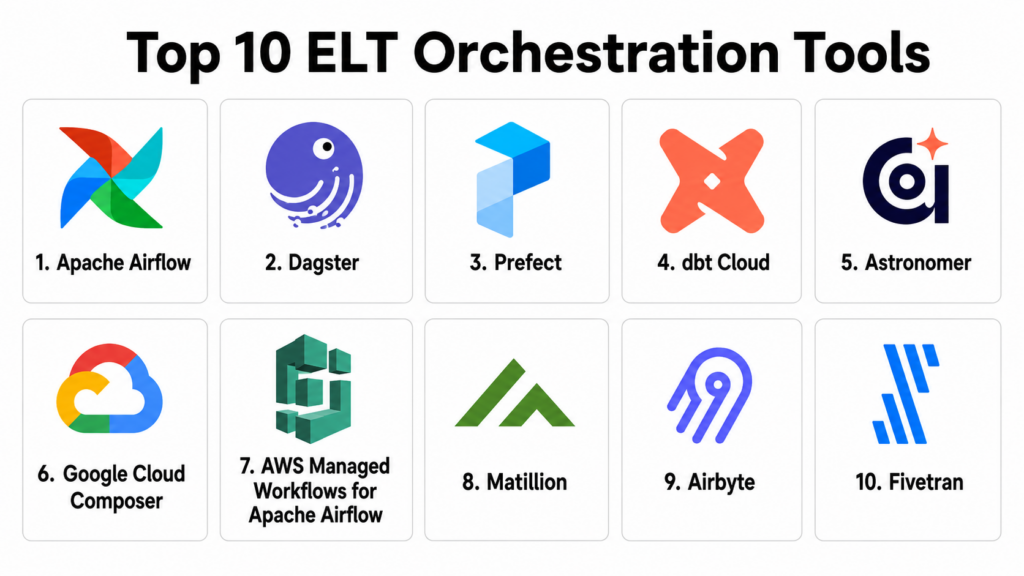
Introduction
ELT Orchestration Tools help data teams schedule, automate, monitor, and manage data pipelines where data is first extracted and loaded into a warehouse, lakehouse, or data platform, then transformed afterward. In simple terms, these tools make sure data movement, transformation, validation, and downstream reporting tasks happen in the correct order with proper retries, alerts, dependencies, and visibility.
ELT orchestration matters because modern data stacks often include many moving parts: SaaS connectors, cloud warehouses, transformation jobs, data quality checks, BI refreshes, ML pipelines, reverse ETL jobs, and governance workflows. Without orchestration, pipelines become fragile, teams miss failures, dashboards show stale data, and business users lose trust.
Real world use cases include SaaS-to-warehouse pipelines, dbt transformation scheduling, data warehouse refresh workflows, data quality validation, analytics pipeline automation, reverse ETL triggers, cloud data integration, warehouse cost control, ML feature preparation, and cross-system data dependency management.
Buyers should evaluate:
- ELT pipeline scheduling
- Dependency and task orchestration
- dbt and warehouse integration
- Connector ecosystem
- Monitoring, alerts, and observability
- Retries, backfills, and recovery
- Cloud data platform support
- Data quality and lineage visibility
- Security, RBAC, and audit logs
- Scalability across teams and workflows
Best for: ELT Orchestration Tools are best for data engineering teams, analytics engineering teams, data platform teams, BI teams, MLOps teams, modern data stack teams, SaaS companies, enterprises, and organizations running recurring data pipelines across warehouses, lakehouses, and cloud applications.
Not ideal for: Very small teams with only one or two simple data syncs may not need a dedicated ELT orchestration tool. A built-in connector schedule, warehouse task, or simple cron job may be enough when dependencies are minimal, failures are easy to detect, and data pipelines are not business-critical.
Key Trends in ELT Orchestration Tools
- Modern data stack integration: ELT orchestration is increasingly connected with dbt, Snowflake, BigQuery, Databricks, Redshift, Fivetran, Airbyte, and BI tools.
- Asset-aware orchestration: Teams want workflows that understand datasets, models, freshness, lineage, downstream reports, and business dependencies.
- Python-first and code-first workflows: Data engineers prefer orchestration tools that support version control, testing, reusable components, and software engineering practices.
- Managed orchestration adoption: More teams are choosing hosted orchestration platforms to reduce infrastructure maintenance and speed up pipeline deployment.
- Data quality as part of orchestration: Validation checks, freshness checks, schema tests, and anomaly detection are becoming part of pipeline execution.
- Event-driven ELT: Pipelines are moving beyond fixed schedules to triggers based on file arrival, API events, warehouse changes, or upstream job completion.
- Observability and lineage focus: Buyers want better visibility into failed jobs, slow tasks, stale tables, broken dependencies, and downstream business impact.
- Warehouse cost awareness: Orchestration is increasingly used to manage compute windows, avoid unnecessary runs, and reduce wasted warehouse spend.
- Hybrid orchestration models: Many teams use more than one tool, such as Airflow for scheduling, dbt Cloud for transformations, and Fivetran or Airbyte for ingestion.
- AI-ready data pipelines: ELT orchestration is becoming important for preparing reliable data for AI applications, RAG systems, feature stores, and model training workflows.
How We Selected These Tools
The tools below were selected using a practical buyer-focused evaluation approach:
- Market recognition in ELT, data orchestration, analytics engineering, cloud data integration, and modern data stack workflows.
- Feature completeness across scheduling, dependencies, monitoring, retries, lineage, backfills, and multi-step workflow management.
- ELT-specific fit, including support for extract/load tools, cloud warehouses, dbt, SQL transformations, and data quality workflows.
- Connector and integration ecosystem, including warehouses, lakehouses, SaaS sources, BI tools, APIs, and data platforms.
- Developer experience, including code-first workflows, CLI support, version control, testing, and deployment patterns.
- Managed and self-hosted flexibility, including open-source, cloud, enterprise, and hybrid deployment options.
- Security and governance, including RBAC, SSO, secrets handling, audit logs, and environment separation.
- Observability and reliability, including logs, alerts, run history, retry handling, and failed pipeline diagnosis.
- Scalability, including support for multiple teams, many workflows, high task volume, and growing data environments.
- Practical adoption fit, including ease of onboarding, learning curve, operational effort, and long-term maintainability.
Top 10 ELT Orchestration Tools
1- Apache Airflow
Short description:
Apache Airflow is one of the most widely used open-source workflow orchestration tools for data engineering and ELT pipelines. It allows teams to define workflows as Python-based DAGs, schedule jobs, manage task dependencies, retry failures, and monitor pipeline runs. Airflow is especially useful for teams with complex ELT workflows involving ingestion tools, warehouse transformations, dbt jobs, data quality checks, and downstream refreshes. It is a strong fit for technical data teams that want flexibility, extensibility, and broad ecosystem support.
Key Features
- Python-based DAG workflow definitions
- Scheduling and dependency management
- Task retries, backfills, and failure handling
- Large provider and operator ecosystem
- Web UI for monitoring pipeline runs
- Supports cloud, warehouse, API, and container tasks
- Flexible executor options for scaling
Pros
- Mature and widely adopted in data engineering
- Strong ecosystem for ELT and cloud data workflows
- Highly flexible for complex pipeline logic
Cons
- Requires operational maintenance if self-hosted
- DAG complexity can grow quickly without governance
- Less beginner-friendly for non-technical users
Platforms / Deployment
Web-based UI and Python workflow development.
Cloud, self-hosted, and managed deployment options vary.
Security & Compliance
Supports role-based access, authentication options, secrets backends, audit-related logs, and deployment-level security controls. Specific compliance depends on hosting model and configuration.
Integrations & Ecosystem
Airflow integrates with many data warehouses, cloud services, ingestion tools, transformation frameworks, APIs, and analytics systems. It is often used as the central orchestration layer for ELT pipelines.
- Snowflake
- BigQuery
- Databricks
- dbt
- Fivetran and Airbyte workflows
- Cloud storage and compute services
Support & Community
Apache Airflow has a large open-source community, extensive documentation, ecosystem providers, and managed service options. Enterprise support depends on chosen vendor, cloud provider, or internal platform team.
2- Dagster
Short description:
Dagster is a modern data orchestration platform focused on software-defined assets, lineage, observability, and data pipeline reliability. It helps teams define data assets, jobs, schedules, sensors, checks, and dependencies in Python. Dagster is especially useful for analytics engineering and data platform teams that want orchestration to understand data outputs rather than only task execution. It is a strong fit for dbt workflows, warehouse pipelines, data quality checks, and modern data product development.
Key Features
- Software-defined assets
- Data lineage and dependency visibility
- Python-based orchestration
- Schedules, sensors, and event triggers
- Data quality checks and asset materialization
- Strong local development and testing workflows
- Integration with dbt and cloud data platforms
Pros
- Strong asset-aware orchestration model
- Good visibility into data dependencies and freshness
- Useful for modern analytics engineering teams
Cons
- Different mental model than traditional task schedulers
- Migration from Airflow-style DAGs may require redesign
- Best suited for data-centric workflows
Platforms / Deployment
Web-based UI and Python development.
Cloud and self-hosted deployment options may be available.
Security & Compliance
Supports workspace permissions, secrets handling, deployment security controls, and audit-friendly workflow visibility depending on edition and configuration. Specific compliance should be validated directly.
Integrations & Ecosystem
Dagster integrates with modern data stack tools, warehouses, lakehouses, transformation frameworks, and Python data workflows.
- dbt
- Snowflake
- BigQuery
- Databricks
- DuckDB
- Kubernetes and cloud services
Support & Community
Dagster provides documentation, community support, commercial support options, and educational content. Community strength is high among modern data engineering teams.
3- Prefect
Short description:
Prefect is a Python-native workflow orchestration platform designed for flexible data workflows, scheduling, monitoring, retries, and distributed task execution. It is especially useful for teams that want dynamic workflows and a simpler developer experience than traditional DAG-only tools. Prefect works well for ELT pipelines, data science workflows, API jobs, warehouse refreshes, and automation tasks. It is a good fit for teams that want fast onboarding, local development, and modern pipeline observability.
Key Features
- Python-native workflow definitions
- Dynamic workflows and task mapping
- Scheduling and event-driven execution
- Retries, caching, and failure handling
- Cloud and self-hosted options
- Run monitoring and logs
- Strong local development experience
Pros
- Developer-friendly and flexible
- Good fit for dynamic ELT and data workflows
- Easier to adopt for many Python teams
Cons
- Ecosystem may be smaller than Airflow in some enterprises
- Advanced governance depends on edition and deployment
- Teams may need to define standards for large-scale use
Platforms / Deployment
Web-based UI and Python development.
Cloud and self-hosted deployment options may be available.
Security & Compliance
Supports access controls, workspace administration, secrets handling, and deployment-level security features. Specific compliance details should be validated based on edition and hosting model.
Integrations & Ecosystem
Prefect integrates with Python data workflows, warehouses, cloud services, APIs, containers, and analytics tools.
- Snowflake
- BigQuery
- Databricks
- dbt
- Docker and Kubernetes
- Cloud storage and APIs
Support & Community
Prefect provides documentation, community resources, developer-focused learning materials, and commercial support options. Support depth depends on plan and deployment model.
4- dbt Cloud
Short description:
dbt Cloud is a managed platform for developing, running, scheduling, and monitoring dbt transformation workflows. It is not a full general-purpose orchestrator, but it is highly relevant for ELT because dbt is commonly used after data is loaded into warehouses and lakehouses. dbt Cloud helps teams run transformation jobs, manage environments, schedule production runs, view logs, and coordinate analytics engineering workflows. It is best for teams that center their ELT process around SQL transformations and dbt models.
Key Features
- dbt job scheduling
- SQL transformation workflow management
- Environment and deployment management
- Job logs and run history
- Documentation and lineage support
- Development IDE for dbt projects
- Integration with cloud data warehouses
Pros
- Strong fit for dbt-centric ELT teams
- Managed scheduling for transformation jobs
- Useful for analytics engineering workflows
Cons
- Not a full orchestration tool for all pipeline steps
- Ingestion orchestration may require another tool
- Best value depends on dbt adoption
Platforms / Deployment
Web-based platform.
Cloud deployment.
Works with dbt projects and supported cloud data platforms.
Security & Compliance
Supports access controls, environment management, credentials handling, and administrative governance. Specific certifications and compliance details should be validated directly.
Integrations & Ecosystem
dbt Cloud integrates with major warehouses, version control, BI workflows, and orchestration tools. It is often used alongside ingestion and scheduling systems.
- Snowflake
- BigQuery
- Databricks
- Redshift
- Git providers
- BI and orchestration workflows
Support & Community
dbt Cloud benefits from strong documentation, community adoption, educational resources, and commercial support options. Support depth varies by plan and agreement.
5- Astronomer
Short description:
Astronomer is a managed and enterprise-focused platform for running Apache Airflow at scale. It helps teams operate Airflow with better deployment workflows, monitoring, security, governance, and reliability. Astronomer is especially useful for organizations that want Airflow’s flexibility without taking on all operational complexity themselves. It is a strong option for enterprises and data platform teams running many ELT workflows across multiple teams.
Key Features
- Managed and enterprise Airflow operations
- Airflow deployment and environment management
- Monitoring, alerting, and observability
- CI/CD support for DAG deployments
- Security and access controls
- Scaling and reliability tooling
- Support for large multi-team Airflow usage
Pros
- Strong fit for organizations committed to Airflow
- Reduces operational burden of Airflow management
- Good enterprise governance and deployment features
Cons
- Still depends on Airflow design patterns
- May be more than small teams need
- Commercial cost should be evaluated against self-hosting
Platforms / Deployment
Web-based platform for Airflow management.
Cloud, hybrid, and enterprise deployment options may vary.
Security & Compliance
Supports enterprise controls such as RBAC, SSO options, secrets handling, environment governance, and audit-friendly administration. Specific compliance coverage should be validated during procurement.
Integrations & Ecosystem
Astronomer supports the Airflow ecosystem and integrates with data platforms, cloud services, CI/CD tools, monitoring systems, and enterprise data workflows.
- Apache Airflow providers
- Snowflake
- BigQuery
- Databricks
- Git and CI/CD tools
- Cloud infrastructure
Support & Community
Astronomer provides Airflow-focused documentation, enterprise support, platform guidance, professional services, and customer success resources.
6- Google Cloud Composer
Short description:
Google Cloud Composer is a managed workflow orchestration service based on Apache Airflow. It helps teams run Airflow pipelines on Google Cloud without managing all underlying infrastructure manually. Cloud Composer is especially useful for organizations using BigQuery, Cloud Storage, Dataflow, Dataproc, and other Google Cloud services in their ELT pipelines. It provides a familiar Airflow experience with managed cloud operations.
Key Features
- Managed Apache Airflow service
- Workflow scheduling and dependency management
- Integration with Google Cloud services
- Airflow DAG monitoring and logs
- Environment management
- Cloud-native data pipeline orchestration
- Support for Python-based workflow definitions
Pros
- Good fit for Google Cloud data teams
- Reduces Airflow infrastructure management
- Strong integration with BigQuery and Google Cloud services
Cons
- Best suited for Google Cloud environments
- Airflow complexity still applies
- Less portable than self-managed Airflow
Platforms / Deployment
Web-based Google Cloud console and Airflow UI.
Cloud deployment.
Security & Compliance
Uses Google Cloud IAM, network controls, encryption, logs, and managed cloud security features. Specific compliance coverage depends on region, configuration, and cloud agreement.
Integrations & Ecosystem
Cloud Composer integrates with Google Cloud data, analytics, storage, and compute services, while also supporting the broader Airflow provider ecosystem.
- BigQuery
- Cloud Storage
- Dataflow
- Dataproc
- Pub/Sub
- Google Cloud analytics services
Support & Community
Google Cloud provides documentation, support plans, partner services, and managed service resources. Community support also comes from the broader Airflow ecosystem.
7- AWS Managed Workflows for Apache Airflow
Short description:
AWS Managed Workflows for Apache Airflow is a managed service for running Apache Airflow on AWS. It helps teams orchestrate ELT pipelines, cloud jobs, data warehouse tasks, and data lake workflows using Airflow without fully managing Airflow infrastructure. It is especially useful for organizations using AWS services such as S3, Glue, Redshift, EMR, Lambda, and Athena. It provides a managed Airflow option for AWS-centric data teams.
Key Features
- Managed Apache Airflow environments
- Workflow scheduling and dependencies
- Integration with AWS data services
- Airflow DAG deployment and monitoring
- Python-based orchestration
- Cloud logs and metrics integration
- Support for ELT and data lake workflows
Pros
- Strong fit for AWS data teams
- Reduces Airflow infrastructure burden
- Works well with AWS data services
Cons
- Best suited for AWS environments
- Airflow design and operational complexity still apply
- Cross-cloud portability may be limited
Platforms / Deployment
Web-based AWS console and Airflow UI.
Cloud deployment.
Security & Compliance
Uses AWS IAM, encryption, logging, network controls, and managed service security features. Specific compliance coverage depends on AWS region, configuration, and architecture.
Integrations & Ecosystem
AWS Managed Workflows for Apache Airflow integrates with AWS data, compute, storage, and analytics services, while supporting Apache Airflow providers.
- Amazon S3
- AWS Glue
- Amazon Redshift
- Amazon EMR
- AWS Lambda
- Amazon Athena
Support & Community
AWS provides documentation, support plans, SDK resources, partner services, and managed service support. Community support also comes from Apache Airflow adoption.
8- Matillion
Short description:
Matillion is a cloud-native data integration and ELT platform focused on building, managing, and orchestrating data pipelines for cloud data platforms. It is especially useful for teams that want low-code or visual pipeline development along with orchestration capabilities. Matillion helps teams extract, load, transform, and manage data workflows across cloud warehouses and modern analytics environments. It is a good fit for organizations that want faster pipeline building without relying entirely on custom code.
Key Features
- Visual data pipeline design
- ELT workflow orchestration
- Cloud data warehouse integration
- Data loading and transformation support
- Scheduling and pipeline monitoring
- Low-code and SQL/Python workflow support
- Integration with modern cloud data platforms
Pros
- Strong low-code ELT experience
- Good fit for cloud warehouse pipelines
- Useful for teams that want faster pipeline development
Cons
- May be less flexible than code-first orchestrators for complex logic
- Best value depends on supported data platform fit
- Enterprise usage should validate governance and cost
Platforms / Deployment
Web-based platform.
Cloud deployment.
Works with supported cloud data platforms.
Security & Compliance
Supports access controls, credentials management, role-based administration, and cloud security features depending on edition and setup. Specific compliance details should be validated directly.
Integrations & Ecosystem
Matillion integrates with cloud warehouses, data lakes, SaaS sources, APIs, and transformation workflows. It is especially relevant for cloud analytics teams.
- Snowflake
- Databricks
- BigQuery
- Redshift
- Cloud storage
- SaaS and API data sources
Support & Community
Matillion provides documentation, customer support, training resources, partner services, and implementation assistance. Support levels vary by plan and contract.
9- Airbyte
Short description:
Airbyte is an open-source data movement platform focused on extracting and loading data from many sources into warehouses, lakes, and databases. While Airbyte is primarily an EL platform rather than a full workflow orchestrator, it plays an important orchestration role in ELT pipelines through sync scheduling, connector management, and integration with orchestrators like Airflow, Dagster, and Prefect. It is especially useful for teams that need flexible connector coverage and open-source data ingestion.
Key Features
- Source-to-destination data syncs
- Large connector ecosystem
- Sync scheduling and monitoring
- Cloud and self-hosted options
- Connector development framework
- API-based orchestration support
- Integration with downstream transformation tools
Pros
- Strong open-source data ingestion ecosystem
- Good fit for flexible ELT connector needs
- Works well with external orchestration tools
Cons
- Not a full end-to-end orchestrator by itself
- Complex dependency workflows may need Airflow, Dagster, or Prefect
- Connector maintenance should be evaluated carefully
Platforms / Deployment
Web-based platform.
Cloud and self-hosted deployment options may be available.
Security & Compliance
Supports workspace administration, credential handling, access controls, and deployment security features depending on edition and configuration. Specific compliance details should be validated directly.
Integrations & Ecosystem
Airbyte integrates with many SaaS sources, databases, warehouses, lakes, and orchestration tools. It is commonly used as the extraction and loading layer in ELT stacks.
- Snowflake
- BigQuery
- Databricks
- Redshift
- Airflow
- Dagster and Prefect workflows
Support & Community
Airbyte has open-source documentation, community resources, connector ecosystem support, and commercial support options depending on edition.
10- Fivetran
Short description:
Fivetran is a managed data movement platform that automates extraction and loading from many SaaS applications, databases, and systems into cloud data platforms. It is not a general workflow orchestrator, but it is highly relevant to ELT orchestration because it automates and monitors upstream data syncs that often feed transformation workflows. Fivetran is especially useful for teams that want managed connectors, reduced pipeline maintenance, and reliable SaaS-to-warehouse ingestion. It is often paired with dbt, Airflow, Dagster, or warehouse-native scheduling.
Key Features
- Managed ELT data connectors
- Automated source-to-warehouse syncs
- Schema change handling
- Sync monitoring and alerts
- Support for SaaS, database, and file sources
- Integration with dbt workflows
- Cloud data platform support
Pros
- Reduces connector maintenance burden
- Strong fit for SaaS-to-warehouse ELT pipelines
- Useful for teams that prefer managed ingestion
Cons
- Not a full general-purpose orchestrator
- Pricing and sync volume should be reviewed carefully
- Custom pipeline logic may need complementary tools
Platforms / Deployment
Web-based platform.
Cloud deployment.
Works with supported sources and destinations.
Security & Compliance
Supports access controls, credential management, security administration, and enterprise governance features. Specific certifications and compliance coverage should be validated during procurement.
Integrations & Ecosystem
Fivetran integrates with SaaS applications, databases, cloud warehouses, data lakes, and transformation tools. It is often used as the managed ingestion layer in ELT workflows.
- Snowflake
- BigQuery
- Databricks
- Redshift
- dbt workflows
- SaaS and database sources
Support & Community
Fivetran provides documentation, customer support, onboarding resources, partner services, and commercial support. Support depth depends on plan and contract.
Comparison Table
| Tool Name | Best For | Platform Supported | Deployment | Standout Feature | Public Rating |
|---|---|---|---|---|---|
| Apache Airflow | Complex ELT and data engineering workflows | Web, Python, workers | Cloud, self-hosted, managed options vary | Mature Python DAG orchestration | N/A |
| Dagster | Data asset orchestration | Web, Python | Cloud, self-hosted options vary | Software-defined assets and lineage | N/A |
| Prefect | Python-native dynamic ELT workflows | Web, Python | Cloud, self-hosted options vary | Flexible Python workflow orchestration | N/A |
| dbt Cloud | dbt transformation orchestration | Web, SQL, dbt projects | Cloud | Managed dbt job scheduling and monitoring | N/A |
| Astronomer | Enterprise Airflow operations | Web, Airflow environments | Cloud, hybrid, enterprise options vary | Managed and governed Airflow at scale | N/A |
| Google Cloud Composer | Google Cloud Airflow orchestration | Web, Python, Airflow | Cloud | Managed Airflow for Google Cloud data pipelines | N/A |
| AWS Managed Workflows for Apache Airflow | AWS Airflow orchestration | Web, Python, Airflow | Cloud | Managed Airflow for AWS data pipelines | N/A |
| Matillion | Low-code cloud ELT pipelines | Web, cloud data platforms | Cloud | Visual ELT pipeline design and orchestration | N/A |
| Airbyte | Open-source data ingestion orchestration | Web, connectors, APIs | Cloud, self-hosted options vary | Flexible ELT connector ecosystem | N/A |
| Fivetran | Managed data ingestion for ELT | Web, managed connectors | Cloud | Automated SaaS and database syncs | N/A |
Evaluation & Scoring of ELT Orchestration Tools
| Tool Name | Core 25% | Ease 15% | Integrations 15% | Security 10% | Performance 10% | Support 10% | Value 15% | Weighted Total 0–10 |
|---|---|---|---|---|---|---|---|---|
| Apache Airflow | 9.0 | 7.4 | 9.3 | 8.2 | 8.5 | 8.7 | 8.8 | 8.59 |
| Dagster | 8.8 | 8.2 | 8.7 | 8.3 | 8.5 | 8.2 | 8.5 | 8.51 |
| Prefect | 8.5 | 8.7 | 8.4 | 8.2 | 8.4 | 8.2 | 8.6 | 8.47 |
| dbt Cloud | 8.4 | 8.8 | 8.7 | 8.5 | 8.5 | 8.5 | 8.2 | 8.52 |
| Astronomer | 8.9 | 8.0 | 9.1 | 8.7 | 8.7 | 8.8 | 8.0 | 8.62 |
| Google Cloud Composer | 8.5 | 7.8 | 9.0 | 8.7 | 8.5 | 8.4 | 8.0 | 8.43 |
| AWS Managed Workflows for Apache Airflow | 8.5 | 7.8 | 9.1 | 8.7 | 8.5 | 8.4 | 8.1 | 8.45 |
| Matillion | 8.3 | 8.6 | 8.6 | 8.3 | 8.4 | 8.2 | 8.1 | 8.37 |
| Airbyte | 7.9 | 8.2 | 9.0 | 8.0 | 8.2 | 8.0 | 8.6 | 8.27 |
| Fivetran | 8.0 | 9.0 | 9.0 | 8.5 | 8.6 | 8.5 | 7.8 | 8.49 |
The scores are comparative and should be used as a practical evaluation guide, not as fixed market ratings. Airflow and Astronomer are strong for complex DAG-based orchestration, while Dagster and Prefect fit modern Python and data asset workflows. dbt Cloud is strongest when transformations are the center of the ELT process. Matillion is useful for low-code ELT, while Airbyte and Fivetran are better viewed as ingestion orchestration layers that often pair with a broader orchestrator. The right choice depends on team skill, data stack, cloud platform, governance needs, and pipeline complexity.
Which ELT Orchestration Tool Is Right for You?
Solo / Freelancer
Solo users usually do not need a heavy ELT orchestration stack. If the workflow is simple, warehouse-native schedules, dbt Cloud jobs, Airbyte syncs, Fivetran schedules, or lightweight Python scripts may be enough.
If the freelancer works with multiple client data pipelines, Prefect, Dagster, or Airflow can provide better repeatability and monitoring. The priority should be simple setup, clear failure alerts, and low operational overhead.
SMB
SMBs should prioritize ease of use, managed services, connector availability, and fast pipeline setup. dbt Cloud, Fivetran, Airbyte Cloud, Matillion, Prefect, and managed Airflow options can be practical depending on budget and team skills.
A small data team should avoid overengineering. If ingestion is the main pain point, Fivetran or Airbyte may be enough. If transformation dependencies are the main issue, dbt Cloud, Dagster, or Prefect may be better.
Mid-Market
Mid-market companies often need stronger pipeline governance, multi-team workflows, warehouse integration, lineage, alerts, and CI/CD support. Apache Airflow, Dagster, Prefect, Astronomer, dbt Cloud, and managed cloud Airflow services are strong candidates.
These organizations should define where orchestration authority lives. Some teams may use Fivetran or Airbyte for ingestion, dbt Cloud for transformation, and Airflow or Dagster for cross-system dependencies.
Enterprise
Enterprises should prioritize RBAC, audit logs, environment separation, secrets management, scaling, lineage, observability, multi-team governance, and support options. Astronomer, Apache Airflow, Dagster, dbt Cloud, Google Cloud Composer, AWS Managed Workflows for Apache Airflow, Fivetran, and Matillion are all relevant depending on architecture.
Large organizations often use more than one orchestration layer because ingestion, transformation, ML, reporting, and operational workflows have different requirements. The key is clear ownership and consistent governance.
Budget vs Premium
Budget-focused teams can start with open-source Apache Airflow, Dagster, Prefect, or Airbyte. These tools can be powerful, but self-hosting requires operational ownership, upgrades, monitoring, and security configuration.
Premium managed platforms are better when teams need support, reliability, governance, faster onboarding, and reduced infrastructure maintenance. The right choice depends on whether engineering time or software cost is the bigger constraint.
Feature Depth vs Ease of Use
Feature-rich orchestration tools provide dependency control, retries, backfills, lineage, observability, custom operators, and multi-team governance. These are valuable for complex pipelines but require standards and platform ownership.
Ease-of-use tools help small teams launch quickly. Matillion, dbt Cloud, Fivetran, and Airbyte can reduce setup effort for specific ELT steps, while Prefect and Dagster offer modern developer-friendly orchestration.
Integrations & Scalability
ELT orchestration tools should integrate with warehouses, lakehouses, ingestion platforms, transformation tools, BI platforms, data quality systems, cloud services, APIs, and monitoring systems. Integration depth determines how easily the tool can coordinate the full data lifecycle.
Scalability matters when workflows grow across hundreds of sources, thousands of models, multiple warehouses, and many teams. Buyers should test job history, backfills, queue behavior, alert routing, metadata performance, and access controls before scaling.
Security & Compliance Needs
ELT orchestration tools often handle credentials, warehouse access, API keys, customer data workflows, and production pipeline permissions. Security should be reviewed early.
Buyers should evaluate SSO, MFA, RBAC, audit logs, secrets management, environment separation, encryption, data access controls, and deployment governance. Regulated organizations should involve security, compliance, and data governance teams before broad rollout.
Frequently Asked Questions
1. What is an ELT Orchestration Tool?
An ELT Orchestration Tool helps teams automate and manage data workflows where data is extracted, loaded into a warehouse or lakehouse, and transformed afterward. It controls when jobs run, which jobs depend on others, how failures are retried, and how teams are alerted. These tools help keep dashboards, data models, and downstream systems reliable. They are especially useful when many pipelines, sources, and transformations must work together. Good orchestration improves trust in data and reduces manual monitoring.
2. How is ELT orchestration different from ETL orchestration?
ETL orchestration usually manages pipelines where data is extracted, transformed before loading, and then stored. ELT orchestration manages pipelines where raw or lightly processed data is loaded first, then transformed inside a warehouse or lakehouse. ELT is common in modern cloud data stacks because warehouses can perform transformations at scale. ELT orchestration often coordinates ingestion tools, dbt jobs, warehouse tasks, data quality checks, and BI refreshes. The key difference is where transformation happens and how dependencies are managed.
3. What pricing models do ELT Orchestration Tools use?
Pricing depends on the tool type. Open-source tools may have no license cost but require hosting, upgrades, monitoring, and internal support. Managed platforms may charge by users, workflows, task runs, compute usage, connectors, data volume, or enterprise contract. Ingestion tools may price by rows, credits, connectors, or monthly active data. Buyers should calculate total cost of ownership, including infrastructure, support, operations, and engineering time. The cheapest tool may become costly if it requires heavy maintenance.
4. How long does ELT orchestration implementation usually take?
Implementation time depends on pipeline complexity, number of sources, warehouse architecture, transformation framework, and team maturity. A small team can orchestrate a few dbt or ingestion jobs quickly. Larger organizations may need more time for environment design, secrets management, CI/CD, alerting, access controls, and migration from existing schedulers. The best approach is to start with one business-critical pipeline and expand gradually. A phased rollout reduces risk and helps teams establish standards.
5. What are common mistakes when choosing an ELT orchestration tool?
A common mistake is choosing a tool based on popularity without understanding the workflow type. Some teams need a general-purpose scheduler, while others need asset-aware orchestration or managed transformation scheduling. Another mistake is ignoring observability and alerting until failures happen. Teams also fail when they do not define ownership for pipelines, credentials, and backfills. The best tool should match the team’s skills, data stack, governance needs, and operational capacity.
6. Are ELT Orchestration Tools secure?
ELT Orchestration Tools can be secure, but they must be configured carefully. These tools often access warehouses, cloud storage, SaaS APIs, databases, and production credentials. Important controls include RBAC, SSO, MFA, secrets management, audit logs, encrypted connections, and environment separation. Teams should avoid hardcoding credentials in workflow code. Security teams should review access policies and credential handling before production rollout.
7. Can ELT orchestration tools work with dbt?
Yes, many ELT orchestration tools work well with dbt. Airflow, Dagster, Prefect, Astronomer, Cloud Composer, AWS Managed Workflows for Apache Airflow, and other orchestrators can trigger dbt jobs or run dbt commands. dbt Cloud also provides built-in job scheduling for dbt transformations. The best setup depends on whether dbt is the main transformation layer or one step in a larger workflow. Teams should also consider lineage, testing, deployment, and alerting needs.
8. Do ELT orchestration tools support data quality checks?
Many ELT orchestration tools can run data quality checks as part of the pipeline. These checks may include dbt tests, schema validations, freshness checks, row count checks, anomaly detection, and custom SQL tests. Some tools provide native data quality features, while others integrate with specialized data quality platforms. Data quality checks should run before downstream dashboards or reverse ETL workflows are refreshed. This helps prevent bad data from reaching business users.
9. When should a business move from built-in schedules to ELT orchestration?
A business should move to ELT orchestration when pipelines have dependencies, failures are hard to trace, multiple systems must coordinate, or business dashboards depend on reliable data freshness. Built-in schedules work for simple jobs but become fragile as pipelines grow. Warning signs include stale dashboards, failed syncs, manual reruns, unclear ownership, and broken downstream reports. An orchestrator provides central visibility, retries, dependency management, and alerting. The move becomes more important when data becomes business-critical.
10. What alternatives exist if we do not need a full ELT orchestrator?
Alternatives include warehouse-native tasks, dbt Cloud schedules, Fivetran schedules, Airbyte sync schedules, cron jobs, CI/CD pipelines, cloud schedulers, and simple scripts. These options may work for small teams with straightforward workflows. However, they become difficult to manage when dependencies, retries, alerts, and cross-system coordination grow. A dedicated orchestrator is better when pipelines span many tools and business processes. The right alternative depends on pipeline complexity and team capacity.
Conclusion
ELT Orchestration Tools help modern data teams coordinate ingestion, transformation, validation, monitoring, and downstream refresh workflows across the cloud data stack. The best platform depends on team skills, warehouse choice, transformation strategy, pipeline complexity, governance requirements, and budget. Apache Airflow remains a strong general-purpose option for complex ELT workflows, while Astronomer, Google Cloud Composer, and AWS Managed Workflows for Apache Airflow reduce Airflow operations burden in managed environments. Dagster and Prefect are strong for modern Python-based and asset-aware workflows, while dbt Cloud is ideal for teams centered on dbt transformations. Matillion is practical for low-code ELT pipeline building, while Airbyte and Fivetran are powerful ingestion layers that often work alongside broader orchestrators. There is no single universal winner because ELT orchestration needs vary by stack and maturity.

Deploying comprehensive unified data load workflow automation sequencing pipeline architecture software optimizes corporate warehousing integration logistics, ensuring accelerated enterprise cloud migration tracking and seamless pipeline orchestration workflows.