MOTOSHARE 🚗🏍️
Rent Bikes & Cars Directly from Owners
Motoshare connects vehicle owners with people who need bikes and cars on rent. Owners earn from idle vehicles, and renters get flexible ride options.
Visit Motoshare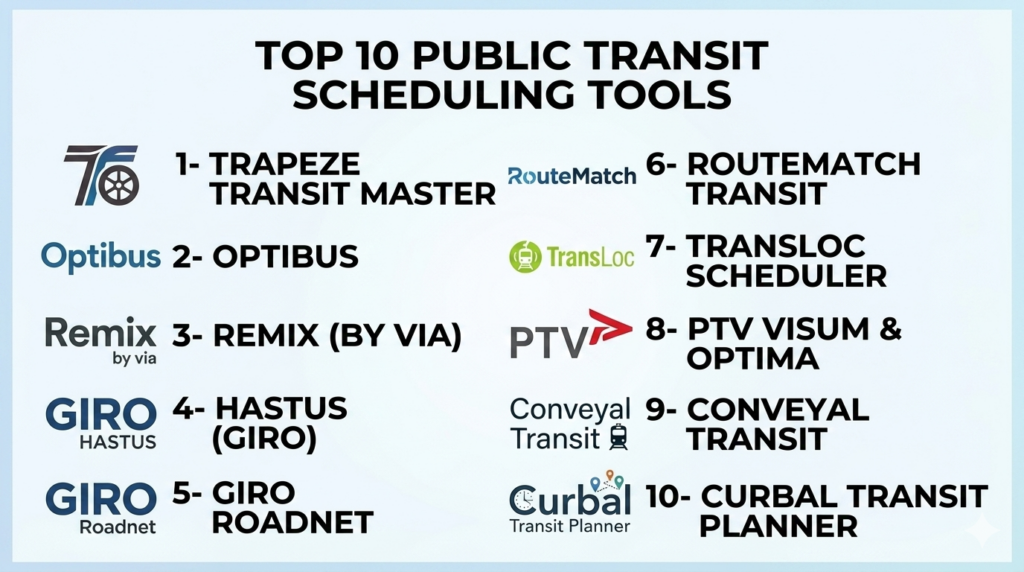
Introduction
Public Transit Scheduling Tools are specialized software solutions that help transit agencies plan, schedule, and optimize routes, timetables, vehicle assignments, crew rosters, and service frequencies. These systems aim to improve on‑time performance, balance demand with operational constraints, reduce service costs, and enhance rider experience. Scheduling software is critical for bus networks, rail systems, light rail, and multimodal transit operators, especially in busy urban and regional environments.
Transit agencies use these systems to generate optimized timetables; coordinate vehicle and crew assignments; align schedules with real‑time demand; handle disruptions; forecast travel patterns; manage resource utilization; and produce data for reporting and performance analysis. Buyers evaluating such tools should consider key criteria such as timetable generation, real‑time integration, optimization capabilities (vehicle and crew), demand forecasting, mobile and cloud support, analytics and KPIs, integration with passenger information systems, scalability, compliance reporting, and customer support.
Best for: Transit agencies, regional transportation authorities, bus operators, commuter rail and metro systems, and mobility planners seeking data‑driven scheduling and optimization.
Not ideal for: Small, single‑route or informal transit operations where basic spreadsheets suffice.
Key Trends in Public Transit Scheduling Tools
- AI‑driven schedule optimization for peak/off‑peak balancing
- Demand forecasting using real‑time and historic data
- Mobile tools for drivers and dispatchers
- Real‑time adjustments from GPS and AVL systems
- Integrated passenger information and arrival prediction
- Cloud‑native deployments with remote access
- Automated crew rostering and compliance checks
- Energy usage and vehicle yield optimization
- APIs for data export and integration
- Analytics dashboards for KPIs and performance tracking
How We Selected These Tools (Methodology)
- Evaluated adoption among public transit agencies
- Assessed core scheduling and optimization features
- Reviewed real‑time data integration (GPS, AVL, demand)
- Considered timetable generation and adjustment workflows
- Evaluated analytics and reporting capabilities
- Assessed integration support with passenger information systems
- Reviewed mobile and cloud access
- Evaluated automation and optimization engines
- Considered scalability across fleet sizes
- Assessed vendor support, documentation, and onboarding
Top 10 Public Transit Scheduling Tools
#1 — Trapeze Transit Master
Short description: Trapeze Transit Master offers a robust suite for public transit scheduling, including timetable planning, vehicle and crew assignment, real‑time monitoring, and analytics tailored for large bus, rail, and multimodal networks.
Key Features
- Route and timetable planning
- Optimized vehicle assignments
- Crew scheduling and compliance
- Real‑time schedule adjustment
- Operational dashboards and reporting
- Integration with AVL/GPS systems
Pros
- Designed for large, complex networks
- Strong real‑time and optimization capabilities
Cons
- Complexity requires training
- Premium pricing for large agencies
Platforms / Deployment
- Web
- Cloud / On‑premise
Security & Compliance
- Role‑based access
- Audit logging
Integrations & Ecosystem
- AVL/GPS feeds
- Passenger information systems
- Dispatch and mobile apps
Support & Community
Vendor documentation and support
#2 — Optibus
Short description: Optibus is an AI‑driven public transit scheduling and operations platform that uses optimization algorithms to improve route planning, vehicle and crew assignments, and real‑time service adjustments.
Key Features
- AI‑assisted schedule optimization
- Dynamic crew and vehicle planning
- Scenario forecasting
- Real‑time monitoring
- Analytics dashboards
- Cloud‑native platform
Pros
- Strong optimization engine
- Forecasting and simulation features
Cons
- Requires quality historical data
- Best for mid‑to‑large agencies
Platforms / Deployment
- Web
- Cloud
Security & Compliance
- Secure access control
- Data protection features
Integrations & Ecosystem
- Transit data APIs
- AVL/GPS integration
- Reporting tools
Support & Community
Documentation and onboarding support
#3 — Remix (by Via)
Short description: Remix provides transit planning, scheduling, and analysis tools focused on accessibility, route design, and performance planning for transit agencies.
Key Features
- Route and timetable design
- Ridership and demographic analysis
- Performance simulation
- Service redesign tools
- Data visualization
Pros
- Excellent planning and design focus
- User‑friendly interface
Cons
- Less real‑time dispatch support
- Core focus on planning over operations
Platforms / Deployment
- Web
- Cloud
Security & Compliance
- Role‑based permissions
- Secure data handling
Integrations & Ecosystem
- GIS and demand data
- Transit data sources
Support & Community
Training resources and help center
#4 — HASTUS (GIRO)
Short description: HASTUS is a mature transit planning and scheduling suite that supports route design, timetable generation, vehicle and crew assignments, and communications for mid‑to‑large agencies.
Key Features
- Route network design
- Timetable and block planning
- Vehicle assignment
- Crew rostering
- Real‑time schedule adjustments
Pros
- Proven enterprise transit solution
- Deep scheduling features
Cons
- User interface can feel dated
- Implementation requires training
Platforms / Deployment
- Web
- Cloud / On‑premise
Security & Compliance
- Secure access and audit logging
Integrations & Ecosystem
- AVL/GPS
- Dispatch systems
- Passenger information
Support & Community
Vendor support and documentation
#5 — GIRO Roadnet Transportation Suite
Short description: Roadnet provides schedule planning, reporting, and analytics for public transit operations with a focus on cost‑efficient routing and fleet usage.
Key Features
- Vehicle routing and planning
- Cost and resource optimization
- Scheduling workflows
- KPI dashboards
- Reporting tools
Pros
- Strong analytics and cost focus
- Flexible route planning
Cons
- Not as specialized for passenger scheduling
- Limited real‑time features
Platforms / Deployment
- Web
- Cloud
Security & Compliance
- Access control and audit logs
Integrations & Ecosystem
- Reporting systems
- Data exports
Support & Community
Vendor documentation and help resources
#6 — RouteMatch Transit
Short description: RouteMatch Transit specializes in transit scheduling, demand response planning, paratransit coordination, and fixed‑route optimization for public transit agencies.
Key Features
- Fixed route schedule planning
- Demand response scheduling
- Vehicle and crew assignments
- Real‑time dispatching
- Performance reports
Pros
- Paratransit and flexible service support
- Transit‑centric features
Cons
- Smaller footprint for very large agencies
- Real‑time analytics require configuration
Platforms / Deployment
- Web
- Cloud / On‑premise
Security & Compliance
- Secure access controls
Integrations & Ecosystem
- AVL/GPS
- Dispatch tools
- Passenger info
Support & Community
Support and training resources
#7 — TransLoc Scheduler
Short description: TransLoc Scheduler supports transit route planning, timetable creation, demand analysis, and multi‑modal coordination for agencies of varying sizes.
Key Features
- Route and schedule planning
- Multi‑modal service coordination
- Ridership forecasting
- Visual optimization tools
- Reporting dashboards
Pros
- User‑friendly interface
- Flexible scheduling workflows
Cons
- Less robust for very large fleets
- Real‑time dispatch features limited
Platforms / Deployment
- Web
- Cloud
Security & Compliance
- Secure access roles
Integrations & Ecosystem
- Demand data
- Reporting systems
Support & Community
Documentation and support
#8 — PTV Visum & PTV Optima
Short description: PTV Visum and Optima provide planning and scheduling for transit networks, including timetable design, simulation, and performance forecasting.
Key Features
- Network modeling
- Timetable optimization
- Simulation tools
- Ridership and demand analysis
- Scenario testing
Pros
- Strong simulation and modeling
- Good for strategic planning
Cons
- Not focused on real‑time dispatch
- Requires expert setup
Platforms / Deployment
- Web
- Cloud / On‑premise
Security & Compliance
- Secure access controls
Integrations & Ecosystem
- GIS and demand data
Support & Community
Documentation and training
#9 — Conveyal Transit
Short description: Conveyal Transit offers tools for scheduling, network design, and performance analysis with an emphasis on accessibility, equity, and data visualization.
Key Features
- Route planning
- Timetable scheduling
- Network performance metrics
- Accessibility analysis
- Visual analytics dashboards
Pros
- Equity and accessibility focus
- Visualization tools
Cons
- Limited real‑time dispatch
- Smaller ecosystem
Platforms / Deployment
- Web
- Cloud
Security & Compliance
- Secure access roles
Integrations & Ecosystem
- Transit data sources
- GIS tools
Support & Community
Open help resources
#10 — Curbal Transit Planner
Short description: Curbal Transit Planner provides a simplified scheduling and planning platform suitable for small to mid‑size agencies focusing on route and timetable construction without deep operational modules.
Key Features
- Timetable creation
- Route planning
- Ridership estimation
- Basic reporting
Pros
- Easy‑to‑use and accessible
- Affordable for smaller agencies
Cons
- Limited real‑time and optimization features
- Less suited for enterprise transit networks
Platforms / Deployment
- Web
- Cloud
Security & Compliance
- Access controls
Integrations & Ecosystem
- Basic data imports
Support & Community
Documentation and help center
Comparison Table (Top 10)
| Tool Name | Best For | Platform(s) Supported | Deployment | Standout Feature | Public Rating |
|---|---|---|---|---|---|
| Trapeze Transit Master | Large agencies | Web | Cloud/On‑premise | Enterprise scheduling & dispatch | N/A |
| Optibus | Mid‑large agencies | Web | Cloud | AI‑driven scheduling | N/A |
| Remix (by Via) | Transit planning | Web | Cloud | Planning & redesign focus | N/A |
| HASTUS (GIRO) | Transit agencies | Web | Cloud/On‑premise | Mature scheduling | N/A |
| GIRO Roadnet | Transit planning & cost | Web | Cloud | Cost optimization | N/A |
| RouteMatch Transit | Paratransit & fixed route | Web | Cloud/On‑premise | Demand response focus | N/A |
| TransLoc Scheduler | Mid‑size systems | Web | Cloud | Multi‑modal coordination | N/A |
| PTV Visum & Optima | Strategic planning | Web | Cloud/On‑premise | Simulation & modeling | N/A |
| Conveyal Transit | Equity & visualization | Web | Cloud | Accessibility analysis | N/A |
| Curbal Transit Planner | Small/mid agencies | Web | Cloud | Easy planning | N/A |
Evaluation & Scoring of Public Transit Scheduling Tools
| Tool Name | Core (25%) | Ease (15%) | Integrations (15%) | Security (10%) | Performance (10%) | Support (10%) | Value (15%) | Weighted Total |
|---|---|---|---|---|---|---|---|---|
| Trapeze Transit Master | 9 | 7 | 9 | 8 | 9 | 8 | 7 | 8.2 |
| Optibus | 9 | 8 | 8 | 8 | 9 | 8 | 8 | 8.4 |
| Remix (by Via) | 7 | 9 | 7 | 8 | 7 | 8 | 8 | 7.8 |
| HASTUS (GIRO) | 8 | 7 | 8 | 8 | 8 | 8 | 7 | 7.8 |
| GIRO Roadnet | 7 | 8 | 7 | 8 | 7 | 7 | 7 | 7.3 |
| RouteMatch Transit | 8 | 8 | 8 | 8 | 8 | 8 | 7 | 7.9 |
| TransLoc Scheduler | 7 | 9 | 7 | 8 | 7 | 8 | 8 | 7.8 |
| PTV Visum & Optima | 8 | 7 | 8 | 8 | 8 | 7 | 7 | 7.6 |
| Conveyal Transit | 7 | 8 | 7 | 8 | 7 | 7 | 8 | 7.4 |
| Curbal Transit Planner | 6 | 9 | 6 | 8 | 6 | 7 | 8 | 7.0 |
Interpretation: Higher scores indicate stronger core scheduling and optimization features, integration support, ease of use, security, vendor support, and overall value for varying agency sizes and needs.
Which Public Transit Scheduling Tool Is Right for You?
Large Transit Agencies
- Optibus and Trapeze Transit Master provide comprehensive scheduling, real‑time adjustments, and optimization suited for high‑demand networks.
Mid‑Size Systems
- RouteMatch Transit, TransLoc Scheduler, and HASTUS (GIRO) balance ease of use with powerful scheduling and operations features.
Strategic Planning & Redesign
- Remix and PTV Visum & Optima excel for planners redesigning routes and timetables based on demand and scenario analysis.
Equity & Accessibility Focus
- Conveyal Transit offers tools for accessibility and equity impact analysis during planning.
Small or Budget‑Conscious Agencies
- Curbal Transit Planner provides basic planning and scheduling without operational complexity.
Frequently Asked Questions (FAQs)
1. What does public transit scheduling software do?
It helps agencies plan routes, timetables, vehicle assignments, and adjust schedules based on demand, optimization, and real‑time inputs.
2. Can these tools handle demand response services?
Yes, tools like RouteMatch Transit provide specialized support for demand response and paratransit routes.
3. Do they integrate with real‑time GPS and AVL?
Many tools integrate with GPS and AVL systems to support real‑time schedule monitoring and adjustments.
4. Are these tools suitable for small transit agencies?
Yes — solutions like Curbal Transit Planner and TransLoc Scheduler are designed for smaller operations.
5. Can they help with long‑term planning?
Tools like Remix and PTV Visum are tailored for strategic planning and long‑term scheduling analysis.
6. Do these platforms support crew scheduling?
Some, particularly enterprise systems like Trapeze and Optibus, include crew rostering and compliance features.
7. Are mobile tools available for dispatchers and drivers?
Many modern systems provide mobile access for dispatchers and communication with operators.
8. Can agencies simulate schedule changes?
Yes — Optibus, PTV, and Remix support scenario simulation to assess impacts before implementation.
9. Do these systems improve on‑time performance?
By optimizing schedules and integrating real‑time data, yes — they help agencies improve punctuality.
10. Is cloud deployment common?
Yes, most modern transit scheduling tools offer cloud deployment for remote access and scalability.
Conclusion
Public Transit Scheduling Tools play a vital role in helping agencies plan, optimize, execute, and monitor transit routes and timetables across bus, rail, and multimodal systems. Large agencies with complex needs can benefit from Optibus and Trapeze Transit Master for deep optimization and real‑time support. Mid‑size operators find a strong balance of features and usability in RouteMatch Transit, TransLoc Scheduler, and HASTUS (GIRO). For planners focused on redesign and long‑term strategy, Remix and PTV Visum & Optima excel with simulation and analytics capabilities. Agencies of all sizes should pilot shortlisted tools with real data to validate scheduling, optimization, and integration capabilities before full deployment.

This is such a clear and helpful breakdown, thanks for sharing!