MOTOSHARE 🚗🏍️
Rent Bikes & Cars Directly from Owners
Motoshare connects vehicle owners with people who need bikes and cars on rent. Owners earn from idle vehicles, and renters get flexible ride options.
Visit Motoshare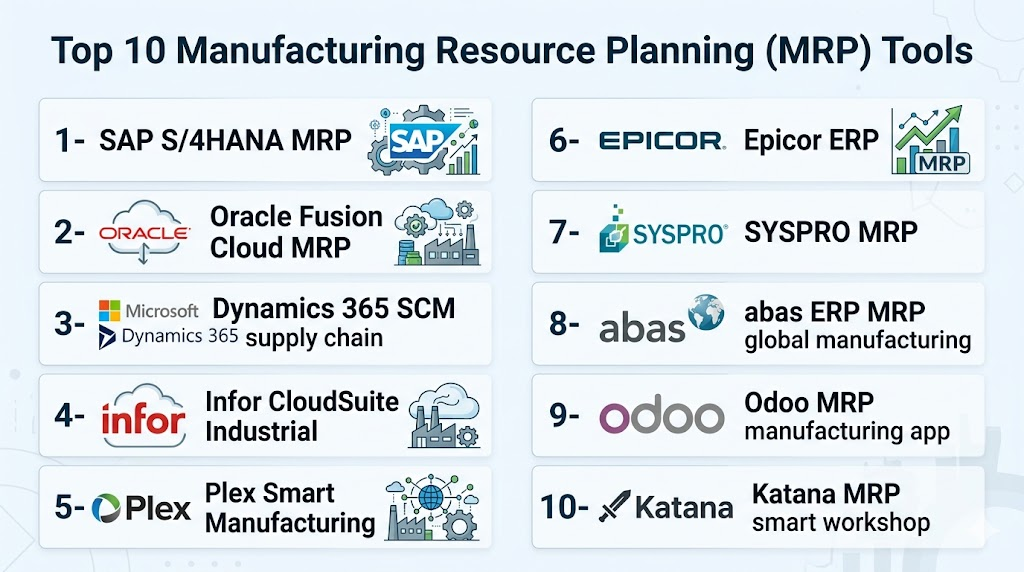
Introduction
Manufacturing Resource Planning (MRP) Tools are enterprise software systems that orchestrate core manufacturing operations — from inventory and procurement to production scheduling, cost tracking, and capacity planning. An evolution of traditional MRP systems, modern MRP platforms integrate with broader ERP suites, data lakes, analytics engines, and shop‑floor systems to deliver real‑time visibility and actionable insights across manufacturing operations.
MRP tools ensure that materials, labor, machines, and information align with production demands. They help manufacturers minimize inventory costs, avoid stockouts, optimize production schedules, streamline supplier coordination, and ultimately improve operational efficiency and delivery performance. In the era of digital manufacturing and supply chain volatility, effective MRP capabilities form the backbone of lean, agile, and cost‑efficient operations.
Real‑world use cases include:
- Coordinating purchase orders, inventory levels, and demand forecasts for electronics assembly.
- Scheduling multi‑stage production with capacity constraints in automotive supply chains.
- Reducing lead times and material shortages for job‑shop and discrete manufacturers.
- Generating cost‑to‑produce estimates and variance reports for financial oversight.
- Integrating shop‑floor execution data with planning functions for real‑time adjustment.
Evaluation Criteria for Buyers:
- Inventory and material planning accuracy
- Production scheduling and capacity planning
- Supplier and procurement coordination
- Integration with ERP, MES, SCADA, and IoT systems
- Reporting and analytics
- Demand forecasting and safety stock support
- Usability for planners and shop‑floor teams
- Support for lot/serial tracking and compliance
- Scalability across facilities
- Cost and deployment flexibility
Best for: Production planners, supply chain managers, plant managers, operations leaders, finance teams, and manufacturers of all sizes seeking to improve planning accuracy, inventory efficiency, and production coordination.
Not ideal for: Very small manufacturers with minimal planning needs or businesses with static workflows where manual spreadsheets suffice.
Key Trends in Manufacturing Resource Planning Tools
- Cloud‑first MRP for multi‑site coordination and remote access.
- Embedded AI forecasting and demand planning models.
- Real‑time integration with shop‑floor execution systems (MES, SCADA).
- Support for lean manufacturing and just‑in‑time (JIT) workflows.
- Modular, low‑code customization and workflow automation.
- Enhanced supplier collaboration portals.
- Mobile access for planners and operations teams.
- Compliance and audit trails for quality and regulatory reporting.
- Open APIs and data exchange with analytics platforms.
How We Selected These Tools (Methodology)
- Evaluated market adoption and reputation across manufacturing sectors.
- Assessed core material planning, scheduling, and forecasting capabilities.
- Reviewed integration breadth with ERP, MES, and supply chain systems.
- Considered scalability and suitability across SMB to enterprise.
- Analyzed usability for non‑technical planners and operations staff.
- Checked analytics, reporting, and KPI tracking features.
- Reviewed security, access controls, and compliance readiness.
- Reviewed vendor support, documentation, and community engagement.
Top 10 Manufacturing Resource Planning (MRP) Tools
#1 — SAP S/4HANA MRP
Short description:
SAP S/4HANA’s MRP capabilities are part of a broader enterprise suite that delivers in‑memory planning, real‑time data visibility, and deep integration with finance, supply chain, and production systems for large enterprises.
Key Features
- Real‑time material and capacity planning
- Advanced demand forecasting and simulation
- Integration with global supply chains
- Analytics and KPI dashboards
- Multi‑site planning and visibility
Pros
- Enterprise‑grade scalability and performance
- Deep integration with broader ERP functions
- Strong analytics and forecasting
Cons
- Complexity and implementation cost
- Long‑term deployment effort
Platforms / Deployment
- Web, Cloud, Hybrid
Security & Compliance
- Enterprise security controls, role‑based access, audit trails
Integrations & Ecosystem
- ERP modules (finance, SCM, quality)
- PLM, MES, and shop‑floor systems
- API and analytics connectors
Support & Community
- SAP enterprise support, knowledge base, industry partners
#2 — Oracle Fusion Cloud MRP
Short description:
Oracle Fusion Cloud delivers a modern cloud‑native MRP module within its broader ERP suite, supporting global manufacturing, supply planning, and inventory optimization.
Key Features
- Demand‑driven material planning
- Supply and capacity balancing
- Multi‑location coordination
- Real‑time inventory health
- Analytics and role‑based dashboards
Pros
- Cloud‑native with automatic updates
- Integrated demand and supply planning
- Strong security and compliance
Cons
- Enterprise focus may be costly for small manufacturers
- Requires integration expertise
Platforms / Deployment
- Web, Cloud
Security & Compliance
- IAM, encryption, audit logging
Integrations & Ecosystem
- ERP financials, SCM, procurement
- IoT and analytics pipelines
- API and BI connectors
Support & Community
- Oracle support, cloud documentation
#3 — Microsoft Dynamics 365 Supply Chain Management
Short description:
Dynamics 365 includes MRP within its supply chain module, with planning, forecasting, and scheduling tools integrated across manufacturing and operations.
Key Features
- Demand forecasting and planning optimization
- Inventory health and safety stock alerts
- Multi‑site production and resource planning
- Embedded analytics with Power BI
- Supplier collaboration portals
Pros
- Seamless integration with Dynamics ecosystem
- Familiar UI and productivity tools
- Cloud and hybrid options
Cons
- Best experienced with full Dynamics suite
- Add‑ons may increase licensing
Platforms / Deployment
- Web, Cloud, Hybrid
Security & Compliance
- Azure security controls, RBAC, encryption
Integrations & Ecosystem
- ERP, CRM, Power Platform
- IoT data feeds
- Analytics and visualization
Support & Community
- Microsoft support and partner network
#4 — Infor CloudSuite Industrial (SyteLine)
Short description:
Infor’s CloudSuite Industrial includes MRP planners, scheduling, and inventory optimization tailored for mid‑market discrete manufacturers.
Key Features
- Multi‑level material planning
- Finite capacity scheduling
- Inventory and order tracking
- Workflow automation
- Real‑time role‑based dashboards
Pros
- Designed for discrete and mixed‑mode manufacturing
- User‑friendly planning screens
- Built‑in analytics
Cons
- Depth varies by module
- Add‑on costs for advanced forecasting
Platforms / Deployment
- Web, Cloud, Hybrid
Security & Compliance
- Role‑based access, encryption
Integrations & Ecosystem
- ERP, MES, CRM
- Analytics platforms
- API connections
Support & Community
- Infor support, user groups
#5 — Plex Smart Manufacturing Platform
Short description:
Plex delivers cloud‑native MRP capabilities within a comprehensive manufacturing execution and ERP platform suited for mid‑market discrete manufacturers.
Key Features
- Real‑time inventory status and planning
- Production scheduling and order orchestration
- Supplier lead time and PO management
- Analytics dashboards
- Mobile planning interfaces
Pros
- Cloud‑native with rapid deployment
- Strong real‑time visibility
- Integrated shop floor data
Cons
- Best when used with broader Plex suite
- Smaller footprint than large enterprise ERP
Platforms / Deployment
- Web, Cloud
Security & Compliance
- Role‑based access, encryption
Integrations & Ecosystem
- ERP and MES modules
- IoT device feeds
- Analytics connectors
Support & Community
- Plex support and forums
#6 — Epicor ERP MRP
Short description:
Epicor’s MRP tools are part of its ERP suite, providing planning, forecasting, and scheduling for discrete manufacturers with robust analytics and shop‑floor integration.
Key Features
- Material requirement planning
- Demand forecasting and safety stock
- Production scheduling and capacity planning
- Supplier tracking and PO management
- Analytics and KPI reporting
Pros
- Balanced feature set for mid‑size manufacturers
- Strong shop‑floor data integration
- Flexible deployment
Cons
- Add‑on modules may be needed
- UI can be complex for new users
Platforms / Deployment
- Web, Cloud, Hybrid
Security & Compliance
- RBAC, encryption
Integrations & Ecosystem
- ERP finance and operations
- MES connectivity
- Analytics dashboards
Support & Community
- Epicor support and resources
#7 — SYSPRO MRP
Short description:
SYSPRO’s MRP capabilities are built for small to mid‑market manufacturers with inventory control, planning, and shop‑floor visibility.
Key Features
- Material planning and demand forecasting
- Inventory optimization
- Supplier and PO tracking
- Capacity planning and scheduling
- Customizable dashboards
Pros
- Simple and intuitive for SMEs
- Good coverage of core MRP functions
- Flexible deployment
Cons
- Less deep analytics than enterprise tools
- Add‑ons needed for advanced simulation
Platforms / Deployment
- Web, Cloud, Hybrid
Security & Compliance
- RBAC, encryption
Integrations & Ecosystem
- ERP, finance, CRM
- Analytics tools
Support & Community
- SYSPRO support network
#8 — abas ERP MRP
Short description:
abas ERP includes material planning and scheduling tools suited for mid‑market discrete and mixed‑mode manufacturers.
Key Features
- Material requirements planning
- Finite scheduling and capacity checks
- Inventory tracking and alerts
- Supplier coordination
- Analytics and reporting
Pros
- Customizable and flexible
- Finite capacity planning
- Good mid‑market balance
Cons
- Smaller ecosystem than large suites
- Added cost for advanced modules
Platforms / Deployment
- Web, Cloud, Hybrid
Security & Compliance
- RBAC, encryption
Integrations & Ecosystem
- ERP, CRM, SCM
- Analytics connectors
Support & Community
- abas support and documentation
#9 — Odoo MRP
Short description:
Odoo’s open‑core MRP module delivers core planning, production orders, and inventory tracking within a modular suite that scales with business needs.
Key Features
- Bill of materials (BOM) and routing
- Work orders and production scheduling
- Inventory and procurement tracking
- Reporting and dashboards
- Modular add‑ons
Pros
- Cost‑efficient and modular
- Easy to deploy and customize
- Integrates with CRM, sales, and inventory
Cons
- Less advanced forecasting
- Requires configuration for complex planning
Platforms / Deployment
- Web, Cloud, Hybrid
Security & Compliance
- Role‑based access, encryption
Integrations & Ecosystem
- CRM, eCommerce, accounting
- Analytics modules
Support & Community
- Odoo community and enterprise support
#10 — Katana MRP
Short description:
Katana is a modern cloud MRP designed for small to mid‑size manufacturers, providing intuitive planning, inventory control, and production tracking.
Key Features
- Real‑time inventory visibility
- Production planning and batching
- Supplier lead time and PO tracking
- Sales integration
- Dashboards and alerts
Pros
- Cloud‑native and easy to use
- Designed for SMB manufacturers
- Rapid implementation
Cons
- Limited advanced analytics
- Fit for simple to moderate planning needs
Platforms / Deployment
- Web, Cloud
Security & Compliance
- Role‑based access, encryption
Integrations & Ecosystem
- eCommerce, accounting, CRM
- Analytics dashboards
Support & Community
- Vendor support and documentation
Comparison Table (Top 10 MRP Tools)
| Tool Name | Best For | Platform(s) Supported | Deployment | Standout Feature | Public Rating |
|---|---|---|---|---|---|
| SAP S/4HANA MRP | Enterprise global planning | Web | Cloud/Hybrid | Real‑time planning at scale | N/A |
| Oracle Fusion Cloud MRP | Cloud‑native manufacturing | Web | Cloud | Integrated supply‑demand balancing | N/A |
| Dynamics 365 SCM | Integrated D365 planning | Web | Cloud/Hybrid | Power BI embedded analytics | N/A |
| Infor CloudSuite Industrial | Mid‑market discrete | Web | Cloud/Hybrid | Finite capacity scheduling | N/A |
| Plex Smart Manufacturing | Cloud MRP + MES | Web | Cloud | Real‑time shop‑floor visibility | N/A |
| Epicor ERP MRP | Mid‑size manufacturers | Web | Cloud/Hybrid | Balanced planning features | N/A |
| SYSPRO MRP | SME focus | Web | Cloud/Hybrid | Intuitive planning | N/A |
| abas ERP MRP | Mid‑market planning | Web | Cloud/Hybrid | Finite scheduling | N/A |
| Odoo MRP | Modular automation suite | Web | Cloud/Hybrid | Cost‑efficient modularity | N/A |
| Katana MRP | SMB manufacturing | Web | Cloud | Simple intuitive planning | N/A |
Evaluation & Scoring of MRP Tools
| Tool | Core (25%) | Ease (15%) | Integrations (15%) | Security (10%) | Performance (10%) | Support (10%) | Value (15%) | Weighted Total (0–10) |
|---|---|---|---|---|---|---|---|---|
| SAP S/4HANA MRP | 9 | 7 | 9 | 8 | 9 | 8 | 7 | 8.4 |
| Oracle Fusion Cloud MRP | 9 | 8 | 8 | 8 | 8 | 8 | 7 | 8.1 |
| Dynamics 365 SCM | 8 | 8 | 8 | 8 | 8 | 8 | 8 | 8.1 |
| Infor CloudSuite | 8 | 7 | 8 | 7 | 8 | 7 | 7 | 7.6 |
| Plex Smart Manufacturing | 8 | 8 | 7 | 7 | 8 | 7 | 8 | 7.8 |
| Epicor ERP MRP | 8 | 7 | 8 | 7 | 7 | 7 | 7 | 7.6 |
| SYSPRO MRP | 7 | 8 | 7 | 7 | 7 | 7 | 8 | 7.4 |
| abas ERP MRP | 7 | 8 | 7 | 7 | 7 | 7 | 7 | 7.3 |
| Odoo MRP | 7 | 8 | 7 | 7 | 7 | 7 | 8 | 7.4 |
| Katana MRP | 7 | 9 | 6 | 7 | 7 | 7 | 8 | 7.5 |
Interpretation: Higher totals indicate stronger core planning, integration, and enterprise readiness. Tools with broader ecosystem support and analytics typically score highest.
Which MRP Tool Is Right for You?
Solo / Freelancer
For small operations needing simple planning, cloud tools like Katana MRP or Odoo MRP offer fast onboarding and intuitive dashboards.
SMB
Mid‑market manufacturers benefit from Plex Smart Manufacturing, SYSPRO MRP, or abas ERP MRP for balanced planning, inventory control, and scalability.
Mid‑Market / Enterprise
Tools such as Infor CloudSuite Industrial, Epicor ERP MRP, or Dynamics 365 SCM deliver deeper planning, analytics, and multi‑site coordination.
Enterprise
Large global manufacturers with complex supply chains should consider SAP S/4HANA MRP or Oracle Fusion Cloud MRP for real‑time planning, forecasting, and integration with global operations.
Budget vs Premium
Cloud‑native platforms offer quick ROI and low IT overhead; enterprise suites provide deeper analytics, customization, and scalability at higher cost.
Feature Depth vs Ease of Use
Enterprise tools have broader planning depth, while SMB tools prioritize ease of use and rapid deployment.
Integrations & Scalability
Evaluate ERP, MES, SCADA, and analytics connections to ensure seamless data flow and real‑time visibility.
Security & Compliance Needs
MRP tools in regulated sectors should support role‑based permissions, audit trails, and encrypted communication to meet compliance requirements.
Frequently Asked Questions (FAQs)
1. What is an MRP tool?
MRP tools help manufacturers plan materials, schedule production, and manage inventory to meet demand efficiently.
2. How do MRP and ERP differ?
MRP focuses on planning and scheduling materials and production; ERP covers broader business functions including finance, HR, and procurement.
3. Does cloud MRP work for large manufacturers?
Yes — cloud-native MRP scales while providing centralized visibility and remote access for multi‑site operations.
4. Can MRP integrate with shop‑floor systems?
Modern MRP tools can integrate with MES, SCADA, and IoT devices for real‑time data and adjustments.
5. How does MRP improve inventory control?
MRP forecasts demand, calculates material needs, and prevents stockouts or overstocking.
6. Are AI forecasting features common?
Emerging MRP platforms embed AI for demand forecasting and supply optimization.
7. Do MRP tools support multi‑site planning?
Yes — many tools offer centralized planning for dispersed facilities.
8. How long does MRP implementation take?
Implementation timelines vary by scope, from weeks (for cloud tools) to months (for enterprise suites).
9. Can small manufacturers use MRP?
Yes — SMB‑focused tools provide light‑weight and intuitive planning without complexity.
10. Is training required for MRP tools?
Training boosts adoption and planning accuracy, especially for deeper scheduling, forecasting, and analytics modules.
Conclusion
Manufacturing Resource Planning (MRP) Tools are critical to modern manufacturing workflows. They ensure that material availability, production schedules, and inventory levels align with business demand and supply constraints. Enterprise platforms such as SAP S/4HANA and Oracle Fusion Cloud MRP deliver deep planning and forecasting across global supply chains, while SMB and mid‑market options like Plex Smart Manufacturing, SYSPRO MRP, and Odoo MRP offer cost‑effective and intuitive solutions. Selecting the right tool requires clarity on production complexity, integration requirements, scalability goals, and budget. A practical approach involves shortlisting tools, piloting with representative workflows, validating analytics and integration, and ensuring alignment with long‑term manufacturing objectives.

Loved this content
Great work! The information is presented in a very simple way.