MOTOSHARE 🚗🏍️
Rent Bikes & Cars Directly from Owners
Motoshare connects vehicle owners with people who need bikes and cars on rent. Owners earn from idle vehicles, and renters get flexible ride options.
Visit Motoshare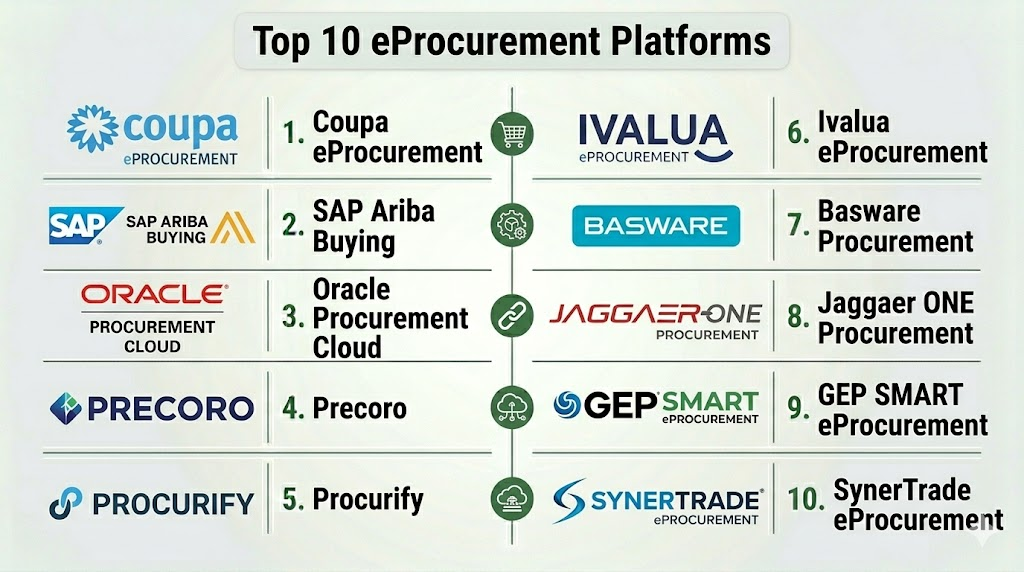
Introduction
eProcurement Platforms are digital systems that automate and manage the procure‑to‑pay (P2P) lifecycle — from requisition and purchase order generation, through approvals, supplier catalog management, invoice matching, and spend analysis. Unlike manual processes or basic ERP purchasing modules, eProcurement platforms provide structured workflows, enforce purchasing policies, enable supplier self‑service, and offer visibility into organizational spend. They reduce cycle times, prevent maverick spend, improve compliance, and strengthen operational controls.
In the modern era of digital procurement , expectations have evolved beyond simple automation: buyers want real‑time spend intelligence, AI‑assisted sourcing insights, supplier risk scoring, mobile approvals, and enterprise‑grade governance. With supply chains and supplier ecosystems growing increasingly complex, eProcurement platforms serve as the foundation for strategic procurement operations in mid‑market and enterprise organizations.
Real‑world use cases include:
- Centralized requisitioning and automated purchase order issuance.
- Structured approval workflows with mobile and role‑based controls.
- Supplier catalog browsing with punch‑out connections to external marketplaces.
- Three‑way matching (PO‑receipt‑invoice) and AP reconciliation.
- Spend analytics and compliance dashboards for finance and procurement leaders.
Evaluation Criteria for Buyers:
- Requisition workflows and approval engines
- Supplier catalogs and punch‑out capability
- Purchase order (PO) automation and matching
- Integration with ERP/AP/AR systems
- Spend visibility and reporting
- Compliance and approval controls
- Mobile access and user experience
- Supplier onboarding and portal self‑service
- Analytics and benchmarking tools
- Security, role‑based access, and audit trails
Best for: Procurement teams, finance controllers, supply chain leaders, category managers, and operations teams in organizations with moderate to high volumes of procurement.
Not ideal for: Very small organizations with low purchasing volume and minimal approval requirements where spreadsheets or basic ERP purchasing suffice.
Key Trends in eProcurement Platforms
- Cloud‑native and API‑first architectures for ease of integration and scalability.
- AI‑assisted requisition guidance and supplier recommendations.
- Integration with supplier networks, punch‑out catalogs, and marketplaces.
- Automated approval routing with mobile notifications.
- Three‑way matching and automated invoice reconciliation.
- Real‑time spend analytics and benchmarking dashboards.
- Supplier risk, compliance, and diversity scoring.
- Self‑service supplier portals with onboarding and KPI dashboards.
- Integration with ERP, AP/AR, and contract management systems.
- User experience (UX) and mobile approvals to support distributed teams.
How We Selected These Tools (Methodology)
- Evaluated feature breadth across requisitioning, ordering, supplier catalogs, and matching.
- Assessed integration capabilities with ERP/AP systems and external marketplaces.
- Considered scalability from mid‑market to enterprise deployment.
- Verified workflow and approval engines, including mobile access.
- Reviewed analytics, spend reporting, and compliance dashboards.
- Checked security, role‑based access, and audit controls.
- Analyzed mobile UX and user onboarding experience.
- Examined supplier portal and self‑service capabilities.
- Evaluated support, documentation, and partner ecosystem.
Top 10 eProcurement Platforms
#1 — Coupa eProcurement
Short description:
Coupa’s eProcurement module is a leading cloud‑native platform that emphasizes usability, catalog punch‑outs, policy enforcement, and spend visibility — backed by a broad ecosystem of integrated suppliers.
Key Features
- Requisition and approval workflows
- Punch‑out catalogs and supplier catalogs
- PO automation and matching
- Spend analytics and benchmarking
- Budget enforcement and controls
Pros
- Excellent user experience
- Strong analytics and insights
- Open ecosystem and integration flexibility
Cons
- Pricing can be high for extensive modules
- Moderate implementation effort for large orgs
Platforms / Deployment
- Web, Cloud
Security & Compliance
- RBAC, encryption, audit trails
Integrations & Ecosystem
- ERP/AP systems
- Supplier networks
- Contract and financial systems
Support & Community
- Coupa support and user community
#2 — SAP Ariba Buying
Short description:
SAP Ariba Buying is part of the broader Ariba Network, offering robust requisitioning, buyer‑supplier connectivity, catalog management, and compliance controls — suited for global enterprise procurement.
Key Features
- Purchase requisitions and PO automation
- Supplier catalogs and punch‑outs
- Supplier network connectivity
- Spend compliance and controls
- Analytics and reporting
Pros
- Deep supplier network reach
- Strong compliance and policy enforcement
- Scales globally
Cons
- Implementation complexity
- Premium pricing for enterprise scale
Platforms / Deployment
- Web, Cloud
Security & Compliance
- Enterprise access control, audit trails
Integrations & Ecosystem
- SAP ERP/S/4HANA
- Supplier networks
Support & Community
- SAP global support
#3 — Oracle Procurement Cloud
Short description:
Oracle’s eProcurement capabilities within Oracle Cloud ERP provide requisitioning, purchasing, supplier qualification, sourcing, and invoicing within a unified suite.
Key Features
- Requisitions and automated PO creation
- Supplier qualification and onboarding
- Punch‑out and catalog management
- AP reconciliation and matching
- Spend dashboards
Pros
- Strong ERP integration
- Comprehensive lifecycle coverage
- Good for enterprise governance
Cons
- Deployment effort high in complex orgs
- Best with Oracle ecosystem
Platforms / Deployment
- Web, Cloud
Security & Compliance
- Enterprise access controls
Integrations & Ecosystem
- Oracle ERP suite
- Financial and AP systems
Support & Community
- Oracle support network
#4 — Precoro
Short description:
Precoro is a mid‑market eProcurement platform that provides requisitioning, approvals, PO automation, budget tracking, and spend dashboards with quick implementation and ease of use.
Key Features
- Requisition workflows
- Approval automation
- PO generation and tracking
- Budget controls and alerts
- Spend reporting
Pros
- Strong mid‑market fit
- Quick onboarding
- Intuitive UI
Cons
- Less advanced analytics than enterprise suites
- Sourcing and supplier management limited
Platforms / Deployment
- Web, Cloud
Security & Compliance
- RBAC, encryption
Integrations & Ecosystem
- ERP/AP connectors
- Accounting systems
Support & Community
- Vendor support
#5 — Procurify
Short description:
Procurify provides an easy‑to‑adopt eProcurement platform with requisition controls, approvals, PO automation, budget tracking, and spend visibility — well‑suited for growing organizations.
Key Features
- Purchase request workflows
- Approval automation
- Budget checking
- PO issuance
- Spend reporting
Pros
- Affordable for mid‑market
- Mobile approvals and dashboards
- Simple learning curve
Cons
- Contract and sourcing features limited
- Advanced analytics basic
Platforms / Deployment
- Web, iOS, Android, Cloud
Security & Compliance
- Encryption, RBAC
Integrations & Ecosystem
- ERP/AP systems
- Accounting tools
Support & Community
- Support and documentation
#6 — Ivalua eProcurement
Short description:
Ivalua offers a unified procurement suite with highly configurable requisitions, catalogs, approvals, supplier onboarding, and spend analytics — ideal for complex, global procurement organizations.
Key Features
- Configurable requisitions and approvals
- Supplier catalogs and punch‑outs
- Budget and policy controls
- Spend analytics and dashboards
- Supplier onboarding and portal
Pros
- Highly flexible and configurable
- Deep supplier controls
- Unified platform
Cons
- Requires experienced administrators
- Implementation can be resource‑intensive
Platforms / Deployment
- Web, Cloud
Security & Compliance
- RBAC, encryption
Integrations & Ecosystem
- ERP/AP connectors
- Supplier networks
Support & Community
- Vendor support
#7 — Basware Procurement
Short description:
Basware’s eProcurement solution emphasizes P2P automation, e‑invoicing, supplier catalog management, and spend visibility with strong compliance capabilities.
Key Features
- Requisitions and PO automation
- E‑invoicing and AP integration
- Supplier catalogs and punch‑outs
- Spend analytics
- Compliance dashboards
Pros
- Live e‑invoicing support
- Strong AP and compliance integration
- Good global reach
Cons
- Sourcing and advanced analytics weaker
- Requires ERP connectors
Platforms / Deployment
- Web, Cloud
Security & Compliance
- Enterprise security controls
Integrations & Ecosystem
- ERP/AP systems
Support & Community
- Basware support
#8 — Jaggaer ONE Procurement
Short description:
Jaggaer’s eProcurement module is part of a broader suite offering requisitioning, sourcing, supplier management, contracts, and spend analytics for complex procurement environments.
Key Features
- Requisitioning and PO workflows
- Supplier catalogs
- Approval and policy enforcement
- Spend analytics
- ERP and financial integrations
Pros
- Broad enterprise capability
- Strong analytics
- Supplier performance tracking
Cons
- Pricier for smaller organizations
- Setup and configuration effort
Platforms / Deployment
- Web, Cloud
Security & Compliance
- RBAC, encryption
Integrations & Ecosystem
- ERP/AP connectors
Support & Community
- Vendor support
#9 — GEP SMART eProcurement
Short description:
GEP SMART offers a unified, cloud‑native procurement platform with requisitioning, purchasing, contract, supplier, and spend modules — emphasizing AI and analytics.
Key Features
- Requisition and PO automation
- Supplier onboarding and risk
- Contract integration
- AI‑assisted sourcing
- Spend dashboards
Pros
- Unified suite
- Strong analytics
- AI‑supported workflows
Cons
- Licensing complexity
- Implementation planning needed
Platforms / Deployment
- Web, Cloud
Security & Compliance
- Encryption, RBAC
Integrations & Ecosystem
- ERP/AP systems
Support & Community
- Training and support
#10 — SynerTrade eProcurement
Short description:
SynerTrade’s eProcurement solution provides requisitions, catalog management, supplier tools, approvals, and spend reporting with flexible deployment options for global enterprises.
Key Features
- Requisition and approval workflows
- Supplier catalog support
- Budget controls
- Spend analysis
- Mobile approvals
Pros
- Flexible and adaptable
- Good supplier catalog tools
- Enterprise scalability
Cons
- UI complexity for new users
- Some modules need configuration
Platforms / Deployment
- Web, Cloud
Security & Compliance
- RBAC, encryption
Integrations & Ecosystem
- ERP/AP systems
Support & Community
- Vendor support
Comparison Table (Top 10 eProcurement Platforms)
| Tool Name | Best For | Platform(s) Supported | Deployment | Standout Feature | Public Rating |
|---|---|---|---|---|---|
| Coupa eProcurement | Cloud‑native procurement | Web | Cloud | Spend insights & policies | N/A |
| SAP Ariba Buying | Global enterprise | Web | Cloud | Supplier network reach | N/A |
| Oracle Procurement Cloud | ERP‑aligned procurement | Web | Cloud | Unified suite | N/A |
| Precoro | Mid‑market buyers | Web | Cloud | Quick onboarding | N/A |
| Procurify | Growing teams | Web, iOS, Android | Cloud | Mobile approvals | N/A |
| Ivalua eProcurement | Configurable enterprise | Web | Cloud | Flexibility | N/A |
| Basware Procurement | AP + P2P focus | Web | Cloud | E‑invoicing integration | N/A |
| Jaggaer ONE Procurement | Complex procurement | Web | Cloud | Analytics & tracking | N/A |
| GEP SMART eProcurement | AI‑assisted spend | Web | Cloud | AI analytics | N/A |
| SynerTrade eProcurement | Flexible enterprise | Web | Cloud | Catalog & controls | N/A |
Evaluation & Scoring of eProcurement Platforms
| Tool Name | Core (25%) | Ease (15%) | Integrations (15%) | Security (10%) | Performance (10%) | Support (10%) | Value (15%) | Weighted Total (0–10) |
|---|---|---|---|---|---|---|---|---|
| Coupa eProcurement | 9 | 8 | 8 | 8 | 8 | 8 | 7 | 8.2 |
| SAP Ariba Buying | 9 | 7 | 9 | 9 | 9 | 8 | 7 | 8.3 |
| Oracle Procurement Cloud | 8 | 7 | 9 | 9 | 8 | 8 | 7 | 8.0 |
| Precoro | 7 | 9 | 7 | 8 | 7 | 8 | 8 | 7.9 |
| Procurify | 7 | 9 | 7 | 8 | 7 | 8 | 8 | 7.9 |
| Ivalua eProcurement | 9 | 7 | 8 | 8 | 8 | 8 | 7 | 8.0 |
| Basware Procurement | 7 | 7 | 8 | 9 | 8 | 7 | 7 | 7.6 |
| Jaggaer ONE Procurement | 8 | 7 | 8 | 8 | 8 | 8 | 7 | 7.9 |
| GEP SMART eProcurement | 8 | 8 | 8 | 8 | 8 | 8 | 7 | 8.0 |
| SynerTrade eProcurement | 8 | 7 | 8 | 8 | 8 | 7 | 7 | 7.7 |
Interpretation: Higher weighted totals indicate balanced platforms with strong core eProcurement capabilities, integrations, governance, and user experience.
Which eProcurement Platform Is Right for You?
Solo / Freelancer
For basic requisitions and approvals, Precoro or Procurify deliver quick onboarding, mobile approvals, and strong mid‑market value.
SMB
Growing organizations can benefit from Coupa eProcurement, Precoro, or Procurify for spend visibility and automated controls.
Mid‑Market / Enterprise
Enterprises with advanced needs should consider SAP Ariba Buying, Oracle Procurement Cloud, Ivalua eProcurement, or GEP SMART for deep analytics, supplier controls, and broad integration.
Budget vs Premium
Cloud‑native platforms offer rapid deployment and easier total cost of ownership; premium enterprise platforms deliver deeper analytics and global procurement governance.
Integrations & Scalability
Choose platforms that integrate with your existing ERP, AP/AR, contract, and supplier networks to streamline end‑to‑end procurement.
Security & Compliance Needs
For regulated industries and multi‑entity organizations, strong role‑based access, audit logging, and compliance controls are essential.
Frequently Asked Questions (FAQs)
1. What is an eProcurement platform?
An eProcurement platform automates and governs purchasing processes including requisitions, approvals, PO generation, supplier catalogs, and spend analytics.
2. How does eProcurement differ from ERP purchasing?
ERP purchasing modules may handle transaction recording, but eProcurement platforms add governance, workflows, catalog management, and analytics.
3. Do these platforms integrate with ERP and AP systems?
Yes — most provide connectors or APIs to ERP and AP systems to align procurement with financial workflows.
4. Can eProcurement reduce cost?
Yes — by enforcing policies, reducing maverick spend, and improving spend visibility and supplier negotiation.
5. Are supplier catalogs supported?
Yes — including punch‑out catalogs to external supplier marketplaces.
6. Do these platforms support mobile approvals?
Many offer mobile apps or mobile‑optimized portals for review and approvals on the go.
7. Is spend analytics included?
Yes — dashboards and reports provide insight into spend categories, trends, and compliance.
8. Can small teams use eProcurement?
Yes — tools like Precoro and Procurify are well‑suited for smaller procurement teams.
9. Do these platforms enforce compliance?
Yes — through automated approval workflows, policies, and audit trails.
10. How long does implementation take?
Cloud solutions can launch in weeks; enterprise deployments may take months depending on integrations and process configuration.
Conclusion
eProcurement platforms are becoming indispensable infrastructure for organizations seeking control, visibility, and efficiency in purchasing. From mid‑market offerings like Precoro and Procurify that provide user‑friendly requisitions and approvals to enterprise platforms like SAP Ariba Buying, Coupa eProcurement, and Oracle Procurement Cloud that deliver deep analytics and supplier controls, there is a solution for every procurement profile. When choosing an eProcurement platform, align your functional needs with integration readiness, governance requirements, and scalability goals. Pilot shortlisted tools with real procurement scenarios and metrics to ensure measurable improvements in cost management, compliance, and operational agility.

Very interesting topic and good explanation.
Very nice and helpful post.