MOTOSHARE 🚗🏍️
Rent Bikes & Cars Directly from Owners
Motoshare connects vehicle owners with people who need bikes and cars on rent. Owners earn from idle vehicles, and renters get flexible ride options.
Visit Motoshare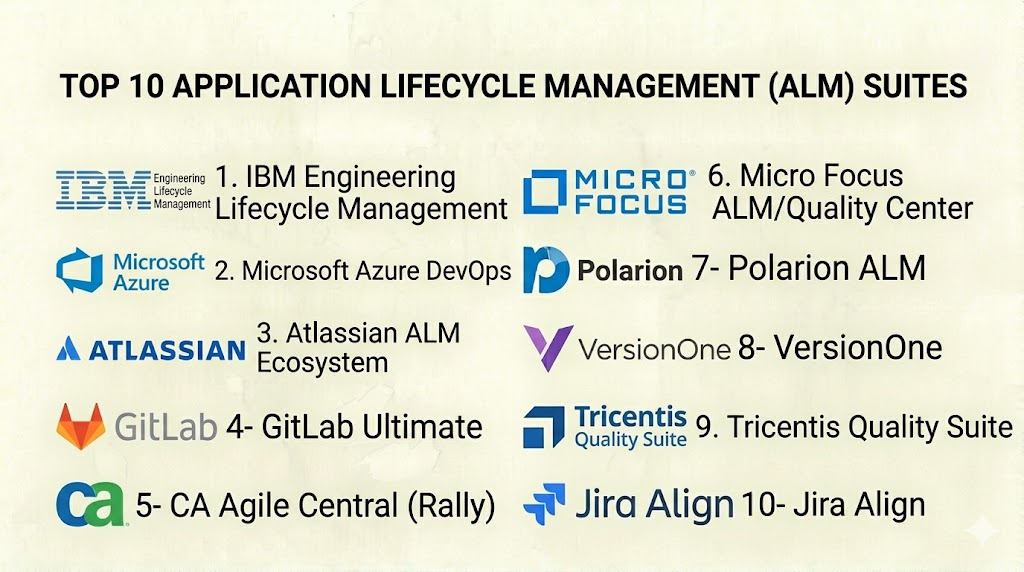
Introduction
Application Lifecycle Management (ALM) Suites are comprehensive platforms designed to manage the entire lifecycle of a software application—from initial concept and requirements through development, testing, deployment, and maintenance. ALM provides a unified framework that connects planning, requirements, development, testing, and release activities to ensure consistency, traceability, and collaboration across teams. In complex software environments where multiple teams operate across different stages of delivery, ALM suites help align business objectives with execution, reduce risk, and improve delivery predictability.
Modern ALM Suites bring together multiple capabilities into a single integrated system, replacing fragmented toolchains and manual handoffs. They often include requirement management, issue and bug tracking, test management, version control, CI/CD integration, reporting, and traceability. As organizations increasingly adopt DevOps and Agile methodologies, ALM Suites serve as the backbone of transparent, measurable software delivery.
Real‑world use cases:
- A distributed software engineering organization coordinating requirements, code, and test artifacts across global teams.
- A regulated industry (medical devices, finance, aerospace) needing traceability and audit trails from requirements through validation.
- A DevOps initiative aligning CI/CD workflows with issue tracking and release planning.
- Product teams seeking to centralize reporting on quality metrics, velocity, and release readiness.
- IT departments consolidating siloed tools into a cohesive lifecycle management solution.
What buyers should evaluate (criteria):
- End‑to‑end lifecycle support (requirements, development, testing, release).
- Traceability and audit capabilities across artifacts and stages.
- Integration with version control, CI/CD, collaboration, and monitoring tools.
- Support for Agile, DevOps, and hybrid methodologies.
- Automation for workflows, reporting, and approvals.
- Customization and extensibility options.
- Security, compliance, and governance features.
- Scalability for enterprise complexity and global teams.
- Usability and onboarding support.
- Pricing models and total cost of ownership.
Best for: Large and mid‑market software teams, enterprises adopting enterprise DevOps or regulated industries requiring traceability and compliance.
Not ideal for: Very small teams or startups with simple workflows, or teams satisfied with lightweight, stand‑alone task tracking and CI/CD tools without full lifecycle needs.
Key Trends in Application Lifecycle Management (ALM) Suites
- AI‑driven planning and risk detection to highlight dependencies, resource bottlenecks, and quality risks.
- Convergence of ALM and DevOps toolchains for unified lifecycle visibility and reduced tool switching.
- Cloud‑native ALM with SaaS delivery to support distributed, remote, and hybrid teams.
- Model‑based systems engineering (MBSE) integration for complex systems alongside software artifacts.
- End‑to‑end traceability dashboards linking requirements to test results and production telemetry.
- Low‑code/no‑code automation of workflows for non‑technical stakeholders.
- Enhanced compliance and audit reporting for regulated industries.
- Role‑based access controls with enterprise identity integration (SSO, RBAC).
- Data‑driven release readiness and quality indicators using analytics and telemetry.
- Subscription and usage‑based pricing allowing flexibility for teams of different sizes.
How We Selected These Tools (Methodology)
- Evaluated broad market adoption across enterprise, regulated, and DevOps‑focused organizations.
- Assessed coverage of core ALM capabilities: planning, requirements, code, test, release, traceability.
- Considered integrations with modern CI/CD, DevOps, monitoring, and collaboration ecosystems.
- Reviewed security posture including identity management, compliance disclosures, and governance support.
- Prioritized tools that support both Agile and traditional methodologies.
- Accounted for scalability, configurability, and multi‑team enterprise rollouts.
- Analyzed ease of use, onboarding support, and documentation quality.
- Examined innovation in automation, AI assistance, and analytics.
- Balanced value relative to features and pricing models.
Top 10 Application Lifecycle Management (ALM) Suites
1 — IBM Engineering Lifecycle Management (ELM)
Short description: IBM ELM is a suite of integrated tools including DOORS Next, Engineering Workflow Management, Quality Management, and Reporting to support enterprise software and systems engineering. It emphasizes traceability, governance, and compliance for complex projects.
Key Features
- End‑to‑end lifecycle coverage: requirements, plans, tasks, tests, metrics.
- Deep traceability across artifacts and stages.
- Baselining and version control.
- Advanced reporting and dashboards.
- Role‑based workflows and approvals.
- Integrations with DevOps and CI/CD ecosystems.
Pros
- Comprehensive enterprise lifecycle support.
- Strong traceability and audit capabilities.
Cons
- Steep learning curve; high administrative overhead.
- Premium pricing and implementation complexity.
Platforms / Deployment
- Web / Windows / Linux
- Cloud / Self‑hosted
Security & Compliance
- Enterprise RBAC, encryption, audit logs
- ISO, SOC 2, GDPR (varies by offering)
Integrations & Ecosystem
Supports integrations with:
- Version control systems
- CI/CD and test automation tools
- Collaboration and reporting platforms
Support & Community
Robust professional support, training programs, and long‑established community.
2 — Microsoft Azure DevOps
Short description: Azure DevOps provides a comprehensive ALM platform combining work planning, repository hosting, pipeline orchestration, artifact management, and test plans under one ecosystem suitable for organizations building modern applications.
Key Features
- Boards for planning and backlog management.
- Azure Repos for source control.
- Pipelines for CI/CD automation.
- Test Plans for manual and exploratory testing.
- Artifacts for package management.
- Integrated dashboards and reporting.
Pros
- Seamless integration with Microsoft ecosystem.
- Strong DevOps and CI/CD support.
Cons
- Limited out‑of‑box compliance reporting.
- Some advanced ALM needs require extensions.
Platforms / Deployment
- Web
- Cloud / Self‑hosted (Azure DevOps Server)
Security & Compliance
- SSO/AAD integration, encryption
- SOC 2, GDPR
Integrations & Ecosystem
- GitHub and external repos
- Monitoring and collaboration tools
- APIs and extensions
Support & Community
Large Microsoft documentation, community forums, and partner ecosystem.
3 — Atlassian Jira + Bitbucket + Bamboo
Short description: Atlassian delivers a composable ALM ecosystem through Jira Software, Bitbucket, and Bamboo for integrated planning, issue tracking, source control, and CI/CD automation with traceability.
Key Features
- Unified issue and backlog tracking.
- Source control with Bitbucket.
- CI/CD automation via Bamboo.
- Roadmaps and backlog prioritization.
- Release tracking and insights.
- Integration across Atlassian suite.
Pros
- Highly customizable and ecosystem‑rich.
- Strong agility and developer workflows.
Cons
- Requires configuration to realize full ALM coverage.
- Costs add up with multiple components.
Platforms / Deployment
- Web / iOS / Android (Jira)
- Cloud / Self‑hosted
Security & Compliance
- SSO/SAML, encryption, RBAC
- SOC 2, GDPR
Integrations & Ecosystem
- Confluence, Opsgenie
- IDE integrations
- Marketplace apps
Support & Community
Large user base, extensive documentation, marketplace ecosystem.
4 — GitLab Ultimate
Short description: GitLab Ultimate is a unified DevOps and ALM platform that spans planning, source control, CI/CD, security scanning, monitoring, and release management in one product.
Key Features
- Issue boards and epics for planning.
- Git repository hosting.
- CI/CD pipelines with security scanning.
- Traceability from issue to deployment.
- Performance and operational dashboards.
- Governance and compliance controls.
Pros
- Unified platform with minimal tool switching.
- Built‑in DevSecOps capabilities.
Cons
- Can be resource‑intensive to optimize.
- Learning curve for full stack.
Platforms / Deployment
- Web
- Cloud / Self‑hosted
Security & Compliance
- RBAC, encryption, audit logs
- SOC 2, GDPR
Integrations & Ecosystem
- Monitoring and logging tools
- Collaboration tools
- Package registries
Support & Community
Professional support tiers; active DevOps community.
5 — CA Agile Central (Rally)
Short description: CA Agile Central provides enterprise planning, tracking, and reporting for scaled Agile delivery across portfolios, programs, and teams.
Key Features
- Strategic portfolio and release planning.
- Iteration tracking and capacity planning.
- Dependency visualization.
- Quality metrics and dashboards.
- Integration with development and ALM tools.
Pros
- Designed for large scaled Agile practices.
- Powerful portfolio visibility.
Cons
- User interface complexity for new users.
- Pricing tailored to enterprise.
Platforms / Deployment
- Web
- Cloud
Security & Compliance
- SSO, encryption
- GDPR, Not publicly stated on other certifications
Integrations & Ecosystem
- CI/CD and test tools
- Issue trackers
- Reporting systems
Support & Community
Customer success programs and documentation.
6 — Micro Focus ALM/Quality Center
Short description: Micro Focus ALM/Quality Center is an enterprise-grade ALM suite with deep support for requirements, test, and defect management, designed for complex and regulated environments.
Key Features
- Requirements management and traceability.
- Test planning and execution.
- Defect lifecycle tracking.
- Release and version control.
- Baselines and audit history.
Pros
- Strong test and quality management.
- Suitable for regulated industries.
Cons
- Legacy UI and higher learning curve.
- Infrastructure overhead for hosting.
Platforms / Deployment
- Web
- Cloud / Self‑hosted
Security & Compliance
- RBAC, encryption
- ISO, SOC 2, GDPR (varies)
Integrations & Ecosystem
- CI/CD tools
- Collaboration and reporting systems
- APIs
Support & Community
Professional support and consulting services.
7 — Polarion ALM
Short description: Polarion provides an integrated ALM environment for requirements, change, test, and release management with deep traceability and compliance support.
Key Features
- Unified artifact management.
- Live traceability matrices.
- Change control and baselining.
- Test and verification workflows.
- Reporting dashboards.
Pros
- Enterprise traceability and governance.
- Compliance features.
Cons
- Complexity of setup and configuration.
- Interface can feel dated compared to newer cloud suites.
Platforms / Deployment
- Web
- Cloud / Self‑hosted
Security & Compliance
- RBAC, encryption, audit logs
- ISO, GDPR
Integrations & Ecosystem
- DevOps and test ecosystems
- Monitoring tools
- APIs
Support & Community
Vendor support and learning resources.
8 — VersionOne (CollabNet)
Short description: VersionOne is a lifecycle suite tailored for Agile and scaled delivery with planning, tracking, test management, and metrics for enterprise software teams.
Key Features
- Scrum and Kanban support.
- Portfolio and program planning.
- Test and defect management.
- Metrics and velocity dashboards.
- Integrations with DevOps tools.
Pros
- Strong Agile portfolio support.
- Intuitive planning views.
Cons
- Reporting can lack depth versus enterprise counterparts.
- Customization limitations in some areas.
Platforms / Deployment
- Web
- Cloud
Security & Compliance
- SSO, encryption
- GDPR
Integrations & Ecosystem
- Git repos and CI/CD
- Issue and test tools
- Collaboration systems
Support & Community
Documentation, community resources, and support options.
9 — Tricentis qTest + Tosca + NeoLoad**
Short description: Tricentis provides a highly integrated ALM suite focused on quality engineering with qTest for test management, Tosca for test automation, and NeoLoad for performance testing under one ecosystem.
Key Features
- End‑to‑end test management.
- Automation for functional and performance tests.
- Traceability between defects, requirements, and tests.
- Dashboards and analytics.
- CI/CD pipeline integrations.
Pros
- Comprehensive quality engineering focus.
- Strong automation capabilities.
Cons
- Less emphasis on planning and backlog management.
- Tool complexity for non‑test roles.
Platforms / Deployment
- Web
- Cloud / Self‑hosted
Security & Compliance
- SSO, encryption
- GDPR
Integrations & Ecosystem
- CI/CD and DevOps tools
- Test ecosystems
- Reporting platforms
Support & Community
Professional support and training programs.
10 — Jira Align
Short description: Jira Align bridges strategic planning with team execution for large enterprises, aligning roadmaps, portfolios, and delivery operations onto a unified platform tied to Jira Software.
Key Features
- Enterprise portfolio planning.
- Strategy visualization and roadmaps.
- OKRs and value stream metrics.
- Predictive analytics.
- Roll‑up of team execution to strategic goals.
Pros
- Ideal for scaled Agile transformations.
- Connects strategy to delivery.
Cons
- Requires disciplined organizational maturity.
- Premium pricing.
Platforms / Deployment
- Web
- Cloud
Security & Compliance
- SSO/SAML, encryption
- SOC 2, GDPR
Integrations & Ecosystem
- Jira Software core
- Monitoring and analytics
- Collaboration systems
Support & Community
Dedicated enterprise support and training.
Comparison Table (Top 10)
| Tool Name | Best For | Platform(s) Supported | Deployment | Standout Feature | Public Rating |
|---|---|---|---|---|---|
| IBM Engineering Lifecycle Management | Enterprise & regulated programs | Web / Windows / Linux | Cloud / Self‑hosted | End‑to‑end traceability | N/A |
| Microsoft Azure DevOps | DevOps teams & cloud apps | Web | Cloud / Self‑hosted | Unified planning to CI/CD | N/A |
| Atlassian ALM Ecosystem | Agile & dev teams | Web / mobile | Cloud / Self‑hosted | Composable toolchain | N/A |
| GitLab Ultimate | Unified DevOps & ALM | Web | Cloud / Self‑hosted | Built‑in DevSecOps | N/A |
| CA Agile Central (Rally) | Scaled Agile enterprises | Web | Cloud | Portfolio planning | N/A |
| Micro Focus ALM/Quality Center | Quality‑centric enterprises | Web | Cloud / Self‑hosted | Test & defect governance | N/A |
| Polarion ALM | Lifecycle governance | Web | Cloud / Self‑hosted | Traceability & compliance | N/A |
| VersionOne | Agile scaling | Web | Cloud | Agile portfolio metrics | N/A |
| Tricentis Quality Suite | Quality engineering | Web | Cloud / Self‑hosted | Integrated quality tools | N/A |
| Jira Align | Strategy to execution | Web | Cloud | Enterprise alignment | N/A |
Evaluation & Scoring of Application Lifecycle Management Suites
| Tool Name | Core (25%) | Ease (15%) | Integrations (15%) | Security (10%) | Performance (10%) | Support (10%) | Value (15%) | Weighted Total (0–10) |
|---|---|---|---|---|---|---|---|---|
| IBM ELM | 10 | 7 | 9 | 9 | 9 | 8 | 7 | 8.8 |
| Azure DevOps | 9 | 9 | 9 | 9 | 9 | 8 | 9 | 9.0 |
| Atlassian ALM | 9 | 8 | 9 | 9 | 8 | 8 | 8 | 8.6 |
| GitLab Ultimate | 9 | 8 | 9 | 9 | 9 | 8 | 8 | 8.8 |
| CA Agile Central | 8 | 7 | 8 | 8 | 8 | 8 | 7 | 8.0 |
| Micro Focus ALM | 8 | 7 | 8 | 8 | 8 | 8 | 7 | 8.0 |
| Polarion ALM | 9 | 7 | 8 | 9 | 8 | 8 | 7 | 8.2 |
| VersionOne | 8 | 8 | 8 | 8 | 8 | 8 | 8 | 8.0 |
| Tricentis Suite | 8 | 7 | 8 | 8 | 8 | 8 | 8 | 8.0 |
| Jira Align | 9 | 7 | 9 | 9 | 8 | 8 | 7 | 8.4 |
Interpreting scores: Weighted totals reflect balance across lifecycle coverage, ease of use, integration depth, security posture, performance, support, and value. Scores help buyers match priorities—DevOps richness, enterprise governance, or portfolio alignment—to tools.
Which Application Lifecycle Management Suite Is Right for You?
Solo / Freelancer
Stand‑alone requirements may be minimal here, but Azure DevOps or GitLab provide inexpensive, cohesive ALM foundations for small teams with CI/CD needs.
SMB
Azure DevOps and Atlassian’s ALM ecosystem deliver robust planning, code, and release workflows with strong integrations and moderate learning curves.
Mid‑Market
GitLab Ultimate, Atlassian, and Azure DevOps balance scope and scalability for growing teams needing integrated lifecycle workflows.
Enterprise
IBM ELM, Polarion, Micro Focus ALM, and Jira Align meet demanding compliance, traceability, and portfolio alignment requirements across global teams.
DevOps & Cloud‑First
Azure DevOps and GitLab shine for cloud engineering teams with built‑in pipelines, artifact management, and telemetry links.
Strategic vs Execution Focus
Jira Align and CA Agile Central excel at portfolio strategy and alignment; IBM ELM and Polarion focus on governance and traceability deeper in regulated domains.
Compliance & Security Needs
Enterprise teams in regulated fields should prioritize lifecycle suites with robust governance, audit trails, and access controls such as IBM ELM and Polarion.
Value & Adoption
Azure DevOps scores high for overall value and ease of adoption; Atlassian provides customization breadth; GitLab balances unified DevOps with deep lifecycle visibility.
Frequently Asked Questions (FAQs)
1. What differentiates ALM from DevOps tools?
ALM suites encompass broader lifecycle stages including planning, requirements, testing, traceability, and compliance. DevOps tools focus primarily on CI/CD, deployment, and operational feedback. Modern ALM can include DevOps components.
2. Do ALM Suites support Agile and traditional methodologies?
Yes, leading suites support flexible methodologies—Agile, waterfall, hybrid, and scaled approaches—enabling cross‑team processes within a single platform.
3. How do ALM Suites help with compliance?
Compliance is supported with traceability across artifacts, audit logs, version baselines, approvals, and reporting templates aligned with regulated industry standards.
4. Can these tools integrate with existing toolchains?
Yes, top ALM suites provide integration with version control, CI/CD, test automation, monitoring, and collaboration tools to ensure seamless workflows.
5. How steep is the learning curve for enterprise ALM?
Enterprise suites like IBM ELM can require dedicated onboarding and governance practices, while cloud‑native platforms like Azure DevOps or GitLab offer gentler learning paths.
6. Are ALM Suites suitable for small teams?
Some cloud‑native tools like Azure DevOps and GitLab scale from small teams upward, while heavy enterprise suites may be overkill for small teams.
7. What pricing models do ALM Suites use?
Most use subscription, per‑user pricing, often tiered by feature sets. Self‑hosted options may involve licenses plus infrastructure costs.
8. Can ALM Suites improve release quality?
Yes, unified planning, traceability, testing and release management provide visibility and controls that improve predictability and quality outcomes.
9. How do ALM Suites support reporting?
Built‑in dashboards, customizable reports, and analytics across stages help stakeholders assess progress, quality, and readiness.
10. How to choose the right ALM Suite?
Evaluate based on lifecycle coverage needs, methodology alignment, team size, regulatory demands, integration requirements, and onboarding support.
Conclusion
Selecting the right Application Lifecycle Management Suite depends on organizational scale, delivery methodologies, compliance needs, and integration priorities. For cloud‑native, DevOps‑centric teams, Azure DevOps and GitLab provide unified, scalable foundations. Enterprises with deep governance and compliance needs benefit from IBM ELM and Polarion. Atlassian’s ecosystem delivers customizable lifecycles for agile and cross‑disciplinary teams. Begin by shortlisting tools that align with your core criteria, plan pilot deployments using real workflows, and validate integrations, security, and governance support. A thoughtful ALM adoption streamlines delivery, enhances collaboration, and drives predictable outcomes across development lifecycles.

Excellent write-up and very useful tips.
This article is informative without being too complicated.
Very well-written article. It’s refreshing to read something so simple yet valuable.