MOTOSHARE 🚗🏍️
Rent Bikes & Cars Directly from Owners
Motoshare connects vehicle owners with people who need bikes and cars on rent. Owners earn from idle vehicles, and renters get flexible ride options.
Visit Motoshare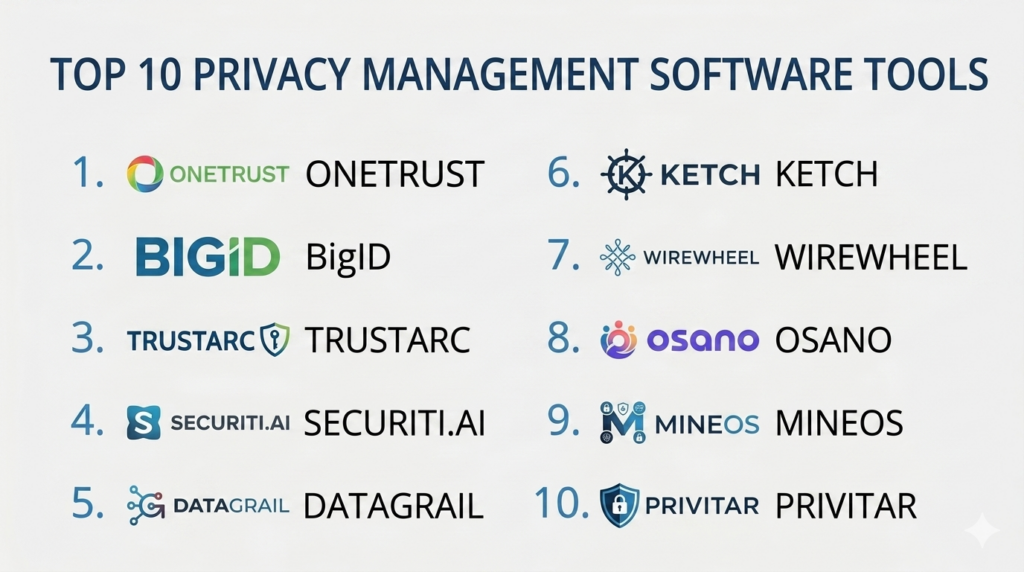
Introduction
Privacy management tools are specialized software solutions designed to help organizations automate and govern their data privacy compliance programs. These platforms act as a centralized repository for managing personal data across an entire enterprise, ensuring that the collection, storage, and processing of information align with global regulatory frameworks. At their core, these tools provide a structured way to identify where personal data resides, who has access to it, and how it is being used, while providing mechanisms to honor individual rights requests.
In an era of increasing digital surveillance and high-profile data breaches, privacy has transitioned from a legal checkbox to a fundamental business requirement. Organizations now handle massive volumes of sensitive information across fragmented cloud environments and legacy systems. Privacy management tools bridge this gap by offering automated data discovery, risk assessment modules, and consent management frameworks. This shift toward “Privacy by Design” allows businesses to build trust with their customers while mitigating the significant financial and reputational risks associated with non-compliance.
Real-world use cases:
- Data Subject Access Requests (DSAR): Automating the process of identifying and retrieving all personal data associated with an individual who requests their records.
- Data Mapping and Inventory: Creating a live, visual representation of data flows between different departments, third-party vendors, and geographical regions.
- Consent and Preference Management: Capturing and synchronizing user choices regarding cookies, marketing emails, and data sharing across all digital touchpoints.
- Privacy Impact Assessments (PIA): Conducting standardized risk evaluations for new projects or technologies that involve the processing of personal data.
- Regulatory Compliance Reporting: Generating audit-ready documentation to prove adherence to frameworks such as GDPR, CCPA, or LGPD.
Evaluation criteria for buyers:
- Automation Depth: The ability to discover data automatically without manual surveys or spreadsheets.
- Regulatory Coverage: Support for a wide range of global, regional, and industry-specific privacy laws.
- Integration Ecosystem: Seamless connectivity with existing HR, CRM, and cloud storage systems.
- User Experience: Intuitive interfaces for both internal privacy teams and external customers.
- Scalability: The platform’s ability to handle millions of records and thousands of individual rights requests.
- Reporting and Analytics: Detailed dashboards that provide a clear view of the organization’s privacy posture.
- Implementation Speed: How quickly the platform can be deployed and begin delivering value.
- Security Posture: The internal security controls and certifications of the tool provider.
- Vendor Risk Management: Tools for assessing the privacy practices of third-party partners.
- Total Cost of Ownership: The balance between licensing fees and the reduction in manual labor costs.
Mandatory paragraph
- Best for: Large enterprises, financial institutions, healthcare providers, and high-growth technology companies that manage large volumes of customer data and must comply with multiple global privacy regulations.
- Not ideal for: Small businesses with minimal data footprints, internal-only organizations with no customer-facing data collection, or companies looking for simple “point solutions” like a basic cookie banner without backend data management.
Key Trends in Privacy Management Software
- AI-Powered Data Discovery: Modern platforms are moving away from manual surveys and toward machine learning models that can scan petabytes of data to identify “hidden” sensitive information in unstructured files.
- Shift Toward Programmatic Privacy: Privacy is being integrated directly into the software development lifecycle (SDLC), allowing developers to treat privacy rules as “code” that is enforced automatically during deployment.
- Privacy by Design (PbD) Automation: Rather than assessing risk after a product is built, tools are embedding privacy checkpoints into the earliest stages of project planning.
- Localization and Data Residency: As more countries pass data sovereignty laws, tools are prioritizing features that help organizations keep data within specific geographical borders.
- Consent Orchestration: Moving beyond simple cookie banners to sophisticated systems that sync user preferences across mobile apps, websites, and physical storefronts in real-time.
- Zero-Knowledge Privacy: A trend toward “privacy-enhancing technologies” (PETs) where analytics can be performed on data without the platform ever seeing the underlying personal information.
- DSAR Self-Service Portals: To reduce administrative burden, platforms are launching automated portals where users can download their own data without human intervention.
- Privacy as a Competitive Advantage: Companies are using their privacy posture as a marketing tool, requiring platforms that provide “trust badges” and transparent public-facing privacy centers.
How We Selected These Tools (Methodology)
The selection of the top 10 privacy management tools was based on a rigorous evaluation of technical capabilities and industry reliability. The methodology included:
- Market Adoption: Prioritizing tools that are trusted by Fortune 500 companies and leading global enterprises.
- Functional Breadth: Ensuring the selected platforms provide a full suite of features, including mapping, assessments, and DSAR fulfillment.
- Innovation Velocity: Favoring vendors that consistently release new features to address emerging global privacy laws.
- Ease of Integration: Analyzing how well these tools connect with standard enterprise software stacks.
- Customer Feedback: Reviewing implementation success stories and professional user ratings from technical communities.
- Scalability Signals: Evaluating the platform’s ability to support organizations with complex, multi-national operations.
Top 10 Privacy Management Software Tools
#1 — OneTrust
Short description: Widely recognized as the market leader, OneTrust provides a massive, modular platform that covers the entire spectrum of privacy, security, and governance.
Key Features
- DataDiscovery AI: Automated discovery and classification of sensitive data across cloud and on-premises environments.
- Privacy Rights Automation: A fully automated workflow for fulfilling DSAR requests from intake to delivery.
- Privacy Impact Assessments: A massive library of templates for PIAs and DPIAs tailored to specific global regulations.
- Vendor Privacy Risk Management: Tools for assessing and monitoring the privacy posture of third-party vendors.
- Consent & Preference Management: High-performance cookie consent and cross-channel preference synchronization.
- Ethics & Compliance: Integrated modules for whistleblower hotlines and internal policy management.
Pros
- The most comprehensive feature set available in a single platform.
- Excellent regulatory intelligence with a dedicated team monitoring legal changes globally.
Cons
- Can be overwhelming and complex for smaller teams to navigate.
- The modular pricing model can become very expensive as more features are added.
Platforms / Deployment
- Web / Windows / macOS
- Cloud / Hybrid
Security & Compliance
- SSO/SAML, MFA, RBAC, Encryption.
- SOC 2 Type II, ISO 27001, FedRAMP.
Integrations & Ecosystem
OneTrust boasts one of the largest integration marketplaces in the industry.
- Salesforce / Adobe
- AWS / Azure / GCP
- Slack / ServiceNow
- Jira / Microsoft Teams
Support & Community
Extensive documentation, a massive user community, and 24/7 global support with dedicated customer success managers for enterprise accounts.
#2 — BigID
Short description: A data-centric privacy platform that specializes in advanced data discovery and classification using machine learning to find sensitive information other tools miss.
Key Features
- ML-Driven Discovery: Uses patented machine learning to identify personal and sensitive data at massive scale.
- Data Cataloging: Automatically builds a catalog of data assets and their privacy risk profiles.
- Correlation & Identity: Links disparate data points to specific identities for accurate DSAR fulfillment.
- Privacy Impact Assessments: Links assessments directly to the live data assets they describe.
- Retention Management: Helps organizations identify and delete data that has exceeded its legal retention period.
- Data Minimization: Pinpoints redundant or obsolete data to reduce the attack surface.
Pros
- Superior technical capability for finding data in unstructured sources (e.g., PDFs, images).
- Strong focus on data security as a core component of privacy.
Cons
- Focused more on the technical “discovery” side than the “legal/policy” side of privacy.
- Implementation can be resource-intensive for the IT department.
Platforms / Deployment
- Web / Linux / Windows
- Cloud / Self-hosted / Hybrid
Security & Compliance
- MFA, RBAC, Data Masking.
- SOC 2, ISO 27001.
Integrations & Ecosystem
Broad integration with data lakes and enterprise infrastructure.
- Snowflake / Databricks
- Hadoop / HDFS
- SAP / Oracle
- Microsoft 365
Support & Community
Highly technical support and a strong presence in the data engineering and security communities.
#3 — TrustArc
Short description: A veteran in the privacy space, TrustArc combines deep legal expertise with a robust platform for managing compliance and certification.
Key Features
- Privacy Central: A unified dashboard for managing privacy across all global operations.
- Assessment Automation: Streamlined workflows for conducting PIAs, DPIAs, and vendor assessments.
- Data Inventory & Mapping: Visual maps of data flows with automated updates.
- Individual Rights Manager: A secure portal for managing customer data requests.
- Cookie Consent: A widely used solution for managing web and mobile consent.
- Assurance & Certification: TrustArc’s famous “TRUSTe” seals for validating a company’s privacy practices.
Pros
- Exceptional legal and regulatory depth; the platform feels built by privacy lawyers.
- Strong focus on building consumer trust through visible certifications.
Cons
- Automation capabilities are sometimes viewed as secondary to the assessment/legal features.
- The UI can feel less modern compared to newer cloud-native competitors.
Platforms / Deployment
- Web / Windows / macOS
- Cloud
Security & Compliance
- SSO, MFA, Encryption.
- SOC 2, ISO 27001, APEC Cross-Border Privacy Rules.
Integrations & Ecosystem
Integrates with standard enterprise applications and marketing tools.
- Salesforce
- Microsoft Dynamics
- GTM (Google Tag Manager)
- ServiceNow
Support & Community
Extensive professional services and consulting are available alongside the software platform.
#4 — Securiti
Short description: An AI-driven “Data Command Center” that unifies privacy, security, and governance to protect data across complex multi-cloud environments.
Key Features
- Sensitive Data Discovery: Real-time scanning and classification of data across the entire hybrid cloud.
- Privacy Rights Automation: Full automation for DSARs, including data redaction.
- Consent Management: Unified consent across digital properties and backend systems.
- Third-Party Risk: Automated assessments and monitoring of vendor privacy compliance.
- Data Sovereignty: Tools for managing data residency and localization requirements.
- Security Posture Management: Identifies misconfigurations that could lead to privacy breaches.
Pros
- Very strong AI/ML capabilities for automating complex privacy tasks.
- Unified interface for multiple disciplines (Privacy, Security, and GRC).
Cons
- Can be complex to configure for organizations with many legacy on-premise systems.
- A relatively newer player compared to giants like OneTrust.
Platforms / Deployment
- Web / Linux / Windows
- Cloud / Hybrid
Security & Compliance
- SSO, MFA, RBAC.
- SOC 2 Type II, ISO 27001.
Integrations & Ecosystem
Designed for modern, cloud-first enterprise stacks.
- AWS / Azure / GCP
- Snowflake / MongoDB
- Slack / Jira
- Workday
Support & Community
Highly responsive support and an active “Security & Privacy” knowledge base.
#5 — DataGrail
Short description: A modern privacy platform known for its ease of use and deep, no-code integrations that allow for rapid deployment and automated data mapping.
Key Features
- Live Data Map: Automatically discovers and maps data across hundreds of SaaS applications without surveys.
- Request Manager: Automates the intake and fulfillment of DSAR, CCPA, and GDPR requests.
- Privacy Dashboard: A clear, executive-level view of compliance status and request volume.
- Consent Management: Synchronizes preferences across various marketing platforms.
- Audit Logging: Detailed reports on all data actions for regulatory evidence.
- Policy Management: Tools for managing internal and public-facing privacy policies.
Pros
- Incredibly fast implementation time due to “no-code” connector approach.
- Clean, modern interface that is easy for non-technical users to manage.
Cons
- May lack the deep “on-premise” scanning capabilities of BigID or Securiti.
- Pricing can be higher for organizations with a massive number of SaaS connectors.
Platforms / Deployment
- Web / Cloud-native
- Cloud
Security & Compliance
- SSO/SAML, MFA, Encryption.
- SOC 2 Type II.
Integrations & Ecosystem
Boasts over 2,000 pre-built integrations for SaaS-heavy organizations.
- Okta / Azure AD
- Salesforce / HubSpot
- Zendesk / Intercom
- Shopify / Stripe
Support & Community
Praised for excellent customer success and “white-glove” onboarding experiences.
#6 — Ketch
Short description: A programmatic privacy platform that treats privacy as “code,” allowing for high-performance data control and automated compliance across all data systems.
Key Features
- Programmatic Privacy: Deploy privacy rules across databases and applications via APIs.
- Dynamic Data Mapping: Continuous discovery of data flows in real-time.
- Consent Orchestration: Real-time synchronization of user choices across the entire tech stack.
- DSAR Automation: Streamlined fulfillment through automated data identification.
- Global Policy Engine: Automatically applies the correct regional laws based on the user’s location.
- Privacy Governance: Tools for ensuring data is used only for the purposes for which it was collected.
Pros
- Ideal for high-growth tech companies and developers who want “Privacy as Code.”
- Extremely scalable for high-traffic websites and complex data pipelines.
Cons
- Requires a more technical team to fully leverage the API-driven features.
- The “code-first” approach may be intimidating for traditional legal/compliance teams.
Platforms / Deployment
- Web / API-driven
- Cloud / Edge
Security & Compliance
- SSO, MFA, RBAC.
- SOC 2 Type II.
Integrations & Ecosystem
Designed to integrate directly into the developer and data engineering stack.
- GitHub / GitLab
- Segment / mParticle
- Snowflake / BigQuery
- Terraform
Support & Community
Excellent technical documentation and a community focused on the intersection of privacy and engineering.
#7 — WireWheel
Short description: A developer-friendly privacy platform that focuses on collaboration and high-speed assessment workflows for complex organizations.
Key Features
- UPCP (Unified Privacy Control Platform): A centralized hub for all privacy operations.
- Automated Data Mapping: Visualizes data lineages and storage locations.
- DSAR Fulfillment: Manages the end-to-end lifecycle of individual rights requests.
- Assessment Automation: Collaborative tools for PIAs, DPIAs, and vendor reviews.
- Trust Access: A consumer-facing portal for managing privacy preferences.
- Data Redaction: Automated tools for cleaning sensitive data before delivery to a requester.
Pros
- Very strong collaboration features for teams working across Legal, IT, and Engineering.
- Excellent customer support and a focus on practical, real-world privacy problems.
Cons
- Reporting interfaces can be less visual than some modern competitors.
- The setup process for deep on-premise discovery can take time.
Platforms / Deployment
- Web / Windows / macOS
- Cloud / Hybrid
Security & Compliance
- SSO, MFA, Encryption.
- SOC 2 Type II.
Integrations & Ecosystem
Wide support for standard enterprise and cloud infrastructure.
- Microsoft 365 / Google Workspace
- AWS / Azure
- Salesforce
- ServiceNow
Support & Community
Known for highly knowledgeable professional services and a helpful user forum.
#8 — Osano
Short description: A B-Corp certified privacy platform designed for mid-market and enterprise teams looking for a reliable, simplified, and ethically-driven compliance solution.
Key Features
- Cookie Consent: One of the most widely deployed and recognized consent banners globally.
- Vendor Discovery: Automatically identifies the third-party trackers and vendors used on your site.
- Vendor Privacy Ratings: Scores over 10,000 vendors based on their privacy practices.
- DSAR Automation: Simplified intake and fulfillment workflows.
- Data Mapping: Automated inventory of data across common SaaS applications.
- Compliance Guarantee: Offers a “no-fine” guarantee (subject to terms) for companies using their platform.
Pros
- Incredibly easy to set up; the cookie consent banner can be live in minutes.
- The vendor rating system provides unique insight into the risks of third-party partners.
Cons
- May lack the deep technical discovery features needed for very complex hybrid-cloud environments.
- Focused more on mid-market needs than “custom” high-end enterprise requirements.
Platforms / Deployment
- Web / Cloud-native
- Cloud
Security & Compliance
- SSO, MFA, Encryption.
- SOC 2 Type II.
Integrations & Ecosystem
Integrates easily with the most common SaaS and marketing platforms.
- Salesforce / HubSpot
- Mailchimp / Shopify
- Google Analytics
- Zendesk
Support & Community
Excellent “how-to” documentation and a highly rated customer support team.
#9 — MineOS
Short description: A business-centric privacy platform that uses a unique “Smart Data Discovery” approach to provide visibility and control over data across the entire organization.
Key Features
- Smart Data Discovery: Scans email headers and SSO logs to find “shadow” SaaS usage.
- Privacy Portal: A high-end, consumer-facing interface for data requests and transparency.
- DSAR Automation: Orchestrates data deletion and retrieval across multiple systems.
- Consent Management: Unified consent across web and mobile platforms.
- Data Mapping: Continuous, AI-driven inventory of the organizational data footprint.
- Governance Score: A proprietary metric that helps companies benchmark their privacy progress.
Pros
- Excellent at finding “Shadow IT”—SaaS tools that employees signed up for without IT approval.
- Very intuitive, modern UI that prioritizes business speed.
Cons
- The “email scan” discovery method might be restrictive for some security-conscious organizations.
- Primarily focused on B2B and SaaS environments.
Platforms / Deployment
- Web / Cloud-native
- Cloud
Security & Compliance
- SSO, MFA, RBAC.
- SOC 2 Type II, ISO 27001.
Integrations & Ecosystem
Optimized for the modern cloud-first business.
- Okta / Microsoft Azure AD
- Google Workspace / Microsoft 365
- Slack / Jira
- Intercom
Support & Community
Highly proactive customer support and a modern technical knowledge base.
#10 — Privitar (Informatica)
Short description: Now part of Informatica, Privitar specializes in high-end data privacy and protection, focusing on data masking and de-identification for massive datasets.
Key Features
- Data Masking: Industry-leading tools for redacting or obfuscating sensitive data.
- De-identification: Enables organizations to run analytics on datasets without exposing identities.
- Privacy Policy Enforcement: Centralized management of how data is protected across the enterprise.
- Synthetic Data Generation: Creates realistic datasets for testing that contain no real personal info.
- Watermarking: Adds traceable marks to data to track potential leaks.
- Audit & Reporting: Comprehensive logs for compliance with GDPR and HIPAA.
Pros
- The best choice for organizations that need to protect data used in analytics and research.
- Deeply integrated with Informatica’s enterprise-grade data management suite.
Cons
- Focused more on “protection” and “masking” than “consent banners” and “cookie management.”
- Requires a high level of technical expertise to implement correctly.
Platforms / Deployment
- Web / Linux / Windows
- Cloud / On-premises / Hybrid
Security & Compliance
- Advanced RBAC, MFA, Data Encryption.
- SOC 2, ISO 27001, HIPAA.
Integrations & Ecosystem
Integrates with the world’s largest data platforms.
- Informatica Intelligent Data Management Cloud (IDMC)
- Snowflake / Databricks
- Hadoop / Teradata
- AWS / Azure / GCP
Support & Community
Enterprise-grade support and professional services through the Informatica network.
Comparison Table (Top 10)
| Tool Name | Best For | Platform(s) Supported | Deployment | Standout Feature | Public Rating |
| OneTrust | Full-stack Enterprise | Web, Win, Mac | Hybrid | Regulatory Intelligence | 4.8/5 |
| BigID | Technical Discovery | Web, Linux, Win | Hybrid | ML-driven Classification | 4.7/5 |
| TrustArc | Legal/Policy Depth | Web, Win, Mac | Cloud | Privacy Certifications | 4.6/5 |
| Securiti | AI Multi-Cloud | Web, Linux, Win | Hybrid | Data Command Center | 4.8/5 |
| DataGrail | Rapid SaaS Mapping | Web | Cloud | Live Data Map | 4.9/5 |
| Ketch | Programmatic/Dev | Web, API | Edge | Privacy as Code | 4.7/5 |
| WireWheel | Collaboration | Web, Win, Mac | Hybrid | UPCP Dashboard | 4.5/5 |
| Osano | Mid-market Ease | Web | Cloud | Vendor Privacy Ratings | 4.6/5 |
| MineOS | Shadow IT Visibility | Web | Cloud | Smart Data Discovery | 4.8/5 |
| Privitar | Data Masking | Web, Linux, Win | Hybrid | Advanced De-identification | 4.4/5 |
Evaluation & Scoring of Privacy Management Tools
The following scoring model evaluates these tools based on the critical requirements of a modern privacy office.
| Tool Name | Core (25%) | Ease (15%) | Integrations (15%) | Security (10%) | Performance (10%) | Support (10%) | Value (15%) | Weighted Total |
| OneTrust | 10 | 5 | 10 | 9 | 8 | 9 | 7 | 8.55 |
| BigID | 10 | 4 | 9 | 10 | 9 | 8 | 7 | 8.20 |
| TrustArc | 9 | 6 | 8 | 9 | 8 | 9 | 7 | 8.05 |
| Securiti | 10 | 6 | 9 | 9 | 9 | 8 | 8 | 8.45 |
| DataGrail | 8 | 10 | 10 | 9 | 9 | 9 | 8 | 9.05 |
| Ketch | 9 | 7 | 8 | 9 | 10 | 8 | 8 | 8.45 |
| WireWheel | 8 | 8 | 8 | 9 | 8 | 9 | 8 | 8.20 |
| Osano | 7 | 10 | 7 | 9 | 8 | 9 | 9 | 8.25 |
| MineOS | 8 | 9 | 9 | 9 | 9 | 9 | 8 | 8.70 |
| Privitar | 9 | 4 | 8 | 10 | 9 | 8 | 7 | 7.75 |
How to interpret these scores:
- Core (25%): The strength of data discovery, mapping, and compliance automation.
- Ease (15%): The simplicity of deployment and day-to-day management.
- Integrations (15%): The breadth and depth of third-party software connectors.
- Weighted Total: A calculation where higher scores represent a more balanced, enterprise-ready solution.
Which Privacy Management Software Tool Is Right for You?
Solo / Freelancer
If you are an individual consultant or a very small business, Osano is the most accessible choice. Its free tier and simple cookie consent management provide enough protection to meet basic legal requirements without a complex setup.
SMB
Small and medium-sized businesses that rely heavily on SaaS should look at DataGrail or MineOS. These tools provide instant visibility into your data footprint with minimal IT intervention, allowing you to fulfill DSARs and map data almost immediately.
Mid-Market
For companies with growing complexity and multiple regional laws to follow, Securiti or WireWheel offer a robust balance of automation and collaborative tools. These platforms scale well as your privacy team expands.
Enterprise
Large-scale enterprises with hybrid-cloud infrastructure and high regulatory pressure should prioritize OneTrust for its regulatory intelligence or BigID for its technical data discovery. If your primary concern is protecting data for analytics, Privitar (Informatica) is the essential choice.
Budget vs Premium
- Budget: Osano, DataGrail (Starter tiers).
- Premium: OneTrust, BigID, Securiti.
Feature Depth vs Ease of Use
- Maximum Depth: OneTrust, BigID.
- Easiest to Use: DataGrail, Osano.
Integrations & Scalability
- Best Integrations: OneTrust, DataGrail.
- Best Scalability: OneTrust, Securiti, BigID.
Security & Compliance Needs
Organizations in banking or healthcare should look for tools with FedRAMP or ISO 27001 certifications, which are most prevalent in OneTrust, BigID, and Informatica.
Frequently Asked Questions (FAQs)
1. What is a DSAR and how does this software help?
A Data Subject Access Request (DSAR) is a legal right for individuals to ask what data a company holds about them. Privacy management tools automate the search across all databases and files to compile this report in minutes instead of days.
2. Is there a difference between data security and data privacy?
Yes. Data security focuses on protecting data from unauthorized access or breaches (encryption, firewalls). Data privacy focuses on the legal right of individuals to control how their personal data is collected, shared, and used.
3. How often should a data map be updated?
Ideally, data maps should be updated in real-time. Modern privacy tools use automated connectors to refresh your data inventory whenever a new SaaS tool is added or a database schema changes.
4. What is the role of AI in privacy management?
AI is used for “sensitive data discovery.” It can read through millions of unstructured documents, images, and chat logs to identify patterns (like credit card numbers or social security numbers) that manual surveys would miss.
5. Can these tools help with GDPR and CCPA at the same time?
Yes. Top-tier platforms are built to be “multi-framework.” They allow you to apply different rules based on where your user is located, ensuring you follow GDPR for Europeans and CCPA for Californians.
6. What is a Privacy Impact Assessment (PIA)?
A PIA is a formal evaluation used to identify and reduce the privacy risks of a new project. Privacy software provides templates and automated workflows to make these assessments faster and more consistent.
7. Why is vendor risk management part of these tools?
Under laws like GDPR, you are responsible for the privacy practices of the vendors you share data with. These tools automate the sending and scoring of privacy questionnaires to ensure your partners are compliant.
8. What is cookie consent management?
It is the process of informing website visitors about the trackers being used and obtaining their permission. Privacy tools provide the “cookie banners” and ensure that trackers are blocked until the user gives consent.
9. Do these tools store my customers’ personal data?
Generally, no. Most privacy management tools only store “metadata”—information about where the data is—rather than the actual personal data itself, which remains in your own secure databases.
10. How long does it take to implement a privacy platform?
Implementation time varies. Simple cookie consent banners take minutes, SaaS-only mapping tools like DataGrail take days, and full enterprise discovery for on-premise systems can take several months.
Conclusion
Privacy management has transitioned from a manual, survey-based effort to an automated, data-centric discipline. While OneTrust remains the giant of the industry with its all-encompassing suite, newer innovators like DataGrail and Ketch are making privacy more accessible and developer-friendly.
The best tool for your organization depends on the complexity of your data environment and the specific regulations you face. For those starting their journey, the priority should be visibility: identifying where your data is. Once you have a clear map, you can begin the journey toward automated fulfillment and programmatic governance, turning privacy from a risk into a core value of your brand.

Excellent article with practical information.
Studying these privacy frameworks guides me on how to respect and safeguard user data.