MOTOSHARE 🚗🏍️
Rent Bikes & Cars Directly from Owners
Motoshare connects vehicle owners with people who need bikes and cars on rent. Owners earn from idle vehicles, and renters get flexible ride options.
Visit Motoshare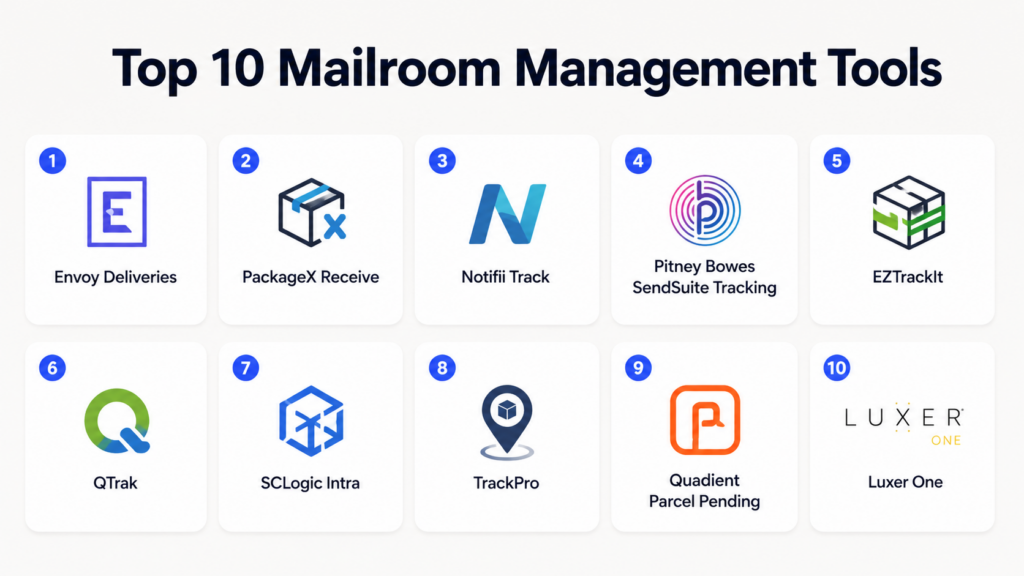
Introduction
Mailroom Management Tools help organizations receive, scan, track, notify, route, store, and deliver incoming mail, packages, documents, and internal parcels. These platforms replace manual mail logs and paper-based tracking with digital workflows that improve visibility, accountability, and delivery accuracy across offices, campuses, residential buildings, universities, coworking spaces, and enterprise facilities.Mailroom operations have become more complex as hybrid work, e-commerce deliveries, distributed offices, secure document handling, and compliance needs continue increasing. Modern mailroom tools now support barcode scanning, digital proof of delivery, automated recipient notifications, chain-of-custody tracking, package lockers, mobile apps, analytics, and integrations with workplace systems.
Real-world use cases include:
- Tracking incoming packages and mail
- Notifying employees when deliveries arrive
- Managing secure document handoffs
- Handling high-volume campus or office mailrooms
- Improving package accountability and delivery proof
Key evaluation criteria buyers should consider:
- Package and mail tracking accuracy
- Barcode and QR code scanning
- Recipient notification workflows
- Proof of delivery and signature capture
- Mobile app and kiosk support
- Chain-of-custody controls
- Locker and hardware integrations
- Multi-location scalability
- Reporting and analytics
- Security and access management
Best for: Corporate offices, universities, hospitals, government facilities, residential communities, coworking spaces, logistics teams, property managers, and enterprises managing high mail or package volume.
Not ideal for: Very small offices with minimal mail traffic, fully remote companies, or teams that only receive occasional low-risk deliveries.
Key Trends in Mailroom Management Tools
- Digital package tracking is replacing handwritten mailroom logs.
- Barcode and QR code scanning are becoming standard for intake and delivery workflows.
- Automated recipient notifications are reducing front-desk and mailroom workload.
- Smart lockers are increasingly integrated with mailroom platforms.
- Hybrid work is increasing the need for flexible package pickup and forwarding workflows.
- Chain-of-custody tracking is becoming more important for sensitive documents.
- Mobile proof of delivery and signature capture are improving accountability.
- Mailroom analytics are helping facilities teams understand delivery volume and staffing needs.
- Multi-location dashboards are becoming essential for enterprises and universities.
- Security controls and audit trails are increasingly important for regulated organizations.
How We Selected These Tools
The following mailroom management platforms were selected using practical workplace operations and facilities management criteria.
- Evaluated market adoption and mailroom workflow maturity
- Reviewed package intake and delivery tracking features
- Assessed barcode scanning and notification workflows
- Considered proof of delivery and chain-of-custody capabilities
- Evaluated multi-location and enterprise scalability
- Reviewed support for lockers, kiosks, and mobile devices
- Assessed ease of use for mailroom staff and recipients
- Considered reporting and analytics capabilities
- Evaluated security controls and access management
- Balanced enterprise platforms with SMB-friendly tools
Top 10 Mailroom Management Tools
1- Envoy Deliveries
Short description: Envoy Deliveries is a workplace delivery and mailroom management solution designed to help organizations receive packages, notify recipients, and manage pickup workflows efficiently. It is especially useful for modern offices already using Envoy for visitor management, workplace access, or hybrid office operations. The platform allows mailroom teams to scan packages, assign recipients, send automatic notifications, and maintain digital delivery records. Envoy Deliveries is well suited for offices that want package management connected to a broader workplace experience platform.
Key Features
- Package intake tracking
- Automated recipient notifications
- Barcode scanning
- Delivery records
- Workplace platform integration
- Multi-location support
- Pickup status tracking
Pros
- Strong workplace ecosystem integration
- Easy package notification workflows
- Good fit for hybrid offices
Cons
- Best value when used with broader Envoy platform
- Advanced workflows may require configuration
- Less suited for complex logistics-heavy mailrooms
Platforms / Deployment
- Web / iOS / Android
- Cloud
Security & Compliance
Supports encryption, admin controls, role-based permissions, and access management. Additional certifications vary by plan.
Integrations & Ecosystem
Envoy Deliveries integrates with workplace tools and employee communication systems to simplify package notifications and office workflows.
- Slack
- Microsoft Teams
- Google Workspace
- Microsoft 365
- Workplace directories
- Visitor management workflows
Support & Community
Envoy provides onboarding resources, documentation, customer support, and workplace implementation guidance for office teams.
2- PackageX Receive
Short description: PackageX Receive is a package and mailroom management platform focused on package intake, OCR scanning, recipient matching, tracking, and digital delivery workflows. The platform is designed for corporate mailrooms, universities, residential properties, logistics teams, and enterprises handling high package volume. PackageX helps reduce manual entry by using AI and computer vision to capture package information from labels. It is especially useful for organizations that want faster package processing and better delivery visibility.
Key Features
- AI-powered label scanning
- Package intake tracking
- Recipient matching
- Digital proof of delivery
- Automated notifications
- Multi-location management
- Analytics and reporting
Pros
- Strong scanning automation
- Good high-volume package handling
- Useful for multi-location operations
Cons
- May be more advanced than small offices need
- Setup requires workflow planning
- Pricing may vary by volume and use case
Platforms / Deployment
- Web / iOS / Android
- Cloud
Security & Compliance
Supports encryption, admin controls, and access permissions. Additional compliance details are not publicly stated.
Integrations & Ecosystem
PackageX integrates with workplace systems, directories, and delivery workflows to automate intake and recipient notifications.
- Employee directories
- Mailroom workflows
- Package lockers
- Mobile scanning
- APIs
- Facility systems
Support & Community
Provides implementation support, documentation, and onboarding assistance for mailroom and logistics teams.
3- Notifii Track
Short description: Notifii Track is a package tracking and mailroom management platform widely used by residential communities, universities, student housing, corporate offices, and property management teams. It helps mailroom staff scan packages, notify recipients, track pickup status, and manage delivery logs digitally. Notifii Track is practical for organizations that need an easy-to-use system for high-volume package intake and resident or employee notifications.
Key Features
- Package scanning
- Automated recipient notifications
- Pickup tracking
- Digital delivery logs
- Signature capture
- Reporting dashboards
- Multi-property support
Pros
- Strong package notification workflows
- Good fit for housing and campus environments
- Easy mailroom staff adoption
Cons
- Less focused on complex enterprise workplace ecosystems
- Advanced integrations may be limited
- Branding customization may vary
Platforms / Deployment
- Web / Mobile
- Cloud
Security & Compliance
Supports encryption and account-level access controls. Additional certifications are not publicly stated.
Integrations & Ecosystem
Notifii Track supports package intake and recipient communication workflows for mailrooms and property teams.
- Email notifications
- SMS notifications
- Mobile scanning
- Property workflows
- Reporting tools
Support & Community
Provides onboarding support, documentation, and customer service for mailroom and property management teams.
4- Pitney Bowes SendSuite Tracking
Short description: Pitney Bowes SendSuite Tracking is an enterprise mail and parcel tracking platform designed for organizations with structured mailroom, shipping, and receiving operations. It helps teams track packages from arrival to final delivery with barcode scanning, chain-of-custody records, recipient notifications, and proof of delivery. The platform is particularly useful for enterprises, government organizations, healthcare facilities, and universities that require reliable mailroom accountability.
Key Features
- Inbound package tracking
- Barcode scanning
- Chain-of-custody records
- Proof of delivery
- Recipient notifications
- Reporting and analytics
- Enterprise mailroom workflows
Pros
- Strong enterprise mailroom functionality
- Good chain-of-custody support
- Suitable for regulated environments
Cons
- More complex than lightweight tools
- Implementation may require planning
- May be excessive for small offices
Platforms / Deployment
- Web / Mobile scanning
- Cloud / Hybrid
Security & Compliance
Supports admin controls, encryption, access management, and audit-friendly tracking workflows.
Integrations & Ecosystem
Pitney Bowes integrates with shipping, receiving, and enterprise mailroom operations.
- Carrier workflows
- Barcode scanners
- Mailroom systems
- Shipping tools
- Enterprise reporting
- Facility workflows
Support & Community
Provides enterprise support, implementation assistance, training resources, and mailroom operations expertise.
5- EZTrackIt
Short description: EZTrackIt is a package tracking and mailroom management tool designed for offices, universities, apartment communities, student housing, and corporate mailrooms. The platform helps staff log incoming packages, notify recipients, capture signatures, and track delivery status. EZTrackIt focuses on simplicity and practical package accountability, making it useful for teams moving away from paper logs or spreadsheets.
Key Features
- Package tracking
- Barcode scanning
- Recipient notifications
- Signature capture
- Pickup confirmation
- Delivery history
- Reporting tools
Pros
- Simple package tracking workflow
- Good for campuses and residential properties
- Practical proof of pickup features
Cons
- Less broad than enterprise workplace platforms
- Advanced automation may be limited
- Interface may feel basic for some teams
Platforms / Deployment
- Web / Mobile
- Cloud
Security & Compliance
Supports account security controls and user permissions. Additional compliance details are not publicly stated.
Integrations & Ecosystem
EZTrackIt supports mailroom and property package workflows with digital tracking and communication features.
- Barcode scanners
- Email notifications
- SMS notifications
- Mobile workflows
- Reporting exports
Support & Community
Provides setup assistance, user documentation, and practical support for mailroom teams.
6- QTrak
Short description: QTrak is a package tracking and internal logistics platform designed for mailrooms, universities, healthcare facilities, corporate offices, and government environments. It supports package intake, route tracking, signature capture, proof of delivery, and accountability workflows. QTrak is especially useful for organizations that need to track items across internal delivery routes and maintain clear custody records.
Key Features
- Package intake tracking
- Internal delivery routing
- Signature capture
- Chain-of-custody tracking
- Barcode scanning
- Mobile delivery workflows
- Reporting and audit trails
Pros
- Strong internal delivery tracking
- Good chain-of-custody workflows
- Suitable for universities and healthcare
Cons
- May require workflow configuration
- Less focused on workplace experience features
- Smaller ecosystem than larger enterprise vendors
Platforms / Deployment
- Web / Mobile
- Cloud
Security & Compliance
Supports encryption, user permissions, and audit-friendly delivery records.
Integrations & Ecosystem
QTrak supports internal logistics and package tracking workflows through mobile and barcode-based operations.
- Barcode scanners
- Mobile delivery apps
- Internal mail routes
- Reporting systems
- Facility workflows
Support & Community
Provides onboarding support and operational guidance for mailroom and internal delivery teams.
7- SCLogic Intra
Short description: SCLogic Intra is an enterprise logistics, mailroom, and facilities management platform designed for complex internal distribution operations. It supports inbound mail tracking, package management, courier workflows, asset movement, chain-of-custody tracking, and service requests. SCLogic Intra is especially suitable for large enterprises, universities, healthcare organizations, and government facilities with advanced internal logistics needs.
Key Features
- Enterprise mailroom tracking
- Package and asset movement
- Internal courier workflows
- Chain-of-custody tracking
- Barcode and mobile scanning
- Workflow automation
- Reporting and analytics
Pros
- Strong enterprise logistics depth
- Good for complex internal operations
- Advanced tracking and workflow automation
Cons
- More complex implementation
- Higher enterprise focus
- May be too robust for small mailrooms
Platforms / Deployment
- Web / Mobile
- Cloud / Hybrid
Security & Compliance
Supports role-based access, encryption, admin controls, and audit-ready workflows.
Integrations & Ecosystem
SCLogic Intra integrates with enterprise facilities, logistics, and service management workflows.
- Mailroom systems
- Facility management tools
- Barcode scanners
- Mobile delivery workflows
- Enterprise service systems
- Reporting platforms
Support & Community
Provides enterprise implementation, training, workflow design, and support services.
8- TrackPro
Short description: TrackPro is a package tracking and mailroom management platform designed for organizations that need to digitally manage incoming packages, mail, and delivery handoffs. The platform supports barcode scanning, digital logs, recipient notifications, and proof-of-delivery workflows. It is practical for offices, schools, property teams, and small mailrooms that need a straightforward package tracking system.
Key Features
- Package logging
- Barcode scanning
- Recipient notifications
- Pickup confirmation
- Digital delivery logs
- Searchable package history
- Basic reporting
Pros
- Simple mailroom workflow
- Useful for smaller teams
- Easy package lookup
Cons
- Limited enterprise functionality
- Fewer advanced integrations
- Analytics may be basic
Platforms / Deployment
- Web / Mobile
- Cloud
Security & Compliance
Supports account-level security and user permissions. Additional compliance details are not publicly stated.
Integrations & Ecosystem
TrackPro supports core package tracking and recipient communication workflows.
- Barcode scanners
- Email notifications
- Mobile workflows
- Reporting exports
- Mailroom operations
Support & Community
Provides setup support and documentation for small and mid-sized mailroom teams.
9- Quadient Parcel Pending
Short description: Quadient Parcel Pending provides smart locker and package management solutions for residential communities, universities, offices, retail, and enterprise environments. The platform helps organizations automate package handoff using secure lockers, digital notifications, and self-service pickup workflows. It is especially useful for high-volume delivery environments where mailroom staff need to reduce manual package handoff workload.
Key Features
- Smart package lockers
- Automated recipient notifications
- Secure package pickup
- Delivery tracking
- Locker management
- Multi-location support
- Reporting and analytics
Pros
- Strong locker automation
- Reduces manual package handoff workload
- Good for residential and campus environments
Cons
- Requires hardware investment
- Less focused on traditional mailroom document workflows
- Deployment planning is required
Platforms / Deployment
- Web / Mobile / Locker hardware
- Cloud-connected hardware
Security & Compliance
Supports secure locker access, user authentication, and admin controls. Additional certifications are not publicly stated.
Integrations & Ecosystem
Quadient Parcel Pending integrates package locker workflows with recipient notifications and property operations.
- Smart lockers
- Mobile notifications
- Property management workflows
- Delivery systems
- Reporting dashboards
Support & Community
Provides hardware deployment assistance, maintenance support, documentation, and customer service for locker operations.
10- Luxer One
Short description: Luxer One provides package locker and package room management solutions for apartments, offices, universities, and commercial buildings. The platform helps organizations manage high package volumes through secure lockers, package rooms, access controls, and automated recipient notifications. Luxer One is especially useful for locations where package volume is too high for manual staff-managed delivery workflows.
Key Features
- Package lockers
- Package room management
- Automated pickup notifications
- Secure access controls
- Package tracking
- Multi-property support
- Delivery analytics
Pros
- Strong package room and locker workflows
- Good for high-volume package environments
- Reduces front-desk workload
Cons
- Hardware and installation costs
- Less focused on general office mail tracking
- Best suited for package-heavy locations
Platforms / Deployment
- Web / Mobile / Locker hardware
- Cloud-connected hardware
Security & Compliance
Supports secure access workflows, admin controls, and package pickup authentication.
Integrations & Ecosystem
Luxer One supports package delivery automation through lockers, package rooms, and digital recipient workflows.
- Smart lockers
- Package rooms
- Mobile notifications
- Property workflows
- Reporting tools
Support & Community
Provides deployment support, hardware service, customer assistance, and operational guidance for package management teams.
Comparison Table
| Tool Name | Best For | Platform(s) Supported | Deployment | Standout Feature | Public Rating |
|---|---|---|---|---|---|
| Envoy Deliveries | Modern office package management | Web, iOS, Android | Cloud | Workplace delivery notifications | N/A |
| PackageX Receive | High-volume package intake | Web, iOS, Android | Cloud | AI label scanning | N/A |
| Notifii Track | Housing and campus mailrooms | Web, Mobile | Cloud | Package notification workflows | N/A |
| Pitney Bowes SendSuite Tracking | Enterprise mailrooms | Web, Mobile | Cloud, Hybrid | Chain-of-custody tracking | N/A |
| EZTrackIt | Campus and office mailrooms | Web, Mobile | Cloud | Simple pickup confirmation | N/A |
| QTrak | Internal delivery routing | Web, Mobile | Cloud | Route and delivery tracking | N/A |
| SCLogic Intra | Enterprise internal logistics | Web, Mobile | Cloud, Hybrid | Advanced mailroom workflows | N/A |
| TrackPro | Small mailroom tracking | Web, Mobile | Cloud | Basic digital package logs | N/A |
| Quadient Parcel Pending | Smart locker package delivery | Web, Mobile, Lockers | Cloud-connected hardware | Secure locker pickup | N/A |
| Luxer One | Package rooms and lockers | Web, Mobile, Lockers | Cloud-connected hardware | High-volume package automation | N/A |
Evaluation & Scoring of Mailroom Management Tools
| Tool Name | Core 25% | Ease 15% | Integrations 15% | Security 10% | Performance 10% | Support 10% | Value 15% | Weighted Total |
|---|---|---|---|---|---|---|---|---|
| Envoy Deliveries | 8.0 | 9.0 | 8.5 | 8.0 | 8.5 | 8.5 | 8.0 | 8.4 |
| PackageX Receive | 9.0 | 8.0 | 8.5 | 8.0 | 8.5 | 8.0 | 8.0 | 8.4 |
| Notifii Track | 8.0 | 8.5 | 7.5 | 7.5 | 8.0 | 8.0 | 8.5 | 8.0 |
| Pitney Bowes SendSuite Tracking | 9.0 | 7.5 | 8.5 | 8.5 | 8.5 | 8.5 | 7.0 | 8.2 |
| EZTrackIt | 7.5 | 8.5 | 7.0 | 7.5 | 8.0 | 8.0 | 8.5 | 7.8 |
| QTrak | 8.5 | 7.5 | 7.5 | 8.0 | 8.0 | 8.0 | 7.5 | 7.9 |
| SCLogic Intra | 9.0 | 7.0 | 8.5 | 8.5 | 8.5 | 8.5 | 7.0 | 8.1 |
| TrackPro | 7.0 | 8.5 | 7.0 | 7.0 | 7.5 | 7.5 | 8.5 | 7.6 |
| Quadient Parcel Pending | 8.5 | 8.0 | 7.5 | 8.5 | 8.5 | 8.0 | 7.0 | 8.0 |
| Luxer One | 8.5 | 8.0 | 7.5 | 8.5 | 8.5 | 8.0 | 7.0 | 8.0 |
These scores are comparative and intended to help organizations evaluate mailroom management tools based on package volume, delivery workflows, security needs, and operational complexity. PackageX and Pitney Bowes are strong for high-volume and structured mailroom operations, while Envoy Deliveries works well for modern offices. Quadient Parcel Pending and Luxer One are strongest when secure locker-based pickup is a priority. Buyers should validate scanning workflows, recipient notifications, proof of delivery, device requirements, and long-term support before selecting a platform.
Which Mailroom Management Tool Is Right for You?
Solo / Freelancer
Solo users and very small offices usually do not need dedicated mailroom software. A simple shared mailbox, spreadsheet, or basic package log may be enough unless deliveries are frequent or sensitive. If package tracking is still needed, lightweight tools such as TrackPro or EZTrackIt may be practical.
SMB
SMBs should prioritize ease of use, automated recipient notifications, barcode scanning, and affordable pricing. Envoy Deliveries, Notifii Track, EZTrackIt, and TrackPro are practical options for offices that want better package visibility without complex enterprise deployment.
Mid-Market
Mid-market organizations often need more reliable tracking, reporting, multi-location support, and proof-of-delivery workflows. PackageX Receive, QTrak, Envoy Deliveries, and Notifii Track can support growing mailroom operations with stronger automation and visibility.
Enterprise
Enterprises should prioritize chain-of-custody tracking, security, scalability, internal delivery routing, analytics, and multi-site management. Pitney Bowes SendSuite Tracking, SCLogic Intra, PackageX Receive, and QTrak are strong choices for complex enterprise mailrooms.
Budget vs Premium
Budget-conscious teams may prefer lightweight package tracking systems with basic scanning and notifications. Premium deployments are better suited for organizations needing AI scanning, secure lockers, internal logistics, multi-location dashboards, or chain-of-custody workflows.
Feature Depth vs Ease of Use
Envoy Deliveries and Notifii Track are easier to adopt for office and property teams. SCLogic Intra and Pitney Bowes offer deeper enterprise mailroom functionality but require more setup. Quadient Parcel Pending and Luxer One focus heavily on locker-based automation rather than traditional mailroom workflows.
Integrations & Scalability
Organizations should prioritize tools that integrate with directories, workplace platforms, lockers, scanners, and notification systems. Multi-location operations should also evaluate centralized reporting, admin controls, and user management.
Security & Compliance Needs
Healthcare, government, legal, finance, and enterprise mailrooms should evaluate proof of delivery, signature capture, chain-of-custody logs, access controls, user permissions, and audit trails before deployment. Sensitive document handling requires stronger governance than standard package pickup workflows.
Frequently Asked Questions
1. What are mailroom management tools?
Mailroom management tools help organizations digitally track incoming mail, packages, documents, and internal deliveries. They replace paper logs and manual spreadsheets with barcode scanning, recipient notifications, delivery records, and proof-of-pickup workflows. These tools improve visibility and accountability across mailroom operations. Many platforms also support mobile scanning, reporting, smart lockers, and chain-of-custody tracking. They are especially useful for offices, campuses, property teams, and enterprises handling regular package volume.
2. Why do organizations need mailroom management software?
Organizations need mailroom management software to reduce lost packages, improve delivery visibility, speed up recipient notifications, and create reliable delivery records. Manual mailroom workflows can become inefficient as package volumes increase. Digital tools help staff scan packages quickly, notify recipients automatically, and confirm pickups with signatures or digital proof. This reduces administrative work and improves accountability. Larger organizations also gain reporting insights into mailroom workload and package trends.
3. How much do mailroom management tools cost?
Pricing varies based on package volume, number of locations, users, features, integrations, and hardware requirements. Basic cloud-based package tracking tools may be affordable for small offices, while enterprise mailroom systems and smart locker deployments require larger investments. Costs may include software licenses, scanners, tablets, lockers, implementation, support, and training. Buyers should consider total operational value rather than only subscription price. Reducing lost packages and manual workload can offset costs over time.
4. What features should buyers prioritize?
Buyers should prioritize package scanning, recipient notifications, pickup confirmation, proof of delivery, reporting, user permissions, and search functionality. High-volume mailrooms should also evaluate OCR scanning, route tracking, chain-of-custody workflows, and locker integrations. Multi-location organizations should look for centralized administration and analytics. The best feature set depends on mail volume, delivery complexity, and security requirements. Simple offices may not need advanced enterprise logistics features.
5. Can mailroom tools reduce lost packages?
Yes, mailroom tools can significantly reduce lost packages by creating a digital record for every package from intake to pickup or delivery. Barcode scanning and recipient matching improve accuracy. Automated notifications reduce delays, while signature capture and delivery confirmation create accountability. Searchable records make it easier to investigate missing items. While no system eliminates every issue, digital tracking greatly improves visibility compared with paper logs.
6. Do mailroom management platforms support smart lockers?
Many modern package management platforms support or integrate with smart lockers. Smart lockers allow recipients to pick up packages securely using codes, mobile credentials, or notifications. They are especially useful in residential buildings, universities, coworking spaces, and high-volume offices. Locker systems reduce staff workload and enable flexible pickup times. Organizations should evaluate hardware costs, installation requirements, maintenance, and integration capabilities before choosing locker-based workflows.
7. Are mailroom management tools secure?
Mailroom tools can improve security through user permissions, delivery logs, proof of pickup, signature capture, and chain-of-custody records. Enterprise platforms may also include admin controls, encryption, audit trails, and role-based access. Security is especially important when handling legal documents, checks, medical records, employee equipment, or sensitive packages. Organizations should define who can scan, view, release, or deliver items. Proper workflow configuration is essential for secure operations.
8. How long does implementation take?
Implementation time depends on mailroom size, package volume, number of locations, hardware needs, and integration requirements. Small offices can often deploy basic package tracking tools quickly. Enterprise mailrooms may require workflow mapping, scanner setup, user training, reporting configuration, and integration with directories or lockers. Smart locker deployments require additional hardware installation and testing. A pilot rollout helps teams validate workflows before expanding.
9. What mistakes should buyers avoid?
A common mistake is choosing a tool without understanding actual mailroom workflows. Buyers should avoid ignoring scanner compatibility, notification reliability, pickup proof, and reporting needs. Another mistake is buying expensive locker systems when a simple tracking tool would solve the problem. Organizations should also avoid weak governance for sensitive deliveries. Testing with real package volumes before full deployment helps prevent poor adoption and workflow gaps.
10. What are the best alternatives to mailroom management tools?
Alternatives include paper logs, spreadsheets, shared inboxes, manual notifications, and basic barcode systems. These may work for very small offices with low package volume. However, they become unreliable as package volume, security needs, or delivery complexity grows. Smart lockers can be an alternative or complement to mailroom software when self-service pickup is the priority. The right alternative depends on package volume, staff availability, compliance needs, and workplace expectations.
Conclusion
Mailroom management tools have become essential for organizations that need better visibility, accountability, and efficiency across package, mail, and internal delivery operations. As workplace delivery volumes continue increasing, manual logs and informal notification processes often create delays, lost packages, and poor recipient experiences. The best platform depends on the organization’s package volume, office footprint, security needs, staffing model, and delivery complexity. Envoy Deliveries is strong for modern workplace package workflows, PackageX Receive is valuable for AI-powered high-volume intake, Pitney Bowes and SCLogic are better suited for enterprise mailrooms, while Notifii Track, EZTrackIt, and TrackPro support simpler mailroom needs. Locker-based solutions like Quadient Parcel Pending and Luxer One are ideal when secure self-service pickup is the main priority. Organizations should shortlist tools based on real mailroom workflows, pilot scanning and notification processes, validate proof-of-delivery requirements, and compare long-term value before scaling across locations.
