MOTOSHARE 🚗🏍️
Rent Bikes & Cars Directly from Owners
Motoshare connects vehicle owners with people who need bikes and cars on rent. Owners earn from idle vehicles, and renters get flexible ride options.
Visit Motoshare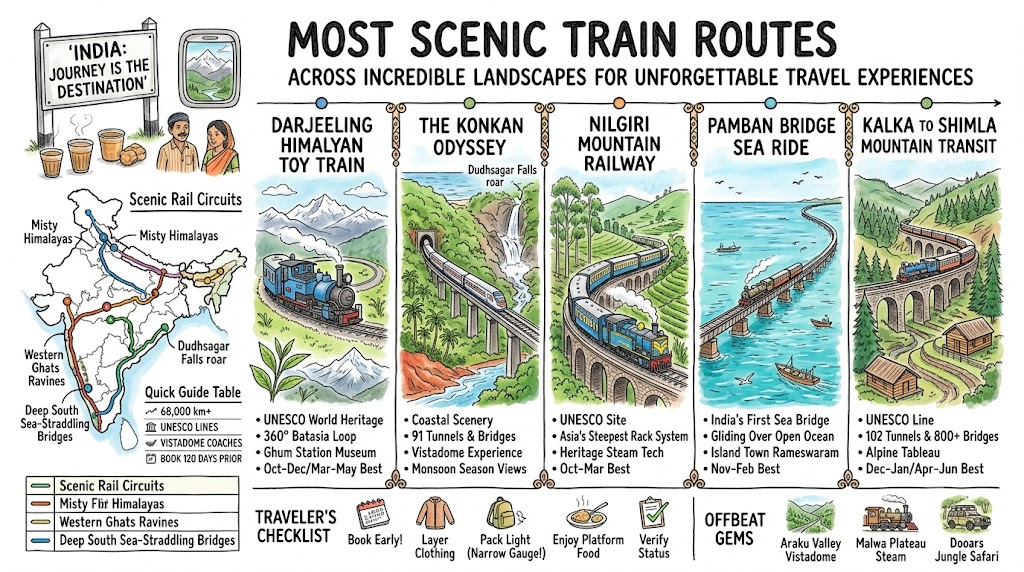
Introduction
Boarding a long-distance train across India is a sensory awakening far removed from sanitized airport lounges and tourist-choked tour buses. While mainstream holidays shuttle vacationers between crowded viewpoint parking lots, life on the rails unfolds at an unhurried, rhythmic pace. Steel tracks trace primeval river gorges, plunge through emerald rainforests, and cling to precipitous Himalayan cliffs.
Here, the journey is not an obstacle to endure; it is the destination itself. The metallic rumble of the tracks harmonizes with station vendors calling out hot clay cups of cardamom chai. Through wide-open carriage windows, you absorb intimate glimpses of rural hamlets, shifting landscapes, and unfiltered heritage that high-speed travel routinely misses.
Kalka-Shimla heritage train over Himalayan viaducts.
Why India Rail Routes Are a Must-Visit Realm
Indian Railways functions as the pulsating circulatory system of a subcontinent that spans alpine passes, arid frontiers, tropical coastlines, and verdant plateaus. Experiencing the nation by train provides cultural immersion that no highway drive or domestic flight can replicate. Beyond mere transport, this vast network preserves historic narrow-gauge marvels—recognized as UNESCO World Heritage sites—that defied severe topographical odds through brilliant mountain engineering.
Whether you are a solo backpacker traveling on loose change or an upscale traveler booking private heritage cabins, the rail circuit adapts effortlessly to your budget. Modernized Vande Bharat expresses with panoramic vista-dome coaches operate alongside century-old heritage steamers, ensuring seamless access across remote districts.
The scenic rail circuits of India fall broadly into three geographical corridors: the misty Himalayan foothills of the north and east, the dramatic monsoon-carved ravines of the Western Ghats along the coast, and the sea-straddling bridges of the deep south.
| Route Feature | Practical Details & Highlights |
|---|---|
| Primary Network Span | Over 68,000 route route-kilometers connecting every climatic zone |
| UNESCO Heritage Lines | Darjeeling Himalayan, Nilgiri Mountain, and Kalka-Shimla Railways |
| Best Scenic Coach Class | Vistadome (Glass ceiling, 180° rotatable seats) & First Class (1A/FC) |
| Accessibility Hubs | Major gateway terminuses: New Delhi, Mumbai CSMT, Kolkata Howrah, Chennai Central |
| Booking Timeline | 120 days in advance via official Indian Railways reservation portals |
Top 5 Legendary Rail Journeys in India
Darjeeling Himalayan Toy Train: New Jalpaiguri to Darjeeling
Climbing from the sweltering plains of Siliguri into the cool embrace of tea-draped ridges, the Darjeeling Himalayan Railway (DHR) remains one of the world’s most astonishing achievements in 19th-century mountain engineering. Established in 1881, this two-foot narrow-gauge line ascends over 2,000 meters without a single cog or rack system, relying entirely on daring loops and reverse zig-zags.
As the vintage steam locomotive puffs up the mountainside, carriage wheels brush past bustling bazaar stalls where shopkeepers step back by mere inches. The journey culminates around the world-famous Batasia Loop, framing unobstructed panoramas of the snow-clad Kanchenjunga peak rising above alpine cedar forests.
- Location: Darjeeling district, West Bengal; starts at New Jalpaiguri (NJP), roughly 580 km north of Kolkata.
- Why it is worth visiting: A living UNESCO World Heritage site showcasing original century-old steam locomotives tackling dramatic mountain gradients.
- Best things to do: Watch the train loop 360 degrees at the Batasia Loop War Memorial, explore the vintage rail museum at Ghum Station (India’s highest railway station), and sip fresh first-flush Darjeeling brew right on the platform.
- Best time to visit: October to December for crystal-clear Himalayan horizons, or March to May for blooming rhododendrons.
- Ideal for whom: Photographers, railway history purists, and slow-travel enthusiasts.
- Travel tip: Book the authentic Steam Joy Ride round-trip between Darjeeling and Ghum well in advance, as diesel engines run on ordinary transit services.
Toy Train navigating the Batasia Loop.
The Konkan Odyssey: Mumbai to Madgaon (Goa)
Carved along India’s dramatic southwestern coastline, the Konkan Railway is a triumph of modern civil engineering that tamed rugged terrain once considered utterly impenetrable. Traversing more than 750 kilometers, the line pierces through 91 tunnels and glides over nearly 2,000 bridges spanning tidal rivers, palm groves, and plunging red-earth valleys.
During the journey, the Western Ghats rise on one side while Arabian Sea estuaries shimmer on the other. Water buffalo graze in flooded paddy fields, sleepy tile-roofed Konkani villages pass by in a flash of terracotta, and seasonal torrents burst through cliff walls right beside the tracks.
- Location: Konkan coastal corridor spanning Maharashtra and Goa, beginning at Mumbai CSMT.
- Why it is worth visiting: Sweeping coastal topography, engineering marvels like the Panval Nadi Viaduct, and lush scenery that transforms during the rains.
- Best things to do: Stand at the open doorways of non-AC sleeper compartments for ocean breeze vistas, sample hot coastal snacks at Ratnagiri Station, and spot hidden estuaries between Chiplun and Karmali.
- Best time to visit: July to September during the monsoon season for roaring waterfalls, or November to February for pleasant, breezy travel.
- Ideal for whom: Backpackers, nature lovers, and coastal road-trippers switching to rail.
- Travel tip: Reserve seats on the Tejas Express or Mandovi Express in a Vistadome coach on the left-hand side (when traveling south) for the finest coastal viewpoints.
Dudhsagar Falls roaring under rail tracks.
The Nilgiri Mountain Railway: Mettupalayam to Ooty
Immortalized in classic cinematic history, the Nilgiri Mountain Railway (NMR) in Tamil Nadu features the steepest track grade in Asia. It utilizes a rare Abt rack-and-pinion system to scale sheer cliff faces, with a distinctive blue-and-yellow steam engine pushing the wooden carriages from behind up into the Blue Mountains.
The ascent starts among dense tropical betel-nut plantations before climbing steeply into fragrant eucalyptus groves and terraced Nilgiri tea estates. Cool mountain mists drift through open windows as the train slows over curved stone viaducts suspended high above river chasms.
- Location: Nilgiris district, Tamil Nadu; starts at Mettupalayam, approximately 40 km from Coimbatore.
- Why it is worth visiting: Asia’s steepest rack railway and a UNESCO World Heritage marvel operating operational heritage steam technology.
- Best things to do: Observe the unique rack-and-pinion teeth engaging at Kallar Station, watch track workers manually replenish water tanks at mountain stops, and disembark at quaint hillside stations like Coonoor.
- Best time to visit: October to March for cool, crisp mountain air and clear skies.
- Ideal for whom: Families, honeymooners, and classic engineering aficionados.
- Travel tip: Sit on the right-hand side when traveling uphill from Mettupalayam to Ooty for the most dramatic valley drops and waterfall views.
The Mandapam to Rameswaram Oceanic Ride: Pamban Bridge
Stretching across the open sea, the historic journey across the Pamban Strait connects peninsular mainland India to the sacred island town of Rameswaram. The cantilever rail bridge, opened in 1914, rests just meters above the crashing surf of the Indian Ocean and the Bay of Bengal.
Looking down from your window, there is no shoreline in sight—only endless turquoise waters and local fishing boats bobbing alongside the rusted steel trestles. The sheer drama of moving across open ocean makes this one of the world’s most breathtaking sea-crossing journeys.
- Location: Ramanathapuram district, Tamil Nadu; bridge crossing spans Mandapam to Pamban Island.
- Why it is worth visiting: India’s first sea bridge, providing the illusion of gliding directly atop open, windswept marine waters.
- Best things to do: Catch early morning light glistening off the ocean waves, spot marine birds circling coral shallows, and watch local fishermen navigate beneath the center lift span.
- Best time to visit: November to February when sea conditions remain calm and afternoon temperatures are mild.
- Ideal for whom: Spiritual pilgrims, coastal photographers, and adventure travelers.
- Travel tip: Cross during low tide on a clear morning for vibrant water clarity, and carry telephoto camera gear to photograph the ocean horizon unobstructed.
Pamban rail bridge across open sea.
The Kalka to Shimla Mountain Transit
Constructed in 1903 to connect the summer capital of British India, the Kalka-Shimla Railway winds through 96 kilometers of pine-forested Shivalik hills. Navigating 102 operational tunnels and more than 800 stone-arch bridges, the narrow-gauge toy train climbs gradually through dramatic mountain turns.
The air turns visibly sharper with every mile climbed, scented by Himalayan cedar and pine resin. As you pass historic stations like Barog and Taradevi, wooden cottages with tin roofs dot terraced slopes, completing an authentic alpine tableau.
- Location: Himachal Pradesh foothills; starts at Kalka station, about 270 km north of New Delhi.
- Why it is worth visiting: A UNESCO World Heritage line known for its stone multi-arch viaducts that echo Roman aqueduct architecture.
- Best things to do: Step out on the platform during the breakfast halt at Barog Station, marvel at the curved multi-tiered arch viaducts near Kanoh, and watch pine-covered valleys unfold outside your window.
- Best time to visit: December to January for fairy-tale snowfall, or April to June to escape the blistering summer heat of the northern plains.
- Ideal for whom: Couples, slow travelers, and road-weary vacationers heading to the mountains.
- Travel tip: Book the Shivalik Deluxe Express, which offers carpeted interiors, wide scenic windows, and catered meals included in your ticket fare.
Offbeat Exploration: Hidden Gems Tourists Miss
The Araku Valley Vistadome Run: Vizag to Kirandul
Most tourists flock straight to north Indian hill railways, completely bypassing the Eastern Ghats. This broad-gauge journey ascends from Visakhapatnam through 58 tunnels and over dizzying bridges into the tribal heartlands of the Ananthagiri Hills. The valley opens up into lush coffee plantations, citrus orchards, and hidden limestone formations around Borra Caves.
The Malwa Plateau Heritage Steam: Patalpani to Kalakund
Tucked away in Madhya Pradesh near Indore, this isolated meter-gauge section winds through the rugged Vindhyachal mountain range. Skirting dramatic drops above the Choral River, this weekend heritage run cuts through dense teak forests and stops directly adjacent to the thunderous Patalpani Waterfall, completely overlooked by international guidebooks.
The Dooars Jungle Safari Line: Siliguri to Alipurduar
Crossing northern West Bengal, this track cuts straight through pristine wildlife sanctuaries, including Mahananda Wildlife Sanctuary and Buxa Tiger Reserve. As the train eases to slow speeds through dense sal tree forests, passengers frequently spot wild Asian elephant herds, one-horned rhinos, and hornbills from their train compartments.
Detailed Practical Guidance for Travelers
| Destination | Standard Entry Fee | General Timings | Best Local Food Options Nearby | Recommended Nearby Attractions |
|---|---|---|---|---|
| Darjeeling Toy Train | ₹1,000 – ₹1,500 (Steam Joy Ride) | 08:00 AM – 04:30 PM (Daily Departures) | Steaming chicken momos & Thukpa at Kunga Restaurant | Peace Pagoda, Tiger Hill, Happy Valley Tea Estate |
| Konkan Railway Route | ₹250 – ₹1,800 (Class Dependent) | Runs 24/7 (Daytime trains best for views) | Malvani fish curry & Solkadhi at Sawantwadi Station | Ratnadurg Fort, Tarkarli Beach, Dudhsagar Falls |
| Nilgiri Mountain Rail | ₹300 – ₹600 (First Class/General) | 07:10 AM (Upward) / 02:00 PM (Downward) | Fresh hot Mysore Pak & Nilgiri masala tea at Coonoor | Sim’s Park Coonoor, Ooty Botanical Gardens, Doddabetta Peak |
| Pamban Sea Bridge | ₹150 – ₹450 (Standard Passenger/Exp) | Regular morning & evening crossings | Chettinad crab masala & parotta near Rameswaram Station | Ramanathaswamy Temple, Dhanushkodi Ghost Town, Agni Theertham |
| Kalka-Shimla Railway | ₹300 – ₹1,200 (Express/Deluxe Car) | 05:30 AM – 12:10 PM (Uphill departures) | Fresh samosas & bun-chole at Barog platform stalls | Shimla Ridge, Christ Church, Viceregal Lodge |
Logistics & On-Ground Navigation
Local Transport Options
- Connecting Railways: Major gateway junctions link smoothly with broad-gauge lines; use Indian Railways reservation counters or verified digital ticketing apps for hassle-free connections.
- Government & Shared Taxis: Fixed-rate taxi kiosks operate right outside hill-station terminuses such as Kalka, New Jalpaiguri, and Mettupalayam to prevent fare manipulation.
- Auto-Rickshaws & E-Rickshaws: Excellent for navigating narrow market roads near coastal and plain stations; always agree on meter rates or establish a price before boarding.
- Self-Drive Rentals: Practical for touring beach districts like Goa after stepping off the Konkan line, but strictly unadvisable on steep Himalayan roads.
Budget Planning
- Budget / Backpacking Tier: Expect to spend around ₹1,200 to ₹1,800 per day. This covers Sleeper or Second-Class Unreserved rail fares, clean homestay dormitories, and hearty platform thalis or local street foods.
- Mid-Range / Comfort Tier: Plan for approximately ₹4,500 to ₹7,500 per day. This provides for AC Chair Car, Vistadome, or First-Class (1A) tickets, boutique heritage hotels, private transfers, and multi-course meals at regional restaurants.
Safety and Inclusivity Tips
- For Families: Reserve dedicated lower berths for elderly companions and children, pack shelf-stable snacks, and always carry personal toilet paper and sanitizer.
- For Couples: Book First-Class AC (1A) compartments on overnight routes, which provide lockable two-berth coupes offering complete privacy and security.
- General Safety: Keep personal luggage chained beneath berths with a numeric padlock on overnight routes; never step out onto footboards while the train is moving.
Strategic Travel Planning Guardrails
Travel Planning Tips for Rail Journeys
- Book Exactly at Opening: Mountain toy trains and Vistadome cars sell out within minutes; secure your tickets precisely 120 days in advance when reservations open.
- Embrace Digital Payments: The Unified Payments Interface (UPI) is accepted across virtually all station platforms, but keep a small stash of cash for remote mountain stations.
- Pack Functional Layers: Hill rail journeys like Kalka-Shimla start in blistering foothill heat and finish in brisk mountain chills; dress in easy layers.
- Verify Live Running Status: Use GPS-based rail tracking apps to track real-time delays, platform numbers, and mechanical updates.
- Respect Photography Boundaries: While scenic window shooting is welcome, never aim lenses at military rail yards or block carriage passageways with tripods.
Common Mistakes to Avoid
- Packing Oversized Hard Luggage: Heritage narrow-gauge train aisles are narrow, and overhead luggage racks cannot fit large hardshell suitcases.
- Assuming High-Speed Reliability: Mountain railways run at leisurely paces of 15 to 25 km/h; do not schedule tight flight transfers directly on arrival days.
- Skipping Regional Platform Food: Passing up hot freshly fried vadas, samosas, or local tea from platform vendors means missing the culinary essence of rail transit.
- Overlooking Track Closures: Monsoon landslides occasionally halt hill trains; check route clearance advisories prior to travel.
- Boarding Unreserved Cars Without Patience: General unreserved compartments get intensely packed; avoid them unless you are seasoned in navigating tight crowds.
Suggested Itinerary Blueprints
1-Day Quick Dash: The Southern Ridge Climb (Mettupalayam to Coonoor)
Take the morning 07:10 AM heritage rack train from Mettupalayam. Enjoy the steepest stretches of track through forest reserves, then disembark by mid-morning at quiet Coonoor. Spend your afternoon walking through tea gardens and scenic viewpoints, then take a one-hour downhill taxi back to Coimbatore by evening.
2-Day Deep-Dive: The Konkan Coastal Rail & Heritage Retreat
- Day 1: Board the morning train from Mumbai CSMT, settling into a Vistadome seat to soak up the Western Ghats viaducts and waterfalls. Arrive in coastal Ratnagiri or Sindhudurg by late afternoon. Savor a traditional Malvani seafood feast and watch the sun set over the sea.
- Day 2: Spend a quiet morning exploring quiet coastal fortresses and empty beaches. Catch an afternoon onward train to Madgaon, Goa, arriving in time for an evening dinner along the beach.
Complete Weekend Travel Plan: The Himalayan Toy Train Loop
- Friday: Catch an evening broad-gauge train from New Delhi up to Kalka Junction.
- Saturday: Board the early-morning Shivalik Deluxe Express at 05:30 AM. Glide across viaducts and through pine forests, reaching Shimla by late morning. Check into a heritage lodge, stroll the pedestrian Mall Road, and tour the historic Viceregal Lodge.
- Sunday: Wake up early to catch the crisp morning light over the cedar ridges. Take a panoramic mountain cab down to Chandigarh by mid-afternoon, boarding an evening express train back to Delhi.
Common Tourist Mistakes to Avoid
- Geographic Blunders: Do not attempt to pair the Darjeeling rail line with northern Himachal trips in a single short vacation; the transit distances between Indian states are vast.
- Commercial Traps: Avoid spending your layovers inside sterile station food courts; step right onto the open platform to find authentic vendors preparing hot regional snacks on iron griddles.
- Neglecting Modern/Alternative Zones: Look beyond the traditional hill-station terminals. Quaint intermediate stops like Kurseong or Barog offer tranquil stays without the commercial noise of main hill hubs.
- Transport Overpayment: Always use pre-paid taxi stands or app-based pickups outside urban terminals like Mumbai CSMT or New Jalpaiguri to dodge inflated tourist markups.
- Luxury Dining Bias: Sticking purely to five-star hotel menus prevents you from tasting local regional dishes—like spicy puri-bhaji or coastal fish curries—served hot by historic station kitchens.
Frequently Asked Questions
1. How far in advance should I book scenic train tickets in India?
Reservations for long-distance trains and special heritage lines open 120 days prior to the departure date on the official IRCTC portal. Popular scenic routes, specifically Vistadome carriages and narrow-gauge toy trains like the Kalka-Shimla or Darjeeling line, routinely fill their seats within minutes during peak holiday seasons.
2. What is a Vistadome coach, and which routes feature it?
A Vistadome coach is a modern tourist rail car designed with transparent glass ceilings, wide side windows, and 180-degree rotatable reclining seats. Prominent routes offering Vistadome coaches include the Mumbai-Goa Konkan line, the Visakhapatnam to Araku Valley route, and select scenic departures across Assam and West Bengal.
3. Are Indian trains safe for solo female travelers?
Yes, Indian trains are generally safe when practicing reasonable travel awareness. Choosing reserved air-conditioned tiers such as 2-Tier AC (2A), 3-Tier AC (3A), or First Class (1A) ensures comfortable, secure surroundings. Always lock your luggage securely, note railway protection helpline numbers, and avoid arriving at isolated rural stations late at night.
4. Can I buy food on board scenic train journeys?
Long-distance express trains feature onboard pantry cars or mobile e-catering services delivering fresh restaurant meals directly to your reserved seat at designated halts. Mountain toy trains do not feature pantry cars, but they make scheduled stops at station platforms where you can easily buy hot tea, fresh fruit, and regional snacks.
5. Which side of the train provides the best views on the Kalka-Shimla line?
When traveling uphill from Kalka up to Shimla, reserve seats on the right-hand side of the train carriage for sweeping valley views, terraced farms, and multi-tier arch stone bridges. Conversely, when returning downhill from Shimla to Kalka, sit on the left-hand side for optimal scenery.
6. Do heritage toy trains operate during the monsoon season?
Most heritage hill lines continue running during the monsoon months, but services occasionally face temporary halts caused by landslides or fallen trees along steep hillside tracks. The Darjeeling line in particular experiences periodic rain disruptions between July and August, making early autumn a more reliable booking window.
7. What luggage restrictions apply on narrow-gauge mountain trains?
While official weight allowances are generous, the physical dimensions of narrow-gauge carriages are compact. Aisles are narrow and overhead baggage racks hold small duffels or backpacks rather than large hardshell suitcases. Pack light, compact bags that can fit neatly under your seat or near the carriage vestibule.
8. How do I travel across the Pamban Sea Bridge by train?
To cross the Pamban Strait, book passenger or express train services terminating at Rameswaram originating from hubs like Madurai, Tiruchirappalli, or Chennai. Verify bridge operational schedules before departure, as severe sea winds or structural retrofits periodically divert trains to terminate at Mandapam station on the mainland.
9. Are meals included in the price of Indian train tickets?
Standard train tickets do not automatically include complimentary meals, with the exception of premium rail classes on trains like the Rajdhani, Shatabdi, and Vande Bharat Express. On select deluxe heritage services, such as the Shivalik Deluxe Express on the Kalka-Shimla route, catered breakfast is included in the base fare.
10. What is the difference between First Class (FC) and First AC (1A)?
First Class (FC) refers to historic non-air-conditioned carriages featuring vintage wooden seating and wide-open windows, largely preserved on hill railways. First AC (1A) represents the top luxury tier on broad-gauge trains, offering air-conditioned, carpeted two-berth and four-berth lockable compartments for elevated privacy and personal service.
11. Can foreign tourists access special booking quotas for Indian rail?
Yes, Indian Railways reserves a dedicated Foreign Tourist Quota (FTQ) on popular trunk and heritage routes. International visitors holding foreign passports and valid tourist visas can access these reserved ticket pools up to 365 days in advance via the official IRCTC web portal or international rail bureaus in major cities.
12. Is it safe to drink water provided on Indian trains?
Never drink raw tap water from train carriage bathroom sinks. While pantry vendors sell packaged water bottles, always inspect the bottle to verify an unbroken factory seal with the official “Rail Neer” brand label. Carrying a reusable water bottle equipped with an internal purifier filter provides added peace of mind.
Conclusion
Choosing to explore India by train delivers a deeply satisfying way to travel that no express flight can ever match. It strips away modern travel anxiety, trading artificial deadlines for the soothing, hypnotic cadence of iron tracks across an ancient landscape. From the cool mountain mists of Himalayan tea estates to sea breezes across open ocean straits, journeying by train reconnects you with the authentic, enduring spirit of slow travel.
