MOTOSHARE 🚗🏍️
Rent Bikes & Cars Directly from Owners
Motoshare connects vehicle owners with people who need bikes and cars on rent. Owners earn from idle vehicles, and renters get flexible ride options.
Visit Motoshare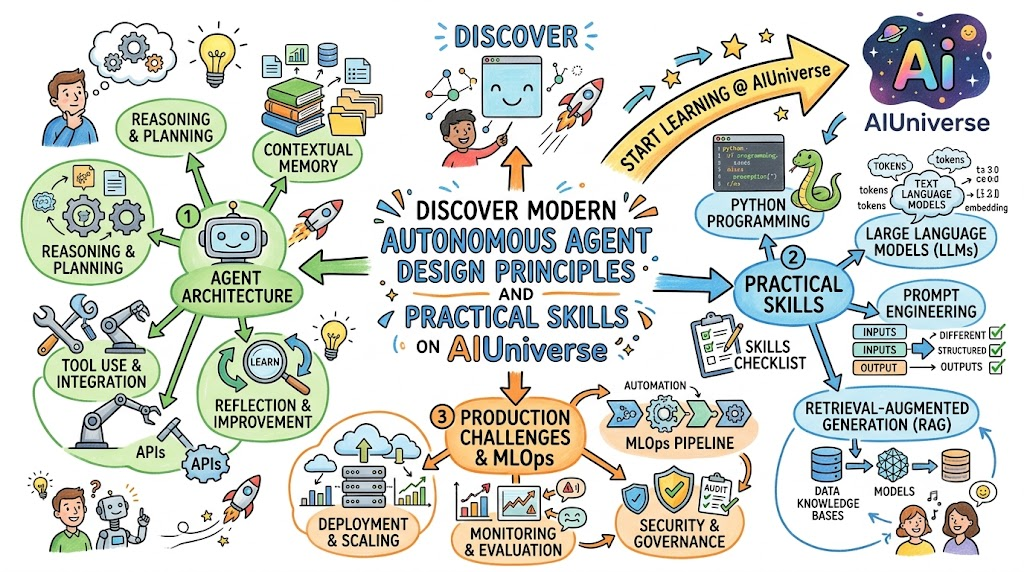
Introduction
Artificial intelligence is undergoing a massive transformation as simple conversational chatbots evolve into proactive systems capable of complex problem-solving. Businesses are moving past basic prompt-response interactions to adopt autonomous software entities that can analyze goals and take real actions. Modern agentic systems reason through multi-step workflows, execute digital tools, and continuously refine their outputs without requiring step-by-step human prompts. Developing expertise in these advanced architectures allows professionals to design reliable enterprise solutions that automate intricate operational processes. Participating in a structured certification program gives learners the hands-on engineering skills and architectural knowledge needed to succeed in this changing technology landscape. This practical guide covers agent core architectures, multi-agent coordination, production MLOps integration, governance frameworks, and industry use cases to help you build enterprise-grade intelligent systems. You can explore structured learning tracks and expert deployment resources directly through AIUniverse.
What Is Agentic AI?
Agentic AI refers to software systems designed to achieve specific goals autonomously by reasoning, breaking down objectives into smaller sub-tasks, and using digital tools. Unlike standard static models that merely answer questions, an agentic system maintains persistent state memory, reflects on its intermediate decisions, and interacts directly with external software applications. For example, when asked to manage a customer refund request, an autonomous agent reads the incoming email, queries the internal database for transaction history, verifies refund eligibility, executes the refund via an API, and updates the CRM record automatically. It continuously evaluates its own outputs, corrects errors during execution, and asks for human intervention only when encountering predefined edge cases or strict policy boundaries.
How Agentic AI Differs from Traditional AI and Generative AI
Traditional rule-based automation follows fixed programming logic and cannot handle unexpected data variations or complex edge cases. Generative AI improves on this by creating text, code, or images based on simple user prompts, but it remains passive and reactive without direct action-taking capabilities. Conversational AI acts as a flexible dialogue interface, managing customer inquiries but relying entirely on human input for every subsequent step. In contrast, agentic AI combines reasoning, memory, tool access, and dynamic planning to execute complex operational tasks end-to-end with minimal supervision.
| Technology Type | Main Capability | Level of Autonomy | Common Example |
| Traditional Automation | Executes rigid rule-based scripts | Zero Autonomy | Basic email auto-responders |
| Generative AI | Produces context-aware content | Passive / Interactive | Writing draft emails from prompts |
| Conversational AI | Manages real-time multi-turn text dialogues | Low / Guided Autonomy | Website customer support chatbots |
| Agentic AI | Plans tasks, executes software tools, and solves problems | High / Semi-Autonomous | Fully automated refund processing systems |
Why Agentic AI Skills Matter for Working Professionals
Mastering autonomous agent architectures is becoming essential across technical and business fields as enterprise software integrates dynamic reasoning into daily workflows. Software developers, DevOps engineers, and cloud specialists must learn how to connect intelligent language models with external APIs, microservices, and continuous deployment pipelines safely. Data scientists and IT operations teams use agent workflows to automate complex data preparation, system anomaly detection, and predictive incident response without manual monitoring. Furthermore, business analysts, finance teams, and project managers can use autonomous agents to process multi-step approvals, perform market research, and update corporate systems automatically, allowing them to focus on strategy and high-level decision-making.
What Is an Agentic AI Certification Course?
An Agentic AI certification course provides a structured educational framework designed to teach learners how to build, deploy, and manage goal-driven autonomous systems in enterprise environments. These programs combine theoretical concepts with hands-on labs, giving students direct experience in tool integration, orchestration frameworks, retrieval systems, and security controls. Learners build working software projects that demonstrate their ability to handle production challenges like API rate limits, model hallucinations, and access permission security. While earning an industry certificate verifies foundational knowledge, true technical capability comes from successfully deploying production-ready agents that solve real-world operational problems under realistic constraints.
Who Should Take an Agentic AI Certification Course?
- Working Professionals: Technical specialists can enhance their careers by upgrading legacy software workflows into dynamic, goal-driven automated systems that increase operational efficiency.
- AI Beginners: Aspiring tech practitioners can build strong foundational knowledge by learning core concepts step-by-step, starting with basic scripting and moving up to advanced autonomous agent design.
- Developers and Engineers: Software engineers learn to orchestrate language models, integrate REST APIs, manage persistent memory stores, and set up continuous MLOps deployment pipelines.
- Managers and Business Leaders: Corporate leaders gain the insights needed to identify high-value business use cases, manage AI transformation costs, calculate return on investment, and enforce compliance policies.
- Enterprise Teams: Cross-functional technical groups can establish standardized system architecture practices, shared prompt repositories, and unified security guidelines across all organizational departments.
Skills Covered in an Agentic AI Certification Program
Artificial Intelligence Fundamentals
Understanding fundamental machine learning concepts, core statistical principles, neural network behaviors, and transformer-based model architectures forms the foundation for building advanced autonomous solutions.
Python Programming
Mastering modern Python development allows engineers to interact with external APIs, construct asynchronous pipelines, manage data structures, and handle runtime execution errors efficiently.
Large Language Model Fundamentals
Learning token limits, context window management, vector embeddings, structured outputs, and prompt hallucination mitigation strategies enables developers to select and configure optimal foundational models.
Prompt Engineering
Structuring precise system instructions, role definitions, operational constraints, dynamic contexts, and output formats ensures underlying language models produce predictable, machine-readable actions consistently.
Prompt Management
Utilizing the best prompt management tools helps teams organize dynamic system prompts, track version histories, execute comparative output evaluations, automate testing, and collaborate effectively across development environments.
API and Tool Integration
Connecting autonomous agents to external REST APIs, relational databases, cloud microservices, customer support ticketing platforms, and enterprise software systems expands their ability to perform complex real-world tasks.
Retrieval-Augmented Generation
Designing retrieval-augmented generation architectures using vector databases and semantic search allows agents to access real-time enterprise data securely without requiring expensive model fine-tuning.
Agent Memory
Implementing short-term conversational buffers, long-term vector stores, persistent task memory, and key-value user preference stores ensures agents maintain context across multi-step execution lifecycles.
Planning and Reasoning
Applying advanced reasoning patterns like ReAct, Chain-of-Thought, and Tree-of-Thought enables agents to break down broad operational goals into logical, actionable sub-tasks autonomously.
Agent Evaluation
Establishing continuous metrics to measure task completion rates, execution latency, API usage costs, output accuracy, and human-intervention requirements helps developers maintain high operational performance over time.
Security and Governance
Implementing strict role-based access controls, robust prompt-injection safeguards, detailed audit logs, and human approval checkpoints keeps software agents operating safely within corporate policies.
Agentic AI Learning Roadmap for Beginners
| Learning Stage | Main Topics | Practical Outcome |
| Stage 1: Fundamentals | Python scripting, JSON, REST APIs, Git version control | Basic data handling scripts and operational software connections |
| Stage 2: LLM Core | Language models, context windows, vector embeddings, prompting | Custom conversational interfaces with structured outputs |
| Stage 3: Retrieval Systems | Vector databases, document parsing, dynamic RAG pipelines | Knowledge base search tools for organizational documents |
| Stage 4: Single-Agent Systems | ReAct logic, tool calling, persistent state management, memory | Task management agents that interact with external APIs |
| Stage 5: Multi-Agent Systems | Specialized roles, agent communication, task orchestration | Multi-agent software code review and testing systems |
| Stage 6: Production & Governance | MLOps pipelines, latency optimization, access control, audit logs | Enterprise-grade agents deployed with real-time monitoring |
Single-Agent and Multi-Agent Systems
Single-agent systems rely on a single central language model that processes inputs, selects tools, and executes operational tasks in a sequential loop. These systems are easy to design, cost-effective to run, and simple to debug, making them ideal for straightforward workflows like answering document questions or converting simple data formats. However, a single agent can struggle when managing complex workflows that require diverse technical skills or long context windows. Developers should start by building robust single-agent applications before attempting to build complex multi-agent architectures.
Multi-agent systems break complex processes into specialized roles, where individual agents handle focused tasks like writing code, running unit tests, or reviewing security compliance. These specialized agents communicate, share state memory, and delegate sub-tasks under a central manager agent to solve complex enterprise problems. For instance, in an automated software development pipeline, a manager agent assigns feature specs to a coder agent, passes the output to a tester agent, and sends failures back for revision before requesting human approval. While multi-agent networks handle intricate projects efficiently, they require strict communication standards, rate-limiting rules, and cost-control measures to prevent endless action loops.
Connection Between Agentic AI and MLOps
Connecting agentic workflows with established enterprise infrastructure requires enrolling in a comprehensive MLOps certification course to learn standard deployment pipelines, model tracking, and system maintenance best practices. Production agents depend on foundational MLOps tools to automate CI/CD deployments, monitor API response latency, log model execution traces, and roll back failing software updates quickly. Selecting the best MLOps tools depends on your enterprise cloud platform, internal security policies, team size, budget limits, and integration requirements for complex agent framework architectures. Modern LLMOps extends traditional MLOps by adding automated prompt testing, vector database versioning, dynamic context tracking, and real-time operational cost monitoring.
Connection Between Agentic AI and AIOps
Taking an AIOps certification course shows infrastructure engineers how artificial intelligence can transform complex IT operations, automated monitoring, and incident remediation processes. Modern AIOps platforms collect real-time system logs, detect abnormal performance spikes, correlate technical events across cloud environments, and pinpoint root causes during unexpected downtime automatically. When paired with agentic capabilities, an AIOps framework can execute initial triage procedures, generate incident reports, and propose recovery actions directly within ticketing platforms. To protect critical infrastructure, production agents must operate under strict permission boundaries, requiring human manager sign-off before executing major system changes.
Role of Federated Learning Platforms
Using modern federated learning platforms allows enterprises to train shared machine learning models across decentralized edge nodes without centralizing confidential raw data. This privacy-focused approach enables organizations in sensitive fields like healthcare, corporate banking, and telecommunications to pool system insights without breaching data privacy regulations. Autonomous agents can use these locally trained models to handle contextual tasks while keeping sensitive customer data isolated on local systems. Although federated learning protects data privacy, engineering teams must manage network communication overhead, balance differing data quality across nodes, and secure systems against gradient-injection attacks.
Practical Agentic AI Use Cases Across Industries
Customer Service
Autonomous support agents resolve complex user inquiries by accessing CRM history, executing refund processes, updating billing details, and escalating edge cases to human support staff when needed.
Software Development
Specialized coding agents write unit tests, fix minor software bugs, analyze security pull requests, document code repositories, and automate repetitive release workflows across cloud pipelines.
IT Operations
System monitoring agents process log files, isolate infrastructure errors, execute initial diagnostic scripts, clear system caches, and notify engineering teams with concise incident summaries during outages.
Sales and Marketing
Sales outreach agents research prospective client leads, personalize communication campaigns, handle initial email inquiries, evaluate buyer intent, and schedule discovery calls directly into sales calendars.
Finance and Accounting
Financial analysis agents process invoices, check operational expense reports against compliance rules, highlight suspicious transactions, reconcile ledger entries, and prepare quarterly audit documentation.
Human Resources
HR assistant agents answer internal employee policy questions, streamline initial candidate screening calls, coordinate interview schedules across team calendars, and manage digital onboarding processes.
Cybersecurity
Security operations agents analyze incoming network threats, check system access logs, flag credential leaks, isolate suspicious IP addresses, and draft incident response reports for security managers.
Healthcare
Clinical workflow agents streamline administrative processes by summarizing patient histories, scheduling appointments, parsing lab reports, and processing insurance claims while strictly protecting patient privacy.
Manufacturing
Supply chain agents evaluate warehouse inventory levels, monitor equipment maintenance schedules, automate purchase orders for parts, and optimize shipping routes to reduce operational delays.
Business Analytics
Data analysis agents transform unstructured corporate reports into clear visual metric dashboards, identify sales trends, run predictive forecasting models, and deliver weekly executive summaries automatically.
Best AI Tools for Business Evaluation Guide
Evaluating the best AI tools for business requires a thorough review process to ensure selected vendor solutions integrate smoothly into your enterprise architecture without introducing security risks. Organizations must avoid selecting AI software based on market hype, focusing instead on tool compatibility, cost transparency, data privacy policies, and measurable business impact. Conducting a small pilot project allows enterprise teams to measure real performance, test data security boundaries, and evaluate vendor support capabilities before scaling deployment across the company.
| Evaluation Area | Questions Businesses Should Ask |
| Business Fit | Does this tool directly solve our defined business challenge and improve daily operational productivity? |
| Data Privacy | Are customer data inputs kept isolated from public training datasets and protected under corporate security standards? |
| Security | Does the software platform support single sign-on, role-based access control, and comprehensive audit logging? |
| Integration | Can the tool connect easily with our existing software applications, databases, and continuous delivery pipelines? |
| Accuracy | How reliably does the platform complete complex tasks, avoid hallucinated outputs, and handle edge cases? |
| Scalability | Can the tool handle increasing enterprise API query volumes without experiencing unexpected downtime or latency? |
| Governance | Are there clear human-in-the-loop review controls, policy enforcement features, and detailed activity tracking? |
| Cost | What are the recurring licensing fees, setup expenses, API compute charges, and long-term scaling costs? |
| Customization | Can the system prompt settings, workflow paths, user interfaces, and task parameters be tailored to our processes? |
| Technical Support | Does the vendor provide reliable enterprise support documentation, dedicated account management, and SLA guarantees? |
| Exit Strategy | Can our internal team export system data, workflow configurations, and prompt assets easily if we switch vendors? |
Practical Agentic AI Project Ideas
Beginner Projects
- Document Question-Answering Agent: A simple RAG-based search assistant that reads internal PDFs and delivers clear, cited answers to user queries.
- Meeting Summary Agent: An automated utility that transcribes raw audio calls, extracts key discussion points, and generates structured action items.
- Personal Task-Planning Agent: A calendar integration tool that prioritizes daily work assignments, creates scheduled time blocks, and sends automated task updates.
- FAQ Assistant: An interactive support utility that answers standard user product questions accurately using an indexed corporate knowledge base.
- Product Information Assistant: A specialized search utility that retrieves specific product specifications, user guides, and inventory availability from catalog databases.
Intermediate Projects
- Customer Support Ticket Agent: An automated support router that reads incoming tickets, queries CRM databases, applies policy rules, and issues standard customer refunds.
- Sales Lead Qualification Agent: A prospecting tool that gathers business intelligence from public company sites, scores incoming leads, and updates pipeline databases.
- Employee Onboarding Assistant: A workflow tool that guides new hires through corporate training modules, sets up software access requests, and schedules team meetings.
- IT Incident Analysis Agent: A diagnostic tool that parses system event logs during outages, isolates probable root causes, and recommends corrective scripts.
- Testing Assistant: A developer utility that reads incoming code changes, automatically writes unit test suites, and highlights potential software edge-case vulnerabilities.
Advanced Projects
- Multi-Agent Software Delivery System: A multi-agent framework where dedicated manager, programmer, and QA agents build, test, and refine software features autonomously.
- Cloud Operations Agent: An enterprise monitoring tool that detects infrastructure anomalies, scales cloud resource capacity, and executes system health checks independently.
- Enterprise Knowledge Agent: A cross-departmental search engine that retrieves confidential company data securely, enforces user permission access levels, and generates executive summaries.
- Security Investigation Agent: An automated threat response framework that tracks suspicious network traffic, correlates security events, and isolates compromised endpoints automatically.
- Supply-Chain Decision-Support System: A predictive logistics assistant that evaluates inventory changes, monitors weather delays, updates purchase orders, and optimizes delivery paths.
For every project built, learners must document the initial problem statement, system architecture diagram, connected data sources, configured APIs, security access controls, evaluation metrics, and practical business value created.
Common Challenges in Agentic AI Development
Hallucinated Information
Language models sometimes produce incorrect or fabricated claims confidently when processing dynamic tasks. Developers can mitigate this challenge by implementing strict retrieval-augmented generation pipelines, enforcing structured data output formats, and cross-checking facts against verified company databases.
Incorrect Tool Usage
Agents can misinterpret API parameters, execute incorrect functions, or pass invalid arguments during complex task runs. Engineering teams solve this by providing detailed JSON schema specifications, clear tool descriptions, and error handling scripts that guide the agent back on track.
Prompt Injection
Malicious users may attempt to bypass underlying system instructions by injecting untrusted text into dynamic inputs. System architects protect platforms by separating untrusted user data from system prompts, using input filtering tools, and running security tests continuously.
Data Leakage
Agents handling multi-tenant enterprise workflows risk exposing confidential data to unauthorized users if security boundaries are weak. Organizations prevent data leaks by enforcing strict role-based access control rules, redacting personal identifiable information, and running real-time output permission filters.
Unlimited Action Loops
System logic bugs can trap autonomous agents in endless execution loops, leading to excessive compute costs and system crashes. Developers prevent these execution failures by implementing strict step-count limits, timeout boundaries, and real-time execution budget monitoring tools.
High API Costs
Running complex agent applications using top-tier commercial models continuously can generate surprisingly high cloud API bills. Engineering teams control operating costs by caching common queries, using smaller fine-tuned open-source models for routine sub-tasks, and setting API usage limits.
Slow Response Time
Chaining multiple sequential reasoning loops and tool API calls increases overall latency, leading to slow user responses. Developers improve execution speed by running independent sub-tasks asynchronously in parallel, optimizing system prompts, and pre-fetching common data context elements.
Difficult Evaluation
Evaluating non-deterministic agent workflows across dynamic operational scenarios remains difficult using standard software testing approaches. Technical teams build robust evaluation pipelines that measure real task completion accuracy, API usage efficiency, output quality, and human correction rates.
Weak Monitoring
Deploying agents without real-time execution trace visibility makes isolating runtime failures and system bottlenecks nearly impossible. System operators fix this by implementing centralized tracing tools, structured JSON log outputs, and automated alert systems for anomalous execution paths.
Lack of Human Control
Granting autonomous agents unsupervised authority over critical enterprise actions creates severe operational risks. System designers remove these risks by requiring explicit human manager sign-off for high-impact actions like processing financial transactions or executing production deployments.
Integration Problems
Connecting modern language model agents to legacy enterprise software with outdated interfaces often causes system integration failures. Engineering teams address these legacy integration problems by building custom REST API wrapper services, standardized middleware layers, and detailed error handling modules.
Regulatory and Compliance Issues
Deploying autonomous systems without clear data governance processes risks violating corporate compliance standards and data privacy laws. Organizations ensure compliance by keeping detailed audit logs of all agent decisions, enforcing strict data retention policies, and adhering to regional privacy regulations.
Responsible Agentic AI Practices
- Enforce the principle of least privilege by granting agents only the minimum tool access permissions required for their specific tasks.
- Mandate explicit human review and approval checkpoints before allowing agents to execute irreversible financial or operational actions.
- Encrypt sensitive customer data completely both in transit across software networks and at rest within persistent vector storage systems.
- Separate development, testing, and production runtime environments strictly to prevent untested agent code from touching live systems.
- Maintain detailed, immutable audit logs tracking every agent reasoning step, tool call, API request, and resulting system response.
- Conduct regular prompt-injection attack simulations and security penetration tests to identify execution vulnerabilities before production release.
- Set strict maximum step execution limits and system timeout limits to eliminate infinite execution loops and reduce processing overhead.
- Establish clear API compute cost budgets and automated query threshold alerts to manage operational cloud spending effectively.
- Connect agents exclusively to verified, updated, and authoritative enterprise knowledge bases to prevent hallucinations.
- Implement structured schema validation checks on all model output responses before passing data into downstream API tools.
- Build automated, multi-step rollback procedures to revert system changes instantly if an agent executes an incorrect action.
- Review persistent memory vector stores routinely to purge outdated, inaccurate, or confidential user context data safely.
- Assign clear human ownership and accountability for every deployed autonomous agent system operating within the organization.
- Track model execution latency, output accuracy drifts, and hallucination rates continuously using continuous LLMOps monitoring dashboards.
- Document known performance limitations, architectural boundaries, and edge-case failure modes clearly for all end users.
Career Opportunities After Agentic AI Certification
Earning an industry-recognized agentic certification opens up technical career tracks across software development, AI engineering, cloud architecture, and corporate technology consulting. Specialized professionals secure high-demand roles like Agentic AI Developer, Generative AI Engineer, MLOps Specialist, LLMOps Architect, AIOps Engineer, and AI Automation Specialist. Organizations also seek skilled professionals for strategic leadership roles, including AI Solutions Architect, AI Product Manager, AI Governance Officer, and Enterprise AI Consultant. Actual job responsibilities, required skills, and title names vary across companies, so focusing on building real hands-on engineering skills remains the best path for long-term career growth.
How to Build a Strong Agentic AI Portfolio
- Working End-to-End Projects: Deploy complete functional applications live on public cloud hosting platforms rather than sharing isolated code snippets or simple scripts.
- Clear Business Problem Focus: Document the exact operational pain point, target workflow, and clear financial or efficiency benefits your agent project delivers.
- Clean Open-Source Code: Maintain clean GitHub repositories with structured module layouts, clear code comments, comprehensive unit tests, and easy setup instructions.
- Detailed Architecture Diagrams: Include clear system topology charts showing data flows, model interactions, vector database connections, and external API integrations.
- API and Tool Integrations: Showcase your ability to connect language models with real third-party services, REST APIs, microservices, and databases smoothly.
- Robust RAG Implementations: Demonstrate advanced vector retrieval configurations using hybrid search algorithms, re-ranking strategies, and precise context chunking parameters.
- Security and Permission Controls: Highlight integrated security features like user authorization checks, input sanitization routines, API rate limits, and approval workflows.
- Evaluation Metrics and Testing: Share comparative performance test results evaluating task completion success, model execution speed, API costs, and output accuracy.
- Production Tracing and Logs: Include operational log trace samples that show how your application tracks agent reasoning steps and catches execution failures.
- Clear Documentation: Write readable, comprehensive project guides that detail runtime requirements, setup commands, environment variables, and known limitations.
Focusing on building three high-quality, production-ready applications that solve real business problems will impress technical hiring teams far more than collecting dozens of basic tutorial repositories.
How to Choose AI Certification Courses Online
Evaluating modern AI certification courses online requires researching curriculum depth, practical focus, and instructor experience to ensure you select a program that advances your career goals. Look for courses that offer hands-on coding labs, real-world project builds, production deployment training, MLOps integration frameworks, and active learner support communities. Avoid high-pressure educational programs that guarantee job placements, promise unrealistic salary increases, use outdated curricula, or focus entirely on static video lectures without practical coding projects. A quality training program focuses on teaching long-term system architectural concepts, practical debugging skills, security governance standards, and real-world implementation strategies.
Weekly Learning Plan for Working Professionals
- Week 1: Core Python and API Integrations: Dedicate eight hours to mastering asynchronous Python programming, dynamic JSON parsing, and connecting REST API endpoints securely.
- Week 2: Foundational LLMs and Prompt Engineering: Spend ten hours studying context windows, token limits, dynamic system prompts, and structured output formatting techniques.
- Week 3: Vector Databases and RAG Architectures: Commit ten hours to configuring vector database stores, generating semantic embeddings, and building hybrid retrieval search tools.
- Week 4: Single-Agent Frameworks and Tool Calling: Dedicate twelve hours to constructing ReAct agent execution loops, setting up custom tools, and managing persistent memory context.
- Week 5: Multi-Agent Coordination and Workflows: Spend twelve hours designing specialized multi-agent architectures, defining inter-agent communication channels, and configuring orchestration rules.
- Week 6: Production MLOps, Tracing, and Deployment: Commit ten hours to deploying agent applications to cloud environments, tracking API logs, and optimizing performance.
- Week 7: Security Governance and Red Teaming: Dedicate eight hours to testing prompt injection vulnerabilities, setting up access control policies, and implementing human approval steps.
- Week 8: Portfolio Capstone Project: Spend fifteen hours building, documenting, testing, and deploying a functional multi-agent enterprise application publicly.
Beginner Roadmap for Starting Agentic AI
- Learn standard Python programming fundamentals, focusing on data structures, functions, async execution, dynamic error handling, and API interactions.
- Master working with web APIs, HTTP protocol request methods, JSON data parsing, environment variables, and authentication security keys.
- Study core artificial intelligence principles, transformer architecture basics, token processing methods, and semantic vector embeddings.
- Explore foundational large language models, experimenting with context windows, system prompt settings, dynamic context inputs, and structured JSON outputs.
- Practice advanced prompt engineering strategies, using system role constraints, dynamic variable insertion, few-shot examples, and strict formatting rules.
- Build a simple interactive conversational interface using open-source libraries to manage multi-turn dialogues and track persistent chat context.
- Add a retrieval-augmented generation pipeline to your chat interface, indexing local document files within a vector database for semantic search query answering.
- Connect an external tool API to your chat interface, enabling the language model to trigger real actions based on user conversation requests.
- Implement dynamic memory structures, step planning loops, and reflection capabilities to convert your simple tool-calling chat interface into an autonomous agent.
- Test your agent system across diverse operational scenarios, measuring task completion accuracy, execution latency, API call costs, and failure modes.
- Deploy your basic agent application live on a cloud hosting platform, securing API authentication keys and configuring runtime environment settings properly.
- Set up continuous MLOps logging tools, track real-time execution step traces, manage API costs, and enforce human approval security rules.
Corporate AI Training for Enterprise Teams
Executive AI Training
Executive training programs help senior business leaders identify high-ROI enterprise use cases, evaluate technology implementation costs, manage organizational changes, and establish corporate governance policies.
Developer and Engineering Training
Technical engineering modules focus on hands-on software development, teaching technical teams how to write multi-agent code, integrate vector databases, configure APIs, and handle errors.
Operations and MLOps Training
Operations training equips DevOps and IT teams to manage continuous delivery pipelines, monitor cloud infrastructure, track model execution traces, and optimize operational system costs.
Business User Training
Business user sessions show non-technical staff how to use autonomous software tools safely, write effective operational prompts, review automated outputs, and manage daily workflows.
AI Governance Training
Governance modules help risk officers, legal teams, and compliance managers set up access permission rules, maintain audit trails, ensure data privacy, and prevent corporate data leaks.
Customizing corporate AI training around an organization’s specific technical ecosystem, compliance requirements, and business goals ensures rapid adoption and measurable productivity gains across all business departments.
How AI Consulting Services Support Implementation
Partnering with professional AI consulting services helps enterprises navigate the technical complexities of selecting, designing, building, and deploying autonomous systems safely. Expert technology consultants guide business leadership through structured AI readiness assessments, help prioritize high-value use cases, design safe software architecture, and select the right tool ecosystems. They also help engineering teams set up robust retrieval-augmented generation pipelines, implement MLOps deployment standards, configure access security policies, and manage pilot implementation projects. By starting with a clearly defined business challenge and measurable key performance indicators, organizations can deliver successful project implementations without wasting money on speculative technology investments.
How AIUniverse Supports Agentic AI Learning and Implementation
AIUniverse serves as a practical, comprehensive hub for technology leaders, developers, business teams, and working professionals who want to master, build, and deploy modern artificial intelligence applications. The platform offers structured educational tracks, including a hands-on Agentic AI certification course, an enterprise-focused MLOps certification course, and a specialized AIOps certification course. Learners can also access a curated selection of AI certification courses online designed to build practical skills across single-agent architectures, multi-agent frameworks, RAG systems, and production security controls.
For enterprise clients, the platform provides tailored corporate AI training programs designed around specific business workflows, infrastructure setups, security policies, and technical team skill levels. Their specialized AI consulting services help businesses evaluate technology readiness, choose high-value use cases, build agent architectures, set up MLOps pipelines, and manage production deployments smoothly. Additionally, the platform publishes technical buyer guides that evaluate the best prompt management tools, compare leading federated learning platforms, analyze the best MLOps tools, and review the best AI tools for business. Through hands-on labs, real-world capstone projects, and expert architectural guidance, AIUniverse helps both individual learners and enterprise teams build real-world AI capabilities safely and effectively.
Expert Tips for Agentic AI Learners
- Focus on solving one clearly defined operational problem thoroughly before attempting to build complex multi-agent system workflows.
- Build and optimize a fully functioning, reliable single-agent application before expanding your system architecture into complex multi-agent frameworks.
- Enforce strict least-privilege security controls on all connected API tools to prevent agents from making unauthorized system changes.
- Require underlying language models to return structured JSON outputs to make integrating with downstream tools and microservices reliable.
- Write individual unit test scripts for every connected tool function separately to ensure APIs process parameter inputs correctly.
- Build explicit human approval checkpoints directly into execution loops before triggering high-risk corporate actions or database writes.
- Monitor runtime compute latency and dollar costs continuously on every sub-task to manage production cloud API expenses effectively.
- Maintain comprehensive execution step logs to make tracking intermediate agent reasoning steps and debugging runtime errors straightforward.
- Connect RAG retrieval architectures exclusively to verified, updated, and trusted corporate knowledge base documents.
- Test agent execution loops against unusual, malformed, or malicious user inputs systematically to verify system safety boundaries.
- Invest time in learning modern MLOps and LLMOps practices to manage continuous integration, trace logging, and deployment pipelines smoothly.
- Document system limits, edge-case failure modes, and architectural boundaries clearly for end users and internal engineering teams.
- Connect your portfolio projects directly to your past industry domain experience to demonstrate valuable domain knowledge to hiring teams.
- Prioritize building practical software engineering skills over memorizing theoretical machine learning math formulas or trendy jargon.
- Monitor live production agents continuously after deployment, using real user feedback to refine system prompts and tool interfaces over time.
Frequently Asked Questions
What fundamental prerequisites do I need before learning agentic AI development?
You need a solid understanding of Python programming, basic REST API integrations, JSON data structures, and foundational generative AI concepts. Familiarity with Git version control and basic cloud environment operations will also help you complete practical hands-on labs smoothly.
How long does it usually take to finish a complete certification program?
Most working professionals complete a comprehensive agentic certification program within eight to twelve weeks by dedicating six to ten hours per week to study, coding labs, and project builds.
Will earning an online certification guarantee me a job as an AI developer?
No certification program can guarantee job placement, as hiring decisions depend on your real technical skills, past experience, project portfolio, and interview performance. A certificate proves structured learning, but building working applications is what validates your capabilities to employers.
What is the main operational difference between single-agent and multi-agent systems?
A single-agent system relies on one central model to process tasks sequentially using standard tools. Multi-agent systems assign specialized roles to distinct agents that communicate, coordinate, and delegate sub-tasks under a central orchestrator to complete complex projects.
Why are human-in-the-loop controls necessary for production agents?
Human approval checkpoints prevent autonomous agents from executing incorrect, high-risk, or irreversible real-world actions like processing unauthorized payments or deleting production data. Retaining human oversight maintains corporate compliance, operational security, and safety.
How do developers keep agents from getting trapped in infinite action loops?
Engineers prevent infinite execution loops by setting strict maximum step counts, system execution timeouts, real-time budget limits, and error handling scripts that end stuck loops automatically.
Can non-technical business managers benefit from taking an agentic certification course?
Yes, business leaders learn how to identify high-ROI use cases, evaluate vendor software tools, manage project budgets, design AI strategy, and establish governance guidelines without needing to write production software code.
How do vector databases support autonomous agent systems?
Vector databases store dynamic document embeddings, allowing agents to execute semantic context searches and retrieve accurate company data using retrieval-augmented generation without requiring costly model retraining.
What role does MLOps play in running agentic AI systems in production?
MLOps provides the infrastructure for continuous integration, automated deployment, API trace logging, latency tracking, version control, and system rollbacks, ensuring production agents run reliably.
How do organizations control API compute costs when running complex agents?
Companies manage API costs by setting query budgets, caching common responses, utilizing open-source models for basic sub-tasks, optimizing prompt lengths, and setting up real-time usage alerts.
What is the best way to demonstrate my agentic engineering skills to employers?
Build, document, and deploy three practical, production-ready applications publicly on cloud platforms. Share your GitHub code repositories, architecture diagrams, testing results, and live working project links in your portfolio.
How does corporate AI training differ from standard individual online courses?
Corporate training is tailored around a company’s specific technical ecosystem, proprietary data workflows, internal security policies, and unique business goals, whereas individual courses follow a general standardized curriculum.
Conclusion
Artificial intelligence is advancing rapidly from simple conversational chat interfaces toward goal-driven autonomous agent architectures that plan, reason, execute tools, and automate complex workflows. Mastering these production systems requires a strong blend of Python software engineering, retrieval-augmented generation design, API tool integration, multi-agent coordination, and robust MLOps practices. However, long-term operational success depends heavily on implementing strict security governance, least-privilege tool access, continuous trace monitoring, and mandatory human approval controls. While completing a structured certification course provides foundational guidance, true mastery comes from building real-world projects, solving deployment challenges, and practicing continuously. Platforms like AIUniverse help learners, developers, and enterprise teams gain the practical skills, technical resources, and deployment frameworks needed to build, scale, and govern production-grade artificial intelligence solutions safely and effectively.
