MOTOSHARE 🚗🏍️
Rent Bikes & Cars Directly from Owners
Motoshare connects vehicle owners with people who need bikes and cars on rent. Owners earn from idle vehicles, and renters get flexible ride options.
Visit Motoshare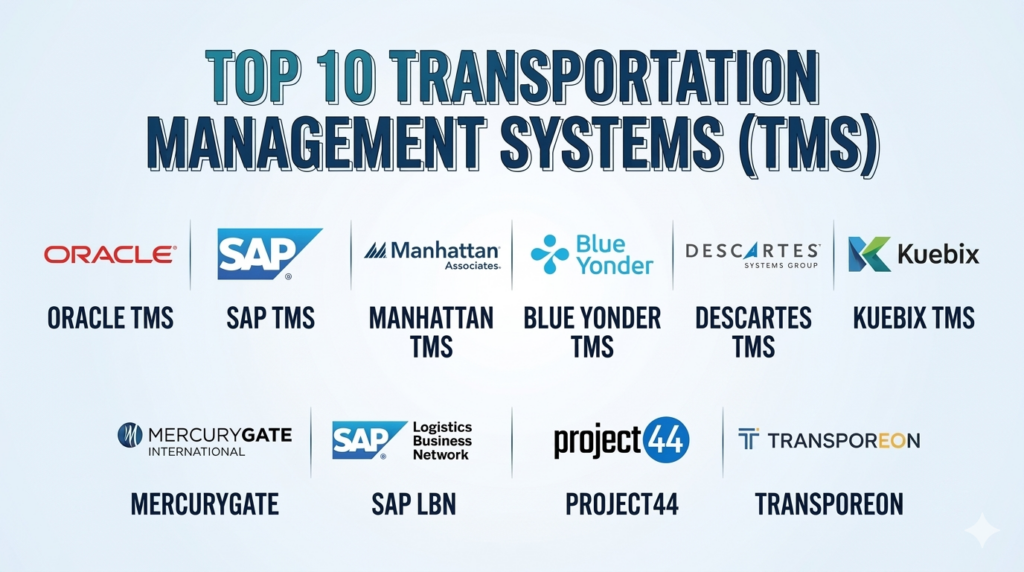
Introduction
Transportation Management Systems (TMS) are software platforms that plan, execute, and optimize the movement of goods across supply chains. TMS solutions centralize shipping, carrier selection, route optimization, freight payment, and shipment tracking. They provide visibility into logistics operations, improve carrier performance, reduce transportation costs, and enhance delivery reliability. By integrating with ERP, WMS, and OMS systems, TMS enables companies to align inventory, fulfillment, and shipping workflows for operational efficiency.
With global supply chains becoming more complex, and omnichannel delivery expectations rising, TMS has become critical for manufacturers, distributors, retailers, and 3PL providers. Modern TMS platforms leverage AI/ML routing, real-time tracking, freight benchmarking, and automation to improve both operational cost and service levels.
Real‑world use cases include:
- Optimizing delivery routes for cost and speed.
- Automating freight auditing and carrier selection.
- Monitoring shipment status in real-time and managing exceptions.
- Integrating with 3PL, ERP, and WMS systems.
- Supporting multi-modal transportation (road, rail, air, ocean).
Evaluation Criteria for Buyers:
- Multi-modal shipment planning and routing
- Carrier management and rate benchmarking
- Freight auditing and payment automation
- Real-time tracking and visibility dashboards
- Integration with ERP, WMS, OMS, and analytics platforms
- Exception handling and notifications
- Scalability across global operations
- Mobile and IoT support for tracking
- Cost analytics and reporting
- Security, role access, and compliance
Best for: Shippers, 3PL providers, logistics managers, supply chain planners, e-commerce fulfillment teams, and enterprises managing complex global transportation networks.
Not ideal for: Companies with minimal shipping operations or very few carriers where simple spreadsheet or ERP-based tools suffice.
Key Trends in Transportation Management Systems (TMS)
- AI-driven route optimization for reduced fuel costs and faster delivery.
- Real-time shipment tracking with IoT and GPS integration.
- Integration with ERP, WMS, OMS, and 3PL platforms.
- Cloud-native TMS for scalability and remote access.
- Automated freight auditing, invoicing, and carrier payment.
- Multi-modal transportation support (road, rail, air, ocean).
- Predictive analytics for exceptions and delays.
- Mobile-first apps for driver updates and field operations.
- Omnichannel logistics support for e-commerce and B2B fulfillment.
How We Selected These Tools (Methodology)
- Evaluated market adoption across shippers and 3PLs globally.
- Assessed feature completeness in planning, execution, and freight management.
- Reviewed integration capabilities with ERP, WMS, OMS, and carrier networks.
- Considered multi-modal and global shipping support.
- Verified analytics, visibility dashboards, and exception handling.
- Checked mobile, IoT, and tracking capabilities.
- Evaluated ease of use and implementation timelines.
- Analyzed security posture and compliance controls.
- Reviewed vendor support, documentation, and community ecosystem.
Top 10 Transportation Management Systems (TMS)
#1 — Oracle Transportation Management (OTM)
Short description:
OTM is a comprehensive TMS for enterprise shippers and 3PLs, providing planning, execution, freight payment, and analytics across domestic and international operations.
Key Features
- Multi-modal transportation planning
- Freight auditing and settlement
- Route optimization with AI/ML
- Real-time shipment tracking and alerts
- Carrier contract and rate management
Pros
- Enterprise-grade global capabilities
- Deep integration with Oracle ERP/SCM
- Strong analytics and reporting
Cons
- Complex implementation
- Premium licensing costs
Platforms / Deployment
- Web, Cloud
Security & Compliance
- Role-based access, encryption, audit logs
Integrations & Ecosystem
- Oracle ERP/SCM
- Carrier networks and 3PL connectors
- Analytics tools
Support & Community
- Oracle enterprise support
#2 — SAP Transportation Management (SAP TM)
Short description:
SAP TM integrates tightly with SAP S/4HANA to provide planning, execution, and freight settlement capabilities for global enterprises.
Key Features
- Multi-modal planning and shipment consolidation
- Carrier selection and rate benchmarking
- Freight settlement and auditing
- Exception management and notifications
- Integration with warehouse and inventory modules
Pros
- Deep SAP ERP ecosystem integration
- Global scalability
- Strong compliance features
Cons
- Best for existing SAP users
- Implementation effort is significant
Platforms / Deployment
- Web, Cloud/Hybrid
Security & Compliance
- Enterprise role-based access, encryption
Integrations & Ecosystem
- SAP ERP/S/4HANA
- OMS, WMS, carrier systems
Support & Community
- SAP global support
#3 — Manhattan Active Transportation Management
Short description:
Manhattan TMS provides enterprise shippers with real-time visibility, multi-modal planning, and predictive analytics to optimize freight costs and service levels.
Key Features
- Real-time shipment visibility dashboards
- Route optimization and planning
- Carrier performance analytics
- Freight auditing and cost control
- Exception management and alerts
Pros
- Strong real-time visibility
- Deep optimization capabilities
- Scalable for global enterprises
Cons
- High cost
- Requires experienced logistics teams
Platforms / Deployment
- Web, Cloud/Hybrid
Security & Compliance
- Role-based access, encryption
Integrations & Ecosystem
- ERP, OMS, WMS
- Carrier network integrations
Support & Community
- Vendor support
#4 — JDA / Blue Yonder TMS
Short description:
Blue Yonder TMS offers predictive planning, execution, and freight settlement with AI-powered optimization across domestic and international shipping.
Key Features
- AI-driven route optimization
- Multi-modal carrier selection
- Freight audit and payment
- Real-time tracking and alerts
- Labor and shipment planning analytics
Pros
- Advanced predictive analytics
- Strong multi-modal planning
- Integration with ERP and OMS
Cons
- Enterprise-focused pricing
- Requires operational expertise
Platforms / Deployment
- Web, Cloud/Hybrid
Security & Compliance
- Enterprise access control, encryption
Integrations & Ecosystem
- ERP, OMS, WMS
- Carrier networks
Support & Community
- Vendor support
#5 — Descartes Systems TMS
Short description:
Descartes TMS focuses on route planning, carrier management, and global logistics execution for shippers and third-party logistics providers.
Key Features
- Route optimization and planning
- Carrier contract management
- Freight auditing and payment
- Real-time shipment visibility
- Exception alerts
Pros
- Strong global logistics support
- SaaS and cloud options
- Mobile tracking
Cons
- Focused on transportation-heavy operations
- Implementation requires configuration
Platforms / Deployment
- Web, Cloud
Security & Compliance
- Role-based access, encryption
Integrations & Ecosystem
- ERP, OMS, WMS
- Carrier networks
Support & Community
- Vendor support
#6 — Kuebix TMS (Trimble)
Short description:
Kuebix TMS is a flexible, cloud-based platform that delivers route optimization, carrier management, and analytics for mid-market to enterprise shippers.
Key Features
- Multi-modal planning
- Carrier selection and benchmarking
- Freight auditing
- Real-time tracking dashboards
- API integrations
Pros
- Cloud-native and scalable
- User-friendly for mid-market companies
- Integration flexibility
Cons
- Advanced features may require premium tiers
- Less enterprise-scale complexity
Platforms / Deployment
- Web, Cloud
Security & Compliance
- Role-based access, encryption
Integrations & Ecosystem
- ERP, OMS, WMS
- Carrier APIs
Support & Community
- Vendor support
#7 — MercuryGate TMS
Short description:
MercuryGate TMS is a global, multi-modal solution for freight planning, execution, and settlement for shippers, carriers, and 3PLs.
Key Features
- Multi-modal freight planning
- Carrier performance management
- Rate shopping and auditing
- Freight settlement
- Exception notifications
Pros
- Strong global multi-modal capability
- Flexible configuration
- Real-time analytics
Cons
- Pricing higher for full capabilities
- Complex onboarding
Platforms / Deployment
- Web, Cloud
Security & Compliance
- Role-based access, encryption
Integrations & Ecosystem
- ERP, WMS, OMS
- Carrier network
Support & Community
- Vendor support
#8 — SAP Logistics Business Network (TMS Adjacent)
Short description:
SAP LBN supports global shipment visibility and collaboration between shippers, carriers, and partners.
Key Features
- Global shipment tracking
- Carrier collaboration portals
- Exception alerts
- Multi-modal transport data
- Integration with SAP ERP and EWM
Pros
- Excellent global visibility
- Strong partner collaboration
- Works with SAP TMS and ERP
Cons
- Limited as standalone TMS
- SAP ecosystem alignment required
Platforms / Deployment
- Web, Cloud
Security & Compliance
- SAP security framework
Integrations & Ecosystem
- SAP ERP, OMS
- Carrier networks
Support & Community
- SAP support
#9 — Project44
Short description:
Project44 focuses on real-time shipment visibility and predictive analytics for multi-modal transportation and global logistics.
Key Features
- Real-time tracking and ETA predictions
- Carrier connectivity across modes
- Exception management
- Freight audit insights
- Data analytics dashboards
Pros
- Real-time and predictive insights
- Multi-modal global coverage
- Scales for enterprise logistics
Cons
- Visibility-focused, less execution control
- Premium pricing
Platforms / Deployment
- Web, Cloud
Security & Compliance
- Role-based access, encryption
Integrations & Ecosystem
- ERP, OMS, WMS
- Carrier networks
Support & Community
- Vendor support
#10 — Transporeon
Short description:
Transporeon TMS connects shippers with carriers for planning, execution, and freight settlement across Europe and global markets.
Key Features
- Carrier connectivity and selection
- Freight audit and invoicing
- Real-time shipment updates
- Exception alerts
- Analytics and reporting
Pros
- Strong European market presence
- Network of carriers
- SaaS-based platform
Cons
- Focused regionally
- Integration effort for global users
Platforms / Deployment
- Web, Cloud
Security & Compliance
- Role-based access, encryption
Integrations & Ecosystem
- ERP, OMS, carriers
Support & Community
- Vendor support
Comparison Table (Top 10 TMS)
| Tool Name | Best For | Platform(s) Supported | Deployment | Standout Feature | Public Rating |
|---|---|---|---|---|---|
| Oracle TMS | Enterprise shippers | Web | Cloud | End-to-end integration | N/A |
| SAP TM | SAP ecosystem | Web | Cloud/Hybrid | ERP integration | N/A |
| Manhattan TMS | Global DCs | Web | Cloud/Hybrid | Optimization & visibility | N/A |
| Blue Yonder TMS | AI & automation | Web | Cloud/Hybrid | Predictive analytics | N/A |
| Descartes TMS | Global logistics | Web | Cloud | Multi-modal execution | N/A |
| Kuebix TMS | Mid-market flexibility | Web | Cloud | Cloud-native & scalable | N/A |
| MercuryGate | Global multi-modal | Web | Cloud | Multi-carrier support | N/A |
| SAP LBN | Partner collaboration | Web | Cloud | Shipment visibility | N/A |
| Project44 | Visibility & ETA | Web | Cloud | Real-time predictive | N/A |
| Transporeon | European shippers | Web | Cloud | Carrier network | N/A |
Evaluation & Scoring of TMS Tools
| Tool Name | Core (25%) | Ease (15%) | Integrations (15%) | Security (10%) | Performance (10%) | Support (10%) | Value (15%) | Weighted Total (0–10) |
|---|---|---|---|---|---|---|---|---|
| Oracle TMS | 9 | 7 | 9 | 8 | 9 | 8 | 7 | 8.3 |
| SAP TM | 9 | 6 | 9 | 9 | 9 | 7 | 7 | 8.0 |
| Manhattan TMS | 9 | 7 | 8 | 8 | 9 | 8 | 7 | 8.1 |
| Blue Yonder TMS | 8 | 7 | 8 | 8 | 9 | 7 | 7 | 7.8 |
| Descartes TMS | 8 | 7 | 8 | 8 | 8 | 7 | 7 | 7.7 |
| Kuebix TMS | 8 | 8 | 8 | 8 | 8 | 7 | 8 | 7.9 |
| MercuryGate | 8 | 7 | 8 | 8 | 8 | 7 | 7 | 7.7 |
| SAP LBN | 7 | 8 | 7 | 8 | 7 | 7 | 8 | 7.5 |
| Project44 | 7 | 8 | 7 | 8 | 7 | 7 | 8 | 7.5 |
| Transporeon | 7 | 8 | 7 | 8 | 7 | 7 | 8 | 7.5 |
Interpretation: Higher weighted scores reflect TMS tools with comprehensive planning, execution, visibility, and integration capabilities.
Which TMS Tool Is Right for You?
Solo / Freelancer
For small shippers, Kuebix TMS or Project44 offer cloud-native visibility and simple multi-carrier support.
SMB
Mid-market companies can leverage Kuebix TMS, MercuryGate, or Descartes TMS for flexible execution and analytics.
Enterprise
Global enterprises with complex supply chains should consider Oracle TMS, SAP TM, or Manhattan TMS for robust execution and optimization.
3PL Providers
MercuryGate, Transporeon, and Descartes TMS provide multi-client and multi-carrier orchestration.
Budget vs Premium
Cloud-native TMS reduce setup costs; enterprise suites provide advanced optimization, global visibility, and deep integrations.
Feature Depth vs Ease of Use
Some TMS platforms prioritize analytics and optimization; others focus on usability and quick deployment.
Integrations & Scalability
Ensure ERP, OMS, WMS, carriers, and multi-modal support integrate seamlessly to manage peak volumes.
Security & Compliance Needs
Role-based access, encryption, and audit logs are critical for compliance and operational security.
Frequently Asked Questions (FAQs)
1. What is a Transportation Management System?
TMS is software that plans, executes, and optimizes shipping, routing, and carrier management across supply chains.
2. Can TMS integrate with ERP and WMS?
Yes — integration ensures consistent inventory, order, and fulfillment data across systems.
3. Does TMS support multi-modal shipping?
Modern TMS support air, ocean, rail, and road transportation for optimized global operations.
4. Can TMS automate freight payment?
Yes — tools provide auditing, rate benchmarking, and payment automation.
5. Do TMS platforms offer real-time tracking?
Yes — GPS, IoT, and carrier integration enable real-time shipment visibility and ETA alerts.
6. Can TMS optimize delivery routes?
AI-driven route optimization reduces transportation cost and improves service levels.
7. Are TMS systems cloud-based?
Many are cloud-native for global scalability and multi-location access.
8. How long does TMS implementation take?
Small cloud TMS deploy in weeks; enterprise-scale multi-modal solutions may take months.
9. Does TMS support exception management?
Yes — alerts, rerouting, and notifications help resolve delays or carrier issues.
10. Can 3PLs use TMS?
Yes — many TMS platforms support multi-client, multi-carrier orchestration for 3PL providers.
Conclusion
Transportation Management Systems are essential for orchestrating modern supply chains, optimizing shipping costs, and enhancing delivery accuracy. Whether a small shipper using Kuebix TMS or Project44, a mid-market operator leveraging MercuryGate or Descartes, or a global enterprise deploying Oracle TMS, SAP TM, or Manhattan TMS, the right TMS delivers operational efficiency, visibility, and cost savings. Selection should align with multi-modal complexity, carrier integrations, visibility needs, and automation objectives. Pilot deployments and real-world testing across your shipments and routes ensure measurable impact on service, cost, and supply chain agility.

Thanks for sharing such valuable knowledge.
Great read! The topic is explained clearly and feels very practical.
Great read! The topic is explained clearly and feels very practical.
Useful comparison of TMS features, especially route optimization, real-time tracking, carrier management, and analytics. These capabilities are also important for efficient truck dispatching. I found this related resource on Truck Dispatch Software Solution: https://mobisoftinfotech.com/products/truck-dispatch-software-solution.
Carrier EDI 214 status updates suffer severe out-of-order ingestion anomalies. Platform engineers must enforce event timestamp re-sequencing via stateful streaming engines; otherwise, inaccurate milestone tracking breaks automated load-matching orchestration across freight tendering microservices.