MOTOSHARE 🚗🏍️
Rent Bikes & Cars Directly from Owners
Motoshare connects vehicle owners with people who need bikes and cars on rent. Owners earn from idle vehicles, and renters get flexible ride options.
Visit Motoshare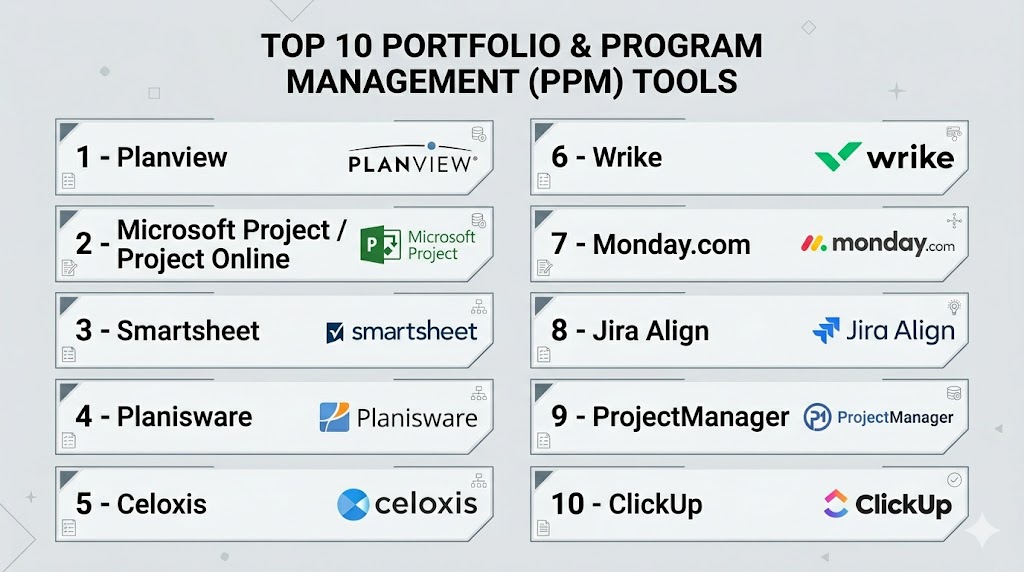
Introduction
Portfolio & Program Management (PPM) Tools help organizations plan, prioritize, govern, and track multiple projects and strategic initiatives in one system. Instead of managing projects in isolation, PPM software gives leaders a portfolio-level view of budgets, resources, risks, timelines, and business outcomes.
These platforms matter more than ever because companies are under pressure to do more with limited budgets, align investments with strategy, and deliver change faster. Modern PPM tools combine traditional planning with dashboards, automation, scenario modeling, and integrations across finance, HR, engineering, and collaboration systems.
Real-world use cases:
- Strategic project prioritization
- Resource capacity planning
- Budget and investment governance
- PMO reporting and executive dashboards
- Multi-program dependency tracking
- Digital transformation portfolios
- IT modernization roadmaps
- Product and innovation portfolios
What buyers should evaluate:
- Portfolio planning depth
- Program dependency management
- Resource forecasting
- Financial planning and budgeting
- Executive dashboards
- Scenario modeling
- Workflow automation
- Integrations and APIs
- Security and governance
- Ease of adoption
Best for: PMOs, CIOs, transformation leaders, operations teams, enterprise program managers, and organizations managing multiple initiatives.
Not ideal for: Very small teams with only one simple project or organizations needing only lightweight task management.
Key Trends in Portfolio & Program Management (PPM) Tools
- AI is improving forecasting, risk alerts, and schedule recommendations.
- Hybrid delivery models now combine waterfall, agile, and product planning.
- Scenario planning is becoming a core buying requirement.
- Real-time executive dashboards are replacing static status decks.
- Resource optimization is more data-driven and predictive.
- Stronger governance supports regulated industries.
- Low-code automation reduces PMO admin work.
- Deeper ERP and finance integrations connect strategy to spend.
- Portfolio tools increasingly support OKRs and strategic outcomes.
- Cloud-first deployment remains dominant, with selective self-hosted demand.
How We Selected These Tools (Methodology)
We selected these tools based on:
- Market recognition and enterprise adoption
- Depth of portfolio and program capabilities
- Resource management maturity
- Financial planning and governance strength
- Reporting and analytics quality
- Flexibility for hybrid methodologies
- Integration ecosystem maturity
- Security and admin controls
- Scalability across business units
- Fit across SMB, mid-market, and enterprise segments
Top 10 Portfolio & Program Management (PPM) Tools
#1 — Planview
Short description: One of the most recognized enterprise PPM platforms for strategy execution, portfolio governance, capacity planning, and investment visibility.
Key Features
- Portfolio prioritization
- Capacity planning
- Scenario modeling
- Roadmaps
- Financial governance
- Executive dashboards
- Demand management
Pros
- Excellent enterprise depth
- Strong strategic alignment features
- Mature governance tools
Cons
- Higher complexity
- Implementation can take time
- Premium pricing for smaller teams
Platforms / Deployment
Web / Cloud
Security & Compliance
Enterprise-grade controls, permissions, governance capabilities.
Integrations & Ecosystem
Strong enterprise connectivity with planning and delivery ecosystems.
- Jira
- Azure DevOps
- ERP systems
- Collaboration tools
- APIs
Support & Community
Strong enterprise services, onboarding, and partner ecosystem.
#2 — Microsoft Project / Project Online
Short description: A trusted platform for project scheduling, portfolio visibility, and enterprise planning within the Microsoft ecosystem.
Key Features
- Project scheduling
- Portfolio views
- Resource planning
- Roadmaps
- Gantt charts
- Reporting
- Templates
Pros
- Familiar Microsoft environment
- Strong scheduling engine
- Good enterprise fit
Cons
- Can feel traditional
- Learning curve for advanced use
- Some features depend on Microsoft stack choices
Platforms / Deployment
Web / Windows / Cloud
Security & Compliance
Microsoft enterprise security controls, identity management, governance options.
Integrations & Ecosystem
Best fit for Microsoft-first organizations.
- Teams
- Excel
- Power BI
- SharePoint
- Outlook
Support & Community
Large global user community and extensive training resources.
#3 — Smartsheet
Short description: Spreadsheet-style work management platform with strong portfolio dashboards, automation, and executive reporting.
Key Features
- Portfolio dashboards
- Gantt planning
- Automation
- Resource tracking
- Forms
- Reports
- Workflow controls
Pros
- Familiar user experience
- Strong reporting
- Good cross-functional adoption
Cons
- Advanced governance may need setup
- Pricing grows with scale
- Less specialized than niche PPM suites
Platforms / Deployment
Web / iOS / Android / Cloud
Security & Compliance
Permissions, admin controls, enterprise governance options.
Integrations & Ecosystem
Broad integrations across business apps.
Support & Community
Strong documentation and enterprise adoption.
#4 — Planisware
Short description: Enterprise-grade PPM platform known for strategic planning, product portfolios, resource optimization, and complex environments.
Key Features
- Strategic portfolio planning
- Resource optimization
- Product portfolio management
- Forecasting
- Financial planning
- Roadmaps
- Analytics
Pros
- Excellent for large enterprises
- Strong planning depth
- Good for R&D and product portfolios
Cons
- Complex implementation
- Premium pricing
- Requires process maturity
Platforms / Deployment
Web / Cloud / Hybrid
Security & Compliance
Enterprise controls and governance capabilities.
Integrations & Ecosystem
Strong fit for enterprise environments and large-scale planning ecosystems.
Support & Community
Strong vendor-led onboarding and consulting support.
#5 — Celoxis
Short description: Modern PPM platform focused on portfolio visibility, financial control, resource planning, and enterprise usability.
Key Features
- Portfolio dashboards
- Resource forecasting
- Budget tracking
- Risk management
- Time tracking
- Project planning
- Custom workflows
Pros
- Strong balance of power and usability
- Good reporting depth
- Broad use-case coverage
Cons
- Smaller brand awareness than largest vendors
- Advanced needs require evaluation
- UI preferences vary by team
Platforms / Deployment
Web / Cloud / Self-hosted
Security & Compliance
Not publicly stated.
Integrations & Ecosystem
Supports APIs and common business integrations.
Support & Community
Well regarded onboarding and business-focused support.
#6 — Wrike
Short description: Work management platform that has grown into a capable PPM solution for collaborative, fast-moving organizations.
Key Features
- Portfolio dashboards
- Work intake
- Automation
- Resource planning
- Cross-project visibility
- Templates
- AI insights
Pros
- Modern UX
- Strong collaboration features
- Good mid-market scalability
Cons
- Advanced features on higher tiers
- Can require admin setup
- Less finance depth than pure PPM suites
Platforms / Deployment
Web / Windows / macOS / iOS / Android / Cloud
Security & Compliance
SSO, permissions, enterprise admin controls.
Integrations & Ecosystem
Broad app integrations and workflow connectivity.
Support & Community
Strong onboarding and help resources.
#7 — Monday.com
Short description: Flexible visual work platform that supports portfolio management through dashboards, automation, and custom workflows.
Key Features
- Portfolio dashboards
- Workload views
- Automation
- Timeline planning
- Custom boards
- Reporting
- Templates
Pros
- Easy adoption
- Highly visual
- Flexible configuration
Cons
- Deep PPM processes need customization
- Premium features cost more
- Can become complex at scale
Platforms / Deployment
Web / Windows / macOS / iOS / Android / Cloud
Security & Compliance
Enterprise admin controls, permissions, governance features.
Integrations & Ecosystem
Strong marketplace and no-code integrations.
Support & Community
Large customer base and strong learning content.
#8 — Jira Align
Short description: Enterprise planning platform for organizations aligning agile delivery, portfolios, roadmaps, and strategic execution.
Key Features
- Portfolio roadmaps
- Program increment planning
- Dependency mapping
- Capacity planning
- Agile-at-scale support
- Executive reporting
- Value tracking
Pros
- Strong for agile enterprises
- Good alignment across teams
- Deep roadmap visibility
Cons
- Best for Jira-centric environments
- Can be complex
- Less suited to lightweight teams
Platforms / Deployment
Web / Cloud
Security & Compliance
Enterprise-grade admin and access controls.
Integrations & Ecosystem
Strongest within Atlassian ecosystem.
Support & Community
Large ecosystem and enterprise adoption.
#9 — ProjectManager
Short description: Project-focused software with portfolio dashboards, workload planning, and real-time reporting for growing teams.
Key Features
- Portfolio dashboards
- Resource planning
- Gantt charts
- Reports
- Roadmaps
- Time tracking
- Collaboration
Pros
- Strong project visibility
- Practical feature set
- Easier than some enterprise suites
Cons
- Smaller ecosystem than market leaders
- Less advanced governance depth
- Brand awareness lower than larger vendors
Platforms / Deployment
Web / Cloud
Security & Compliance
Role-based permissions and business-grade controls.
Integrations & Ecosystem
Supports common PM and business integrations.
Support & Community
Good onboarding and support responsiveness.
#10 — ClickUp
Short description: All-in-one productivity platform with portfolio dashboards, docs, goals, and broad customization.
Key Features
- Portfolio dashboards
- Goals
- Docs
- Automation
- Multiple views
- Resource visibility
- Templates
Pros
- Strong value for money
- Feature-rich platform
- Flexible across departments
Cons
- Can feel crowded
- Requires governance for scale
- Some teams need onboarding support
Platforms / Deployment
Web / Windows / macOS / Linux / iOS / Android / Cloud
Security & Compliance
Permissions, SSO options, enterprise controls.
Integrations & Ecosystem
Broad ecosystem across business and developer tools.
Support & Community
Large and active community.
Comparison Table (Top 10)
| Tool Name | Best For | Platform(s) Supported | Deployment | Standout Feature | Public Rating |
|---|---|---|---|---|---|
| Planview | Enterprise PMOs | Web | Cloud | Scenario planning | N/A |
| Microsoft Project | Microsoft-first enterprises | Web / Windows | Cloud | Scheduling depth | N/A |
| Smartsheet | Cross-functional teams | Web / Mobile | Cloud | Spreadsheet + PPM | N/A |
| Planisware | Large strategic portfolios | Web | Cloud / Hybrid | Resource optimization | N/A |
| Celoxis | Mid-large enterprises | Web | Cloud / Self-hosted | Financial + portfolio control | N/A |
| Wrike | Collaborative mid-market teams | Multi-platform | Cloud | Work management + PPM | N/A |
| Monday.com | Visual operations teams | Multi-platform | Cloud | Dashboards + automation | N/A |
| Jira Align | Agile enterprises | Web | Cloud | Agile portfolio alignment | N/A |
| ProjectManager | Growing PM teams | Web | Cloud | Real-time portfolio dashboards | N/A |
| ClickUp | Value-focused teams | Multi-platform | Cloud | Broad feature set | N/A |
Evaluation & Scoring of Portfolio & Program Management (PPM) Tools
| Tool Name | Core | Ease | Integrations | Security | Performance | Support | Value | Weighted Total |
|---|---|---|---|---|---|---|---|---|
| Planview | 9.5 | 7.2 | 8.8 | 9.0 | 8.8 | 8.6 | 7.4 | 8.5 |
| Microsoft Project | 9.0 | 7.4 | 8.6 | 9.0 | 8.7 | 8.5 | 7.8 | 8.4 |
| Smartsheet | 8.7 | 8.4 | 8.5 | 8.5 | 8.5 | 8.4 | 8.0 | 8.4 |
| Planisware | 9.3 | 6.9 | 8.2 | 8.8 | 8.7 | 8.3 | 7.1 | 8.2 |
| Celoxis | 8.8 | 8.0 | 8.0 | 8.0 | 8.4 | 8.1 | 8.6 | 8.3 |
| Wrike | 8.5 | 8.0 | 8.4 | 8.5 | 8.4 | 8.3 | 7.8 | 8.2 |
| Monday.com | 8.2 | 8.8 | 8.5 | 8.3 | 8.4 | 8.2 | 7.9 | 8.3 |
| Jira Align | 8.9 | 7.0 | 8.5 | 8.6 | 8.5 | 8.2 | 7.3 | 8.1 |
| ProjectManager | 8.3 | 8.1 | 7.8 | 7.8 | 8.3 | 8.0 | 8.2 | 8.0 |
| ClickUp | 8.4 | 7.9 | 8.7 | 8.1 | 8.2 | 8.1 | 9.0 | 8.3 |
These scores are comparative, not absolute. A higher score does not automatically mean a better fit for every organization. Consider governance needs, internal maturity, integration requirements, and budget before selecting a platform.
Which Portfolio & Program Management (PPM) Tool Is Right for You?
Solo / Freelancer
Most solo users do not need full PPM software. ClickUp or Monday.com may be enough.
SMB
ClickUp, Monday.com, Smartsheet, and ProjectManager offer strong balance and faster adoption.
Mid-Market
Celoxis, Wrike, Smartsheet, and Monday.com are strong fits.
Enterprise
Planview, Microsoft Project, Planisware, and Jira Align are top contenders.
Budget vs Premium
- Budget: ClickUp, ProjectManager
- Mid-range: Monday.com, Smartsheet, Wrike
- Premium: Planview, Planisware, Jira Align
Feature Depth vs Ease of Use
- Easiest: Monday.com, Smartsheet, ClickUp
- Deepest: Planview, Planisware, Microsoft Project
Integrations & Scalability
Microsoft Project, ClickUp, Wrike, Jira Align, and Planview perform well.
Security & Compliance Needs
Planview, Microsoft Project, Planisware, Wrike, and enterprise-grade vendors are strong choices.
Frequently Asked Questions (FAQs)
What are PPM tools?
PPM tools help organizations manage multiple projects, programs, resources, and investments from one central platform.
How are PPM tools different from project management tools?
Project tools manage single projects. PPM tools manage many projects together with strategic prioritization.
Who uses PPM software?
PMOs, CIOs, operations leaders, transformation teams, and enterprise executives commonly use them.
Are PPM tools only for enterprises?
No. Some platforms work well for mid-market and growing businesses too.
Can PPM tools support agile teams?
Yes. Many modern platforms support agile, waterfall, and hybrid models.
Do PPM tools include budgeting?
Many do, especially enterprise-focused platforms with portfolio finance features.
How long does implementation take?
It depends on complexity. Small rollouts may take days, while enterprise programs may take months.
Can I migrate from spreadsheets?
Yes. Many vendors support imports, templates, and guided onboarding.
What integrations matter most?
ERP, collaboration apps, HR systems, dev tools, BI platforms, and identity providers are common priorities.
How do I choose the right PPM tool?
Shortlist based on scale, governance needs, reporting depth, integrations, and user adoption.
Conclusion
Portfolio & Program Management (PPM) Tools help organizations move from isolated project tracking to strategic execution at scale. Some platforms prioritize deep governance and financial planning, while others focus on usability and faster rollout. The best solution depends on your portfolio complexity, leadership reporting needs, and internal processes. Shortlist two or three tools, run a pilot, validate integrations and governance, then choose the platform your teams will actually use consistently.

One aspect I’d add is the need for continuous portfolio governance beyond the initial rollout. In large organizations, a PPM platform is only as valuable as the quality of the data it receives from project, finance, and engineering systems. It would be helpful to evaluate how each solution supports automated portfolio health checks, dependency validation, benefit realization tracking, and alerts for outdated project status or resource forecasts. From an operational perspective, these governance capabilities help PMOs make strategic decisions based on reliable data rather than stale dashboards, ultimately improving investment prioritization and reducing execution risk across the portfolio.