MOTOSHARE 🚗🏍️
Rent Bikes & Cars Directly from Owners
Motoshare connects vehicle owners with people who need bikes and cars on rent. Owners earn from idle vehicles, and renters get flexible ride options.
Visit Motoshare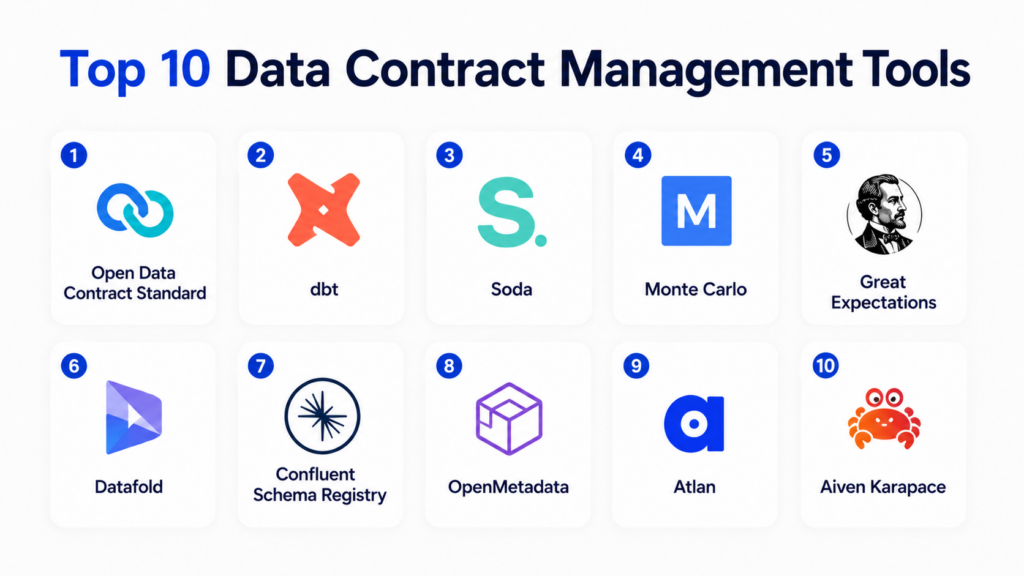
Introduction
Data Contract Management Tools help data producers and data consumers define, validate, enforce, and monitor agreements about how data should be structured, delivered, changed, and used. A data contract usually describes schema, ownership, data types, freshness expectations, quality rules, service-level expectations, and change management rules between teams or systems.
Data contracts matter because modern data environments often involve many pipelines, applications, APIs, warehouses, streaming systems, analytics tools, and machine learning workflows. Without clear contracts, upstream changes can silently break dashboards, models, reports, and downstream applications. Data contract management tools reduce data incidents by making expectations explicit and enforceable.
Real-world use cases include:
- Preventing schema-breaking changes in data pipelines
- Managing producer and consumer expectations
- Enforcing data quality rules before release
- Supporting data product ownership
- Improving governance across analytics and ML workflows
Key evaluation criteria buyers should consider:
- Schema contract definition support
- Data quality validation
- CI/CD and pipeline integration
- Version control and change management
- Ownership and approval workflows
- Data catalog and lineage integration
- Monitoring and alerting
- API and event contract support
- Security and access controls
- Scalability across data teams
Best for: Data engineering teams, analytics engineering teams, platform teams, data governance teams, data product owners, ML teams, and enterprises managing complex data pipelines.
Not ideal for: Small teams with very simple data flows, organizations without mature data ownership, or businesses that only need basic schema documentation without enforcement.
Key Trends in Data Contract Management Tools
- Data contracts are becoming a core part of data product and data mesh strategies.
- CI/CD validation is increasingly used to block breaking schema changes before deployment.
- Data quality rules are being embedded directly into contracts.
- Streaming and event-driven systems are increasing the need for contract enforcement.
- Data catalogs are integrating contract metadata with lineage and ownership.
- Analytics engineering teams are adopting contracts to protect dbt models and downstream dashboards.
- Governance teams are using contracts to improve accountability between producers and consumers.
- API-style thinking is spreading into data warehouse and lakehouse environments.
- Automated alerting is becoming important for freshness, schema, and quality breaches.
- Contract versioning is becoming essential for controlled data evolution.
How We Selected These Tools
The following tools were selected using practical data engineering, governance, observability, and contract enforcement criteria.
- Evaluated relevance to data contract workflows
- Reviewed schema validation and data quality capabilities
- Assessed CI/CD and pipeline integration support
- Considered data catalog, lineage, and governance features
- Evaluated monitoring and alerting functionality
- Reviewed support for batch, streaming, and warehouse environments
- Considered usability for data producers and consumers
- Assessed scalability for enterprise data platforms
- Evaluated ecosystem maturity and integration flexibility
- Balanced dedicated tools, open-source tools, and platform-based solutions
Top 10 Data Contract Management Tools
1- Open Data Contract Standard
Short description: Open Data Contract Standard is an open specification for defining data contracts in a structured and technology-neutral way. It helps teams document schemas, data quality rules, ownership, service expectations, and metadata in a consistent contract format. While it is not a full commercial platform by itself, it is highly relevant for organizations building data contract workflows across pipelines, catalogs, and governance systems. It is especially useful for data teams that want portability, standardization, and vendor-neutral contract definitions.
Key Features
- Open data contract specification
- Schema and metadata definitions
- Ownership documentation
- Quality rule support
- Service-level expectations
- Versionable contract files
- Tool-agnostic contract structure
Pros
- Vendor-neutral and flexible
- Good foundation for custom workflows
- Useful for standardizing contract definitions
Cons
- Requires tooling around it for enforcement
- Not a full management platform alone
- Implementation depends on team maturity
Platforms / Deployment
- Files / YAML-based workflows / Repository-based workflows
- Self-managed
Security & Compliance
Security depends on the repository, pipeline, and governance systems used around the standard.
Integrations & Ecosystem
Open Data Contract Standard can be integrated into data engineering, CI/CD, catalog, and governance workflows.
- Git repositories
- CI/CD pipelines
- Data catalogs
- Data quality tools
- Data pipeline frameworks
- Governance workflows
Support & Community
Community-driven support with adoption depending on engineering maturity and internal implementation practices.
2- dbt
Short description: dbt is an analytics engineering framework widely used to build, test, document, and manage data transformations. While dbt is not only a data contract tool, its model contracts, tests, documentation, and CI workflows make it highly relevant for enforcing data expectations in warehouse and lakehouse environments. Teams use dbt to define model schemas, test data quality, document dependencies, and prevent breaking changes before downstream consumers are affected. It is especially strong for analytics teams building governed transformation layers.
Key Features
- Model contracts
- Schema tests
- Data quality tests
- Documentation generation
- CI/CD validation
- Lineage visualization
- Version-controlled data models
Pros
- Strong analytics engineering ecosystem
- Good CI/CD and testing workflows
- Excellent fit for warehouse transformations
Cons
- Focused mainly on transformation layer
- Requires engineering discipline
- Not a complete contract lifecycle platform alone
Platforms / Deployment
- Web / CLI / Cloud / Developer environments
- Cloud / Self-hosted depending on edition
Security & Compliance
Supports role-based access and enterprise controls depending on deployment. Additional certifications vary by plan.
Integrations & Ecosystem
dbt integrates with warehouses, orchestration tools, Git workflows, observability tools, and data catalogs.
- Snowflake
- BigQuery
- Databricks
- Redshift
- Git platforms
- Data observability tools
Support & Community
Large community ecosystem, strong documentation, active developer adoption, and enterprise support options.
3- Soda
Short description: Soda is a data quality and monitoring platform that helps teams define, test, and monitor data expectations across pipelines and warehouses. It supports quality checks that can be aligned with data contracts, allowing teams to validate schema, freshness, completeness, uniqueness, and business rules. Soda is useful for organizations that want data contract enforcement through measurable data quality rules. It is especially practical for data engineering and analytics teams that need quality gates in CI/CD and production workflows.
Key Features
- Data quality checks
- Schema validation
- Freshness monitoring
- CI/CD quality gates
- Alerting workflows
- Data source integrations
- Contract-aligned rule definitions
Pros
- Strong data quality enforcement
- Good CI/CD integration support
- Useful for operational data monitoring
Cons
- More quality-focused than contract lifecycle-focused
- Requires rule design and governance
- Advanced workflows may need setup
Platforms / Deployment
- Web / CLI
- Cloud / Self-hosted options
Security & Compliance
Supports secure connections, access controls, and enterprise administration depending on deployment.
Integrations & Ecosystem
Soda integrates with warehouses, data lakes, orchestration systems, and engineering workflows.
- Snowflake
- BigQuery
- Databricks
- Redshift
- Airflow
- CI/CD tools
Support & Community
Provides documentation, community resources, and enterprise support options for data quality programs.
4- Monte Carlo
Short description: Monte Carlo is a data observability platform that helps organizations detect, investigate, and prevent data reliability issues. While not exclusively a data contract platform, it supports monitoring for schema changes, freshness issues, volume anomalies, lineage impact, and downstream breakages that align closely with data contract management. Data teams use Monte Carlo to monitor whether data is meeting expected behavior across pipelines, warehouses, and dashboards. It is especially useful for enterprises needing broad data reliability coverage.
Key Features
- Schema change monitoring
- Freshness monitoring
- Data volume anomaly detection
- Lineage and impact analysis
- Alerting and incident workflows
- Data quality monitoring
- Root cause analysis
Pros
- Strong data observability capabilities
- Good enterprise-scale monitoring
- Useful incident detection and lineage context
Cons
- Not a dedicated contract authoring tool
- Premium enterprise pricing
- Best suited for mature data platforms
Platforms / Deployment
- Web
- Cloud
Security & Compliance
Supports enterprise access controls, encryption, SSO, and governance features depending on deployment.
Integrations & Ecosystem
Monte Carlo integrates with data warehouses, BI platforms, orchestration tools, and collaboration systems.
- Snowflake
- BigQuery
- Databricks
- Looker
- Airflow
- Slack
Support & Community
Provides enterprise onboarding, customer success, documentation, and data reliability guidance.
5- Great Expectations
Short description: Great Expectations is an open-source data quality framework used to define, validate, and document expectations about data. It can support data contract workflows by allowing teams to express rules about schemas, values, completeness, uniqueness, and business logic. Data teams use it to create validation suites that run in pipelines or CI/CD workflows. It is especially useful for engineering teams that want flexible, code-driven data quality enforcement.
Key Features
- Data expectation suites
- Schema validation
- Data quality testing
- Pipeline integration
- Documentation generation
- Custom validation rules
- Open-source flexibility
Pros
- Highly flexible validation framework
- Strong open-source adoption
- Good fit for engineering-led teams
Cons
- Requires technical setup
- Not a full contract management platform
- Operational scaling requires planning
Platforms / Deployment
- Python / CLI / Notebooks / Pipelines
- Self-hosted / Cloud depending on setup
Security & Compliance
Security depends on deployment, infrastructure, and data access configuration.
Integrations & Ecosystem
Great Expectations integrates with data pipelines, warehouses, lakes, and orchestration systems.
- Python workflows
- Airflow
- Snowflake
- BigQuery
- Databricks
- Data pipelines
Support & Community
Strong open-source community, documentation, and ecosystem support with enterprise options available through related offerings.
6- Datafold
Short description: Datafold is a data reliability and data diff platform that helps teams detect data changes before they impact downstream consumers. It supports CI workflows, schema comparison, data diffing, lineage, and impact analysis. Datafold is highly relevant for data contract management because it helps teams validate whether proposed changes will break expectations or alter important datasets. It is especially useful for analytics engineering teams working with dbt and modern data warehouses.
Key Features
- Data diffing
- CI/CD validation
- Schema change detection
- Lineage and impact analysis
- dbt workflow support
- Data quality monitoring
- Change review workflows
Pros
- Strong pre-deployment validation
- Good fit for analytics engineering teams
- Useful for preventing breaking data changes
Cons
- Not a standalone contract authoring platform
- Best value in modern warehouse workflows
- Requires integration with development processes
Platforms / Deployment
- Web / CI workflows
- Cloud
Security & Compliance
Supports secure data connections, access controls, and enterprise administration depending on plan.
Integrations & Ecosystem
Datafold integrates with data warehouses, dbt, CI/CD platforms, and engineering workflows.
- dbt
- Snowflake
- BigQuery
- Redshift
- GitHub
- CI/CD systems
Support & Community
Provides documentation, onboarding resources, and customer support for data reliability workflows.
7- Confluent Schema Registry
Short description: Confluent Schema Registry is a schema management platform for event streaming and Kafka-based data systems. It helps teams define, validate, and evolve schemas for streaming data while enforcing compatibility rules between producers and consumers. This makes it highly relevant for data contract management in event-driven architectures. Teams use it to prevent breaking changes in message formats and maintain reliable communication across streaming applications.
Key Features
- Schema registry
- Schema compatibility checks
- Kafka event schema management
- Producer and consumer validation
- Versioned schema evolution
- API-based schema access
- Event contract enforcement
Pros
- Strong streaming contract enforcement
- Essential for Kafka-based architectures
- Mature schema evolution support
Cons
- Focused on event streaming use cases
- Requires Kafka ecosystem knowledge
- Not designed for general warehouse contracts
Platforms / Deployment
- Web / API / Kafka ecosystem
- Cloud / Self-hosted / Hybrid
Security & Compliance
Supports enterprise security features depending on deployment, including access controls and encryption.
Integrations & Ecosystem
Confluent Schema Registry integrates with Kafka, streaming applications, and event-driven data platforms.
- Apache Kafka
- Confluent Platform
- Streaming applications
- APIs
- Event pipelines
- Data governance workflows
Support & Community
Strong Kafka ecosystem support, documentation, enterprise support, and developer community adoption.
8- OpenMetadata
Short description: OpenMetadata is an open-source data catalog and metadata platform that supports data discovery, lineage, governance, quality, ownership, and documentation workflows. While not exclusively a data contract platform, it helps organizations manage contract-related metadata such as owners, schemas, lineage, quality rules, and consumer relationships. It is useful for teams that want to connect data contracts with broader governance and metadata management.
Key Features
- Data catalog
- Schema documentation
- Data lineage
- Ownership management
- Data quality integration
- Metadata governance
- Collaboration workflows
Pros
- Strong open-source metadata platform
- Good ownership and lineage visibility
- Useful for governance-oriented contract workflows
Cons
- Contract enforcement requires integration
- Setup and maintenance require technical effort
- Not a dedicated data contract lifecycle tool
Platforms / Deployment
- Web
- Self-hosted / Cloud depending on deployment
Security & Compliance
Supports authentication, role-based access, permissions, and governance controls depending on deployment.
Integrations & Ecosystem
OpenMetadata integrates with warehouses, BI tools, pipelines, and quality systems.
- Snowflake
- BigQuery
- Databricks
- Looker
- Airflow
- Data quality tools
Support & Community
Active open-source community, documentation, and enterprise support options through commercial offerings.
9- Atlan
Short description: Atlan is a modern data catalog and active metadata platform that helps organizations manage data discovery, ownership, lineage, governance, and collaboration. It supports data contract-adjacent workflows by making ownership, schemas, lineage, glossary terms, and quality context visible to producers and consumers. Atlan is especially useful for enterprises that want to operationalize data governance and collaboration across modern data stacks.
Key Features
- Data catalog
- Active metadata management
- Ownership workflows
- Lineage visibility
- Data quality context
- Collaboration tools
- Governance workflows
Pros
- Strong collaboration and governance experience
- Good modern data stack integrations
- Useful for data product ownership
Cons
- Not a dedicated contract enforcement engine
- Premium enterprise pricing
- Requires metadata governance maturity
Platforms / Deployment
- Web
- Cloud
Security & Compliance
Supports SSO, RBAC, encryption, audit logs, and enterprise governance controls depending on deployment.
Integrations & Ecosystem
Atlan integrates with warehouses, BI tools, data quality platforms, and orchestration systems.
- Snowflake
- BigQuery
- Databricks
- Looker
- dbt
- Airflow
Support & Community
Provides enterprise onboarding, documentation, customer success support, and active data community resources.
10- Aiven Karapace
Short description: Aiven Karapace is an open-source schema registry compatible with Kafka-style event streaming environments. It helps teams manage schemas and enforce compatibility across producers and consumers in event-driven systems. Karapace is relevant for data contract management when organizations need schema governance for streaming data without relying entirely on proprietary schema registry tools. It is especially useful for teams building open-source-friendly streaming platforms.
Key Features
- Schema registry
- Kafka-compatible schema management
- Schema compatibility checks
- API-based schema access
- Versioned schema evolution
- Event schema governance
- Open-source deployment flexibility
Pros
- Open-source schema registry option
- Good for event-driven contracts
- Useful Kafka-compatible workflows
Cons
- Focused on streaming schemas
- Requires engineering expertise
- Not designed for broad enterprise data contracts alone
Platforms / Deployment
- API / Streaming infrastructure
- Self-hosted / Cloud depending on setup
Security & Compliance
Security depends on deployment architecture, access controls, and infrastructure configuration.
Integrations & Ecosystem
Karapace integrates with Kafka-compatible environments and event streaming systems.
- Kafka-compatible platforms
- Event producers
- Event consumers
- APIs
- Streaming pipelines
- Schema validation workflows
Support & Community
Open-source community support with enterprise support depending on deployment provider and implementation model.
Comparison Table
| Tool Name | Best For | Platform(s) Supported | Deployment | Standout Feature | Public Rating |
|---|---|---|---|---|---|
| Open Data Contract Standard | Vendor-neutral contract definitions | Files, Repositories | Self-managed | Open contract specification | N/A |
| dbt | Analytics engineering contracts | Web, CLI, Cloud | Cloud, Self-hosted | Model contracts and tests | N/A |
| Soda | Data quality enforcement | Web, CLI | Cloud, Self-hosted | Contract-aligned quality checks | N/A |
| Monte Carlo | Data observability | Web | Cloud | Schema and freshness monitoring | N/A |
| Great Expectations | Code-driven validation | Python, CLI, Pipelines | Self-hosted, Cloud options | Expectation-based data validation | N/A |
| Datafold | Pre-deployment data change checks | Web, CI workflows | Cloud | Data diff and impact analysis | N/A |
| Confluent Schema Registry | Streaming data contracts | API, Kafka ecosystem | Cloud, Self-hosted, Hybrid | Schema compatibility enforcement | N/A |
| OpenMetadata | Metadata and governance | Web | Self-hosted, Cloud options | Catalog and ownership workflows | N/A |
| Atlan | Active metadata governance | Web | Cloud | Collaborative data ownership | N/A |
| Aiven Karapace | Open-source event schema registry | API, Streaming infrastructure | Self-hosted, Cloud options | Kafka-compatible schema registry | N/A |
Evaluation & Scoring of Data Contract Management Tools
| Tool Name | Core 25% | Ease 15% | Integrations 15% | Security 10% | Performance 10% | Support 10% | Value 15% | Weighted Total |
|---|---|---|---|---|---|---|---|---|
| Open Data Contract Standard | 8.0 | 6.5 | 8.0 | 7.0 | 8.0 | 7.0 | 9.0 | 7.8 |
| dbt | 8.5 | 8.0 | 9.0 | 8.0 | 8.5 | 9.0 | 8.5 | 8.5 |
| Soda | 8.5 | 8.0 | 8.5 | 8.0 | 8.0 | 8.0 | 8.0 | 8.2 |
| Monte Carlo | 8.5 | 8.0 | 9.0 | 9.0 | 9.0 | 8.5 | 7.0 | 8.4 |
| Great Expectations | 8.0 | 7.0 | 8.5 | 7.5 | 8.0 | 8.5 | 9.0 | 8.0 |
| Datafold | 8.5 | 8.0 | 8.5 | 8.0 | 8.5 | 8.0 | 8.0 | 8.3 |
| Confluent Schema Registry | 9.0 | 7.0 | 9.0 | 8.5 | 9.0 | 8.5 | 8.0 | 8.5 |
| OpenMetadata | 8.0 | 7.5 | 8.5 | 8.0 | 8.0 | 8.0 | 9.0 | 8.1 |
| Atlan | 8.0 | 8.5 | 9.0 | 9.0 | 8.5 | 8.5 | 7.0 | 8.4 |
| Aiven Karapace | 8.0 | 6.5 | 8.0 | 7.5 | 8.5 | 7.5 | 8.5 | 7.8 |
These scores are comparative and should be interpreted based on use case. dbt is strong for analytics engineering contracts, while Confluent Schema Registry and Karapace are stronger for streaming data contracts. Soda and Great Expectations are useful for contract-aligned quality validation. Monte Carlo and Datafold help detect and prevent contract-breaking data changes, while OpenMetadata and Atlan support governance, lineage, and ownership around data contracts.
Which Data Contract Management Tool Is Right for You?
Solo / Freelancer
Solo data consultants or small independent teams may prefer lightweight, open, and flexible tools. Open Data Contract Standard, Great Expectations, and dbt are practical starting points because they can be adopted incrementally without requiring a large governance platform.
SMB
SMBs should prioritize usability, low operational overhead, and practical validation workflows. dbt, Soda, Great Expectations, and OpenMetadata can help establish basic contract-style practices across analytics and engineering workflows.
Mid-Market
Mid-market organizations often need stronger CI/CD integration, ownership visibility, quality monitoring, and lineage. dbt, Soda, Datafold, OpenMetadata, and Atlan are strong options depending on whether the main challenge is transformation reliability, quality validation, or governance.
Enterprise
Enterprises should prioritize scalability, access controls, lineage, governance, monitoring, and platform interoperability. Monte Carlo, Atlan, Confluent Schema Registry, dbt, Soda, and OpenMetadata can support enterprise-grade data contract programs when implemented with strong ownership models.
Budget vs Premium
Budget-conscious teams can begin with open standards, dbt, Great Expectations, OpenMetadata, or Karapace. Premium platforms such as Monte Carlo and Atlan provide stronger enterprise usability, governance, monitoring, and support but require larger investment.
Feature Depth vs Ease of Use
Open standards and open-source tools provide flexibility but require more engineering effort. Commercial platforms offer better usability, monitoring, and support. Teams should choose based on maturity, staffing, and the importance of enforcement versus documentation.
Integrations & Scalability
Organizations should prioritize integration with warehouses, lakehouses, orchestration tools, CI/CD platforms, catalogs, streaming systems, and observability platforms. Data contracts work best when they are embedded directly into development and deployment workflows.
Security & Compliance Needs
Highly regulated organizations should evaluate access controls, audit logs, data lineage, ownership metadata, encryption, and governance workflows. Contract definitions should also support privacy, retention, and regulatory requirements where applicable.
Frequently Asked Questions
1. What are data contract management tools?
Data contract management tools help teams define and enforce agreements about data structure, quality, ownership, freshness, and change expectations. These tools reduce the risk of upstream changes breaking downstream reports, models, applications, or machine learning workflows. Some tools focus on schema validation, while others focus on observability, quality testing, lineage, or governance. Together, they help organizations create more reliable and accountable data systems. Data contracts are especially useful in complex modern data platforms.
2. Why are data contracts important?
Data contracts are important because data pipelines often connect many producers and consumers. If one team changes a schema, field name, data type, or freshness pattern without warning, downstream teams can experience broken dashboards, failed models, or incorrect decisions. Contracts make expectations explicit and enforceable. They improve communication between teams and reduce data incidents. Over time, they help organizations treat data as a reliable product rather than an unpredictable byproduct.
3. What should a data contract include?
A data contract typically includes schema definitions, field names, data types, ownership details, data quality rules, freshness expectations, service-level expectations, versioning rules, and change management requirements. It may also include privacy classifications, allowed values, validation checks, and consumer expectations. The exact structure depends on the data platform and business use case. Strong contracts are both human-readable and machine-enforceable.
4. Are data contracts only for data engineering teams?
No, data contracts involve both producers and consumers of data. Data engineering teams often implement and enforce contracts, but analytics teams, product teams, business owners, governance teams, and ML teams all benefit from them. A contract is most valuable when it reflects real downstream expectations. Collaboration between producers and consumers is essential. Without shared ownership, data contracts can become technical documentation rather than operational agreements.
5. How do data contracts relate to data quality tools?
Data quality tools help validate whether data meets specific expectations, such as completeness, uniqueness, freshness, and allowed values. Data contracts often include these expectations as enforceable rules. Tools like Soda and Great Expectations can help operationalize contract checks in pipelines and CI/CD workflows. In this way, data quality tools become an enforcement layer for data contracts. However, contracts also include ownership, versioning, and change management beyond quality checks alone.
6. What is the difference between schema registry and data contract management?
A schema registry manages schemas and compatibility rules, especially in event streaming systems. Data contract management is broader and may include schema, quality rules, ownership, freshness, SLAs, governance metadata, and change approval workflows. Schema registries are excellent for enforcing event format compatibility. Data contracts extend the idea into broader data platforms such as warehouses, pipelines, APIs, and analytics workflows. Many organizations use both together.
7. Can data contracts prevent pipeline failures?
Data contracts can reduce pipeline failures by catching breaking changes before they reach production. CI/CD checks, schema validation, and quality gates can block changes that violate agreed rules. They also improve visibility into ownership and downstream impact. However, contracts do not eliminate every data problem. They work best when combined with observability, monitoring, alerting, and incident management processes.
8. How long does implementation take?
Implementation time depends on data platform complexity, team maturity, tool selection, and contract scope. Small teams can start quickly by defining contracts for critical tables, events, or APIs. Larger organizations may need governance models, ownership mapping, CI/CD integration, catalog alignment, and rollout planning. A practical approach is to begin with high-impact data products and expand gradually. Trying to contract every dataset at once often creates unnecessary complexity.
9. What mistakes should buyers avoid?
A common mistake is treating data contracts as static documentation instead of enforceable agreements. Buyers should also avoid selecting tools without clear ownership, adoption plans, or CI/CD integration. Another mistake is focusing only on schema while ignoring freshness, quality, and downstream impact. Organizations should start with business-critical datasets and define practical contracts that teams can maintain. Overly complex contracts can reduce adoption and slow delivery.
10. What are the best alternatives to data contract tools?
Alternatives include manual documentation, shared spreadsheets, basic schema checks, data catalog notes, and informal team agreements. These may work for small teams but become unreliable as data platforms grow. Data quality tools, schema registries, and data observability platforms can partially address contract needs. However, dedicated contract practices are better when organizations need clear producer-consumer accountability, automated validation, and controlled data evolution.
Conclusion
Data contract management tools help organizations make data more reliable by defining clear expectations between producers and consumers and enforcing those expectations through schema validation, data quality checks, CI/CD workflows, lineage, monitoring, and governance. The best tool depends on where contracts need to operate: dbt is strong for analytics engineering and warehouse transformations, Confluent Schema Registry and Karapace are better for streaming data contracts, Soda and Great Expectations help enforce quality rules, while Monte Carlo and Datafold provide monitoring and change detection. OpenMetadata and Atlan add ownership, lineage, and governance context, while Open Data Contract Standard provides a vendor-neutral foundation for teams building custom workflows. Organizations should start with their most critical datasets, define practical ownership and quality expectations, integrate validation into deployment workflows, monitor contract breaches, and scale gradually as data maturity improves.
