MOTOSHARE 🚗🏍️
Rent Bikes & Cars Directly from Owners
Motoshare connects vehicle owners with people who need bikes and cars on rent. Owners earn from idle vehicles, and renters get flexible ride options.
Visit Motoshare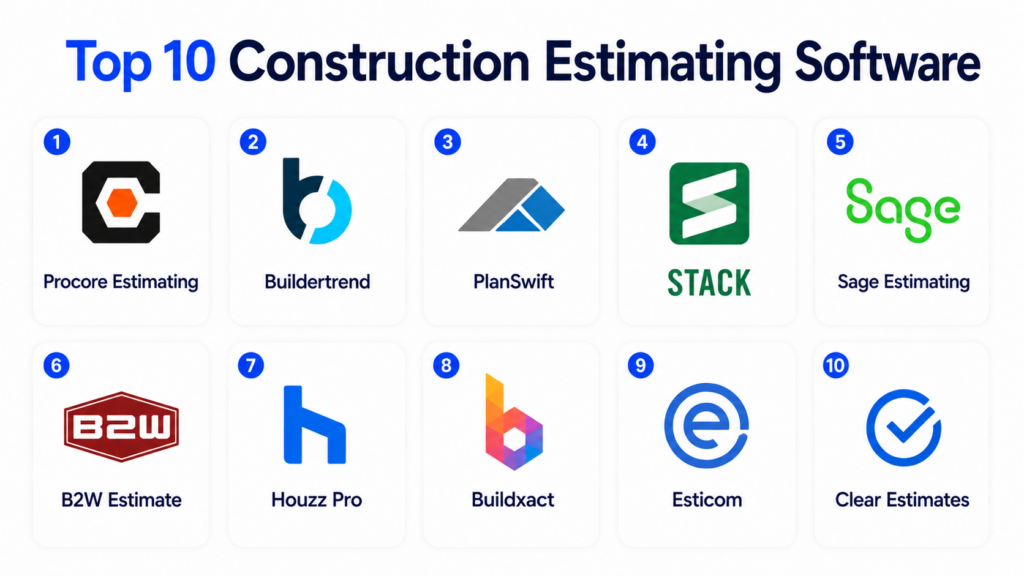
Introduction
Construction Estimating Software helps contractors, builders, subcontractors, and project teams calculate project costs accurately before work begins. These tools support quantity takeoff, labor costing, material pricing, bid preparation, proposal generation, subcontractor pricing, change order estimates, and project cost forecasting.
Accurate estimating is critical because construction margins are often tight, and small mistakes in labor, materials, equipment, or subcontractor costs can significantly affect profitability. Modern estimating platforms now combine digital takeoff, cost databases, templates, assemblies, historical project data, integrations, and collaboration workflows to help teams create faster and more consistent bids.
Real-world use cases include:
- Creating project estimates and bids
- Performing digital quantity takeoffs
- Managing subcontractor pricing
- Building proposal documents
- Comparing estimated vs actual costs
Key evaluation criteria buyers should consider:
- Quantity takeoff capabilities
- Cost database and assemblies
- Bid and proposal generation
- Subcontractor and vendor quote management
- Integration with accounting and project management tools
- Ease of use for estimators
- Collaboration and version control
- Reporting and cost tracking
- Security and permissions
- Scalability across projects and teams
Best for: General contractors, specialty contractors, residential builders, commercial builders, construction estimators, project managers, subcontractors, and firms managing frequent bids or complex cost planning.
Not ideal for: Very small contractors with rare estimating needs, teams comfortable with simple spreadsheets, or companies requiring only basic quote templates without takeoff or cost tracking.
Key Trends in Construction Estimating Software
- Digital takeoff tools are replacing manual paper plan measurements.
- Cloud-based estimating is improving collaboration between office and field teams.
- Historical cost data is becoming more important for accurate future bids.
- Integration with accounting and project management platforms is now a major requirement.
- AI-assisted cost prediction is emerging in advanced construction platforms.
- Trade-specific estimating tools are improving accuracy for electrical, mechanical, and concrete contractors.
- Real-time pricing and supplier data are becoming increasingly valuable.
- Estimating workflows are connecting more closely with change orders and job costing.
- Mobile access is helping teams review estimates from job sites.
- Bid management and estimating are increasingly being combined into unified preconstruction platforms.
How We Selected These Tools
The following construction estimating platforms were selected using practical construction, preconstruction, and contractor workflow criteria.
- Evaluated market adoption and product maturity
- Reviewed estimating and takeoff capabilities
- Assessed suitability for general contractors and specialty trades
- Considered cost database and assembly functionality
- Evaluated proposal and bid generation workflows
- Reviewed integrations with accounting and project management systems
- Assessed usability for estimators and project managers
- Considered collaboration and multi-user workflow support
- Evaluated reporting and cost visibility
- Balanced SMB-friendly and enterprise-grade platforms
Top 10 Construction Estimating Software
1- Procore Estimating
Short description: Procore Estimating is part of Procore’s broader construction management ecosystem and helps contractors create estimates, perform takeoffs, manage bids, and connect preconstruction data with project execution. It is especially useful for construction companies already using Procore for project management, financials, and field collaboration. The platform supports cloud-based estimating workflows and helps teams reduce disconnects between estimating, bidding, and project delivery.
Key Features
- Construction estimating workflows
- Digital takeoff tools
- Bid management support
- Cost item organization
- Proposal generation
- Project management integration
- Cloud collaboration
Pros
- Strong construction ecosystem integration
- Good for teams already using Procore
- Helps connect estimating with project execution
Cons
- May be costly for smaller contractors
- Best value inside Procore ecosystem
- Setup may require workflow planning
Platforms / Deployment
- Web / Mobile
- Cloud
Security & Compliance
Supports enterprise access controls, permissions, secure cloud workflows, and administrative controls.
Integrations & Ecosystem
Procore Estimating integrates with construction project management, financial, and collaboration workflows.
- Procore project management
- Construction financial workflows
- Bid management tools
- Accounting integrations
- Document management systems
- Field collaboration tools
Support & Community
Provides onboarding, training resources, customer support, implementation assistance, and a large construction user community.
2- Buildertrend
Short description: Buildertrend is a construction management platform with estimating, proposals, scheduling, change orders, customer communication, and project management features. It is widely used by residential builders, remodelers, and specialty contractors. Buildertrend helps teams create estimates, convert them into proposals, manage client approvals, and track project costs through the construction lifecycle. It is especially useful for companies that want estimating connected with customer-facing project management.
Key Features
- Estimate creation
- Proposal generation
- Change order management
- Scheduling tools
- Client communication
- Budget tracking
- Project management workflows
Pros
- Strong residential construction fit
- Good customer communication tools
- Useful estimate-to-project workflow
Cons
- Less ideal for large commercial contractors
- Advanced takeoff depth may be limited
- Pricing may be high for very small teams
Platforms / Deployment
- Web / iOS / Android
- Cloud
Security & Compliance
Supports secure account access, permissions, user roles, and administrative controls.
Integrations & Ecosystem
Buildertrend integrates with accounting, payment, and construction business workflows.
- QuickBooks
- Xero
- Payment tools
- Client portals
- Scheduling systems
- Project communication workflows
Support & Community
Provides onboarding, customer support, training materials, and builder-focused implementation guidance.
3- PlanSwift
Short description: PlanSwift is a digital takeoff and estimating software used by contractors to measure plans, calculate quantities, and build estimates from digital drawings. It is popular with general contractors and specialty trades because of its takeoff flexibility and trade-focused measurement workflows. PlanSwift helps estimators reduce manual measurement errors and speed up bid preparation. It is especially useful for contractors who need strong takeoff functionality without a fully enterprise preconstruction suite.
Key Features
- Digital takeoff
- Plan measurement tools
- Material and labor calculations
- Assembly support
- Estimate templates
- Trade-specific workflows
- Export functionality
Pros
- Strong takeoff functionality
- Good for specialty contractors
- Flexible estimating workflows
Cons
- Desktop-focused workflow may feel traditional
- Collaboration features are less cloud-native
- Broader project management features are limited
Platforms / Deployment
- Windows
- Desktop
Security & Compliance
Supports local file and user workflow controls. Enterprise security features are limited compared with cloud platforms.
Integrations & Ecosystem
PlanSwift supports estimating workflows through exports and integrations with construction business tools.
- Excel exports
- Accounting workflows
- Estimating databases
- Digital plan files
- Trade estimating workflows
- Construction proposal tools
Support & Community
Provides documentation, training materials, support resources, and a broad estimator user community.
4- STACK
Short description: STACK is a cloud-based construction takeoff and estimating platform designed for general contractors, subcontractors, suppliers, and preconstruction teams. It supports plan upload, digital takeoff, cost estimating, bid preparation, collaboration, and reporting. STACK is especially useful for teams that want browser-based takeoff and estimating without managing desktop software. It helps estimators collaborate more easily and standardize estimating workflows across teams.
Key Features
- Cloud-based takeoff
- Construction estimating
- Plan management
- Cost item libraries
- Collaboration tools
- Bid preparation
- Reporting dashboards
Pros
- Strong cloud takeoff experience
- Good collaboration features
- Useful for contractors and subcontractors
Cons
- Advanced workflows may require setup
- Pricing can scale with users and features
- Integration needs vary by workflow
Platforms / Deployment
- Web
- Cloud
Security & Compliance
Supports secure cloud access, permissions, user management, and administrative controls.
Integrations & Ecosystem
STACK integrates with construction estimating, accounting, and preconstruction workflows.
- Accounting tools
- Excel exports
- Plan management workflows
- Bid workflows
- Construction project tools
- Reporting systems
Support & Community
Provides onboarding, customer support, training resources, and estimating workflow guidance.
5- Sage Estimating
Short description: Sage Estimating is a construction estimating platform designed for contractors that need detailed cost databases, assemblies, takeoff integration, and financial workflow alignment. It is especially useful for commercial contractors and construction firms already using Sage construction accounting or ERP systems. Sage Estimating supports detailed estimate creation, cost tracking, and bid preparation for teams that need structured cost control.
Key Features
- Detailed estimating workflows
- Cost databases
- Assemblies and formulas
- Bid item organization
- Integration with Sage systems
- Reporting tools
- Estimate comparison
Pros
- Strong cost database functionality
- Good fit for Sage users
- Useful for detailed commercial estimating
Cons
- Learning curve for new users
- Best value inside Sage ecosystem
- Implementation may require setup and training
Platforms / Deployment
- Windows / Web depending on configuration
- Desktop / Cloud / Hybrid depending on deployment
Security & Compliance
Supports role-based access, administrative controls, and secure business workflow management depending on deployment.
Integrations & Ecosystem
Sage Estimating integrates with Sage construction accounting and operational systems.
- Sage construction products
- Accounting workflows
- ERP systems
- Takeoff tools
- Reporting platforms
- Cost databases
Support & Community
Provides enterprise support, implementation assistance, documentation, and construction accounting ecosystem resources.
6- B2W Estimate
Short description: B2W Estimate is a heavy construction estimating platform designed for civil contractors, infrastructure firms, road builders, utility contractors, and earthwork teams. It supports detailed estimating, crew-based costing, equipment rates, production rates, bid management, and project cost planning. B2W Estimate is especially useful for contractors handling complex heavy civil projects where labor, equipment, and production assumptions must be carefully modeled.
Key Features
- Heavy civil estimating
- Crew and production rate estimating
- Equipment cost management
- Bid management
- Cost item libraries
- Historical estimate data
- Reporting and analysis
Pros
- Strong heavy construction focus
- Good equipment and crew costing
- Useful for infrastructure contractors
Cons
- Not ideal for small residential builders
- Implementation requires estimating discipline
- More specialized than general estimating tools
Platforms / Deployment
- Web / Windows depending on deployment
- Cloud / Hybrid
Security & Compliance
Supports role-based access, admin controls, and secure business workflows depending on deployment.
Integrations & Ecosystem
B2W Estimate integrates with heavy construction operations, accounting, and project management workflows.
- B2W platform modules
- Accounting systems
- Project management tools
- Equipment management workflows
- Reporting systems
- Cost tracking systems
Support & Community
Provides implementation support, training, customer success resources, and heavy construction workflow expertise.
7- Houzz Pro
Short description: Houzz Pro is a business management and estimating platform designed for residential contractors, remodelers, interior designers, and home improvement professionals. It helps users create estimates, proposals, invoices, mood boards, client communications, and project workflows. Houzz Pro is especially useful for small residential businesses that want estimating connected with client experience and project presentation tools.
Key Features
- Estimates and proposals
- Client communication
- Invoicing
- Project management
- Visual presentation tools
- Lead management
- Change order support
Pros
- Strong residential and design-focused workflows
- Easy client-facing proposals
- Good for small home improvement businesses
Cons
- Less suited for complex commercial estimating
- Advanced takeoff capabilities are limited
- Enterprise construction workflows are not its focus
Platforms / Deployment
- Web / iOS / Android
- Cloud
Security & Compliance
Supports secure account access, permissions, and administrative controls.
Integrations & Ecosystem
Houzz Pro supports residential construction, design, and client communication workflows.
- Client portals
- Payment workflows
- Lead management
- Invoicing systems
- Project communication tools
- Visual design workflows
Support & Community
Provides onboarding resources, customer support, templates, and residential contractor guidance.
8- Buildxact
Short description: Buildxact is a construction estimating and project management platform designed for residential builders, remodelers, and contractors. It helps teams complete takeoffs, create estimates, generate quotes, manage jobs, and track costs. Buildxact is especially useful for small and mid-sized residential construction businesses that want estimating and job management in one cloud-based system. It supports faster quoting and better project cost visibility.
Key Features
- Digital takeoff
- Estimate creation
- Quote generation
- Job management
- Cost tracking
- Supplier pricing support
- Scheduling tools
Pros
- Good residential builder fit
- Combines estimating and job management
- Easy cloud-based workflow
Cons
- Less suited for large commercial projects
- Advanced enterprise features are limited
- Trade-specific complexity may vary
Platforms / Deployment
- Web
- Cloud
Security & Compliance
Supports secure user access, permissions, and cloud administration controls.
Integrations & Ecosystem
Buildxact integrates with residential construction workflows and business systems.
- Accounting tools
- Supplier workflows
- Project management workflows
- Quote and proposal tools
- Cost tracking systems
- Scheduling workflows
Support & Community
Provides onboarding, training resources, support documentation, and builder-focused customer assistance.
9- Esticom
Short description: Esticom is a cloud-based estimating and takeoff platform designed for specialty contractors, especially electrical, plumbing, HVAC, and mechanical trades. It helps teams perform digital takeoffs, create estimates, manage bid items, and collaborate on preconstruction workflows. Esticom is especially useful for subcontractors that need trade-specific estimating without relying heavily on spreadsheets or desktop-only tools.
Key Features
- Digital takeoff
- Trade-specific estimating
- Bid management
- Cost item libraries
- Cloud collaboration
- Proposal support
- Reporting tools
Pros
- Strong specialty contractor focus
- Good cloud-based takeoff workflow
- Useful for electrical and mechanical trades
Cons
- Less suited for general contractor project management
- Feature depth depends on trade needs
- Some workflows may require setup
Platforms / Deployment
- Web
- Cloud
Security & Compliance
Supports secure user access, permissions, and cloud-based workflow controls.
Integrations & Ecosystem
Esticom supports specialty contractor estimating and preconstruction workflows.
- Cloud takeoff workflows
- Cost databases
- Proposal tools
- Accounting exports
- Trade estimating workflows
- Bid management systems
Support & Community
Provides training resources, customer support, onboarding, and specialty contractor workflow guidance.
10- Clear Estimates
Short description: Clear Estimates is a construction estimating software designed for remodelers, contractors, handymen, and small construction businesses. It helps users create professional estimates and proposals using templates and cost data. Clear Estimates is especially useful for smaller residential contractors who need quick, polished estimates without complex enterprise workflows. It focuses on simplicity and speed for common remodeling and home improvement jobs.
Key Features
- Estimate templates
- Cost database support
- Proposal generation
- Residential construction workflows
- Line item estimating
- Customer-ready documents
- Quote management
Pros
- Simple and easy to use
- Good for remodelers and small contractors
- Professional proposal output
Cons
- Limited advanced takeoff functionality
- Not suitable for complex commercial estimating
- Collaboration features are lighter
Platforms / Deployment
- Web
- Cloud
Security & Compliance
Supports secure account access and basic user management.
Integrations & Ecosystem
Clear Estimates supports simple residential estimating and proposal workflows.
- Proposal workflows
- Residential cost data
- Customer estimate documents
- Small contractor workflows
- Basic business systems
Support & Community
Provides onboarding resources, customer support, templates, and guidance for small contractors.
Comparison Table
| Tool Name | Best For | Platform(s) Supported | Deployment | Standout Feature | Public Rating |
|---|---|---|---|---|---|
| Procore Estimating | Construction teams using Procore | Web, Mobile | Cloud | Estimating connected to project management | N/A |
| Buildertrend | Residential builders | Web, iOS, Android | Cloud | Estimate-to-client workflow | N/A |
| PlanSwift | Digital takeoff users | Windows | Desktop | Flexible plan takeoff | N/A |
| STACK | Cloud takeoff and estimating | Web | Cloud | Browser-based collaboration | N/A |
| Sage Estimating | Commercial cost estimating | Windows, Web options | Desktop, Cloud, Hybrid | Detailed cost databases | N/A |
| B2W Estimate | Heavy civil contractors | Web, Windows options | Cloud, Hybrid | Crew and equipment costing | N/A |
| Houzz Pro | Remodelers and designers | Web, iOS, Android | Cloud | Client-facing residential proposals | N/A |
| Buildxact | Residential builders and remodelers | Web | Cloud | Takeoff plus job management | N/A |
| Esticom | Specialty trade contractors | Web | Cloud | Trade-focused cloud takeoff | N/A |
| Clear Estimates | Small contractors | Web | Cloud | Simple residential estimating | N/A |
Evaluation & Scoring of Construction Estimating Software
| Tool Name | Core 25% | Ease 15% | Integrations 15% | Security 10% | Performance 10% | Support 10% | Value 15% | Weighted Total |
|---|---|---|---|---|---|---|---|---|
| Procore Estimating | 9.0 | 7.5 | 9.0 | 9.0 | 8.5 | 8.5 | 7.5 | 8.5 |
| Buildertrend | 8.0 | 8.5 | 8.0 | 8.0 | 8.0 | 8.5 | 8.0 | 8.2 |
| PlanSwift | 8.5 | 7.5 | 7.5 | 7.0 | 8.5 | 8.0 | 8.5 | 8.0 |
| STACK | 8.5 | 8.5 | 8.0 | 8.0 | 8.5 | 8.0 | 8.0 | 8.3 |
| Sage Estimating | 9.0 | 7.0 | 8.5 | 8.5 | 8.5 | 8.0 | 7.5 | 8.2 |
| B2W Estimate | 9.0 | 7.0 | 8.5 | 8.5 | 8.5 | 8.5 | 7.0 | 8.2 |
| Houzz Pro | 7.5 | 9.0 | 7.5 | 7.5 | 8.0 | 8.0 | 8.5 | 8.0 |
| Buildxact | 8.0 | 8.5 | 8.0 | 8.0 | 8.0 | 8.0 | 8.5 | 8.2 |
| Esticom | 8.5 | 8.0 | 8.0 | 8.0 | 8.0 | 8.0 | 8.0 | 8.1 |
| Clear Estimates | 7.0 | 9.0 | 7.0 | 7.5 | 7.5 | 8.0 | 8.5 | 7.8 |
These scores are comparative and intended to help buyers evaluate tools based on contractor type, estimating complexity, and workflow needs. Procore Estimating, Sage Estimating, and B2W Estimate are stronger for larger or more structured organizations. Buildertrend, Houzz Pro, Buildxact, and Clear Estimates are better for residential builders and remodelers. PlanSwift, STACK, and Esticom are strong choices when digital takeoff is a major priority.
Which Construction Estimating Software Is Right for You?
Solo / Freelancer
Solo contractors and independent estimators usually need simple estimating, proposal creation, and basic cost organization. Clear Estimates, Houzz Pro, Buildxact, or PlanSwift can be practical choices depending on whether takeoff or proposal speed matters more.
SMB
SMBs should prioritize ease of use, quote generation, digital takeoff, accounting integrations, and customer-ready proposals. Buildertrend, Buildxact, STACK, Esticom, and Clear Estimates are strong options for small and growing construction businesses.
Mid-Market
Mid-market contractors often need stronger collaboration, cost databases, project integration, and bid management. Procore Estimating, STACK, Sage Estimating, B2W Estimate, and Buildxact can support more structured estimating workflows.
Enterprise
Enterprises should prioritize scalability, security, collaboration, cost control, integration with project management, and detailed reporting. Procore Estimating, Sage Estimating, and B2W Estimate are strong candidates for larger construction organizations.
Budget vs Premium
Budget-conscious contractors may prefer Clear Estimates, Houzz Pro, Buildxact, or PlanSwift depending on scope. Premium tools are better when teams need integrated project management, advanced cost databases, heavy civil estimating, multi-user collaboration, or enterprise reporting.
Feature Depth vs Ease of Use
Clear Estimates and Houzz Pro are easier for small residential teams. Procore, Sage, and B2W offer deeper estimating and enterprise workflows but require more setup. STACK and PlanSwift provide strong takeoff capabilities without full enterprise complexity.
Integrations & Scalability
Construction firms should prioritize integrations with accounting, project management, CRM, bid management, and document management systems. Estimating becomes more valuable when cost data flows into budgets, contracts, schedules, and job costing workflows.
Security & Compliance Needs
Larger construction companies should evaluate permissions, user roles, audit trails, project access controls, secure document storage, and integration governance before deploying estimating software across teams.
Frequently Asked Questions
1. What is construction estimating software?
Construction estimating software helps contractors calculate project costs before work begins. It supports labor, materials, equipment, subcontractor pricing, overhead, profit margins, and proposal creation. Many tools also include digital takeoff features for measuring quantities from plans. These platforms reduce manual spreadsheet work and improve bid consistency. They are used by general contractors, builders, remodelers, and specialty trade contractors.
2. Why do contractors need estimating software?
Contractors need estimating software to create accurate bids, reduce errors, save time, and improve profitability. Manual estimates can miss quantities, use outdated prices, or rely too heavily on guesswork. Estimating software helps standardize cost calculations and proposal workflows. It also improves visibility into assumptions, markups, and project scope. Better estimates help contractors win the right jobs at the right margins.
3. What is quantity takeoff?
Quantity takeoff is the process of measuring materials, areas, lengths, counts, and volumes from construction drawings or plans. Examples include measuring flooring area, wall lengths, concrete volume, pipe runs, electrical fixtures, or roofing materials. Digital takeoff tools allow estimators to measure directly from PDF plans or digital drawings. Accurate takeoff is essential because material and labor costs depend on quantities. Many estimating tools include takeoff as a core feature.
4. What features matter most in construction estimating tools?
Important features include digital takeoff, cost databases, assemblies, templates, proposal generation, bid comparison, subcontractor pricing, reporting, and integrations. Contractors should also look for version control, collaboration, and accounting integration. Specialty trades may need trade-specific measurement and cost tools. Heavy civil contractors may need equipment rates and production-based estimating. The right features depend on company size and project type.
5. Can estimating software replace spreadsheets?
Yes, estimating software can replace many spreadsheet-based estimating workflows, especially when projects become more complex. However, some teams still export data to spreadsheets for custom analysis. Dedicated estimating tools provide better consistency, reusable templates, cost libraries, and takeoff integration. They also reduce formula errors and improve collaboration. Spreadsheets may still work for very small or simple jobs, but they become risky as estimating complexity grows.
6. Is construction estimating software useful for subcontractors?
Yes, subcontractors often benefit significantly from estimating software because they need fast, accurate bids for specific scopes of work. Electrical, mechanical, plumbing, concrete, drywall, roofing, and flooring contractors can use takeoff and trade-specific templates to improve bid speed. Subcontractors also benefit from proposal generation and bid tracking. Tools like PlanSwift, STACK, and Esticom are especially relevant for trade-focused estimating workflows.
7. How long does implementation take?
Implementation time depends on team size, project complexity, cost database setup, templates, integrations, and training needs. Small contractors can start quickly with simpler tools. Larger organizations may need to configure assemblies, import cost data, define estimating standards, and train multiple estimators. A phased rollout is often best. Teams should begin with common project types and refine templates over time.
8. What mistakes should buyers avoid?
A common mistake is choosing estimating software without matching it to project type and trade needs. Buyers should also avoid ignoring takeoff accuracy, cost database maintenance, training, and accounting integration. Another mistake is assuming software alone will fix poor estimating discipline. Teams must still define standard processes, review assumptions, and keep pricing updated. Pilot testing with real estimates is strongly recommended.
9. What is the difference between estimating software and project management software?
Estimating software focuses on predicting project costs before work begins. Project management software focuses on managing schedules, tasks, documents, communication, budgets, and execution after a job is awarded. Some construction platforms combine both capabilities. Estimating tools are most valuable during bidding and preconstruction, while project management tools are essential during delivery. Integrated systems help reduce data re-entry between estimating and execution.
10. What are the best alternatives to construction estimating software?
Alternatives include spreadsheets, manual takeoff, paper plans, calculator-based estimates, accounting software, or basic proposal tools. These may work for small jobs or very simple projects. However, dedicated estimating software is better when contractors need accuracy, speed, repeatability, digital takeoff, collaboration, and cost tracking. The best approach depends on project volume, trade complexity, and business growth goals.
Conclusion
Construction estimating software helps contractors create more accurate bids, reduce manual errors, speed up takeoffs, improve proposal quality, and protect project profitability. The best platform depends on company size, project type, trade specialty, and workflow complexity. Procore Estimating is strong for teams that want estimating connected with broader project management, while Sage Estimating and B2W Estimate are better for structured commercial and heavy civil estimating. STACK, PlanSwift, and Esticom are practical choices for takeoff-heavy workflows and specialty contractors. Buildertrend, Buildxact, Houzz Pro, and Clear Estimates are strong options for residential builders, remodelers, and smaller contractors. Buyers should shortlist tools based on real estimating workflows, test takeoff accuracy, validate cost database flexibility, review integrations with accounting and project management systems, and run pilot estimates before adopting a platform across the business.
