MOTOSHARE 🚗🏍️
Rent Bikes & Cars Directly from Owners
Motoshare connects vehicle owners with people who need bikes and cars on rent. Owners earn from idle vehicles, and renters get flexible ride options.
Visit Motoshare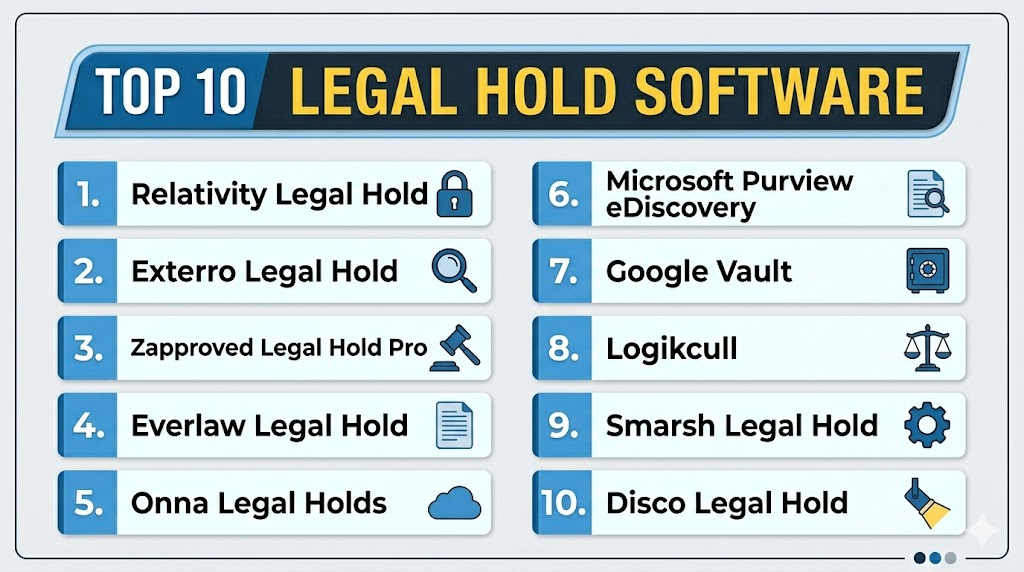
Introduction
Legal Hold Software helps organizations preserve potentially relevant data during litigation, investigations, audits, regulatory inquiries, or compliance matters. These platforms automate legal hold notifications, acknowledgment tracking, custodian management, reminders, escalation workflows, reporting, and defensible audit trails to reduce the risk of data loss or non-compliance.As data volumes continue increasing across cloud applications, collaboration platforms, emails, devices, and enterprise systems, manual legal hold management has become difficult and risky. Modern legal hold platforms now combine automation, custodian tracking, eDiscovery integration, compliance reporting, and workflow management to help legal teams preserve information efficiently and defensibly.
Real-world use cases include:
- Managing litigation preservation notices
- Tracking custodian acknowledgments
- Supporting internal investigations
- Preserving employee communications and records
- Automating compliance and audit workflows
Key evaluation criteria buyers should consider:
- Legal hold automation capabilities
- Custodian notification workflows
- Acknowledgment tracking and reminders
- Audit trails and defensibility
- eDiscovery and data source integrations
- Reporting and compliance visibility
- Scalability across large organizations
- Security and access controls
- Ease of deployment and usability
- Multi-jurisdiction and regulatory support
Best for: Corporate legal departments, law firms, government agencies, financial institutions, healthcare organizations, compliance teams, eDiscovery providers, and enterprises managing litigation or regulatory workflows.
Not ideal for: Small businesses with minimal legal exposure, organizations with extremely limited data preservation needs, or teams handling legal holds manually on rare occasions.
Key Trends in Legal Hold Software
- Automation is replacing manual spreadsheet-based legal hold tracking.
- Cloud collaboration platforms are increasing legal hold complexity.
- AI-assisted custodian identification is becoming more common.
- Integration with eDiscovery ecosystems is now a major buyer requirement.
- Legal hold platforms increasingly support Slack, Teams, and cloud data sources.
- Auditability and defensible workflows are becoming more important in regulatory matters.
- Automated reminder and escalation workflows are improving custodian compliance.
- Cross-border data governance is becoming a key enterprise concern.
- Legal operations teams are prioritizing centralized legal workflow management.
- Analytics and reporting are improving legal hold visibility across matters.
How We Selected These Tools
The following legal hold platforms were selected using practical legal operations, compliance, and eDiscovery workflow criteria.
- Evaluated market adoption and legal technology maturity
- Reviewed legal hold automation functionality
- Assessed custodian tracking and acknowledgment workflows
- Considered integration with eDiscovery ecosystems
- Evaluated audit trails and defensibility features
- Reviewed scalability for enterprise legal departments
- Assessed reporting and workflow visibility
- Considered deployment flexibility and cloud support
- Evaluated security and access management controls
- Balanced enterprise-grade and mid-market legal platforms
Top 10 Legal Hold Software
1- Relativity Legal Hold
Short description: Relativity Legal Hold is an enterprise legal hold management platform designed to automate preservation workflows, custodian communications, acknowledgment tracking, and audit reporting. It is part of the broader Relativity legal and eDiscovery ecosystem, making it especially useful for enterprises, law firms, and government agencies already managing litigation and review workflows within Relativity. The platform helps legal teams streamline legal hold operations while maintaining defensible records and scalable workflows across large organizations.
Key Features
- Automated legal hold notices
- Custodian acknowledgment tracking
- Escalation and reminder workflows
- Audit trails and reporting
- Matter management support
- eDiscovery integration
- Enterprise workflow automation
Pros
- Strong enterprise legal workflow support
- Deep Relativity ecosystem integration
- Good auditability and defensibility
Cons
- Complex enterprise deployment
- Higher implementation and licensing costs
- May be excessive for smaller legal teams
Platforms / Deployment
- Web
- Cloud / Hybrid
Security & Compliance
Supports encryption, RBAC, audit logs, permissions management, and enterprise governance workflows.
Integrations & Ecosystem
Relativity Legal Hold integrates with broader legal review, eDiscovery, and enterprise compliance environments.
- RelativityOne
- eDiscovery workflows
- Legal review systems
- Enterprise identity systems
- Document repositories
- Matter management systems
Support & Community
Provides enterprise onboarding, legal workflow consulting, implementation support, and a large legal technology ecosystem.
2- Exterro Legal Hold
Short description: Exterro Legal Hold is a legal governance and data preservation platform designed to automate legal hold issuance, custodian management, compliance workflows, and reporting. The platform helps organizations reduce legal risk by centralizing hold management and integrating preservation workflows with broader eDiscovery and data governance processes. Exterro is especially useful for enterprises handling complex litigation, privacy compliance, and regulatory matters.
Key Features
- Automated legal hold workflows
- Custodian tracking
- Escalation and reminder automation
- Reporting dashboards
- Data preservation support
- eDiscovery integration
- Compliance workflow management
Pros
- Strong governance and compliance focus
- Good automation capabilities
- Useful enterprise scalability
Cons
- Enterprise setup can be complex
- Requires legal operations planning
- Smaller organizations may not need full feature depth
Platforms / Deployment
- Web
- Cloud / Hybrid
Security & Compliance
Supports encryption, access controls, RBAC, audit logging, and enterprise governance features.
Integrations & Ecosystem
Exterro integrates with legal governance, eDiscovery, and enterprise compliance workflows.
- eDiscovery platforms
- Compliance workflows
- Enterprise repositories
- Identity systems
- Legal operations environments
Support & Community
Provides onboarding assistance, implementation guidance, documentation, and legal workflow support.
3- Zapproved Legal Hold Pro
Short description: Zapproved Legal Hold Pro is a legal hold automation platform focused on simplifying preservation notice management, custodian tracking, reminders, and reporting. The platform is widely used by legal departments seeking a more approachable and streamlined legal hold solution without excessive complexity. Zapproved emphasizes usability while still supporting defensible legal hold operations and audit workflows.
Key Features
- Automated legal hold notices
- Custodian acknowledgment tracking
- Reminder automation
- Audit reporting
- Matter dashboards
- Workflow management
- Centralized hold administration
Pros
- Easy-to-use legal hold workflows
- Good balance of functionality and usability
- Useful for corporate legal teams
Cons
- Less broad than larger governance suites
- Advanced enterprise integrations may vary
- Complex global workflows may require customization
Platforms / Deployment
- Web
- Cloud
Security & Compliance
Supports encryption, permissions, audit trails, and secure legal workflow management.
Integrations & Ecosystem
Zapproved integrates with legal operations and eDiscovery workflows to simplify preservation management.
- eDiscovery systems
- Legal operations tools
- Enterprise email systems
- Reporting workflows
- Matter management processes
Support & Community
Provides customer onboarding, legal workflow training, and support resources for corporate legal teams.
4- Everlaw Legal Hold
Short description: Everlaw Legal Hold is part of Everlaw’s cloud-native litigation and eDiscovery platform. It helps legal teams automate legal hold notices, track custodian compliance, manage escalations, and preserve defensible records during litigation and investigations. Organizations already using Everlaw for review and discovery workflows benefit from centralized legal operations and streamlined preservation management.
Key Features
- Automated legal hold notices
- Custodian response tracking
- Escalation workflows
- Matter-based workflows
- Audit trails
- Cloud-native administration
- eDiscovery integration
Pros
- Strong cloud-based legal workflow support
- Good collaboration capabilities
- Useful unified litigation environment
Cons
- Primarily suited for Everlaw ecosystem users
- Enterprise legal workflows may require training
- Pricing may scale with broader litigation usage
Platforms / Deployment
- Web
- Cloud
Security & Compliance
Supports encryption, permissions, audit logging, and enterprise-grade legal workflow security.
Integrations & Ecosystem
Everlaw Legal Hold integrates with legal review, litigation, and cloud-based discovery workflows.
- Everlaw review workflows
- Litigation management
- Legal document review
- Cloud repositories
- Matter collaboration
Support & Community
Provides onboarding support, legal workflow guidance, training resources, and customer success assistance.
5- Onna Legal Holds
Short description: Onna Legal Holds is a legal preservation and collaboration data management platform designed to help organizations preserve modern cloud communications and workplace collaboration data. It is especially useful for organizations using Slack, Microsoft Teams, Google Workspace, and other SaaS collaboration environments. Onna helps legal teams automate preservation workflows while improving visibility into distributed cloud data.
Key Features
- Legal hold automation
- SaaS collaboration preservation
- Custodian management
- Slack and Teams preservation
- Search and reporting
- Cloud data governance
- Compliance workflows
Pros
- Strong cloud collaboration support
- Useful for modern SaaS environments
- Good preservation visibility
Cons
- Best suited for cloud-first organizations
- Broader legal review workflows may require integrations
- Enterprise governance setup may take planning
Platforms / Deployment
- Web
- Cloud
Security & Compliance
Supports encryption, access controls, permissions, and enterprise governance workflows.
Integrations & Ecosystem
Onna integrates with cloud collaboration and workplace productivity systems for preservation workflows.
- Slack
- Microsoft Teams
- Google Workspace
- Confluence
- SaaS collaboration platforms
- Cloud storage systems
Support & Community
Provides onboarding assistance, cloud governance support, and implementation resources.
6- Microsoft Purview eDiscovery
Short description: Microsoft Purview eDiscovery includes legal hold and preservation capabilities for organizations using Microsoft ecosystems. It helps legal and compliance teams place holds on mailboxes, Teams messages, SharePoint content, OneDrive data, and other Microsoft workloads. It is especially useful for enterprises already standardized on Microsoft 365 because legal hold workflows are tightly integrated into the Microsoft compliance environment.
Key Features
- Legal hold management
- Microsoft 365 preservation
- Custodian workflows
- Compliance case management
- Search and retention tools
- Audit logging
- Teams and Exchange preservation
Pros
- Strong Microsoft ecosystem integration
- Useful enterprise compliance workflows
- Centralized Microsoft governance support
Cons
- Best optimized for Microsoft environments
- Complex licensing structure
- Broader non-Microsoft preservation may require additional tools
Platforms / Deployment
- Web
- Cloud
Security & Compliance
Supports RBAC, encryption, audit logging, retention controls, and enterprise compliance governance.
Integrations & Ecosystem
Microsoft Purview integrates deeply with Microsoft workplace and compliance ecosystems.
- Microsoft 365
- Exchange Online
- SharePoint
- Teams
- OneDrive
- Azure environments
Support & Community
Provides enterprise documentation, compliance guidance, and Microsoft support resources.
7- Google Vault
Short description: Google Vault is Google Workspace’s information governance and legal hold platform. It allows organizations to preserve, search, retain, and export Gmail, Drive, Chat, and other Google Workspace content for legal and compliance purposes. Google Vault is particularly useful for organizations operating heavily within Google Workspace environments and needing integrated legal hold workflows.
Key Features
- Legal hold preservation
- Gmail and Drive retention
- Search and export workflows
- Audit logging
- User-based holds
- Data retention management
- Compliance administration
Pros
- Strong Google Workspace integration
- Simplified cloud administration
- Useful retention and preservation controls
Cons
- Best suited for Google environments
- Limited broader eDiscovery workflows
- Advanced legal operations features are lighter than dedicated platforms
Platforms / Deployment
- Web
- Cloud
Security & Compliance
Supports audit logs, permissions, encryption, and enterprise Google Workspace governance controls.
Integrations & Ecosystem
Google Vault integrates with Google Workspace productivity and compliance environments.
- Gmail
- Google Drive
- Google Chat
- Google Workspace admin controls
- Compliance workflows
Support & Community
Provides Google enterprise documentation, support resources, and administrative guidance.
8- Logikcull
Short description: Logikcull is a cloud-based legal discovery and legal hold platform designed to simplify litigation workflows for law firms, corporate legal teams, and investigations. It helps organizations issue legal holds, manage custodians, preserve records, and prepare defensible workflows without requiring highly technical infrastructure. Logikcull emphasizes accessibility and ease of use for legal professionals.
Key Features
- Legal hold management
- Custodian tracking
- Cloud-based eDiscovery
- Automated notifications
- Reporting dashboards
- Search workflows
- Matter management
Pros
- Easy-to-use cloud legal workflows
- Good fit for smaller legal teams
- Simplified eDiscovery operations
Cons
- Less enterprise depth than large governance platforms
- Complex regulatory workflows may require customization
- Large-scale enterprise analytics are more limited
Platforms / Deployment
- Web
- Cloud
Security & Compliance
Supports encryption, permissions, audit logging, and cloud-based legal governance controls.
Integrations & Ecosystem
Logikcull integrates with cloud storage, legal review, and document workflows.
- Cloud repositories
- Legal document review
- eDiscovery workflows
- Matter management systems
- Litigation workflows
Support & Community
Provides onboarding support, legal workflow guidance, and customer success assistance.
9- Smarsh Legal Hold
Short description: Smarsh Legal Hold is a legal preservation and compliance platform focused heavily on regulated communications and financial services environments. The platform helps organizations preserve emails, chats, messages, and regulated communications while supporting legal hold workflows, compliance management, and investigations. It is particularly useful for financial institutions and regulated industries.
Key Features
- Legal hold workflows
- Regulated communication preservation
- Custodian tracking
- Audit reporting
- Messaging preservation
- Compliance workflows
- Investigation support
Pros
- Strong regulated industry focus
- Good communication preservation support
- Useful compliance visibility
Cons
- Best suited for regulated sectors
- Broader enterprise workflows may require integrations
- Setup may require compliance expertise
Platforms / Deployment
- Web
- Cloud
Security & Compliance
Supports encryption, audit logs, permissions, and regulated communications governance workflows.
Integrations & Ecosystem
Smarsh integrates with messaging, email, and compliance ecosystems for preservation management.
- Email systems
- Messaging platforms
- Financial compliance workflows
- Enterprise archives
- Investigation environments
Support & Community
Provides enterprise onboarding, compliance support, and regulated industry guidance.
10- Disco Legal Hold
Short description: Disco Legal Hold is part of the broader Disco legal technology platform that combines legal hold workflows, cloud eDiscovery, analytics, and legal review tools. The platform helps organizations automate hold notices, track custodian compliance, manage matters, and maintain defensible audit records. Disco is especially useful for legal teams wanting a modern cloud-native legal operations environment.
Key Features
- Legal hold automation
- Custodian tracking
- Cloud-based matter management
- Audit reporting
- eDiscovery integration
- Search and analytics
- Workflow automation
Pros
- Modern cloud-native legal workflows
- Good integration with Disco review platform
- Useful automation support
Cons
- Best value inside Disco ecosystem
- Enterprise migration planning may be required
- Broader governance workflows may vary
Platforms / Deployment
- Web
- Cloud
Security & Compliance
Supports encryption, permissions, audit logging, and enterprise-grade cloud security controls.
Integrations & Ecosystem
Disco integrates with litigation review, analytics, and legal operations workflows.
- Disco eDiscovery workflows
- Legal review systems
- Matter management
- Cloud repositories
- Litigation collaboration tools
Support & Community
Provides onboarding, legal workflow training, and cloud litigation support resources.
Comparison Table
| Tool Name | Best For | Platform(s) Supported | Deployment | Standout Feature | Public Rating |
|---|---|---|---|---|---|
| Relativity Legal Hold | Enterprise litigation teams | Web | Cloud, Hybrid | Deep eDiscovery ecosystem integration | N/A |
| Exterro Legal Hold | Enterprise governance | Web | Cloud, Hybrid | Governance-focused legal hold workflows | N/A |
| Zapproved Legal Hold Pro | Corporate legal teams | Web | Cloud | User-friendly legal hold management | N/A |
| Everlaw Legal Hold | Cloud-native litigation workflows | Web | Cloud | Unified litigation and legal hold platform | N/A |
| Onna Legal Holds | SaaS collaboration preservation | Web | Cloud | Slack and Teams preservation | N/A |
| Microsoft Purview eDiscovery | Microsoft environments | Web | Cloud | Native Microsoft preservation workflows | N/A |
| Google Vault | Google Workspace organizations | Web | Cloud | Google Workspace legal hold integration | N/A |
| Logikcull | Small and mid-sized legal teams | Web | Cloud | Simplified cloud eDiscovery | N/A |
| Smarsh Legal Hold | Regulated communications | Web | Cloud | Financial services preservation workflows | N/A |
| Disco Legal Hold | Modern legal operations | Web | Cloud | Cloud-native legal automation | N/A |
Evaluation & Scoring of Legal Hold Software
| Tool Name | Core 25% | Ease 15% | Integrations 15% | Security 10% | Performance 10% | Support 10% | Value 15% | Weighted Total |
|---|---|---|---|---|---|---|---|---|
| Relativity Legal Hold | 9.5 | 7.5 | 9.5 | 9.5 | 9.0 | 9.0 | 7.0 | 8.8 |
| Exterro Legal Hold | 9.0 | 7.5 | 9.0 | 9.0 | 8.5 | 8.5 | 7.5 | 8.5 |
| Zapproved Legal Hold Pro | 8.5 | 8.5 | 8.0 | 8.5 | 8.5 | 8.5 | 8.0 | 8.4 |
| Everlaw Legal Hold | 8.5 | 8.0 | 8.5 | 9.0 | 8.5 | 8.5 | 7.5 | 8.4 |
| Onna Legal Holds | 8.5 | 8.0 | 9.0 | 8.5 | 8.5 | 8.0 | 7.5 | 8.4 |
| Microsoft Purview eDiscovery | 9.0 | 7.5 | 9.5 | 9.0 | 9.0 | 8.5 | 8.0 | 8.7 |
| Google Vault | 8.0 | 8.5 | 8.5 | 8.5 | 8.5 | 8.0 | 8.5 | 8.3 |
| Logikcull | 8.0 | 8.5 | 7.5 | 8.0 | 8.0 | 8.0 | 8.5 | 8.1 |
| Smarsh Legal Hold | 8.5 | 7.5 | 8.5 | 9.0 | 8.5 | 8.0 | 7.5 | 8.2 |
| Disco Legal Hold | 8.5 | 8.0 | 8.0 | 8.5 | 8.5 | 8.0 | 8.0 | 8.2 |
These scores are comparative and intended to help organizations evaluate legal hold software relative to operational complexity and litigation requirements. Relativity, Exterro, and Microsoft Purview are especially strong for enterprise-scale preservation and governance workflows. Zapproved and Logikcull are more approachable for mid-sized legal teams. Onna stands out for SaaS collaboration preservation, while Google Vault is highly practical for Google Workspace-centric organizations.
Which Legal Hold Software Is Right for You?
Solo / Freelancer
Solo legal professionals and very small organizations may not require advanced legal hold platforms unless they manage frequent litigation or investigations. Lightweight preservation workflows or simpler legal technology tools may be sufficient for smaller matters.
SMB
SMBs should prioritize usability, automation, acknowledgment tracking, and affordable deployment. Zapproved Legal Hold Pro, Logikcull, and Google Vault can be practical depending on existing productivity ecosystems and legal complexity.
Mid-Market
Mid-market organizations often need stronger reporting, integrations, escalation workflows, and cloud collaboration preservation. Everlaw Legal Hold, Onna Legal Holds, and Exterro Legal Hold can support growing legal operations effectively.
Enterprise
Enterprises should prioritize auditability, defensible workflows, automation, eDiscovery integration, custodian scalability, and governance controls. Relativity Legal Hold, Microsoft Purview eDiscovery, Exterro, and Smarsh are strong enterprise options.
Budget vs Premium
Budget-conscious teams may prefer lightweight legal hold workflows integrated into productivity ecosystems. Premium enterprise platforms are more appropriate for organizations managing regulatory matters, large-scale litigation, cross-border preservation, or complex investigations.
Feature Depth vs Ease of Use
Zapproved and Logikcull focus more on usability and streamlined workflows, while Relativity and Exterro provide deeper enterprise governance and litigation capabilities. Microsoft Purview and Google Vault work best when organizations already operate heavily within those ecosystems.
Integrations & Scalability
Organizations should prioritize legal hold tools that integrate with collaboration platforms, email systems, cloud storage, eDiscovery workflows, and identity management systems. SaaS-heavy organizations should evaluate Slack, Teams, and cloud preservation support carefully.
Security & Compliance Needs
Healthcare, financial services, government, legal, and regulated enterprises should carefully evaluate encryption, RBAC, audit logs, preservation workflows, defensibility reporting, and data governance controls before deployment.
Frequently Asked Questions
1. What is legal hold software?
Legal hold software helps organizations preserve potentially relevant information during litigation, investigations, audits, or regulatory matters. It automates legal hold notices, tracks custodian acknowledgments, manages reminders, and creates defensible audit trails. These tools reduce the risk of accidental data deletion or inconsistent preservation practices. Modern platforms also integrate with eDiscovery and cloud collaboration systems. Legal hold software is especially important for organizations managing large volumes of digital data.
2. Why is legal hold management important?
Legal hold management is important because organizations may be legally required to preserve relevant information once litigation or investigations are anticipated. Failure to preserve data properly can create legal penalties, sanctions, compliance violations, or reputational damage. Manual legal hold tracking is often unreliable and difficult to scale. Automated legal hold platforms improve consistency, accountability, and auditability. They also help legal teams manage custodian communications more efficiently.
3. What data sources can legal hold software preserve?
Modern legal hold platforms can preserve emails, cloud storage data, chats, collaboration platforms, shared drives, mobile communications, documents, and enterprise records. Many tools now support Microsoft Teams, Slack, Google Workspace, SharePoint, OneDrive, and Exchange preservation workflows. Some enterprise platforms also integrate with archives, repositories, and eDiscovery systems. Preservation scope depends on platform integrations and organizational infrastructure.
4. What is a custodian in legal hold workflows?
A custodian is a person who may possess relevant information related to a legal matter, investigation, or compliance issue. Custodians often include employees, contractors, executives, administrators, or department personnel. Legal hold software helps legal teams notify custodians about preservation obligations and track acknowledgments. Automated reminders and escalation workflows improve compliance and reduce risk. Accurate custodian management is essential for defensible legal hold operations.
5. Can legal hold software automate notifications?
Yes, modern legal hold platforms automate hold notices, reminders, escalations, acknowledgments, and reporting workflows. Automation reduces manual administrative work and improves consistency across legal matters. Some platforms also support recurring reminders and manager escalation if custodians fail to respond. Automation is especially valuable for large organizations managing many custodians and ongoing legal matters. Defensible workflows become easier to maintain at scale.
6. Are legal hold tools secure?
Enterprise legal hold platforms generally support encryption, RBAC, permissions management, audit logs, and enterprise-grade governance controls. Security is critical because legal hold workflows often involve sensitive business, legal, financial, or personal information. Organizations should carefully review data residency, access permissions, cloud security architecture, and auditability before deployment. Regulated industries may require additional governance and preservation controls.
7. What is the difference between legal hold software and eDiscovery software?
Legal hold software focuses on preserving information and managing custodian obligations, while eDiscovery software focuses more on collecting, reviewing, analyzing, and producing documents for litigation or investigations. Some platforms combine both capabilities in a unified legal operations environment. Organizations handling complex litigation often use integrated preservation and eDiscovery workflows. The right solution depends on legal workflow maturity and matter complexity.
8. How long does implementation take?
Implementation time depends on organizational size, number of custodians, integrations, legal workflow complexity, and data governance requirements. Cloud-native platforms can often be deployed relatively quickly, while enterprise governance systems may require identity integration, workflow configuration, and legal operations planning. Pilot deployments are recommended before organization-wide rollout. Training legal teams and compliance stakeholders is also important.
9. What mistakes should buyers avoid?
A common mistake is relying on spreadsheets or manual email tracking for legal holds. Organizations should also avoid choosing platforms without evaluating integrations with cloud collaboration systems and repositories. Another mistake is ignoring escalation workflows and audit reporting. Legal hold software should support defensible documentation and preservation consistency. Buyers should validate workflows using real legal scenarios before deployment.
10. What are the best alternatives to legal hold software?
Alternatives include manual preservation notices, spreadsheets, email-based tracking, or basic compliance tools. These methods may work for very small organizations with limited litigation exposure but become risky as data volume and legal complexity increase. Enterprise organizations handling regulated data or frequent litigation generally benefit from dedicated legal hold platforms because of automation, defensibility, and auditability. The right approach depends on legal risk profile and operational maturity.
Conclusion
Legal hold software has become a critical part of modern legal operations, helping organizations preserve data defensibly, automate custodian workflows, reduce compliance risk, and improve litigation readiness across increasingly complex digital environments. The best platform depends on organizational size, litigation exposure, collaboration ecosystems, compliance requirements, and legal workflow maturity. Relativity Legal Hold and Exterro are strong enterprise governance platforms, while Zapproved Legal Hold Pro and Logikcull provide more streamlined experiences for corporate legal teams. Microsoft Purview and Google Vault are particularly effective for organizations heavily invested in Microsoft 365 or Google Workspace, while Onna stands out for preserving modern SaaS collaboration data. Organizations should shortlist tools based on real preservation workflows, test custodian notification processes, validate auditability and integration support, and run pilot deployments before scaling across legal and compliance operations.
