MOTOSHARE 🚗🏍️
Rent Bikes & Cars Directly from Owners
Motoshare connects vehicle owners with people who need bikes and cars on rent. Owners earn from idle vehicles, and renters get flexible ride options.
Visit Motoshare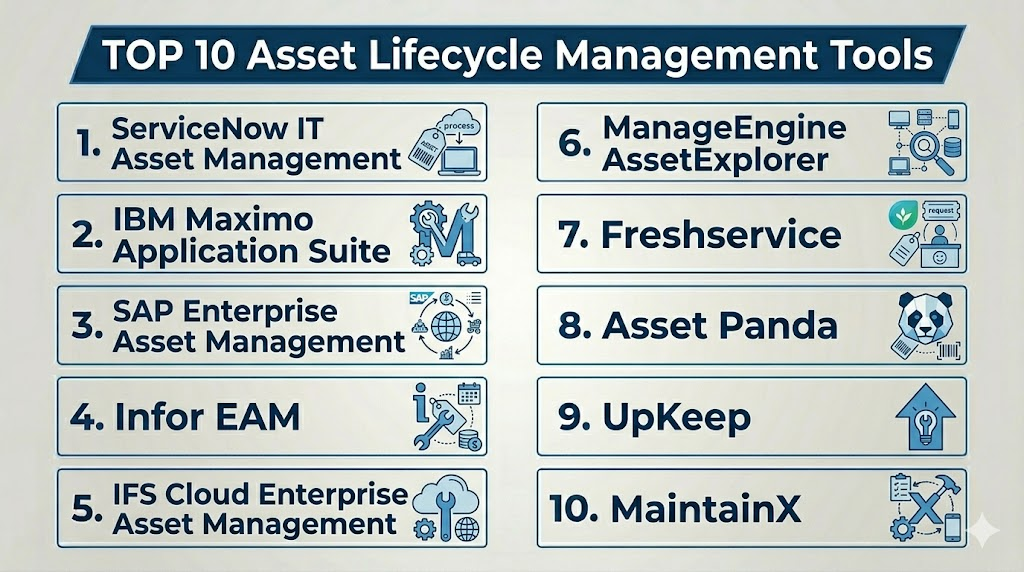
Introduction
Asset Lifecycle Management Tools help organizations manage assets from the moment they are planned or purchased until they are retired, replaced, sold, or disposed of. These assets may include IT devices, software licenses, vehicles, production equipment, medical devices, facilities, machinery, tools, servers, laptops, network devices, and other business-critical resources. A strong asset lifecycle platform gives teams visibility into procurement, inventory, usage, maintenance, depreciation, compliance, warranty, ownership, cost, and end-of-life decisions.Asset lifecycle management matters because unmanaged assets create cost leakage, security risk, downtime, compliance gaps, poor utilization, and inaccurate planning. Modern organizations need a reliable system that connects assets with finance, IT, operations, maintenance, procurement, and service workflows.
Real-world use cases include:
- Tracking assets from purchase to retirement
- Managing IT hardware, software, and licenses
- Scheduling preventive maintenance for equipment
- Reducing downtime and improving asset utilization
- Supporting audits, compliance, warranties, and depreciation
Evaluation Criteria for Buyers:
- Asset discovery and inventory accuracy
- Lifecycle workflow coverage
- Maintenance and work order management
- Procurement and vendor tracking
- Depreciation, warranty, and contract visibility
- Integration with ITSM, ERP, CMDB, finance, and procurement systems
- Mobile access and field usability
- Reporting, dashboards, and audit history
- Security, roles, and compliance controls
- Scalability across departments, locations, and asset types
Best for: IT teams, facilities teams, maintenance teams, operations leaders, finance departments, procurement teams, manufacturing companies, healthcare organizations, education institutions, logistics firms, utilities, government agencies, and enterprises managing large asset portfolios.
Not ideal for: Very small teams with only a few assets, businesses that only need a simple spreadsheet inventory, or organizations that do not have repeatable asset processes for procurement, maintenance, ownership, and retirement.
Key Trends in Asset Lifecycle Management Tools
- AI-driven asset insights are becoming more common, helping teams predict maintenance needs, identify underused assets, and prioritize replacements.
- IT asset management and enterprise asset management are converging, especially as organizations manage both digital and physical assets.
- Mobile-first asset operations are growing, enabling technicians, field teams, warehouse staff, and facilities teams to update asset records from anywhere.
- Predictive maintenance is becoming a major differentiator, especially in manufacturing, utilities, healthcare, and infrastructure-heavy industries.
- Integration with ERP and ITSM systems is now essential, because assets affect finance, service delivery, compliance, and operations.
- Lifecycle cost visibility is becoming more important, helping buyers understand total cost of ownership instead of only purchase price.
- Sustainability and disposal tracking are growing, especially for electronics, facilities, fleet, and industrial equipment.
- Cloud-based asset platforms are replacing older on-premises systems, offering faster deployment and easier multi-site access.
- Barcode, QR code, RFID, and IoT support are expanding, improving real-time tracking and reducing manual inventory errors.
- Audit-ready reporting is becoming a buyer requirement, especially for regulated industries and organizations with distributed assets.
How We Selected These Tools
The tools below were selected based on practical asset lifecycle coverage, market recognition, feature depth, customer fit, and operational usefulness across different industries.
- Market adoption and mindshare across IT, facilities, manufacturing, healthcare, education, enterprise, and field operations
- Feature completeness, including inventory, acquisition, maintenance, tracking, depreciation, contracts, workflows, and retirement
- Lifecycle depth, covering planning, purchase, assignment, usage, maintenance, transfer, renewal, and disposal
- Integration strength with ITSM, ERP, CMDB, procurement, finance, HR, and maintenance systems
- Deployment flexibility, including cloud, self-hosted, hybrid, and mobile options
- Asset type coverage, including IT assets, physical equipment, facilities, fleet, tools, and machinery
- Reporting and audit quality, including lifecycle history, compliance records, cost analysis, and ownership trails
- Usability for administrators and field users
- Scalability across sites, departments, and complex asset portfolios
- Support and onboarding quality, including documentation, implementation help, and partner ecosystems
Top 10 Asset Lifecycle Management Tools
1- ServiceNow IT Asset Management
Short description:
ServiceNow IT Asset Management helps organizations manage IT assets throughout their lifecycle, including planning, procurement, inventory, assignment, contracts, software licenses, compliance, cost control, and retirement. It is especially strong for enterprises already using ServiceNow ITSM, CMDB, procurement, and workflow automation. The platform connects asset records with incidents, changes, users, departments, and business services. It is a strong option for large organizations that want asset lifecycle management inside a broader digital workflow platform.
Key Features
- IT hardware and software asset lifecycle tracking
- Contract, license, and entitlement management
- CMDB and ITSM workflow integration
- Procurement and request workflow support
- Asset normalization and lifecycle status management
- Reporting, dashboards, and audit trails
- Automation for approvals, renewals, and retirement
Pros
- Strong fit for enterprise IT asset lifecycle management
- Deep integration with ServiceNow ITSM and CMDB
- Useful for compliance, cost control, and workflow automation
Cons
- May be too complex for small organizations
- Implementation requires planning and ServiceNow expertise
- Best value comes when used within the broader ServiceNow ecosystem
Platforms / Deployment
Cloud
Web / Mobile / Enterprise IT environments
Security & Compliance
Enterprise controls commonly include SSO, RBAC, audit logs, encryption, workflow approvals, and admin controls depending on configuration. Buyers should validate compliance requirements directly.
Integrations & Ecosystem
ServiceNow IT Asset Management works best inside ServiceNow’s broader workflow ecosystem. It can connect asset data with incidents, changes, procurement, contracts, CMDB, and enterprise operations.
- ServiceNow ITSM
- ServiceNow CMDB
- Procurement workflows
- HR and user directories
- Software asset management systems
- Enterprise reporting tools
Support & Community
ServiceNow provides enterprise support, documentation, partner services, implementation consultants, and a large ecosystem. Support level depends on contract and deployment scope.
2- IBM Maximo Application Suite
Short description:
IBM Maximo Application Suite is an enterprise asset management platform designed for complex physical assets, equipment, facilities, utilities, manufacturing operations, transportation, and infrastructure. It supports asset lifecycle management, maintenance planning, inspections, reliability strategies, work orders, IoT data, and operational analytics. Maximo is especially strong for asset-intensive industries where downtime, safety, compliance, and maintenance cost are critical. It is a strong choice for organizations that need deep enterprise asset management rather than only basic inventory tracking.
Key Features
- Enterprise asset lifecycle management
- Preventive and predictive maintenance
- Work order and inspection management
- Reliability and condition-based maintenance support
- IoT and operational data integration
- Asset performance analytics
- Industry-focused asset management workflows
Pros
- Strong fit for asset-intensive enterprises
- Deep maintenance and reliability capabilities
- Useful for utilities, manufacturing, transportation, and infrastructure
Cons
- May be complex for smaller organizations
- Implementation can require specialized expertise
- Best value comes from mature maintenance and asset processes
Platforms / Deployment
Cloud / Hybrid
Web / Mobile / Enterprise operations environments
Security & Compliance
Enterprise controls may include SSO, RBAC, audit logs, encryption, workflow controls, and compliance-oriented reporting depending on deployment. Buyers should validate requirements directly.
Integrations & Ecosystem
IBM Maximo integrates with enterprise operations, IoT, ERP, maintenance, and analytics systems. It is useful when asset lifecycle decisions depend on maintenance history, sensor data, reliability data, and cost impact.
- ERP systems
- IoT platforms
- Maintenance systems
- Asset performance tools
- Analytics platforms
- Mobile technician workflows
Support & Community
IBM provides enterprise support, partner services, documentation, consulting, and implementation resources. Support depth depends on contract and deployment model.
3- SAP Enterprise Asset Management
Short description:
SAP Enterprise Asset Management helps organizations manage physical assets, maintenance operations, asset performance, work orders, and lifecycle planning inside the SAP ecosystem. It is well suited for large enterprises already using SAP ERP, finance, procurement, supply chain, and manufacturing modules. SAP EAM supports asset planning, maintenance execution, spare parts coordination, cost tracking, and compliance workflows. It is a strong option for organizations that want asset lifecycle management deeply connected with business operations and finance.
Key Features
- Enterprise asset lifecycle tracking
- Maintenance planning and execution
- Work order and service management
- Spare parts and materials integration
- Cost and financial visibility
- Integration with SAP ERP and procurement
- Asset performance and reliability support
Pros
- Strong fit for SAP-centric enterprises
- Deep connection with finance, procurement, and operations
- Useful for global asset-intensive organizations
Cons
- Can be complex to implement and configure
- Best suited for organizations already invested in SAP
- May require SAP expertise and partner support
Platforms / Deployment
Cloud / Hybrid
Web / Mobile / SAP enterprise environments
Security & Compliance
Enterprise controls may include SSO, RBAC, audit logs, encryption, segregation of duties, and compliance workflows depending on SAP configuration. Buyers should validate exact requirements directly.
Integrations & Ecosystem
SAP EAM works best when connected with SAP finance, procurement, supply chain, materials, and plant maintenance processes. It is useful when asset lifecycle cost and operational execution must be managed together.
- SAP ERP
- SAP procurement
- SAP finance
- Supply chain systems
- Maintenance workflows
- Analytics and reporting tools
Support & Community
SAP provides enterprise support, partner services, documentation, implementation resources, and a large global ecosystem. Support depends on contract and deployment scope.
4- Infor EAM
Short description:
Infor EAM is an enterprise asset management platform focused on maintenance, asset lifecycle management, reliability, work orders, inventory, and operational performance. It is used by industries such as manufacturing, healthcare, public sector, utilities, transportation, and facilities management. Infor EAM helps teams improve asset uptime, plan maintenance, manage inspections, track costs, and optimize lifecycle decisions. It is a strong fit for organizations that need mature maintenance workflows and industry-specific asset management capabilities.
Key Features
- Asset lifecycle and maintenance management
- Preventive maintenance and work orders
- Inspection and compliance workflows
- Inventory and spare parts management
- Asset performance and reliability tracking
- Mobile maintenance workflows
- Reporting and analytics dashboards
Pros
- Strong fit for maintenance-heavy organizations
- Useful industry-specific asset management capabilities
- Good balance of asset lifecycle and operational workflows
Cons
- Implementation may require process design and data cleanup
- Some organizations may need integration support
- Public package details may vary by region and industry
Platforms / Deployment
Cloud / Hybrid
Web / Mobile / Enterprise operations environments
Security & Compliance
Security controls may include user roles, access management, audit history, and secure administration depending on deployment. Buyers should validate SSO, RBAC, audit logs, encryption, and compliance requirements directly.
Integrations & Ecosystem
Infor EAM integrates with ERP, maintenance, inventory, procurement, and operational systems. It is useful when asset lifecycle decisions depend on work history, cost, reliability, and maintenance planning.
- ERP systems
- Procurement tools
- Inventory management
- Mobile technician apps
- Reporting systems
- Industry operations platforms
Support & Community
Infor provides enterprise support, documentation, partner implementation services, and customer resources. Support quality may vary by contract and region.
5- IFS Cloud Enterprise Asset Management
Short description:
IFS Cloud Enterprise Asset Management is designed for organizations that manage complex physical assets, service operations, field work, maintenance, and capital-intensive infrastructure. It supports asset lifecycle planning, maintenance, service management, project operations, and operational performance. IFS is especially strong in industries such as utilities, energy, aerospace, manufacturing, construction, and service-heavy environments. It is a good choice when asset lifecycle management must connect with field service, projects, and operational execution.
Key Features
- Enterprise asset lifecycle management
- Preventive and predictive maintenance support
- Field service and work order integration
- Asset performance and reliability workflows
- Project and operational planning
- Mobile technician support
- Analytics and dashboards
Pros
- Strong fit for asset-intensive and service-heavy industries
- Good connection between assets, field service, and operations
- Useful for complex maintenance and project workflows
Cons
- May be more advanced than smaller teams need
- Implementation requires process maturity
- Best value comes from broader IFS adoption
Platforms / Deployment
Cloud / Hybrid
Web / Mobile / Enterprise operations environments
Security & Compliance
Enterprise controls may include SSO, RBAC, audit logs, encryption, workflow controls, and compliance support depending on configuration. Buyers should validate requirements directly.
Integrations & Ecosystem
IFS Cloud connects asset lifecycle data with service management, project delivery, maintenance, and enterprise operations. It is useful when assets are tied closely to field work and operational outcomes.
- ERP systems
- Field service workflows
- Maintenance systems
- Project management tools
- Mobile workforce tools
- Analytics platforms
Support & Community
IFS provides enterprise support, documentation, partner services, and implementation resources. Support level depends on contract and deployment model.
6- ManageEngine AssetExplorer
Short description:
ManageEngine AssetExplorer is an IT asset management tool that helps organizations track hardware, software, licenses, purchase details, ownership, contracts, and asset lifecycle status. It is practical for SMBs, mid-market IT teams, and organizations that need IT asset visibility without the complexity of large enterprise platforms. AssetExplorer supports asset discovery, inventory, software compliance, purchase tracking, and reporting. It is a strong option for teams that want focused IT asset lifecycle management at a manageable cost.
Key Features
- Hardware and software inventory
- IT asset lifecycle tracking
- Software license compliance
- Purchase and contract management
- Asset discovery and scanning
- Relationship mapping for IT assets
- Reports and audit-ready asset records
Pros
- Practical and affordable for SMB and mid-market IT teams
- Good IT asset tracking and license visibility
- Easier to adopt than large enterprise asset platforms
Cons
- Less suitable for complex industrial physical assets
- Advanced enterprise workflows may require additional tools
- Interface and configuration should be tested during evaluation
Platforms / Deployment
Cloud / Self-hosted
Web / Windows / Enterprise IT environments
Security & Compliance
Security controls may include user roles, access management, and audit-oriented records depending on deployment. Buyers should validate SSO, RBAC, encryption, logs, and compliance needs directly.
Integrations & Ecosystem
ManageEngine AssetExplorer fits well with IT service desk and IT operations workflows. It is useful when asset data must support support tickets, license compliance, and procurement visibility.
- ManageEngine ecosystem
- IT service desk workflows
- Network discovery tools
- Procurement records
- Software license tracking
- Reporting dashboards
Support & Community
ManageEngine provides documentation, support resources, community forums, and customer support options. Support level may vary by plan and region.
7- Freshservice
Short description:
Freshservice is an IT service management platform that includes IT asset management and lifecycle tracking capabilities. It helps organizations manage hardware, software, contracts, purchase records, users, tickets, changes, and service workflows from one platform. Freshservice is especially useful for SMBs and mid-market IT teams that want asset lifecycle visibility connected with helpdesk and ITSM processes. It is a strong option for organizations that need modern usability and integrated IT operations rather than a heavy enterprise EAM system.
Key Features
- IT asset inventory and lifecycle tracking
- Hardware and software asset management
- Contract and purchase tracking
- ITSM and service desk integration
- Discovery and asset relationship visibility
- Automation and workflow rules
- Reporting and dashboards
Pros
- Strong usability for IT teams
- Good fit for SMB and mid-market ITSM environments
- Connects assets with tickets, changes, and service workflows
Cons
- Not designed for heavy industrial asset management
- Advanced enterprise asset workflows may be limited
- Feature depth depends on plan and configuration
Platforms / Deployment
Cloud
Web / Mobile / IT service environments
Security & Compliance
Security controls may include SSO, role-based access, audit logs, encryption, and admin controls depending on plan. Buyers should validate exact compliance requirements directly.
Integrations & Ecosystem
Freshservice integrates asset data with ITSM, discovery, user management, and service operations. It is useful when IT assets need to support helpdesk, incident, change, and request workflows.
- Freshworks ecosystem
- ITSM workflows
- Discovery tools
- Identity providers
- Procurement records
- Reporting and automation tools
Support & Community
Freshservice provides documentation, support resources, onboarding help, and customer support options. Support level may vary by subscription plan.
8- Asset Panda
Short description:
Asset Panda is a customizable asset tracking and lifecycle management platform designed for organizations that need flexible asset records, mobile scanning, workflows, and reporting. It is suitable for education, healthcare, construction, nonprofits, IT teams, facilities teams, and businesses managing varied asset types. Asset Panda is especially useful when teams need custom fields, barcode scanning, check-in and check-out workflows, and practical inventory control. It is a strong option for organizations that want flexibility without a large enterprise EAM implementation.
Key Features
- Customizable asset records and workflows
- Barcode and mobile scanning
- Check-in and check-out tracking
- Maintenance and repair history
- Warranty and contract tracking
- Role-based access and reporting
- Mobile app support for field updates
Pros
- Highly flexible for different asset types
- Good fit for SMBs, education, healthcare, and operations teams
- Strong mobile tracking and barcode workflows
Cons
- May require customization effort during setup
- Not as deep as enterprise EAM for complex maintenance operations
- Advanced integrations should be validated before purchase
Platforms / Deployment
Cloud
Web / iOS / Android
Security & Compliance
Security controls should be validated directly. Buyers should review SSO, RBAC, audit logs, encryption, backup, and compliance needs based on plan.
Integrations & Ecosystem
Asset Panda fits into practical asset tracking and operational workflows. It is useful when organizations need flexible inventory records and mobile updates.
- Barcode workflows
- Mobile devices
- Procurement records
- Helpdesk workflows
- Reporting dashboards
- Business process tools
Support & Community
Asset Panda provides support resources, onboarding assistance, documentation, and customer support. Support depth should be reviewed by plan.
9- UpKeep
Short description:
UpKeep is a maintenance management and asset operations platform that helps teams manage work orders, preventive maintenance, asset records, inspections, and technician workflows. It is suitable for facilities, manufacturing, property management, hospitality, warehouses, and maintenance-heavy teams. While it is often categorized as CMMS, it supports important asset lifecycle activities such as maintenance history, asset health, repair tracking, and replacement planning. It is a strong option for operations teams that need mobile-first maintenance and asset visibility.
Key Features
- Asset and equipment records
- Work order management
- Preventive maintenance scheduling
- Mobile technician workflows
- Inspection and checklist support
- Maintenance history tracking
- Reporting and performance dashboards
Pros
- Strong fit for maintenance teams and facilities operations
- Mobile-friendly technician experience
- Good option for preventive maintenance and asset uptime
Cons
- Not a full IT asset management platform
- May need integrations for procurement and finance workflows
- Complex enterprise asset lifecycle needs may require broader EAM
Platforms / Deployment
Cloud
Web / iOS / Android
Security & Compliance
Security controls should be validated directly. Buyers should review SSO, RBAC, audit logs, encryption, data retention, and compliance needs by plan.
Integrations & Ecosystem
UpKeep integrates asset records with maintenance, inspections, and field operations. It is useful when the lifecycle focus is uptime, repairs, and preventive maintenance.
- Maintenance workflows
- Mobile technician apps
- Inventory systems
- Facilities operations
- Reporting dashboards
- Business automation tools
Support & Community
UpKeep provides documentation, onboarding resources, customer support, and learning materials. Support level may vary by plan.
10- MaintainX
Short description:
MaintainX is a maintenance and frontline operations platform used for work orders, asset management, inspections, procedures, preventive maintenance, and operational communication. It is suitable for manufacturing, facilities, restaurants, logistics, hospitality, and maintenance teams. MaintainX supports asset lifecycle visibility by tracking equipment records, work history, inspections, downtime, and maintenance tasks. It is a strong option for teams that need practical mobile-first asset operations rather than a complex enterprise EAM system.
Key Features
- Asset and equipment tracking
- Work order management
- Preventive maintenance scheduling
- Inspection checklists and procedures
- Mobile team communication
- Maintenance history and downtime tracking
- Reporting and operational dashboards
Pros
- Strong mobile-first usability
- Good fit for frontline maintenance and operations teams
- Easy to adopt for practical work order workflows
Cons
- Not a full enterprise ERP-style asset lifecycle platform
- Advanced finance and procurement workflows may require integrations
- Best suited for operations and maintenance use cases
Platforms / Deployment
Cloud
Web / iOS / Android
Security & Compliance
Security details should be validated directly. Buyers should review SSO, RBAC, audit logs, encryption, admin controls, and compliance needs by plan.
Integrations & Ecosystem
MaintainX fits into frontline operations, maintenance, and facilities workflows. It is useful when asset lifecycle visibility is tied to inspections, work orders, downtime, and team execution.
- Maintenance workflows
- Mobile technician operations
- Inventory systems
- Communication workflows
- Reporting dashboards
- Business process tools
Support & Community
MaintainX provides documentation, support resources, onboarding assistance, and customer support options. Support level may vary by plan.
Comparison Table
| Tool Name | Best For | Platforms Supported | Deployment | Standout Feature | Public Rating |
|---|---|---|---|---|---|
| ServiceNow IT Asset Management | Enterprise IT asset lifecycle management | Web, Mobile, Enterprise IT | Cloud | Asset lifecycle integrated with ITSM and CMDB | N/A |
| IBM Maximo Application Suite | Asset-intensive enterprises | Web, Mobile, Enterprise operations | Cloud / Hybrid | Deep EAM, maintenance, and reliability management | N/A |
| SAP Enterprise Asset Management | SAP-centric global enterprises | Web, Mobile, SAP environments | Cloud / Hybrid | Asset lifecycle connected with ERP and finance | N/A |
| Infor EAM | Maintenance-heavy organizations | Web, Mobile, Enterprise operations | Cloud / Hybrid | Asset maintenance and reliability workflows | N/A |
| IFS Cloud Enterprise Asset Management | Field service and asset-intensive operations | Web, Mobile, Enterprise operations | Cloud / Hybrid | Asset management connected with service and projects | N/A |
| ManageEngine AssetExplorer | SMB and mid-market IT asset tracking | Web, Windows, IT environments | Cloud / Self-hosted | Practical IT asset and license lifecycle tracking | N/A |
| Freshservice | ITSM-connected asset management | Web, Mobile, IT service environments | Cloud | Asset lifecycle tied to service desk workflows | N/A |
| Asset Panda | Flexible asset tracking | Web, iOS, Android | Cloud | Custom asset records and mobile barcode workflows | N/A |
| UpKeep | Maintenance and facilities operations | Web, iOS, Android | Cloud | Mobile work orders and preventive maintenance | N/A |
| MaintainX | Frontline maintenance teams | Web, iOS, Android | Cloud | Mobile-first asset operations and procedures | N/A |
Evaluation and Scoring of Asset Lifecycle Management Tools
| Tool Name | Core 25% | Ease 15% | Integrations 15% | Security 10% | Performance 10% | Support 10% | Value 15% | Weighted Total 0–10 |
|---|---|---|---|---|---|---|---|---|
| ServiceNow IT Asset Management | 9.2 | 7.8 | 9.4 | 9.0 | 8.7 | 8.7 | 8.0 | 8.68 |
| IBM Maximo Application Suite | 9.4 | 7.5 | 9.0 | 8.8 | 8.8 | 8.6 | 7.8 | 8.57 |
| SAP Enterprise Asset Management | 9.2 | 7.4 | 9.2 | 8.8 | 8.7 | 8.6 | 7.7 | 8.52 |
| Infor EAM | 8.8 | 7.8 | 8.5 | 8.4 | 8.5 | 8.3 | 8.0 | 8.34 |
| IFS Cloud Enterprise Asset Management | 8.8 | 7.8 | 8.6 | 8.5 | 8.5 | 8.3 | 8.0 | 8.36 |
| ManageEngine AssetExplorer | 8.0 | 8.5 | 8.0 | 8.0 | 8.1 | 8.1 | 8.8 | 8.23 |
| Freshservice | 8.0 | 8.8 | 8.5 | 8.2 | 8.2 | 8.4 | 8.5 | 8.38 |
| Asset Panda | 7.8 | 8.6 | 7.8 | 8.0 | 8.0 | 8.1 | 8.6 | 8.13 |
| UpKeep | 8.0 | 8.8 | 7.8 | 8.0 | 8.2 | 8.2 | 8.5 | 8.23 |
| MaintainX | 8.0 | 9.0 | 7.8 | 8.0 | 8.2 | 8.2 | 8.6 | 8.27 |
These scores are comparative, not absolute. A higher score means the tool performs strongly across the selected criteria, but it may not be the right fit for every organization. ServiceNow may be best for IT asset lifecycle workflows, IBM Maximo may fit asset-intensive operations, SAP may fit ERP-driven enterprises, and MaintainX or UpKeep may fit frontline maintenance teams. Buyers should validate tools with real asset data, workflows, integrations, compliance requirements, and user adoption tests before choosing.
Which Asset Lifecycle Management Tool Is Right for You?
Solo / Freelancer
Solo users and freelancers usually do not need a full enterprise asset lifecycle platform. A simple inventory tool, spreadsheet, or lightweight asset tracker may be enough unless they manage assets for clients. If a freelancer manages devices, tools, or equipment across projects, Asset Panda or Freshservice may be useful depending on the asset type. The focus should be simple records, ownership tracking, warranty dates, and basic reporting. Avoid large enterprise tools unless client contracts require formal asset governance.
SMB
SMBs should prioritize affordability, ease of use, asset visibility, and practical workflows. ManageEngine AssetExplorer, Freshservice, Asset Panda, UpKeep, and MaintainX are strong options depending on whether the assets are IT devices or physical equipment. SMB IT teams may prefer ManageEngine or Freshservice. Maintenance-heavy SMBs may prefer UpKeep or MaintainX. SMBs should avoid buying complex enterprise platforms before they have stable asset processes and clean data.
Mid-Market
Mid-market organizations usually need stronger workflows, reporting, integrations, and role-based controls. Freshservice, ManageEngine AssetExplorer, Asset Panda, Infor EAM, IFS Cloud EAM, and ServiceNow IT Asset Management may be relevant depending on maturity. If IT service workflows are important, Freshservice or ServiceNow may fit well. If physical equipment and maintenance are central, Infor, IFS, UpKeep, or MaintainX may be better. Mid-market buyers should focus on integration with finance, procurement, ITSM, and operations.
Enterprise
Enterprises need scalability, governance, workflow automation, security controls, integrations, and full lifecycle visibility across departments and geographies. ServiceNow IT Asset Management, IBM Maximo, SAP Enterprise Asset Management, Infor EAM, and IFS Cloud EAM are strong enterprise candidates. Organizations should choose based on asset type: IT assets, industrial equipment, fleet, facilities, infrastructure, or mixed portfolios. Enterprises should run a formal pilot using real asset records, maintenance history, contracts, and reporting needs.
Budget vs Premium
Budget-conscious buyers should evaluate ManageEngine AssetExplorer, Freshservice, Asset Panda, UpKeep, or MaintainX. These tools can provide strong value without enterprise-level complexity. Premium buyers with complex operations should evaluate ServiceNow, IBM Maximo, SAP EAM, Infor EAM, or IFS Cloud EAM. Premium tools often offer deeper workflows, integrations, analytics, and governance, but they require stronger implementation planning. The best decision should compare total cost, operational value, and adoption effort.
Feature Depth vs Ease of Use
If ease of use matters most, Freshservice, Asset Panda, UpKeep, and MaintainX are practical starting points. If feature depth matters more, IBM Maximo, SAP EAM, ServiceNow, Infor EAM, and IFS Cloud EAM provide broader enterprise capabilities. A powerful platform can fail if teams do not keep data accurate or follow lifecycle workflows. A simpler tool used consistently may produce better outcomes than a complex tool with poor adoption.
Integrations & Scalability
Asset lifecycle tools should integrate with ITSM, ERP, procurement, finance, HR, CMDB, barcode systems, RFID, IoT sensors, maintenance systems, and reporting platforms. IT-heavy buyers should prioritize CMDB and service desk integration. Operations-heavy buyers should prioritize ERP, maintenance, and work order integration. Enterprises should validate APIs, data imports, role permissions, automation rules, and reporting exports. Scalability includes asset volume, site count, user roles, workflows, and data governance.
Security & Compliance Needs
Security and compliance needs depend on asset type and industry. Buyers should validate SSO, RBAC, audit logs, encryption, data retention, approval workflows, and administrator permissions. IT asset tools should support audit trails for devices, software, and licenses. Physical asset platforms should support maintenance records, inspection history, safety evidence, and disposal documentation. Regulated organizations should involve security, compliance, finance, and operations teams during evaluation. Asset lifecycle data can be sensitive because it reveals business infrastructure and operational dependencies.
Common Mistakes to Avoid When Buying Asset Lifecycle Management Tools
- Choosing software before defining asset lifecycle processes
- Treating asset management as only inventory tracking
- Not cleaning existing asset data before migration
- Ignoring finance, procurement, IT, operations, and maintenance stakeholders
- Failing to assign ownership for asset data accuracy
- Buying an enterprise platform when a simpler tool is enough
- Choosing a simple tool when complex maintenance workflows are required
- Not integrating with ITSM, ERP, CMDB, or procurement systems
- Ignoring mobile usability for field or maintenance teams
- Not tracking warranty, contract, and end-of-life dates
- Overlooking audit logs, role permissions, and compliance reporting
- Failing to define disposal and retirement workflows
Implementation Playbook
First Phase
Start by defining which asset types will be managed: IT devices, software, equipment, facilities, vehicles, tools, machinery, or mixed assets. Document the current lifecycle process from request and purchase to assignment, maintenance, transfer, renewal, and disposal. Clean existing asset data and remove duplicates before migration. Identify stakeholders from IT, finance, procurement, operations, maintenance, facilities, and compliance. Define success metrics such as better inventory accuracy, lower downtime, improved license compliance, faster audits, or reduced replacement costs.
Second Phase
Deploy the platform with a limited but meaningful asset group. Import clean asset records, configure lifecycle statuses, assign owners, set up user roles, and define workflows for purchase, assignment, maintenance, transfer, and retirement. Add barcode, QR code, RFID, or discovery integrations where useful. Connect the tool with ITSM, ERP, CMDB, procurement, or maintenance systems if needed. Train administrators and end users before expanding. Review reports regularly to identify missing data, duplicate records, and process gaps.
Third Phase
Move from basic tracking to lifecycle optimization. Use the tool to forecast replacements, manage warranties, schedule maintenance, identify underused assets, reduce downtime, and improve budget planning. Automate renewal reminders, approval workflows, inspections, and disposal processes. Create governance rules for updating records when assets move, change owners, get repaired, or reach end-of-life. Review lifecycle metrics monthly with IT, finance, procurement, and operations. Continue improving integrations and reporting as the asset portfolio grows.
Frequently Asked Questions
1- What are Asset Lifecycle Management Tools?
Asset Lifecycle Management Tools help organizations manage assets from planning and purchase through usage, maintenance, transfer, renewal, and retirement. They track important information such as asset owner, location, status, warranty, contract, cost, maintenance history, and disposal details. These tools can manage IT assets, equipment, vehicles, facilities, tools, machinery, and other physical or digital resources. They help teams reduce waste, improve visibility, support audits, and make better replacement decisions. A good platform connects asset data with business workflows. It becomes especially valuable when assets are spread across multiple departments or locations.
2- Why do businesses need asset lifecycle management?
Businesses need asset lifecycle management because unmanaged assets create hidden costs, downtime, security gaps, compliance issues, and poor planning. Without a system, teams may buy duplicate equipment, miss warranty claims, lose devices, overlook maintenance, or fail audits. Asset lifecycle tools help track who owns an asset, where it is located, how it is being used, and when it should be repaired or replaced. They also improve collaboration between IT, finance, procurement, facilities, and operations. Better lifecycle visibility leads to smarter budgeting and reduced risk. The value increases as asset volume and complexity grow.
3- What is the difference between ITAM and EAM?
IT Asset Management ITAM focuses on technology assets such as laptops, servers, software licenses, mobile devices, network equipment, and cloud resources. Enterprise Asset Management EAM focuses more on physical and operational assets such as machinery, facilities, vehicles, utilities, and production equipment. ITAM is usually connected with ITSM, CMDB, software compliance, and device discovery. EAM is usually connected with maintenance, work orders, inspections, reliability, and operations. Some organizations need both. The right choice depends on whether the main assets are digital IT assets, physical operational assets, or a mix of both.
4- How much do Asset Lifecycle Management Tools cost?
Pricing varies based on asset count, user count, modules, deployment model, integrations, support level, and industry requirements. Lightweight tools may be affordable for SMBs, while enterprise platforms may require larger software, implementation, and consulting budgets. Buyers should consider total cost, including data migration, process design, training, integrations, and ongoing administration. A cheap tool may become expensive if it lacks required workflows. A premium platform may be unnecessary if the asset portfolio is simple. A pilot helps estimate real cost and value before full rollout.
5- How long does implementation take?
Implementation time depends on asset volume, data quality, number of workflows, integration needs, and organizational readiness. A small team with clean asset data may deploy quickly. A large enterprise with multiple asset types, departments, locations, integrations, and compliance requirements will need more planning. The most time-consuming part is often cleaning asset records and defining lifecycle processes. Starting with one asset category or department is usually better than launching everywhere at once. A phased rollout improves adoption and reduces errors. Ongoing governance is needed after launch to keep data accurate.
6- What features should buyers look for?
Buyers should look for asset inventory, lifecycle status tracking, ownership records, location tracking, warranty management, contract tracking, maintenance history, reporting, mobile access, and audit logs. IT teams should prioritize discovery, CMDB, ITSM, software license, and endpoint integrations. Operations teams should prioritize work orders, preventive maintenance, inspections, and spare parts. Finance teams should look for depreciation, cost tracking, and procurement visibility. Mobile access is important for field and maintenance teams. The best feature set depends on asset type and business process maturity.
7- Can asset lifecycle tools help reduce costs?
Yes, asset lifecycle tools can reduce costs by improving visibility, preventing duplicate purchases, tracking warranties, reducing downtime, improving maintenance planning, and identifying underused assets. They also help organizations plan replacements more accurately instead of reacting to failures. IT teams can reduce software overspending by tracking licenses and entitlements. Maintenance teams can reduce emergency repairs through preventive maintenance. Finance teams can improve budgeting with lifecycle cost data. Cost savings depend on clean data, process adoption, and regular use of reports.
8- Are asset lifecycle tools useful for compliance?
Yes, asset lifecycle tools are useful for compliance because they create records showing ownership, usage, maintenance, inspections, software licenses, warranties, transfers, and disposal. Regulated industries may need proof that assets are maintained, secured, or retired properly. IT teams may need audit trails for devices and software. Operations teams may need inspection and maintenance history. Finance teams may need depreciation and inventory evidence. A good tool makes audits easier by keeping records centralized and searchable. Buyers should validate audit logs, reporting, and data retention capabilities.
9- What are common alternatives to asset lifecycle tools?
Common alternatives include spreadsheets, CMDB tools, ITSM platforms, CMMS tools, ERP modules, inventory systems, barcode tools, and maintenance platforms. These alternatives may work for small teams or specific asset types. However, they often become difficult to manage when asset volume, locations, workflows, and compliance requirements increase. Spreadsheets are flexible but error-prone. CMMS tools are strong for maintenance but may not cover IT assets. ITSM tools are strong for IT but may not cover machinery or facilities. Dedicated asset lifecycle tools are best when full lifecycle visibility is required.
10- How should a company switch asset lifecycle management tools?
Switching tools should begin with a review of current asset records, workflows, integrations, reports, user roles, and data quality issues. Clean and standardize data before migration to avoid carrying old problems into the new system. Start with a pilot asset group and compare usability, reporting, workflow support, and integration quality. Export important historical records, warranties, contracts, and maintenance logs before retiring the old system. Train users before full rollout. After migration, assign ownership for data accuracy and review lifecycle reports regularly.
Conclusion
Asset Lifecycle Management Tools help organizations gain control over the full asset journey from planning and procurement to usage, maintenance, renewal, and retirement. The best tool depends on asset type, company size, industry, workflow maturity, integration needs, and budget. ServiceNow IT Asset Management is strong for enterprise IT asset lifecycle workflows, IBM Maximo and SAP EAM fit asset-intensive enterprises, Infor and IFS support maintenance-heavy operations, ManageEngine and Freshservice are practical for IT teams, Asset Panda offers flexible asset tracking, and UpKeep or MaintainX are strong for frontline maintenance and operations. Buyers should not choose only by brand name or feature count.
