MOTOSHARE 🚗🏍️
Rent Bikes & Cars Directly from Owners
Motoshare connects vehicle owners with people who need bikes and cars on rent. Owners earn from idle vehicles, and renters get flexible ride options.
Visit Motoshare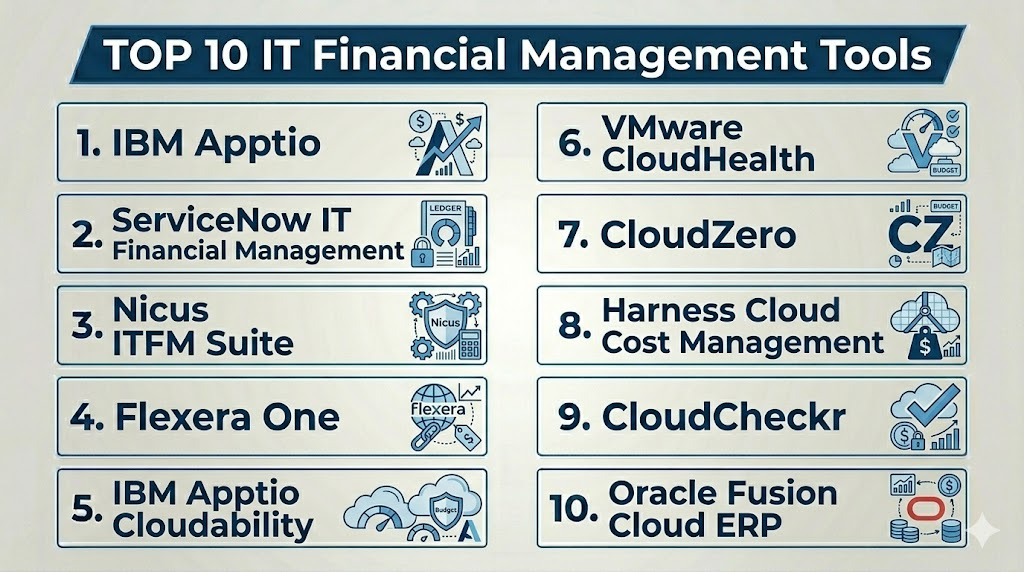
Introduction
IT Financial Management Tools help organizations plan, control, allocate, and optimize technology spending across cloud, SaaS, infrastructure, software licenses, labor, vendors, projects, and business services. These platforms give CIOs, CFOs, IT finance teams, FinOps teams, and business leaders a clearer view of where IT money is being spent and how technology investments support business outcomes. Instead of relying on disconnected spreadsheets, manual invoices, and delayed finance reports, ITFM tools create structured cost models, forecasts, budgets, and allocation reports.IT financial management is important because technology costs are growing across cloud platforms, cybersecurity, AI workloads, SaaS subscriptions, infrastructure modernization, and digital transformation programs. Without proper visibility, organizations can overspend, underutilize resources, miss renewal risks, and struggle to explain IT value to business units.
Real-world use cases include:
- Tracking IT spend across cloud, SaaS, infrastructure, vendors, labor, and projects
- Creating IT budgets and forecasts for departments, services, and portfolios
- Allocating costs through showback and chargeback models
- Managing cloud cost and FinOps workflows
- Connecting IT investments with business services and outcomes
Evaluation Criteria for Buyers:
- Cost transparency and allocation accuracy
- Budgeting and forecasting capabilities
- Showback and chargeback support
- Cloud cost and FinOps visibility
- ERP, ITSM, CMDB, cloud, and procurement integrations
- Application and service cost modeling
- Executive dashboards and reporting
- Scenario planning and variance analysis
- Governance, audit logs, and role-based access
- Ease of use for IT, finance, and business stakeholders
Best for: CIOs, CFOs, IT finance teams, FinOps teams, enterprise architects, procurement leaders, cloud operations teams, IT operations teams, and organizations with complex technology budgets.
Not ideal for: Very small businesses with simple IT expenses, teams that only need basic accounting software, or organizations without enough IT cost complexity to justify a dedicated ITFM platform.
Key Trends in IT Financial Management Tools
- FinOps and ITFM are becoming more connected, especially as cloud spending becomes a major part of overall technology budgets.
- AI-assisted forecasting is gaining attention, helping teams detect anomalies, budget drift, and optimization opportunities faster.
- Showback and chargeback models are becoming more common, giving business units clearer accountability for technology usage.
- Technology Business Management models are influencing ITFM, helping IT leaders explain technical spend in business-friendly language.
- SaaS and software license costs are becoming harder to control, making renewal visibility and usage tracking more important.
- ERP and ITSM integrations are now essential, because finance and IT teams need shared data instead of disconnected reports.
- Scenario planning is becoming more valuable, especially when leaders compare vendor changes, cost reductions, or cloud migration plans.
- Executive dashboards are shifting from cost reports to value reporting, showing how technology supports business services and outcomes.
- Automation is reducing manual spreadsheet work, especially for cost allocation, invoice reconciliation, and monthly reporting.
- Governance and auditability are becoming more important, especially in regulated industries with complex vendor and infrastructure spend.
How We Selected These Tools
The tools below were selected based on practical ITFM relevance, market recognition, financial management depth, cloud cost visibility, and fit across different organization sizes.
- Market adoption and mindshare across IT finance, FinOps, TBM, procurement, and IT operations
- Feature completeness, including budgeting, forecasting, cost allocation, showback, chargeback, and reporting
- IT cost modeling depth, including applications, services, infrastructure, cloud, labor, vendors, and business units
- Integration strength with ERP, ITSM, CMDB, cloud platforms, procurement tools, and financial systems
- Cloud financial management capability, including tagging, allocation, forecasting, optimization, and anomaly detection
- Executive reporting quality, including dashboards, variance analysis, and business-value communication
- Governance and audit readiness, including role-based access, approvals, logs, and financial traceability
- Ease of use for IT and finance teams
- Scalability across departments, portfolios, regions, and complex technology environments
- Customer fit across mid-market and enterprise use cases
Top 10 IT Financial Management Tools
1- IBM Apptio
Short description:
IBM Apptio is one of the most recognized IT Financial Management and Technology Business Management platforms. It helps enterprises understand technology costs, allocate spend, manage budgets, forecast demand, and communicate IT value to business leaders. The platform is especially strong for organizations that need structured cost models, showback, chargeback, and executive-level financial reporting. IBM Apptio is a strong fit for mature IT finance teams that want to connect technology spend with business services and outcomes.
Key Features
- IT cost transparency and allocation
- Budgeting and forecasting workflows
- Showback and chargeback capabilities
- Service and application cost modeling
- Technology Business Management support
- Executive dashboards and variance analysis
- ERP, ITSM, cloud, and finance system integrations
Pros
- Strong fit for enterprise ITFM and TBM programs
- Mature cost modeling and allocation capabilities
- Useful for CIO and CFO-level technology value reporting
Cons
- May be more complex than smaller organizations need
- Requires disciplined financial and operational data governance
- Implementation can require planning, training, and stakeholder alignment
Platforms / Deployment
Cloud
Web / Enterprise IT and finance environments
Security & Compliance
Enterprise controls may include SSO, RBAC, audit logs, encryption, admin roles, and secure reporting depending on configuration. Buyers should validate exact compliance requirements directly.
Integrations & Ecosystem
IBM Apptio works best when connected with ERP, ITSM, cloud billing, CMDB, procurement, and financial systems. It becomes more valuable when cost data can be mapped to services, applications, teams, and business units.
- ERP and finance systems
- ITSM platforms
- CMDB tools
- Cloud billing data
- Procurement systems
- BI and executive reporting tools
Support & Community
IBM provides enterprise support, documentation, onboarding, implementation partners, and customer success resources. Support depth depends on contract and deployment scope.
2- ServiceNow IT Financial Management
Short description:
ServiceNow IT Financial Management helps organizations manage technology budgets, service costs, forecasting, allocations, and financial transparency within the ServiceNow ecosystem. It is especially useful for enterprises already using ServiceNow ITSM, CMDB, ITOM, and Strategic Portfolio Management. The platform connects IT costs with services, assets, incidents, changes, projects, and business capabilities. It is a strong option for organizations that want IT finance workflows integrated with IT operations and service management.
Key Features
- IT budgeting and forecasting
- Service-based cost modeling
- Cost allocation and financial transparency
- Integration with ServiceNow CMDB and ITSM
- Portfolio and project financial visibility
- Dashboards and reporting
- Workflow automation for approvals and reviews
Pros
- Strong fit for ServiceNow-centric enterprises
- Connects IT finance with operational workflows
- Useful for service-based financial reporting
Cons
- Best value comes inside the ServiceNow ecosystem
- Configuration can require ServiceNow expertise
- May be less suitable for teams seeking standalone ITFM only
Platforms / Deployment
Cloud
Web / Mobile / ServiceNow enterprise environments
Security & Compliance
Enterprise controls commonly include SSO, RBAC, audit logs, encryption, workflow permissions, and admin controls depending on configuration. Buyers should validate compliance needs directly.
Integrations & Ecosystem
ServiceNow IT Financial Management integrates naturally with ServiceNow ITSM, CMDB, asset management, portfolio management, and service operations. It is useful when finance and IT operations need a shared workflow platform.
- ServiceNow ITSM
- ServiceNow CMDB
- ServiceNow SPM
- ERP and finance tools
- Asset management workflows
- Reporting and analytics tools
Support & Community
ServiceNow provides enterprise support, documentation, implementation partners, training resources, and a large ecosystem. Support level depends on contract and implementation scope.
3- Nicus ITFM Suite
Short description:
Nicus ITFM Suite is built specifically for IT financial management, cost transparency, budgeting, forecasting, and chargeback or showback programs. It helps IT finance teams model technology costs, allocate expenses, create service rates, and communicate IT value to business stakeholders. Nicus is especially relevant for organizations that want a focused ITFM platform rather than a broader ITSM or ERP product. It is a strong choice for teams building a mature IT financial management practice.
Key Features
- IT cost modeling and transparency
- Budgeting and forecasting
- Showback and chargeback support
- Service costing and rate development
- Variance analysis and financial reporting
- Executive dashboards
- Integration with finance and IT operations systems
Pros
- Purpose-built for IT financial management
- Strong support for cost allocation and service costing
- Useful for IT finance teams that need dedicated ITFM workflows
Cons
- May require finance and IT data maturity
- Less broad than large platform ecosystems
- Buyers should validate integration needs carefully
Platforms / Deployment
Cloud
Web / Enterprise IT finance environments
Security & Compliance
Not publicly stated in full detail. Buyers should validate SSO, RBAC, audit logs, encryption, data retention, and compliance requirements directly.
Integrations & Ecosystem
Nicus fits well into IT finance environments where cost data must be gathered from multiple enterprise systems and translated into service-level financial insights.
- ERP and finance systems
- ITSM tools
- CMDB platforms
- Cloud billing sources
- Procurement systems
- Reporting and BI tools
Support & Community
Nicus provides vendor-led support, onboarding, implementation guidance, and customer resources. Support details should be validated by contract.
4- Flexera One
Short description:
Flexera One provides technology spend management across software, SaaS, cloud, and IT assets. It helps organizations improve visibility into technology costs, optimize licenses, manage cloud spend, reduce waste, and support IT financial decisions. Flexera is especially strong for organizations that need software asset management, SaaS management, cloud cost management, and IT asset visibility in one platform. It is a strong option for enterprises with complex vendor, license, and hybrid cloud environments.
Key Features
- Technology spend visibility
- Software and SaaS cost management
- Cloud cost optimization and FinOps support
- IT asset and license management
- Vendor and contract visibility
- Usage-based optimization insights
- Reporting and governance dashboards
Pros
- Strong fit for software, SaaS, cloud, and asset cost visibility
- Useful for license optimization and vendor management
- Good option for hybrid technology portfolios
Cons
- May not be a pure ITFM cost-modeling tool for every use case
- Implementation can require data integration and normalization
- Some advanced modules may add complexity
Platforms / Deployment
Cloud
Web / Enterprise IT and finance environments
Security & Compliance
Enterprise controls may include SSO, RBAC, audit logs, encryption, and administrative controls depending on modules. Buyers should validate exact security and compliance needs directly.
Integrations & Ecosystem
Flexera One works well where IT finance must connect with software licenses, SaaS usage, cloud spend, procurement, and asset data. It is useful for reducing waste across technology portfolios.
- Cloud providers
- SaaS platforms
- Software license systems
- Procurement tools
- IT asset management workflows
- Reporting and BI platforms
Support & Community
Flexera provides documentation, support, implementation resources, and enterprise customer assistance. Support level depends on contract and selected modules.
5- IBM Apptio Cloudability
Short description:
IBM Apptio Cloudability is a cloud financial management and FinOps platform focused on cloud spend visibility, allocation, budgeting, forecasting, and optimization. It helps organizations understand cloud costs by application, team, service, environment, and business unit. Cloudability is especially useful for organizations with multi-cloud or fast-growing cloud spend. It is a strong option for FinOps teams that need to connect engineering, finance, and business leaders around cloud cost accountability.
Key Features
- Cloud cost visibility and allocation
- Budgeting and forecasting
- FinOps reporting and workflows
- Tagging and cost allocation support
- Optimization recommendations
- Anomaly detection and alerts
- Multi-cloud cost management
Pros
- Strong fit for FinOps and cloud cost management
- Useful for engineering and finance collaboration
- Helps improve cloud cost accountability
Cons
- Focused mainly on cloud financial management
- May need broader ITFM tools for non-cloud costs
- Accurate allocation depends on tagging and cloud data quality
Platforms / Deployment
Cloud
Web / Cloud finance and FinOps environments
Security & Compliance
Enterprise controls may include access controls, admin roles, encryption, and reporting permissions depending on configuration. Buyers should validate SSO, RBAC, audit logs, and compliance needs directly.
Integrations & Ecosystem
Cloudability integrates with cloud billing data and FinOps workflows. It is most valuable when cloud spend needs to be allocated to applications, teams, products, or business units.
- AWS
- Microsoft Azure
- Google Cloud
- FinOps workflows
- Reporting tools
- Engineering and finance dashboards
Support & Community
IBM provides enterprise support, documentation, onboarding resources, and customer success support. FinOps adoption support may vary by contract.
6- VMware CloudHealth
Short description:
VMware CloudHealth is a cloud cost management and governance platform used to manage cloud spend, optimize resources, track budgets, and support cloud financial accountability. It helps organizations analyze usage, identify waste, apply policies, and manage multi-cloud environments. CloudHealth is especially useful for IT, cloud operations, and FinOps teams that need visibility into cloud costs and usage patterns. It is a strong fit for organizations focused on cloud cost optimization rather than full enterprise ITFM modeling.
Key Features
- Cloud cost visibility and reporting
- Budgeting and forecasting support
- Resource optimization recommendations
- Multi-cloud cost management
- Governance policy controls
- Usage and performance insights
- Dashboards for finance and operations
Pros
- Strong fit for cloud operations and FinOps teams
- Useful for identifying waste and optimization opportunities
- Good multi-cloud visibility for cloud cost governance
Cons
- Less focused on full IT cost modeling outside cloud
- Requires consistent cloud tagging and account structure
- Buyers should validate roadmap and ecosystem fit
Platforms / Deployment
Cloud
Web / Multi-cloud environments
Security & Compliance
Security details vary by deployment and account setup. Buyers should validate SSO, RBAC, audit logs, encryption, and compliance needs directly.
Integrations & Ecosystem
CloudHealth fits into cloud operations, FinOps, and cloud governance workflows. It is useful when teams need to connect cloud usage with budget, accountability, and optimization.
- AWS
- Microsoft Azure
- Google Cloud
- Cloud operations tools
- Reporting systems
- Governance workflows
Support & Community
VMware provides documentation, enterprise support, partner services, and customer resources. Support level depends on contract and product package.
7- CloudZero
Short description:
CloudZero is a cloud cost intelligence platform designed to help engineering, finance, and product teams understand cloud costs in business context. It focuses on mapping cloud spend to products, features, customers, teams, and unit economics. CloudZero is especially useful for SaaS companies and engineering-led organizations that need more than basic cloud bills. It is a strong option when cloud financial management must connect with product profitability and engineering decisions.
Key Features
- Cloud cost intelligence
- Cost allocation by product, feature, team, or customer
- Unit cost and margin analysis
- Anomaly detection and alerts
- Engineering-focused cost visibility
- FinOps collaboration workflows
- SaaS and product cost modeling
Pros
- Strong fit for SaaS and engineering-led companies
- Useful for product-level cost visibility
- Helps connect cloud costs with business value and margins
Cons
- Focused mainly on cloud cost intelligence
- Less suitable for full ITFM across all technology spend
- Requires cost mapping and engineering participation
Platforms / Deployment
Cloud
Web / Cloud and SaaS engineering environments
Security & Compliance
Not publicly stated in full detail. Buyers should validate SSO, RBAC, audit logs, encryption, and compliance requirements directly.
Integrations & Ecosystem
CloudZero is designed for cloud, engineering, product, and finance workflows. It is useful when cloud spend must be understood through product and customer economics.
- AWS
- Cloud cost data sources
- Engineering workflows
- Finance reporting
- Product analytics
- BI and dashboard tools
Support & Community
CloudZero provides vendor support, onboarding, documentation, and FinOps guidance. Support depth should be validated by plan.
8- Harness Cloud Cost Management
Short description:
Harness Cloud Cost Management helps engineering and DevOps teams monitor, allocate, optimize, and control cloud spend. It is part of the broader Harness software delivery platform and is especially useful for organizations that want cloud cost visibility connected to engineering workflows. The platform supports budget tracking, anomaly detection, cost allocation, and optimization recommendations. It is a strong option for DevOps-led organizations where engineering teams need real-time cost awareness.
Key Features
- Cloud cost visibility and dashboards
- Kubernetes cost management support
- Budgeting and anomaly detection
- Cost allocation by team, service, or environment
- Optimization recommendations
- Integration with DevOps workflows
- Engineering-focused cost governance
Pros
- Strong fit for DevOps and Kubernetes-heavy teams
- Useful for connecting cloud spend with engineering ownership
- Good option for teams already using Harness
Cons
- More cloud and engineering-focused than enterprise ITFM-focused
- May not cover broad non-cloud IT financial management
- Best value may come inside the Harness ecosystem
Platforms / Deployment
Cloud
Web / DevOps and cloud environments
Security & Compliance
Security controls may include access controls, user roles, audit logs, and integrations depending on configuration. Buyers should validate SSO, RBAC, encryption, and compliance requirements directly.
Integrations & Ecosystem
Harness Cloud Cost Management works best where cost visibility is part of software delivery and DevOps operations. It is useful for teams managing cloud-native and Kubernetes environments.
- Cloud providers
- Kubernetes environments
- DevOps workflows
- CI/CD pipelines
- Engineering dashboards
- Harness platform modules
Support & Community
Harness provides documentation, support, community resources, and customer success assistance. Support depth depends on subscription and deployment scope.
9- CloudCheckr
Short description:
CloudCheckr is a cloud management and cost optimization platform focused on cloud financial management, governance, security, and reporting. It is often used by cloud operations teams, MSPs, and organizations that need cloud cost visibility and optimization across cloud accounts. CloudCheckr helps identify waste, manage budgets, enforce policies, and improve cloud accountability. It is a strong option for organizations looking for cloud-focused financial management and governance rather than broad ITFM modeling.
Key Features
- Cloud cost reporting and optimization
- Budgeting and spend monitoring
- Rightsizing and waste reduction insights
- Cloud governance and policy checks
- Multi-account reporting
- MSP and service provider workflows
- Security and compliance visibility
Pros
- Strong fit for cloud operations and MSP use cases
- Useful for cloud cost governance and optimization
- Supports multi-account reporting and policy visibility
Cons
- Less focused on full enterprise ITFM cost modeling
- Accurate insights depend on cloud account and tagging structure
- Buyers should validate current platform fit and roadmap
Platforms / Deployment
Cloud
Web / Cloud management environments
Security & Compliance
Security details should be validated directly. Buyers should review SSO, RBAC, audit logs, encryption, access permissions, and compliance requirements.
Integrations & Ecosystem
CloudCheckr fits into cloud operations, MSP, cloud governance, and FinOps workflows. It is useful when teams need detailed cloud spend and policy reporting.
- AWS
- Microsoft Azure
- Cloud operations tools
- MSP reporting workflows
- Governance systems
- Finance reporting tools
Support & Community
CloudCheckr provides documentation, support, and service provider resources. Support level may vary by contract and product package.
10- Oracle Fusion Cloud ERP
Short description:
Oracle Fusion Cloud ERP provides enterprise financial planning, budgeting, procurement, project costing, and expense management capabilities that can support IT financial management in Oracle-centric organizations. While it is not a dedicated ITFM-only platform, it is highly relevant for enterprises that manage IT budgets, capital expenses, operating expenses, vendor costs, and project financials inside Oracle finance systems. It is best suited for organizations that want IT financial control tied directly to enterprise finance processes. Oracle works well where IT spending must align tightly with procurement, accounting, and corporate planning.
Key Features
- Enterprise budgeting and financial planning
- Procurement and vendor cost tracking
- Project costing and expense management
- Capital and operating expense visibility
- Financial approvals and controls
- Reporting and analytics
- Integration with Oracle enterprise systems
Pros
- Strong fit for Oracle-centric finance organizations
- Useful for enterprise budgeting and procurement control
- Connects IT spend with corporate financial governance
Cons
- Not a dedicated ITFM cost modeling platform by itself
- IT service costing may require configuration or additional tools
- Best suited for organizations already using Oracle ERP
Platforms / Deployment
Cloud
Web / Oracle enterprise finance environments
Security & Compliance
Enterprise controls may include SSO, RBAC, audit logs, encryption, approval workflows, segregation of duties, and compliance controls depending on configuration. Buyers should validate requirements directly.
Integrations & Ecosystem
Oracle Fusion Cloud ERP works best when IT financial management must align with enterprise finance, procurement, accounting, and planning workflows.
- Oracle finance systems
- Procurement workflows
- Project portfolio systems
- Vendor management
- Budgeting and planning tools
- Enterprise reporting systems
Support & Community
Oracle provides enterprise support, documentation, partner services, implementation consultants, and a large global ecosystem. Support level depends on contract and deployment scope.
Comparison Table
| Tool Name | Best For | Platforms Supported | Deployment | Standout Feature | Public Rating |
|---|---|---|---|---|---|
| IBM Apptio | Enterprise ITFM and TBM programs | Web, Enterprise IT and finance | Cloud | Mature IT cost modeling and TBM reporting | N/A |
| ServiceNow IT Financial Management | ServiceNow-centric enterprises | Web, Mobile, ServiceNow environments | Cloud | IT finance connected with ITSM and CMDB workflows | N/A |
| Nicus ITFM Suite | Dedicated IT finance teams | Web, Enterprise IT finance | Cloud | Purpose-built ITFM and service costing | N/A |
| Flexera One | Software, SaaS, cloud, and asset spend | Web, Enterprise IT environments | Cloud | Technology spend visibility across hybrid portfolios | N/A |
| IBM Apptio Cloudability | FinOps and cloud cost management | Web, Cloud environments | Cloud | Cloud cost allocation and FinOps reporting | N/A |
| VMware CloudHealth | Multi-cloud cost governance | Web, Multi-cloud environments | Cloud | Cloud spend optimization and governance | N/A |
| CloudZero | SaaS and product cost intelligence | Web, Cloud and SaaS environments | Cloud | Cloud costs mapped to products and unit economics | N/A |
| Harness Cloud Cost Management | DevOps and Kubernetes cost control | Web, DevOps and cloud environments | Cloud | Engineering-led cloud cost visibility | N/A |
| CloudCheckr | Cloud governance and MSP reporting | Web, Cloud management environments | Cloud | Cloud cost optimization with governance checks | N/A |
| Oracle Fusion Cloud ERP | Oracle-centric IT finance governance | Web, Oracle finance environments | Cloud | IT spend aligned with enterprise finance workflows | N/A |
Evaluation and Scoring of IT Financial Management Tools
| Tool Name | Core 25% | Ease 15% | Integrations 15% | Security 10% | Performance 10% | Support 10% | Value 15% | Weighted Total 0–10 |
|---|---|---|---|---|---|---|---|---|
| IBM Apptio | 9.5 | 7.8 | 9.2 | 9.0 | 8.8 | 8.8 | 8.0 | 8.75 |
| ServiceNow IT Financial Management | 8.8 | 8.0 | 9.4 | 9.0 | 8.7 | 8.8 | 8.0 | 8.65 |
| Nicus ITFM Suite | 8.8 | 8.2 | 8.5 | 8.4 | 8.5 | 8.4 | 8.2 | 8.48 |
| Flexera One | 8.7 | 8.0 | 8.8 | 8.6 | 8.5 | 8.5 | 8.3 | 8.54 |
| IBM Apptio Cloudability | 8.7 | 8.2 | 8.7 | 8.5 | 8.6 | 8.5 | 8.4 | 8.56 |
| VMware CloudHealth | 8.4 | 8.0 | 8.5 | 8.4 | 8.4 | 8.3 | 8.2 | 8.32 |
| CloudZero | 8.3 | 8.5 | 8.2 | 8.2 | 8.5 | 8.2 | 8.4 | 8.34 |
| Harness Cloud Cost Management | 8.2 | 8.6 | 8.4 | 8.2 | 8.5 | 8.2 | 8.5 | 8.38 |
| CloudCheckr | 8.2 | 8.0 | 8.2 | 8.2 | 8.3 | 8.1 | 8.2 | 8.20 |
| Oracle Fusion Cloud ERP | 8.0 | 7.7 | 9.0 | 9.0 | 8.5 | 8.6 | 7.8 | 8.30 |
These scores are comparative, not absolute. A higher score means the tool performs strongly across the selected evaluation model, but it may not be the best choice for every organization. IBM Apptio may fit mature ITFM and TBM programs, ServiceNow may fit organizations already using ServiceNow workflows, and Cloudability or CloudZero may fit cloud-focused FinOps teams. Buyers should validate tools with real budget data, cloud bills, service models, allocation rules, ERP feeds, and stakeholder reporting needs before choosing.
Which IT Financial Management Tool Is Right for You?
Solo / Freelancer
Solo users and freelancers usually do not need a dedicated IT Financial Management platform. Basic accounting software, spreadsheets, expense tracking tools, and cloud provider cost dashboards may be enough. If the freelancer manages cloud environments for clients, a cloud-focused tool such as CloudZero, Harness Cloud Cost Management, or native cloud cost tools may be useful. The main focus should be simple cost tracking, client billing, budget alerts, and project-level visibility. Enterprise ITFM platforms are usually unnecessary unless the freelancer supports a large client implementation.
SMB
SMBs should prioritize ease of use, cloud cost visibility, software spend tracking, and basic forecasting. Flexera One, CloudZero, Harness Cloud Cost Management, CloudCheckr, or cloud-native cost tools may be practical depending on the environment. If the SMB uses ServiceNow or a structured ITSM platform, ServiceNow IT Financial Management may become relevant. SMBs should avoid overbuilding complex chargeback models before they have reliable cost data. The first goal should be visibility into major IT spend categories and clear ownership.
Mid-Market
Mid-market organizations usually need stronger budgeting, cloud cost allocation, SaaS spend visibility, and department-level reporting. IBM Apptio Cloudability, Flexera One, Nicus ITFM Suite, CloudZero, and ServiceNow IT Financial Management are strong candidates depending on maturity. Mid-market buyers should focus on integrating cloud bills, ERP data, ITSM records, and cost centers. Showback may be a good starting point before full chargeback. The best tool should improve collaboration between IT, finance, and business leaders.
Enterprise
Enterprises need mature ITFM, cost modeling, forecasting, governance, service costing, chargeback, portfolio financial visibility, and executive reporting. IBM Apptio, ServiceNow IT Financial Management, Nicus ITFM Suite, Flexera One, and Oracle Fusion Cloud ERP are strong enterprise options depending on architecture. Cloud-heavy enterprises should also evaluate IBM Apptio Cloudability, VMware CloudHealth, and CloudZero. Enterprises should run pilots using real ERP, cloud, ITSM, CMDB, vendor, and application data. Stakeholder alignment is as important as tool capability.
Budget vs Premium
Budget-focused teams should start with clear cost categories, cloud billing dashboards, simple reporting, and lightweight FinOps tools before buying a large ITFM platform. Tools such as Harness Cloud Cost Management, CloudZero, CloudCheckr, or native cloud cost tools may be enough for cloud-focused teams. Premium buyers with complex enterprise cost allocation should evaluate IBM Apptio, ServiceNow, Nicus, Flexera, or Oracle. Premium tools usually provide deeper modeling, stronger governance, better executive reporting, and integration scale. The right choice depends on cost complexity, not company size alone.
Feature Depth vs Ease of Use
If ease of use is the priority, cloud-focused tools like CloudZero, Harness Cloud Cost Management, or Cloudability may be easier for specific FinOps workflows. If feature depth is required, IBM Apptio, ServiceNow, Nicus, and Flexera provide broader enterprise ITFM capabilities. ERP-based financial control through Oracle can be strong but may require finance system expertise. Buyers should avoid choosing the most feature-rich tool if their processes are immature. A phased approach often works better than trying to implement full ITFM in one step.
Integrations & Scalability
ITFM tools should integrate with ERP, procurement, ITSM, CMDB, cloud billing, SaaS management, HR, project portfolio management, and BI systems. Integration quality matters because ITFM depends on clean cost and operational data. Enterprises should validate APIs, data imports, allocation rules, cost model flexibility, and reporting exports. Cloud-heavy teams should test AWS, Azure, Google Cloud, Kubernetes, and tagging support. Scalability includes not only data volume but also cost model complexity, stakeholder reporting, and governance workflows.
Security & Compliance Needs
IT financial data is sensitive because it reveals technology strategy, vendor spend, budgets, investments, and business priorities. Buyers should validate SSO, RBAC, audit logs, encryption, data retention, approval workflows, and administrator permissions. Regulated organizations should review compliance reporting, access history, and financial controls. ITFM tools should support separation of duties between finance, IT, procurement, and business users. Security review should be completed before connecting ERP, cloud billing, or vendor contract data.
Common Mistakes to Avoid When Buying IT Financial Management Tools
- Choosing software before defining IT financial processes
- Trying to implement chargeback before cost data is trusted
- Ignoring finance stakeholders during tool selection
- Treating cloud cost management and full ITFM as the same thing
- Not integrating with ERP, ITSM, CMDB, and cloud billing systems
- Building overly complex allocation models that business users do not understand
- Ignoring data quality, cost center accuracy, and tagging discipline
- Measuring only cost reduction instead of business value and accountability
- Not training business stakeholders on reports and showback models
- Buying an enterprise platform when a cloud cost tool is enough
- Choosing a cloud cost tool when enterprise ITFM modeling is required
- Not assigning ownership for cost model governance
Implementation Playbook
First Phase
Start by defining the scope of IT financial management. Decide whether the focus is full ITFM, FinOps, SaaS cost management, service costing, chargeback, vendor spend, or technology portfolio planning. Identify key stakeholders from IT, finance, procurement, cloud operations, engineering, business units, and executive leadership. Gather current data sources such as ERP records, cloud bills, vendor contracts, ITSM records, CMDB data, project budgets, and asset records. Define success metrics such as better budget accuracy, improved cost transparency, reduced cloud waste, faster reporting, or more accountable business-unit consumption.
Second Phase
Build a pilot cost model using a limited but meaningful scope. This could be one business unit, one cloud platform, one application portfolio, or one IT service group. Import cost data, map it to cost centers, define allocation rules, and create dashboards for IT and finance stakeholders. Start with showback before chargeback if business users are not ready for direct billing. Validate numbers with finance teams before sharing reports broadly. Use the pilot to identify data gaps, unclear ownership, missing tags, and integration issues.
Third Phase
Scale the ITFM practice across more services, business units, cloud platforms, and cost categories. Automate data feeds from ERP, cloud, ITSM, CMDB, procurement, and billing systems. Create governance for cost model updates, allocation rules, budget changes, and reporting cadence. Train IT leaders and business stakeholders to interpret dashboards correctly. Add forecasting, scenario planning, optimization recommendations, and executive reporting. Review ITFM outcomes regularly to ensure the tool supports better investment decisions, not just more reports.
Frequently Asked Questions
1- What are IT Financial Management Tools?
IT Financial Management Tools are platforms that help organizations understand, plan, allocate, forecast, and optimize technology spending. They connect costs from cloud, SaaS, infrastructure, labor, vendors, projects, and services into structured financial models. These tools help IT and finance teams answer questions about where money is going and which teams or services consume resources. They often support budgeting, forecasting, showback, chargeback, and executive reporting. ITFM tools are especially useful when technology spend is complex and spread across multiple systems. They help convert technical cost data into business-friendly financial insight.
2- Why do organizations need IT Financial Management Tools?
Organizations need ITFM tools because technology spending is often fragmented across cloud bills, software contracts, hardware, labor, vendors, and project budgets. Without a centralized model, finance teams may see total cost but not understand what drives it. IT teams may know usage but struggle to explain business value. ITFM tools create transparency and accountability by connecting spend to services, applications, teams, and outcomes. They also improve budgeting and forecasting accuracy. This helps CIOs and CFOs make better investment, optimization, and prioritization decisions.
3- What is the difference between ITFM and FinOps?
ITFM is broader and covers financial management across technology spend, including infrastructure, labor, vendors, software, services, projects, and enterprise IT budgets. FinOps focuses mainly on cloud financial management, including cloud cost visibility, allocation, optimization, forecasting, and engineering accountability. FinOps is often a part of the broader ITFM practice. A cloud-heavy organization may start with FinOps and later expand into full ITFM. Enterprises often need both. The right approach depends on whether the main pain point is cloud spend or total technology financial management.
4- What is showback and chargeback in ITFM?
Showback means reporting technology costs to business units so they can see what they consume, without directly billing them. Chargeback means actually allocating or billing costs to those business units based on usage or agreed rules. Showback is usually easier to start with because it builds trust and awareness. Chargeback requires stronger data accuracy, clear allocation rules, and executive agreement. Both models help create accountability for IT consumption. A good ITFM tool should support both approaches with transparent reporting.
5- How much do IT Financial Management Tools cost?
Pricing varies based on users, modules, data volume, integrations, deployment scope, and enterprise requirements. Dedicated enterprise ITFM platforms are usually more expensive than basic cloud cost tools because they support complex cost modeling and governance. Cloud cost management tools may be priced based on cloud spend, accounts, or feature tier. Buyers should also consider implementation, data integration, training, and ongoing model maintenance. The lowest-cost tool may not provide enough financial rigor. The best value comes from matching tool depth to actual financial complexity.
6- How long does ITFM implementation take?
Implementation time depends on data quality, number of cost sources, stakeholder alignment, cost model complexity, and integration needs. A cloud-only FinOps tool can often start with a smaller scope, while enterprise ITFM with ERP, ITSM, CMDB, labor, vendor, and service costing data takes more planning. The most difficult work is usually defining allocation rules and validating cost models. Organizations should begin with a pilot before full enterprise rollout. Early success depends on clean data, clear ownership, and finance validation. ITFM should be implemented as a practice, not only as software.
7- What features should buyers look for?
Buyers should look for budgeting, forecasting, cost allocation, showback, chargeback, variance analysis, service costing, cloud cost visibility, executive dashboards, and reporting. Integration with ERP, ITSM, CMDB, procurement, cloud billing, SaaS systems, and BI tools is very important. FinOps teams should prioritize tagging, anomaly detection, optimization recommendations, and cloud allocation. Enterprises should prioritize governance, audit trails, role-based access, and scenario planning. The best feature set depends on whether the organization needs full ITFM, cloud cost management, or both.
8- Can ITFM tools reduce technology costs?
Yes, ITFM tools can help reduce costs by making spending visible, identifying waste, improving forecasts, supporting vendor negotiations, and creating accountability for consumption. Cloud-focused tools can identify idle resources, oversized services, and untagged spend. Full ITFM platforms can reveal expensive services, underused systems, and poor allocation models. However, tools do not reduce costs automatically. Teams must act on insights, change behavior, improve governance, and review spending regularly. Cost savings depend on data quality, leadership support, and operational discipline.
9- What are common alternatives to ITFM tools?
Common alternatives include spreadsheets, ERP reports, cloud-native cost tools, procurement systems, ITSM reports, CMDB data, and BI dashboards. These alternatives may work for small teams or simple budgets. However, they often become difficult when technology costs span many systems, services, vendors, and business units. Spreadsheets are flexible but fragile. ERP systems are strong for accounting but may not explain service-level IT costs. Cloud-native tools are useful but often limited to one cloud provider. Dedicated ITFM tools are best when organizations need structured allocation, forecasting, and stakeholder reporting.
10- How should a company switch ITFM tools?
Switching ITFM tools should start with a review of current cost models, data sources, allocation rules, reports, users, dashboards, and stakeholder requirements. Export important historical data and document how current numbers are calculated. Clean cost center, service, application, and cloud tagging data before migration. Start with a pilot model in the new platform and compare results with existing reports. Validate numbers with finance before executive rollout. After migration, create governance for model updates, reporting cadence, and data quality ownership.
Conclusion
IT Financial Management Tools help organizations turn complex technology spending into clear, actionable financial insight. The best tool depends on whether the main need is enterprise ITFM, cloud FinOps, software spend visibility, ERP-based financial governance, or service-based cost modeling. IBM Apptio is strong for mature ITFM and TBM programs, ServiceNow fits organizations already using ServiceNow workflows, Nicus is focused on dedicated ITFM needs, Flexera is strong for software, SaaS, cloud, and asset spend, Cloudability and CloudHealth support FinOps, CloudZero helps SaaS teams understand product cost, Harness supports DevOps-led cost visibility, CloudCheckr supports cloud governance, and Oracle fits finance-led enterprises. Buyers should shortlist tools, test them with real cost data, validate integrations and security controls, review allocation logic with finance, and choose the platform that improves transparency, accountability, forecasting, and long-term technology investment decisions.
