MOTOSHARE 🚗🏍️
Rent Bikes & Cars Directly from Owners
Motoshare connects vehicle owners with people who need bikes and cars on rent. Owners earn from idle vehicles, and renters get flexible ride options.
Visit Motoshare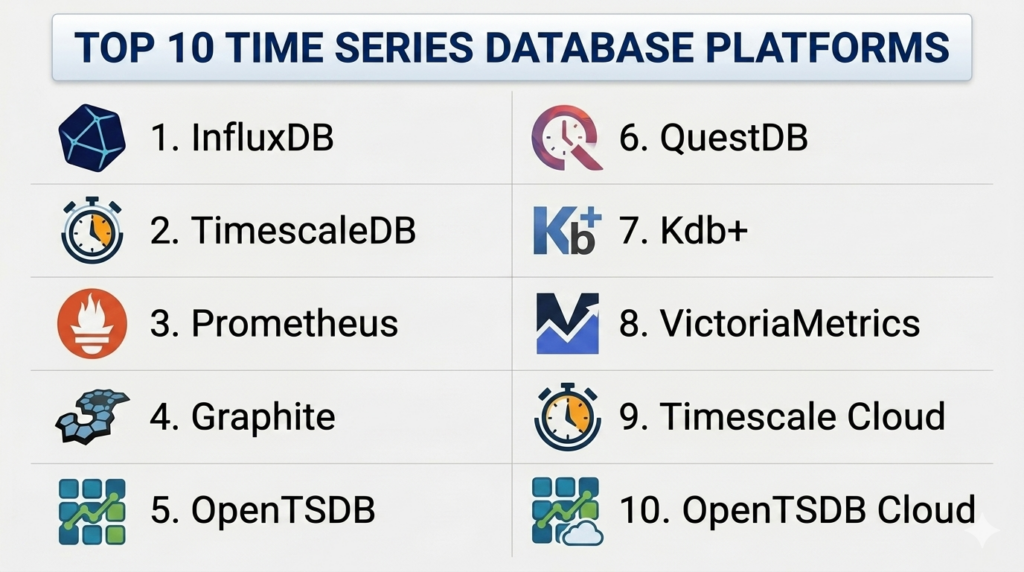
Introduction
Time Series Database (TSDB) Platforms are specialized databases optimized for storing, indexing, and querying timestamped data efficiently. They are essential for applications that generate high-velocity, sequential data, such as IoT devices, monitoring logs, financial transactions, and telemetry streams. TSDBs handle high ingestion rates and offer query optimizations tailored for time-ordered datasets, making them ideal for real-time analytics and observability.
Real-world use cases include monitoring server and application metrics for DevOps teams, analyzing IoT sensor data for industrial automation, managing financial market time-series data, providing real-time analytics dashboards for cloud-native applications, and enabling predictive maintenance for manufacturing equipment. Buyers evaluating TSDBs should consider ingestion performance, query speed, data retention policies, scaling capabilities, cloud and hybrid deployments, integration with analytics and ML pipelines, security, and cost-effectiveness.
Best for: DevOps engineers, data engineers, IoT platform developers, enterprises monitoring telemetry or logs, and analytics teams managing large-scale time-stamped datasets.
Not ideal for: teams managing purely relational or unstructured data without time-series requirements, small projects with low data volume, or applications without monitoring or real-time analytics needs.
Key Trends in Time Series Database Platforms
- Cloud-native, fully managed TSDB services offering elastic scaling.
- High-performance ingestion using compression and indexing technologies.
- Integration with AI/ML pipelines for anomaly detection and predictive analytics.
- Real-time analytics and dashboards for observability and monitoring.
- Multi-cloud and hybrid deployments ensuring high availability.
- Open-source adoption for flexible, cost-effective monitoring solutions.
- Integration with visualization tools such as Grafana and Kibana.
- Security with encryption, role-based access control, and audit logging.
- Subscription and pay-as-you-go pricing models for SMB adoption.
- Automated backup, replication, and disaster recovery.
How We Selected These Tools (Methodology)
- Evaluated adoption and usage among enterprises, SMBs, and startups.
- Assessed feature completeness, including ingestion, query performance, analytics, and retention.
- Reviewed reliability, uptime, and operational monitoring capabilities.
- Examined integration with visualization, AI/ML pipelines, and cloud services.
- Considered security and compliance, including encryption and access controls.
- Evaluated ease of management and operational simplicity.
- Prioritized multi-cloud, hybrid, and high-availability deployment options.
- Focused on high-frequency ingestion and low-latency querying performance.
Top 10 Time Series Database Platforms
#1 — InfluxDB
Short description: InfluxDB is a high-performance time series database designed for large-scale metric storage and real-time analytics. It is widely used in DevOps monitoring, IoT telemetry, and cloud-native applications. With support for both open-source and enterprise editions, InfluxDB provides features such as efficient compression, retention policies, and seamless integration with Grafana for visualization. The platform enables rapid ingestion of high-frequency data while maintaining low-latency query performance, making it suitable for mission-critical monitoring applications.
Key Features
- SQL-like query language (InfluxQL) and Flux.
- High write throughput and compression.
- Retention policies and downsampling for historical data.
- Integration with Grafana and cloud services.
- Cloud and on-premises deployment options.
Pros
- Scalable and easy to deploy.
- Strong ecosystem and visualization support.
Cons
- Enterprise features require a subscription.
- Complex queries may affect performance.
Platforms / Deployment
- Windows / Linux / macOS / Cloud
- On-premises / Cloud / Hybrid
Security & Compliance
- TLS encryption, role-based access
- ISO 27001, SOC 2 (enterprise edition)
Integrations & Ecosystem
- Grafana, Telegraf, Kapacitor
- Cloud providers: AWS, Azure, GCP
- Python, Go, and Java APIs
Support & Community
- Open-source community, enterprise support, and documentation.
#2 — TimescaleDB
Short description: TimescaleDB is a PostgreSQL-based time series database that offers the reliability of SQL with the performance of a specialized TSDB. It supports high-volume data ingestion, complex queries, and analytics for IoT, monitoring, and ML-driven applications. TimescaleDB enables automatic partitioning through hypertables, ensuring scalability and efficient data management. Its compatibility with PostgreSQL makes it easy for organizations to integrate with existing SQL-based tools, while also offering cloud-managed and on-premises deployments for flexibility.
Key Features
- PostgreSQL compatibility with SQL support.
- Hypertables for automatic partitioning and scaling.
- Multi-node clustering for high availability.
- Integration with Grafana, Prometheus, and ML pipelines.
- Automated backups and monitoring.
Pros
- SQL interface simplifies adoption.
- Scalable and analytical-ready.
Cons
- Enterprise features require subscription.
- Cluster setup may be complex for beginners.
Platforms / Deployment
- Windows / Linux / macOS / Cloud
- On-premises / Cloud / Hybrid
Security & Compliance
- TLS encryption, role-based access
- Not publicly stated for SOC 2
Integrations & Ecosystem
- Grafana, Prometheus, Python, R
- Cloud providers: AWS, Azure, GCP
- ML pipelines and analytics integration
Support & Community
- Open-source community and enterprise support, documentation available.
#3 — Prometheus
Short description: Prometheus is an open-source monitoring and time series database optimized for cloud-native environments. It excels at metric collection, real-time alerting, and integration with observability dashboards such as Grafana. Prometheus supports multi-dimensional time series data with powerful querying using PromQL. Its pull-based collection model and built-in alerting system make it ideal for DevOps teams monitoring applications, infrastructure, and containers in real time.
Key Features
- Multi-dimensional time series data model.
- PromQL query language for analytics.
- Built-in alerting and monitoring support.
- Pull-based metrics collection model.
- Integration with Grafana for dashboards.
Pros
- Highly reliable and cloud-native.
- Real-time monitoring and alerting capabilities.
Cons
- Not optimized for long-term historical storage.
- Limited built-in advanced analytics.
Platforms / Deployment
- Linux / Cloud
- On-premises / Cloud / Hybrid
Security & Compliance
- TLS encryption, role-based access
- Not publicly stated for SOC 2
Integrations & Ecosystem
- Grafana, Kubernetes, Alertmanager
- Python and Go SDKs
- Cloud metrics aggregation
Support & Community
- Active open-source community, documentation available.
#4 — Graphite
Short description: Graphite is an open-source TSDB widely used for real-time metric visualization and monitoring. It is commonly deployed in DevOps environments to track server and application performance. Graphite leverages the Whisper TSDB for storage and integrates seamlessly with visualization platforms such as Grafana. Its REST API and Python clients allow developers to automate metric ingestion and querying, making it suitable for both operational monitoring and historical analysis of time-stamped data.
Key Features
- Time-series storage and retrieval.
- Integration with visualization platforms.
- Real-time and historical metrics analysis.
- Whisper TSDB storage backend.
- REST API and Python clients.
Pros
- Simple and effective for DevOps monitoring.
- Easy deployment and management.
Cons
- Limited analytics for large-scale historical datasets.
- No built-in alerting system.
Platforms / Deployment
- Linux / Cloud
- On-premises / Cloud / Hybrid
Security & Compliance
- TLS encryption for transport
- Not publicly stated for SOC 2
Integrations & Ecosystem
- Grafana, StatsD, Python APIs
- Cloud providers: AWS, GCP
- Integration with alerting tools
Support & Community
- Open-source community, documentation available.
#5 — OpenTSDB
Short description: OpenTSDB is a distributed, scalable TSDB built on top of HBase. It can ingest millions of metrics per second, making it suitable for high-volume monitoring applications. OpenTSDB integrates with visualization tools like Grafana, supports RESTful APIs, and can be deployed across multiple nodes with replication for high availability. It is widely used for telemetry collection, IoT monitoring, and observability pipelines in large-scale environments.
Key Features
- High-volume metric ingestion.
- HBase backend for storage and scalability.
- REST API for storage and query.
- Integration with Grafana and alerting tools.
- Multi-node replication for availability.
Pros
- Extremely scalable for large deployments.
- Open-source with a strong community.
Cons
- Requires HBase and Hadoop infrastructure.
- Operational setup can be complex.
Platforms / Deployment
- Linux / Cloud
- On-premises / Cloud / Hybrid
Security & Compliance
- TLS encryption
- Not publicly stated
Integrations & Ecosystem
- Grafana dashboards, ML pipelines
- Cloud providers: AWS, GCP
- Python and Java APIs
Support & Community
- Open-source community, documentation available.
#6 — QuestDB
Short description: QuestDB is an open-source time series database optimized for high-speed ingestion and analytics. It supports standard SQL queries for time-series data and integrates with Grafana for visualization. QuestDB’s column-oriented architecture ensures fast read and write performance, making it ideal for telemetry, IoT, and financial analytics workloads. Both cloud and on-premises deployment options are available.
Key Features
- SQL support for time-series queries.
- Column-oriented storage with compression.
- Real-time ingestion and analytics.
- Integration with Grafana and ML pipelines.
- Cloud and on-premises deployment.
Pros
- High-performance ingestion and queries.
- SQL interface simplifies adoption.
Cons
- Smaller ecosystem compared to InfluxDB or TimescaleDB.
- Enterprise features require paid subscription.
Platforms / Deployment
- Windows / Linux / Cloud
- On-premises / Cloud / Hybrid
Security & Compliance
- TLS encryption
- Not publicly stated
Integrations & Ecosystem
- Grafana, Python, Java APIs
- Cloud deployments: AWS, GCP, Azure
- ML and analytics pipelines
Support & Community
- Open-source community and enterprise support.
#7 — Kdb+
Short description: Kdb+ is a high-performance, columnar TSDB widely used in financial services. It offers extremely fast analytics on large-scale time-stamped data, leveraging the q query language. Kdb+ is ideal for trading platforms, market data analysis, and real-time financial monitoring, providing ultra-low latency ingestion and query processing for high-frequency time series data.
Key Features
- Columnar storage optimized for speed.
- q query language for advanced analytics.
- Multi-threaded, memory-optimized performance.
- Integration with analytics and ML pipelines.
- High-throughput ingestion of financial or telemetry data.
Pros
- Exceptional performance for high-frequency time-series data.
- Widely adopted in finance and trading sectors.
Cons
- Proprietary software with licensing costs.
- Requires knowledge of q query language.
Platforms / Deployment
- Windows / Linux / Cloud
- On-premises / Cloud / Hybrid
Security & Compliance
- AES encryption, role-based access
- ISO 27001, SOC 2
Integrations & Ecosystem
- Python, Java, C++ APIs
- Cloud and on-prem analytics
- ML pipelines
Support & Community
- Vendor support, professional services.
#8 — VictoriaMetrics
Short description: VictoriaMetrics is a fast, scalable TSDB designed for high-performance metric storage and retrieval. It is compatible with Prometheus metrics and integrates seamlessly with Grafana for visualization. VictoriaMetrics supports horizontal scaling, real-time ingestion, and low-latency querying, making it suitable for observability stacks and monitoring workloads across cloud and on-premises deployments.
Key Features
- High-performance ingestion and compression.
- Horizontal and vertical scalability.
- Integration with Prometheus and Grafana.
- Real-time querying and visualization.
- Cloud and self-hosted deployment options.
Pros
- Optimized for high-volume metrics.
- Simple integration with monitoring stacks.
Cons
- Limited advanced analytics features.
- Enterprise features require subscription.
Platforms / Deployment
- Linux / Cloud
- On-premises / Cloud / Hybrid
Security & Compliance
- TLS encryption
- Not publicly stated
Integrations & Ecosystem
- Grafana, Prometheus, Python APIs
- Cloud providers: AWS, GCP, Azure
- ML and analytics pipelines
Support & Community
- Open-source community, commercial support.
#9 — Timescale Cloud
Short description: Timescale Cloud is a fully managed cloud-hosted TimescaleDB offering automated scaling, backups, and monitoring. It provides SQL querying for time-series data, hypertables for partitioning, and integration with Grafana for visualization. Timescale Cloud is ideal for developers and teams who prefer a managed solution without the operational overhead of maintaining TSDB infrastructure.
Key Features
- Fully managed SQL-based TSDB.
- Automated backups and scaling.
- Hypertables for partitioning.
- Integration with Grafana, ML pipelines.
- Multi-region cloud deployment.
Pros
- Fully managed and easy to deploy.
- SQL interface simplifies analytics.
Cons
- Limited to cloud deployment.
- Enterprise features require subscription.
Platforms / Deployment
- Cloud-native
- Cloud
Security & Compliance
- TLS encryption, role-based access
- ISO 27001, SOC 2
Integrations & Ecosystem
- Grafana, ML pipelines, Python/Java APIs
- Cloud providers: AWS, Azure, GCP
Support & Community
- Vendor support and documentation.
#10 — OpenTSDB Cloud
Short description: OpenTSDB Cloud is a managed service version of OpenTSDB built on HBase. It allows scalable ingestion, querying, and storage of time-series metrics. The platform integrates with Grafana for visualization and supports multi-node replication for high availability, making it suitable for cloud-native observability pipelines and large-scale monitoring workloads.
Key Features
- Distributed TSDB on HBase backend.
- REST API for ingestion and querying.
- Integration with Grafana dashboards.
- Multi-node replication for high availability.
- Cloud-managed scaling and monitoring.
Pros
- Fully managed, scalable cloud service.
- Compatible with large-scale metrics pipelines.
Cons
- Subscription required for cloud edition.
- Less flexible than self-hosted OpenTSDB.
Platforms / Deployment
- Cloud-native
- Cloud
Security & Compliance
- TLS encryption
- Not publicly stated
Integrations & Ecosystem
- Grafana dashboards, ML pipelines, APIs
- AWS, Azure, GCP cloud providers
Support & Community
- Vendor enterprise support.
Comparison Table (Top 10)
| Tool Name | Best For | Platform(s) Supported | Deployment | Standout Feature | Public Rating |
|---|---|---|---|---|---|
| InfluxDB | IoT & monitoring | Windows / Linux / macOS / Cloud | On-prem / Cloud / Hybrid | High write throughput & compression | N/A |
| TimescaleDB | SQL & analytics | Windows / Linux / macOS / Cloud | On-prem / Cloud / Hybrid | SQL interface with hypertables | N/A |
| Prometheus | DevOps metrics | Linux / Cloud | On-prem / Cloud / Hybrid | Multi-dimensional metrics & PromQL | N/A |
| Graphite | Monitoring dashboards | Linux / Cloud | On-prem / Cloud / Hybrid | Visualization with Grafana | N/A |
| OpenTSDB | Large-scale metrics | Linux / Cloud | On-prem / Cloud / Hybrid | HBase backend & distributed storage | N/A |
| QuestDB | Real-time analytics | Windows / Linux / Cloud | On-prem / Cloud / Hybrid | SQL for time-series queries | N/A |
| Kdb+ | Financial data | Windows / Linux / Cloud | On-prem / Cloud / Hybrid | Ultra-fast columnar analytics | N/A |
| VictoriaMetrics | Observability metrics | Linux / Cloud | On-prem / Cloud / Hybrid | High ingestion & compression | N/A |
| Timescale Cloud | Managed TSDB | Cloud-native | Cloud | Fully managed SQL TSDB | N/A |
| OpenTSDB Cloud | Cloud metrics | Cloud-native | Cloud | Managed OpenTSDB service | N/A |
Evaluation & Scoring of Time Series Database Platforms
| Tool Name | Core (25%) | Ease (15%) | Integrations (15%) | Security (10%) | Performance (10%) | Support (10%) | Value (15%) | Weighted Total |
|---|---|---|---|---|---|---|---|---|
| InfluxDB | 9 | 8 | 8 | 8 | 9 | 8 | 7 | 8.3 |
| TimescaleDB | 8 | 8 | 8 | 8 | 8 | 7 | 7 | 7.8 |
| Prometheus | 8 | 8 | 7 | 8 | 8 | 7 | 7 | 7.7 |
| Graphite | 7 | 7 | 7 | 7 | 7 | 6 | 7 | 7.0 |
| OpenTSDB | 8 | 7 | 7 | 7 | 8 | 7 | 7 | 7.5 |
| QuestDB | 8 | 8 | 7 | 7 | 8 | 7 | 7 | 7.6 |
| Kdb+ | 9 | 7 | 7 | 8 | 9 | 7 | 6 | 7.8 |
| VictoriaMetrics | 8 | 7 | 7 | 7 | 8 | 7 | 7 | 7.5 |
| Timescale Cloud | 8 | 8 | 8 | 8 | 8 | 7 | 7 | 7.8 |
| OpenTSDB Cloud | 8 | 8 | 7 | 7 | 8 | 7 | 7 | 7.6 |
Which Time Series Database Platform Is Right for You?
Solo / Freelancer
InfluxDB, QuestDB, or Graphite are ideal for small-scale monitoring or personal projects with minimal operational overhead.
SMB
TimescaleDB, VictoriaMetrics, or Prometheus provide scalable metrics ingestion and analytics for small to medium teams.
Mid-Market
OpenTSDB, Timescale Cloud, or InfluxDB Enterprise offer multi-node scaling, cloud or hybrid deployments, and integration with dashboards.
Enterprise
Kdb+, InfluxDB Enterprise, and OpenTSDB Cloud provide high-performance ingestion, enterprise-grade analytics, and cloud-managed services for large-scale monitoring, IoT, and financial telemetry.
Budget vs Premium
Open-source platforms like Prometheus, Graphite, QuestDB, and VictoriaMetrics are cost-effective. Managed and enterprise editions provide advanced features, scaling, and SLA support at higher costs.
Feature Depth vs Ease of Use
Managed TSDB services (Timescale Cloud, OpenTSDB Cloud) simplify deployment and maintenance, while open-source solutions provide deeper control but require operational expertise.
Integrations & Scalability
Cloud-native TSDBs integrate seamlessly with Grafana, ML pipelines, and cloud observability stacks. Enterprise TSDBs scale horizontally and can handle millions of metrics per second.
Security & Compliance Needs
Select TSDBs offering TLS encryption, role-based access control, audit logging, and compliance certifications such as ISO 27001 or SOC 2 for regulated workloads.
Frequently Asked Questions (FAQs)
1. What is a time series database?
A database optimized for storing, querying, and analyzing sequential timestamped data.
2. Which use cases require TSDBs?
IoT telemetry, server/app monitoring, financial market analysis, and observability dashboards.
3. Can small businesses use TSDBs?
Yes, open-source and managed cloud options scale for SMB workloads efficiently.
4. How do TSDBs handle high-frequency data?
Using optimized storage, compression, indexing, and horizontal scaling for ingestion.
5. Are TSDBs secure?
Managed services offer TLS encryption, role-based access, and audit logging.
6. Can TSDBs integrate with ML pipelines?
Yes, metrics and time-stamped data can feed predictive models and anomaly detection workflows.
7. Which TSDB is best for real-time monitoring?
Prometheus, InfluxDB, and QuestDB provide low-latency real-time analytics.
8. Can TSDBs run in the cloud?
Most modern TSDBs offer cloud-native or managed services.
9. Do TSDBs scale horizontally?
Yes, many support multi-node clustering for high-throughput data ingestion.
10. How do I choose the right TSDB?
Consider workload volume, ingestion rate, query requirements, cloud preference, and operational expertise.
Conclusion
Time Series Database Platforms are essential for managing high-volume, sequential data in real-time analytics, IoT, and monitoring applications. Open-source TSDBs like Prometheus, Graphite, QuestDB, and VictoriaMetrics are cost-effective and flexible for SMBs and development teams. Enterprise-grade or managed TSDBs like InfluxDB Enterprise, Timescale Cloud, Kdb+, and OpenTSDB Cloud offer scalability, reliability, and integration with analytics and ML pipelines for large-scale deployments. Choosing the right TSDB depends on ingestion rates, deployment preferences, operational expertise, and integration needs. The recommended next steps are to shortlist suitable TSDBs, run pilot deployments to evaluate ingestion and query performance, and validate security, scalability, and integration requirements before full-scale adoption.

This gave me a fresh perspective, really useful.