MOTOSHARE 🚗🏍️
Rent Bikes & Cars Directly from Owners
Motoshare connects vehicle owners with people who need bikes and cars on rent. Owners earn from idle vehicles, and renters get flexible ride options.
Visit Motoshare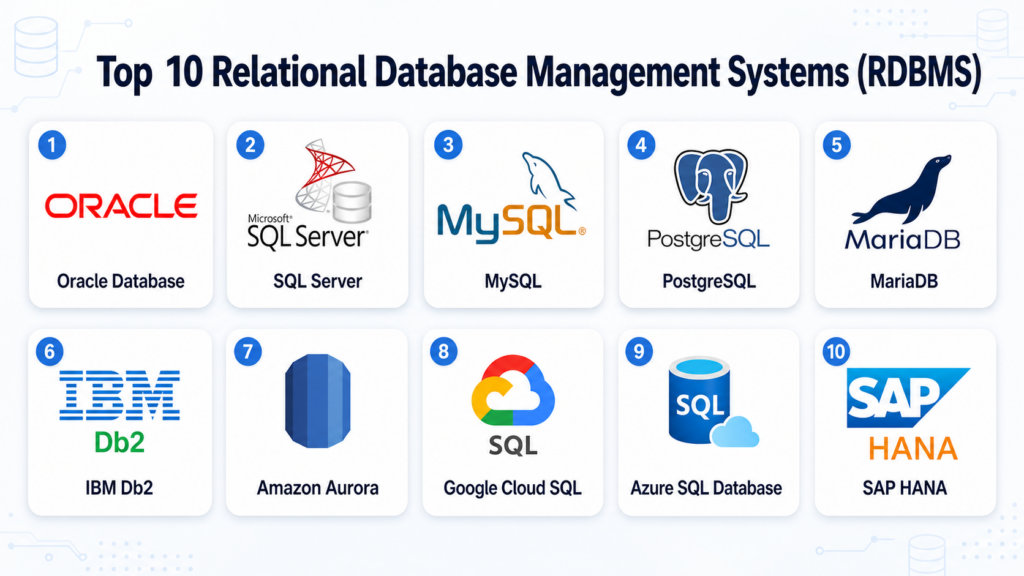
Introduction
Relational Database Management Systems (RDBMS) are software solutions designed to store, manage, and query structured data using tables, rows, and columns. They enable efficient data storage, retrieval, and integrity through SQL-based operations, supporting transactional consistency, relationships, and constraints. RDBMS are fundamental for business applications, analytics, and cloud services.
Real-world use cases include managing financial records, customer relationship management (CRM), e-commerce inventory, healthcare patient data, and ERP systems. They are widely used in enterprises, SMBs, and cloud-native environments, ensuring high availability, security, and compliance.
Evaluation criteria for buyers include database engine performance, scalability, SQL compliance, ACID support, cloud and on-prem deployment options, security features, backup and recovery, high availability, integration with BI and analytics tools, and cost-effectiveness.
Best for: enterprises, SMBs, IT and data teams, application developers, cloud-native companies, and organizations requiring structured data storage with transactional integrity.
Not ideal for: organizations primarily handling unstructured or semi-structured data that may be better served by NoSQL or data lake solutions.
Key Trends in RDBMS
- Cloud-native RDBMS adoption with hybrid deployment models.
- AI-driven query optimization and predictive scaling.
- Integration with DevOps pipelines and CI/CD workflows.
- Multi-cloud and cross-region high availability.
- Improved analytics, in-memory processing, and columnar storage.
- Automated backup, recovery, and disaster recovery features.
- Enhanced security with encryption, role-based access, and auditing.
- Subscription and SaaS pricing models for SMBs.
- Compliance with GDPR, HIPAA, SOC 2, and ISO 27001.
- Open-source RDBMS gaining enterprise adoption due to flexibility.
How We Selected These Tools (Methodology)
- Evaluated market adoption and enterprise usage.
- Assessed feature completeness including performance, high availability, and scalability.
- Reviewed reliability and uptime statistics.
- Examined integration capabilities with BI, DevOps, and cloud services.
- Considered security, compliance, and encryption features.
- Evaluated ease of management and administrative tools.
- Prioritized multi-cloud and hybrid deployment support.
- Focused on performance optimization and operational efficiency.
Top 10 Relational Database Management Systems (RDBMS)
#1 — Oracle Database
Short description: Oracle Database is an enterprise-grade RDBMS offering high performance, scalability, and security for mission-critical applications in on-premises and cloud environments.
Key Features
- ACID-compliant transactional support.
- Multi-tenancy and clustering for high availability.
- In-memory processing and advanced analytics.
- Automated backup, recovery, and patching.
- Security features including encryption and auditing.
Pros
- Enterprise-grade reliability and performance.
- Extensive tooling and ecosystem support.
Cons
- High licensing cost.
- Complexity requires experienced DBAs.
Platforms / Deployment
- Windows / Linux / Cloud
- On-premises / Hybrid / Cloud
Security & Compliance
- AES encryption, role-based access
- ISO 27001, SOC 2, GDPR, HIPAA
Integrations & Ecosystem
- Oracle Cloud services
- BI and analytics tools
- APIs for application integration
Support & Community
- Oracle support, documentation, and professional services.
#2 — Microsoft SQL Server
Short description: SQL Server is a widely adopted RDBMS offering robust performance, integration with Microsoft tools, and support for cloud, on-prem, and hybrid deployments.
Key Features
- ACID transactions and relational integrity.
- In-memory OLTP for performance.
- Advanced analytics and reporting services.
- High availability with clustering and Always On.
- Integration with Power BI and Azure services.
Pros
- Seamless integration with Microsoft ecosystem.
- Strong enterprise support and tooling.
Cons
- Primarily Windows-centric.
- Licensing costs for enterprise features.
Platforms / Deployment
- Windows / Linux / Cloud
- On-premises / Hybrid / Cloud
Security & Compliance
- Transparent Data Encryption, auditing
- ISO 27001, SOC 2, GDPR
Integrations & Ecosystem
- Azure cloud and Power BI
- Active Directory integration
- DevOps CI/CD pipelines
Support & Community
- Microsoft support, forums, and extensive documentation.
#3 — MySQL
Short description: MySQL is an open-source RDBMS popular for web applications, SaaS, and SMB deployments, known for ease of use, reliability, and cross-platform support.
Key Features
- ACID compliance and transactional support.
- Multi-platform deployment.
- Replication and clustering for scalability.
- Integration with cloud services and programming languages.
- Security features with authentication and SSL/TLS.
Pros
- Free and widely adopted.
- Easy to deploy and manage.
Cons
- Enterprise features require paid versions (MySQL Enterprise).
- Limited advanced analytics compared to enterprise RDBMS.
Platforms / Deployment
- Windows / Linux / macOS / Cloud
- On-premises / Cloud
Security & Compliance
- SSL/TLS encryption
- Not publicly stated for SOC 2
Integrations & Ecosystem
- PHP, Python, Java applications
- AWS, Azure, GCP integration
- Backup and monitoring tools
Support & Community
- Open-source community and optional enterprise support.
#4 — PostgreSQL
Short description: PostgreSQL is a free, open-source RDBMS known for extensibility, standards compliance, and advanced features suitable for enterprise and cloud deployments.
Key Features
- ACID-compliant transactions.
- JSON and JSONB support for semi-structured data.
- Advanced indexing and full-text search.
- Replication and high availability.
- Security with roles, SSL, and encryption.
Pros
- Highly extensible and standards-compliant.
- Strong open-source community support.
Cons
- Advanced features require DBA expertise.
- Less commercial support compared to Oracle or SQL Server.
Platforms / Deployment
- Windows / Linux / macOS / Cloud
- On-premises / Cloud / Hybrid
Security & Compliance
- SSL, role-based access
- Not publicly stated for SOC 2
Integrations & Ecosystem
- Cloud services: AWS RDS, Azure, GCP
- BI and analytics platforms
- Programming languages: Python, Java, Node.js
Support & Community
- Open-source community, forums, and commercial support options.
#5 — MariaDB
Short description: MariaDB is a community-driven fork of MySQL with enterprise and cloud support, offering enhanced performance, scalability, and security features.
Key Features
- ACID-compliant storage engines.
- Replication and clustering support.
- Advanced indexing and query optimization.
- Cloud and hybrid deployment support.
- Security with SSL/TLS and authentication plugins.
Pros
- Free, open-source, and compatible with MySQL.
- Enterprise-ready with MariaDB Enterprise subscription.
Cons
- Some enterprise features require paid subscriptions.
- Community support may be limited for complex scenarios.
Platforms / Deployment
- Windows / Linux / macOS / Cloud
- On-premises / Cloud
Security & Compliance
- SSL/TLS encryption, role-based access
- Not publicly stated for SOC 2
Integrations & Ecosystem
- AWS, Azure, GCP
- BI tools and DevOps pipelines
- APIs and connectors
Support & Community
- Open-source community and MariaDB enterprise support.
#6 — IBM Db2
Short description: IBM Db2 is an enterprise RDBMS with high scalability, analytics capabilities, and cloud integration, used in finance, healthcare, and large-scale business applications.
Key Features
- ACID-compliant transactions.
- Advanced analytics and in-memory processing.
- Multi-cloud and hybrid support.
- High availability and disaster recovery.
- Security features with encryption and auditing.
Pros
- Enterprise-grade performance and reliability.
- Integration with IBM Cloud and analytics tools.
Cons
- Licensing cost may be high.
- Complex setup for small teams.
Platforms / Deployment
- Windows / Linux / Cloud
- On-premises / Cloud / Hybrid
Security & Compliance
- AES encryption
- ISO 27001, SOC 2, HIPAA
Integrations & Ecosystem
- IBM Cloud, analytics, and BI tools
- DevOps pipelines
- APIs for automation
Support & Community
- Vendor support, knowledge base, and professional services.
#7 — Amazon Aurora
Short description: Aurora is AWS’s cloud-native RDBMS compatible with MySQL and PostgreSQL, offering high performance, availability, and automated administration.
Key Features
- Cloud-native with automated backups, replication, and patching.
- MySQL and PostgreSQL compatibility.
- High availability across multiple availability zones.
- Performance optimization and scaling.
- Security features including encryption at rest and in transit.
Pros
- Fully managed, scalable, and reliable.
- Integration with AWS ecosystem.
Cons
- Limited to AWS environment.
- Costs scale with usage.
Platforms / Deployment
- Cloud
- Cloud-native (AWS)
Security & Compliance
- AES encryption
- ISO 27001, SOC 2, GDPR, HIPAA
Integrations & Ecosystem
- AWS services: Lambda, S3, EC2
- DevOps and CI/CD pipelines
- Monitoring with CloudWatch
Support & Community
- AWS enterprise support, documentation, and forums.
#8 — Google Cloud SQL
Short description: Cloud SQL is a fully managed relational database service for MySQL, PostgreSQL, and SQL Server, optimized for Google Cloud applications.
Key Features
- Managed backups, replication, and patching.
- Multi-zone high availability.
- SQL compatibility for MySQL, PostgreSQL, and SQL Server.
- Automated scaling and monitoring.
- Security with encryption at rest and in transit.
Pros
- Fully managed and cloud-native.
- Integration with Google Cloud ecosystem.
Cons
- Limited outside Google Cloud.
- Less control over database internals.
Platforms / Deployment
- Cloud
- Cloud-native (Google Cloud)
Security & Compliance
- AES encryption
- ISO 27001, SOC 2, GDPR, HIPAA
Integrations & Ecosystem
- Google Cloud services
- BI and analytics tools
- APIs for automation
Support & Community
- Google enterprise support and documentation.
#9 — Microsoft Azure SQL Database
Short description: Azure SQL Database is a fully managed RDBMS with high availability, automated administration, and advanced analytics, integrated with Microsoft Azure cloud services.
Key Features
- Fully managed with automated backups and patching.
- Built-in high availability and replication.
- SQL Server compatibility and scaling.
- Performance monitoring and tuning.
- Security with TDE, auditing, and access control.
Pros
- Cloud-native and fully managed.
- Seamless Azure integration.
Cons
- Limited to Azure cloud environment.
- Cost scales with usage.
Platforms / Deployment
- Cloud
- Cloud-native (Azure)
Security & Compliance
- AES encryption, TDE
- ISO 27001, SOC 2, GDPR, HIPAA
Integrations & Ecosystem
- Azure services
- DevOps and CI/CD pipelines
- Monitoring and BI tools
Support & Community
- Microsoft enterprise support and documentation.
#10 — SAP HANA
Short description: SAP HANA is an in-memory RDBMS designed for high-performance analytics, real-time processing, and enterprise-scale applications.
Key Features
- In-memory processing for high-speed transactions.
- Advanced analytics and real-time reporting.
- Multi-cloud and on-premises support.
- High availability and disaster recovery.
- Security with encryption and role-based access.
Pros
- Extremely fast analytics and transactions.
- Enterprise-grade scalability and reliability.
Cons
- High licensing cost.
- Requires specialized DBA expertise.
Platforms / Deployment
- Windows / Linux / Cloud
- On-premises / Cloud / Hybrid
Security & Compliance
- AES encryption
- ISO 27001, SOC 2, GDPR, HIPAA
Integrations & Ecosystem
- SAP applications
- Cloud services and analytics tools
- APIs for automation
Support & Community
- Vendor support, documentation, and professional services.
Comparison Table (Top 10)
| Tool Name | Best For | Platform(s) Supported | Deployment | Standout Feature | Public Rating |
|---|---|---|---|---|---|
| Oracle Database | Enterprise | Windows / Linux / Cloud | On-prem / Hybrid / Cloud | High performance & scalability | N/A |
| SQL Server | Enterprise / SMB | Windows / Linux / Cloud | On-prem / Hybrid / Cloud | Microsoft integration | N/A |
| MySQL | Web / SMB | Windows / Linux / macOS / Cloud | On-prem / Cloud | Open-source & widely used | N/A |
| PostgreSQL | Enterprise / Cloud | Windows / Linux / macOS / Cloud | On-prem / Cloud / Hybrid | Extensible & standards-compliant | N/A |
| MariaDB | Enterprise / SMB | Windows / Linux / macOS / Cloud | On-prem / Cloud | MySQL-compatible & open-source | N/A |
| IBM Db2 | Enterprise | Windows / Linux / Cloud | On-prem / Hybrid / Cloud | Enterprise-grade & analytics | N/A |
| Amazon Aurora | Cloud-native | Cloud | AWS Cloud | High performance & compatibility | N/A |
| Google Cloud SQL | Cloud-native | Cloud | Google Cloud | Fully managed & scalable | N/A |
| Azure SQL Database | Cloud-native | Cloud | Azure Cloud | Managed SQL Server | N/A |
| SAP HANA | Enterprise | Windows / Linux / Cloud | On-prem / Cloud / Hybrid | In-memory analytics & speed | N/A |
Evaluation & Scoring of RDBMS Tools
| Tool Name | Core (25%) | Ease (15%) | Integrations (15%) | Security (10%) | Performance (10%) | Support (10%) | Value (15%) | Weighted Total |
|---|---|---|---|---|---|---|---|---|
| Oracle Database | 9 | 7 | 8 | 9 | 9 | 8 | 6 | 8.0 |
| SQL Server | 8 | 8 | 8 | 8 | 8 | 8 | 7 | 7.9 |
| MySQL | 7 | 9 | 7 | 8 | 7 | 7 | 9 | 7.8 |
| PostgreSQL | 8 | 8 | 8 | 8 | 8 | 7 | 8 | 7.9 |
| MariaDB | 7 | 8 | 7 | 8 | 7 | 7 | 8 | 7.6 |
| IBM Db2 | 9 | 7 | 8 | 9 | 8 | 8 | 6 | 7.9 |
| Amazon Aurora | 8 | 8 | 8 | 8 | 9 | 8 | 7 | 8.0 |
| Google Cloud SQL | 8 | 8 | 8 | 8 | 8 | 8 | 7 | 7.9 |
| Azure SQL Database | 8 | 8 | 8 | 8 | 8 | 8 | 7 | 7.9 |
| SAP HANA | 9 | 7 | 8 | 9 | 9 | 7 | 6 | 7.9 |
Which RDBMS Tool Is Right for You?
Solo / Freelancer
MySQL, PostgreSQL, or MariaDB provide free, open-source solutions suitable for small projects and development environments.
SMB
SQL Server or MySQL/MariaDB with cloud deployment offers reliable performance with manageable costs.
Mid-Market
Oracle Database, PostgreSQL, or Amazon Aurora provides multi-database support, high availability, and analytics.
Enterprise
Oracle Database, IBM Db2, SAP HANA, and Azure SQL Database offer enterprise-grade scalability, security, and cloud/hybrid deployments.
Budget vs Premium
Open-source RDBMS (MySQL, PostgreSQL, MariaDB) are cost-effective. Enterprise solutions provide advanced features at a higher cost.
Feature Depth vs Ease of Use
Enterprise RDBMS provide deep features for performance, analytics, and security but require experienced DBAs. Open-source and cloud-native solutions are easier to deploy and maintain.
Integrations & Scalability
Enterprise RDBMS integrate with cloud platforms, BI, analytics, and DevOps pipelines. SMB solutions scale for fewer databases or small cloud deployments.
Security & Compliance Needs
Tools with encryption, auditing, role-based access, and compliance certifications ensure GDPR, SOC 2, ISO 27001, and HIPAA readiness.
Frequently Asked Questions (FAQs)
1. What is an RDBMS?
An RDBMS stores structured data in tables with relationships and supports SQL for data management and queries.
2. Can SMBs use enterprise RDBMS?
Yes, cloud-native or open-source RDBMS offer scalable and cost-effective solutions.
3. How is performance optimized?
Through query optimization, indexing, in-memory processing, and monitoring tools.
4. Are these RDBMS secure?
Enterprise RDBMS provide encryption, role-based access, and auditing; open-source solutions rely on proper configuration.
5. Do these RDBMS support cloud deployments?
Yes, most provide managed cloud options or hybrid deployment support.
6. Can they scale for large workloads?
Enterprise solutions like Oracle, SAP HANA, and Amazon Aurora scale to handle massive transactional and analytical workloads.
7. Are open-source RDBMS reliable?
Yes, MySQL, PostgreSQL, and MariaDB are widely adopted and maintained by active communities.
8. How do RDBMS integrate with DevOps?
They offer APIs, connectors, and cloud integration to automate deployment, scaling, and monitoring in CI/CD pipelines.
9. Can they handle analytics?
Enterprise RDBMS and cloud-native options offer in-memory processing and integration with BI tools for analytics.
10. How is data backed up?
RDBMS provide automated backup, snapshot, and replication features for data protection and disaster recovery.
Conclusion
Relational Database Management Systems (RDBMS) remain the foundation for structured data storage, transactional consistency, and enterprise applications. Selection depends on organizational size, cloud adoption, performance requirements, and budget. Open-source RDBMS like MySQL, PostgreSQL, and MariaDB are ideal for development and SMB use, offering flexibility and cost savings. Enterprise solutions such as Oracle Database, SQL Server, IBM Db2, and SAP HANA provide scalability, high availability, advanced analytics, and compliance for mission-critical workloads. Cloud-native offerings like Amazon Aurora, Google Cloud SQL, and Azure SQL Database simplify management and integrate with cloud services. The next steps are to shortlist suitable RDBMS based on requirements, pilot deployments to test performance and scalability, and validate security and integration needs before full-scale adoption

Super insightful, thanks for sharing!