MOTOSHARE 🚗🏍️
Rent Bikes & Cars Directly from Owners
Motoshare connects vehicle owners with people who need bikes and cars on rent. Owners earn from idle vehicles, and renters get flexible ride options.
Visit Motoshare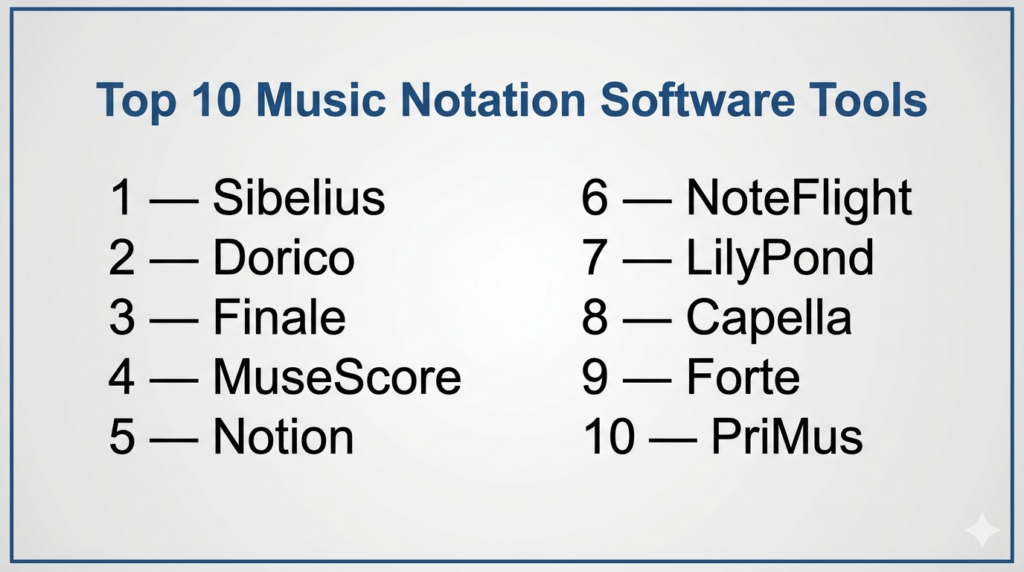
Introduction
Music notation software enables composers, musicians, and educators to create, edit, and share sheet music digitally. In simple terms, it works like a word processor for music—allowing users to write notes, arrange compositions, and produce professional-looking scores without manual handwriting.
With the increasing demand for digital composition, music education, and remote collaboration, notation tools have evolved into powerful platforms. Modern solutions now include AI-assisted engraving, real-time playback, MIDI integration, and cloud-based collaboration, making it easier to compose, arrange, and distribute music efficiently.
Common use cases include:
- Composing orchestral, film, and game music
- Creating sheet music for bands, choirs, and ensembles
- Music education and classroom assignments
- Transcribing audio into notation
- Publishing and printing professional scores
Key evaluation criteria buyers should consider:
- Engraving quality and notation accuracy
- MIDI input and playback capabilities
- Ease of use vs advanced customization
- File compatibility (MusicXML, MIDI, PDF)
- Collaboration and sharing features
- Performance and responsiveness
- Plugin and sound library support
- Cross-platform availability
- Automation and AI features
- Pricing and licensing flexibility
Best for: Composers, arrangers, music teachers, students, and publishers working with sheet music and notation workflows.
Not ideal for: Users focused purely on audio production or beat-making, where DAWs are more suitable.
Key Trends in Music Notation Software
- AI-assisted engraving: Automatic spacing, alignment, and layout improvements
- Realistic playback engines: Better instrument simulation for previewing compositions
- Cloud collaboration: Multiple users editing scores simultaneously
- Integration with DAWs: Bridging notation and audio production workflows
- Automation features: Faster part extraction and formatting
- Mobile and tablet support: Composing on the go
- Open-source innovation: Free tools gaining advanced capabilities
- Hybrid workflows: Combining notation with piano roll editing
- Template-based composition: Pre-built score layouts for faster work
- Standard file formats: Improved interoperability across tools
How We Selected These Tools (Methodology)
- Evaluated market adoption among composers, educators, and publishers
- Assessed notation accuracy and engraving quality
- Reviewed feature completeness (notation, playback, layout tools)
- Considered ease of use vs professional control
- Evaluated integration with MIDI devices and DAWs
- Reviewed community support and documentation quality
- Considered platform compatibility and accessibility
- Assessed performance and stability
- Included a mix of free, open-source, and premium tools
- Balanced tools for beginners, intermediate users, and professionals
Top 10 Music Notation Software Tools
#1 — Sibelius
Short description: A professional music notation software widely used in education, composition, and publishing environments.
Key Features
- Magnetic layout for automatic spacing
- MIDI input and playback
- Advanced notation tools
- Cloud sharing capabilities
- Version control for projects
- Video sync for scoring
- Extensive instrument support
Pros
- High-quality engraving output
- Widely adopted industry tool
- Strong collaboration features
Cons
- Subscription-based pricing
- Complex interface for beginners
Platforms / Deployment
Windows / macOS — Self-hosted
Security & Compliance
Not publicly stated
Integrations & Ecosystem
Sibelius integrates well with professional music workflows.
- MIDI devices
- Plugin ecosystem
- Audio tools
- Cloud sharing systems
Support & Community
Large global community with extensive learning resources.
#2 — Dorico
Short description: A modern notation software focused on intelligent engraving and streamlined workflows.
Key Features
- Automatic engraving engine
- Flow-based project structure
- Advanced notation tools
- MIDI and keyboard input
- Integrated playback engine
- Piano roll editing
- Flexible layout management
Pros
- Excellent default engraving quality
- Efficient and modern workflow
- Continuous feature improvements
Cons
- Learning curve for new users
- Requires time to master
Platforms / Deployment
Windows / macOS / iPadOS — Self-hosted
Security & Compliance
Not publicly stated
Integrations & Ecosystem
- MIDI controllers
- DAW workflows
- Plugin ecosystem
Support & Community
Active and growing community.
#3 — Finale
Short description: A long-established notation tool known for its deep customization and control over score formatting.
Key Features
- Advanced notation capabilities
- Flexible layout customization
- MIDI support
- Plugin extensions
- Publishing workflows
Pros
- Highly customizable
- Trusted by professional engravers
Cons
- Complex interface
- Slower workflow compared to modern tools
Platforms / Deployment
Windows / macOS — Self-hosted
Security & Compliance
Not publicly stated
Integrations & Ecosystem
- Plugin ecosystem
- Publishing workflows
Support & Community
Legacy community with extensive documentation.
#4 — MuseScore
Short description: A free and open-source notation tool suitable for beginners and intermediate users.
Key Features
- Multi-platform support
- MusicXML and MIDI compatibility
- Built-in sound library
- Real-time playback
- Plugin support
- Community sharing
- Intuitive interface
Pros
- Completely free
- Easy to use
- Strong global community
Cons
- Limited advanced engraving precision
- Fewer enterprise features
Platforms / Deployment
Windows / macOS / Linux — Self-hosted
Security & Compliance
Not publicly stated
Integrations & Ecosystem
- Open-source plugins
- Community ecosystem
Support & Community
Very active and supportive community.
#5 — Notion
Short description: A hybrid notation tool focused on combining composition with high-quality playback.
Key Features
- Realistic instrument playback
- MIDI and handwriting input
- Mobile compatibility
- Real-time editing
- Integrated audio tools
Pros
- Excellent playback realism
- Good for composers
Cons
- Limited engraving control
- Smaller ecosystem
Platforms / Deployment
Windows / macOS / iOS — Self-hosted
Security & Compliance
Not publicly stated
Integrations & Ecosystem
- MIDI devices
- Audio production tools
Support & Community
Moderate but active community.
#6 — NoteFlight
Short description: A browser-based notation platform designed for collaboration and education.
Key Features
- Cloud-based editing
- Real-time collaboration
- Playback tools
- Classroom features
- No installation required
Pros
- Easy collaboration
- Accessible from any device
Cons
- Limited advanced features
- Requires internet connection
Platforms / Deployment
Web — Cloud
Security & Compliance
Not publicly stated
Integrations & Ecosystem
- Educational tools
- Cloud workflows
Support & Community
Popular in educational environments.
#7 — LilyPond
Short description: A text-based notation system designed for high-quality engraving.
Key Features
- Text-based input system
- Professional engraving output
- Scriptable workflows
- Custom layout control
- Open-source
Pros
- Exceptional engraving quality
- Highly customizable
Cons
- Steep learning curve
- Not beginner-friendly
Platforms / Deployment
Windows / macOS / Linux — Self-hosted
Security & Compliance
Not publicly stated
Integrations & Ecosystem
- Script-based tools
- Open-source ecosystem
Support & Community
Technical and niche community.
#8 — Capella
Short description: A notation software focused on education and small ensemble compositions.
Key Features
- Note input tools
- Playback functionality
- Score editing
- Music scanning
- Export options
Pros
- Easy to use
- Suitable for beginners
Cons
- Limited advanced features
- Smaller ecosystem
Platforms / Deployment
Windows — Self-hosted
Security & Compliance
Not publicly stated
Integrations & Ecosystem
- Basic workflows
- Education tools
Support & Community
Regional user base.
#9 — Forte
Short description: A beginner-friendly notation tool designed for simple compositions and learning.
Key Features
- Basic notation tools
- Playback support
- Simple interface
- Templates for beginners
- MIDI support
Pros
- Easy to learn
- Good for students
Cons
- Limited professional capabilities
- Smaller ecosystem
Platforms / Deployment
Windows — Self-hosted
Security & Compliance
Not publicly stated
Integrations & Ecosystem
- Basic integrations
Support & Community
Limited support resources.
#10 — PriMus
Short description: A simple and affordable notation software focused on education and entry-level composition.
Key Features
- Basic notation editing
- MIDI compatibility
- Simple interface
- Export capabilities
- Beginner-friendly design
Pros
- Easy to use
- Affordable
Cons
- Limited advanced features
- Small ecosystem
Platforms / Deployment
Windows / macOS — Self-hosted
Security & Compliance
Not publicly stated
Integrations & Ecosystem
- Basic workflows
Support & Community
Small but active user base.
Comparison Table (Top 10)
| Tool Name | Best For | Platform(s) Supported | Deployment | Standout Feature | Public Rating |
|---|---|---|---|---|---|
| Sibelius | Professional scoring | Win/macOS | Self-hosted | Magnetic layout | N/A |
| Dorico | Modern engraving | Win/macOS/iPad | Self-hosted | Auto engraving | N/A |
| Finale | Publishing control | Win/macOS | Self-hosted | Customization | N/A |
| MuseScore | Free notation | Cross-platform | Self-hosted | Open-source | N/A |
| Notion | Playback realism | Win/macOS/iOS | Self-hosted | Realistic audio | N/A |
| NoteFlight | Collaboration | Web | Cloud | Online editing | N/A |
| LilyPond | Precision engraving | Cross-platform | Self-hosted | Text-based system | N/A |
| Capella | Education | Windows | Self-hosted | Simplicity | N/A |
| Forte | Beginners | Windows | Self-hosted | Easy templates | N/A |
| PriMus | Entry-level use | Win/macOS | Self-hosted | Simple interface | N/A |
Evaluation & Scoring of Music Notation Software
| Tool Name | Core | Ease | Integrations | Security | Performance | Support | Value | Weighted Total |
|---|---|---|---|---|---|---|---|---|
| Sibelius | 10 | 7 | 9 | 6 | 9 | 10 | 7 | 8.9 |
| Dorico | 10 | 7 | 9 | 6 | 10 | 9 | 8 | 9.0 |
| Finale | 9 | 6 | 8 | 6 | 8 | 8 | 6 | 7.8 |
| MuseScore | 8 | 9 | 7 | 6 | 8 | 9 | 10 | 8.6 |
| Notion | 8 | 8 | 7 | 6 | 8 | 7 | 8 | 7.9 |
| NoteFlight | 7 | 9 | 7 | 6 | 7 | 8 | 9 | 7.9 |
| LilyPond | 9 | 5 | 6 | 6 | 9 | 7 | 10 | 7.8 |
| Capella | 6 | 8 | 6 | 6 | 7 | 6 | 7 | 6.9 |
| Forte | 5 | 9 | 5 | 6 | 6 | 6 | 8 | 6.8 |
| PriMus | 6 | 8 | 5 | 6 | 6 | 6 | 7 | 6.7 |
How to interpret these scores:
- Scores are comparative within this category
- Core features carry the highest weight
- Higher scores indicate stronger overall capability
- Security reflects publicly available information only
- Value reflects cost vs features balance
Which Music Notation Software Is Right for You?
Solo / Freelancer
- Best: MuseScore, Notion
- Affordable and easy to use
SMB
- Best: Sibelius, Dorico
- Balanced for collaboration and output quality
Mid-Market
- Best: Dorico, Sibelius
- Suitable for complex compositions
Enterprise
- Best: Sibelius
- Established workflows and scalability
Budget vs Premium
- Budget: MuseScore, LilyPond
- Premium: Sibelius, Dorico
Feature Depth vs Ease of Use
- Easy: MuseScore, NoteFlight
- Advanced: Dorico, Sibelius
Integrations & Scalability
- Strongest: Sibelius, Dorico
Security & Compliance Needs
- Most tools do not publicly disclose compliance certifications; internal validation is recommended
Frequently Asked Questions (FAQs)
What is music notation software?
It is software used to create and edit sheet music digitally.
Which software is best for beginners?
MuseScore and NoteFlight are beginner-friendly options.
Is there free notation software?
Yes, MuseScore and LilyPond are widely used free tools.
What is MusicXML?
It is a standard format for sharing sheet music between tools.
Can I use MIDI with notation software?
Yes, most tools support MIDI input and playback.
Which software is used professionally?
Sibelius and Dorico are widely used in professional environments.
What is engraving in music?
It refers to the visual layout and formatting of musical notation.
Can I collaborate using notation software?
Yes, some tools support real-time collaboration features.
Do I need a powerful computer?
Basic systems are sufficient, but complex scores may require better performance.
Can notation software replace a DAW?
No, DAWs are better for audio production, while notation tools focus on sheet music.
Conclusion
Music notation software plays a crucial role in modern composition, education, and publishing. Whether you are a beginner writing your first score or a professional composer working on complex arrangements, there are tools available to match your needs

One area that could use more attention is long-term score portability and preservation. Composers and institutions often maintain libraries of arrangements and manuscripts for decades, and migrating projects between notation tools can introduce formatting issues, playback inconsistencies, or lost metadata. Support for open standards, reliable import/export behavior, and backward compatibility can become far more important over time than engraving quality alone, especially for publishers, orchestras, and educational organizations managing large music archives.