MOTOSHARE 🚗🏍️
Rent Bikes & Cars Directly from Owners
Motoshare connects vehicle owners with people who need bikes and cars on rent. Owners earn from idle vehicles, and renters get flexible ride options.
Visit Motoshare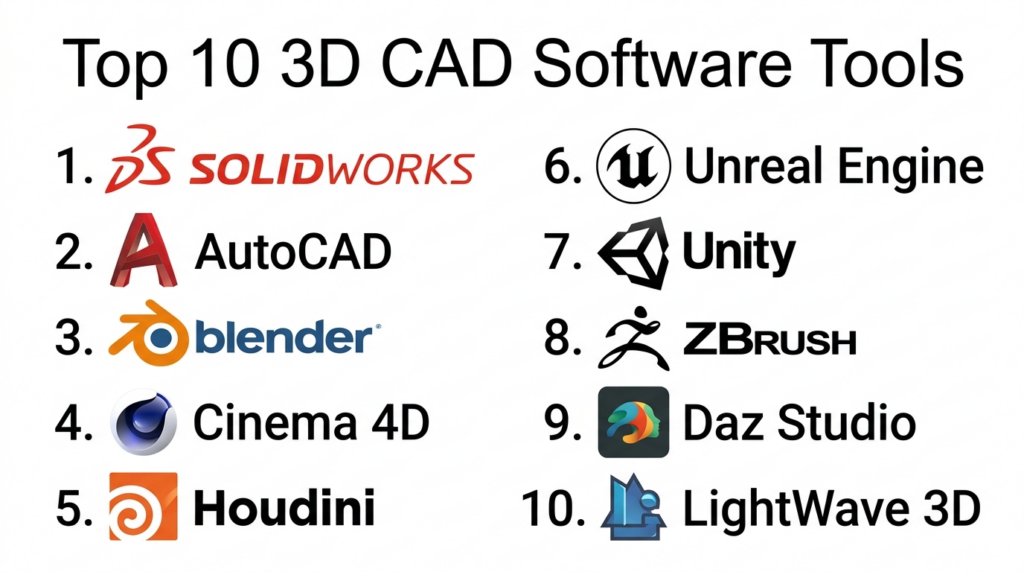
Introduction
3D CAD software (Computer-Aided Design) enables engineers, designers, and manufacturers to create precise digital models of physical objects. These tools are used to design everything from mechanical parts and consumer products to buildings and industrial systems.
With increasing demand for digital transformation, simulation-driven design, and faster product development cycles, 3D CAD tools have become essential across industries. Modern platforms now include AI-assisted modeling, cloud collaboration, and integrated simulation, making them more powerful and accessible than ever.
Common Use Cases
- Product design and engineering
- Mechanical and industrial component modeling
- Architecture and construction planning
- Prototyping and manufacturing workflows
- Simulation and testing of designs
What to Evaluate Before Choosing a Tool
- Parametric vs direct modeling capabilities
- Ease of use and learning curve
- Performance with large assemblies
- Integration with PLM, CAM, and simulation tools
- File compatibility and interoperability
- Collaboration and version control features
- Deployment model (cloud vs desktop)
- Cost and licensing flexibility
- Customization and API support
- Security and data management capabilities
Mandatory Considerations
Best for:
Mechanical engineers, product designers, architects, manufacturing teams, and enterprises that require precise modeling, simulation, and scalable design workflows.
Not ideal for:
Users who only need simple sketches or basic 2D drafting. Lightweight CAD or drawing tools may be more suitable in those cases.
Key Trends in 3D CAD Software for and Beyond
- AI-assisted design and generative modeling
- Cloud-native CAD platforms enabling real-time collaboration
- Integration with simulation and digital twin technologies
- Increased adoption of browser-based CAD tools
- Automation in repetitive design tasks
- Stronger interoperability across CAD ecosystems
- Subscription-based and usage-based pricing models
- Integration with additive manufacturing (3D printing) workflows
- Growing importance of version control and design history tracking
- Enhanced security expectations for enterprise deployments
How We Selected These Tools (Methodology)
- High market adoption and industry recognition
- Comprehensive feature sets across design and modeling workflows
- Performance and reliability with complex assemblies
- Integration capabilities with engineering and manufacturing tools
- Availability of APIs, plugins, and extensions
- Suitability for different user segments (individuals to enterprises)
- Evidence of innovation in AI, cloud, and automation
- Strength of community, training resources, and support
- Cross-platform compatibility and deployment flexibility
Top 10 3D CAD Software Tools
1 — SolidWorks
Short description: A widely used 3D CAD tool for mechanical design and product development, popular among engineers and manufacturers.
Key Features
- Parametric modeling
- Assembly design and simulation
- Integrated rendering tools
- Sheet metal and surface modeling
- Design validation tools
- Extensive library of components
Pros
- Industry-standard for mechanical design
- Strong simulation capabilities
- Large ecosystem
Cons
- Expensive licensing
- Windows-only
Platforms / Deployment
Windows
Security & Compliance
Not publicly stated
Integrations & Ecosystem
SolidWorks integrates deeply into engineering workflows with strong compatibility across tools.
- PLM systems
- CAM software
- Simulation tools
- API for customization
Support & Community
Large professional community with extensive training resources.
2 — AutoCAD
Short description: A versatile CAD tool used for both 2D drafting and 3D modeling across industries.
Key Features
- 2D drafting and 3D modeling
- Customizable workflows
- Precision drawing tools
- Cloud storage integration
- Industry-specific toolsets
Pros
- Highly versatile
- Widely adopted
- Strong documentation
Cons
- Not specialized for advanced 3D modeling
- Subscription cost
Platforms / Deployment
Windows / macOS
Security & Compliance
Not publicly stated
Integrations & Ecosystem
- Autodesk ecosystem
- Cloud storage tools
- APIs and plugins
Support & Community
Extensive documentation and large global user base.
3 — Fusion 360
Short description: A cloud-based CAD platform combining design, simulation, and manufacturing tools.
Key Features
- Parametric and direct modeling
- Cloud collaboration
- Integrated CAM and simulation
- Generative design tools
- Version control
Pros
- All-in-one platform
- Cloud-based collaboration
- Affordable for startups
Cons
- Internet dependency
- Limited offline capabilities
Platforms / Deployment
Windows / macOS / Cloud
Security & Compliance
Not publicly stated
Integrations & Ecosystem
- Autodesk ecosystem
- APIs
- Manufacturing tools
Support & Community
Strong community with growing adoption.
4 — CATIA
Short description: A high-end CAD solution used in aerospace, automotive, and large-scale engineering projects.
Key Features
- Advanced surface modeling
- Large assembly management
- Simulation tools
- Product lifecycle integration
- Collaborative design
Pros
- Extremely powerful
- Enterprise-grade capabilities
- Industry-specific modules
Cons
- Very expensive
- Complex to learn
Platforms / Deployment
Windows / Cloud
Security & Compliance
Not publicly stated
Integrations & Ecosystem
- PLM integration
- Enterprise systems
- APIs
Support & Community
Enterprise-level support with specialized training.
5 — Siemens NX
Short description: A comprehensive CAD, CAM, and CAE platform used in advanced manufacturing and engineering.
Key Features
- Integrated CAD/CAM/CAE
- Advanced simulation
- Parametric modeling
- High-performance assembly handling
- Digital twin support
Pros
- End-to-end engineering solution
- Scalable for large enterprises
Cons
- Expensive
- Steep learning curve
Platforms / Deployment
Windows
Security & Compliance
Not publicly stated
Integrations & Ecosystem
- PLM systems
- Simulation tools
- APIs
Support & Community
Strong enterprise support.
6 — PTC Creo
Short description: A robust CAD platform focused on parametric modeling and product design.
Key Features
- Parametric modeling
- Simulation tools
- AR integration
- Additive manufacturing support
- Design automation
Pros
- Strong parametric capabilities
- Advanced engineering tools
Cons
- Complex interface
- High cost
Platforms / Deployment
Windows
Security & Compliance
Not publicly stated
Integrations & Ecosystem
- PLM integration
- APIs
- Simulation tools
Support & Community
Professional support and training resources.
7 — Onshape
Short description: A cloud-native CAD platform designed for real-time collaboration and version control.
Key Features
- Browser-based CAD
- Real-time collaboration
- Version control system
- Parametric modeling
- Mobile access
Pros
- No installation required
- Excellent collaboration features
- Scalable
Cons
- Internet dependency
- Subscription model
Platforms / Deployment
Web / Cloud
Security & Compliance
Not publicly stated
Integrations & Ecosystem
- APIs
- Cloud integrations
- Extensions
Support & Community
Growing community and documentation.
8 — SketchUp
Short description: A user-friendly CAD tool popular for architectural and interior design.
Key Features
- Easy-to-use interface
- 3D modeling tools
- Large asset library
- Rendering plugins
- Cloud sharing
Pros
- Beginner-friendly
- Fast modeling
- Affordable
Cons
- Limited advanced features
- Not ideal for engineering
Platforms / Deployment
Web / Windows / macOS
Security & Compliance
Not publicly stated
Integrations & Ecosystem
- Plugin marketplace
- Rendering tools
- Cloud sharing
Support & Community
Strong community and tutorials.
9 — FreeCAD
Short description: An open-source parametric CAD tool suitable for hobbyists and engineers.
Key Features
- Parametric modeling
- Modular architecture
- Custom scripting
- Open-source flexibility
- Multi-platform support
Pros
- Free to use
- Customizable
- Active community
Cons
- Less polished UI
- Limited enterprise features
Platforms / Deployment
Windows / macOS / Linux
Security & Compliance
Not publicly stated
Integrations & Ecosystem
- Plugins
- Scripting
- File format support
Support & Community
Active open-source community.
10 — TinkerCAD
Short description: A beginner-friendly browser-based CAD tool focused on simple designs and education.
Key Features
- Drag-and-drop modeling
- Browser-based interface
- Basic shape tools
- 3D printing support
- Educational resources
Pros
- Very easy to use
- No installation required
- Great for beginners
Cons
- Limited advanced features
- Not suitable for professional use
Platforms / Deployment
Web / Cloud
Security & Compliance
Not publicly stated
Integrations & Ecosystem
- 3D printing tools
- Basic export formats
Support & Community
Educational-focused support and community.
Comparison Table (Top 10)
| Tool Name | Best For | Platform(s) Supported | Deployment | Standout Feature | Public Rating |
|---|---|---|---|---|---|
| SolidWorks | Mechanical design | Windows | Local | Parametric modeling | N/A |
| AutoCAD | General CAD | Win / macOS | Local | Versatility | N/A |
| Fusion 360 | Startups | Win / macOS / Cloud | Hybrid | All-in-one platform | N/A |
| CATIA | Enterprise | Win / Cloud | Hybrid | Advanced engineering | N/A |
| Siemens NX | Manufacturing | Windows | Local | Integrated CAD/CAM/CAE | N/A |
| Creo | Engineering | Windows | Local | Parametric design | N/A |
| Onshape | Collaboration | Web | Cloud | Real-time collaboration | N/A |
| SketchUp | Architecture | Web / Win / macOS | Hybrid | Ease of use | N/A |
| FreeCAD | Open-source users | Win / macOS / Linux | Local | Free parametric CAD | N/A |
| TinkerCAD | Beginners | Web | Cloud | Simplicity | N/A |
Evaluation & Scoring of 3D CAD Software
| Tool Name | Core | Ease | Integrations | Security | Performance | Support | Value | Weighted Total |
|---|---|---|---|---|---|---|---|---|
| SolidWorks | 10 | 7 | 9 | 6 | 9 | 9 | 6 | 8.3 |
| AutoCAD | 8 | 8 | 8 | 6 | 8 | 9 | 7 | 7.9 |
| Fusion 360 | 9 | 8 | 9 | 6 | 8 | 8 | 9 | 8.5 |
| CATIA | 10 | 5 | 9 | 6 | 10 | 8 | 5 | 8.0 |
| Siemens NX | 10 | 6 | 9 | 6 | 10 | 8 | 5 | 8.1 |
| Creo | 9 | 6 | 8 | 6 | 9 | 8 | 6 | 7.8 |
| Onshape | 8 | 9 | 8 | 6 | 8 | 8 | 8 | 8.1 |
| SketchUp | 7 | 9 | 7 | 5 | 7 | 8 | 9 | 7.9 |
| FreeCAD | 7 | 6 | 6 | 5 | 7 | 7 | 10 | 7.3 |
| TinkerCAD | 5 | 10 | 5 | 5 | 6 | 7 | 10 | 7.0 |
These scores are comparative and intended to guide decision-making. A higher score reflects stronger overall capabilities, but the best tool depends on your specific workflow, budget, and technical requirements.
Which 3D CAD Software Tool Is Right for You?
Solo / Freelancer
Fusion 360, FreeCAD, and SketchUp offer flexibility, affordability, and ease of use.
SMB
Fusion 360, Onshape, and SolidWorks provide scalability and collaboration.
Mid-Market
SolidWorks, Creo, and Onshape balance performance and usability.
Enterprise
CATIA and Siemens NX are best suited for large-scale engineering workflows.
Budget vs Premium
Budget: FreeCAD, TinkerCAD
Premium: CATIA, Siemens NX
Feature Depth vs Ease of Use
Deep features: CATIA, Siemens NX
Ease of use: SketchUp, TinkerCAD
Integrations & Scalability
Strongest: SolidWorks, Fusion 360, Siemens NX
Security & Compliance Needs
Most tools do not publicly disclose compliance details; enterprises should validate directly.
Frequently Asked Questions (FAQs)
What is 3D CAD software used for?
It is used to design, model, and simulate physical objects in a digital environment.
Which tool is best for beginners?
TinkerCAD and SketchUp are beginner-friendly options.
Are there free CAD tools available?
Yes, FreeCAD and TinkerCAD are free options.
Do I need a powerful computer?
Yes, especially for handling large assemblies and simulations.
What industries use CAD software?
Engineering, manufacturing, architecture, automotive, aerospace, and more.
Can CAD tools integrate with manufacturing systems?
Yes, many integrate with CAM and PLM systems.
How long does it take to learn CAD?
Basic skills can take weeks, while mastery takes months or longer.
Are cloud-based CAD tools reliable?
Yes, but they depend on internet connectivity.
Can I switch CAD tools later?
Yes, but file compatibility and learning curves should be considered.
What are alternatives to CAD?
2D drafting tools or basic design software may be alternatives for simpler tasks.
Conclusion
3D CAD software plays a critical role in modern design, engineering, and manufacturing workflows. From simple modeling tools to advanced enterprise platforms, the options vary widely in capability and complexity.
There is no single best solution—only the one that aligns with your specific requirements.
A practical next step is to shortlist a few tools, test them with real projects, and evaluate how well they fit your workflow, integration needs, and long-term goals.

One practical consideration I would add is how well a 3D CAD system handles design changes across the entire product lifecycle. In real projects, changing one part can affect assemblies, drawings, BOMs, simulations, tooling, and manufacturing processes, so dependency tracking is critical. A small design update can create significant rework if downstream teams are working from outdated references. I would therefore evaluate how reliably a CAD platform identifies affected components, manages engineering change orders, and keeps released manufacturing data synchronized with the latest design revision. This kind of change-impact visibility can be just as important as modeling performance when products go through frequent iterations.