MOTOSHARE 🚗🏍️
Rent Bikes & Cars Directly from Owners
Motoshare connects vehicle owners with people who need bikes and cars on rent. Owners earn from idle vehicles, and renters get flexible ride options.
Visit Motoshare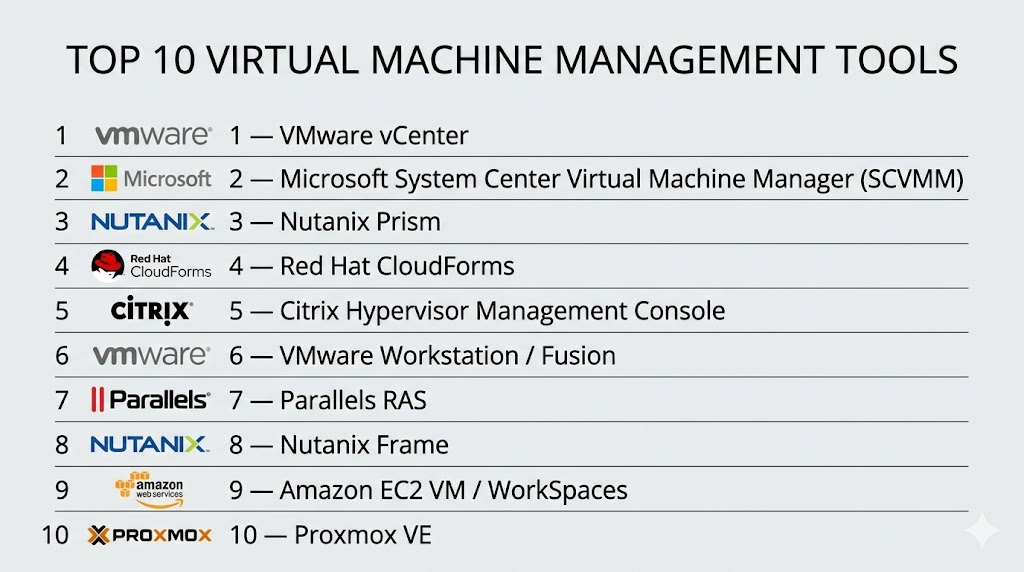
Introduction
Virtual Machine Management Tools are software solutions designed to create, monitor, and manage virtual machines (VMs) across physical servers, cloud environments, and hybrid infrastructures. They allow IT teams to optimize resource utilization, enforce security policies, and maintain centralized control over multiple operating systems and applications running concurrently.
Common use cases include provisioning VMs for developers and QA teams, managing virtual desktops for remote employees, automating VM deployment and scaling, monitoring VM performance and health, and enabling disaster recovery and business continuity planning.
When evaluating virtual machine management tools, buyers should consider:
- Cross-platform and multi-OS support
- Hypervisor compatibility (Type 1, Type 2)
- Centralized management dashboards
- Automation and orchestration capabilities
- Security, encryption, and access controls
- Performance monitoring and analytics
- Cloud, on-premises, and hybrid deployment options
- Licensing and cost flexibility
- Integration with ITSM, DevOps, and CI/CD pipelines
- Support and community resources
Best for: IT managers, system administrators, enterprises, SMBs, and cloud service providers who need centralized management of multiple VMs.
Not ideal for: Small teams with minimal virtualization requirements or organizations relying solely on cloud-native applications.
Key Trends in Virtual Machine Management Tools
- AI-driven VM optimization and resource allocation
- Hybrid and multi-cloud deployments for flexibility and scalability
- Integration with container orchestration tools such as Kubernetes and Docker
- Enhanced security features including encryption, MFA, and RBAC
- Automation of provisioning, patching, and VM lifecycle management
- GPU virtualization for graphics-intensive workloads
- Subscription and usage-based licensing models
- Real-time performance monitoring and reporting
- Edge computing support for distributed workloads
- Interoperability with ITSM, DevOps, and cloud management platforms
How We Selected These Tools (Methodology)
- Market adoption and enterprise customer base
- Feature completeness including hypervisor support, orchestration, and monitoring
- Performance and reliability in real-world deployments
- Security posture and compliance certifications
- Integration with cloud, ITSM, and automation platforms
- Fit across solo, SMB, mid-market, and enterprise segments
- Cross-platform support for multiple OS types
- Quality of documentation, onboarding, and support
- Licensing flexibility and cost-effectiveness
- Alignment with emerging IT and virtualization trends
Top 10 Virtual Machine Management Tools
#1 — VMware vCenter
Short description: Centralized platform for managing VMware vSphere virtual environments, suitable for enterprises and SMBs.
Key Features
- Centralized VM management
- Automation and orchestration
- High availability and disaster recovery
- Performance monitoring and analytics
- Integration with VMware Cloud
- Role-based access control
Pros
- Enterprise-grade reliability
- Extensive feature set for large environments
Cons
- Requires trained IT staff
- Higher licensing costs
Platforms / Deployment
- Windows / Linux
- Cloud / Self-hosted / Hybrid
Security & Compliance
- MFA, encryption, RBAC
- SOC 2, ISO 27001
Integrations & Ecosystem
- VMware vSphere and Cloud
- REST APIs for automation
- ITSM integrations
Support & Community
- Enterprise support tiers
- Active VMware community
#2 — Microsoft System Center Virtual Machine Manager (SCVMM)
Short description: Microsoft’s VM management solution for Hyper-V, Azure, and mixed virtual environments.
Key Features
- VM provisioning and templates
- Storage and network management
- Resource optimization
- Integration with Azure and Hyper-V
- Automation via PowerShell
Pros
- Seamless Windows ecosystem integration
- Simplified Hyper-V management
Cons
- Limited non-Windows support
- Complexity in large deployments
Platforms / Deployment
- Windows
- Self-hosted / Hybrid / Cloud
Security & Compliance
- Role-based access, encryption
- Not publicly stated
Integrations & Ecosystem
- Azure integration
- System Center suite
- PowerShell and APIs
Support & Community
- Microsoft support
- Knowledge base and forums
#3 — Nutanix Prism
Short description: Management platform for Nutanix HCI environments providing VM monitoring, automation, and analytics.
Key Features
- Centralized VM monitoring
- Automation of provisioning and scaling
- Performance analytics and reporting
- High availability
- Multi-cloud support
Pros
- Simplified management for hybrid environments
- Efficient resource allocation
Cons
- Limited support outside Nutanix HCI
- Dependent on Nutanix infrastructure
Platforms / Deployment
- Windows / Linux
- Cloud / Hybrid
Security & Compliance
- Encryption, MFA
- Not publicly stated
Integrations & Ecosystem
- Nutanix Prism console
- APIs for automation
- Cloud connectors
Support & Community
- Enterprise support
- Nutanix community forums
#4 — Red Hat CloudForms
Short description: Open-source management tool for virtual and cloud environments with automation and monitoring.
Key Features
- VM lifecycle management
- Multi-hypervisor support
- Compliance and auditing
- Automation policies
- Performance monitoring
Pros
- Open-source flexibility
- Cross-platform support
Cons
- Requires technical expertise
- Limited native cloud integration
Platforms / Deployment
- Linux / Windows
- Self-hosted / Hybrid
Security & Compliance
- RBAC, encryption
- Not publicly stated
Integrations & Ecosystem
- Red Hat ecosystem
- REST APIs
- Monitoring tools
Support & Community
- Enterprise support plans
- Open-source community
#5 — Citrix Hypervisor Management Console
Short description: Enterprise-grade platform for managing Citrix Hypervisor VMs with GPU support.
Key Features
- Centralized VM management
- GPU virtualization
- High availability and clustering
- Security policies and auditing
- Automation for VM provisioning
Pros
- High-performance VM management
- Enterprise-ready with GPU support
Cons
- Complex setup
- Requires trained administrators
Platforms / Deployment
- Windows / Linux
- Cloud / Self-hosted / Hybrid
Security & Compliance
- MFA, encryption, RBAC
- SOC 2, ISO 27001
Integrations & Ecosystem
- Citrix Workspace
- ITSM integration
- API access
Support & Community
- Enterprise support
- Active community forums
#6 — VMware Workstation / Fusion
Short description: Desktop VM management software for developers and IT teams to run multiple OS locally.
Key Features
- Snapshot and cloning
- Cross-platform support
- Networking and security options
- Integration with VMware vSphere
- Resource allocation controls
Pros
- Ideal for development and testing
- Multiple OS compatibility
Cons
- Not cloud-based
- Resource-intensive
Platforms / Deployment
- Windows / macOS / Linux
- Self-hosted
Security & Compliance
- Disk encryption
- Not publicly stated
Integrations & Ecosystem
- VMware Horizon
- APIs for automation
- Enterprise management tools
Support & Community
- VMware support
- Documentation and knowledge base
#7 — Parallels RAS
Short description: Centralized management for virtual desktops and applications, targeting SMBs and enterprises.
Key Features
- Virtual desktop and app delivery
- Load balancing
- High availability
- Multi-device access
- Security policies
Pros
- Easy to deploy
- Cost-effective
Cons
- Limited enterprise analytics
- Smaller ecosystem
Platforms / Deployment
- Windows / macOS / Linux / iOS / Android
- Cloud / Self-hosted / Hybrid
Security & Compliance
- Encryption, MFA
- Not publicly stated
Integrations & Ecosystem
- Cloud and on-prem apps
- API automation
- Monitoring tools
Support & Community
- Email/chat support
- Documentation
#8 — Nutanix Frame
Short description: Cloud-based VM and desktop management platform supporting multi-cloud deployments.
Key Features
- Browser-based VM access
- Multi-cloud support
- GPU acceleration
- Centralized management
- Security and compliance controls
Pros
- Rapid deployment
- Flexible cloud options
Cons
- Subscription pricing
- Limited offline support
Platforms / Deployment
- Windows / macOS / Linux / iOS / Android / Web
- Cloud / Hybrid
Security & Compliance
- Encryption, MFA
- SOC 2, GDPR
Integrations & Ecosystem
- Cloud platforms
- APIs for automation
- Enterprise app delivery
Support & Community
- Enterprise support
- Documentation
#9 — Amazon EC2 VM / WorkSpaces
Short description: AWS cloud-based VM and virtual desktop management solution for scalable deployments.
Key Features
- Managed VMs and desktops
- Auto-scaling and high availability
- Secure access with MFA
- Integration with AWS services
- Monitoring via AWS tools
Pros
- Fully managed
- Scalable
Cons
- Requires AWS expertise
- Costs may vary
Platforms / Deployment
- Windows / macOS / Linux / iOS / Android
- Cloud
Security & Compliance
- MFA, encryption
- SOC 2, ISO 27001
Integrations & Ecosystem
- AWS services
- API automation
- Cloud app delivery
Support & Community
- AWS support
- Documentation
#10 — Proxmox VE
Short description: Open-source VM and container management platform leveraging KVM and LXC.
Key Features
- KVM and LXC virtualization
- High availability and clustering
- Backup and snapshot management
- Centralized web interface
- Resource monitoring
Pros
- Open-source flexibility
- Enterprise-grade features
Cons
- Requires technical expertise
- Smaller ecosystem
Platforms / Deployment
- Linux
- Self-hosted / Hybrid
Security & Compliance
- Encryption, RBAC
- Not publicly stated
Integrations & Ecosystem
- REST API
- Monitoring tools
- Enterprise management tools
Support & Community
- Enterprise support plans
- Active open-source community
Comparison Table (Top 10)
| Tool Name | Best For | Platform(s) Supported | Deployment | Standout Feature | Public Rating |
|---|---|---|---|---|---|
| VMware vCenter | Enterprises | Windows / Linux | Cloud / Self-hosted / Hybrid | Centralized management | N/A |
| Microsoft SCVMM | Windows-heavy SMBs | Windows | Cloud / Self-hosted / Hybrid | Hyper-V and Azure integration | N/A |
| Nutanix Prism | Enterprises | Windows / Linux | Cloud / Hybrid | HCI integrated management | N/A |
| Red Hat CloudForms | Open-source enterprises | Windows / Linux | Self-hosted / Hybrid | Multi-hypervisor management | N/A |
| Citrix Hypervisor Management | Enterprises | Windows / Linux | Cloud / Self-hosted / Hybrid | GPU virtualization | N/A |
| VMware Workstation / Fusion | Developers & IT Teams | Windows / macOS / Linux | Self-hosted | Local VM deployment | N/A |
| Parallels RAS | SMBs & Enterprises | Windows / macOS / Linux / iOS / Android | Cloud / Self-hosted / Hybrid | Simplified VDI | N/A |
| Nutanix Frame | SMBs & Enterprises | Windows / macOS / Linux / iOS / Android / Web | Cloud / Hybrid | Multi-cloud VDI | N/A |
| Amazon EC2 VM / WorkSpaces | Enterprises & SMBs | Windows / macOS / Linux / iOS / Android | Cloud | Fully managed cloud VMs | N/A |
| Proxmox VE | Open-source enterprises | Linux | Self-hosted / Hybrid | KVM + LXC virtualization | N/A |
Evaluation & Scoring of Virtual Machine Management Tools
| Tool Name | Core (25%) | Ease (15%) | Integrations (15%) | Security (10%) | Performance (10%) | Support (10%) | Value (15%) | Weighted Total |
|---|---|---|---|---|---|---|---|---|
| VMware vCenter | 9 | 8 | 9 | 9 | 9 | 9 | 7 | 8.7 |
| Microsoft SCVMM | 8 | 8 | 8 | 9 | 8 | 8 | 8 | 8.25 |
| Nutanix Prism | 8 | 8 | 8 | 8 | 8 | 7 | 8 | 8.0 |
| Red Hat CloudForms | 8 | 7 | 7 | 8 | 8 | 7 | 8 | 7.8 |
| Citrix Hypervisor Management | 9 | 7 | 8 | 9 | 9 | 8 | 7 | 8.4 |
| VMware Workstation / Fusion | 7 | 8 | 7 | 7 | 8 | 7 | 8 | 7.65 |
| Parallels RAS | 8 | 9 | 7 | 8 | 8 | 8 | 8 | 8.1 |
| Nutanix Frame | 8 | 8 | 8 | 8 | 8 | 7 | 8 | 8.0 |
| Amazon EC2 VM / WorkSpaces | 8 | 7 | 8 | 9 | 8 | 7 | 7 | 7.85 |
| Proxmox VE | 8 | 7 | 7 | 8 | 8 | 7 | 8 | 7.8 |
Interpretation: Scores are comparative across core features, usability, integrations, security, performance, support, and value. Higher totals indicate stronger suitability. Selection depends on organization size, infrastructure complexity, and use cases.
Which Virtual Machine Management Tools Tool Is Right for You?
Solo / Freelancer
VMware Workstation / Fusion or Proxmox VE for local VM management and development/testing.
SMB
Parallels RAS, Nutanix Frame, or Microsoft SCVMM for scalable, manageable virtualization.
Mid-Market
Citrix Hypervisor Management or VMware vCenter for centralized enterprise management and performance.
Enterprise
VMware vCenter, Nutanix Prism, and Amazon EC2 / WorkSpaces for large-scale, secure, and hybrid deployments.
Budget vs Premium
Open-source solutions like Proxmox VE and Red Hat CloudForms offer flexibility; premium enterprise tools provide advanced features and support.
Feature Depth vs Ease of Use
Parallels RAS and Nutanix Frame prioritize usability; VMware vCenter and Citrix Hypervisor provide deep enterprise functionality.
Integrations & Scalability
VMware vCenter, Citrix Hypervisor, and Amazon EC2 integrate extensively with cloud, ITSM, and DevOps platforms.
Security & Compliance Needs
VMware vCenter, Citrix Hypervisor, and Nutanix Prism offer encryption, MFA, RBAC, and compliance support.
Frequently Asked Questions (FAQs)
What are typical pricing models?
Subscription, per-user, per-VM, or enterprise licensing depending on deployment.
How long does deployment take?
Cloud VMs can be ready in hours; on-premises enterprise platforms may take days or weeks.
What common mistakes should I avoid?
Over-provisioning resources, neglecting backups, or ignoring network configuration.
Can these tools manage GPU-intensive workloads?
Yes, VMware, Citrix, Nutanix, and Parallels support GPU virtualization.
How is security enforced?
Encryption, RBAC, MFA, and monitoring ensure secure VM operations.
Can users access VMs from mobile devices?
Yes, most solutions support iOS, Android, and web access.
Is automation available?
Yes, provisioning, scaling, and monitoring can be automated in most platforms.
Are open-source tools viable?
Yes, Proxmox VE and Red Hat CloudForms provide enterprise-grade features with community support.
How do these tools integrate with other IT systems?
APIs, ITSM connectors, and DevOps integration frameworks enable seamless workflows.
What are alternatives to VM management tools?
VDI solutions, cloud-native platforms, or container orchestration may suffice for smaller teams.
Conclusion
Virtual Machine Management Tools are essential for managing, monitoring, and optimizing virtualized environments. Lightweight solutions like VMware Workstation or Proxmox VE are ideal for developers and SMBs, while enterprise-grade platforms such as VMware vCenter, Nutanix Prism, and Citrix Hypervisor provide advanced functionality, scalability, and compliance. Organizations should shortlist 2–3 tools, run pilot deployments, and ensure security, performance, and integrations align with operational requirements.

One consideration that often gets overlooked is VM lifecycle management. Creating virtual machines is easy, but tracking unused resources, managing updates, and preventing VM sprawl can become a significant operational challenge as environments grow.
One area that is often overlooked when evaluating virtual machine management platforms is the operational challenge of VM lifecycle governance. Most organizations are not limited by their ability to provision VMs—they struggle with VM sprawl, inconsistent configurations, orphaned workloads, and rising infrastructure costs over time. It would be valuable to compare how these tools handle automated lifecycle policies, configuration drift detection, capacity reclamation, and integration with infrastructure-as-code workflows. From a platform operations perspective, the long-term success of a VM management solution depends heavily on its ability to enforce governance, maintain visibility across environments, and reduce manual administrative overhead. As hybrid and multi-cloud deployments continue to expand, lifecycle automation and policy-driven management will likely become more important differentiators than provisioning features alone.