MOTOSHARE 🚗🏍️
Rent Bikes & Cars Directly from Owners
Motoshare connects vehicle owners with people who need bikes and cars on rent. Owners earn from idle vehicles, and renters get flexible ride options.
Visit Motoshare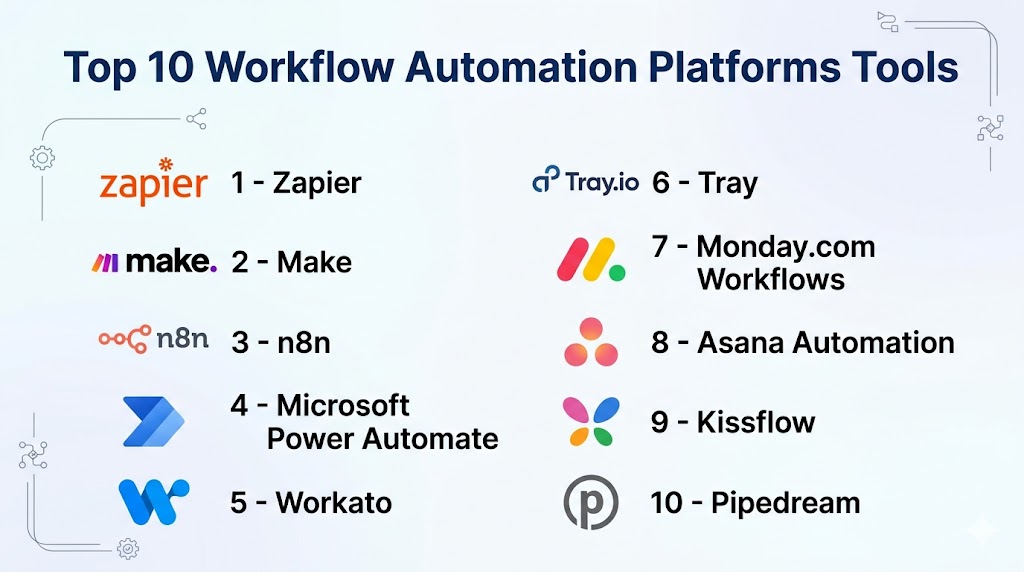
Introduction
Workflow Automation Platforms help businesses automate repetitive tasks, connect apps, route approvals, move data, trigger notifications, and streamline processes without constant manual work. Instead of relying on spreadsheets, emails, and copy-paste operations, teams can build automated workflows that run in the background.
These tools matter more than ever because organizations are expected to move faster, do more with lean teams, and improve accuracy. Modern platforms now include AI-assisted workflow building, low-code interfaces, stronger governance, and enterprise-grade integrations. They are used across marketing, HR, finance, operations, IT, and customer support. Workflow automation platforms can reduce delays, lower human error, and improve visibility into business operations.
Common use cases:
- Lead capture and CRM updates
- Employee onboarding and approvals
- Invoice processing and finance workflows
- Customer support ticket routing
- Cross-app notifications and reporting
What buyers should evaluate:
- Ease of use
- Number of integrations
- Logic and branching capabilities
- Error handling and monitoring
- Security controls
- AI features
- Scalability
- Pricing model
- Team collaboration
- Support quality
Best for: Startups, SMBs, enterprises, agencies, operations teams, marketers, HR teams, IT admins, and founders.
Not ideal for: Very small teams with one or two tools only, or companies with highly custom engineering needs that require fully coded internal systems.
Key Trends in Workflow Automation Platforms
- AI copilots are helping users build workflows from plain language prompts.
- Low-code and no-code builders are expanding adoption beyond IT teams.
- Governance features are improving for enterprise rollouts.
- More tools now support multi-step orchestration, not just simple triggers.
- Real-time integrations and webhooks are standard expectations.
- Self-hosted automation is gaining popularity for privacy-conscious teams.
- Usage-based pricing models are evolving and becoming more competitive.
- Workflow analytics and observability are becoming core features.
- Agentic AI workflows are emerging for decision-based automation.
- Hybrid human + automation approval flows are growing fast.
How We Selected These Tools (Methodology)
We selected these tools using the following criteria:
- Market awareness and adoption
- Breadth of integrations
- Ease of setup for non-technical users
- Advanced logic and workflow depth
- Security and admin controls
- Reliability and runtime stability
- Documentation and learning resources
- Support quality and vendor maturity
- Fit across SMB, mid-market, and enterprise users
- Long-term relevance and innovation pace
Top 10 Workflow Automation Platforms Tools
#1 — Zapier
Short description: One of the most popular no-code automation platforms for connecting apps and automating workflows quickly. Strong fit for SMBs, marketers, and growing teams.
Key Features
- Large integration library
- Trigger/action workflows
- Multi-step automations
- Conditional paths
- AI workflow builder
- Tables and forms
- Team collaboration tools
Pros
- Very beginner-friendly
- Huge app ecosystem
- Fast time to value
Cons
- Can get expensive at scale
- Complex logic can feel limiting
- Heavy task usage impacts cost
Platforms / Deployment
Web / Cloud
Security & Compliance
SSO, audit logs, MFA, encryption, GDPR. Additional certifications vary.
Integrations & Ecosystem
Excellent ecosystem across business apps, marketing tools, CRM, helpdesk, spreadsheets, and communication tools.
- Google Workspace
- Slack
- HubSpot
- Salesforce
- Airtable
- Shopify
Support & Community
Strong documentation, templates, training resources, and large user community.
#2 — Make
Short description: Visual automation platform known for advanced scenarios, branching logic, and flexible workflow design.
Key Features
- Visual flow builder
- Advanced branching
- Data transformation
- Scheduling tools
- Webhooks
- AI automation features
- Reusable modules
Pros
- Powerful visual builder
- Better for complex workflows
- Good value for many users
Cons
- Learning curve for beginners
- Debugging can get complex
- Interface can feel dense
Platforms / Deployment
Web / Cloud
Security & Compliance
Encryption, admin controls, permissions. Other details vary.
Integrations & Ecosystem
Strong integrations with SaaS tools and APIs.
- Google Sheets
- Notion
- Slack
- Shopify
- CRM tools
- Webhooks
Support & Community
Good help center and active user community.
#3 — n8n
Short description: Popular workflow automation platform for technical teams that want flexibility, self-hosting, and custom logic.
Key Features
- Self-hosted option
- Code nodes
- AI nodes
- API-first workflows
- Visual editor
- Reusable workflows
- Open architecture
Pros
- Great for developers
- Strong privacy control
- Flexible customization
Cons
- Requires technical skill
- Smaller non-technical learning path
- Some setup overhead
Platforms / Deployment
Web / Cloud / Self-hosted
Security & Compliance
RBAC, credentials management, deployment-based controls.
Integrations & Ecosystem
Works well with APIs, databases, and modern SaaS apps.
Support & Community
Strong open-source community plus paid support options.
#4 — Microsoft Power Automate
Short description: Workflow automation platform tightly integrated with the Microsoft ecosystem and enterprise productivity stack.
Key Features
- Microsoft 365 automation
- Desktop RPA
- Approval flows
- AI Builder
- Governance tools
- Templates
- Enterprise connectors
Pros
- Excellent for Microsoft users
- Strong enterprise controls
- Combines cloud + desktop automation
Cons
- Best value inside Microsoft stack
- Licensing can be confusing
- Some connectors are premium
Platforms / Deployment
Web / Windows / Cloud
Security & Compliance
Enterprise-grade Microsoft security controls, SSO, audit logs, compliance tools.
Integrations & Ecosystem
Best fit with Microsoft tools and enterprise systems.
Support & Community
Large documentation library and strong enterprise support.
#5 — Workato
Short description: Enterprise automation platform focused on scalable integrations, governance, and business process automation.
Key Features
- Enterprise workflows
- Deep integrations
- API automation
- Governance controls
- Recipe templates
- Data orchestration
- Monitoring tools
Pros
- Strong enterprise capability
- Excellent governance
- Broad use cases
Cons
- Premium pricing
- Overkill for small teams
- Requires planning for rollout
Platforms / Deployment
Web / Cloud / Hybrid
Security & Compliance
SSO, RBAC, audit logs, encryption. Additional certifications vary.
Integrations & Ecosystem
Strong enterprise connectors and workflow templates.
Support & Community
High-touch onboarding and enterprise support.
#6 — Tray
Short description: Developer-friendly automation platform built for advanced workflows, APIs, and enterprise orchestration.
Key Features
- Low-code builder
- API connectors
- Complex branching
- Embedded automation
- Data mapping
- AI workflow tools
- Governance features
Pros
- Strong for technical teams
- Good API flexibility
- Scales well
Cons
- Less beginner-friendly
- Smaller connector library than leaders
- Setup can require specialists
Platforms / Deployment
Web / Cloud
Security & Compliance
SSO, admin controls, audit features.
Integrations & Ecosystem
Strong for API-driven businesses and custom systems.
Support & Community
Good vendor support, smaller community footprint.
#7 — Monday.com Workflows
Short description: Built-in workflow automation inside a work management platform. Best for project and operations teams.
Key Features
- No-code automations
- Task routing
- Notifications
- Status changes
- Templates
- Cross-board workflows
- Team collaboration
Pros
- Easy for business teams
- Great project visibility
- Fast setup
Cons
- Less advanced than dedicated automation tools
- Best inside Monday ecosystem
- Complex integrations may need extras
Platforms / Deployment
Web / iOS / Android / Cloud
Security & Compliance
Enterprise admin controls vary by plan.
Integrations & Ecosystem
Good integrations for common business apps.
Support & Community
Strong onboarding and broad business adoption.
#8 — Asana Automation
Short description: Workflow automation features embedded inside Asana for project management and team operations.
Key Features
- Rules engine
- Task assignment
- Due date triggers
- Notifications
- Templates
- Multi-team workflows
- Reporting support
Pros
- Very easy for teams
- Good for task processes
- Strong collaboration focus
Cons
- Limited outside project workflows
- Not full iPaaS depth
- Advanced logic is lighter
Platforms / Deployment
Web / iOS / Android / Cloud
Security & Compliance
Enterprise controls vary by plan.
Integrations & Ecosystem
Useful for productivity stack integrations.
Support & Community
Strong help center and user adoption.
#9 — Kissflow
Short description: Low-code workflow and process automation platform for business users and internal approvals.
Key Features
- Process builder
- Approval flows
- Forms
- Workflow tracking
- Role permissions
- Reporting
- Low-code apps
Pros
- Good for approvals and forms
- Business-user friendly
- Fast internal deployment
Cons
- Smaller ecosystem than leaders
- Less ideal for deep API engineering
- Advanced customization may vary
Platforms / Deployment
Web / Cloud
Security & Compliance
Role-based access, admin controls, security features vary.
Integrations & Ecosystem
Focuses on business processes and internal workflows.
Support & Community
Good onboarding and vendor-led support.
#10 — Pipedream
Short description: Automation platform for developers combining workflows, code, APIs, and event-driven integrations.
Key Features
- Code-first workflows
- Event triggers
- API connectors
- Serverless execution
- Custom scripts
- Reusable steps
- Logs and debugging
Pros
- Great for developers
- Powerful customization
- Strong API support
Cons
- Not ideal for beginners
- Requires technical knowledge
- Less business-user oriented
Platforms / Deployment
Web / Cloud
Security & Compliance
Secrets management, logs, admin controls vary.
Integrations & Ecosystem
Strong for developer tooling and APIs.
Support & Community
Growing community with technical documentation.
Comparison Table
| Tool Name | Best For | Platform(s) Supported | Deployment | Standout Feature | Public Rating |
|---|---|---|---|---|---|
| Zapier | SMBs & marketers | Web | Cloud | Massive integrations | N/A |
| Make | Advanced automations | Web | Cloud | Visual scenarios | N/A |
| n8n | Technical teams | Web | Cloud/Self-hosted | Flexibility + self-hosting | N/A |
| Power Automate | Microsoft users | Web/Windows | Cloud | Microsoft ecosystem | N/A |
| Workato | Enterprise teams | Web | Cloud/Hybrid | Governance + scale | N/A |
| Tray | API-heavy teams | Web | Cloud | Deep orchestration | N/A |
| Monday.com | Ops teams | Web/Mobile | Cloud | Work management automation | N/A |
| Asana | Task workflows | Web/Mobile | Cloud | Rules for projects | N/A |
| Kissflow | Internal approvals | Web | Cloud | Process workflows | N/A |
| Pipedream | Developers | Web | Cloud | Code + events | N/A |
Evaluation & Scoring of Workflow Automation Platforms
| Tool Name | Core | Ease | Integrations | Security | Performance | Support | Value | Weighted Total |
|---|---|---|---|---|---|---|---|---|
| Zapier | 9 | 9 | 10 | 8 | 8 | 9 | 7 | 8.7 |
| Make | 9 | 7.5 | 8.5 | 8 | 8 | 8 | 8.5 | 8.4 |
| n8n | 8.5 | 6.5 | 8 | 8 | 8 | 8 | 9 | 8.0 |
| Power Automate | 8.5 | 8 | 8 | 9 | 8.5 | 8.5 | 8 | 8.3 |
| Workato | 9 | 7 | 9 | 9 | 9 | 8.5 | 7 | 8.4 |
| Tray | 8.5 | 6.5 | 8 | 8 | 8.5 | 8 | 7.5 | 7.9 |
| Monday.com | 7.5 | 9 | 7 | 7.5 | 8 | 8 | 8 | 7.9 |
| Asana | 7 | 9 | 7 | 7.5 | 8 | 8 | 8 | 7.8 |
| Kissflow | 7.5 | 8 | 7 | 7.5 | 7.5 | 7.5 | 8 | 7.7 |
| Pipedream | 8 | 6.5 | 8 | 7.5 | 8.5 | 7.5 | 8.5 | 7.9 |
These scores are comparative, not absolute. A higher score means stronger all-around fit, but the best choice depends on your use case, budget, team skills, and existing software stack.
Which Workflow Automation Tool Is Right for You?
Solo / Freelancer
Choose Zapier or Make for fast automations without coding.
SMB
Zapier, Make, Monday.com, or Power Automate are strong options depending on your app stack.
Mid-Market
Workato, Tray, Power Automate, or n8n work well as needs grow.
Enterprise
Workato, Power Automate, Tray, and Zapier Enterprise are strong enterprise contenders.
Budget vs Premium
- Budget: n8n, Make
- Premium: Workato, Tray, Zapier Enterprise
Feature Depth vs Ease of Use
- Easiest: Zapier, Monday.com
- Deepest: Workato, Tray, n8n
Integrations & Scalability
Choose Zapier or Workato for ecosystem depth.
Security & Compliance Needs
Power Automate and Workato are strong for governance-heavy environments.
Frequently Asked Questions (FAQs)
What is a workflow automation platform?
It is software that automates tasks between apps, people, and systems using triggers, rules, and actions.
Do I need coding skills?
Not always. Many tools are no-code, though advanced platforms may benefit from technical skills.
Which tool is easiest for beginners?
Zapier and Monday.com are among the easiest to start with.
Which tool is best for developers?
n8n and Pipedream are strong options for technical teams.
Are these tools secure?
Most leading platforms offer encryption, permissions, and admin controls. Enterprise plans usually include stronger governance.
Can I automate approvals?
Yes. Many tools support approval flows, notifications, and conditional routing.
How do pricing models work?
Common models include tasks, operations, users, workflow runs, or custom enterprise pricing.
Can workflow automation replace employees?
Usually no. It removes repetitive work so teams can focus on higher-value tasks.
What is the biggest mistake buyers make?
Choosing based only on price instead of integrations, scalability, and support.
Can I switch tools later?
Yes, but migration can take time. Test workflows and export logic where possible.
Conclusion
Workflow Automation Platforms are now essential for teams that want speed, efficiency, and fewer manual errors. The right platform depends on your technical skills, process complexity, software stack, governance needs, and budget. Some tools prioritize simplicity, others prioritize power and scale. Shortlist two or three options, test real workflows, and validate integrations, pricing, and security before committing.

One aspect that’s often overlooked when evaluating workflow automation platforms is their operational resilience over time. As automations become business-critical, organizations need capabilities such as end-to-end observability, retry policies, dead-letter handling, version-controlled workflows, dependency impact analysis, and automated alerting for failed executions. Without these operational safeguards, even small API changes or integration failures can silently disrupt key business processes. Assessing a platform’s debugging, monitoring, and rollback capabilities is just as important as comparing its integrations or no-code experience for long-term enterprise reliability.